
By Danielle Steitz
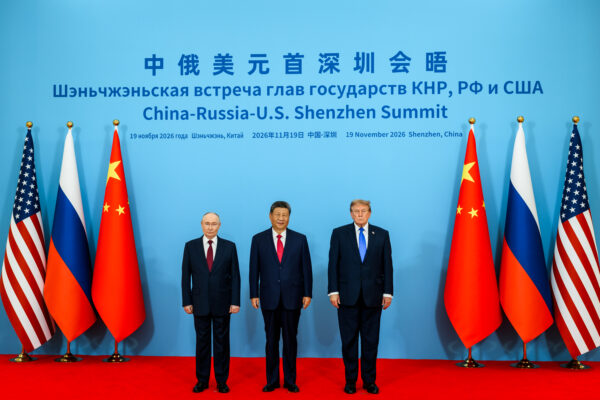
President Donald Trump met Thursday with his Chinese and Russian counterparts, Xi Jinping and Vladimir Putin, in a trilateral summit in Shenzhen, China. The summit, billed as the first of its kind between the leaders of the three nations, resulted in a joint statement from the three heads of state that the White House called a “declaration towards peace.” The statement included calls for UN reform and increased petroleum production, as well as the conduct of a dialogue on reducing nuclear risks and a warning to the International Criminal Court not to abuse its jurisdiction. The leaders also reportedly discussed the war in Ukraine, a topic President Trump has prioritized in efforts to reach a negotiated settlement, but Russian President Putin told reporters after the trilateral discussion that Ukraine and Europe were “not yet ready” to compromise and that Russia would not negotiate after Ukraine’s strike on the Kerch Bridge earlier this week.
PPI Expert Analysis:
Danielle Steitz, Director of National Security Policy: This trilateral summit between American, Chinese, and Russian leaders appears to have resulted in little movement on President Trump’s stated pre-summit priorities of ending the wars in Ukraine and Iran and finding a new agreement on nuclear weapons. What it has undoubtedly done, however, is legitimize Vladimir Putin’s Russia as a co-equal on the level of the United States and China, giving Putin long-sought validation that the world shares his view of Russia as a global superpower. It is surreal to see Putin, whose war of aggression against Ukraine is poised to enter its fifth year, sit at the same table as the American president and claim “we hold joint responsibility for maintaining international peace and security.” The inclusion of language recognizing that “the principle of state consent and respect for immunities of State officials are of paramount importance” in the castigation of the ICC is also a major win for Putin, who has not only managed to convince the American president that they are friends, but that the ICC warrant against him for war crimes in Ukraine should hold no meaning. The actions and rhetoric of the Trump administration against the ICC and the very concept of international law continue to erode the foundations of international order in favor of Trump’s “strongman” theory of the world — a theory Americans of all political stripes should recognize as dangerous and ought to disavow.
By Danielle Steitz
President Trump’s dual-hatted Secretary of State and National Security Advisor Marco Rubio delivered the keynote address at last week’s Federalist Society national convention, where he argued against the ability of international institutions and international law to serve as a check on American actions. Rubio took particular aim at the International Criminal Court, touting the Trump administration’s sanctions on the “fake court,” which he referred to as an “unelected world tribunal” that has joined with “its allies in the global bureaucracy” to appoint themselves “judge, jury, and executioner of the international order.” In a soundbite that was later amplified by Secretary of Defense Pete Hegseth on social media, Rubio responded to hypothetical ICC enforcement attempts by quoting Roman general Pompey Magnus, stating, “stop quoting laws to men with swords.”
PPI Expert Analysis:
Danielle Steitz, Director of National Security Policy: If only Senator Marco Rubio were around to see the way Secretary of State Marco Rubio speaks about international law and global order. The one-time believer in the international community’s ability to police its members, who spoke of crimes against humanity and fundamental rights and the “internationally-recognized right to freedom of expression,” and pushed for the “global bureaucracy” to advance human rights in nations like North Korea and Nicaragua, has become unrecognizable in his attempt to amass power and influence in the “might makes right” world of Trumpian foreign policy. The Rubio of today speaks of international law and the “quote-unquote ‘rules-based order’” as “alien to who we are,” an ahistorical understanding that omits a fundamental truth: that America is the nation that created the rules-based order in the first place. As stated above, Americans of all stripes should move beyond this short-sighted “strongman” view that is inconsistent with America’s national character and instead recommit to the fundamental American values of liberty, freedom, and justice across the world.
By Danielle Steitz
The month of November has seen several major system outages that have impacted air travel, online banking, digital services from Microsoft and Apple, and even the classified internal network of the National Security Agency. The cluster of high-profile and disruptive outages has drawn questions from politicians and the American public as to whether these incidents are the result of cyberattacks by malicious actors. On Wednesday, Homeland Security Secretary Markwayne Mullin, Director of National Intelligence Jay Clayton, and FBI Deputy Director Christopher Raia testified before Congress that based on available information, these incidents are not the result of malicious cyber attacks, but rather are the result of separate outages associated with “maintenance and technical changes” across these networks and systems.
PPI Expert Analysis:
Danielle Steitz, Director of National Security Policy: While the timing of so many major incidents within such a short timespan is bound to raise some eyebrows, it does (somewhat ironically) appear that these outages are occurring as a result of companies and agencies doing much-needed system upgrades or network vulnerability patching. For instance, DNI Clayton has pointed to patching of the PHP2Shell vulnerabilities discovered last month as the culprit for NSA’s system outage, citing system infrastructure that reacted to patching in unexpected ways. The nationwide FAA ground stop that threw air travel into chaos also appears to be related to a hardware update that resulted in older router hardware being overwhelmed and creating a cascading disruption. Much of the nation’s cyber infrastructure systems were designed and created for a very different era of the internet than the one we live in now, and the pace of modern technology is illuminating the stress fractures and weak points in that existing infrastructure in real time. As companies and government agencies seek to accelerate the pace with which they patch vulnerabilities in response to the AI-fueled “vulnopocalypse,” it is likely that we continue to see systems respond in unexpected ways to those patches, causing further disruptions during this time of rapid transition in our cyber architecture.
By Danielle Steitz
The Senate Appropriations Committee this week unveiled its $1.1 trillion defense spending bill for fiscal year 2027, a number that falls slightly below House and Senate authorizers’ $1.14 trillion topline and substantially below the $1.5 trillion request from the Trump administration. The administration’s budget request was structured as $1.15 trillion in the base budget and another $350 billion in a party-line reconciliation bill; however, despite lobbying this week from Deputy Secretary of Defense Steve Feinberg for a defense reconciliation bill, House Armed Services Committee Chairman Mike Rogers has stated that $350 billion “is not going to happen.” Rogers left the door open for a reconciliation bill in the $100 billion range to deal with “the hole in the defense budget that Venezuela and Iran have created,” seemingly shifting the purpose of the bill from longer-term program investment into a supplemental to pay for increased operations costs.
PPI Expert Analysis:
Danielle Steitz, Director of National Security Policy: Between the NDAA, the base appropriations bills, and any potential reconciliation or supplemental funding, the lame-duck Congress has a lot of defense-related items on its to-do list and not much time to do them. The odds of a party-line reconciliation bill or supplemental look incredibly long at this point, but SAC-D’s inclusion of nearly $69 billion of funding initially rolled into the reconciliation request in the base bill instead helps to keep funding alive for administration priorities like Golden Dome and rebuilding munitions stockpiles. On the authorization side of the house, both Rogers and HASC Ranking Member Adam Smith have been optimistic about their ability to get the NDAA through in the lame-duck session, and defense policy watchers in D.C. have learned never to bet against the defense policy bill.
Senators Bennet and Schmitt-led Letter on U.S.-New Zealand Space Cooperation
Senators Michael Bennet (D-Colo.) and Eric Schmitt (R-Mo.), along with a bipartisan group of seven of their colleagues in the U.S. Senate, recently wrote to Secretary of the Air Force Troy Meink calling for additional steps to strengthen space cooperation with New Zealand. The senators argue that such steps could enhance innovation while also advancing cooperative regional deterrence measures in the Indo-Pacific region. Space capabilities provide the backbone for modern Joint Force operations, and it is certainly in America’s national interest to have capable allies and partners in strategic geographic locations that can interoperate with U.S. forces in the space domain.

