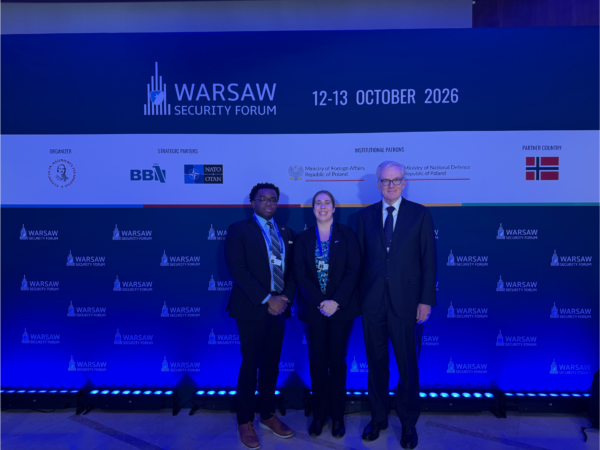
** Programming note: Welcome to a special Tuesday edition of Domain Awareness, featuring our recap of the Warsaw Security Forum! We’ll resume our normal format on Thursday this week, but read on for our analysis and takeaways from a very successful and newsy Forum.
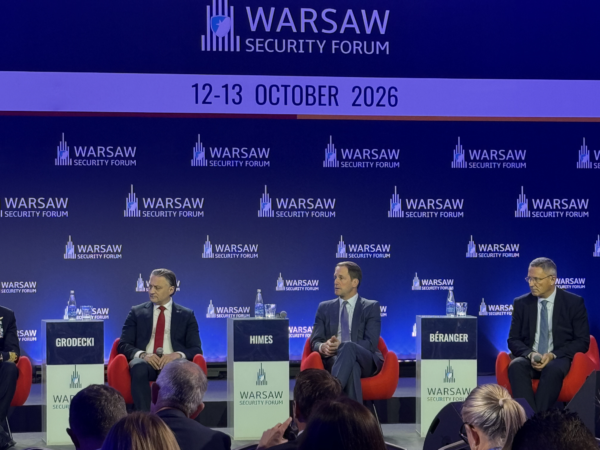
Congressman Jim Himes in a discussion on “A New European Security Architecture: Is There a Way Back to Strategic Stability?”
By Danielle Steitz and Tamar Jacoby
Danielle Steitz, Director of National Security Policy:
The Warsaw Security Forum took place on October 12th and 13th in Warsaw, Poland, against the backdrop of the war in Ukraine entering its fifth winter and an emboldened Russia conducting hybrid attacks against European nations with increasing frequency. However, the talk of the conference in many ways was President Donald Trump’s announcement just prior to the forum that he had brokered a “diesel deal” with Russian leader Vladimir Putin, which would allow Russia to profit from diesel exports to the United States while allegedly lowering prices at the pump for Americans. Of course, such a deal appeared to European leaders as an absolute betrayal of Ukraine and Europe, who Trump has castigated for years about how slowly Europe’s decoupling from Russian energy has proceeded; speakers at the Forum repeatedly described it as sending all the wrong signals to Europe and to Russia.
In this context, navigating the Forum as an American traveling with two U.S. congressmen — we had the distinct pleasure of having Reps. Jim Himes and Jason Crow join our delegation to Warsaw — was an eye-opening experience. Most Europeans that we engaged with were excited that two American congressmen had taken the time to travel to Europe just before the midterm elections to participate in conversations around the future of the transatlantic relationship. It was evident just how closely European politicians and policymakers are tracking this November’s midterm elections, and how much desire there is for the U.S. Congress to reassert itself as a check on President Trump’s foreign policy.
Time and again, we also heard Europeans reiterate that they are no longer interested in a return to the longtime status quo of Europe as a “junior partner” to the United States. Instead, the new dynamic they foresee for the transatlantic relationship centers around a more “grown-up” or “eye-level” relationship of equal partners, where Europe is increasingly able to hold its own regardless of America’s level of engagement with the continent. It only makes sense — why would these nations go backward when they have made extensive multiyear investments in their own defense over the past several years, and Russia has only gotten bolder in undertaking arson and sabotage activities within Europe’s borders?
As American Democrats await the results of the midterm elections and develop their governance agenda moving forward, they should understand this clearly — there is no “back to normal” that will happen in January 2027 or under a new administration in January 2029. “Superficially, everything is different,” under a Democratic administration, Rep. Himes said, while reiterating that it “is a tectonic fact that there is a consensus in the United States that the cost that was paid in the post-war era… was too high.”
Congressman Himes stated that Europe could expect continued pressure — albeit in a far more diplomatic and less outrageous way than at present—to continue assuming a larger role in European defense. Democratic leaders should be thinking now about a realistic and clear-eyed path vision for the transatlantic relationship, recognizing where it is now and finding practical ways to drive towards where allies and partners agree it ought to be.
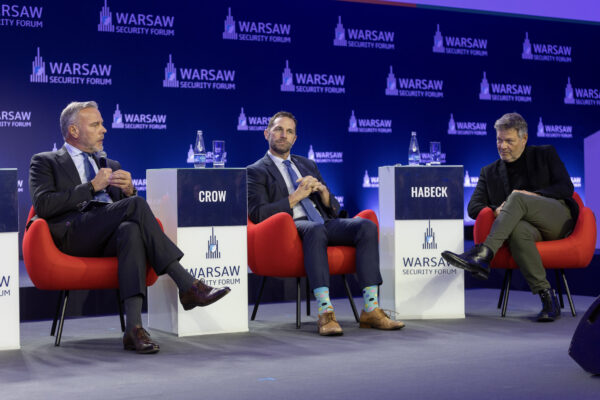
Congressman Jason Crow participating in the panel discussion “The West Under Attack: Confronting Malign Powers.”
Tamar Jacoby, Director of PPI’s New Ukraine Project:
One takeaway moment stood out among many at last week’s Warsaw Security Forum. The moderator of one panel sought to frame the conversation by turning to the audience — a distinguished group of elected officials, diplomats, defense industry leaders, and military men, most of them from Europe. “How many of you are sure that if Europe is attacked,” she asked, “the U.S. will fulfill its NATO obligation to come to our defense?”
In an audience of perhaps 250, not even 10 hands went up, and most of them were tentative — more half-mast than wholeheartedly sure. Then, over the next two days, countless speakers underlined the point, expressing, often in emotional terms, their feelings of disappointment and betrayal at America’s turn away from the transatlantic alliance.
Nearly two years into Donald Trump’s second term, the American pivot is no longer shocking for Europeans. It’s an established fact, and virtually no one expects it to be reversed, no matter who wins the White House in 2028.
But two existential questions remain, hovering menacingly over the continent. One centers on the future of the alliance: will it survive in any form, and if so, what will it look like? The second question, no less pressing: can Europe reorganize and rearm quickly enough to defend itself with significantly less help from the U.S.?
Conversations that included Americans — both on stage and in the corridors — tended to focus on the first issue. But if anything, most Europeans seemed more concerned about the second.
Panelist after panelist made a version of the same point. Europeans are rearming as fast as they can in the face of what many see as imminent Russian aggression — aiming higher, spending more, manufacturing more, and pushing themselves to what feels like the limit. But it isn’t enough. The continent is far from where it needs to be as the U.S. turns away.
“We spent twice as much on defense in 2026 [as we spent in 2021],” one former defense minister argued heatedly. “We have the money. We have the technology. We have the skilled labor force. We can do it if we want to. The question is, do we want to?” It’s a matter of political will.
In some ways, this was anguishing — hearing from people trying as hard as possible and still coming up short. But it was also encouraging. If the urgency expressed at the Warsaw conference translates into action — national policy, NATO initiatives, EU regulations, defense industry planning and production, civilian awareness campaigns – the continent may rearm fast enough to fill the gaps left by the U.S. pivot.
Speakers largely agreed on the most pressing items on the agenda. Some were technical: strategic enablers, air defense, and military mobility, among others. Also essential: more speed and scale — vastly increased, faster defense production – and incorporating lessons learned from Ukraine.
But by far the most urgent need, most concurred, is cooperation — more continent-wide collective action by countries that have historically seen defense as a national prerogative.
What this would mean in practice: arriving at a shared assessment of the threat, followed by collective planning, pooled procurement, joint defense production, and new mechanisms for faster continent-wide decision-making, including with Ukraine. “We need a new mentality,” one decorated military man argued. “We will not survive without a truly collective defense.”
For an American listener, it made for a bittersweet two days. It was hard not to come away angry at the abrupt way Trump has turned on the alliance that represented and defended American values for three generations. But it was also hard not to feel hopeful about the Europeans pressing their countries to step up and fill the void we’re leaving. “Yes, we are moving too slowly,” one sitting foreign minister conceded. “Yes, we are still too fragmented. But we are finally moving in the right direction.”