Can digitizing the food manufacturing industry boost living standards?

A version of this post originally appeared on Forbes.com

Can digitizing the food manufacturing industry help boost living standards? The short answer is yes, if we link food manufacturing into the Internet of Goods.

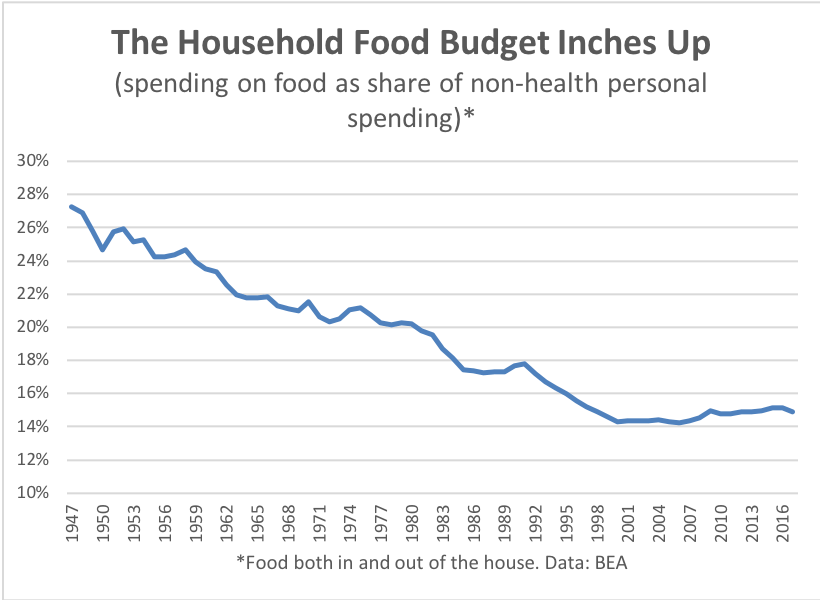
We’re used to thinking of food as cheap and getting cheaper. In 1947, spending on food—both in and out of the home—accounted for 27% of non-health personal spending. By 2000, the food budget share, omitting healthcare, had dropped to 14%.

This 50-year decline in the food budget share fueled American prosperity. With much less of their budgets going to food, middle-class households could afford to spend more on housing, cars, vacations, and all the other aspects of a good life.

But as Figure 1 shows, around 2000, something changed. The decline in the food budget share stopped. Indeed, household spending on food has inched up to close to 15% of non-health personal spending by 2017.

To put it another way, if the past trends had continued,  the food share of non-health spending would be only 10%.  Americans would have almost $500 billion more to spend in other areas.

What happened to the food industry? Groups such as the American Antitrust Institute point to consolidation in industries such as meat processing, which potentially has increased the market power of major players and their ability to raise prices.

Another factor boosting food costs may be greater attention to safety.  In particular the Food Safety Modernization Act (FSMA) was signed into law by President Barack Obama on January 4, 2011. This legislation gives the FDA a new mandate to regulate food production and processing. Indeed, the necessary rules are still being implemented–for example, the FDA is currently asking for comments on a proposed guidance for “Standards for the Growing, Harvesting, Packing, and Holding of Produce for Human Consumption.” Obviously  an important step given the current lettuce issue!

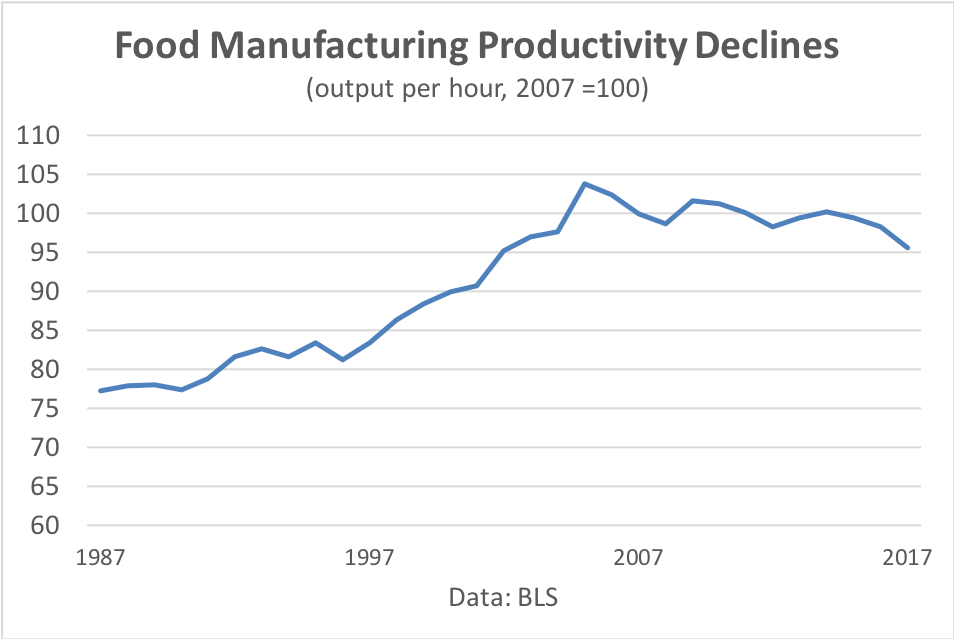
But perhaps most important, the food manufacturing industry has been in a deep and profound productivity slump in recent years. Measured by the Bureau of Labor Statistics (BLS), output per hour in food manufacturing has dropped by 8% since its peak in 2005 (Figure 2).

In response, the food manufacturing industry has been embracing digitization, but it’s a slow process. According to data from the BLS, the entire food manufacturing industry employed less than 1000 software developers and programmers as of May 2017, compared to 25,000 engineers and scientists.

Digitization will have a significant impact in several different areas of food manufacturing. First, it will become much easier to consistently track food from “farm to fork.”  As a result, food recalls will become easier and cheaper. (According to one count, there were 456 food recalls in 2017).

Second, digitization of the production process will help boost productivity and lower costs. This includes product development. For example, FlavorWiki is a startup that uses data analytics to quantify consumer taste perceptions, and potentially help companies develop new products.

Finally, and perhaps the most important, digitization allows the development of local production models for food, requiring food to be shipped much shorter distances. In Japan, for example, the world’s largest automated leaf-vegetable factory has just opened in a suburb of Kyoto. In the U.S., companies such as Iron Ox are developed autonomous and hydroponic production models.

Such vertical farms might be tied directly into ecommerce networks to handle local delivery direct to consumers, thus cutting out several layers of the distribution chain. The result would be lower prices, higher quality, and less pollution from shipping, These are some of the benefits of the Internet of Goods.

Indeed, digitization will enable the rethinking of the entire food production, manufacturing, and distribution chain, to the benefits of consumers. With any luck, Americans will once again find their food budget shares falling and their standard of living rising.

Why Progressives Need to Embrace Innovation: Amazon’s $15/hr minimum wage

Amazon just announced that it would raise the minimum hourly wage for all of its US workers to $15 per hour, including workers employed by temp agencies.  This is good news for Amazon’s workers, obviously.  But it’s also a sign that we’ve moved into a new era, where technology is driving rising real wages for everyone, not just the well-educated.

Ecommerce is proving to be a positive force for labor. For 30 years, retail workers struggled with a horrible status quo that suppressed any growth in retail wages and forced workers of color into the lowest paying retailing jobs. Between 1987 and 2017, real hourly earnings for production and nonsupervisory workers in retail went up a grand total of 2%.

Amazon and other ecommerce sellers have decisively disrupted that horrible status quo, and created hundreds of thousands of better paying jobs. Even before the Amazon wage hike, PPI research found that ecommerce fulfillment centers typically pay 30% more than brick-and-mortar retail in the same area. Labor share in warehousing rose from 75.8% in 2007 to 83.2% in 2017, coinciding with the rapid growth of ecommerce fulfillment centers. Amazon’s latest move will only push the labor share up further.

These higher wages don’t make Amazon a philanthropic organization, anymore than Henry Ford was being benevolent when he boosted wages for workers in his factories in 1914. Ford needed to pay more to attract a competent workforce because his introduction of the assembly line boosted productivity, lowered prices, made cars affordable to the masses, and created an auto boom and an insatiable demand for skilled workers.

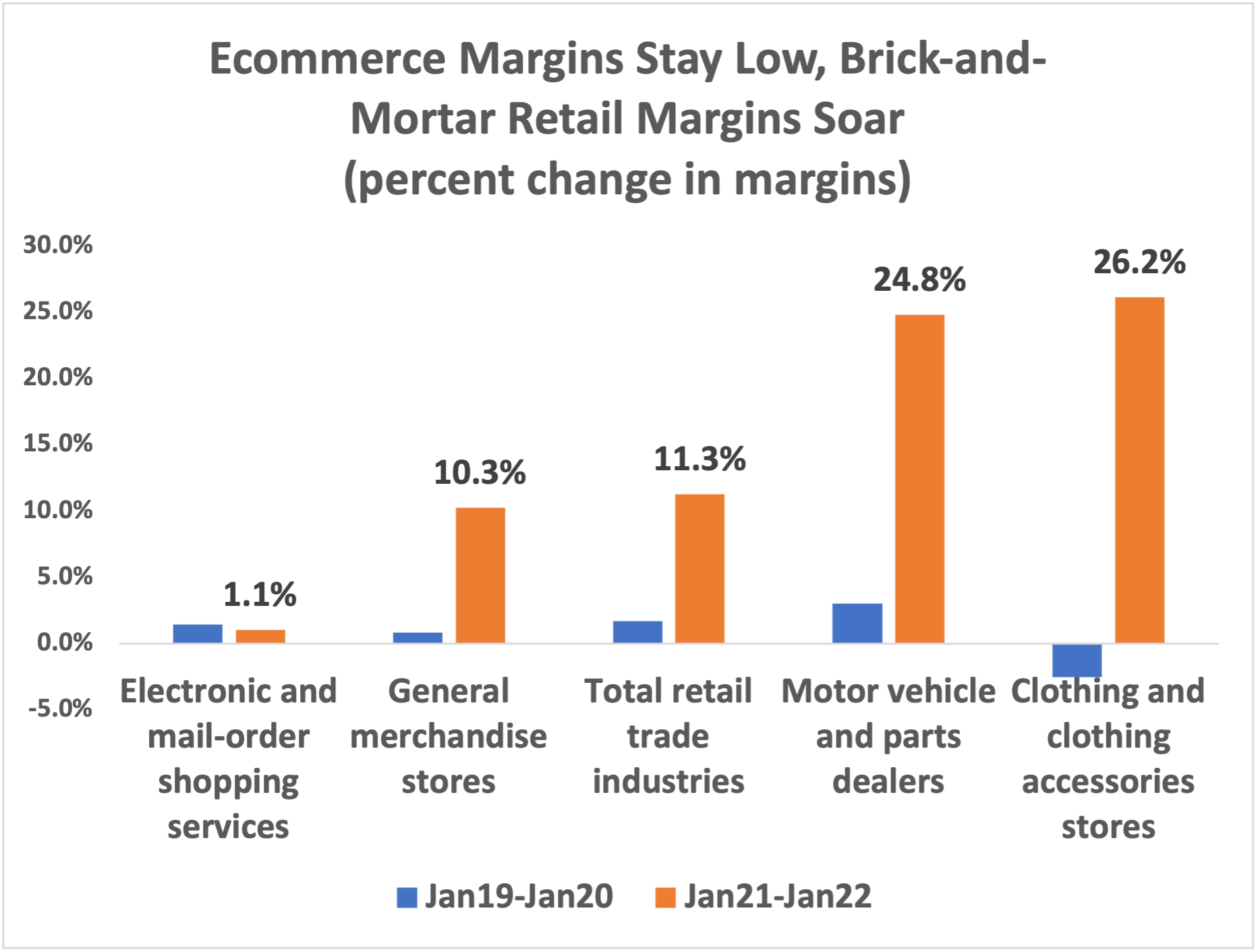
In the same way, Amazon and other ecommerce firms are using technology to transform the previously expensive process of getting products from manufacturers into the hands of consumers—what we call the “Internet of Goods.” These technological improvements have created benefits for both consumers and workers. For example, BLS data shows that real margins in the electronic shopping industry (NAICS 4541)—defined as prices received by retailers less their acquisition price of goods—have fallen by 13% since 2007. That means consumers are gaining from lower prices.

Progressives need to embrace innovation. It’s the only road to the best future for everyone.

The Digital Sector: Rising Labor Share, Falling Gross Margin

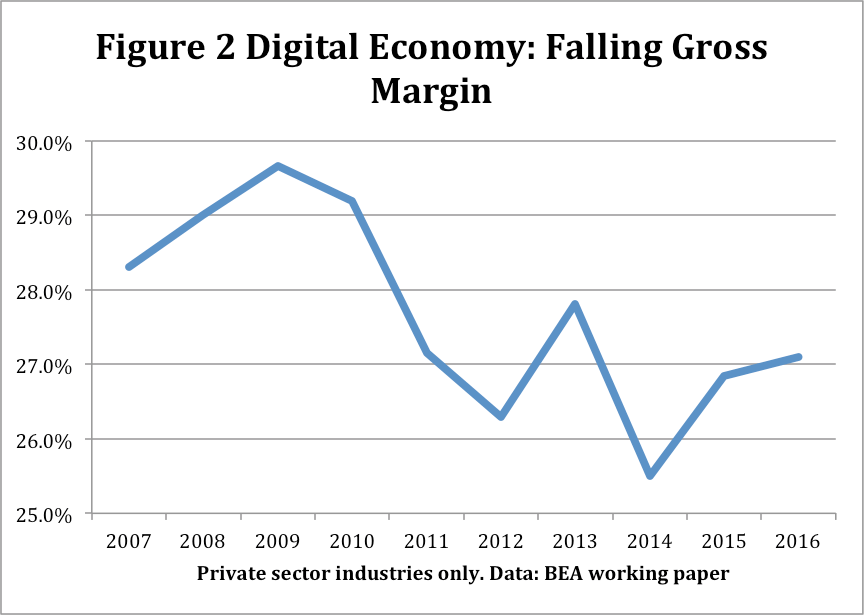
Summary: Based on new “digital economy” data from a recent BEA working paper, we calculate that the labor share of the digital sector has risen since 2007, while gross margin of the digital sector has fallen over the same period. This result is consistent with strong competition in the digital product and labor markets (see the research note here).

In March 2018, the Bureau of Economic Analysis (BEA) released a working paper called “Defining and Measuring the Digital Economy.[1] The working paper presented BEA’s initial work “to lay the foundation for a digital economy satellite account.”

The BEA authors focus on outlining their definition of the digital economy, and calculating its real growth and share of GDP. However, their data allows us to calculate two other policy-relevant measures of the digital economy: Labor share and gross margin.

 Labor share is a measure of how much of the income of an industry is going to workers. For the purposes of this paper, we define the labor share as compensation (COMP) divided by value-added (VA), expressed as a percentage. [2]

Gross margin is a measure of the profitability of an industry per unit of sales. In the business literature, gross margin is a company’s total sales revenue minus its cost of goods sold, divided by total sales revenue, expressed as a percentage.[3]

For our purposes, we define gross margin as an industry’s total gross output (GO), minus the cost of intermediate inputs (II) and labor compensation (COMP), divided by total gross output, expressed as a percentage.[4]

Based on this definition, labor share in the private sector has trended down since at least 1990 (Table 1). Similarly, private sector gross margin have trended up since at least 1990. Since 2007, private sector labor share has fallen by 0.8 percentage points, and private sector gross margin has risen by 1.9 percentage points.[5]

Table 1: Private Sector: Falling Labor Share, Rising Gross Margin
1990 2007 2016
Labor Share 52.2% 50.6% 49.8%
Gross Margin 26.0% 26.7% 28.6%
Data: BEA (as of April 2018)


Table 2: Digital Sector: Rising Labor Share, Falling Gross Margin
2007 2016
Labor Share 53.4% 55.4%
Gross Margin 28.4% 27.2%
Private sector industries only. Data: BEA working paper

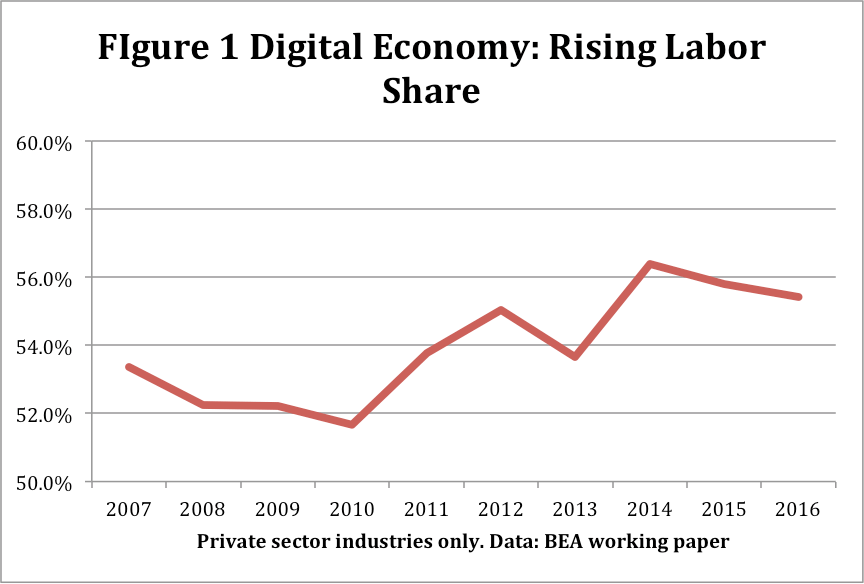
The digital economy data from the BEA allows us to calculate the labor share and gross margin for the digital sector of the economy (Table 2). We see that labor share for private industries in the digital sector rose by 2 percentage points in the post-2007 “tech boom” period. Gross margin fell by 1.2 percentage points.

Figures 1 and 2  show the change in the labor share over time. Please note that this data was released prior to the July 2018 benchmark revision.

These results suggest that benefits of productivity growth in the digital sector since 2007 are being shared with workers and customers. This is consistent with strong competition in the digital product and labor markets. By contrast, companies in the broader private sector are benefitting from lower labor share and higher gross margin, which suggest that market power is rising outside of the digital sector.

The PDF version of this research note are found here. The results in this note are drawn from a forthcoming PPI policy paper, “Taking Competition Policy Seriously.” 


Definition of Measures

Labor share = COMP/VA

Gross margin = (VA-COMP)/GO = (GO- II-COMP)/GO

VA = value-added

COMP = labor compensation

GO = Gross output

II= Intermediate inputs


[1] Kevin Barefoot, Dave Curtis, William Jolliff, Jessica R. Nicholson, Robert Omohundro. “Defining and Measuring the Digital Economy,” March 2018. https://www.bea.gov/digital-economy/_pdf/defining-and-measuring-the-digital-economy.pdf

[2] Several alternative measures of the labor share all have the same general trend.

[3] https://www.investopedia.com/terms/g/grossmargin.asp#ixzz5No688Apd

[4] The numerator includes profit-type income, such as profits, rents, and interest. It also includes taxes on production and imports that are chargeable to business expenses, such as state and local sales and property taxes, and a hodgepodge of state, local, and federal excise taxes.

[5] All data in this note is prior to the July 2018 benchmark revision. We focus only on private industries.

Perceptions versus Reality: Regulating Digital Platforms

Digital platforms, also known as “online intermediation services,” are increasingly important for European businesses, bringing wide-ranging benefits to both individual consumers and to the participating companies. More and more new platforms are arising – in areas such as manufacturing and healthcare. Not surprisingly, as digital platforms have become more numerous and significant, they have come under the scrutiny of regulators. In particular, the European Commission has been examining the perception that European business users are being treated unfairly by digital platforms. The result was a recently
proposed new regulation “promoting fairness and transparency for business users of online intermediation services.”

In this paper, we first analyze the economic and commercial constraints facing digital platforms. In particular, we focus on two economic imperatives: First, platforms have a strong incentive to maintain user trust. Second, platforms have a strong incentive to keep transaction-related costs under control.

Open Internet: Time for Congress to Act

The FCC, under Chairman Ajit Pai,  voted today to start the process of eliminating Title II rules on ISPs. We applaud his move. As we have said before, the Internet was thriving under the light-touch regulatory regime that preceded Title II. Indeed, government data shows that the telecom industry was one of the top contributors to US productivity growth from 2000 to 2014, before Title II was put in place. *

Our belief is that the economy could be entering into a renewed period of productivity growth, propelled by the application of digital technology to the physical industries (see The Coming Productivity Boom). That transition would have been much more difficult under the antiquated regulatory structure that comes with Title II.

But as we have also said before, smart regulations are essential for a well-functioning economy. There’s no doubt in our mind that open internet rules are needed to govern the Internet. We think now is the right time for Congress to codify the open internet principles into law–that’s the best way to get a consistent regulatory structure that will produce faster growth for us all.


*Contribution to multifactor productivity growth, as calculated from the BEA-BLS Integrated Production Accounts.


The Physical Nation vs The Digital Nation

Here are some bullet points on the economics of the election:

  1. America is divided between the Digital Nation and the Physical Nation. The Digital Nation includes tech, entertainment, publishing, telecom, finance, and professional services such as management consulting, accounting, computer programming, design. The Physical Nation includes manufacturing, mining, construction, retail, transportation, health care, and the rest of the economy The Digital Nation makes up about 25% of private sector employment, the Physical Nation 75% (we first laid out this division of the economy in a March 2016 report).
  2. While there are many factors going into Trump’s election, on the economic side, there was one reality:  The members of the Physical Nation finally got tired of suffering  while the Digital Nation soared. And since the Physical Nation outnumbers the Digital Nation 3-1, that’s the election.
  3. For the past fifteen years, the Digital Nation enjoyed strong productivity growth, stable prices, high investment in IT, rising employment, and higher (and rising) incomes. By contrast, the Physical Nation has suffered from weak productivity growth, rising prices, weak investment in IT, weak employment growth (outside of healthcare), and lower (and barely rising) incomes.
Digital Nation vs Physical Nation
Digital Nation Physical Nation
Productivity growth rate (2000-2015) 2.7% 0.7%
 

Real compensation per worker,  growth rate (2000-2015)

1.3% 0.8%
Employment growth rate (2000-2015) 1.3% 1.4%

0.1% (without healthcare)

Share of private sector employment (2015) 25% 75%
Share of private sector compensation (2015) 35%  

65%


Share of IT investment (2015) 75%  

25%


Annual price change 0.8%  

2.4%


Data: BEA, BLS, author calculations

The split between the digital and the physical sector was first described in Mandel (2016). Numbers may differ slightly from earlier calculations.


4. The Digital Nation is concentrated in blue states. States that voted for Clinton in this election averaged 35% digital, while states that voted for Trump are 23% digital on average. Here are the top states, measured by share of private sector GDP coming from the digital sector.


Top Digital States
Share of private economy that is digital
DC 49.9%
Delaware 47.8%
New York 43.8%
Massachusetts 37.7%
Oregon 37.4%
Connecticut 34.3%
Virginia 33.5%
California 33.5%
Colorado 32.5%
Rhode Island 31.5%
Maryland 31.1%
Georgia 30.8%
NH 30.4%
Illinois 30.1%
New Jersey 29.8%
Minnesota 29.8%
Washington 29.4%
Missouri 28.0%
North Carolina 27.7%
Utah 27.6%
Pennsylvania 27.2%
Arizona 26.8%
Florida 26.5%
South Dakota 26.3%
Ohio 25.8%
Nebraska 23.5%
Kansas 23.3%
Michigan 23.3%
Wisconsin 23.2%
Data: BEA, author calculations


Next: How trade and productivity growth have affected the Physical Nation

The End of Safe Harbor and the Rise of Digital Protectionism

Today the European Court of Justice invalidated the “Safe Harbor” agreement that allowed thousands of  US companies to transfer personal data from Europe to the US, including personal data of employees at their European subsidiaries. As the WSJ wrote:

In a victory for privacy advocates, the European Court of Justice ruled that national regulators in the EU can override the 15-year-old “Safe Harbor” pact used by about 4,500 companies, including Apple Inc. and Alphabet Inc.’s Google, because it violates the privacy rights of Europeans by exposing them to allegedly indiscriminate surveillance by the U.S. government.

Leaving aside the legalities, this ruling indicates a rising mood of digital protectionism which is likely to hurt Europe far more than the US. Data traffic flows both ways, after all, and efforts to keep personal data inside the EU is likely to end up keeping useful data  out as well. The future belongs to those countries who participate fully in the global digital economy.

Copyright in the Digital Age: Key Economic Issues

The bounds of traditional copyright are being stretched and broken by technological change. The ease of digital copying, combined with new forms of creativity and production, including 3D printing, is transforming the copyright landscape at an accelerated pace.

Creators, companies, and governments need to think clearly about which goal or goals of copyright is the most important to them, and move towards a system that supports those goals. Speaking in the broadest terms, copyright establishes the right of an author or creator to control and benefit from his or her artistic endeavor. Yet what is society trying to achieve by granting such a right?

There is no better time to consider this fundamental question. The European Commission, under President Jean-Claude Juncker, has put a high priority on creating a Digital Single Market, which among other things would replace national copyright systems with a single EU system. Meanwhile, over the next several months, the European Parliament will be considering a draft report that offers up its own version of an EU-wide copyright system.

Simultaneously, American and European T-TIP negotiators are talking about how to harmonize intellectual property protection across the Atlantic, which could affect copyright as well. And national governments in Germany and Spain extended their copyright systems in recent years for the explicit—and ultimately unsuccessful—purpose of charging Google News and other sites a fee for running snippets of stories from national newspapers.

Download “2015.04-Mandel_Copyright-in-the-Digital-Age_Key-Economic-Issues.pdf”

Bridging The Data Gap: How Digital Innovation Can Drive Growth and Jobs

Seldom has the world stood poised before economic changes destined to bring as much palpable improvement to people’s lives and desirable social transformation as “big data.”

Breathless accounts abound of the huge amounts of data that citizens, consumers and  governments now generate on a daily basis in studies ranging from the French Prime Minister’s Commissariat général à la stratégie et à la prospective study on Analyse des big data: Quels usages, quels défis to Viktor Mayer-Schönberger and Kenneth Cukier’s seminal Big Data: A Revolution That Will Transform How We Live, Work and Think.

But the larger revolution will come not from the exabytes of data being generated on a daily basis, but through the vast advances in analytics that will help us convert this information into better lives, and better societies. Already, many companies are using the new information to offer more tailored products and services to customers; consumers are receiving more effective healthcare; clever administrations are cutting pollution and commuter transit times; people of all types are being entertained and educated in fascinating new ways; and entrepreneurs who seize the opportunity are helping raise North America and Europe from the longest economic recession since statistic-taking began.

Download the full report here.

Michael Mandel and Paul Hofheinz presented their paper today at the PPI & Lisbon Council joint event: New Engines of Growth: Driving Innovation and Trade in Data

Beyond Goods and Services: The (Unmeasured) Rise of the Data-Driven Economy

INTRODUCTION
We live in a world where ‘data-driven economic activities’—the production, distribution and use of digital information of all types—are the leading edge of economic growth. Mobile broadband, increasingly available even in poor countries, is fostering a fundamental technological and social transformation.  Big data—the storage, manipulation, and analysis of huge data sets—is changing the way that businesses and governments make decisions.  And torrents of data ceaselessly flow back and forth across national borders, keeping the global economy linked.

Yet paradoxically, economic and regulatory policymakers around the world are not getting the data they need to understand the importance of data for the economy. Consider this: The Bureau of Economic Analysis, the U.S. agency which estimates economic growth, will tell you how much Americans increased their consumption of jewelry and watches in 2011, but offers no information about the growing use of mobile apps or online tax preparation programs.  Eurostat, the European statistical agency, reports how much European businesses invested in buildings and equipment in 2010, but not how much those same businesses spent on consumer or business databases. And the World Trade Organization publishes figures on the flow of clothing from Asia to the United States, but no official agency tracks the very valuable flow of data back and forth across the Pacific.

The problem is that data-driven economic activities do not fit naturally into the traditional economic categories.  Since the modern concept of economic growth was developed in the 1930s, economists have been systematically trained to think of the economy is being divided into two big categories: ‘Goods’ and ‘services’.

Goods are physical commodities, like clothes and steel beams, while services include everything else from healthcare to accounting to haircuts to restaurants. Goods are tangible and can be easily stored for future use, while services are intangible, and cannot be stockpiled for future use.   In theory, a statistician could estimate the output of a country by counting the number of cars and the bushels of corns coming out of the country’s factories and farms, and by watching workers in the service sector and counting the number of haircuts performed and the number of meals served.

But data is neither a good or service. Data is intangible, like a service, but can easily be stored and delivered far from its original production point, like a good. What’s more, the statistical techniques that have been traditionally used to track goods and services don’t work well for data-driven economic activities.  The implication is that the key statistics watched by policymakers—economic growth, consumption, investment, and trade—dramatically understate the importance of data for the economy.  In turn, these misleading statistics distort government policy.

SUMMARY
In this policy brief we will show that government economic statistics, stuck in the 20th century, are missing most of the data boom.  To remedy this problem, it is time to expand our economic statistics to add data as a primary economic category, just like goods and services.  Until we do this, policymakers and regulators won’t have the information they need to make good decisions.

This policy brief is organized around three major arguments:

  1. We explain why data is becoming important enough to get its own statistical category. Individuals can consume data, just like they can consume soda (a good) or haircuts (a service). Businesses can invest in databases, just like they invest in buildings and equipment.  And countries can export and import data, just like they export and import goods and services. As a result, instead of breaking down the economy into goods and services, statisticians need to be thinking about goods, services, and data. Adding data as a primary economic category can give policymakers a much more accurate picture of economic growth, consumption, investment, employment, and trade.
  2. We show how the official economic statistics dramatically undercount the growth of data-driven activities.  To give a real-life example, we focus on the consumption of data by Americans.  According to statistics from the Bureau of Economic Analysis, real consumption of ‘internet access’ has been falling since the second quarter of 2011.
  3. In other words, according to official U.S. government figures, consumer access to the Internet—including mobile—has been a drag on economic growth for the past year and a half.  This is simply absurd. As a result, the official statistics are missing such important trends as the increasing adoption of smartphones and tablets, the growth of mobile broadband, and the enormous surge of usage of services like Gmail, Dropbox, Facebook, and Twitter.
  4. We adjust the official U.S. statistics to account for unmeasured data consumption by individuals. Based on our estimates, we show that real GDP rose at a 2.3% rate in the first half of 2012, compared to the 1.7% official rate. In other words, the impact of the data-driven economy on overall economic growth is being substantially underestimated. Based on these figures, the growth in data consumption in the United States accounts for roughly one-quarter of adjusted GDP growth in the first half of 2012, making  data consumption by individuals is one of the largest contributors to U.S. economic growth in this period.
  5. We assess the link between economic growth and future government privacy and data regulatory policy in the 21st century data-driven economy Given that we have shown that data powers growth, correctly measured, we discuss the possibility that excessive privacy and data regulation can inadvertently harm future growth prospects.

To put it another way, restrictive and prescriptive regulation of the Internet and the movement and uses of data could have the effect not only of constraining Internet freedom but also Internet free trade.  Such regulation could become the trade barriers of the data-driven economy, “balkanizing” access to information and innovative data-driven products and services and constraining global economic growth. That’s a highly undesirable outcome for everyone.

Download the memo.

Photo credit: Shutterstock/photobank.kiev.ua

Why Bash Innovative Google?

Let me get this straight.  The communications boom is finally reviving the U.S. economy. There’s an incredible wave of startup activity and excitement around smartphones, mobile apps, broadband wireless. Jobs are being created, and the economy feels alive again.  Sounds like a great time to be celebrating our success, doesn’t it?

Yet the Federal Trade Commission has apparently decided that it’s a good time to go after Google, one of the key leaders of the communications revolution. And, oh yes, incidentally one of the most  innovative companies in the world.  Are these guys serious?

According to a front page story in the NYT this morning, “[f]ederal regulators escalated their antitrust investigation of Google on Thursday by hiring a prominent litigator, sending a strong signal that they are prepared to take the Internet giant to court.”  The story went on to say “the core question is whether power was abused.”

Continue reading “Why Bash Innovative Google?”