The Daily Beast: California Democrats Should Heed Obama on Trade, Not Labor

If any state ought to be pro-trade, it’s California. America’s second-largest exporter, after Texas, the Golden State boasts 840 miles of coastline rimming the burgeoning Asia-Pacific economy, as well as the nation’s busiest port, Los Angeles. Trade supports the jobs of more than 1 in 5 Californians.

Yet most of California’s overwhelmingly Democratic Congressional delegation refuses to support President Obama’s trade agenda.

Only two of the state’s 39 House Democrats – Reps. Ami Bera of Sacramento and Jim Costa of Fresno – have publicly backed Obama’s request for trade negotiating authority (or TPA in Washington speak). The rest are either opposed or undeclared. Has this famously entrepreneurial, outward-looking and future-oriented state suddenly caught the protectionist virus?

Not likely. It’s true that trade has become a tough issue for Democrats in recent decades as California has become more liberal. But the White House did manage to muster double-digit support among House Democrats there for pacts with Korea and Panama. The paucity of support this time may reflect Obama’s declining clout, but it’s also a testament to the success of a ham-fisted campaign of political intimidation spearheaded by organized labor.

In a raw display of financial muscle, the AFL-CIO has frozen all contributions to Democrats until after the TPA vote. Not only that, but labor and anti-trade “progressives” promise to spend lavishly on primary challenges to defeat Democrats, and if that doesn’t work, to spend more against them in the general election – to the benefit of Republicans.

Remember that the next time you hear progressives bemoaning the sinister power of money in American politics.  It’s insidious all right, but it’s hardly confined to the Koch brothers and right-wing super PACs.

Continue reading at the Daily Beast.

The Hill: Can this Congress agree to agree?

Political gridlock is a problem, but in a 50-50 country you have to expect some issues will be hard to move forward.  In today’s Washington, however, Congress is stuck and immobilized even on issues where most of its members agree.  That’s gridlock on steroids, and it’s destructive to our civics.

Consider the recent debate over the Internet protection rules called net neutrality. These rules aren’t controversial – leaders of both parties and probably two thirds or more of the members of Congress agree that all traffic should move freely on the Internet and that Internet providers should not be able to block lawful websites or relegate competitors to second-class “slow lanes” online.

But despite this broad consensus, Congress has refused to act, leaving net neutrality in a litigation limbo that could last 3 years or more.

Some Republicans refuse to pass a net neutrality law because they aren’t willing to give a President they dislike a win, even when they agree with him.  Some Democrats won’t budge because they would rather hold on to the more intrusive “utility-style” style regulatory approach employed by the FCC that goes far beyond what is necessary to protect the open Internet.

The result is a too-familiar story of a government that fails to act through normal channels, leaving the rest of the government to scramble for “work-arounds” and half-measure solutions.

The Federal Communications Commission has attempted to fill the gap left by a congressional inaction with its own set of Internet regulations.  But due to the politics of the agency and potential gaps in its legal authority, the FCC rules go far beyond consensus net neutrality reforms, putting the entire Internet ecosystem at risk.

Continue reading at The Hill.

The Wall Street Journal: How the FCC Will Wreck the Internet

The Federal Communications Commission injected a considerable amount of uncertainty into the high-tech sector in February when it reclassified Internet service providers (ISPs) as public utilities. If it is upheld by the courts, the Open Internet Order—which inserts the government directly into private dealings between ISPs and firms that generate or aggregate Internet content—will drag down investments in new networks and infrastructure and slow down innovation.

In a new paper for the Progressive Policy Institute, I estimate that ISP capital expenditures will fall between 5% and 12% per year relative to 2014 levels—based on experience in the late 1990s and early 2000s, the last time telecommunications companies were subject to public-utility rules.

This may not sound like much, but ISPs invested nearly $77 billion in 2014. A 5% drop means billions in network upgrades forgone. Thousands of jobs would also be lost—20 jobs for every million dollars of fiber investment, according to a paper I co-wrote with Jeffrey West in 2010. The losses won’t be limited to ISPs. Investment in new networks propels innovation everywhere, thanks to faster connections and greater capabilities.

From the late 1990s to 2005, telecommunications firms were required to offer a component of their DSL Internet service on a common-carrier basis. During that period their broadband investments grew at a significantly slower rate than those of cable competitors who were not subject to the utility regulations.

Continue reading at The Wall Street Journal.

PPI Applauds Senate Passage of TPA

PPI applauds the Senate for passing Trade Promotion Authority and taking a key step in assuring that America continues to be a global leader in crafting strong, progressive trade rules that will help grow our economy and support good jobs—while also advancing important American values.

As PPI has detailed in recent reports on the Administration’s trade agenda and open digital trade, new U.S. trade agreements can make vital progress on issues that are important to Democrats and progressives. They can, for example, tap a growing global middle class to power more inclusive American economic growth, expand the reach of strong rules on labor rights and environment protection, reform past agreements like NAFTA, and “democratize” trade by empowering entrepreneurs, small businesses, and consumers to more directly participate in and benefit from global commerce.

TPA would provide a fair and more open process for considering new trade agreements, and would obligate future Administrations—both Democrat and Republican—to pursue these and other progressive provisions in future trade agreements, as well.

Finally, today’s vote illustrates the leverage that pro-growth, pro-trade Democrats can exercise in trade debates. As trade legislation moves to the House, PPI urges Democrats to continue to work constructively to build smart, progressive policies that enhance America’s global competitiveness. In addition to support for TPA, these efforts should include a comprehensive program of reform—in education, training, innovation, infrastructure, and more—like that proposed in the New Democrat Coalition’s American Prosperity Agenda. Unlike reflexive opposition to new trade initiatives, this approach will assure that America—and more Americans—can share in the significant benefits of global growth.

Three Ways The FCC’s Open Internet Order Will Harm Innovation

The Federal Communication Commission’s 2015 Open Internet order threatens innovation in three distinct ways. First, by barring paid priority arrangements, the order undermines innovation in the nascent market for real-time applications like telemedicine and HD voice. Second, because sponsored-data plans (including zero-rating plans) may run afoul of its “general conduct” standard, the order could discourage procompetitive offerings that would subsidize Internet access for low income Americans. Third, by reclassifying Internet service providers (“ISPs”) as telecommunications providers under Title II of the 1934 Communications Act, the order will likely slow the flow of investment dollars by ISPs, which will adversely affect innovation.

This Policy Brief examines the potential harm to innovation in qualitative terms, and where possible, in quantitative terms. The major findings are as follows:

  • The nascent markets for certain real-time applications, including telemedicine, virtual reality, and HD voice, are expected to develop into billion dollar industries in the coming years. Although no application needs priority to function per se, there is a class of applications that need a certain level of quality of service that is not always consistently available on networks, especially across wireless networks that are subject to congestion. The ban on payments for priority arrangements could undermine certain collaborations among ISPs and websites/application providers (“content providers”), and thereby thwart a non-trivial portion of these applications from taking root, potentially costing the U.S. economy hundreds of millions of dollars annually.
  • By discouraging ISPs and content providers from pursuing different ways to subsidize Internet access for consumers—another form of collaboration—the order could deny the poorest Americans hundreds of millions in benefits annually. There are millions of Americans for whom broadband is just out of reach and who would otherwise be eligible for a subsidy in the form of a sponsored-data plan.
  • Subjecting telecommunications companies to Title II in the early 2000s caused their capital expenditures to decline by between five and thirteen percent under conservative assumptions. Exposing ISPs to the same regulatory risk could undermine core investment to the same degree. Based on U.S. Telecom’s estimated $76 billion in aggregate capex among U.S. ISPs in 2014, such a reduction would amount to between a $4 and $10 billion decline in investment at the core of the network.


Download “2015.05-Singer_Three-Ways-the-FCCs-Open-Internet-Order-Will-Harm-Innovation”

The Blame Game: Multinational Taxation in an Era of Knowledge

U.S.-based companies such as Google, McDonalds, Starbucks, Apple, and Mi-crosoft are being attacked by European politicians for not paying their fair share of taxes. For example, in March 2014 Google was hit by a French tax assessment of perhaps as much as a billion euros according to press reports at the time. In November 2014, U.K. lawmakers accused Google, Amazon, and Starbucks of us-ing convoluted accounting methods to reduce their tax liabilities.

Indeed, the feeling that U.S. multinationals—especially digital giants—are ‘getting away with something’ has fueled a concerted effort by developed countries to re-write the global tax system. This so-called BEPS project (for Base Erosion and Profit Shifting), organized by the OECD, is in the process of issuing a series of guidelines for how countries can revamp their tax codes to best capture “stateless income.”

However, these accusations of tax avoidance are, in reality, not as clear-cut as they seem. Certainly some companies are taking advantage of legal but blatant loopholes that make no economic sense. Eliminating such loopholes is an im-portant part of the BEPS project that we support.

Download “2015.05-Mandel-Weinstein-OByrne_The-Blame-Game-Multinational-Taxation-in-an-Era-of-Knowledge”

The Hill: Student loan borrowers need financial literacy, not more regulation

Yesterday’s Consumer Financial Protection Bureau (CFPB) field hearing in Wisconsin was designed to address how student loan servicers could better serve millions of struggling borrowers. But instead of mandating that servicers provide more after-the-fact counseling, the CFPB could better help borrowers through reforms aimed at enhancing their financial literacy on the front end.

The CFPB is right to be concerned about growing burden of student debt both on the borrowers and the broader economy. Total outstanding debt, and the share of loans in default, are at historic highs. And although countless studies show that a college degree is still worth the investment, the majority of loan defaults are wracked up by students who don’t complete college. They therefore don’t enjoy the wage premium that comes with a four-year degree.

But in its quest to hold loan servicers accountable for the student debt problem, the CFPB is overlooking the behavior of borrowers. It should also be thinking about ways to enable the students to make better borrowing choices.

Continue reading at The Hill.

RealClearPolicy: A Bipartisan Approach to Energy

The infrastructure debate in Washington usually centers on planes, trains, and automobiles. However, President Obama recently highlighted America’s other great infrastructure challenge — modernizing the way we move kilowatts to power our homes and businesses — by unveiling the first Quadrennial Energy Review (QER). Developed by the U.S. Department of Energy, the QER is a strategic plan for upgrading the nation’s energy systems — the vast network of storage, distribution, and transmission facilities that power the U.S. economy. Based on similar exercises at the Pentagon and the State Department, the QER provides a new roadmap for policymakers struggling to understand America’s fast-changing energy landscape.

The last comprehensive national energy report was published nearly 14 years ago — well before two key developments that have transformed America’s energy landscape: the shale gas and oil boom and the rapid expansion of wind and solar energy. While the QER is not a comprehensive document, it does examine, and calls for measures to improve, America’s energy backbone.

With the QER, Congress has an opportunity to move beyond the distracting and highly partisan Keystone XL pipeline debate and focus instead on urgently needed improvements to America’s aging energy systems.

Continue reading at RealClearPolicy.

PPI Statement on Senate Trade Vote: Don’t Misread Vote as Repudiation of TPA

It would be a huge mistake to misread today’s Senate trade vote as a repudiation of Trade Promotion Authority and the U.S. trade agenda. The pro-trade Democrats who provided the decisive votes today were not voting against TPA, but were seeking to include other trade measures—including those on trade enforcement and trade with Africa—in the debate. There are various ways to address concerns about these important issues and we hope that trade supporters in the Senate can work together to craft a solution that allows the vital debate on trade to proceed.

As PPI has explained in recent reports on the Obama Administration’s trade agenda and on open digital trade, new U.S. trade agreements have the potential to advance goals that are important to Democrats and progressives. These new initiatives can, for example, tap a growing global middle class to help power American economic growth, expand the reach of strong rules on labor rights and environment protections, update past agreements like NAFTA, and “democratize” trade by empowering entrepreneurs, small businesses and consumers to more directly participate in and benefit from global commerce. TPA would provide a fair and considered process for considering new trade deals, and would obligate future Administrations—both Democrat and Republican—to seek these and other progressive provisions in future trade agreements, as well.

Today’s developments illustrate the leverage that pro-trade Democrats can exercise in trade debates. PPI hopes that more Democrats will engage in constructive efforts to build and support a progressive pro-trade agenda. Simply working to kill TPA legislation, and other reflexive opposition to new trade initiatives, does little to advance important progressive goals.

Creating New Pathways into Middle Class Jobs

Many policy ideas on how to reduce income inequality and improve the upward mobility of low-income Americans are gaining popularity, on both sides of the political aisle. As usual, Republicans suggest that tax cuts heavily tilted towards the rich can address these problems, though many of their proposals would actually worsen inequality and mobility. Populist Democrats’ proposals include minimum wage increases, gender pay equity and the like—which deserve support but would have very modest effects on overall inequality and mobility into the middle class. If we want to have large impacts on these problems, and create systemic rather than mostly symbolic effects, there is only one place to go: postsecondary education or other skills by low-income workers, and whether they get the kinds of jobs that reward these skills in the job market.

Most job training in the United States now occurs in community and for-profit colleges, as well as the lower-tier of four-year colleges. We send many young people to college, even among the disadvantaged, but completion rates are very low and earnings are uneven for graduates. The public colleges that the poor attend lack not only resources but also incentives to respond to the job market. Approaches like sectoral training and career pathways, which combine classroom and work experience, show promise but need to be scaled, while employers need greater incentives to create middle-paying jobs.

This report proposes a three-part strategy for equipping more Americans with new tools for economic mobility and success: 1) A “Race to the Top” program in higher education, where the federal government would help states provide more resources to their community (and perhaps four-year) colleges but also require them to provide incentives and accountability for the colleges based on their student completion rates and earnings of graduates; 2) Expanding high-quality career and technical education along with work-based learning models like apprenticeship; and, 3) Giving employers incentives to create more good jobs.


Download “2015.05-Holzer_Creating-New-Pathways-into-Middle-Class-Jobs”

Carew for Republic 3.0: The Case for a Data-Driven FDA

The Food and Drug Administration (FDA) is fast finding itself at the center of the debate over healthcare regulation in the 21st century. At issue: to embrace the power of data-driven innovation, or to stand by the current regulatory paradigm. Fortunately, two major Congressional initiatives may be the push the FDA needs to see the data-driven economy as an opportunity instead of a risk.

Current rulemaking at the FDA follows a rubric laid out in 20th century legislation: safety and efficacy above all else. Medications and devices must be proven to be at least as good as what’s already available, through long and extensive clinical trials. All publicly available information about medications and devices must be deemed truthful and non-misleading, essentially sticking to only what’s “on-label.” The underlying assumption is that all drug and medical device companies are driven by profits, even if at the expense of public health.

The FDA’s current approach imposes strict requirements on drug and device companies that few other industries are subject to. Even the seemingly simple goal of sharing information is highly complicated under the current system. As PPI has documented, drug and device companies face a severely restricted ability to communicate information to the medical community and to consumers. So onerous are the requirements that many drug and device companies have more incentive to block the flow of information than to create it. Patients are hurt most because medical providers lack access to the best resources to treat them.

Such an outmoded approach to rulemaking will likely dampen future innovation and investment in healthcare. We live in a “sharing economy,” defined by the rise of the Internet, social media, and instant communication. Our unprecedented connectedness has facilitated an explosion of medical apps and real world observational data. Imagine how harnessing and sharing this information could help the 117 million Americans living with a chronic disease, or 20 million Americans with cancer, many of whom rely on unapproved uses of approved drugs for treatment.

Yet such potentially valuable information could not be shared under current rules. The FDA requires any sharing of information on unapproved uses of approved drugs be based on “adequate and well-controlled” clinical investigations, documented in peer-reviewed journals. Instead of embracing the power of data, the FDA seems to be scared of it.

Fortunately, two recent initiatives in Congress are addressing this critical need for rethinking the FDA’s approach to regulation. They are both ongoing efforts, driven by the opportunity to modernize our approach to healthcare rulemaking. Notably, both efforts explicitly address the outmoded approach to communications as a core part of 21st century healthcare regulation reform.

The House initiative, dubbed 21st Century Cures, has spent the last year collecting public comments and conducting analysis on how to use data-driven innovation to redesign healthcare. The most recent white paper notes, “as innovative companies know more about their products than anyone, precluding them from responsibly communicating about new scientific and medical developments does not promote the public health.”

In the Senate, Innovation for Healthier Americans similarly seeks to arm the FDA with tools to modernize healthcare regulation. It argues that restrictions on how drug and device companies can communicate could actually harm public health. The report notes that “in today’s online world[,] where doctors can look on the internet and find studies, it may be a disadvantage not to be able to discuss this information with the product developers who know the most about the project.”

The House and Senate efforts to modernize healthcare regulation give the FDA a rare opportunity to shine. By rethinking its approach to rulemaking in the 21st Century, the agency could define the future of U.S. healthcare design and delivery.

Instead of being viewed as bureaucratic, inefficient, opaque, and over-priced, the U.S. healthcare system could be innovative and dynamic. Customized nano-medicine, treatment delivered remotely, and apps that monitor chronic disease could be the envy of other healthcare systems.

Such a large-scale task may seem daunting for one regulatory agency, but the FDA could start small – say, with communications regulation. By allowing drug and medical device companies to better communicate with the medical community and consumers, a data-driven healthcare ecosystem could sprout and flourish. Each part of the diagnosis and treatment chain could work together, employing cost-saving techniques that improve patient outcomes.

The FDA opportunity should not be taken for granted. With the aid of Congress, it is possible for one agency to set the new gold standard for healthcare regulation, ensuring information is truthful and non-misleading, but also embracing the power of data to improve public well-being.

This is cross-posted from Republic 3.0.

Why the Healthcare Job Boom May Be a Bubble, and Why Progressives Should Care

Our recent report on tech employment, authored by myself and Diana Carew,  calculated that women have been getting three times as many healthcare-related bachelors degrees as men. A NYT article from February 2015 lauded women for taking advantage of the stable, middle class jobs in healthcare, observing that

As the job market has shifted, women, in general, have more skillfully negotiated the twists and turns of the new economy, rushing to secure jobs in health care and other industries that demand more education and training. Men, by contrast, have been less successful at keeping up.

And indeed, the number of healthcare jobs have soared, even during the recession, propelled by government spending and the aging of the population. In fact, college administrators, students, and policymakers have encouraged young Americans and mid-career switchers to go into healthcare.

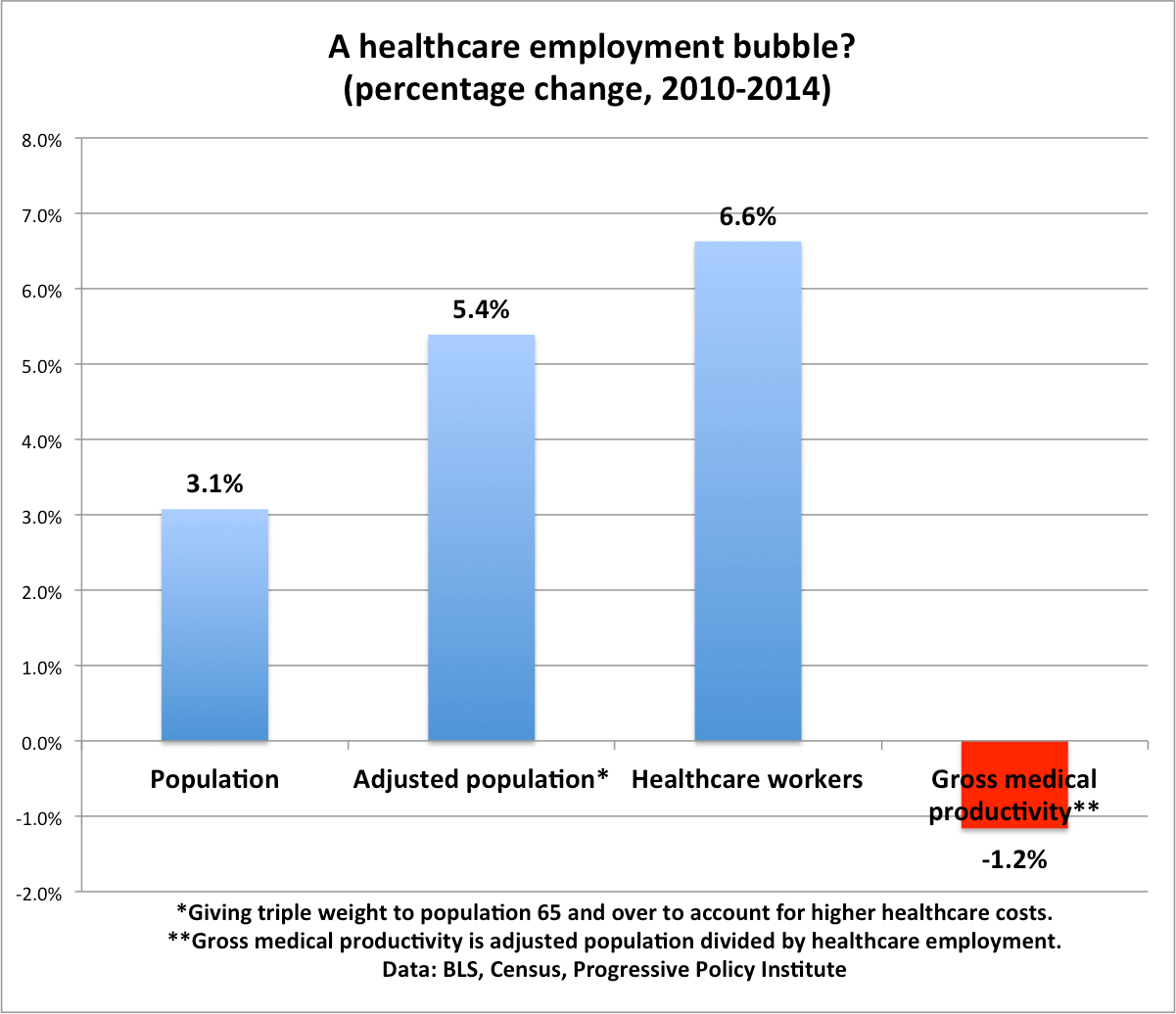
But the healthcare employment boom may actually represent a bubble. College students and administrators may be overestimating the safety and security of healthcare careers, especially in an era where the healthcare sector is under increasing pressure to control costs. And if the bubble bursts, women may bear the brunt. Consider the following chart.

healthprod1
The first bar of the chart shows that total population grew by 3.1% between 2010 and 2014. The second bar adjusts population to account for higher spending on the elderly, by effectively tripling the contribution of 65-and-over Americans. So demographics by itself would argue that healthcare spending and employment would rise by 5.4% between 2010 and 2014.

In fact, healthcare employment rose by 6.6% over the same stretch. The fact that healthcare employment is outpacing adjusted population is the most tangible manifestation of healthcare costs being out of control.

We calculated what we call “gross medical productivity”–adjusted population divided by the number of healthcare workers. We’d like to see gross medical productivity rise, which would mean that fewer healthcare workers are needed per potential patient, adjusted for demographics. In fact, the exact opposite is happening–even after we adjust for demographics, more healthcare workers are needed for each potential patient in the population.

So the healthcare employment boom is being fueled by falling gross medical productivity, or, conversely, rising costs. As we note in the tech employment paper:

Containing healthcare costs therefore means incorporating productivity enhancing—or cost- cutting—technology into the sector…That means that to increase productivity and reduce costs long-term, the rate of increase of healthcare employment needs to slow.

Note that we are not saying that healthcare employment will fall, as manufacturing employment did. Healthcare jobs are still relatively protected from foreign competition, and people value health as much as anything else. Yet given the number of young people and mid-career switchers going into healthcare, we could easily have a situation where the mere slowdown in healthcare employment growth by 1 percentage point could dramatically shift the balance of supply and demand in the field.

Given the strong possibility of such a change, we suggest that progressives should strongly support a diversification of college degrees out of healthcare and into other growing areas such as tech. This is especially important for women, who according to our calculations got more than 20 healthcare-related bachelors degrees for every tech-related degree in 2013.


Productivity Growth Continues to Plunge: Why A Growth Policy Is Necessary

Should progressives focus more on promoting growth, or fostering redistribution? The unfortunate fact is that we live in an era of weak productivity growth.  That means growth policies to encourage investment and innovation are essential for broad prosperity.

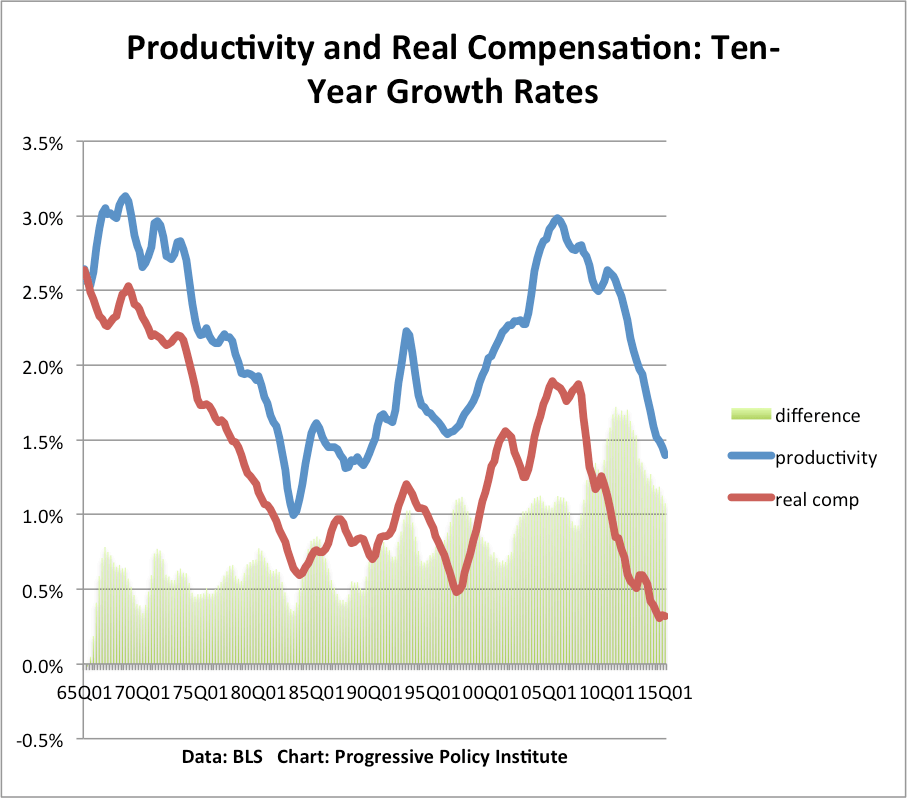
Based on today’s release from the BLS, ten-year productivity growth has now plunged to 1.4%, the lowest level since the 1980s (see chart below).  By comparison, ten-year productivity growth was 2.2% when Bill Clinton left office at the end of 2000, and hit a high of 3% at the end of 2005.

Productivity growth is the central force determining the size of the economic pie. Without productivity gains, living standards cannot show a sustainable rise.


Certainly real compensation growth is very weak as well. However, the difference between ten-year productivity growth and ten-year real compensation growth has also been narrowing.  It was 1.1 percentage points as of the first quarter of 2015, after peaking at 1.7 percentage points in 2011. That difference of 1.1 percentage points is only slightly above the 50-year average of 0.8 percentage points.

To put it a slight different way, real compensation growth has fallen from 1.5% in 2000 to 0.3% today, a catastrophic drop. However, two-thirds of that plunge can be attributed to a drop in productivity growth (from 2.2% to 1.4%), and only one-third to a widening of the gap between productivity and compensation growth. 

My conclusion: The sharp fall in productivity growth is the major reason why Americans feel so squeezed. Growth policies are key.


Gerwin for Republic 3.0: The Digital Economy, Trade Agreements and the 99 Percent

Who benefits from trade deals like the Trans-Pacific Partnership (TPP)?

Critics—like Joseph Stiglitz and Senator Elizabeth Warren—charge that these agreements would primarily help the world’s one percent. Stiglitz, for example, claims there’s a real risk that TPP will “benefit the wealthiest sliver of the American and global elite at the expense of everyone else.”

But a rapidly growing segment of the 99 percent—entrepreneurs, small businesses, and consumers who trade globally on the Internet—likely sees things differently. For these newly empowered traders, the TPP—and pacts like the Transatlantic Trade and Investment Partnership (TTIP) and the Trade in Services Agreement (TiSA)—can play a critical role in supporting their businesses by writing new rules that promote and protect electronic trade.

Continue Reading at Republic 3.0.

The Digital Opportunity: Democratizing Trade for the 99 Percent

Trade critics often charge that proposed trade agreements like the Trans Pacific Partnership (TPP) essentially serve the one percent—while harming virtually everyone else. But new trade pacts actually present a significant opportunity to drive more inclusive trade—especially by supporting the revolution in digitally enabled global commerce.

In this policy brief, we explain why it is critical for America to lead in writing modern trade rules that promote the free flow of data and open digital commerce. And we highlight some of the many ways in which the 99 percent—from entrepreneurs and small businesses to consumers and communities—benefit from “democratized” trade in a global digital economy that is both open and fair.

Who Benefits from New Trade Deals?
Over the past three decades, America’s trade agreements have become increasingly complex. While early trade agreements were focused on eliminating high tariffs, modern trade pacts also address non-tariff and “behind the border” barriers, like standards that discriminate against imported products or rules that discourage foreign investment.

To President Obama and supporters of trade promotion authority (TPA) legislation, addressing “21st Century” issues in the TPP and other new trade pacts would enable America to benefit broadly from expanding trade with a growing global economy.

Download “2015.05-Gerwin_The-Digital-Economy-Trade-Agreements-and-the-99-Percent”

Governor Markell for The Atlantic: Americans Need Jobs, Not Populism

In an op-ed for The Atlantic, Governor Jack Markell (D-Del.) argues that instead of raging against a “rigged” system, Democrats should work together with business to build an economy that distributes its benefits more broadly.

The bottom line is that private enterprise creates the primary condition for reducing poverty and want: economic growth. Governments don’t create jobs; however, government has an ability and responsibility to create a nurturing environment where business leaders and entrepreneurs want to locate and expand. What that means is that government has an active role in creating an economic environment that creates middle class success and prosperity. …

Long-term success requires an active government that partners with business to ensure that the bounty of economic growth is shared broadly. Sharing this bounty is not about having a “bleeding heart.” It’s a matter of cold economic sense.  

I am hugely bullish about the future of the American economy because I believe in investing in people, engaging with the world and sharing broadly the bounty that economic growth will generate. Growing without sharing won’t get it done.  And neither will redistribution without growth. Americans really are in this together.

Read the piece in its entirety at The Atlantic.