Tech job growth continues to accelerate!

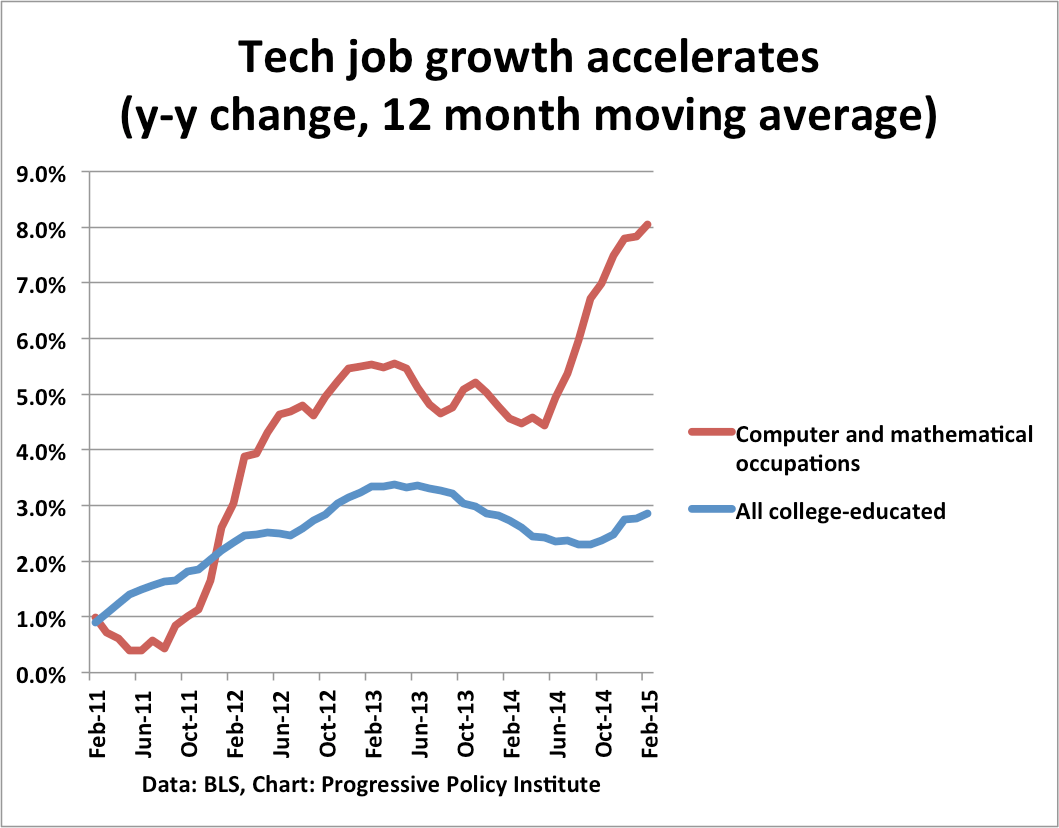
This morning’s employment report shows that tech jobs continues to grow at an accelerating pace. As of February 2015, the number of people working in computer and mathematical occupations–such as software developers and information security specialists–is up by 8% over a year earlier (based on 12-month moving averages).  By comparison, in February 2014, the comparable tech job growth rate was only  4.6%.

This acceleration in tech job growth is not being driven by a comparable acceleration in employment of educated workers. As the chart below shows, the number of employed workers with a bachelor’s degree or better is growing at a fairly steady pace.

techjobsmarch2015


Combined with our latest analysis of PPP’s tech/info job index, these numbers suggest that tech is still playing a critical role in driving state and local job markets.


PPI Tech/Info Job Ranking, 2009-2013

In October 2013 PPI released the first PPI Tech/info Job Ranking. In that report, we ranked counties by the strength of their tech/information sector. We found that “places with strong tech/information growth had survived the recession much better than their counterparts.”

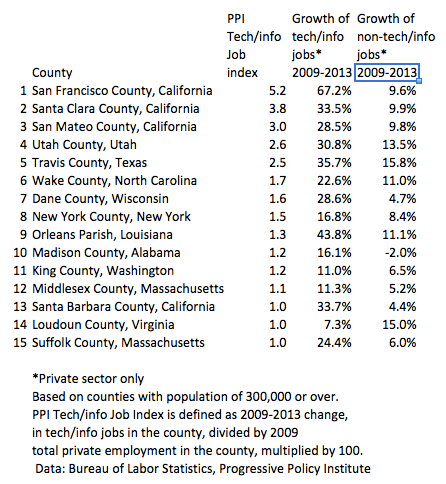
This blog item updates that earlier report, and provides our latest Tech/Info Job Ranking (these are the figures cited in the 3/5/2015 New York Times article entitled “What Is the Next ‘Next Silicon Valley’?”) In particular now we focus on the recovery years, from 2009 to 2013. In order to quantify the link between the tech/information sector and overall growth, we construct a new version of the PPI Tech/Info Job Index. For each of 214 large and medium-size counties, the Index measures the number of new tech/information jobs between 2009 and 2013, as a share of 2009 total private sector employment in that county. For example, an index of 1 means that new tech/info jobs created between 2009 and 2013 equal 1% of total 2009 private employment.

On average, the top 25 counties, as measured by the Index, showed an average private sector job gain of 9.1% between 2009 and 2013. That’s compared with a 5.5% gain for the remaining counties. Equally interesting, the top 25 counties, as measured by the index, produced an average non-tech/info job gain of 8.1% between 2009 and 2013, compared to 5.7% for the other counties.

The implication: counties with vibrant tech/info sectors have enjoyed stronger recoveries than other regions of the country, including faster growth of non-tech/info jobs.   

We use the term ‘tech/info’ to emphasizes the convergence of tech firms such as software developers and information and content companies such as newspapers and movie producers. Tech firms and information companies used to live in completely different worlds. Now the walls have come down.

For the purposes of this ranking, the tech/info sector consists of the following industries spanning NAICS 51 and NAICS 5415: Broadcasting (Internet, cable and over-the-air); Custom computer programming (including app developers and web developers); Data processing and hosting (including cloud computing); Film, video, and sound recording (conventional and digital distribution); News services (i.e. Reuters, Bloomberg, Associated Press); Publishing (print and digital); Software; Web search portals and social media; Wired and wireless telecom; Other computer-related services.

The table below gives the top 15 counties, as measured by the tech/info job index. If there’s interest, we will publish a longer list.

Screenshot 2015-03-04 20.20.53

Zero-Rating: Kick-Starting Internet Ecosystems in Developing Countries

The power of the Internet has redefined the global economy for the 21st Century. As of 2014, over three billion people around the world were connected. The corresponding boom in Internet-based retailers, news and information providers, and online entertainment and video companies has been just as impressive. Businesses go where the customers are, and increasingly the customers are online or mobile.

Unfortunately, the online revolution is lagging in many of the least developed parts of the world. Consider that as of 2014, fewer than 30 percent of Africa’s 1.1 billion population used the Internet. At the same time, relatively few African businesses have participated in the Internet business boom. Less than one percent of all existing domain name registrations in 2013 originated from Africa, meaning African-based businesses have very little local or global presence on the internet.

The problems are multiple. Building a broadband infrastructure to all homes, especially in rural areas, is too costly for many low-income countries. And mobile broadband service, while more broadly available, is also relatively expensive to provide and high-priced compared to incomes. As a result, broadband markets are limited in many poor and developing areas. In 2013, for example, there were 20 mobile broadband subscriptions per 100 people in the Philippines, and just three for every 100 people in Kenya.

Download “2015.03-Carew_Zero-Rating_Kick-Starting-Internet-Ecosystems-in-Developing-Countries”

Roll Call: Centrist New Democrats Want Bigger Role in Party’s Message

PPI President Will Marshall was quoted in a piece by Roll Call laying out the role of pragmatic progressives this Congress and their hope to make their centrist message heard in the larger, and distinctly more left-leaning, House Democratic Caucus:

Will Marshall, president of the Progressive Policy Institute, said that House Democratic leaders ultimately have a responsibility to represent the ideology of the majority of their members.

“The leaders have to reflect the caucus, right? And numerically speaking, the people in the caucus now have the lefter-tilt,” Marshall explained. “To the extent that there’s resistance [to the New Democrats], I don’t think it comes from the leaders as it does from the left wing of the party. Folks that are in very safe Democratic districts, very urban districts that produce supermajorities, people who are not vulnerable, they’re just under a different set of incentives and frankly they have closer ties to groups that are happier with the party’s status quo than the moderates are.”

Read the piece in its entirety on Roll Call.

Will a strict privacy bill of rights hurt growth?

The White House has come out with a discussion draft of a consumer privacy bill of rights. I’m not going to discuss the details of the proposal, which has already come under attack from both sides.

Instead, let me make a broader point: The advocacy of a strict privacy standard has the potential of harming the one sector that has been driving growth in consumer living standards. To summarize:

  • The living standard of Americans is stuck in slow gear. Per capita real consumption has only risen by 3.2% since 2007, in total.
  • More than half of the gain in living standards since 2007 has come from the rapid growth of data-related goods and services.*
  • A strict privacy bill of rights will almost certainly slow the growth of data-related goods and services.
  • Conclusion: A strict privacy bill of rights, if enacted, will inevitably further drag down the already slow growth in living standards.

Do Democrats who support a strict privacy standard understand the economic consequences of imposing more regulations on the sector which has been the main force for lifting living standards since the bust?  Do they understand the political consequences of being anti-growth?  And does the Administration realize that its proposal effectively gives the Europeans and others the ok to go over the top with regulation of US tech companies?

I don’t know the answer to these questions.

*This figure comes from an upcoming PPI policy memo,  “The Tech/Info Sector: Economic Hero or Market Predator?”  The upcoming policy memo defines the ‘consumer data ecosystem’ as including all data-related goods and services—that is, personal consumption of all types of goods and services that involve the transmission, delivery, and consumption of data. This includes personal computing devices, such as smartphones, tablets, and laptops. It also includes video and audio equipment, such as televisions and iPods, newspaper and periodicals, movie theater revenues, books, live entertainment such as music performances, cable and satellite subscriptions, cell phone and data plans, and Internet access.

Other results from the policy memo:

  •  Average prices in the consumer data ecosystem have fallen by 16% since 2007, and by 31% since 2000.
  • The consumer data ecosystem’s share of consumer spending is the same as it was in 2000.

These figures may be revised slightly as the government updates its statistics.


PPI Statement On FCC Net Neutrality Vote: FCC Shouldn’t Have the Last Word

Will Marshall, President of the Progressive Policy Institute (PPI), today released the following statement after the FCC voted in favor of Chairman Wheeler’s Open Internet rules to reclassify the Internet as a public utility:

“The FCC’s decision today to impose outmoded telephone regulation on the Internet is a bad call, substantively and politically.

“In the first instance, there is no evidence of systemic misconduct that would justify dramatically expanding the FCC’s power to regulate the Internet. In a classic case of fixing something that ain’t broke, the FCC has reached for the biggest possible hammer to deal with abuses that have yet to happen.

“In embracing preemptive regulation, the FCC also reverses the ‘light touch’ approach to Internet oversight the Clinton administration pioneered two decades ago. Such regulatory humility enabled the Internet’s exponential growth as a platform for digital innovation and competition. As PPI has documented, the communications boom is a prime catalyst of U.S. growth and has made America the world’s leader in digital innovation and trade.

“There is nothing ‘progressive’ about the FCC’s backsliding to common carrier rules dating back to the 1930s. Also troubling is its lack of transparency — the 317-page rule it approved has not yet been made public. Decisions this important to U.S. jobs, growth, and competitiveness ought to be made by Congress, following open democratic deliberation and debate.

“PPI therefore urges lawmakers from both parties to collaborate in crafting legislation that would do what the FCC has failed to do: Assure a free and open Internet without resorting to heavy-handed regulation that could inhibit investment and innovation in a fiercely competitive digital sector.”

Ehrlich: The Wrong Way to Enact The Wrong Policy — The FCC’s No Good, Very Bad Day

“This is no more a plan to regulate the Internet than the First Amendment is a plan to regulate free speech,” said Federal Communications Commission Chair Tom Wheeler, whereupon he cast the deciding vote for the most far-reaching plan ever developed to regulate the Internet.  Let’s hope he isn’t in charge of the First Amendment, too.

As a veteran of the Clinton Administration, whose policy of light regulation set the stage for today’s burgeoning Internet, Wheeler’s decision is a disappointment, to say the least. This Administration – an administration that in almost every other aspect I support – is shackling the Internet in a regulatory straitjacket designed for the monopoly phone system eight decades ago in order to implement “net neutrality.”  It isn’t going to be a very good fit.

Neutrality is the idea doctrine that everything on the Internet should travel at the same speed, whether it’s a high-definition concert or video game, a signal from a remote heart monitor, an email to Aunt Tilly, or a video of a cat playing the xylophone.  Advocates prefer this “one size fits all” approach to letting the market decide how price and quality should be lined up, much the same way Sears does when it offers the consumer “good,” “better,” and “best.”

But advocates – often paid by the big Internet sites who like the Internet just like it is, thanks – have conflated this issue and used language as surreal as Wheeler’s, claiming this market-based process is equivalent to letting service providers throttle or impede the traffic they don’t like, or asserting that “priority” service will kill the innovative Internet, as if first class travel killed air travel or Priority Mail ended daily delivery to the home.

But it’s one thing to implement a mistaken policy.  It’s even worse to do so in a mistaken way.  Right now, as we speak, there is a bipartisan effort underway in the Congress that would enact the core protections of “neutrality,” but would do so by statute, period, full stop, as opposed to the long and tortuous road today’s decision will find itself on when it is challenged (and probably overturned) in the Courts.

The difference is important.  Aside from eliminating the possibility of legal challenge, The Congressional route would eliminate the regulatory baggage that today’s “reclassification” potentially allows.  For example, the FCC can force a provider of a phone-like service to offer their infrastructure to competitors at government-reviewed prices, and can even regulate prices generally.  Chairman Wheeler says the FCC will “forebear” these extreme regulatory prerogatives, but if he’s serious about that, then why not embrace a Congressional law that makes that clear?

What I fear, and fear greatly, that the advocates for “reclassifying” the Internet as a phone-like service really want more than “net neutrality” – they want the Internet to be a public utility for all purposes.  After all, they might argue – and some have, calling on us to emulate failed public-sector Internets in places like Australia – the Internet is just so damned important that it needs to be under public control.

Yes, the Internet is important.  So is food, but we let farmers grow it.  And the Internet is not at all like public utilities we’ve known, like electricity and the old phone system.  The Internet is not a series of “dumb pipes” that blindly carry content the way the phone system was a “dumb system” that just closed circuits or “dumb wires” carried electricity.  It’s a complex system that requires management and that doesn’t tolerate “busy signals” or “brown outs” if there’s overload.

But more importantly, unlike electricity or phones, there are many ways to provide broadband connectivity in the market today.  Virtually every household in America now can receive broadband from three or four sources – from cable systems, from fiber or, when fiber isn’t there, from ever-improving DSL over the old phone lines, from mobile sources (in which we are the world’s leader), or from satellite, often the last alternative, but usually an acceptable one.

What the “public utility” view really argues is that the government should pick one of these, or some combination of these, to meet our broadband needs rather than letting this competition play itself out, which is something like deciding the winner of a ballgame in the middle of the second inning.  It’s this very “platform competition” that has allowed the U.S. to vault past most of our industrialized competitors, certainly those that don’t crowd their populations into cramped apartment blocks that are cheap to wire.  Is that what we, as Democrats, really want?

There’s still time to adopt a legislative compromise, achieve the “neutrality” objective, and put the issue to bed for good.  And if the making of sound policy doesn’t move my Democratic friends, consider this:  A future Republican President is elected and announces that the FCC will change course and go back to the framework first laid out by President Clinton.  Without a statute in place, there is nothing to prevent President Jeb, Rand, Ben, or whomever from putting net neutrality on the shelf and leaving the Internet without even the most basic consumer protections most would agree are necessary.

And during the debates leading up to that election, President Rick or Rick or Carly will look over at Secretary Clinton and ask if the Clinton Administration made a mistake when it championed the 1996 Telecommunications Act and brought over a trillion dollars of investment in to build the Internet.

If good policy doesn’t move you to accept the legislative solution, perhaps that unfortunate political outcome will.

Politico Pro: Report urges progressives to reconsider Obama trade agenda

PPI Senior Fellow Ed Gerwin’s latest report was featured in a trade story by Politico Pro‘s Doug Palmer:

A new report urges progressive Democrats opposed to President Barack Obama’s trade agenda with countries in the Asia-Pacific to give it another look, arguing that trade deals support progressive goals in a variety of ways, including by helping economic growth.

“Trade-skeptical progressives … should take a thoughtful look at the details of the Obama trade agenda and how it might better position America in the modern global economy,” Ed Gerwin, a senior fellow at the Progressive Policy Institute, said in the report. “If they do, they’re likely to find important policies and initiatives for progressives to like.”

“A progressive society that is both prosperous and fair requires strong and inclusive economic growth. The Administration’s trade agenda can play an important role in assuring that America can tap into one key source of economic vitality — surging demand in key foreign markets,” Gerwin said.

The report comes as Congress is gearing up for action on trade promotion authority, also known as fast-track trade legislation because it would allow the White House to submit trade agreements to Congress for straight up-or-down votes without any amendments.


The Obama Trade Agenda: Five Things for Progressives to Like

In his recent State of the Union address, President Obama went all in on international trade.

The Administration has already been aggressively pursuing the most ambitious set of trade agreements in decades—including potentially groundbreaking deals with 11 Asian-Pacific countries (the Trans Pacific Partnership, or TPP), and the European Union (the Transatlantic Trade and Investment Partnership, or T-TIP), as well as agreements in key sectors like services, information technology, and environmental products.

Now, to set the stage for eventual Congressional approval for these deals, the President has launched an Administration-wide effort to obtain Trade Promotion Authority (TPA) from Congress. Under TPA, Congress sets detailed priorities and extensive consultation requirements for U.S. trade negotiators, and agrees to follow special expedited procedures for agreements that meet these rules.

Congressional Republicans largely support TPA and the Administration’s trade agenda. There is less support, however, among Congressional Democrats, many of whom have doubts about new trade deals. And, because trade has long been a difficult political issue, it’s quite tempting for these trade skeptics to readily side with those who have consistently opposed trade agreements.

Download “2015.02-Gerwin_The-Obama-Free-Trade-Agenda”


Reuters: One last chance to save the Internet – from the FCC

As the Federal Communications Commission readies new net-neutrality rules this week, congressional Democrats face a choice: Should they work with the Republicans who control Congress to help pass new rules, or should they stay on the sidelines and leave the matter to a volatile regulatory process, subject to possible undoing in the courts?

I disagree with neutrality — the idea that everything on the Internet should travel at the same speed, whether it’s the remote monitoring of a cardiac device or a video of a cat. But both critics and advocates of neutrality would likely agree that a new law is the best way to set new policy — not regulatory decrees.

Let’s start with some history. The Communications Act of 1934 says phone companies are like public utilities and should be strongly regulated. But the 1996 Telecommunications Act, championed by President Bill Clinton, labeled the Internet as an “information service” that should be lightly regulated. That seems like a good decision: The Internet has grown spectacularly in this unregulated format.

But last month, Tom Wheeler, chairman of the Federal Communications Commission, proposed treating the Internet like a public utility, run for the public good. He said that the Web should be regulated much like the Ma Bell telephone companies of generations ago. Why this sudden turnaround?

Continue reading at Reuters.

The Hill: A bipartisan bill is the best way to net neutrality

In a letter to the editor of The Hill today, PPI Executive Director Lindsay Lewis argues for Congress to address net neutrality:

Why not simply bypass the FCC process, which seems sadly divided on partisan lines in any event, and pass stronger bipartisan net neutrality rules through the ordinary legislative process? That would eliminate any concerns about a “tainted process” and bring other benefits as well.

Read the piece in its entirety on The Hill.

WSJ: Why Entrenching Net Neutrality Carries Risks

PPI Senior Fellow Hal Singer was cited by The Wall Street Journal today in an article arguing that the Internet marketplace has so far kept “paid prioritization” of Internet traffic at bay without the heavy hand of regulators:

When regional Bell companies were forced to “unbundle” and lease their infrastructure to competitors at cost, it dampened investment in that infrastructure, Mr. Singer and Robert Litan, an economist at the Brookings Institution, argue in a report for the PPI. Not until the unbundling requirement ended early in the 2000s did cable and fiber investment take off, they say.

Read the piece in its entirety at The Wall Street Journal.

PRESS RELEASE: New Survey Finds Americans Skeptical that FCC Regulation of the Internet Will Be Helpful; Favor More Disclosure

For Immediate Release

WASHINGTON—The Progressive Policy Institute (PPI) today released the results of a new survey finding that most Americans are unfamiliar with the term “net neutrality,” want greater disclosure of the details of the FCC’s proposal to regulate the Internet, and think that the government regulating the Internet like a public utility will not be helpful.

The nationwide survey, by Hart Research Associates, was conducted from February 13 to 15, 2015 on behalf of PPI. The survey was conducted by telephone (both landline and cell phone) among a cross section of 800 adults age 18 and over. It found:

  • Nearly three out of four (74%) Americans are unfamiliar with the term “net neutrality” and what it refers to.
  • 73% of Americans want greater disclosure of the details of the FCC’s proposal to regulate the Internet.
  • Nearly eight in ten (79%) Americans favor public disclosure of the exact wording and details of the FCC’s proposal to regulate the Internet before the FCC votes on it.
  • Only one in three Americans thinks that regulating the Internet like telephone service will be helpful.

“The public neither understands nor supports the FCC voting on net neutrality rules without greater disclosure of the exact wording and the details of the proposal,” said Peter Hart, Founder of Hart Research Associates. “Net neutrality is near net zero understanding: just one in four Americans knows what the term refers to, and just one in 10 Americans has positive feelings about it. In addition, a majority of Americans think ‘the government should not take a stronger and more active role in overseeing and regulating the Internet.’”

“These findings suggest that the FCC’s bid to impose outdated telephone regulations on the Internet is driven more by professional activists than by the public, which seems instinctively to resist the idea,” said Will Marshall, PPI President. “That’s why Congress should take a closer look at what the FCC is up to and make sure these issues get a thorough public airing.”

The survey’s margin of error is ±3.46 percentage points for 800 adults at the 95% confidence level.  Sample tolerances for subgroups are larger. This is the first of several public opinion surveys PPI plans to release on issues related to regulation of the Internet and telecommunications law.

Download “2015.02_Survey_FCC-Approach-to-Net-Neutrality.pdf/”

Survey Questionnaire

For more information, please contact Cody Tucker or Steven Chlapecka at 202.525.3926.

# # #

Wall Street Journal: A Disconnect on Municipal Broadband

Should city governments get into the Internet service business, competing with the likes of Verizon, AT&T and Comcast for the right to pipe the Web into your living room or office? President Obama thinks so. He visited Cedar Falls, Iowa, on Jan. 14 to laud the city’s publicly owned utility, which offers residents fiber-optic Internet. He urged other municipalities to follow its example.

“Today, tens of millions of Americans have only one choice for that next-generation broadband, so they’re pretty much at the whim of whatever Internet provider is around,” Mr. Obama said. “And what happens when there’s no competition? You’re stuck on hold. You’re watching the loading icon spin. You’re waiting, and waiting, and waiting. And meanwhile, you’re wondering why your rates keep on getting jacked up when the service doesn’t seem to improve.”

Government-owned networks, the White House claims, can bring healthy competition to Internet service, increasing speeds and lowering prices. Mr. Obama even included a line about this in his recent State of the Union address, saying he intended to “help folks build the fastest networks.” Unfortunately for the president, his premise—that our current broadband is slow, costly and inaccessible to many Americans—simply does not check out.

Internet speeds in the U.S. are among the fastest in the world. More than 90% of American households are now served by connections capable of neck-snapping speeds of 100 megabits per second. (Streaming a movie from Netflix on the “ultra high-definition” setting requires a connection of only 25 megabits per second.) Many consumers choose to pay lower fees for slower service. Still, if individual U.S. states were ranked by average broadband speed alongside countries from across the globe, we would hold 12 of the top 20 spots.

Continue reading at The Wall Street Journal.

Ignore Today’s Jobs Report: Read the MGI Debt Report Instead

Ignore the January jobs report. Yes, the US economy has added 1 million jobs in the past three months, and that’s great news for everyone. [ed. added Friday morning] But really, just forget it. If you really want to know what’s going on in the global economy and what’s at stake in the 2016 election,  read McKinsey Global Institute’s latest report “Debt and (not much) deleveraging.”  And while you are at it, read two other groundbreaking MGI reports, “Disruptive technologies: Advances that will transform life, business, and the global economy” and Global flows in a digital age.

Together the three MGI reports tell a persuasive story that the global status quo going to break sometime soon–the only question is in what direction.  On the one hand, global debt has grown by $57 trillion, as the first report shows, which “poses new risks to financial stability and may undermine global economic growth.”

This massive global borrowing is only justified if global growth accelerates enough to pay down the debt. That sort of global boom will require the   disruptive technologies that MGI so ably describes in the other reports.

So here’s what we can expect around the corner–either a global financial crisis bigger than the last one, or an explosion of disruptive technologies that will transform our world. Or as a friend said, somewhat sarcastically, “Great! I can’t wait!”

And that’s why the 2016 election in the U.S., and comparable elections around the world, are so important. The next stage of the global economy is going to be fraught with surprises, both good and bad. We need political leaders with the skills to negotiate a complicated and unexplored economic and technological landscape.

[Headline modified on 2/6/15]

[Text added  on 2/7/15]


CNN: The problem with Obama’s budget

The $4 trillion budget President Barack Obama sent Congress on Monday is his blueprint for reviving “middle class opportunity.” Liberals are thrilled by the redistributive thrust of the president’s budget — it would hit affluent Americans with a battery of new tax hikes, totaling $2 trillion over the next decade, and use the proceeds to finance substantial tax cuts for low and middle income families.

However, this has, of course, scandalized tax-averse congressional Republicans, who echo House Ways and Means Chairman Paul Ryan in denouncing the Obama budget as an exercise in “envy economics.”

Given the partisan stalemate in Washington, many pundits therefore view the White House budget as a purely political statement intended to frame the 2016 presidential debate. Next, the GOP Congress will produce a conservative alternative, and each side will spend the next two years accusing the other of waging class warfare.

Except that the federal government actually does need a budget, especially one that reinforces the economy’s gathering momentum. The one thing both parties seem to agree on is that reversing middle class stagnation is the nation’s top priority. What America needs more than anything else is a long stretch of robust economic growth, something we have not seen since the 1990s, when both the growth and unemployment rates averaged about 4 percent a year.

Continue reading at CNN.