Why GDP and productivity growth may be underestimated

On Friday, the very fine economists at the Bureau of Economic Analysis will release their estimate of fourth quarter GDP growth.  Current estimates peg the US economy’s growth at roughly 3% for the quarter.

But here’s the rub:  The rise of the data-driven economy means government economic statistics may significantly understate US GDP growth and productivity growth. Official numbers are afflicted by huge and growing blind spots that increasingly distort the published figures.  To summarize, we are building a mammoth data-driven economy that, perversely, is only partly visible in the economic data.

To give just one simple example:  As of January 29, the official statistics report that the real value of of Internet access consumed by households has fallen by 5% over the past year.   The official statistics also report that real value of cable and satellite television and radio services has fallen by 2% over the same stretch.  And supposedly the real consumer value to households, as measured by the government, of mobile, cable, and internet access together has risen by a measly 0.4% over the past year.

These numbers can’t be right (for more of the theory here, see PPI’s 2012 paper “Beyond Goods and Services:The (Unmeasured) Rise of the Data-Driven Economy” )

Or to give another example, private investment in big data.  All sorts of organization are building up huge data stores with long-term value.  For example, the shift to electronic health records is predicated on the value of that data for lowering health care costs and improving patient treatments. (see, for example https://www.healthit.gov/providers-professionals/benefits-electronic-health-records-ehrs).

In theory, the investment in big data should be reported as part of GDP. Indeed, the BEA has recently started reporting spending on R&D and “entertainment, literary, and artistic originals” as part of investment spending.  And the original researchers on intangible investment did in fact include investment in databases.

However, in practice, the BEA does not include investment in big data in GDP: The tech equipment and the programming, yes, but  not the actual labor and costs necessary to collect and clean the data. For example, when a hospital employs medical coders to clean up their electronic patient records, that coder’s salary is recorded as an expense, but not as a contribution to GDP.  Similarly, the costs of converting from paper to electronic records is not being counted a part of GDP.

The distortion in the statistics from omitting big data is becoming bigger as big data becomes more important.  I cite health care because health care organizations are devoting vast resources to electronic health records, but the same holds for any company collecting big data.

We can list example after example where the data-driven economy is simply missed by the current statistics.  An earlier PPI paper,   Data, Trade and Growth, showed that the government does a terrible job measuring cross-border data flows, because many of them do not leave a monetary footprint. to the extent that the US holds a commanding position in cross-border data trade, this omission may be important for GDP and productivity growth.

Finally, it’s worth noting that reshoring may be artificially depressing the growth and productivity statistics, just as offshoring artificially inflated growth and productivity gains in the early part of the 2000s (this give me a chance to plug a new conference volume edited by myself and Susan Houseman, entitled “Measuring Globalization: Better Trade Statistics for Better Policy“). I will address this point at length in a future post.


Pipeline Politics: The Keystone Distraction

The decision by Senate and House Republicans to make approval of the Keystone XL Pipeline their first legislative priority has a decidedly retro feel. Much has changed since the Keystone project was first proposed in 2008. Most important is America’s shale oil and gas boom, which has contributed to a sharp drop in global oil prices. With U.S. oil production in particular surging, why do Republicans persist in claiming that Keystone is a matter of such urgent national interest?

The answer clearly has more to do with politics than with the new realities of U.S. energy abundance. Republicans see Keystone as a classic wedge issue that splits two important Democratic constituencies, labor and environmentalists. So much for claims by Senate Majority Leader Mitch McConnell and others that the GOP will use its new Congressional majority to govern responsibly and put problem-solving over partisanship.

That’s a shame, because the Keystone debate is a distraction from a bigger and more important issue: How to move America’s shale windfall to market. A good portion of U.S. production is happening in places like North Dakota, which is far outside America’s original “oil patch.” When Keystone was first proposed, about 60% of domestic production came from Alaska, Texas, and the Gulf of Mexico, where significant oil and gas infrastructure is located. However, with production now occurring in shale developments like North Dakota, surpluses are developing at storage and transportation hubs making it difficult to get to market.

Download “2015.01-Freeman_Pipeline-Politics_The-Keystone-Distraction.pdf/”

Politico: Barack Obama nears limit of executive powers

PPI President Will Marshall was quoted by David Nather in Politico on President Obama’s upcoming State of the Union speech:

Will Marshall, president of the Progressive Policy Institute, said Obama can still “set the terms of the debate” through executive orders, but what’s at stake is broader than a few executive actions: “Nothing is more important to his legacy than making sure that economic growth works for everyone.”

Continue reading at Politico.

The Hill: It’s time for Congress to end the net neutrality wars

At the Consumer Electronic Show in Las Vegas last week, Federal Communications Commission (FCC) Chairman Tom Wheeler announced his intention to reclassify Internet service as a public utility in order to achieve President Obama’s laudable goal of a free and open Internet. Because this outdated “solution” has tied the FCC in knots for years, and is fraught with legal risk, it’s time for Congress to step in and lift net neutrality out of the regulatory morass.

By making equal access to the Internet the law of the land, Congress could settle this contentious issue once and for all. It should create a new source of authority to regulate the dealings between Internet service providers (ISPs) and content providers — outside the creaky confines of Title II of the 1934 Communications Act. In this way, Congress can more effectively meet the president’s net neutrality goals without recourse to outdated telecom regulations that could raise broadband prices, impede investment in the core of the network, and pull content providers and the services they offer within the ambit of archaic telephone regulations.

A bipartisan consensus is forming around the need for a legislative solution to the net neutrality problem, which has lingered for nearly a decade without resolution by the FCC. Just this week, Senate Commerce Committee ranking member Bill Nelson (D-Fla.) announced that he’s in discussions with the panel’s chairman, John Thune (R-S.D.) on a targeted, bipartisan solution. The Senate is now in a race against Wheeler to find a solution.

Continue reading at The Hill.

Obama’s Muni Broadband Initiative: Bad Economics, Bad Politics

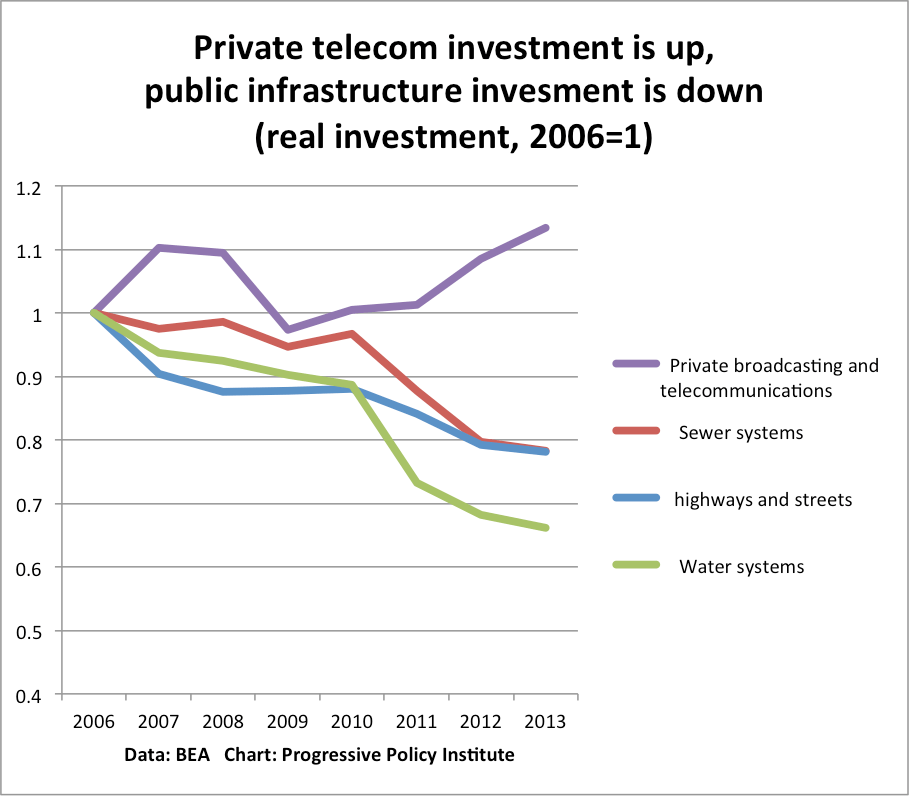
Here are some staggering statistics: Since 2006, state and local real investment in highways and streets has fallen by 22%.  Their spending on sewer systems, in real terms, is also down by 22%. And real investment by state and local governments in water systems has fallen by a stunning 34% (chart below).

Meanwhile, over the same period, private real investment by telecommunications and broadcasting companies is up by 13%, according to statistics from the Bureau of Economic Analysis.

broadband

Why, then, does President Obama want to load yet another spending burden–muni broadband–on localities that are already stretched too thin to cover their existing obligations? On Wednesday the President unleashed a set of initiatives designed to make it easier for cities and towns to build their own broadband networks.   Setting up muni broadband networks certainly has some superficial appeal—apparently creating more competition for private ISPs and offering cheaper rates to poor residents.

But there’s an enormous problem: State and local governments are already  struggling to come up with the funds to maintain the current infrastructure of roads, bridges, sewer and water systems.  Government infrastructure spending in real terms is way down compared to before the recession, leading to potholed roads, leaky water systems, and inadequate sewers.

Meanwhile private investment in telecom and broadcasting has continued to rise, boosting network speeds for both wireless and wired broadband.  Private companies are putting private money into improving the nation’s networks, without any cost to the taxpayers.

So if state and local governments have any spare change—or rather, if they have any of the taxpayer’s spare change—they shouldn’t put it into building broadband networks that would duplicate already existing private networks. Rather, they should fix the roads, bridges, and other infrastructure for which they are legally and politically responsible, and for which there are no private alternatives.

Focusing on rebuilding traditional infrastructure can have big economic payoffs. As Diana Carew and myself noted in a March 2014 PPI policy memo– ”Infrastructure Investment and Economic Growth:  Surveying New Post-Crisis Evidence”–recent studies show that investment in transportation infrastructure can have large positive multiplier effects on the local economy.

Finally, running a muni broadband network is hard and expensive, especially since broadband networks–unlike roads and water systems–need continuous upgrading to keep with technological change.  Does the Democratic party–and local politicians—really want to be on the phone when voters complain about their Internet service? In the end, Obama’s muni broadband plan looks like both bad economics and bad politics.


Fixing Shabby America

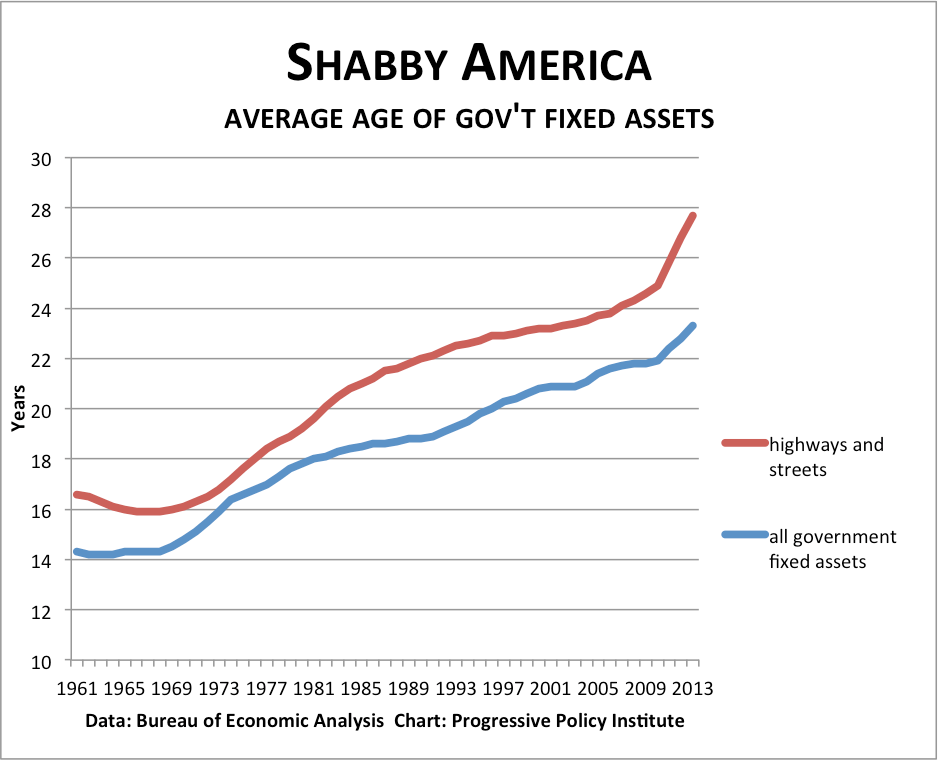
America’s infrastructure is like a house where the carpets are worn, the shower is leaking, and cracks in the wall let through the winter winds. The average age of U.S. highways and streets now stands at about 28 years, almost double the average age fifty years ago. (That figure factors in the amount spent on repairs and upgrading).

To avoid the U.S. becoming a shabby nation, Congress should act on raising the gas tax.  By itself, that won’t solve America’s infrastructure woes. But at least we can patch the biggest cracks.

shabby


Congress Answers PPI Call, Exempts End-Users From Dodd-Frank

The Senate voted 93-4 Thursday to reauthorize the Terrorism Risk Insurance Act (TRIA) for six years. The legislation, which is expected to be signed into law by President Obama, includes a provision exempting “end-users”– non-financial institutions, such as farms, ranches, manufacturers, small businesses, etc.– from certain inadvertent regulations imposed by the 2010 Dodd-Frank Wall Street reform law.

In a 2011 policy brief, The Risks of Over-Regulating End-User Derivatives, PPI Senior Fellows Jason Gold and Anne Kim warned policymakers to be wary of these unintended requirements as they implemented the law and called on Congress to rectify the issue:

No one doubts that the abuse of some forms of exotic derivatives contributed to the systemic risk that led to the 2008 crisis. But derivatives are an important tool used by major American manufacturing and service companies (“end users”) to manage and protect against risks—not create them. These derivatives contribute little—if anything—to systemic risk.

Federal agencies are nonetheless contemplating regulations that could put the conventional derivatives companies use to hedge against risk in the same categorical box as the speculative trades or trades done by systemically risky firms, even though Congress did not intend for this to occur.

Subjecting these derivatives to the same limitations as riskier speculative trades—such as by imposing “margin” requirements and other overly tough regulations—would unnecessarily burden American companies. It would tie up capital that would otherwise be directed to investment and hiring, drive up the cost of producing goods and services, and ultimately cost American jobs. Ironically enough, the result would be to create more potential risk for the economy, not less.

As we emerge from the worst recession in generations, policymakers are confronted with the dual task of implementing regulations that promote private sector economic growth while also mitigating systemic risk. Sensible regulations to deal with end-user derivatives and the companies that use them are an important piece of meeting this challenge.

See: The Risks of Over-Regulating End-User Derivatives.

What Would Benefit Mississippi Voters: The Tech Effect

In recent months we’ve seen the attorney general of Mississippi, Jim Hood, issue a subpoena against Google requesting information on a very broad range of search engine activities, based on the theory that Google is legally responsible for questionable content on third-party sites indexed by the search giant.  Google responded last week with a lawsuit against Hood,  asking a federal court to stop the subpoena on a variety of grounds.

Leaving aside the details of the dueling subpoenas and lawsuits, there are two problems here. First, it makes no sense to develop Internet policy on the state level.  Hood’s challenge to Google raises issues that by existing law and by common sense are and should be handled at the national level.

Second, Hood’s actions are odd and self-defeating for Mississippi voters,  because the state needs to be encouraging tech employment, not waging war against tech firms. Mississippi has an unemployment rate of 7.3%,  the highest in the country, in part because the state has not taken advantage of the tech boom.  Only 2% of Mississippi’s private-sector workers are in the tech/info sector, the second-lowest share in the U.S. Similarly, only 1.1% of Mississippi workers are in computer and mathematical occupations, also the second-lowest share in the country.

Hood would serve his constituency better by devoting his admirable energies and talents to helping tech firms grow in Mississippi, rather than chasing misguided legal theories.


Data:

1.The Mississippi unemployment rate comes from the November 2014 BLS report on state unemployment, released December 19.

2, The figure on Mississippi’s tech/info employment as a share of private sector employment comes from PPI calculations using BLS state data, based on the definition of the tech/info sector described in this report. Note that Mississippi movie and video jobs as a share of all private sector employment is the lowest in the country, out of all states with available data.

3. The figure on computer and mathematical employment in Mississippi is based on PPI analysis of the 2013 American Community Survey.


Earnings for Young Americans: Which City Tops the List?

For young Americans, Washington, D.C. may have more to offer than government jobs and free museums.  It may also provide more opportunities to get a raise than any other top 10 U.S. city.

According to my analysis of new Census data on young Americans, Washington, D.C. was the only top 10 U.S. city, by population, where young workers saw an increase in real median earnings since 2000 (in addition to having the highest real median earnings overall).  Young workers in every other top 10 U.S. city experienced sizable declines.  More than half – six – of the top 10 cities saw declines greater than 10 percent, with young workers in Miami and Atlanta enduring real declines of more than 15 percent.

The table below shows the 2000-2013 change in real median earnings for young Americans age 18-34 working full-time by major U.S. city, where 2013 is measured as a five-year average over 2009-2013. Data for 2000 comes from the 2000 Census long form, and data for the 2009-2013 five year average comes from the American Community Survey 2009-2013 five-year estimate.

Median Earnings for Young Americans Aged 18-34 in the Ten Most Populated Metro Areas

  2013 Median Earnings         (in 2013$)* 2000-2013 Change           (in 2013$)** 2000-2013 Percent Change** Percent of 18-34 year-olds with a college degree or higher, 2013**
Washington, D.C. 47,380 1,560 3.4% 38.9
Boston 44,548 -2,196 -4.7% 38.9
New York City 42,108 -3,216 -7.1% 33.3
Philadelphia 39,413 -3,582 -8.3% 28.5
Houston 33,674 -4,082 -10.8% 21.0
Los Angeles 33,667 -4,200 -11.1% 23.6
Chicago 38,415 -5,111 -11.7% 30.2
Dallas 33,369 -5,660 -14.5% 22.6
Miami 30,728 -5,683 -15.6% 20.6
Atlanta 34,573 -7,203 -17.2% 25.4
US Average 33,883 -3,472 -9.3% 22.3
*Full-time, year round workers aged 18-34, where 2013 is the average median real earnings over 2009-2013
**Where 2013 is the five-year average over 2009-2013
Source: 2000 Census Long Form, 2009-2013 American Community Survey, PPI

That real median earnings increased in Washington, D.C. while falling elsewhere might help explain why the nation’s capital has become an increasingly popular place to be for young people. The number of 18-34 year-olds living in the D.C. metro area has increased by 19 percent, or 226,000, since 2000, compared to one percent increases in Chicago and New York, and 9 percent nationally. Washington, D.C. also has a high share of employment dependent on the federal government, and a highly educated youth population, both of which may have been less affected by the economic downturn. (Houston, however, was the top city for youth inflows in spite of falling real median earnings, which saw its 18-34 year-old population increase 25 percent since 2000.)

Still, falling real median earnings across the board outside Washington, D.C. suggests the underlying issues affecting young workers is not solely about educational attainment or geography. Other major cities with a higher than average share of young college graduates, such as New York and Chicago, also experienced a decline in real median earnings. This is consistent with my previous research, which shows falling real average earnings for young college graduates at a time when many are questioning the value of a college degree.

Overall, the sharp decline in real median earnings for young workers is troubling. It suggests young Americans continue to face strong financial headwinds during their professionally formative years. Moreover, it could hinder young people’s ability to fully participate in the greater economy long-term. That has significant implications for politicians on both sides of the aisle, especially Democrats who care about creating a more convincing pro-growth agenda.

What to Make of a CFO’s Musings on Regulatory Hypotheticals?

In recent days, the net neutrality crowd has seized on select, abbreviated versions of comments by certain executives of Internet service providers (ISPs) as evidence that ISPs are in fact supportive of the public-utility-style regulations being considered by the FCC for internet access service. Even the Chairman of the FCC made hay with the comments to advance his regulatory agenda.

As it turns out, the “gotcha” quotes were amplified in the media, while statements consistent with the “regulation-can-be-harmful” thesis were neglected. Even if we ignore what else those executives said, corporate financial officers (CFOs), or any executive for that matter, don’t have complete say over their firm’s investment decisions. That’s because external investors who lend money to ISPs are equally if not more important, particularly over the long run.

A small helping of investment theory is in order. Tim Karr at Free Press is fond of characterizing the ISP investment decision as an all-or-nothing affair, but in reality, investments (like any decision in economics) are made at the margin. Each project has a different expected return. And even within a project—say, fiber to the home (FTTH)—the expected return will vary depending on the city in which the investment would be made.

As any CFO knows, basic investment theory teaches that a firm invests in a project so long as the internal rate of return (IRR) on a project is greater than the minimum required rate of return, as measured by the firm’s the cost of capital. This is simple, folks: Line up your projects from highest to lowest IRR, and fund the ones that exceed your cost of capital. Continue reading “What to Make of a CFO’s Musings on Regulatory Hypotheticals?”

Sony Hack, Guardrails, and Job Creation

Are companies finally realizing that they need to invest in  “guardrails” for the information highway, aka the data-driven economy? And will this labor-intensive effort help create more mid-level jobs?

The Sony hack has forced the company to withdraw its newest film from the market, as well as causing the release of countless numbers of damaging and/or embarrassing documents.  While not a death blow to Sony, the hack is certainly deeply wounding.

This event followed in the wake of the high-profile cyberattack on J.P. Morgan Chase, and other well-reported cybercrimes and data breaches affecting companies such as Home Depot and Target.

In response, companies are beefing up their cybersecurity funding and staffs. Jamie Dimon announced that Chase would be doubling its spending on cybersecurity, while Wells Fargo has increased cybersecurity staff by 50%.

Now, cybersecurity tends to be labor intensive, because it requires supervising the activities of all the workers in the company, while dealing with novel incursions from cybercrooks and hostile national states. As a result, all this cybersecurity is leading to increased jobs for information security and data security specialists. Right now Indeed.com is reporting almost 20,000 want ads nationally for information and data security specialists, out of which almost 5000, or 25%,  are in the Washington DC area (this estimate is based on a keyword list of cybersecurity-related search terms that I developed). New York and Silicon Valley still lag behind in their demand for information security specialists, at least according to the want ad data.

While top level information security analysts are extremely well paid, many are mid-level jobs.  They require a mixture of security skills with some tech savvy, and they pay on average roughly $90K per year.

But there’s a broader point here that goes beyond information security. Think of the data-driven economy like a winding highway, with mountains on one side and a sharp drop to a rocky shore on the other (visualize the Pacific Coast Highway north of San Francisco, if you want). The highway is scenic and fun to drive. On the other hand, it’s expensive to build guardrails, fill potholes,  and keep the highway well-maintained. But without those expenditures, you get high profile accidents.

Companies like Sony and Home Depot. have been so busy trying to keep up with the data-driven economy that they haven’t invested enough in the less glamorous tasks of building guardrails and filling potholes.  But as more big disasters happen, that way of thinking will change.

As companies build guardrails–boosting spending on cybersecurity, beefing up customer support, keeping mainframe, desktop , and mobile software up-to-date–they will inevitably have to hire more workers. That’s why the number of people working in computer-related occupations continues to rise.

The Internet ecosystem is being expanded to include less-glamorous but essential labor-intensive tasks such as cybersecurity. And as that happens, more jobs are being created.


No Guarantees When It Comes to Telecom Fees

To rebut our estimate of new annual state and local taxes and fees caused by reclassification, Free Press offers two claims: (1) that all of these taxes and fees are preempted by the recent extension of the Internet Tax Freedom Act (ITFA) by Congress, and in the alternative, (2) that the Commission can designate broadband as an interstate service upon reclassification, thereby shielding broadband users from any new state or local taxes. Although the ITFA has been extended, the precise way in which the Commission designates broadband is speculative. Even if broadband is designated as an interstate service, these two elixirs fail to provide the relief for broadband users that Free Press asserts.

The ITFA Claim

In a December 14, 2014 filing with the Commission, Free Press seizes on the recent extension of the ITFA to claim that reclassification would have zero impact on the state and local fees paid by broadband users.[1] Although Free Press previously estimated the new state and local fees caused by reclassification to be $4 billion annually,[2] their revised estimate is apparently zero based on the mistaken assumption that the renewed ITFA will preempt all telecom-related taxes and fees. Free Press claims that our original (pre-extension) estimate of $15 billion is also upwardly biased in light of the extension.

The facts do not bear this out, for several reasons. First, the ITFA pertains to specific taxes such as a “sales or use taxes”[3] as opposed to telecom-related fees. Second, sales taxes constituted only one of several types of taxes and fees we considered.[4] Indeed, in 14 of the states, sales taxes were absent from the list of telecom-related taxes and fees. Third, because extension of the ITFA was uncertain at the time of our initial report, we elected not to exclude those taxes. With the benefit of hindsight, one could revise our estimates downward to exclude these sales taxes, but doing so still leaves a large annual tab for broadband users.[5]

The focus of our report was on state-based telecom-related fees for which there is no federal preemption—not from Congress and not from the Commission.[6] Indeed, the ITFA carves out state-based fees that comprise the majority of our estimate. In a section titled “Exceptions,” the original ITFA explains that the term “tax” excludes: “Any franchise fee or similar fee imposed by a State or local franchising authority, pursuant to section 622 or 653 . . . or any other fee related to obligation of telecommunications carriers under the Communications Act of 1934.”[7] In 2004, the ITFA was amended to permit states and localities to continue to collect “any fee or charges used to preserve and advance Federal universal service or similar state programs.”[8] These exemptions are nowhere to be found in the Free Press analysis. In light of these exemptions, which to our knowledge are perpetuated in the current extension of ITFA, the mere extension of ITFA will not prevent states and localities from continuing to collect all telecom-related fees.

Even with respect to state sales taxes, there is still some uncertainty over how the ITFA would apply. Free Press relies on a legislative history that assumes there is an information component to Internet access, as well as a transmission component.[9] And while it seems clear that the exemption would apply to Internet access if it were classified as a telecom service, or to the transmission component of Internet access if it remained classified as an information service, it is not clear how the exemption would apply to a hypothetical transmission service that is separately offered to end user customers.

Stated differently, the ITFA appears to exempt taxation of transmission when it is an input to Internet access.[10] It is less clear on what happens if the transmission component is offered separately to end users from the information component. This appears to be the approach described by Justice Scalia.[11] It would be very helpful if Free Press and others would explain precisely the service and underlying facilities that they believe should be reclassified, as Justice Scalia did. Without knowing precisely what would be reclassified, there is still some uncertainty over the assessment of general sales taxes on hypothetical broadband transmission services.

The Interstate Designation Claim

In the event that the extension of the ITFA does not afford protection, Free Press offers a backup plan. To negate any telecom-based fees, Free Press claims that the Commission should wave its magic wand and declare broadband service to be an interstate service: It is not a “multiple choice question,” in their words, but instead an obvious conclusion “based on observable facts of how the service functions.”[12] According to Free Press, treating broadband as an interstate service would immunize broadband providers (and thus their customers) from the remaining state-based telecom-related fees, as states have traditionally taxed only intrastate revenues.[13] Free Press is mistaken here as well.

When the Commission previously considered the jurisdiction of Internet traffic, it determined that such traffic was “largely interstate,” but “jurisdictionally mixed.”[14] States routinely tax jurisdictionally mixed services that are classified as “interstate” for purposes of regulation. For example, wireless services may not be regulated by state public utility commissions, but they are subject a host of state and local taxes and fees. In several states, interstate wireless revenues are subject to taxation.[15]

Indeed, the only state or local taxes in our analysis that could be avoided if the FCC were to declare broadband to be an interstate service would be the state-based universal service fees adopted pursuant to state utility commissions. Even here, the protection is not ironclad, as there are a handful of states that assess universal service fees on interstate voice revenues, including South Carolina and Vermont.[16]

It is true that our analysis did not consider state law limitations on the application of taxes and fees to jurisdictionally mixed services that are classified as interstate for regulatory purposes. It is possible that such limitations may mitigate to some extent the effects of reclassification on consumers. Given the widespread application of state taxes and fees on wireless service, however, any such mitigation is likely to be minimal.

———–

ENDNOTES

[1] Free Press Letter, Dec. 14, 2014, at 1 (“Congress’s reauthorization of the Internet Tax Freedom Act (“ITFA”) precludes any new state or local taxes for broadband Internet access, no matter how the Commission defines and classifies it, just as the existing ITFA precluded such taxes before that reauthorization.”) (emphasis added).

[2] Matt Wood, “Claims That Real Net Neutrality Would Result in New Internet Tax Skew the Math and Confuse the Law,” Free Press Blog, Dec. 2, 2014, available at https://www.freepress.net/blog/2014/12/02/claims-real-net-neutrality-would-result-new-internet-tax-skew-math-and-confuse-law

result-new-internet-tax-skew-math-and-confuse-law (last accessed on Dec. 3, 2014) (“Even if you used PPI’s fuzzy math, this would amount to approximately $4 billion in total, nowhere near the $15 billion sum Singer and Litan cite.”).

[3] ITFA, Sec. 1104, 8 (A)(ii) (signed as Public Law 105-277 on October 21, 1998).

[4] For 14 of the states in our sample, there was no general sales tax. For the 36 states with a general sales tax, the average state sales tax was 5.5 percent.

[5] Zeroing out all sales taxes (state and local) in those states reduces our midpoint annual estimate of new state and local fees from $15 billion to $11 billion. It bears noting that we conservatively assumed no increase in the federal program demand, which resulted in a modest $0.5 billion lift in federal fees paid by residential broadband users, as the consumer contribution (compared to business) of broadband revenues (which would be newly added to the fund’s revenues) is proportionally greater than the consumer contribution of long-distance revenues. To the extent that federal program demand increases from reclassification—due to the enhanced political pressures associated with deeming broadband a public utility—the reduction in state and local fees caused by the extension of the ITFA could easily be offset by an increase in federal fees.

[6] In the same December 2, 2014 Free Press blog posting, Free Press argued that the Commission could preempt these state-based fees: “Just as the FCC can decline to extend USF assessments to retail broadband access at this time, it also has the authority to preempt states from doing so.” Section 253 of the Act authorizes the Commission to preempt state laws that would impair a carrier from providing interstate or intrastate telecom services. But assessing fees on broadband providers would not impair a firm from providing broadband services. At most, such fees would reduce broadband penetration by squeezing out marginal (price-sensitive) customers.

[7] ITFA, Sec. 1104, 8 (B) (emphasis added).

[8] ITFA, Sec. 1107, A (amended Apr. 29, 2004).

[9] Free Press Letter, at 4 (citing Report of the Senate Committee on Commerce, Science, and Transportation, “Internet Tax Non-Discrimination Act of 2003,” S. 150, S. Rep. No. 108-155, at 2, Sept. 29, 2003).

[10] ITFA, Sec. 1104(2)(B)(i) (amended Apr. 29, 2004).

[11] Scalia Dissent, NCTA v. Brand X Internet Service, ¶96 (“Since the delivery service provided by cable (the broadband connection between the customer’s computer and the cable company’s computer-processing facilities) is downstream from the computer-processing facilities, there is no question that it merely serves as a conduit for the information services that have already been assembled by the cable company in its capacity as ISP.”).

[12] Free Press Letter, at 3.

[13] Free Press Letter, at 5 (“This means that states will not apply to broadband any taxes or fees, including universal service fund assessments or contributions, that apply solely to intrastate telecommunications services.”).

[14] FCC adopts order addressing dial-up internet traffic, Feb. 25, 1999, available at https://transition.fcc.gov/Bureaus/Common_Carrier/News_Releases/1999/nrcc9014.html.

[15] Scott Mackey & Joseph Henchman, Wireless Taxation in the United States 2014, Tax Foundation Fiscal Fact, Oct. 2014, Appendix A.

[16] Vermont Public Service Board, Universal Service Funds, available at https://psb.vermont.gov/utilityindustries/telecom/backgroundinfo/vusf; 2014 South Carolina Universal Service Contribution Worksheet, available at https://www.regulatorystaff.sc.gov/TTWWW/2014%20SC%20USF%20Contribution%20Worksheet%20Instructions.pdf (instruction that interstate revenues must be reported).

USA Today: Old rules make Internet more expensive

If the Federal Communications Commission (FCC) votes to “reclassify” the Internet as a public utility, U.S. consumers will have to dig deeper into their pockets to pay for access to the Internet.

How deep? By our estimates, broadband subscribers would have to pay about $70 annually in additional state and local fees. When you add it all up, reclassification could add a whopping $15 billion in new user fees to consumer bills.

At issue is whether Internet service providers (ISPs) — telco and cable companies — should be regulated as public utilities under Title II of the Communications Act of 1934. Activists pushing for this approach — echoed recently by President Obama — claim it is the only way to protect “net neutrality.” Critics argue that there are better ways to ensure an open Internet without subjecting ISPs to archaic regulations designed for the old Ma Bell telephone monopoly.

Missing from this debate until now is any serious assessment of what Title II regulation would cost broadband consumers. So we ran the numbers and discovered there is nothing but bad news on this front. Once Internet access service is labeled a “telecommunications service” under Title II, consumer broadband services could become subject to a whole host of new taxes and fees.

Although these fees are paid by broadband providers, history shows — and economic models of competitive markets predict — that these charges are passed along to customers, just as they are now on your phone bill.

The Internet Tax Freedom Act pending in Congress might limit the impact of some of these taxes and fees, but not all of them. And while the FCC has the power to limit the amount of the federal Universal Service Fee, recent history shows the FCC is more likely to increase USF than reduce it. Perhaps most telling — even the staunchest defenders of Title II acknowledge that various federal and state authorities could impose billions in new charges if broadband is reclassified as a utility.

Continue reading at USA Today.


Free Energy Trade: Time to Lift the Oil Export Ban

In July 2014, the United States passed Saudi Arabia and Russia to become the world’s biggest oil producer for the first time since 1970. This dramatic turn of events marked the end of an era in U.S. energy policy—an era that began in the 1970s with two oil embargoes, soaring gas prices, and growing dependence on imported oil, especially from the Middle East.

For better or worse—and some environmentalists think it’s definitely for worse—America unexpectedly finds itself richly endowed with fossil fuels again. The question now is how can we take advantage of this new energy abundance without accelerating global warming?

The answer, in PPI’s view, lies in a balanced national energy strategy that promotes both economic growth and a healthy environment. Such a strategy would capitalize on the domestic shale oil and gas boom while also enabling America to meet its international commitments to reduce greenhouse gas emissions. There are two ways to square that circle. One is to boost public investment in energy-related research and development. The other is to price carbon accurately, which will spur more investment in efficiency, clean tech innovation, and renewable and nuclear energy.

This approach steers a pragmatic course between “drill baby drill” conservatives, who ignore or deny the overwhelming scientific evidence for climate change, and extreme environmentalists who imagine that Americans will go along with their demands to keep the nation’s shale bounty “in the ground.”

Download “2014.12-Freeman_Free-Energy-Trade_Time-to-Lift-the-Oil-Export-Ban.pdf/”

The Hill: Shooting yourself in the foot

What’s gotten into our European friends? Beset by slow growth, tensions over immigration and a rising fever of anti-Euro populism, some leaders are trying to deflect public discontent onto U.S. companies—a move that may turn out to backfire economically

The latest example comes from UK Chancellor of the Exchequer, George Osborne. He recently floated a proposed “diverted profits tax” on foreign companies doing business in Britain. It’s been called the “Google tax” and little wonder, since it’s clearly aimed at U.S. tech companies.

Osborne describes the idea as a way to foil tax avoidance strategies many companies use. That’s a legitimate issue. But what the Chancellor is proposing is a unilateral step that could torpedo the elaborate process the European Union and other governments already launched (through the Organization for Economic Cooperation and Development) to develop a common approach to tax base erosion and profit-shifting.

This gambit by the government of Prime Minister David Cameron, a Conservative who is forever extolling Britain’s “special relationship” with America, is unfortunately not an isolated incident.

Continue reading at The Hill.

WSJ: Obama’s New Web Tax

The Wall Street Journal editorialized PPI’s recent policy brief by Hal Singer and Bob Litan, Outdated Regulations Will Make Consumers Pay More for Broadband.

Now the Progressive Policy Institute reports that state and local regulators would join with the feds in gouging Internet consumers. That’s because states and localities have their own levies that would kick in if the Internet is officially deemed a monopoly telephone network. Authors Robert Litan of the Brookings Institution and PPI’s Hal Singer optimistically expect regulators to reduce the federal levy from the current 16.1%. But the analysts still forecast significant pain for Internet users.

“We have calculated that the average annual increase in state and local fees levied on U.S. wireline and wireless broadband subscribers will be $67 and $72, respectively. And the annual increase in federal fees per household will be roughly $17. When you add it all up, reclassification could add a whopping $17 billion in new user fees,” report Messrs. Litan and Singer.

That’s in addition to “the planned $1.5 billion extra to fund the E-Rate program,” which subsidizes schools and libraries. The authors add that the “higher fees would come on top of the adverse impact on consumers of less investment and slower innovation that would result from reclassification.”

Read the entire piece at The Wall Street Journal.