Washington Post reports on U.S. Investment Heroes of 2014

The Washington Post quoted PPI Chief Economic Strategist Michael Mandel in a story mentioning PPI’s newest report, U.S. Investment Heroes of 2014: Investing at Home in a Connected World:

For a more optimistic one, look inside one more report out this week, from the Progressive Policy Institute. It lists the 25 companies that invested the most in capital improvements in America last year, led by AT&T and Verizon. Most of the companies on the list come from the telecommunications sector, the energy sector or the tech sector – all areas where American minds have engineered big breakthroughs in recent years.

“The investments have followed the innovations,” one of the report authors, Michael Mandel, said in an interview. Jobs, he added, have followed the investments. So if you spur more innovation, you’ll spur more jobs.

Read more at The Washington Post.


WJLA Channel 7: Websites protest FCC ‘fast lanes’ with Internet Slowdown Day

PPI Senior Fellow Hal Singer was quoted in a story by WJLA Channel 7 regarding yesterday’s Internet Slowdown Day, a protest organized by net neutrality advocates unhappy with new Open Internet rules being proposed by the Federal Communications Commission:

Hal Singer, senior fellow at the Progressive Policy Institute, supports the FCC proposal. He says, “Fast lanes is a loaded term. What I prefer to say is ‘just say no to slow lanes.’”

He continued, “It’s a political campaign. These guys on the other side are very effective at this game. They would like all of these priority delivery offerings to be available for free. Well, that’s very convenient for them. I say, on the other hand, if you don’t want the priority delivery offering, it’s a free country. You can always decline it.”

Singer says – for the average small business or Internet start-up – there’s no demand for such high-speeds. Meanwhile, major telecom firms point out video traffic consumes enormous bandwidth and costs more. And they warn that treating broadband like a utility would harm innovation.

“We’re going to freeze the current technology in place,” Singer said. “And that’s not good for anyone, particularly Internet consumers, because we’re going to keep coming up with new fancy applications that we want and who knows what kind of speeds are required to support those applications.”

Read more on WJLA Channel 7.

Multichannel News: Comcast, TWC On List Of Top Capital Spend

Multichannel News quoted PPI Senior Fellow Hal Singer accompanying the release of PPI’s newest report, U.S. Investment Heroes of 2014: Investing at Home in a Connected World.

“Given the importance of broadband investment to the U.S. economy, the social costs of imposing rate regulation under Title II will be even larger than the immediate harms to broadband consumers from an atrophying network; growth in U.S. productivity and job formation could be slowed,” said senior fellow Hal Singer in a statement.

Read more on Multichannel News.

“Given the importance of broadband investment to the U.S. economy, the social costs of imposing rate regulation under Title II will be even larger than the immediate harms to broadband consumers from an atrophying network; growth in U.S. productivity and job formation could be slowed,” said senior fellow Hal Singers in a statement – See more at: https://www.multichannel.com/news/policy/comcast-twc-list-top-capital-spend/383702#sthash.2C5Yd5yy.dpuf
“Given the importance of broadband investment to the U.S. economy, the social costs of imposing rate regulation under Title II will be even larger than the immediate harms to broadband consumers from an atrophying network; growth in U.S. productivity and job formation could be slowed,” said senior fellow Hal Singers in a statement accompanying release of the report. – See more at: https://www.multichannel.com/news/policy/comcast-twc-list-top-capital-spend/383702#sthash.2C5Yd5yy.dpuf

U.S. Investment Heroes of 2014: Investing at Home in a Connected World

In this era of globalization, goods, services, money, people, and data all cross national borders with ease. Indeed, connectedness to the rest of the world is now essential for the data-driven economy we find ourselves in to thrive. It follows that our tax, trade, immigration, and regulatory policies must be oriented to encourage that connectedness.

But perhaps paradoxically, prospering in a connected world requires a dedication to investing at home. It is impossible to participate as a full partner in the global economy unless we are investing in digital communications networks, education, infrastructure, research, energy production, product development, content, and security domestically. Investment generates increased productivity, higher incomes, new jobs, and more opportunities for the economic mobility and growth that we all desire.

Such prosperity-enhancing investment comes in many flavors, both private and public. In this report, we focus on identifying the U.S.-based corporations with the highest levels of domestic capital expenditures, as defined by spending on plants, property, and equipment in the United States. Currently, accounting rules do not require companies to report their U.S. capital spending separately, although some do. We fill in this gap in available knowledge using a methodology outlined at the end of this paper, based on estimates derived from published data from nonfinancial Fortune 150 companies.

To understand which companies are betting on America’s future, we rank the top 25 companies by their estimated domestic investment. We believe this list can help inform good policy for encouraging continued and renewed investment domestically.

Download “2014.09 Carew_Mandel_US-Investment-Heroes-of-2014_Investing-at-Home-in-a-Connected-World

USA Today: AT&T, Verizon, Exxon are top corporate spenders

PPI Economist Diana Carew was quoted in a USA Today exclusive covering PPI’s newest report, U.S. Investment Heroes of 2014: Investing at Home in a Connected World. Carew co-authored the report with PPI Senior Economic Strategist Michael Mandel.

PPI economist Diana Carew says the government should promote faster capital spending growth and contributions from more industries through policies that encourage investment.

Last year, three sectors — telecommunications and cable, Internet and technology, and energy — accounted for 83% of the top 25 firms’ total investment.

“Policies need to make investment an explicit focus,” Carew says.

Continue reading on USA Today.

The Data-Driven Economy and the FDA

The shift to data-driven growth is the single most important reason why the U.S. economy is far outperforming the European economy these days. Online sales are up by 16 percent over the past year, and Americans are getting more and more of their information online, spending an average of 40 minutes per day on Facebook alone.

Yet regulators are struggling to keep up with the data-driven economy.  Regulatory assumptions designed for a slower, information-poor age are ill-suited for today’s information-rich environment, both failing to take advantage of new opportunities and failing to protect consumers against new threats.

Nowhere is this regulatory struggle clearer than the attitude of the Food and Drug Administration (FDA) towards social media. Rather than embracing the astonishing power of social media to inform the public, the FDA is proposing to protect consumers by greatly hobbling the ability of pharmaceutical companies to communicate directly with them. The FDA implicitly assumes that communications from pharma companies regarding prescription drugs and medical devices are likely to be promotional or marketing in nature.

Certainly the FDA is justified in its mission to protect consumers against false or misleading information. There are serious risks associated with prescription drugs and medical devices, some of which could be fatal.

But in its approach to protecting consumers, the FDA is ignoring the trade-off between consumer protection and promoting cost-saving healthcare innovation in an economy dependent on constant communication.

The FDA’s outmoded thinking threatens to hold back cost-saving innovation in healthcare design and delivery. Pharmaceutical companies don’t just produce drugs, they produce information that is useful to consumers, and not intended for promotional or marketing purposes. By restricting the transmission of information, the FDA is increasing costs and reducing productivity.  Consumers could greatly benefit from increased access to truthful and non-misleading healthcare information, but pharmaceutical companies need flexibility in how they can communicate.

For example, proposed January guidance would dictate that every interactive “promotional” communication – including items on blog sites, Facebook, and Twitter – must be submitted to the FDA. This would apply to any interactive communication that is owned, controlled, created, influenced, or operated by the company, regardless of the intended audience. Further, every month pharmaceutical companies would have to submit reports on interactive or real-time communications for any site in which they are actively engaged.

In June, subsequent draft guidance from the FDA would further restrict how drug companies can communicate online.The “Internet/Social Media Platforms with Character Space Limitations-Presenting Risk and Benefit Information for Prescription Drugs and Medical Devices” draft guidance requires that each communication must include detail about risk, established name, and dosage information, in addition to a clearly marked link to a more complete risk discussion. (A corresponding draft guidance would provide a narrow exception to the rules when correcting explicit cases of misinformation.) So comprehensive are the requirements, communicating information about prescription drugs and medical devices on sites like Twitter and Facebook would be very onerous.

The FDA should rethink its approach to communications regulation to embrace the data-driven economy. Pharmaceutical companies need more flexibility in their communications, not less. A greater ability to share information will enable these companies to reduce healthcare costs, through innovation in healthcare design and delivery. Moreover, it will promote gains in consumer welfare, as people are able to get better quality healthcare information faster online. Finally, such regulatory reform will actually better protect consumers against risk, because it will enable rules to remain effective in a constantly changing communications landscape.

Forbes: Want To Keep Telecom Investment Going Strong? Avoid Rate Regulation Under Title II

Quants have been studying the million-plus comments submitted to the FCC during the Open Internet proceeding, and unsurprisingly, the vast majority favor net neutrality. But what does that mean?

Those pressing for heavy-handed regulations would like it to mean “support for Title II,” but the myriad comments that mentioned Title II were most likely form letters generated by advocacy groups: It is doubtful that ordinary citizens understand the legal nuances that distinguish the FCC’s authority to regulate Internet service providers (ISPs) under section 706 and Title II.

To understand which regulatory path to take, we need to clearly define what sort of conduct cannot be tolerated on the Internet. Consider the following offer (“Offer A”) by an ISP to a content provider: “If you don’t take my priority-delivery offering, I will degrade your connection speeds on my network.” Such repugnant conduct would diminish the absolute performance of any content provider who declined the offer.

Now consider a slightly different offer by an ISP (“Offer B”): “If you don’t take my priority-delivery offering, you will continue to receive the same connection speeds that you previously enjoyed. If you take it, however, your connection will be even faster.” In contrast to Offer A, this offer would not threaten the absolute performance of the content provider; the only impact for those who decline it would be a diminution in their performance relative to those who elected priority delivery.

A broad consensus has formed around the need for regulation to prevent the type of conduct associated with Offer A. There is also wide acceptance of rules that would bar ISPs from favoring affiliated websites over independents by, for example, slowing or blocking access to the competing content. Importantly, none of these regulations would require the FCC to engage in rate regulation. All would be achievable under the “light-touch” approach of section 706.

What section 706 cannot prevent, however, is the type of conduct associated with Offer B. The D.C. Circuit has said as much, ruling that any attempt to prevent ISPs and content providers from negotiating for priority delivery smacks of common-carriage regulation. In other words, if rates for priority delivery were set by regulatory fiat, then there would be no need for ISPs and content providers to negotiate over the rate.

Will FCC Chairman Tom Wheeler give a "thumbs up" to Title II?

Title II would not bar priority-delivery offerings out of the gate: Even under Title II, ISPs would be free to offer such services, so long as they did so in a non-discriminatory way—that is, each package would have to be available to all similarly situated websites. But Title II could empower the FCC to begin a rate proceeding for priority delivery, at which point interested parties could petition the agency for zero rates, which would effectively eliminate priority delivery from the marketplace.

Would it be a good thing to unleash rate regulation on ISPs to prevent the formation of priority delivery? Not if investment is the metric. In a new study released by the Progressive Policy Institute (PPI), Bob Litan and I analyzed the impact of rate regulation pursuant to Title II on the investment of incumbent telcos, entrants, and cable providers in the 1990s and early 2000s. The results should give regulators pause before dabbling in rate regulation again.

Telco entrants: The 1996 Telecom Act required the incumbent Regional Bell Operating Companies—the localized telephone monopolies that were part of the integrated AT&T before it was broken up by court order in 1984—to share or “unbundle” the pieces of their local exchange networks to telco entrants at regulated rates to allow the latter to begin breaking down the local monopolies. With two co-authors (including your fearless blogger), Bob Crandall of Brookings used cross-state variation in the price of constructing local phone lines relative to leasing unbundled loops at regulated rates to identify the sensitivity of the entrants’ investment in local lines to these regulated rates. The researchers found that facilities investment by telco entrants was actually greater in states with higher unbundling rates; in other words, the more generous the subsidy, the less facilities-based investment occurred by telco entrants.

Cable companies: Cable television providers were best positioned to challenge the telcos’ hegemony in voice and Internet services in the mid-1990s. But to enter, cable operators first had to upgrade their networks to support IP-based transmissions. Yet cable companies were reluctant to make such investments so long as regulators were providing a less expensive entry path to their competitors (the telco entrants). High margins in local telephony and Internet access were the signal for cable entry, but the FCC’s unbundling experiment was injecting unnecessary noise. It took a series of court orders that unwound the unbundling regime by 1999 for the cable operators to see the market signal through the noise. Using data from NCTA, we found that the average annual capital expenditure for cable operators during the three years following the 1996 Act was $6 billion. In comparison, the cable industry’s average annual capital expenditure during the three-year period after the unbundling rules were unwound was $15.1 billion.

Incumbent telcos: Perhaps the most pivotal regulatory decision concerning the fate of broadband occurred in 2003. In its Triennial Review Order, which became effective in October 2003, the FCC determined that there would be no unbundling requirement for fiber-to-the-home loops. Once the telcos understood that they were free of the obligation to lease their fiber-based networks to competitors at regulated rates, they entered into a race with their cable counterparts to begin building the broadband networks that are now transforming the telecom landscape. In the span of just five years, from the FCC’s adoption of a policy of regulatory forbearance for fiber and IP networks in 2003, the miles of optical fiber doubled from five to ten million. Annual wireline broadband investment by the telcos jumped to $15.5 billion by 2008.

Why should the FCC focus on investment when promulgating new Internet regulations? First, Congress instructed the agency to do so in section 706 of the Act. Second, and perhaps even more important, investment in the communications sector continues to play a pivotal roll in driving the U.S. economy.

This week, PPI released its third annual report on “U.S. Investment Heroes,”  authored by Diana Carew and Michael Mandel, which analyzes publicly available information to rank non-financial companies by their capital spending in the United States. Once again, AT&T and Verizon ranked first and second, respectively, with $21 and $15 billion in domestic investment in 2013. Comcast, Google, and Time Warner also made PPI’s top 25 list, each investing over $3 billion. The authors credit investment in the core of the network with sparking the rise of the “data-driven economy.”

In light of the results from prior experiments in rate regulation, the FCC should eschew calls to regulate ISPs under Title II. The incremental benefits (potentially barring fast lanes) are dubious, but the incremental costs (less investment at the core of the network) would be economically significant. Given its size and contribution to the U.S. economy in terms of jobs and productivity, even a small decline in core investment in response to rate regulation would impose social costs beyond the immediate harm to broadband consumers from an atrophying network.

Let’s not repeat the mistakes of the past. If we focus on what’s important—preventing an absolute decline in the welfare of content providers and preserving incentives to invest—we can nurture our precious Internet ecosystem at both the edge and the core.

Anti-inversion legislation: A “boomerang bill”

There must be a good word for legislation that produces exactly the opposite result that its supporters intend. I know, let’s call it a “boomerang bill.”

The anti-inversion legislation that Treasury Secretary Jack Lew advocated on September 7th is, unfortunately, a classic example of a boomerang bill.  It is intended to stop a feared tidal wave of corporate inversions–that’s a fancy technical term for when a U.S. company moves its headquarters to another country, often but not always for tax reasons.

In reality, anti-inversion legislation, at least as currently proposed, is likely to turn U.S.-based multinationals into hunted prey, selling out to foreign rivals. The proposed legislation basically draws up a roadmap for activist investors and foreign companies, showing them how to get access to the overseas cash of U.S. companies by buying them up and moving their headquarters out of the country.

How does that happen? Proponents of anti-corporate-inversion legislation are worried that the tax benefits of moving the headquarters of a U.S. multinational overseas are compelling–so compelling that if they allow a few companies to do it, a tidal wave will follow.

So to stop the flood, the legislation would require that any company that wants to “invert” show at least 50% foreign ownership in order to escape the U.S. tax system. That’s intended to stop companies such as Medtronic, which is planning to acquire the Irish company Covidien and move its headquarters to Ireland, while maintaining its existing operations in the U.S.

Now, there is much debate about whether Medtronic is making this move for strategic or tax reasons. But that’s not important.  The big problem is that the anti-inversion legislation does nothing to fix the underlying problem, which is the incredibly weird and broken U.S. corporate tax system.

Instead, the legislation encourages activist investors and foreign companies to work together to make takeover bids for U.S. multinationals with large amounts of cash outside of the country. No company, no matter how large, would be safe.

What’s the real solution here? America’s corporate tax system is broken, and you don’t fix a broken leg by applying a band-aid. For one, it has a higher corporate tax rate, 35%, than almost any other industrialized country.

Second, America taxes all income, foreign and domestic, of U.S.-headquartered companies at this higher rate, something almost no other country does.

Let me state for the record that I believe America is an awesome place to live and work. In particular, America’s history and culture as a wellspring of innovation makes it the best place to build a business in the world, bar none.  And I am gratified when I see foreign businesses open up factories, software labs, or R&D facilities in this country.

At the same time, I don’t necessarily like it when a U.S.-based company moves its headquarters overseas. Still, it’s a business decision, the same as when a foreign company takes tax breaks to open up a big plant, say, in Alabama or Kentucky.

The solution here is to fix the corporate tax system, not to enact a boomerang bill that will only make things worse.


The Great Squeeze Continues to Hit Young People

The latest jobs numbers, along with new research from the Federal Reserve and Brookings, reaffirms what I’ve been writing for some time: the Great Squeeze in labor force participation is hitting the young and least educated the hardest. Further, the conclusion that this drop is a structural problem bolsters my argument that both a slow-growth economy and a workforce skill mismatch are to blame, instead of simply higher rates of school enrollment. This has big implications for what policies will – and won’t – fix the problem.

The new joint Brookings-Federal Reserve study takes a deep dive into the troubling fall in the labor force participation rate for young people aged 16-24 since the mid-1990s. The study concludes that:

“some crowding out of job opportunities for young workers [is] associated with the decline in middle-skill jobs and thus greater competition for the low-skilled jobs traditionally held by teenagers and young adults”

I’ve been writing about this for two years – calling this phenomenon the “Great Squeeze.” The premise of the Great Squeeze is simple: the slow-growth economy, coupled with a skills mismatch, is forcing more college graduates and experienced professionals to take lower-skill jobs for less pay. This is hitting those with less education and experience the hardest – young people, who are being forced down and out of the labor force.

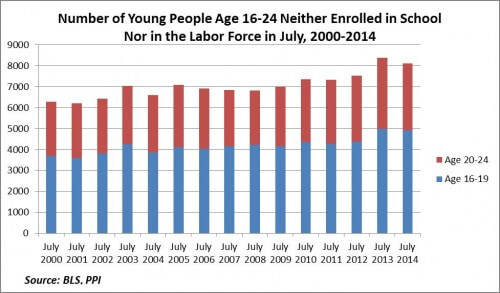
That’s why we still see historically high numbers of young people neither enrolled in school nor in the labor force, particularly during the summer. In fact, the latest numbers for July show that more than 8.1 million people aged 16-24, 4.9 million of whom were teenagers, were neither enrolled in school nor in the labor force. This is 1.8 million more young people than in July 2000, and still 1.3 million more than in July 2007.

chart1-number

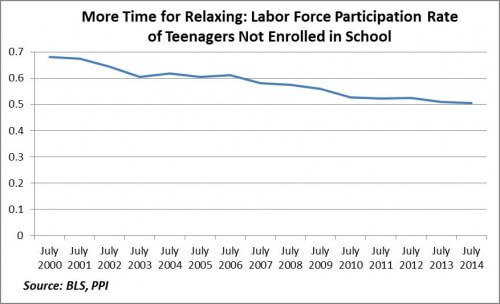
Importantly, the new Brookings-Fed paper makes it clear that most of this problem is structural – that is, it is a long-term problem as opposed to a temporary effect of the Great Recession. This can certainly be seen in the latest data, where the labor force participation for teenagers not enrolled in school during July has dropped from 67 percent in 2000 to 50 percent in 2014.

chart2-share

The structural nature of the Great Squeeze has significant implications for policy. First, it suggests that some of the problem stems from employers not creating enough middle-skill jobs. In other words, the slow-growth economy of the last decade has left a large amount of young college graduates underemployed. That calls for a pro-growth, pro-investment agenda, which we will outline in a forthcoming PPI paper.

Second, it suggests there is a workforce skill mismatch, particularly for young underemployed college graduates. This will not be solved by maintaining the current postsecondary education system, or funneling everyone into four-year college degrees. New research also out from the Fed demonstrates that a Bachelor’s degree is not the right investment for everyone, with a quarter of college graduates earning the same salary as those with a GED. Instead, we need more public-private partnerships in higher education, and viable, employer-driven alternative pathways into the workforce.

The Best Path Forward on Net Neutrality

Net neutrality—the notion that all Internet traffic, regardless of its source or type, must be treated the same by Internet Service Providers (ISPs)—is back on the nation’s political radar. The catalyst was the D.C. Court of Appeals’ decision last January in Verizon v. FCC, which overturned the Federal Communications Commission’s (FCC) “Open Internet Order.” The essence of the Court’s ruling was that the FCC lacked legal authority to impose the specific non-discrimination requirements embodied in that order, which prohibited ISPs and content providers from negotiating rates for speedier delivery or “paid prioritization.” The Court’s rationale was that the FCC had previously declined to designate Internet access “common carriage” under Title II of the Telecommunications Act, a classification that the Court essentially suggested could have justified its order.

Importantly, the Court also articulated a less-invasive path for regulating such arrangements, in which ISPs and content providers could voluntarily negotiate the terms for priority delivery. The FCC could serve as a backstop to adjudicate disputes if negotiations broke down and discrimination was to blame. Moreover, the Court signaled that the FCC could invoke this alternative approach under its existing (Section 706) authority without reclassifying ISPs.

The Court’s decision has unleashed a vigorous debate over both paid prioritization and whether Internet access now should be subject to Title II. Broadly speaking, public interest and some consumer groups, coupled with some in the tech community (collectively, the “netizens”), want the same (zero) price for all types of online content, regardless of the volume of traffic on each site. The surest legal way to that result, many in this camp believe, is for the FCC to accept the Court’s implicit invitation to impose Title II regulation on Internet access. Understandably, the ISPs, parts of the tech community and many economists oppose that path forward. They fear that imposing public-utility style regulation on Internet access—complete with rate filings and FCC approvals, among other requirements—would dampen innovation and investment in more, faster broadband.

Unfortunately, the debate between the two sides has taken on the character of a religious dispute, with the FCC caught in the crossfire. The key to a possible resolution, however, may be the eventual realization by the Commission that Title II regulation of Internet access would (1) reduce ISP investment at the “core” of the Internet by more than what it stimulated at the “edge” by content providers, resulting in a net loss in investment, and (2) could one day boomerang on certain major tech companies or be expanded to regulate other ISP offerings. In that case, the FCC will need another way to move forward on net neutrality—and we propose one in this report.

Download “2014.09-Litan-Singer_The-Best-Path-Forward-on-Net-Neutrality

PPI Report: ‘The Best Path Forward on Net Neutrality’ is to Focus on Investment, Case-by-Case Adjudication

The Progressive Policy Institute (PPI) today released a new policy report providing evidence that the best possible resolution to the current “net neutrality” stalemate is for the FCC to avoid the heavy-handed approach of Title II regulation, and lean instead on its Section 706 authority to regulate potential abuses by Internet Service Providers (ISPs) on a case-by-case basis.  The report was also filed into the FCC’s official docket on the proposed rules for the Open Internet.

Co-authored by PPI Senior Fellow Hal Singer and Brookings Non-Resident Senior Fellow Robert Litan, The Best Path Forward on Net Neutrality argues that by relying on its Section 706 authority the FCC can promote greater investment across both edge and content providers compared to Title II. It will also allow the FCC to avoid any unintended consequences, such as creeping regulation, that encompasses content providers or other ISP services.

“Internet policy, including the resolution of the net neutrality debate, should be guided, in our view, by a simple rule: Pick the policy that maximizes total investment across the entire Internet ecosystem,” write Singer and Litan. “Investment by both core and edge providers is paramount to a properly functioning Internet ecosystem, and due to feedback effects, investment by one depends on the investment by the other.”

“Imposing public-utility style regulation on Internet access would dampen innovation and investment in more, faster broadband. We propose the FCC implement the same case-by-case process to adjudicate discrimination complaints it has established for cable companies to broadband providers.”

The report’s release comes at a critical time when the FCC is seeking public comment on the current role of the Internet’s openness in facilitating innovation, economic growth, free expression, civic engagement, competition, and broadband investment and deployment. The FCC’s open comment period on the proposed Open Internet rules is set to close on September 15.

Download The Best Path Forward on Net Neutrality.

Forbes: Rate Regulation Run Amok: Lessons for Net Neutrality

Readers of this blog who follow the net neutrality debate will recognize an important case called Cellco, cited repeatedly in the D.C. Circuit’s January decision to gut key provisions of the FCC ’s Open Internet Order that smacked of heavy-handed rate regulation.

In Cellco, the D.C. Circuit blessed the FCC’s 2011 Data Roaming Order, which established the terms by which wireless broadband providers should contract for data roaming. Importantly, the Court approved a light-touch approach to adjudicating roaming disputes: Rather than set a roaming rate by fiat, the Data Roaming Order granted the parties the freedom to negotiate towards a “commercially reasonable” roaming rate.

To ensure that his agency’s revised Open Internet Order survives scrutiny by the same court, the Chairman of the FCC, Tom Wheeler, has imported the “commercially reasonable” language from the Data Roaming Order to establish the terms under which content providers and Internet service providers (ISPs) should contract for priority delivery. I’ve written about his proposal glowingly here.

Not everyone agrees with my assessment. Proponents of strong net neutrality such as Netflix and Kickstarter claim that the current proposal would permit the development of “fast lanes” for content companies that could afford priority delivery. They seek to steer the Chairman toward heavy-handed rate regulation, which would bar any contracting for priority delivery by effectively setting its rate at $0.


While net neutrality garners press attention, similar efforts by competitors are underway to steer the FCC toward heavy-handed rate regulation for roaming disputes. In particular, they are trying to convert the “commercially reasonable” standard embraced in the Data Roaming Order into de facto rate regulation. And they have brought out the big guns.

Writing on behalf of T-Mobile, Dr. Joseph Farrell, former chief economist of the FCC and currently professor of economics at UC Berkeley, has proposed a new standard for determining whether a roaming rate is “commercially reasonable.” According to Professor Farrell, any roaming rate, expressed on a per-megabyte (MB) basis, that substantially exceeds the access provider’s retail rate for the incremental MBs used while roaming should be looked at with suspicion.

To make his proposal concrete, consider Sprint’s current wireless offering at $50 per month. Assuming the average wireless broadband user consumes 1,700 MB of data per month, Sprint’s roaming rate should not exceed three cents per MB (equal to $50 divided by 1,700 MB).

Not only would Professor Farrell’s proposal constitute heavy-handed rate regulation of the kind rejected by the Court, it would also impose the wrong rate. To see why, consider the following hypothetical:

Sprint competes with T-Mobile (as well as AT&T T +0.17% and Verizon) for business customers in Whatever, USA. To commute downtown, suburbanites ride a bus across a bridge that is covered by Sprint, AT&T and Verizon, but is not covered by T-Mobile. Although T-Mobile’s license covers the bridge, T-Mobile chooses not to build out its network there. Assume further that the typical commuter consumes five percent of her daily consumption of MB on the bridge. And most important, no commuter would ever subscribe to a wireless carrier that did not cover the bridge.

By providing bridge coverage to T-Mobile via roaming, Sprint creates a new option for commuters that did not previously exist. It is now possible for a commuter who previously would have opted for Sprint, to now opt instead for T-Mobile. Is it any wonder why Sprint is reluctant to cut a roaming deal in this circumstance?

Sprint’s margins that are put in play via the roaming agreement are not just the margins associated with the commuter’s MB usage over the bridge. Instead, the entirety of Sprint’s retail margin is put in play! Accordingly, it would be perfectly commercially reasonable for Sprint to demand to be compensated for its forgone retail margins when setting its roaming rate.

At margins of roughly 40 percent, that would mean a $20 roaming fee per subscriber per month (equal to 0.4 x $50 per month). But if Sprint asked for anything more than $2.50 per subscriber per month (equal to 0.05 x 1,700 MB x 3 cents per MB), Sprint’s offer would violate Professor Farrell’s proposed standard. In other words, the roaming rate that would make Sprint indifferent between serving the customer indirectly (via a roaming agreement) and directly (as a retailer) is eight times T-Mobile’s asking price!

And herein lies the harm from rate regulation: Wireless providers made massive investments in broadband networks under the belief that those retail margins would provide a sufficient return on investment; dilute those margins too aggressively and the investments disappear. The access seeker sits back and then wants to cherry pick that investment at regulated rates rather than build the network itself. Yet an explicit goal of the Data Roaming Order was to provide incentives to “those providers to invest and deploy advanced data networks, and avoid potential disincentives for those providers to invest.”

Investment incentives are particularly important because wireless carriers are continually upgrading their networks. 4G is just the current flavor, but it followed 3G, and it will soon be followed by 5G, which might just serve as a viable alternative to wireline access technologies such as cable modem. If only wireless investment were complete, it might be possible to construct an economic model showing that Professor Farrell’s proposed solution maximized short-term consumer welfare. But when an industry is as dynamic as wireless, investment is never complete, and attempts to appropriate “sunk” investment will surely backfire.

To be fair, allowing access providers to capture the forgone retail margin may not be wise policy when retail markets are monopolized. But that is not the case here: The effective price per MB on U.S. wireless networks declined from $0.25 in 2008 to less than $0.05 by 2012. Retail competition among four national providers ensures that the voluntary access rates do not reflect monopoly rents.

So what is the lesson for net neutrality? Competitors are lobbying the FCC to set a regulated price for roaming, with little concern for investment effects. With the same recklessness, certain content providers are lobbying the FCC to set the regulated price for priority delivery at zero. In both instances, the FCC should refrain from getting embroiled in rate regulation.

The Chairman should stick with his original net neutrality proposal. ISPs and content providers should be free to contract for priority delivery pursuant to a commercially reasonable standard. Under such a standard, special arrangements for affiliated websites could be barred. And an ISP that tried to reduce the speeds of its standard offering—with the introduction of a “slow lane”—would be presumptively in violation of the standard. But there would be no regulated price for priority delivery.

If the FCC is dragged into rate regulation in these important cases, the incentives for private-sector investment will be undermined and, when the current flavor of technology is locked in place, broadband consumers will suffer.

This is cross-posted from Forbes.

Regulation and the Data-Driven Boom

The FCC has a full plate: It is dealing a wide variety of regulatory policy decisions in the coming months, including net neutrality, IP transition, spectrum auctions, the Comcast-Time Warner merger, and the AT&T-Direct TV merger.

Even as the FCC engages with these different issues, the U.S. economy is experiencing an unprecedented data-driven boom that is the envy of the world. A new PPI analysis shows that Americans consume 58 gigabytes of data per month per capita, on average, compared to only 23 and 19 gigabytes of data per month per capita, for France and Germany respectively.* In other words, Americans use 3 times as much data as Germans, per capita. The only major European country that even comes close to the U.S. is Sweden.

The combined innovative and investment efforts of the telecom/cable providers, such as AT&T, Verizon and Comcast, and the edge Internet companies, such as Google, Amazon, and Apple, helped propel economic growth above 4% in the second quarter. The number of computer and mathematical workers is up more than 400,000, or 11%, over the past year alone. The tech/info sector—including telecom/cable providers, edge companies, and content creators—is proving to be the most dynamic part of the economy. And as our upcoming “Investment Heroes” report will show, the tech/info sector also includes some of the companies investing the most in the domestic economy.

So how can the FCC keep this data-driven boom going? As the old saying goes, if it ain’t broke, don’t fix it. In recent years, with some large exceptions, the FCC has more or less followed the principle of moderate regulation when it comes to broadband and wireless policy. That means only intervening when there is clear and compelling reasons to do so, in order to give maximum scope for innovation and investment.

This advice is, of course, very different than the more aggressive regulatory approach advocated by some critics who point to Europe as a better example. But if we compare apples to apples—the data consumed per person in the U.S. versus the data consumer per person in most European countries—we see that the U.S. comes out way ahead.

Given the good results so far, we suggest that the FCC should stay on its same moderate course, balancing out the important goal of consumer protection against the long-term benefits of emphasizing innovation and investment. The same principle applies to other regulators, such as the FTC, as they deal with issues such as privacy. Only in that way can we ensure the continued gains from the data-driven economy.

*These figures update our earlier paper “Bridging the Data Gap.”

CS Monitor: Whither summer jobs? They’re coming back, but the road is long, experts say.

Diana Carew, PPI economist and director of the Younger American Prosperity Project, was quoted on youth unemployment in The CS Monitor.

“You see overall progress,” says Carew. “It’s a slow recovery, but there have been some gains.”

Carew also points to changing priorities and perspectives, such as “higher summer camp enrollment,” and an attitude of “Do I really need to get a job?”

Read the entire article at The Christian Science Monitor.


PPI Mission to Australia: Jobs in the Australian App Economy

Leaders from the Progressive Policy Institute recently returned from Australia, where they engaged top government officials, business leaders, tech entrepreneurs, and policy analysts in discussions about the rising contribution of digital innovation to the country’s economy.

At a public forum held in the Legislative Assembly Chamber of the New South Wales Parliament in Sydney (left), PPI released its newest report, Jobs in the Australian Economy. The event featured a keynote address from Australian Minister for Communications, Mr. Malcolm Turnbull MP, followed by remarks from PPI President Will Marshall and Chief Economic Strategist Michael Mandel. Authored by Mandel, the report is the first effort to measure the tens of thousands of tech-related jobs created in Australia since the introduction of the smartphone in 2007.

Based on a methodology Mandel developed to estimate app job growth in the United States and United Kingdom, the study identified 140,000 Australian jobs that are directly related to the building, maintaining, marketing, and support of applications for smart-devices. Additionally, the report shows that the growth rate of Australian App Economy jobs, as a share of all tech jobs created since 2007, has significantly outpaced both the United States and United Kingdom. Perhaps more interesting, according to Mandel, is that Sydney and Melbourne are roughly on par with New York and London in a comparison of app-related growth.

“I congratulate Dr. Mandel on his new paper, Jobs In Australia’s App Economy, which is perfectly timed in identifying apps as a major and growing component of the ICT sector and economy generally,” said Mr. Turnbull (right) in his address. “It tells a very positive story in that many Australians ‘get it’— that apps will be important for their business, whether they are small businesses connecting directly with consumers or providing services to larger multinationals.

“This emergence and growth of this industry is a direct result of the market reacting to demand. That suggests there is a limited role for government here and the best thing we can do is to get out of the way to let private sector innovation continue to flourish.”

Indeed, as Mandel clarifies in his report, “Now, it’s important for policymakers to strike the right balance between essential and excessive regulation, especially in areas such as data privacy. … A general principle is that the tighter the regulations, the more obstacles in the path of the growth of the rapidly innovating App Economy.”

By creating a regulatory environment that fosters robust innovation, established democracies around the world can allow their growing app economies to become an integral part of their economic future bringing with them thousands of jobs and a wealth of other positive economic and social benefits.

While in Sydney and Melbourne, PPI leaders also held meetings with the following Australian thought leaders: The Honorable Paul Fletcher MP, Parliamentary Secretary to the Minister for Communications; The Honorable Jason Clare MP, Shadow Minister for Communications; The Honorable Ed Husic MP; Keith Besgrove, Chair, National Standing Committee on Cloud Computing; Linda Caruso, Australian Communications and Media Authority; Niels Marquardt, CEO American Australian Chamber of Commerce; Suzanne Campbell, CEO Australian Information Industry Association; Brenda Aynsley, Australian Computer Society Inc.

Additionally, PPI’s release of Jobs in the Australian App Economy received extensive coverage in the Australian media, including in the Australian Associated Press, Australian Financial Review, The Australian, International Business Times,  iTWire, and Startup Smart.

To read more about PPI’s work in this area please also see: Bridging the Data Gap: How Digital Innovation Can Drive Growth and Create Jobs; Data, Trade and Growth; Can the Internet of Everything Bring Back the High-Growth Economy?; The Rise of the Data-Driven Economy: Implications for Growth and Policy; Beyond Goods and Services: The (Unmeasured) Rise of the Data-Driven Economy

Why is My Cable Box Still So Big?

Technological change is nothing new, but the speed of innovation in recent years has been unprecedented. It took decades to go from railroads to private cars, or from Kitty Hawk to the Jet Age. Yet we have sprinted from simple cell phones to smartphones carrying the entire Internet – plus apps – for every purpose under the sun in just a few short years. Flat screen TVs were a novelty a decade ago; now you can’t buy anything else.

Maintaining this pace of innovating in the digital age requires flexible rules that keep pace with the latest technology. This is especially true in the video services market, where change has been fast and furious. That’s why Congress should act to repeal an expensive and innovation-restricting requirement on the design of set top cable boxes.

Currently the FCC mandates that each cable box—the electronics in your home that links your TV with your cable provider—use a particular type of technology known as a “CableCARD” that contains the security mechanisms needed to receive programming. The FCC’s rule, formally known as the “integration ban,” requires that these security functions cannot be hard-wired or otherwise integrated within the rest of the box.

Continue reading at the New Jersey Star-Ledger.