How the FCC Could Shape a Mobile Data-Driven Economy

Tom Wheeler, President Obama’s nominee to be the next chairman of the Federal Communications Commission (FCC), has a critical choice to make if he is confirmed by the Senate. The direction he takes with mobile broadband regulation will set the future pace of U.S. growth and innovation. It also will have major implications for government at all levels, on issues ranging from public-safety communications to rural health care to economic development.

If confirmed, Wheeler would come to the FCC at a critical juncture: The agency is at a regulatory fork in the road. For three years in a row, the FCC has been unable to conclude, in its annual mobile competition report, whether or not the mobile phone market is competitive. This is not simply a technical issue. Rather, it highlights an internal debate: The FCC can’t decide what regulatory framework to apply to the mobile broadband market and, by extension, to the entire digital network.

Continue reading at Governing HERE.

How Much Does Student Debt Burden Young People?

According to a new estimate by PPI, Americans under the age of 30 are spending an unprecedented $43.5 billion annually to pay back student loans.

This sum—large and growing—imposes a serious financial burden on young people. By our estimate, $43.5 billion amounts to over 7 percent of the total annual income for people under 30 with education beyond high school (using an average annual income).

Putting this into perspective, in today’s prices, here’s what $43.5 billion could buy:

155,413

New Homes

339,076

Audi R8 Etrons (Iron Man’s ride)

66,923,077

New iPhone 5’s

488,764,045

Tickets to Disney World

22,307,692,308

McDonald’s Happy Meals

Our estimates also show how fast the income burden on young people from student debt is growing. If their outstanding student debt remained at 2004 levels, the income burden would fall from 7 percent to just 4 percent – a $19 billion difference (in constant dollars).

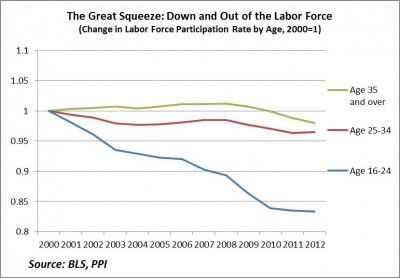
The increasing burden of student debt exacerbates the economic struggles facing young people. Young college graduates have watched their real earnings fall by 15 percent, or $10,000 annually, in the last decade. Those without education beyond high school are being squeezed down and out of the workforce altogether (something we call “The Great Squeeze”).

The examples above illustrate how student debt is affecting young people’s quality of life. But they also show that it’s not only young people that are negatively impacted by rising student debt. The rising burden of student debt on young people also has enormous implications for the entire economy.

Continue reading “How Much Does Student Debt Burden Young People?”

“Cut and Invest” vs. Austerity

President Obama’s new budget attempts to define a progressive alternative to conservative demands for a politics of austerity. Having just returned from a gathering of center-left parties in Copenhagen, I can report that European progressives are wrestling with the same challenge, and are reaching similar conclusions.

There was wide agreement that the wrong answer is to revert to “borrow and spend” policies that have mired transatlantic economies in debt, while failing to stimulate sustained economic growth. The right answer is a “cut and invest” approach that shifts spending from programs that support consumption now to investments that will make our workers and companies more productive and competitive down the road.

“You can only have a Nordic model if you’re competitive,” declared conference host Helle Thorning-Schmidt, prime minister of Denmark. “In this country, we cannot tax more; it’s that simple,” she added. “If you like the welfare state, if you want to sustain it, you have to take the tough decisions.” Continue reading ““Cut and Invest” vs. Austerity”

The New Politics of Production

It’s easy enough to get progressives to agree that austerity is not the answer to the malaise that pervades the transatlantic world. What’s hard is to forge consensus around a new vision for reviving the west’s economic dynamism. One reason is that the policies necessary to put the United States and Europe back on a high-growth path will disrupt old arrangements and social bargains forged and defended by centre-left parties.

Progressives nonetheless need a new growth narrative, and it must begin with an accurate diagnosis of our core economic dilemma. Many US liberals believe it is weak economic demand, and call for more government spending to stimulate consumption. That’s the standard Keynesian remedy, but it’s insufficient at best because it doesn’t deal with the US economy’s structural weaknesses: lagging investment and innovation; eroding mid-level jobs and stagnant wages; a dearth of workers with technical skills; and, unsustainable budget and trade deficits. None of these problems can be fixed by boosting consumption.

What if progressives made expanding production rather than consumption the organising principle of their economic policy? What if they tackled the imperatives of economic investment, innovation and wealth creation with the same passion they normally reserve for fairness and wealth distribution? Stronger economic growth by itself may not be sufficient to reverse the disturbing rise of economic inequality. But it is the necessary precondition for progressive success in getting people back to work, lifting the middle class, allaying class friction and nativism, and restoring the allure of market democracy.

Here, from an American perspective, are some key steps toward a progressive politics of production:

1. Recognise that slow growth is the fundamental problem

Between 2001 and 2012, the US economy turned in its worst economic performance since before World War II. Annual growth rates averaged just 1.6 per cent (and were lackluster even before the recession and financial crisis hit). The situation in Europe, of course, is far worse: growth in the eurozone was negative (0.4 per cent) last year, and unemployment topped 11 per cent. The transatlantic economies simply aren’t growing fast enough to create jobs for all who need work, finance the social benefits they’ve promised, and sustain their high living standards. They’ve resorted instead to heavy borrowing, and so are mired in a dreary politics of debt and fiscal retrenchment.

2. Shift resources from consumption to investment

More than 40 per cent of the US budget goes to three social insurance programmes: Medicare, Medicaid and Social Security. Automatic, formuladriven spending on health and retirement benefits will double by mid-century as the baby boomers surge into retirement. Such “mandatory” outlays have drastically narrowed Congressional discretion and relentlessly squeezed out domestic spending, now just 14 per cent of the budget and falling. That means less money to modernise America’s ageing infrastructure, plug gaps in our education and worker training systems, and nurture science and technology – not to mention protecting the environment, ensuring public safety and helping people escape poverty. In short, the promises made by politicians long retired or dead are constraining the government’s fiscal flexibility and capacity to grapple with today’s challenges. Instead of imagining that they can evade this dilemma solely by taxing the rich, progressives need to take welfare spending off auto-pilot and shift resources from present consumption to investments that will make our people and businesses more productive in the future.

3. Cut health costs by boosting productivity

Although medical inflation has slowed over the past three years, public health spending is still on a collision course with demographics. Yet many Democrats have dug in their heels against reforms that would “bend down” the health cost curve. This confronts progressives with a Hobson’s Choice: either borrow more to cover the yawning gap between contributions and benefits, or raise taxes on working families. Instead, they ought to trim benefits for affluent retirees, and be open to ways to spur competition among providers to offer higher quality and more efficient care. Over the long term, however, the key to restraining overall US health spending – now 17 per cent of the economy – is raising medical productivity. This will require more technological innovation, not less as many budget analysts assume.

4. Embrace pro-growth tax reform

Given that the rich have reaped the lion’s share of US economic gains, it’s no wonder that progressives want them to pay more in taxes. Rather than focus exclusively on fairness, however they ought to view tax policy as an instrument for spurring productive investment and growth. Since new enterprises contribute disproportionately to net job creation, for example, it makes sense to lower taxes on business start-ups. More broadly, progressives should champion reform of America’s perverse corporate tax code. Its high top rate (35 per cent) leads US companies to shift income abroad, depriving the Treasury of revenue and leaving $1.7 billion in earnings stranded abroad that could otherwise be invested at home. And the code is riddled with loopholes and special breaks that steer companies toward activities that are tax-favoured rather than toward those that can make them more productive and competitive.

5. Enable the “data-driven economy”

Data-driven activities – the production, distribution and use of digital information of all kinds – have become the leading edge of economic innovation and growth in the United States. Since the smart phone was introduced in 2007, the nascent “App” sector has created more than 500,000 jobs. Fueled by major private investment in mobile broadband, mobile commerce doubled in 2012 to $25 billion, about 11 per cent of all e-commerce sales. Europe is also getting a big economic boost from digital commerce. Roberto Masiero of Think!, an innovation-oriented thinktank in Milan, estimates that the Internet economy added almost 500 billion euros to eurozone growth in 2010, equivalent to 4.1 percent of Europe’s GDP. Now “big data” processing and the integration of IT into healthcare, education and energy are poised to spark big gains in productivity – if regulators don’t get in the way. In the United States, for example, regulators persist in applying top-down rules governing telephony to the new medium of broadband communication. And while Europe-wide regulation is a positive step forward, many analysts worry that the EU’s forthcoming data protection regulation could hobble homegrown innovation and disadvantage US companies. Progressives on both sides of the Atlantic should work toward harmonising rules that promote more, not less, data-driven trade and that strike a sensible balance between economic innovation and important values like privacy and data security.

6. Don’t give up on manufacturing

While hugely important, the broadband revolution alone won’t deliver the balanced growth and mid-level jobs western societies need to rebuild the middle class. Rather than concede the permanent loss of manufacturing jobs to offshoring, progressives should develop new strategies aimed at “import recapture.” Thanks to a confluence of factors – rising wages in China, the shale gas boom and recognition that advanced manufacturing requires that design and engineering not be separated from production – major US companies are beginning to “onshore” production. Germany and the Nordic countries have shown that high-wage economies can remain competitive in manufacturing by emphasising premium quality, advanced techniques and intensive workforce training regimes. While we shouldn’t expect dramatic leaps in manufacturing employment, even modest increases will have knockoff effects on employment in related activities. Progressives can’t reverse the impact of globalisation, but we can rebalance it in favour of domestic production.

7. Lower state-imposed obstacles to growth

US conservatives never fail to affix the epithet “job killing” before the word “regulation.” This is empirically false and ignores the essential role that regulation plays in making markets work and keeping powerful actors honest. Still, it’s a mistake for progressives to defend regulations as reflexively as conservatives attack them. Between these extremes there is ample room for common-sense efforts to improve the regulatory climate for growth. PPI’s work, for example, has shown that the accumulated weight of old rules imposes large compliance and opportunity costs on firms, especially small and medium-sized enterprises. The problem isn’t that governments keep writing new rules, but that they have no mechanism for rescinding old ones. What’s needed are institutional innovations – like PPI’s idea for a “Regulatory Improvement Commission” that would periodically prune or modify old rules. By championing regulatory improvement, progressives would underscore their commitment to growth as well as their resolve to reform, not just expand, the public sector. Omitted from this list are other crucial elements of a progressive highgrowth strategy, including better education and training systems, skills-based immigration reform, tougher trade enforcement and energy innovation. But it illustrates the magnitude of the policy changes required to get America and Europe out of their slow-growth rut. Rapid innovation and growth are disruptive, and these changes will blur old partisan lines and discomfit old political allies. But the payoff – a surge of innovation and production across the transatlantic, and the chance to restore shared prosperity – is surely worth the risk.

This is an excerpt from Progressive Governance: The Politics of Growth, Stability and Reform, a collection of memos published by Policy Network. Download the entire publication here: Will-Marshall-Chapter

Anatomy of a Special Tax Break and The Case for Broad Corporate Tax Reform

Washington policymakers turn to broad tax reform perhaps once in a generation, and now may be such a time. Today’s focus is on the corporate code, the source of most of the complexity and many of the economic problems associated with the U.S. tax system. There are many views about what aspects of the corporate code require reform and how to do it. Nevertheless, a consensus has formed that the reforms should simplify the corporate code by phasing out many special preferences and using some or all of the revenues to lower the
corporate tax rate.

This consensus reflects a growing recognition by policymakers and business people of how certain features of the corporate tax code impose burdens on American competitiveness. The feature noted most often is our 35 percent marginal tax rate on corporate profits, the highest of any developed country. The impact of this high marginal rate on competitiveness is exacerbated by the worldwide character of the U.S. tax system: We apply that rate to the worldwide profits of U.S.- based companies, while all but five other nations have territorial tax systems that tax businesses only on the profits earned in their domestic markets. Finally, over many decades, policymakers have created scores of special tax deductions, tax credits and tax exemptions for designated business activities, products or industries. These provisions not only entail costly administrative and compliance burdens for the companies that use them. They also interfere with our markets’ ability to allocate capital and other economic resources to their most productive uses, leaving the overall economy less efficient and productive. Phasing out special tax preferences and using all or most of the additional revenues to lower the corporate tax rate is the most reasonable response to these issues.

Here, we offer a case study of these dynamics using one of the larger and most recently-enacted special tax preferences, Section 199 of the corporate tax  code. Since 2005, this provision has provided a special deduction for some of the profits arising from certain designated “domestic production activities.” As we will see, the provision, originally designed for domestic manufacturing, now covers an estimated one-third of corporate economic activities. For example, food processing qualifies, but not retail food businesses—unless the food establishment roasts beans used to brew coffee. That exception allowed Starbucks, for example, to cut its effective tax rate by more than 2 percentage points in 2009. At the same time, the complex terms of Section 199 limit its value to most industries and companies. So, while the provision lowers the effective tax rate of those firms that can claim it – and no one faults a company for taking advantage of a badly-crafted policy – it also induces them to channel their investment and other business decisions in the particular ways required to claim the deduction. As a result, Section 199 distorts the allocation of capital and other critical resources, including entrepreneurial activity, both within and across industries, and for the economy as a whole.

Download the policy memo.

The Great Squeeze Persisted in 2012

New PPI research finds young people continued to be squeezed from the labor force in 2012 relative to people age 35 and over. More young people, facing limited job prospects in spite of a broader economic recovery, are being forced to leave or stay out of the workforce. This could have serious long-term implications for the economic well-being an entire generation.

Over 2000-2012, the labor force participation rate for young people aged 16-24 fell by 17 percent, a precipitous fall that was exacerbated by the recession but started well before. Similarly, in 2012 those aged 25-34 were still 4 percent below their labor force participation high in 2000. They are struggling to recapture lost jobs during the formative years of what determines one’s career and earnings potential.

The staggering fall of labor force participation rates for the youngest working age segment of the population cannot be explained solely by increased college enrollment. Had the labor force participation rate remained constant since 2000, I estimate there would have been an additional 4.1 million people aged 16-24 in the labor force in 2011. Meanwhile, BLS data shows college enrollment of people aged 16-24 was 3.2 million higher in 2011 than 2000, and more college students were in the labor force (although the participation rate fell).

Continue reading “The Great Squeeze Persisted in 2012”

Progressive Policy Institute to Host Media Teleconference Featuring Robert Shapiro to Discuss the Case for Broad Corporate Tax Reform

FOR IMMEDIATE RELEASE

March 15, 2013

PRESS CONTACT: Steven Chlapecka – schlapecka@ppionline.org T: 202.525.3931

Progressive Policy Institute to Host Media Teleconference Featuring Robert Shapiro to Discuss the Case for Broad Corporate Tax Reform

Teleconference to take place in Advance of Release of Shapiro’s Newest Policy Memo: Anatomy of a Special Tax Break and The Case for Broad Corporate Tax Reform

Washington, D.C. – On Wednesday, March 20, 2013 at 11 a.m. EST, join the Progressive Policy Institute and economist Robert Shapiro, chairman of Sonecon LLC and former Under Secretary of Commerce for Economic Affairs. Shapiro will outline findings from his forthcoming PPI policy memo, “Anatomy of a Special Tax Break and The Case for Broad Corporate Tax Reform”. The memo dissects Section 199 as a case study in the way special tax breaks distort economic decisions, add undue complexity and force rates up by leaking revenue.

WHO: Dr. Robert Shapiro, Chairman, Sonecon LLC; Senior Policy Fellow, Georgetown University McDonough School of Business

WHEN: 11 a.m. EST, Wednesday, March 20

Media wishing to participate or interested in an advance copy of the report, contact Steven Chlapecka at 202.525.3931 or schlapecka@ppionline.org.

RSVP to: schlapecka@ppionline.org to receive dial-in information.

– END –

Paul Ryan’s Third Strike

If Rep. Paul Ryan was chastened by his 2012 election defeat, it doesn’t show in his latest budget. It’s a defiant reaffirmation of libertarian dogma that makes no pretense of being a realistic blueprint for governing.

In fact, the House Budget Committee chairman’s new plan aims to shrink government on an even faster timetable than his previous two, balancing the federal budget in 10 years. He proposes to cut public spending by $4.6 trillion over the next decade, but raises nary a penny in new tax revenue.

That of course makes his plan radioactive to Senate Democrats and President Obama, who campaigned and won on explicit promises to take a “balanced” approach to debt reduction. Nonetheless, Ryan seems quite pleased with his handiwork. “We House Republicans have done our part,” he wrote in Tuesday’s Wall Street Journal. “We’re outlining how to solve the greatest problems facing America today.”

Actually, all Ryan’s plan proves is that it is mathematically possible to balance the budget in 10 years with spending cuts alone. So what? You could achieve the same result by raising taxes the same amount. Neither is going to happen. Democrats will never accede to the first, and Republicans will never accede to the second.

Read more.

Solving the Student Debt Crisis-Deflate the Bubble

PPI’s Student Debt Investment Fund (SDIF) policy proposal was picked up by Kay Steiger of The Raw Story:

A new proposal published last week claims that creating a new secondary market would to “deflate” the so-called student debt “bubble” by repackaging both public and private student loans for banks to buy and sell.

“The student loan bubble is about to burst,” the authors write in the proposal, released by the center-left think tank Progressive Policy Institute (PPI) last Tuesday. The authors warn that while this proposal wouldn’t tackle the problem of rising student tuition, they do insist this would help tackle the problem of student debt that’s already been taken out, which has recently reached the $1 trillion mark and surpassed both credit card and auto loan debt in America.

“Young college grads have been bearing the brunt of the declining real wages over the last decade, they’re taking jobs that are less skill for less pay, and there’s a hollowing out of those middle-skill jobs,” Diana Carew, an economist at PPI and the lead author on the proposal, told Raw Story. “At the same time, tuition has been rising very rapidly, so they’re less likely to be able to pay in the long term.”

Read the entire article.

Big Data: An Emerging Frontier for Innovation and Policy

Michael Mandel participated in a recent OECD conference in Paris, France, Growth, Innovation And Competitiveness: Maximizing The Benefits Of Knowledge-Based Capital.  Mandel joined Matteo Pacca of McKinsey & Company and Jakob Haesler of tinyclues for a panel entitled, “‘Big-data: An Emerging Frontier for Innovation and Policy?”. He spoke on trade relating to “Big-data” and its role on generating growth and jobs.

Watch the event webcast.

Reuters Cites PPI Student Debt Data

Writing for Reuters on the Student loan bubble, Chadwick Matlin cites PPI published data on the topic.

The New York Federal Reserve, always interested in brightening our days, released a slideshow last week on student loans. It had little good news, but it did offer a reminder that in 2013 fewer people are indebted to the American Dream. Instead, they’re in debt because of it.

College, we’ve long been told, is the great equalizer. (And, despite the doomsayers, there’s reason to think it still is.) But increasingly, people are graduating in vastly different economic situations. More than 40 percent of 25-year-olds now have student debt, and 35 percent of twentysomethings are more than 90 days delinquent on loans that are being repaid. All of this comes as the average income for a 25- to 34-year-old with a bachelor’s degree is the lowest it’s been in years, down about $10,000 since 2000.

Read the full article here.

Financial Innovation Key to Future of Homeownership

The housing bubble and ensuing financial crisis not only wreaked havoc on the U.S. economy, but it also shook public confidence in financial markets and robbed Americans of their faith in homeownership as a stable iconic pillar of middle class security.

Much of the fallout can be blamed on the exotic financial “innovations” hawked by Wall Street in the run-up to the financial bust: “liar loans,” where no verification of income was required; synthetic derivatives, whose highly speculative design put the entire financial system at risk; and home equity lines of credit that exceeded the value of homes by up to 125 percent.

Today, housing prices are finally rising and the stock market is going gangbusters. But the idea of “financial innovation” retains its negative aura. That’s a problem, because just as there are good and bad witches in Oz, there’s good and bad innovation on Wall Street.

Read the entire piece at U.S. News & World Report.

Washington Monthly Covers PPI’s Student Debt Proposal

Washington Monthly’s Daniel Luzer cites PPI’s new Student Debt Investment Fund (SDIF) proposal as a “potentially useful” plan to alleviate the growing student debt crisis. Luzer contends that a slow deflation of the bubble like that contained in the proposal might not be necessary as “the worst education debt is already deflating on its own.” He also says that PPI’s proposed solution also might not be the most structurally efficient. Overall however, Luzer thinks the policy idea is “interesting” and that it could indeed be part of a solution to a growing problem.

Read the full article here.

Student Debt: A Bubble More Like a Balloon

There is an intense debate as to whether the student debt crisis is a bubble or not. The short answer: yes, but it’s more like a balloon. And the good thing about balloons is that they don’t have to burst; there is an option to deflate them slowly.

In some ways the ongoing student debt crisis has the classic symptoms of a bubble. There is an artificial inflation of value (here, tuition) that is in part fueled by low-cost funding (here, government-issued student aid). The latest Federal Reserve numbers show student debt is now a staggering $1 trillion and climbing. Yet the real earnings of young college grads are falling, down 15 percent since 2000. Already student loan defaults are at 11 percent and rising. Moreover, the true default rate is actually higher because of post-graduation grace periods. Not surprisingly, the Wall Street Journal reported earlier this week that student loan debt is now crowding out other borrowing and spending.

In other ways the student debt crisis is different—potentially worse—than the typical financial bubble. First, student debt is uncollateralized. There’s no home or property that can be reclaimed in default. Second, student debt cannot be discharged in bankruptcy, or restructured to meet the repayment ability of struggling debt owners. And most importantly, the majority (85 percent) of student debt is owned by the government. That means taxpayers are directly on the hook for $850 billion in potential losses. Worse, the government doesn’t really have the option to cut back on loan issuances or raise interest rates because that would go against equal access and opportunity.

The fact that the government holds the majority of student debt is what could transform this bubble into a controlled balloon—a balloon that can be deflated slowly. We know where most student debt is; it is not as spread out across unknown entities like subprime mortgage debt.

This week we released a preliminary proposal for the creation of private-sector student debt investment fund (SDIF) that would purchase existing student loans, refinance the debt at today’s historically low interest rates, and apply a discount to the loan amount. This could be the release valve that deflates the balloon, by reducing the financial burden to debt holders and transferring risk. That could free up government resources to address another important issue—rising tuition.

Student Debt Investment Fund (SDIF): A Preliminary Proposal for Addressing the Student Debt Crisis

The Progressive Policy Institute proposes the creation of a new, private sector Student Debt Investment Fund (“SDIF”) that would address the student debt crisis. The proposed SDIF would act as a secondary market for student loan debt, capitalized by corporate profits currently held abroad. In return, participating U.S. corporate entities would receive tax credits. The SDIF would purchase existing student loans, apply a discount to the loan amount, and restructure the loan through refinancing the debt.

By matching need for financial relief with available investment funds, the proposed SDIF could be a private sector solution to a public problem. Without action, the student debt crisis will be the next financial disaster. One in five households is currently saddled with student debt, now over $1 trillion, which cannot be discharged in bankruptcy or refinanced at today’s historically low interest rates. At the same time, multinational U.S.-based companies are sitting on an estimated $2 trillion in cash reserves, much of it profits held abroad. Companies are unwilling to repatriate these profits under current tax law for fear of excessive financial penalties.

Societal benefits of the proposed SDIF include: (1) deflating the student debt bubble slowly, (2) facilitating economic growth by freeing financial resources for millions of young Americans, (3) enabling more young people to invest in their human capital, and (4) providing a way for U.S. corporate entities to invest their excess funds in America strategically and promote public well-being. The benefits to business include tax credits issued annually over the term of the investment and the potential for an annual return on investment depending on the success of the SDIF. The benefits to government include transferred risk to the private sector from reduced student loan exposure and potential tax revenue that would not have been received otherwise.

Download the policy proposal.

Three Ways to Bring Manufacturing Back to America

Writing for The Washington Monthly, Anne Kim discusses insourcing, and how it can affect the U.S. economy and U.S.-based innovation in the future.

In January 2012, President Barack Obama convened nineteen CEOs and business leaders at a White House forum to tout a potentially promising new phenomenon: instead of “shipping jobs overseas,” U.S. companies were bringing them back. “[W]hat these companies represent is a source of optimism and enormous potential for the future of America,” Obama said. “What they have in common is that they’re part of a hopeful trend: they are bringing jobs back
to America.”

Anecdotally, the record is impressive. A number of major companies—including some of the same firms that first took flak for “offshoring” jobs to China—are now expanding their manufacturing operations stateside. General Electric, for example, says it has created 16,000 new U.S. jobs since 2009, including jobs at a new locomotive plant in Fort Worth, Texas; a solar panel factory in Aurora, Colorado; and an engine manufacturing facility in Pennsylvania. The company’s recent revival of Appliance Park, in Louisville, Kentucky, as a maker of high-end refrigerators, was the subject of high-profile coverage, including a recent piece in the Atlantic.

Other companies that have seemingly caught the “reshoring” wave are appliance maker Whirlpool (which rejected sites in Mexico in favor of Tennessee), and iconic brands like Intel, Canon, Caterpillar, and DuPont. All of these firms have reported expanding or building new U.S. facilities in the last few years. In December 2012, computing giant Apple announced it would bring some Mac production back to America, investing about $100 million to do so.

So given these recent wins, can “insourcing” save America’s economy?

Read the complete piece at The Washington Monthly.