Rising Home Prices May Not Spell Recovery

In recent months, a slew of new data from several major indices suggests home prices have found a floor nationally and are now slowly rising. While that may be welcome news to homeowners and a real estate industry battered by years of lost equity and sluggish sales, they might want to keep the champagne on ice for now. This is not to suggest the data is wrong and house prices aren’t going up, it’s just worth taking a closer look at the fundamentals behind the recent price trends and asking if there is a corresponding “housing recovery.”

Here are four reasons to temper optimism with caution:

  1. Investors drive a significant share of home buying. Many former homeowners and new households have chosen the safety of renting over the risks (and potential benefits) associated with homeownership. This increased rental demand, combined with home prices that are only now getting back up to 2004 levels, have driven residential rental rates to all-time highs.

    Naturally, this combination has attracted the attention of investors. These include seniors looking for income opportunities at a time when near-zero interest rates are punishing savers, to large investment funds and international speculators that see an attractive real estate opportunity.

    As of May 2012, investor purchases made up 25.3% of all real estate transactions. That’s simply unsustainable.As prices continue to rise, the opportunity for investors to reap sweet returns begins to fall. In fact, we’re already seeing signs of diminished demand as investor purchases fell to 21.9 percent of all real estate transactions in July, down from 23.5 percent in June and 25.3 percent in May. Continue reading “Rising Home Prices May Not Spell Recovery”
Young College Grads: Real Earnings Fell in 2011

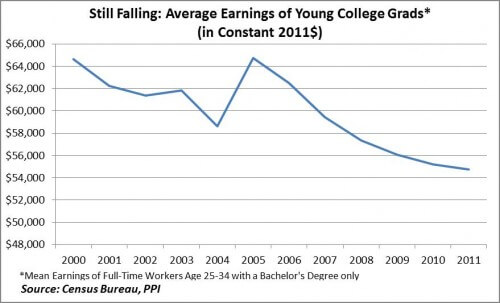
The latest Census figures show real earnings for young college grads fell again in 2011. This makes the sixth straight year of declining real earnings for young college grads, defined as full-time workers aged 25-34 with a bachelor’s only. All told, real average earnings for young grads have fallen by over 15% since 2000, or by about $10,000 in constant 2011 dollars.

This statistic is fundamental to our understanding of the current economy. College graduates have jumped through the hoops that were supposed to give them a better life. They are supposed to have the skills that enable them to compete on the global economy. But something is going wrong. The fastest growing jobs now for young college grads include dental assistants, hairstylists, and bus drivers.

The middle-skill jobs that young college grads generally take (think sales agents, teachers, and financial analysts) continued to shed workers in 2011. And for the few high-skill jobs actively hiring (think engineers, web developers, and computer support specialists) most college graduates still lack the necessary training. That leaves many young grads taking jobs that don’t require a college degree for less pay. I call this “The Great Squeeze” – as college grads take the lower-skill jobs, they squeeze out those with less education and experience from the labor market. Nobody wins.

Given the prospect of falling real wages, coupled with rising college costs and debt, many young people are beginning to question the value of a college degree altogether. That means it’s essential whoever wins the election make the plight of young college grads a priority. Not making the investment in education is not the answer; ensuring there are better jobs upon graduation is.

WTO Filing a Step Toward Enhancing Competitiveness

Are U.S. manufacturing jobs gone for good? Many so-called experts have mocked the Obama Administration’s latest trade action against China as being fundamentally useless, the economic equivalent of spitting into the wind. After all, factory job seem like a relic of the past.

Yet by our calculations, the U.S. could regain 4 million jobs in manufacturing at relatively low cost – if we follow the right policies. PPI does not advocate a trade war with China, or a tit-for-tat exchange of trade actions. But taking legitimate disputes to the WTO is the right way to enforce the rules – and in most cases to date with China the U.S. has had success. Such carefully targeted actions, back by accurate data, could make a big difference in boosting the economy.

That’s because we are fighting to recapture competitiveness that may have been disingenuously lost. When countries like China provide non-market financing or other subsidies to industries like automobiles, it gives their companies an advantage that wouldn’t be there absent government support. Such an advantage negatively impacts U.S. companies trying to compete, even if China does not export directly to the U.S. As the NYT explains, “While China exports virtually no fully assembled cars to the United States, it has rapidly expanded exports to developing countries, and those exports compete to some extent with cars exported from or designed in the United States.”

Monday’s WTO filing may be a small first step, but we must start somewhere. We are in a slow-growth economy with an anemic labor market. If we want U.S. companies to keep and increase production (and jobs) here, if we want to close the non-oil trade gap, we must be competitive. And it would help if we gave U.S. companies a level playing field to fight on instead of an uphill battle. Continue reading “WTO Filing a Step Toward Enhancing Competitiveness”

Don’t Ground the Golden Goose

Serendipity is crucial to scientific discovery. Researchers often stumble on breakthroughs when they are working on entirely different problems. That’s why it’s vital for government to cast a wide net in funding scientific research.

Unfortunately, government-funded research will be on the chopping block unless Congress acts to avert a budget “sequester” by the end of the year. The sequester would cut discretionary domestic spending, for science and everything else, by over 8 percent, or nearly $39 billion in 2013 alone.

This is the wrong way to solve America’s debt problem. Washington’s investment in science is critical to preserving our country’s comparative advantage in technological and economic innovation. PPI has stressed the need to boost investment in knowledge production, as well as our physical and human capital.

That’s why PPI is proud to join Rep. Jim Cooper, the Association of American Universities and other pro-innovation organizations in today’s unveiling of the “Golden Goose” award. Continue reading “Don’t Ground the Golden Goose”

Manufacturing Jobs Boom Is For Real

PPI’s Michael Mandel was quoted in CNN Money about the bottoming out of the manufacturing sector:

“What we’re seeing is the bottoming out of manufacturing,” said Michael Mandel, chief economy strategist with the Progressive Policy Institute. “The really sharp jump in wanted ads coincides with the portion of manufacturing that is switching from shrink to growth mode.”

Read the entire article here.

Romney’s stance on housing: ‘Let it run its course’

PPI’s Jason Gold was quoted in foxnews.com about the way Romney wants to fix the ailing housing market:

“Romney’s running as Mr. Fix-it on the economy, but he has nothing to say  about one of the biggest pieces of the puzzle,” said Jason Gold, a senior fellow  at the Progressive Policy Institute, a Washington D.C. think tank  affiliated with the Democratic Party.

Gold, who specializes in housing policy, questioned whether Romney’s  selection of Ryan as a running mate indicates he supports privatizing Fannie Mae and Freddie Mac, as Ryan called for in a budget blueprint last year. Romney  hasn’t said.

Many conservatives argue such a move would finally untangle government — and  taxpayers — from the mortgage business. Gold calls it an impractical step that would almost  certainly end the days of 30-year fixed mortgages. “It would take a sledgehammer to the housing market and throw us right back into recession.”

Read the entire article here. 


What Paul Ryan learned from Jack Kemp

The Washington Post’s Suzy Khimm quotes Will Marshall on Jack Kemp and Empower America:

“What the Empower America folks wanted to do is move beyond the green eyeshade, balance-the-budget message of traditional conservatism. They didn’t want to have simply a negative narrative about government,” said Will Marshall, who headed a similar policy shop for Clinton’s New Democrats.

Marshall also pointed out that Kemp went out of his way to advocate for new ways of helping low-income Americans. He proposed creating specially targeted business and income-tax breaks in designated “enterprise zones” of high poverty as an alternative to direct government handouts.

Read the entire article.

Young America: Squeezed into Summer Vacation

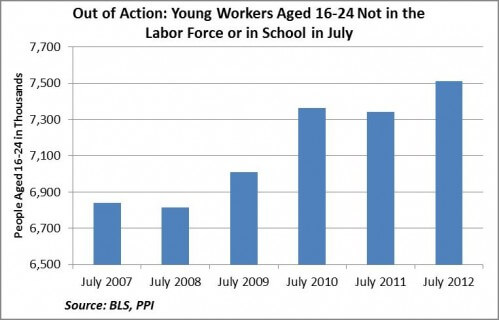
Last week’s employment status report of America’s youth from the BLS shows the number of people aged 16-24 not in the labor force or enrolled in school in July continues to rise, despite the overall recovery in the labor market.

The number of youth “at loose ends” during the summer of 2012 totaled over 7.5 million – a 2% increase over the same month in 2011, and a 10% increase over 2007. These are young people aged 16-24 that were not working for pay, not actively looking for work, and not enrolled in school in July. I analyzed data from the Current Population Survey to get these numbers.

What’s likely happening is that potential young workers are being squeezed out of the labor force. I’ve written about the “Great Squeeze” before. As middle-tier jobs fall away, we see a shift down in the workforce. College grads squeeze out non-degree holders by taking jobs that don’t require a degree (and pay less). Those with less education squeeze out those with even less education. Eventually there are no jobs left for the youngest, least educated workers.

So, what are these 7.5 million young Americans doing on their summer vacation? Beach getaways and late nights out? Auditioning for American Idol? One Fed economist found an answer that may surprise most parents: “watching TV, playing video games and sleeping.” Of course we can also take comfort knowing at least some of these people are getting experience in unpaid internships, as they don’t count as being employed (statistically speaking).

How young Americans spend their summer vacation matters – for the 7.5 million young people in this category that aren’t unpaid interns, they are not getting the “real-world” experience that will enable future success. And we need them to be prepared for the economy they will inherent. Or at least able to pay for our retirement. That means doing what we can to fix the real problem: Getting young people the education and training that they need to prosper.


The Untouchable Economy: Why Americans Are Turning Against ‘Stuff’

Writing for The Atlantic, PPI’s Michael Mandel argues that young people are viewing themselves as microbusinesses operating in a highly uncertain economic environment.

Millennials are shifting from tangibles (cars and homes) to intangibles (education and access to data), but they are not alone. In today’s data-driven economy, the business sector is moving along the same tangible-to-intangible path as the Millennials, perhaps at an even faster pace. Business spending on nonresidential structures, other than mining-related, is roughly 30% below the 2007 pre-recession highs, while investment in software is up almost 20% over the same period.

In fact, Millennials are responding to the same trends as businesses, and for much the same reasons. Members of the younger generation are being forced — or encouraged — to think entrepreneurially, to view themselves as microbusinesses operating in a highly uncertain economic environment. Why buy a home or car if there are lower-risk, lower-cost options? Why invest in physical capital if spending on human capital and data can have bigger payoffs?

This shift changes corporate strategy and marketing aimed towards Millennials. If Millennials are operating like microbusinesses, then companies must reframe their appeal in terms of business values such as security, collaboration and competitiveness. So they will be open to companies that create products and services to help them protect themselves, find allies, or prosper economically.

Read the entire article.

Is real GDP real?

The Star Tribune’s Adam Belz quotes Michael Mandel on the flaws of the GDP data and the state of the Minnesota economy:

“(The numbers) don’t mean what they look like they mean,” Mandel said. “Minnesota manufacturing is not nearly so robust as the numbers make it appear.”

Growth in manufacturing in Minnesota and the rest of the U.S. is a mirage, Mandel said. He goes into great detail for his reasons here, but basically he doesn’t think the output figures are accurate.

Read the entire article.

The Recession and Unemployment

PPI’s Michael Mandel was quoted in The Washington Post about the long-term effects of the recession on unemployment.

Many workers are nervous about their livelihoods despite the economic recovery — and for good reason, it turns out.

Among those workers who lost a good job because of the struggling economy over the past three years, roughly one in four found a job that pays as well, according to data released Friday by the Labor Department.

The others remained unemployed, stopped looking for work or accepted jobs at lower wages.

“This data is telling a story of unemployment inflicting long-term damage for a lot of people,” said Michael Mandel, an economist at the Progressive Policy Institute, a centrist think tank. “This won’t turn around until wages overall start rising — and so far, we haven’t seen any strong signs of that.”

Read the entire article HERE.

FCC: A Broadband Assessment without Mobile is Incomplete

This week the FCC concluded that “broadband is not being deployed to all Americans in a reasonable and timely fashion” in its eighth annual “Broadband Progress Report.”  It found 19 million Americans are still without fixed broadband access.

But note the word ‘fixed’ – this conclusion doesn’t include mobile access. The FCC didn’t forget wireless broadband; they explicitly chose not to include it. In fact, the FCC is operating under the mandate that all Americans should have access to fixed and mobile broadband. They use this as a justification for excluding mobile in their determination – that it should be assessed separately, even though no such assessment has been made. So someone who has a smartphone but no access to a wireline connection still counts as not having access.

That’s just silly – by excluding mobile access, the FCC is missing the fastest growing segment of the broadband market. And at this point it may take longer for all Americans to have access to fixed broadband than to mobile. The Telecommunications Industry Association estimates investment on mobile broadband infrastructure could total $100 billion through 2015. The FCC’s own data suggests that if access to either fixed or mobile were counted, the number of Americans without broadband access could be as low as 5.5 million.

Such an obvious exclusion makes the report’s findings hard to use in a meaningful way. It’s like judging a book by its cover – you’re missing a vital part of the story. Yet important regulatory decisions are being derived from this report. The only conclusion I derived from this report is that the FCC needs to adapt its mandates in a way that keeps pace with the fast-changing broadband landscape.

Should the FTC Make Innovation a Bigger Priority?

The FTC’s recent settlements with Google and Facebook raise an interesting question about how such regulatory run-ins can affect future innovation.

The FTC fined Google $22.5 million for misrepresenting privacy assurances to users of Apple’s internet browser. And the FTC is requiring that Facebook obtain consumers’ express consent before sharing their information, maintain a comprehensive privacy program, and get independent biennial privacy audits after Facebook allegedly shared consumer information when they claimed it was being kept private.

My purpose is not to say whether these settlements were justified or not. The problem I’m referring to is not just one or two regulatory actions, but the fear that the government is going to keep regulating until these companies are scared into becoming more cautious. The analogy is yelling at a child every time he or she colors outside the line. Eventually the child will stop coloring.

In effect the FTC is drawing the lines within which these companies must operate and expand. The Googles and Facebooks of the world will have to watch their every move, and anticipate in advance how potential innovations may be scrutinized. Continue reading “Should the FTC Make Innovation a Bigger Priority?”

Election Watch: Democrats and Republicans Elated By Romney/Ryan Ticket

Without question, the big election-related event of the last week was the surprising announcement—both its content and its timing, before the Summer Olympics had ended—of Paul Ryan as Mitt Romney’s running-mate. I cannot recall any such event that (a) had so pervasive an immediate impact on the party in question’s general election strategy, and (b) was welcomed with such joy by activists in both parties.

The two dimensions of the choice are closely related. Whatever else you think of Romney/Ryan, this ticket represents a large strategic concession to the Obama campaign, which has been struggling all year to convert the election from a referendum on the economy to a choice of two future agendas for the country. Indeed, Romney’s promise that he would sign the Ryan Budget if passed by Congress was exhibit A in that effort. With Ryan on the ticket itself, and drawing enormous media attention for his views, the Obama campaign can declare “mission accomplished” in its most fundamental strategic mission (which is not to say, of course, that the “referendum” phenomenon has gone away entirely or that a downward lurch in the economy between now and November 6 might not be disastrous).

But the excitement of conservative activists about Ryan reflects their own unhappiness with the “referendum” strategy, not to mention their fears that Romney (a) might not be reliable if he wins, and (b) might not have a mandate to carry out the policies they desire. I’ve argued before that one of Romney’s problems is that he’s never quite ended the GOP primaries. The choice of Ryan achieves that objective decisively, and could give the GOP campaign slightly more tactical flexibility that it would otherwise enjoy. Continue reading “Election Watch: Democrats and Republicans Elated By Romney/Ryan Ticket”

Why the Tech Boom Has Not Yet Entered Bubble-land

There seems to be a theory going around that the current tech boom has entered into bubble territory. In a piece entitled “Is the dot com bubble about to burst?”, one journalist wrote:

Sometimes, when a love affair ends, you can’t remember what it was you ever saw in someone in the first place. That is the feeling right now of a lot of once-amorous investors who breathlessly wooed Facebook at its flotation in May and paid $38 for the privilege of a share in the social network.

And certainly some other tech stocks have been disappointing to investors, including Zynga and Pandora. Indeed, some skeptical  spirits have pointed to the surge in the venture capital investments as a sign that the top is here.

But let’s be serious. While the tech boom will likely enter Bubble-land eventually, we are nowhere near that point. I will offer three reasons. First, as long as the big telecom companies are still pouring billions into extending the capabilities of their  high speed mobile networks,  there will be new apps to develop and new companies to start.  Indeed, we have not yet seen an iPhone with 4G connections.

Continue reading “Why the Tech Boom Has Not Yet Entered Bubble-land”

The Big Companies Betting On America: AT&T And Verizon Lead The Way

PPI’s popular summer policy brief, Investment Heroes, was picked up this week over at Forbes with analysis and commentary from Diana Carew. Carew explains how capital investments designed to increase efficiency still create jobs, points to foreign companies that would have made the list, and makes the case for a more positive view of Apple’s spending.

For all the talk about the trillions sitting on the balance sheets of the biggest U.S. companies, you might think that the S&P 500 is sitting on its hands and waiting for sunnier skies before investing capital.

The truth is rather different though, and a July report from the Progressive Policy Institute explains that capital investment, a critical means of growth for the economy, is hardly at a dead stop.

According to PPI, while the level of business investment remains below its 2007 peak, there are still companies shelling out hard-earned cash for new buildings, equipment and software. The think tank’s report lists 25 “Investment Heroes,” or companies that are pumping billions of dollars into the U.S. economy through their capital expenditures.

Looking over the list one thing becomes immediately clear: capital-intensive industries like telecom and energy are still spending. AT&T and Verizon Communications top PPI’s list, which drew on 2011 financial reports and regulatory filings by 150 of the biggest companies in the U.S.  with $20.1 billion and $16.2 billion in capital expenditures respectively. Exxon Mobil comes in third, with$11.7 billion, followed by Wal-Mart ($8.2 billion) and Intel ($7.4 billion).

Read the entire story HERE.