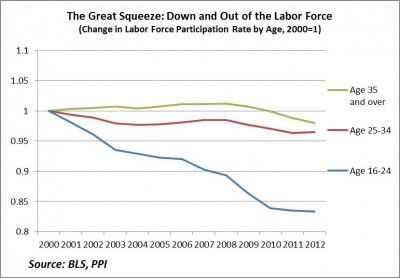
The Great Squeeze Persisted in 2012

New PPI research finds young people continued to be squeezed from the labor force in 2012 relative to people age 35 and over. More young people, facing limited job prospects in spite of a broader economic recovery, are being forced to leave or stay out of the workforce. This could have serious long-term implications for the economic well-being an entire generation.

Over 2000-2012, the labor force participation rate for young people aged 16-24 fell by 17 percent, a precipitous fall that was exacerbated by the recession but started well before. Similarly, in 2012 those aged 25-34 were still 4 percent below their labor force participation high in 2000. They are struggling to recapture lost jobs during the formative years of what determines one’s career and earnings potential.

The staggering fall of labor force participation rates for the youngest working age segment of the population cannot be explained solely by increased college enrollment. Had the labor force participation rate remained constant since 2000, I estimate there would have been an additional 4.1 million people aged 16-24 in the labor force in 2011. Meanwhile, BLS data shows college enrollment of people aged 16-24 was 3.2 million higher in 2011 than 2000, and more college students were in the labor force (although the participation rate fell).

Continue reading “The Great Squeeze Persisted in 2012”

Student Debt Crisis and the Private Sector

Does the government have a conflict of interest when it comes to student debt? On one hand, the government fills an important role in providing financial access to higher education. But on the other hand, it needs to deleverage a record-level debt that now amounts to over 70% of GDP.

This question may seem odd given the government’s move to bring the student loan market in-house over the last few years (ending its guarantee program in favor of direct loans). But it may be an important question if we want to develop a politically viable solution to the growing student debt crisis.

Bringing loans in-house saved interest and administrative costs, but it didn’t actually decrease tax payer risk: the government now has $850 billion in student debt exposure on its books, up from $381 billion in 2005. And as tuition keeps rising, public funding keeps falling, and more people pursue college, new debt issuance is growing fast – new government loans were over $100 billion last year. This is potentially problematic, especially given the recent rise in default rates, because it means fewer government assets are available to respond to future crises. Not to mention it leaves tax payers increasingly vulnerable.

Continue reading “Student Debt Crisis and the Private Sector”

Solving the Student Debt Crisis-Deflate the Bubble

PPI’s Student Debt Investment Fund (SDIF) policy proposal was picked up by Kay Steiger of The Raw Story:

A new proposal published last week claims that creating a new secondary market would to “deflate” the so-called student debt “bubble” by repackaging both public and private student loans for banks to buy and sell.

“The student loan bubble is about to burst,” the authors write in the proposal, released by the center-left think tank Progressive Policy Institute (PPI) last Tuesday. The authors warn that while this proposal wouldn’t tackle the problem of rising student tuition, they do insist this would help tackle the problem of student debt that’s already been taken out, which has recently reached the $1 trillion mark and surpassed both credit card and auto loan debt in America.

“Young college grads have been bearing the brunt of the declining real wages over the last decade, they’re taking jobs that are less skill for less pay, and there’s a hollowing out of those middle-skill jobs,” Diana Carew, an economist at PPI and the lead author on the proposal, told Raw Story. “At the same time, tuition has been rising very rapidly, so they’re less likely to be able to pay in the long term.”

Read the entire article.

Reuters Cites PPI Student Debt Data

Writing for Reuters on the Student loan bubble, Chadwick Matlin cites PPI published data on the topic.

The New York Federal Reserve, always interested in brightening our days, released a slideshow last week on student loans. It had little good news, but it did offer a reminder that in 2013 fewer people are indebted to the American Dream. Instead, they’re in debt because of it.

College, we’ve long been told, is the great equalizer. (And, despite the doomsayers, there’s reason to think it still is.) But increasingly, people are graduating in vastly different economic situations. More than 40 percent of 25-year-olds now have student debt, and 35 percent of twentysomethings are more than 90 days delinquent on loans that are being repaid. All of this comes as the average income for a 25- to 34-year-old with a bachelor’s degree is the lowest it’s been in years, down about $10,000 since 2000.

Read the full article here.

Washington Monthly Covers PPI’s Student Debt Proposal

Washington Monthly’s Daniel Luzer cites PPI’s new Student Debt Investment Fund (SDIF) proposal as a “potentially useful” plan to alleviate the growing student debt crisis. Luzer contends that a slow deflation of the bubble like that contained in the proposal might not be necessary as “the worst education debt is already deflating on its own.” He also says that PPI’s proposed solution also might not be the most structurally efficient. Overall however, Luzer thinks the policy idea is “interesting” and that it could indeed be part of a solution to a growing problem.

Read the full article here.

Student Debt: A Bubble More Like a Balloon

There is an intense debate as to whether the student debt crisis is a bubble or not. The short answer: yes, but it’s more like a balloon. And the good thing about balloons is that they don’t have to burst; there is an option to deflate them slowly.

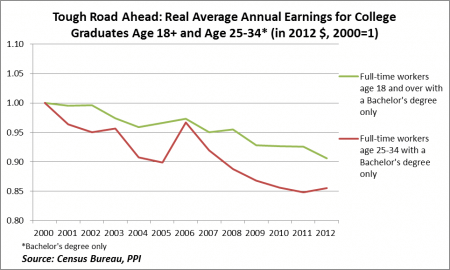
In some ways the ongoing student debt crisis has the classic symptoms of a bubble. There is an artificial inflation of value (here, tuition) that is in part fueled by low-cost funding (here, government-issued student aid). The latest Federal Reserve numbers show student debt is now a staggering $1 trillion and climbing. Yet the real earnings of young college grads are falling, down 15 percent since 2000. Already student loan defaults are at 11 percent and rising. Moreover, the true default rate is actually higher because of post-graduation grace periods. Not surprisingly, the Wall Street Journal reported earlier this week that student loan debt is now crowding out other borrowing and spending.

In other ways the student debt crisis is different—potentially worse—than the typical financial bubble. First, student debt is uncollateralized. There’s no home or property that can be reclaimed in default. Second, student debt cannot be discharged in bankruptcy, or restructured to meet the repayment ability of struggling debt owners. And most importantly, the majority (85 percent) of student debt is owned by the government. That means taxpayers are directly on the hook for $850 billion in potential losses. Worse, the government doesn’t really have the option to cut back on loan issuances or raise interest rates because that would go against equal access and opportunity.

The fact that the government holds the majority of student debt is what could transform this bubble into a controlled balloon—a balloon that can be deflated slowly. We know where most student debt is; it is not as spread out across unknown entities like subprime mortgage debt.

This week we released a preliminary proposal for the creation of private-sector student debt investment fund (SDIF) that would purchase existing student loans, refinance the debt at today’s historically low interest rates, and apply a discount to the loan amount. This could be the release valve that deflates the balloon, by reducing the financial burden to debt holders and transferring risk. That could free up government resources to address another important issue—rising tuition.

Student Debt Investment Fund (SDIF): A Preliminary Proposal for Addressing the Student Debt Crisis

The Progressive Policy Institute proposes the creation of a new, private sector Student Debt Investment Fund (“SDIF”) that would address the student debt crisis. The proposed SDIF would act as a secondary market for student loan debt, capitalized by corporate profits currently held abroad. In return, participating U.S. corporate entities would receive tax credits. The SDIF would purchase existing student loans, apply a discount to the loan amount, and restructure the loan through refinancing the debt.

By matching need for financial relief with available investment funds, the proposed SDIF could be a private sector solution to a public problem. Without action, the student debt crisis will be the next financial disaster. One in five households is currently saddled with student debt, now over $1 trillion, which cannot be discharged in bankruptcy or refinanced at today’s historically low interest rates. At the same time, multinational U.S.-based companies are sitting on an estimated $2 trillion in cash reserves, much of it profits held abroad. Companies are unwilling to repatriate these profits under current tax law for fear of excessive financial penalties.

Societal benefits of the proposed SDIF include: (1) deflating the student debt bubble slowly, (2) facilitating economic growth by freeing financial resources for millions of young Americans, (3) enabling more young people to invest in their human capital, and (4) providing a way for U.S. corporate entities to invest their excess funds in America strategically and promote public well-being. The benefits to business include tax credits issued annually over the term of the investment and the potential for an annual return on investment depending on the success of the SDIF. The benefits to government include transferred risk to the private sector from reduced student loan exposure and potential tax revenue that would not have been received otherwise.

Download the policy proposal.

The Real Problem with Colleges’ Business Model

In the Slate blog Money Box, Mathew Yglesias argues that the decrease of college graduates’ earnings is related to the irrelevant business model followed by most colleges. He uses Diana G. Carew’s graphs from her blog post “Is the Labor Market for College Grads Looking Up?”.

Below is an important chart from Diana Carew of the Progressive Policy Institute showing the falling earnings of college graduates in the 25-to-34-year-old bracket.

1360252466769

And that right there is the simple problem with the existing higher education business model in the United States, which has involved aggregate per student spending that rises faster than inflation for a long time. This has relatively little bearing on the missplaced worry about whether or not college is “worth it” (the relative earnings of college gradatues are still high) or on the overhyped idea that online education is going to disrupt traditional learning. The real issue is simply that people can’t spend money they don’t have on tuition, nor will banks want to lend people money that they aren’t going to have.

Read Yglesias’s blog post here.

Is the Labor Market for Colleges Grads Looking Up?

Young educated Americans are finally rejoining the workforce. According to BLS statistics, the labor force participation of Americans age 18-34 with a Bachelor’s or Associate’s degree is rising again. By comparison, young people without higher education are still dropping out of the labor force.

The chart below shows the divergence in labor force participation between young people with and without a degree. Having a degree makes a big difference in who shares in the labor market recovery and who is increasingly left behind. Interestingly, young people with a vocational Associates degree are having the best recovery in labor force participation, even better than those with a Bachelor’s degree.

To be sure, the news is not all good. College students are well aware of the challenges awaiting them, like rising average student debt and falling real earnings. Most young grads say their biggest ambition has come to finding a job that pays enough to cover rent.

Continue reading “Is the Labor Market for Colleges Grads Looking Up?”

Funding Cuts Hit College Students Harder Than Faculty

Fiscal cliff or not, the coming years are certain to bring cuts in public spending on higher education. The looming sequestration threatens to cut $500 billion in federal discretionary spending starting next year, leaving a multi-billion dollar hole in R&D funding at public universities. State governments have already begun higher education funding cutbacks. So as policymakers pledge austerity and deficit reduction, colleges and universities will be left in a financial pinch.

Students and university faculty and staff are the obvious targets to fill these budget holes. But who actually pays the price for cuts in university funding?

New PPI research suggests college students will bear the brunt of additional austerity imposed on colleges and universities. Looking at previous cuts in public funding, we found college students were unquestionably worse off relative to faculty and staff when it came to making up the difference. And the impact of this uneven allocation could be serious. If college students continue to pay the biggest price for austerity, the next generation of young people may think twice about the value of going to college.

That’s because college students paid a high price for cuts in university funding over the last decade, while faculty and staff were relatively unaffected.  As shown in this first graph, total tuition at four-year universities rose a staggering 35% over the last decade (in constant dollars). These rising prices are certainly behind the rising real average debt per graduate, up almost 30% over the same time.

Continue reading “Funding Cuts Hit College Students Harder Than Faculty”

Young People Turned Out to Re-Elect President Obama. Now What?

They defied the pundits: young people turned out to vote in numbers that rivaled their 2008 record. An estimated 23 million young people age 18-29 voted, even more than the highly coveted 65 and over cohort. And not surprisingly, for reasons I’ve previously pointed out, young people overwhelmingly supported President Obama by a margin of 60-40.

But President Obama’s work has really just begun. Now that TV advertising has returned to normal, young people are eager to know what’s next, what President Obama is going to do to help them get more jobs and more money.

Young people are struggling: they’ve had a worse recession and recovery than any other age group. The 18-34 year old cohort is still over 2 million jobs short since the recession began and real earnings continue to fall. But helping young people means understanding why they have been hit so hard in the first place relative to other age groups, why they weren’t the first to be re-hired as common theory dictates, and why the youngest and least educated are being squeezed out of the labor force. Continue reading “Young People Turned Out to Re-Elect President Obama. Now What?”

Democratic Devolution: How America’s Colleges and Universities Can Strengthen Their Communities

In the face of a deepening economic and political crisis, the U.S. political and governing system is deadlocked. We need a new way forward. The old and tired government versus markets debate is just that—old and tired. It’s time for a broader mobilization of America’s civic resources, including the nonprofit sector and especially our colleges and universities.

We see government as a catalyst that stimulates new forms of interaction and partnerships between all sectors of society. Based on our experience at the University of Pennsylvania, we believe government should challenge all institutions of higher education (public and private; community colleges, colleges, and universities) to contribute systematically to improving the quality of life and learning in their local communities.

When called to service (e.g., Peace Corps, AmeriCorps) young people have answered the call. Each year, more than 75,000 citizens serve through AmeriCorps alone. But it is not enough to simply call upon college students to serve. Rather, government should challenge institutions of higher education, as well as students, to make a greater contribution to the public good.

America’s colleges and universities represent immense concentrations of human and economic capital (with nearly four million employees, 20 million enrolled students, $400 billion in endowments, and $1 trillion in annual economic activity). As “anchor institutions,” they have the potential to be sources of stability and permanence in civic partnerships with government and the private sector to revitalize local communities. For colleges and universities to fulfill their great potential and more effectively contribute to positive change in their communities, cities, and metropolitan areas, however, they will have to critically examine and change their organizational cultures and structures and embed civic engagementacross all components of the institution. Through more effectively targeting existing resources, as well as utilizing both modest financial incentives and the bully pulpit, the federal government can stimulate colleges and universities to realize their stated—but not fully realized—mission of service to society.

To realize this potential, we recommend a five-part strategy:

First, Congress should create a new federal commission—comprised of local, state, and national government officials along with leaders from the private sector and higher education—to forge civic partnerships with the nation’s institutions of higher education;

Second, the commission should develop innovative strategies for integrating federal programs and funding streams, as well as aligning federal efforts with these new local civic partnerships that involve colleges and universities;

Third, the commission should promote regional consortia of higher educational institutions to significantly and effectively improve schooling and community life;

Fourth, the federal government should create prestigious Presidential Awards for outstanding Higher Education-Civic Partnerships, and;

Fifth, government should provide support to colleges and universities based on the “Noah Principle”—funding given only for building arks (producing real change), not for predicting rain (describing the problems that exist and will develop if actions are not taken).

Download the memo.

Young College Grads: Real Earnings Fell in 2011

The latest Census figures show real earnings for young college grads fell again in 2011. This makes the sixth straight year of declining real earnings for young college grads, defined as full-time workers aged 25-34 with a bachelor’s only. All told, real average earnings for young grads have fallen by over 15% since 2000, or by about $10,000 in constant 2011 dollars.

This statistic is fundamental to our understanding of the current economy. College graduates have jumped through the hoops that were supposed to give them a better life. They are supposed to have the skills that enable them to compete on the global economy. But something is going wrong. The fastest growing jobs now for young college grads include dental assistants, hairstylists, and bus drivers.

The middle-skill jobs that young college grads generally take (think sales agents, teachers, and financial analysts) continued to shed workers in 2011. And for the few high-skill jobs actively hiring (think engineers, web developers, and computer support specialists) most college graduates still lack the necessary training. That leaves many young grads taking jobs that don’t require a college degree for less pay. I call this “The Great Squeeze” – as college grads take the lower-skill jobs, they squeeze out those with less education and experience from the labor market. Nobody wins.

Given the prospect of falling real wages, coupled with rising college costs and debt, many young people are beginning to question the value of a college degree altogether. That means it’s essential whoever wins the election make the plight of young college grads a priority. Not making the investment in education is not the answer; ensuring there are better jobs upon graduation is.

Debacle in Chicago

The Chicago teachers’ strike is turning into an all-round debacle – for school children and their families, for President Obama and his party, and quite likely for the teachers themselves. Only Republicans are smiling, as the strike supplies fresh fodder to their campaign to vilify and weaken public sector unions.

By shutting down the city’s public schools over a contract dispute, the Chicago Teachers Union (CTU) has left about 350,000 students in the lurch, not to mention their parents, who’ve had to scramble to find safe places to park them during the day. Even if you think the teachers have valid grievances, it’s hard to justify using Chicago’s public school students as pawns in a political test of will with city leaders.

Now in its fourth day, the strike also threatens to throw a monkey wrench into President Obama’s finely tuned campaign machine.

Chicago, after all, is the President’s home town. Its mayor, the sharp-tongued Rahm Emanuel, is Obama’s former Chief of Staff and a key political ally. The CTU, 25,000 members strong, is furious at Emanuel for pushing accountability measures it claims are unfair to teachers. And teachers’ unions are a potent source of votes and money for Democrats.

The stage is thus set for a family feud among Democrats at the worst possible moment – just as Obama seems to be pulling away from Mitt Romney.

Continue reading at The Hill.

Photo credit: Shutterstock

Young America: Squeezed into Summer Vacation

Last week’s employment status report of America’s youth from the BLS shows the number of people aged 16-24 not in the labor force or enrolled in school in July continues to rise, despite the overall recovery in the labor market.

The number of youth “at loose ends” during the summer of 2012 totaled over 7.5 million – a 2% increase over the same month in 2011, and a 10% increase over 2007. These are young people aged 16-24 that were not working for pay, not actively looking for work, and not enrolled in school in July. I analyzed data from the Current Population Survey to get these numbers.

What’s likely happening is that potential young workers are being squeezed out of the labor force. I’ve written about the “Great Squeeze” before. As middle-tier jobs fall away, we see a shift down in the workforce. College grads squeeze out non-degree holders by taking jobs that don’t require a degree (and pay less). Those with less education squeeze out those with even less education. Eventually there are no jobs left for the youngest, least educated workers.

So, what are these 7.5 million young Americans doing on their summer vacation? Beach getaways and late nights out? Auditioning for American Idol? One Fed economist found an answer that may surprise most parents: “watching TV, playing video games and sleeping.” Of course we can also take comfort knowing at least some of these people are getting experience in unpaid internships, as they don’t count as being employed (statistically speaking).

How young Americans spend their summer vacation matters – for the 7.5 million young people in this category that aren’t unpaid interns, they are not getting the “real-world” experience that will enable future success. And we need them to be prepared for the economy they will inherent. Or at least able to pay for our retirement. That means doing what we can to fix the real problem: Getting young people the education and training that they need to prosper.


PPI Event – Improving Charter School Accountability: The Challenge of Closing Failing Schools


The Progressive Policy Institute hosted a forum to discuss the importance of holding charter schools accountable and closing those schools that are failing.  David Osborne, Senior Fellow at PPI, released his report “Improving Charter School Accountability: The Challenge of Closing Failing Schools”

Accompanied by Greg Richmond, Nancy Van Meter, and Lindsey Burke, the forum stressed the potential for success of charter schools as a whole, but pointed to the importance of closing those charters that are failing their students.  While the causes for failing schools was debated, there was a general consensus that these failing schools must do better and should be held to higher standards in their charters.

According to Osborne’s report, the primary way of achieving higher accountability and success is to start at the beginning, with the actual charters and authorizers.  More training, larger staffs, better funding, and improved information are all critical to improving the quality of charter school authorizers and the schools that they are responsible for.

Download the report here: Improving Charter School Accountability: The Challenge of Closing Failing Schools

Continue reading “PPI Event – Improving Charter School Accountability: The Challenge of Closing Failing Schools”