Young Americans: Is Recovery Coming?

Young Americans – the 80 million Americans age 16-34 – have had a rough recession and an almost non-existent recovery. This is reinforced by the latest jobs report, which shows unemployment falling at the expense of labor force participation, now a historically low 70.9 percent. For young Americans age 16-24, labor force participation is just 54.8 percent. Looking ahead, is recovery ever coming?

Four telling facts about jobs and wages for young Americans suggest a labor market recovery is coming, although it will be gradual and uneven by educational attainment. Specifically, young Americans with a postsecondary degree are more likely to be employed, but the nature of their employment suggests they are taking lower-skill jobs at the expense of their less educated peers. These facts also suggest there is more that policymakers could be doing to boost young Americans’ long-term economic and financial well-being.

Read the full brief, including three charts and a table on young Americans in the recovery, here.

Mandel’s work featured as one of “The Most Important Economic Stories of 2013” by The Atlantic

Matthew O’Brien writing for The Atlantic highlighted the work of Michael Mandel, PPI’s cheif economic strategist, in a recent survey of “The Most Important Economic Stories of 2013 – in 42 Graphs.”  Mandel’s contribution was a graph reflecting the increasing tech education of minorities:


“The tech boom has opened up new opportunities for minorities. Over the past two year, the number of blacks working in computer and mathematical occupations has risen 28%, while the number of Hispanics working in computer and mathematical occupations has risen by 24%. That’s more than double the 10% rise in overall tech employment.”

Find the full list of important economic stories on The Atlantic‘s website here.


Is PAYE Paying for the Wrong Higher-Ed Model?

Universal adoption of today’s high-speed, low-cost broadband could move the current higher education model into the 21st century. But are federal student aid programs like Pay As You Earn (PAYE) – a student loan repayment plan based on borrowers’ annual incomes – delaying the industry’s transition?

Quite possibly. One potential consequence of Pay as You Earn (PAYE) is that it enables colleges to transfer the cost of less effective industrial organization to taxpayers, allowing them to maintain status quo practices.  The result of less effective higher-ed administration, during a time of rising enrollment, is higher costs. As I explain in my new FAQ sheet, PAYE gives colleges and universities no incentive to curb excessive increases in tuition, because there is no accountability.

Instead of managing tuition, through harnessing the power of broadband to provide mass education and workforce training at lower cost, more colleges are relying on federal aid and debt repayment programs like PAYE. That’s why we are starting to see more schools like GW admitting to “need-aware” admissions policies, and schools like Georgetown taking obvious advantage of the current federal student aid system and income-based repayment plans. And that’s why we are seeing the dramatic rise in outstanding student debt, along with reports of the long-term financial strain it is placing on young Americans.

This week, I spoke on a panel at the Urban Ideas Forum 2013 on “Advancing a Broadband Agenda for Urban America,” that covered the importance of broadband in spurring economic growth and innovation. The key takeaway was that the power of broadband, and the tremendous potential economic and social benefits it can facilitate, will only be possible if adoption is universal.

But realizing the full potential of broadband means the post-secondary education industry must buy-in through systemic adoption. The post-secondary education industry is fast approaching a fork in the road: either it can maintain its role as the premier workforce preparation vehicle, or it can lose competitiveness to alternative sources of post-secondary training provided at lower cost. The first requires the industry to realign itself more closely with the needs of employers, and to cut costs by integrating the power of broadband into its education model. The second is inevitable if the industry maintains its status quo practices, most predominately at second and third tier four-year institutions.

Decision-making time for U.S. colleges and universities is coming, in spite of federal student aid and programs like PAYE. The latest report from the College Board shows average tuition at four-year public universities for this academic year rose at twice the current rate of general inflation, and the difference was even greater at four-year private universities. With rates like this, how long will it be before another provider of workforce training swoops in at lower cost, or before consumers – students – look elsewhere?

Student Debt: The FAQs on Pay As You Earn (PAYE)

In August 2013, President Obama announced a major drive to increase enrollment in “Pay As You Earn” (PAYE), a federal student loan repayment option based on income and family size. PAYE was introduced by the administration in 2011 as a temporary relief for struggling borrowers.

With the planned expansion, however, the program is fast turning into a permanent part of higher education funding. PAYE is particularly being targeted to young college graduates, who have been among the worst affected by the Great Recession and slow recovery.

Given PAYE’s increasing role as a policy tool, it’s important we get our FAQs straight on what PAYE is and the potential implications for borrowers, colleges and universities, and taxpayers.

This factsheet addresses some common questions about PAYE, to help inform the discussion surrounding the future of higher education funding.

Read the entire Factsheet on PAYE here.

Real Earnings for Young College Grads Rose in 2012

Finally some good news for young college grads – in 2012 their real average annual earnings increased for the first time in six years. New data reveals average annual earnings for college graduates age 25-34 working full-time increased 0.9 percent in 2012, in constant dollars.

The turnaround could represent a major shift in the fortunes of young grads, who have seen their real average annual earnings fall by 15 percent since 2000. A bottoming out of this precipitous decline is welcome news to current and recent college graduates struggling to balance paying off student loans with gaining financial independence.

However, this good news should be met with cautious optimism. The same data also shows that real average annual earnings of all college graduates continued to fall in 2012. As shown in the chart below, real average annual earnings for people age 18 and over working full-time with a Bachelor’s degree only fell 2 percent last year, now almost 10 percent below 2000 levels. The fact remains that people with a college degree (and only a college degree) continue to have a tough time in today’s labor market.

That real earnings for all college graduates continued to fall suggests young college graduates aren’t yet in the clear. Young college graduates epitomize the today’s middle-class – they typically work in middle-skill jobs that pay average wages. It follows that young college grads were one of the groups worst affected by the financial crisis and the decade-long hollowing out of middle-skill jobs. Since their wages have fallen significantly more than their older college graduate peers, the turnaround could be an early indicator of labor market recovery for the middle-class or it could simply reflect they have much further to climb. Continued downward pressure on earnings of all college graduates won’t help sustain this momentum.

That means many challenges remain for young college graduates, in spite of this turnaround in earnings. The most recent figures show over half of recent college graduates are underemployed or unemployed, a historical high. The downward pressure on earnings from “The Great Squeeze” – the economic reality that college graduates are increasingly forced to take lower skill jobs for less pay – was exacerbated by the recession but started well before. Once a college graduate starts on a slow-growth career trajectory, it can be very hard to catch up financially.

The economic obstacles afflicting young college graduates will be difficult to truly reverse unless there are fundamental changes in how we prepare and train our workforce. Given how much lost ground real earnings for young graduates still have to recapture, and the importance of investing in a college education in today’s economy, that means policymakers would be well-served to make such reforms a bigger priority.

Can Obama Redefine the Role of College?

President Obama’s speech in Buffalo yesterday launched a new conversation on the role of higher education as a platform for social and economic mobility. The speech represents a major policy shift on higher education policy toward a performance-based funding approach that holds colleges accountable for how graduates do in the job market. Though it is true such a formula for assessing college performance may be imperfect, changing how colleges think about their role in workforce preparation is essential. For young Americans to succeed in today’s global economy we must smartly invest in higher education that will enhance our competitiveness.

In the speech, President Obama finally acknowledged the current structure of the federal student aid program – a structure that now doles out over $100 billion in new loans annually while asking few questions – is unsustainable. In this context he unveiled a new proposed strategy for federal student aid distribution that holds both colleges more accountable by creating a new ranking that rewards schools for low student debt levels and high job placement rates. Students will also be held more accountable by having to show good grades from the year before to get next year’s loans.

President Obama is right to propose drastic changes to the federal student aid program. Federal aid for higher education has quadrupled in size over the last decade, yet the program itself remains essentially unchanged from its establishment in 1965. And now is the right time: the Higher Education Act, the legislation that determines eligibility criteria for federal student aid programs, is set for reauthorization at the end of this year. Hopefully this new proposal sets the tone for a serious review of current programs.

The current federal student aid party cannot go on forever. Doling out essentially unlimited federal aid to colleges will only delay an industry reorganization and consolidation that is both necessary and inevitable, especially at second and third tier schools. In its current form federal student aid subsidizes ineffective schools and transfers those costs to its graduates, who likely will struggle most to repay the average $26,000 per borrower student debt. The fact that President Obama reckoned the government would end up footing the bill for these schools shows he probably agrees. It’s time for higher ed to fully embrace the cost-saving education technology revolution that is finally gaining traction.

Early dissenters of the proposed changes to federal aid distribution, including the American Council on Higher Education, a major higher ed lobbying group, are concerned the ranking will overemphasize college’s role in job preparation. But isn’t that exactly what college’s major role is, and what colleges should be held accountable for?  Perhaps such dissenters should explain their view to the 50 percent of young college graduates who are currently underemployed or unemployed and try again.

Can US Hold Its Lead on 3D Printing?

Everyone is abuzz about 3D printing. President Obama gave it a shout out in his most recent State of the Union address. The Economist hailed it as a harbinger of a “3rd industrial revolution.” UPS is putting 3D printers in its retail stores. Some analysts think it’s the key to reviving advanced manufacturing in America.

With 60% of the global market, there’s no doubt that U.S. firms dominate the fledgling market for 3D printers. But as with other breakthrough technologies hatched in America, there’s no guarantee that our competitors – yes, especially China – won’t catch up and eventually surpass us. After all, China is a manufacturing powerhouse that desperately wants to move up the value chain, and has few scruples about filching U.S. technology.

Although 3D printing is still in its infancy, Washington needs a strategy for maintaining U.S. leadership as other countries strive to catch up. Its key elements should include robust public investment in 3D research, and beefed up safeguards against intellectual property theft. Continue reading “Can US Hold Its Lead on 3D Printing?”

Unpaid Internships Aren’t so Black and White

Does having a paid internship make the difference between getting a job and sitting home after college? It depends.

Unpaid internships have been criticized as a waste of students’ time,  effort, and money. Now it appears holding an unpaid internship won’t even help a student on the job market. An upcoming study from the National Association of Colleges and Employers (NACE) on the graduating class of 2013 found 63.1% of graduating college students who had paid internships received a job offer, compared with 37.0% of those who took only unpaid internships and 35.2% of students who had taken no internships.

However, although job offers may seem like a straightforward measure of an internship’s impact, but the reality is not so black and white. There are many factors that influence whether a college graduate has a job offer at graduation, of which internships are just one. Moreover, there is also a wide variety of internships, and an equally diverse number of reasons students chose to take them.

Certainly not all internships are created equal.  For some employers, internships are explicitly used as a screening process for new hires. These employers may invest more time and effort to see which interns would make good employees, and so provide interns with substantive tasks and compensation.

Such ‘screening’ internship programs make the most sense for employers who continually need new hires with a technical skill set. So it is little surprise that the majority of paid internships are for majors who are typically hired in large numbers at entry-level. As the chart below shows, engineering majors, computer science majors, engineering technology majors, and business- related majors were far more likely to have a paid internships- with comparatively high wages- than other majors. The data is from Intern Bridge’s 2012 survey of college students.

But by itself this chart can be misleading.  Some majors’ career paths are inherently different than others, and this is not reflected in either the Intern Bridge or NACE data. For example, neither one reports the percent of students who intend to go straight to graduate school rather than enter the workforce. For some students, the primary purpose of an internship is not to receive an immediate job offer, but rather to build a professional network or explore a particular field of work.

The reality is the payoff for participating in an internship – whether paid or unpaid – varies from student to student. The greatest benefit of an internship is not measurable in wages, but by how much it furthers a student’s career aspirations. It would be a mistake for college students to use the NACE and Intern Bridge survey results as an excuse to sit home and do nothing. That will almost assuredly hurt their job prospects.


No Recovery for Young People?

In July 2013, just 36 percent of Americans age 16-24 not enrolled in school worked full-time, 10 percent less than in July 2007. It’s no secret that young people are struggling economically, but my analysis of Friday’s BLS release sheds light to what extent. The fact that so many young people are not realizing their true earnings potential in these formative years could have serious long-term consequences.

Friday’s numbers are the latest sign the recovery is passing young Americans by. The below chart shows the share of young Americans not enrolled in school working full-time fell with the recession and have yet to return to 2007 levels. This is true even if we divide it by age – that is, for both young Americans age 16-19 and age 20-24 not enrolled in school in July.

While the initial drop in full-time employment is not surprising, what is startling is that is that either age group is showing much, if any, improvement since the recovery began four years ago. The same trend holds even if we look at months where more students are enrolled in school (i.e., January). The non-recovery is also true if we look at total employment and overall labor force participation.

What’s more, education matters in how likely young people are to work full-time. As shown in the next chart, for those with less than a high school diploma, 14 percent worked full-time, compared to 66 percent with a Bachelor’s degree or higher. This re-emphasizes the importance of higher education in successfully finding full-time work in today’s economy.

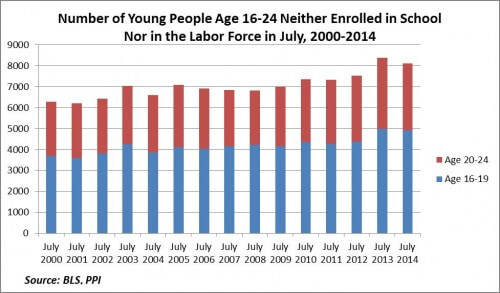
Of the 17 million Americans age 16-24 not enrolled in school or working full-time in July 2013, 5.6 million were working part-time, 3.2 million were unemployed – a 17.1 percent unemployment rate – and another 8.4 million were not in the labor force altogether.

Together, these charts suggest the problem facing young Americans is structural. If worsening labor market conditions were a temporary effect of the recession, we would have expected to see improvement with the recovery. Instead, young Americans appear stuck in their post-recessionary state.

What could be behind the stubborn labor market for young Americans? One explanation is the Great Squeeze, which I’ve written about before. The dearth of middle-skill jobs is forcing workers unqualified for today’s high-skill, high-wage jobs to take lower skill jobs for less pay, squeezing those with less education and experience down and out of the workforce.

The struggles facing young Americans should not be ignored. It’s clear the policies in place now to prepare and integrate young Americans into the workforce are not sufficient. If we are serious about moving from a slow-growth economy to a high-growth economy, it’s something policymakers will have to address.

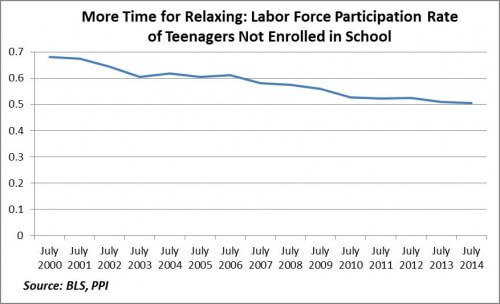
Note: For those interested in the effect of rising college enrollment on overall labor force participation of young people, there are several points to consider. One, in July most college students are not enrolled, and would be counted here. Second, the number of young Americans age 16-24 not enrolled in school and not working continues to rise. In July 2007 labor force participation for this group was 73.3 percent; in July 2013 it was 68.8 percent. Third, college enrollment has actually been falling for the last two years, with the decline actually accelerating. Finally, many college students also work. According to the same BLS data 42 percent of people age 16-24 enrolled in school also were in the labor force in July 2013.

A Grand Bargain on Student Debt?

Yesterday a coalition of eight Senators finally announced a deal on federal student loan interest rates. The compromise, which takes cues from previous proposals from the White House and House Republicans, will peg interest rates on all new federal student loans to the rate on 10-year Treasuries plus a margin. The deal, several months in the works, will retroactively replace the doubling of interest rates that took effect July 1.

Senate Democrats, who had wanted more generous terms for students, are calling the deal more of a grand rip-off than a grand bargain for students pursuing college. Although the deal calls for capping interest rates, they argue that even with the caps borrowers will still pay higher rates than before, especially as the economy improves and interest rates rise. Moreover, according to CBO estimates, the deal will increase federal student loan profits by additional $700 million over the next decade – all on the backs of innocent parents and students.

This deal should be seen as a reasonable compromise.  As I’ve written before, interest rates are only a small part of the actual problem facing student debt. Whether interest rates are 6.8 percent or 8.25 percent (the deal’s new cap for unsubsidized Stafford loans, which most undergraduates get) makes little difference in an economy where half of recent college graduates are underemployed or unemployed, and where real earnings for young college graduates are falling. It does little to address what’s really bloating the amount students owe – ever-rising principal from higher tuition – and it does nothing to address the existing $1.2 trillion mountain of outstanding student loans.

Moreover, it’s not clear pegging long-term student debt to short-term debt borrowing costs, like the federal funds rate or 1-month Treasuries, is the best approach. Such term mismatching – borrowing on short-terms and lending on longer-terms – can be risky, especially for student loans, which are uncollateralized and dependent on future earnings.

If Senate Democrats are unhappy with the deal, they should take the rising burden student debt seriously when they review federal student loan programs for the reauthorization of the Higher Education Act (HEA) later this year. That will be a great opportunity to address one of the biggest issues of our time: helping young people succeed in today’s economy.

New Fed Data Highlights the “Great Squeeze”

Yesterday’s New York Fed release on recent college graduates concluded that “young college workers have been struggling more in recent years.” The study found that almost half of recent college grads were underemployed in 2012, a figure which has continued to rise since the start of the recession. In fact, last year underemployment of young grads was the highest it’s been since the early 1990’s.

High underemployment for young college grads exactly encompasses what I call the “Great Squeeze.” The continuing disappearance of middle-wage jobs, coupled with a lack of preparedness for today’s high-wage, high-skill jobs, means more educated young people are taking lower skill jobs for less pay. This is squeezing those with less education and experience down and out of the labor force, having a disproportionate effect on the youngest segment of the working population.

To be sure, a college degree is still worth it. In spite of their economic struggles, those with a degree are still more likely to find a job and have higher earnings than those without a college degree.

And not all college graduates are feeling the squeeze. The New York Fed presentation also showed, not surprisingly, that those who studied more technical fields that were in high-growth sectors of the economy are enjoying significantly less underemployment and higher earnings than those in other fields of study.

But that doesn’t negate the clear majority of recent college graduates that are feeling the squeeze. Adding in the share of recent college grads that were unemployed in 2012, and we see a picture where at least half of young college grads were either underemployed or unemployed last year. Student debt, now over $1 trillion and climbing, is exacerbating the problem.

This is not by any means a hopeless scenario, but it does call for action. The slow-growth recovery we are stuck in is not enough to get today’s young graduates back on track to buy a home or save for a secure retirement. Instead we need policies that prioritize investment over consumption, and move us into a high-growth economy. A key part of that is having an educated workforce which is able to realize its full potential.

Why Student Debt Proposals in Congress are only a Band-Aid

The student debt debate is heating up just in time for summer. With less than a month to go before a key federal student loan interest rate is set to double, a multitude of legislation calling for more government intervention is popping up in Congress.

The cover on the various proposals may be different – some call for extending the low fixed interest rate on subsidized Stafford loans while others call for pegging all direct loan interest rates to borrowing costs – but the approach is the same: they all tackle the growing student debt burden through targeting interest rates. Proponents of lower interest rates point to the sizeable profit the government makes from student debt, arguing that the government can afford to cut costs for students.

However, an interest rate approach and the accompanying rationale miss the mark. As I recently pointed out, the issue of rising student debt is larger than interest rates. It is a complicated issue with multiple parts that require different responses. And it turns out student loans, especially at subsidized interest rates, may not be as profitable as we think over the long-term.

A new CBO report that proponents of increasing government support for student loans use shows the federal student loan portfolio will turn a $184 billion profit over the next decade. But this commonly cited method of cost accounting, based on the Federal Credit Reform Act, does not include the risk to taxpayers from economic volatility. Fair value accounting, the alternative measure CBO estimates, does.  It turns out that under fair value accounting, the CBO estimates the government will incur a $95 billion loss over the next ten years at current interest rates.  Moreover, under both accounting measures, the CBO study found that permanently extending the reduced interest rate on subsidized Stafford loans results in a net cost. It turns out the profitability of federal student loans is all in the accounting.

College access and affordability must continue to be the main priority to encourage investment in higher education. Going to college remains the best way to increase one’s economic prospects, and an educated workforce is necessary for a high-growth economy. But we must acknowledge that addressing the rising burden on students through interest rate reduction is only a temporary Band-Aid. Any long-term solution to the student debt burden must address the larger issues: a slow-growth economy and excessive increases in tuition.

The Student Debt Problem Is Bigger Than Interest Rates

If you believe the recent blitz of student debt coverage, greedy private lenders  and high interest rates are to blame for the economic woes of recent college  graduates. Lending at what is seen to be excessively high interest rates, the  pressure on private lenders to restructure student loans, even at the expense of  public funds, is rising. At the same time, the government is taking concrete  actions to squeeze private lenders out of the student loan market. Now Sen.  Elizabeth Warren (D-Mass.) has followed in President Obama’s footsteps by  proposing to peg student loan interest rates to the government’s historically  low borrowing costs.

Tempting as it may be, attacking private lenders  alone will not solve the student debt problem. For one, private student loans  are an increasingly small fraction of total outstanding student debt. And while  overall student loan defaults have been rising, private student loan defaults  have been falling. Second, although not innocent, villainizing private lenders  misses the point: outstanding student debt is rising too much too fast. A  government-controlled student loan market will not solve the underlying problem  that recent college graduates are struggling in today’s slow-growth  economy.

Since the 2008 financial crisis, the Department of Education has  essentially taken over the entire student loan market. The federal guarantee  program was scrapped, and interest rates on subsidized Stafford loans were “temporarily” cut in half with another extension debate underway. New government  student loans increased 40 percent over 2008-2012 while new private loans fell  75 percent, to just $6 billion last year. The government now holds more than 85  percent of the $1 trillion in outstanding student debt. Meanwhile, just three  major private lenders remain active in the market. Continue reading “The Student Debt Problem Is Bigger Than Interest Rates”

A Government Takeover of Student Debt Won’t Solve the Problem

If you believe the recent blitz of student debt coverage, private student lenders are to blame for the economic woes of recent college graduates. Lending at what is seen to be excessively high interest rates, the pressure on private lenders to restructure student loans, even at the expense of public funds, is rising. At the same time, the government is taking concrete actions to squeeze private lenders out of the student loan market. Most recently, Senator Elizabeth Warren followed in President Obama’s footsteps by proposing to peg student loan interest rates to the government’s historically low borrowing costs.

Tempting as it may be, attacking private lenders alone will not solve the student debt problem. For one, private student loans are an increasingly small fraction of total outstanding student debt. And while overall student loan defaults have been rising, private student loan defaults have been falling. Second, although not innocent, villainizing private lenders misses the point: outstanding student debt is rising too much too fast. A government-controlled student loan market will not solve the underlying problem that recent college graduates are struggling in today’s slow-growth economy.

Since the 2008 financial crisis, the Department of Education has essentially taken over the entire student loan market. The federal guarantee program was scrapped, and interest rates on subsidized Stafford loans were “temporarily” cut in half. New government student loans increased 40 percent over 2008-2012 while new private loans fell 75 percent, to just $6 billion last year. The government now holds over 85 percent of the $1 trillion in outstanding student debt. Meanwhile, just three major private lenders remain active in the market. Continue reading “A Government Takeover of Student Debt Won’t Solve the Problem”

How Much Does Student Debt Burden Young People?

According to a new estimate by PPI, Americans under the age of 30 are spending an unprecedented $43.5 billion annually to pay back student loans.

This sum—large and growing—imposes a serious financial burden on young people. By our estimate, $43.5 billion amounts to over 7 percent of the total annual income for people under 30 with education beyond high school (using an average annual income).

Putting this into perspective, in today’s prices, here’s what $43.5 billion could buy:

155,413

New Homes

339,076

Audi R8 Etrons (Iron Man’s ride)

66,923,077

New iPhone 5’s

488,764,045

Tickets to Disney World

22,307,692,308

McDonald’s Happy Meals

Our estimates also show how fast the income burden on young people from student debt is growing. If their outstanding student debt remained at 2004 levels, the income burden would fall from 7 percent to just 4 percent – a $19 billion difference (in constant dollars).

The increasing burden of student debt exacerbates the economic struggles facing young people. Young college graduates have watched their real earnings fall by 15 percent, or $10,000 annually, in the last decade. Those without education beyond high school are being squeezed down and out of the workforce altogether (something we call “The Great Squeeze”).

The examples above illustrate how student debt is affecting young people’s quality of life. But they also show that it’s not only young people that are negatively impacted by rising student debt. The rising burden of student debt on young people also has enormous implications for the entire economy.

Continue reading “How Much Does Student Debt Burden Young People?”

“Cut and Invest” vs. Austerity

President Obama’s new budget attempts to define a progressive alternative to conservative demands for a politics of austerity. Having just returned from a gathering of center-left parties in Copenhagen, I can report that European progressives are wrestling with the same challenge, and are reaching similar conclusions.

There was wide agreement that the wrong answer is to revert to “borrow and spend” policies that have mired transatlantic economies in debt, while failing to stimulate sustained economic growth. The right answer is a “cut and invest” approach that shifts spending from programs that support consumption now to investments that will make our workers and companies more productive and competitive down the road.

“You can only have a Nordic model if you’re competitive,” declared conference host Helle Thorning-Schmidt, prime minister of Denmark. “In this country, we cannot tax more; it’s that simple,” she added. “If you like the welfare state, if you want to sustain it, you have to take the tough decisions.” Continue reading ““Cut and Invest” vs. Austerity”