Ryan for The Wall Street Journal: LNG Export Ban Is Atrocious Politics

By Tim Ryan

Many climate activists are celebrating the Biden administration’s decision to curtail exports of liquefied natural gas. The policy, however, is a political misstep and not only for the reasons most critics give. For a moment, set aside the national-security implications—that limiting American exports will punish our allies around the world—and the concern that this decision may spur European and Asian countries to burn more coal. By picking at a cultural scab some of us in the Democratic Party have worked to heal, the policy also risks alienating key voting blocs from Joe Biden’s campaign and climate policy writ large.

This is a political challenge I know personally. When I used to make my weekly journey from Youngstown, Ohio, to Pittsburgh on my way to Washington, I passed an enormous “cracker plant” being constructed off the expressway—a facility that processed ethane and other components of the natural gas being extracted from Appalachian shale formations. As a Democratic congressman, I looked on with hope and pride: Our region was creating well-paying union jobs in an industry that was fighting climate change by retiring coal in favor of cleaner gas.

What those celebrating the LNG export pause don’t understand is that the people working in that cracker plant, as well as the voters who thrived in the fracking boom, aren’t all climate-change deniers, which I discovered through conversations with constituents. Though they once resisted the idea that the climate is changing, many told me that they now believe in climate change and agree that extractive and energy-producing industries do need to change and become cleaner. The employees at that cracker plant rightly saw their work as their contribution to progress. The natural gas they were pulling out of the ground was supposed to replace dirty coal and nurture clean-energy businesses in the region. They had gone from being labeled as part of the problem to part of the solution—and they were proud.

Keep reading in The Wall Street Journal.

Navigating the Winds of Change: Asset Managers’ Strategic Shifts in Climate Initiatives

The finance industry has, until recently, taken a collective approach to climate change, showing a united front in addressing one of the great challenges of our time. But that groupthink approach is evolving, as seen by recent third-party engagement modifications made by top asset managers such as BlackRock, JPMorgan Asset Management, and State Street Global Advisors. These coalition changes, especially in how they interact with Climate Action 100+, a climate-focused, investor-led program that was introduced in 2017 that recently announced an evolution in focus known as “phase 2,” (described by the organization as “markedly shifting the focus from corporate climate-related disclosure to the implementation of climate transition plans”), indicate a subtle recalibration as opposed to a retreat from environmental commitments.

The decision of State Street and JPMorgan to reallocate resources elsewhere, together with BlackRock’s decision to transfer its involvement to its overseas arm, demonstrate the difficult balancing act these multinational behemoths face.  They find themselves at a crossroads where they must continue to carry out their fiduciary responsibilities in the face of shifting market and regulatory environments while attempting to pilot the maiden voyage toward environmental sustainability. This shift demonstrates a wider trend in the financial sector: the path to a low-carbon, sustainable future is complex and calls for a flexible multimodal strategy that respects global decarbonization targets while navigating a patchwork of regulatory frameworks and client preferences.

In its announcement, BlackRock previewed the launch of a new stewardship option that will provide clients additional decarbonization engagement and proxy voting options. Furthermore, the introduction of programs such as Decarbonization Partners by Temasek and BlackRock highlights a consistent commitment to creative solutions to climate-related problems. This pledge to make strategic investments in next-generation businesses that are necessary to achieve a net-zero global economy by 2050 is an example of how the investment landscape is changing in terms of how it approaches climate action, and- to be blunt- a more efficient use of institutional resources and expertise being applied to climate efforts. (and yes, potentially profitable.)

The shift towards proactive participation is also shown by JPMorgan Chase’s Center for Carbon Transition (CCT), which offers bespoke assistance and in-house expertise to worldwide clients as they navigate the low-carbon transition. This project, which aims to match the company’s finance portfolio with the goal of net-zero emissions by 2050, demonstrates an understanding and actionable willingness to address the challenges associated with making the transition to a sustainable energy future.

State Street Global Advisors has demonstrated its active involvement in influencing policy directions that promote sustainable investment practices by continuing to invest in research and content platforms to interact with policymakers on decarbonization and the clean energy transition. This proactive approach to innovation and policy formation shows a dedication to the ultimate objective of realizing a path to a low-carbon economy.

These calculated realignments show the extent to which the financial industry understands the challenges and opportunities associated with the shift to more sustainable energy sources. (It is also a tacit acknowledgement that a “one size fits all” approach itself, isn’t sustainable.)  Rather than indicating a turnback, these organizations are improving their tactics to more effectively advance the decarbonization of the world economy. This sophisticated approach highlights the value of flexibility, client autonomy, and active participation in the dynamic field of climate action.

Ultimately, these tactical changes, however, continue to underscore a collective, if changing, commitment to helping the global energy transformation as the financial world continues to work through the great unknown of the energy transition. This journey, characterized by thoughtful analysis, demonstrates the industry’s willingness to make the tough decisions posed by a sustainable, environmentally conscious future.

PPI Proposes Path Forward on White House LNG Export Pause

Washington, D.C. — The Biden administration’s recent decision to pause expansion of LNG export terminals has created uncertainty among producers and consumers of U.S. natural gas, including America’s allies abroad. Today, the Progressive Policy Institute (PPI) released a memo to the White House proposing a way forward: Lifting the pause for companies that submit to third-party measurement and certification of their methane emissions.

PPI proposes that the Department of Energy (DOE) act swiftly to design an environmental public interest test for LNG exports that is meaningful, workable, and transparent. Such a test could be built around a third-party verification of methane performance for the entire supply chain. Current certification standards cover roughly one third of U.S. gas production, and ensuring a high environmental standard across exports would benefit both the environment and U.S. companies, especially at a time when major trading partners are implementing similar requirements.

“The indefinite LNG permit pause has created significant uncertainty that risks the economic, national security, and coal-displacement benefits of U.S. LNG exports,” said Elan Sykes, Director of Energy and Climate Policy at PPI. “Paired with key mitigation provisions from the Inflation Reduction Act, methane certification would meet the administration’s climate aims and reassure U.S. allies and trading partners who increasingly depend on a reliable supply of low-methane gas.

U.S. LNG exports play an essential role in meeting global energy demand, especially after Russia’s invasion of Ukraine. PPI’s proposal aims to achieve net emissions reductions on a global scale, vital to combating climate change, without disrupting the LNG industry in the U.S. This industry has grown to play a sizable role in the U.S. economy, with jobs that pay well above the national average and $47.4 billion in exports in 2022 driving the energy sector to a record-high 18% share of overall U.S. goods exported that year.

The Biden Administration has made tremendous progress in America’s clean energy transition, especially through the Inflation Reduction Act, Infrastructure Investment and Jobs Act, and the CHIPS Act. The Administration can continue to build on this success by focusing on emissions reductions at home and abroad through faster domestic permitting, deployment of clean energy, and continued innovation to bring down the cost of low-carbon technologies for the world.

###

Media Contact: Amelia Fox – afox@ppionline.org

Challenges with the LNG Climate Test Pause

Today, the White House announced a temporary pause on future Liquefied Natural Gas (LNG) export terminal projects to include consideration of their climate impact. PPI is concerned that the pause announced today overstates and oversimplifies the serious climate, energy, and foreign policy considerations involved in assessing America’s stance on future LNG export expansion. Europe has still not fully recovered from the energy crisis caused by Russia’s invasion of Ukraine, during which U.S. exports were crucial in providing stability to the European Union.

As PPI has previously noted, we do not oppose a well reasoned climate test for LNG export facilities. But the threat of curtailing LNG exports to our allies will put the markets, the EU, and Asia in turmoil, threatening the energy security of our allies with no climate benefit. Since the invasion of Ukraine, LNG shipments to Europe came at the expense of exports to other U.S. allies and developing-world trading partners that were forced to cut back or burn more coal instead; in the longer run, trading partners with manufacturing and chemicals industries that rely on natural gas cannot simply swap in coal, and so will lose out to countries that rely on older and dirtier production methods fed by coal.

As the U.S. works with importing allies like the EU, Japan, and South Korea to develop standards that ensure low-methane LNG purchases, a transparent and rigorous test could help all exports track the progress made through President Biden’s signature IRA methane policies and fairly stack gas emissions against the climate cost of mining and burning more coal or dirtier Russian gas.

But the tenor of today’s announcement belies the real hopes of most test supporters — in their misguided crusade to keep U.S. natural gas “in the ground,” the activists pushing the test could lead to a world of greater global greenhouse gas emissions as countries that import our gas find dirtier sources, or even revert to coal while killing U.S. jobs and increasing Putin’s leverage in Europe. Speeding up zero-carbon clean energy deployment at home and abroad is a much higher priority for the global fight against climate change, and one that doesn’t pit Democratic constituencies or U.S. allies against each other. The urgency of the energy transition cannot excuse counterproductive purity tests: We need to reduce emissions as fast as possible, not stop producing energy and hoping working people around the world stop needing it.

Sykes and Brown for The Messenger: Uncompromising Activism: The New Threat to the Environment, Geopolitics and the Biden Administration

By Elan Sykes and Neel Brown

Under pressure from green activists, the Biden administration is considering adopting a climate test in permits for new liquefied natural gas (LNG) export facilities. Coming out of the pandemic-driven supply shocks and Russia’s invasion of Ukraine, American LNG exports were the largest of any single country in 2023 and served crucial roles in the U.S. economy, the environment and geopolitical support for European allies.

The activists hope to stop LNG infrastructure projects in spite of these benefits, apparently out of misguided trust for a single study and seemingly without concern for the political backlash among working-class and swing-state voters at home and allies abroad. The form of policy demand these left-wing activists have adopted is to require the inclusion of climate impacts in the federal government’s calculation of public interest in permits for LNG export facilities. Based on an unreviewed paper with what we view as overly narrow calculations and sorely outdated evidence, it seems the activists assume that the inclusion of climate criteria in the permit decision would end the export of LNG — which they believe would constitute climate progress. But gas is cleaner than coal, and because U.S. gas is relatively clean and getting even cleaner due to signature Biden policies, the climate calculus of growing liquefied gas exports does not mean that a comprehensive test of their impact would bear out the anti-export position of some environmental activists.

The economic and political risk for Democrats is enormous. President Biden knows that his political future is tied directly to issues like inflation and to winning back working-class voters in swing states like Pennsylvania. Remember that Biden made a late 2020 campaign stop in Pennsylvania for the explicit purpose of letting voters know that he was not against fracking. To allow the far left to derail the natural gas successes of this administration would be electorally disastrous.

Read more.

This story was originally published by The Messenger on January 18, 2024.

Uncompromising Activism: The New Threat to the Environment, Geopolitics and the Biden Administration

Under pressure from green activists, the Biden administration is considering adopting a climate test in permits for new liquefied natural gas (LNG) export facilities. Coming out of the pandemic-driven supply shocks and Russia’s invasion of Ukraine, American LNG exports were the largest of any single country in 2023 and served crucial roles in the U.S. economy, the environment and geopolitical support for European allies.

The activists hope to stop LNG infrastructure projects in spite of these benefits apparently out of misguided trust for a single study and seemingly without concern for the political backlash among working-class and swing-state voters at home and allies abroad. The form of policy demand these left-wing activists have adopted is to require the inclusion of climate impacts in the federal government’s calculation of public interest in permits for LNG export facilities. Based on an unreviewed paper with what we view as overly narrow calculations and sorely outdated evidence, it seems the activists assume that the inclusion of climate criteria in the permit decision would end the export of LNG — which they believe would constitute climate progress. But gas is cleaner than coal, and because U.S. gas is relatively clean and getting even cleaner due to signature Biden policies, the climate calculus of growing liquefied gas exports does not mean that a comprehensive test of their impact would bear out the anti-export position of some environmental activists.

The economic and political risk for Democrats is enormous. President Biden knows that his political future is tied directly to issues like inflation and to winning back working-class voters in swing states like Pennsylvania. Remember that Biden made a late 2020 campaign stop in Pennsylvania for the explicit purpose of letting voters know that he was not against fracking. To allow the far left to derail the natural gas successes of this administration would be electorally disastrous.

Furthermore, world energy markets and our allies in Europe and East Asia are relying on the U.S. to serve as a clean backstop supplier of LNG exports to avoid market shocks like COVID-19 and Russia’s invasion of Ukraine.

Because American natural gas exports provide such significant geopolitical and economic benefits, and because they provide world markets that lack other coal substitutes with a key source of lower-polluting LNG, a well-constructed test for the climate impact of LNG exports would not be the death knell of the export industry supposed by both sides of this debate. If the groups pushing for a test were to write it themselves, the simplistic result could cause significant damage to the global environment and world energy markets.

By contrast, a well-designed calculation could serve as a rigorous and transparent benchmark for assessing the relative climate benefits of U.S. natural gas and the development of differentiated markets for lower-methane gas with like-minded green importing allies. An honest approach to evaluating the climate and geopolitical impacts of LNG facilities would take into account the climate costs of mining more coal, burning more coal and using coal as a chemical feedstock. A fair test would acknowledge air pollution differences and coal mine methane leaks that exceed natural gas methane emissions by likely underestimated official measurements. It would account for the boon to Putin if U.S. LNG shipments to Europe and Asia declined, sending those markets back into the fold of the Russian petrostate.

The U.S. reduced greenhouse gas emissions by 2% in 2023, largely as a result of lower coal use. The U.S. was instrumental in averting an energy catastrophe in Europe following Putin’s invasion of Ukraine. There is finally a path forward to help Asia reduce its dependence on coal by switching to cleaner U.S. LNG. The synergies of natural gas electricity production with intermittent wind and solar are paying huge climate benefits. And future technology deployments in carbon capture and hydrogen may require infrastructure innovations developed in gas transport.

Some far-left environmentalists seem willing to throw all of that away in a misguided attempt to just keep all of the oil and gas in the ground. Who benefits from this new push to stymie the U.S. LNG infrastructure buildout? Ultimately, it would be the coal industry and Putin. Out of a misguided fear of stranded assets and infrastructure lock-in, some greens believe that turning off U.S. exports will reduce emissions, simple as that. However, America exports LNG to meet real global energy demand, and simply cutting off supplies of gas does not mean that demand disappears; instead, energy importers will be forced to buy dirtier fuels and are likely to reward autocratic suppliers like Russia.

The energy transition is a global and gradual process that cannot be implemented immediately with only good intentions to power it. We have no choice but to build our way through the energy transition with the energy system we have.

There are credible environmental organizations working on pragmatic greenhouse gas reductions from energy supply chains in concert with industry, such as the Environmental Defense Fund (EDF), and ambitious policies in the Inflation Reduction Act will allow the Biden administration to push already declining emissions down even further. The real absurdity here lies in an unreviewed working paper using 30-year-old numbers that, in a matter of months, has ascended to seemingly steer national policy at the highest levels of the Biden administration. Our geopolitical allies, the climate, the U.S. economy and the electoral future of the Democrats depend on better policy.

This op-ed was originally published in The Messenger.

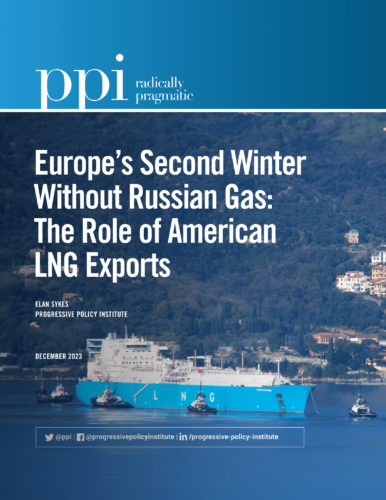
Europe’s Second Winter Without Russian Gas: The Role of American Exports

Energy dynamics in Europe have undergone a significant transformation as the European Union continues to navigate the aftermath of Russia’s invasion of Ukraine and subsequent energy shortage. The reliance on Russian gas, which comprised 38% of EU imports in pre-pandemic 2019, has drastically reduced to just 6% through the first nine months of this year. Notably, the United States’ exports of Liquefied Natural Gas (LNG) has played a pivotal role in filling this gap, reaching historic highs and making the U.S. the largest LNG exporter globally. With approximately half of U.S. LNG cargoes destined for Europe, America has risen to become the second-largest supplier of gas to Europe, following only Norway.

Today, the Progressive Policy Institute (PPI) released a new policy brief titled “Europe’s Second Winter Without Russian Gas: The Role of American LNG Exports,” assessing the implications and successes of the U.S.’ increase in LNG exports to Europe. Report author Elan Sykes, PPI’s Energy Policy Analyst, evaluates the EU’s strategies, including the expansion of LNG import terminals, demand reduction targets, and the accelerated deployment of renewable energy. Sykes finds that while European energy costs remain high and industrial output reduced, the acute crisis of the energy shortage appears to have subsided.

The policy brief sheds light on the United States’ pivotal role in supporting the EU’s energy transition, as well as fostering unified support for Ukraine. The U.S. is well-positioned to serve as a low-methane backstop LNG supplier while complementary clean energy supply chains scale up as rapidly as possible.

“The U.S. is leading this pragmatic and orderly global transition to net zero,” said Elan Sykes. “In the near future, the U.S. should build on this success by continuing to play a backstop role for world energy markets, implement ambitious IRA policies to push down upstream methane leakage, and expand the global coalition of low-methane producer and consumer markets for LNG with stringent and transparent certification metrics.”

Read and download the full report here.

The Progressive Policy Institute (PPI) is a catalyst for policy innovation and political reform based in Washington, D.C. Its mission is to create radically pragmatic ideas for moving America beyond ideological and partisan deadlock. Learn more about PPI by visiting progressivepolicy.orgFind an expert at PPI and follow us on Twitter.

###

Media Contact: Amelia Fox – afox@ppionline.org

Europe’s Second Winter Without Russian Gas: The Role of American LNG Exports

EXECUTIVE SUMMARY

Approaching the second winter after Russia’s invasion of Ukraine, the European Union has made real progress in overcoming the severe energy shortage that followed the August 2022 shutdown of the Nord Stream pipelines. Through the first nine months of this year, Russian gas comprised only 6% of EU imports compared to 38% in pre-pandemic 2019.

More than any other supplier, United States exports of Liquefied Natural Gas (LNG) have
stepped in to fill the gap: U.S. exports are at all-time historic highs and America is now the single largest LNG exporter in the world, with roughly half of U.S. cargoes going to Europe since the invasion and America rising to become the second-largest supplier of gas to Europe after only Norway.

It is impossible to imagine unified support for Ukraine between the U.S. and EU could have continued as it did without the long-term project of expanding U.S. export capacity and the rapid short-term expansion of import terminals in Europe. The EU paired the rapid expansion of temporary and permanent new LNG import terminals with demand reduction targets, accelerated deployment of renewable energy and electrified heating, and increased coal combustion; though European energy costs remain high and energy-intensive industry has languished, the shortage is no longer an acute crisis. In the near future, the U.S. should build on this success by continuing to play a backstop role for world energy markets, implement ambitious IRA policies to push down upstream methane leakage, and expand the global coalition of low-methane producer and consumer markets for LNG with stringent and transparent certification metrics. The U.S. is leading this pragmatic and orderly global transition to netzero.

Read the full report.

Brown for The Messenger: The Wrong Green Plan Can Mean Climate Disaster

By Neel Brown

There is wisdom in the words of legendary boxer Mike Tyson, “Everyone has a plan until they get punched in the mouth.”

The ultra-green activists have been punched in the mouth, so to speak. Their plan to keep all fossil fuels in the ground has been bested by a tough opponent: reality.

As a result, their efforts to limit U.S. liquified natural gas (LNG) production and exports in the name of abolishing all fossil fuel use are bringing us closer to a climate disaster.

There is no question that we are in a climate emergency that must be addressed with a determined push for a clean energy transition. That push should be pursued with speed and resolve — but without losing sight of the goal, which is to reduce greenhouse gas emissions. This is vital to the health and prosperity of current and future generations.

Read more in Medium.

Bledsoe for The Messenger: Hamas-Israel War Must Not Prevent Progress at COP 28 Climate Talks

By Paul Bledsoe

The next United Nations climate change conference, COP28 , is scheduled to begin at the end of November in Dubai. Beyond the challenges of getting the world to agree on difficult climate issues, progress may be imperiled by the cloud of war between Hamas and Israel, and also by the choice of the United Arab Emirates as the host country.

The Middle East’s tangled politics and tortured alliances will make gaining unanimity of action on critical climate issues that much harder. Credible analysis indicates that Iran’s long-time support for Hamas, and claims that it helped plan the vicious attack on Israel, had a strategic objective of preventing incipient attempts to renew diplomatic relations between Saudi Arabia and Israel. Saudi Arabia and Qatar also find themselves on opposite sides in this crisis, as Qatar has maintained close relations with Hamas for years. That, too, could further complicate efforts to get major oil and gas states aligned.

Yet, hope remains that the conference-hosting UAE — despite deriving nearly one-third of its GDP from oil and gas revenue — can leverage its relationships with other major state-owned energy producers to gain agreements to limit their greenhouse gas emissions, especially of that super-climate-pollutant, methane. Fully 75% of all carbon dioxide and methane emissions from the oil and gas industry come from state-owned companies. Thus, climate protection cannot be achieved without dramatically reducing emissions from the world’s petro-states.

Read more.

This story was originally published in The Messenger on October 18, 2023.

Bledsoe for The Messenger: Biden, Not Trump, Is Right on the Autoworkers’ Strike and Electric Vehicles

By Paul Bledsoe

Donald Trump and the rest of the Republican Party, seemingly devoid of original policy ideas themselves, have tried to make Joe Biden’s advocacy of incentives for U.S. production of electric vehicles (EVs) a campaign issue in the midst of the United Auto Workers (UAW) strike over higher pay and improved benefits. But the truth is that President Biden’s efforts to deliver large EV incentives for American car buyers and U.S. automakers are our best hope so far for the U.S. to outcompete China in the domestic and global auto market and to save American jobs.

It is the automakers themselves and, increasingly, consumers who are switching to EVs, for the obvious reason that EVs are already much cheaper to operate than gasoline-power cars, and very soon, they are expected to be far cheaper to manufacture and purchase than gasoline vehicles. EVs are the future of the auto industry, and Biden is making sure America will be ready for the decades ahead.

Read more.

This story was originally published in the Messenger on October 3, 2023.

Bledsoe for Medium: In Both U.S. and UK, Overtaxing Voters is Bad Climate Politics

By Paul Bledsoe

No political comparison is as discordant to British ears as one suggesting commonality with the American scene, particularly with Donald Trump still at large. Nonetheless, recent UK contretemps over energy taxes and climate policy may find an illustrative corollary in U.S. politics and prove the exception to the rule.

The decision this week by mayor Sadiq Khan to extend the Ultra-low Emissions Zone (ULEZ) tax to almost all of greater London may be justified in terms of helping air quality, but it is still questionable politics for a Labour Party attempting to regain power for the first time in 13 years.

Keep reading in Medium.

Maag and Sykes for The Messenger: Is Our Workforce Ready for a Successful Green Energy Transition?

By Taylor Maag and Elan Sykes

Over the past two years, the Biden administration has made large national investments aimed at putting America ahead in the global race to develop clean energy industries and jobs. Investment is flowing all across the country, for projects like solar panel factories in Louisianaenergy-efficient apartment buildings in New York and electric vehicle battery factories sprouting everywhere from Georgia to Michigan.

This emphasis on a green transition comes at an important time. Just last week, our nation’s deadliest wildfire killed at least 111 people and destroyed Maui’s historic town of Lahaina. While detailed studies have not yet determined exactly how climate change influenced Maui’s fire, climate scientists have pointed to specific climate-driven factors, and existing attribution science suggests that climate change fuels warmer temperatures, less rainfall, stronger storms and powerful winds — increasing the likelihood of devastating events like this. It’s clear there is no time like the present to create a lower-emissions economy, mitigate climate impacts and protect public safety.

Yet, even with increased federal attention, implementing investments and new solutions has become difficult. One reason is our workforce. The rapidly growing clean energy sector is bumping up against serious labor constraints — facing challenges filling jobs and ensuring workers have the right skills for these positions. In the next seven years, there are expected to be over 550,000 new energy-transition jobs in the U.S. Just in 2022, U.S. green job postings on LinkedIn jumped 20% — yet, the pool of workers with the skills required to fill these jobs only grew by 8.4%.

Read more.

This story was originally published in The Messenger on August 20, 2023.


One Year Later, the IRA has Made Strides in Clean Energy Transition and Created Opportunities for Working Families

Elan Sykes, Energy Policy Analyst at the Progressive Policy Institute (PPI) released the following statement on the one-year anniversary of President Biden signing the Inflation Reduction Act (IRA), the largest-ever investment into clean energy technology, into law.

“The Inflation Reduction Act is a historic inflection point in America’s progress toward clean energy investment, and decarbonization. This legislation creates opportunities for working-class families across the country through its monumental investment in manufacturing, working to lower energy costs for all Americans during a time of record inflation. However, there is much more work to be done.

“Maximizing the benefits of the IRA will require Congress and the Biden Administration to reduce barriers to deployment in the federal permitting process, expand secure supply chains domestically and in partnership with global allies, and increase the skilled clean energy workforce going forward. PPI calls on the Biden Administration and both parties in Congress to work pragmatically to secure a cleaner, brighter future for American Energy.”

Sykes, along with Paul Bledsoe, Strategic Advisor at PPI, recently released a report on a new ambitious approach to permitting reform. The report proposes a fundamental change to the permitting process by utilizing new analytics, scoping, and mapping technologies that can provide federal agencies and regulators the tools they need to comprehensively approve large batches of projects together, instead of individually reviewing projects.

The Progressive Policy Institute (PPI) is a catalyst for policy innovation and political reform based in Washington, D.C. Its mission is to create radically pragmatic ideas for moving America beyond ideological and partisan deadlock. Learn more about PPI by visiting progressivepolicy.org.

Follow the Progressive Policy Institute.

More from PPI’s Energy and Climate Solutions Initiative.

Find an expert at PPI.

###

Media Contact: Amelia Fox – afox@ppionline.org

Bledsoe for The Messenger: Gas Is a Better Option Than Coal on Our Path to Draw Down Emissions

By Paul Bledsoe

As the climate crisis worsens, the debate over emissions from natural gas is heating up, too. Unfortunately, both gas opponents and gas supporters have been cherry-picking the data, especially regarding the lifecycle emissions of gas, which under almost all circumstances are still lower than coal.

These contretemps are obscuring significant agreement between many gas suppliers, government regulators and climate campaigners about the need to dramatically reduce fugitive emissions of methane from the U.S. and global systems so gas can be as low-emitting as possible.

Switching from coal to natural gas in the U.S. has been responsible for three-fifths of U.S. carbon dioxide emissions reductions from 2005 to 2020. Across the U.S., major electric utilities continue to reduce coal. Duke Energy, for example, which operates in six states, including North Carolina, has retired more than 50 coal power plants and 7,000 megawatts of coal production since 2010.

Read more.

This story was originally published in The Messenger on August 12, 2023.

Bledsoe and Sykes for The Hill: Energy permitting is broken: New analytics can fix it

By Paul Bledsoe and Elan Sykes

The energy permitting reforms included in the recent bipartisan budget agreement represented modest progress — but they didn’t fix the problem. The main challenge, and the huge economic opportunity, is the sheer number of energy projects that must be permitted rapidly to save consumers money and limit emissions.

Thousands of these projects — wind power, solar, geothermal, powerlines, pipelines, carbon capture and many more — are pending reviews by federal agencies, electricity grid operators and state and local jurisdictions in every region. These permits cannot possibly be processed rapidly on a one-by-one basis, as the current system demands.

Fortunately, analytic and scoping technologies developed in the half-century since the passage of the National Environmental Policy Act (NEPA) can help expedite the process. These advances include a far better understanding of geological, ecological and other scientific conditions as well as the capacity to process and display information through technologies like computationally intensive modeling and Geographical Information Systems programs. These technologies can provide regulators the capacity they need to more comprehensively approve large batches of similar projects together. Only such basic reforms will upgrade our national energy infrastructure quickly and cost-effectively.

Agencies can increasingly use these technologies to conduct programmatic reviews that study groups of projects across wide geographic or technological areas. These systematic reviews can proactively identify, study and map places with significant clean energy potential and recognize issues that may require mitigation measures.

Read more in The Hill.