Denier-in-chief: Trump, COVID and climate change

It is a tale of two worlds. In Real World, the COVID scourge continues to inflict massive human suffering and economic costs on the American people. More than 177,000 Americans have died. More than 5.7 million have been infected. These are by far the largest tolls in the world. No wonder the U.S. economy is now a basket case.

More than 22 million jobs were lost in April alone, and many more in March and May, yet only 42% of those jobs have returned. Even with so many jobless Americans waiting to go back to work, job growth has slowed with July employment less than half that of June, and August looking weaker still.

This is the worst job market since the Great Depression. Yet after more than almost nine months, the Trump administration still does not have a coherent or effective national COVID-19 strategy, and Senate Republicans went on vacation rather than pass unemployment extensions for millions of jobless Americans.

But as his convention continues, the president seems to reside in Trump World, a land of alternative facts where everything appears fine. Late last week, Trump called his presidency the “most successful period of time in the history of our country, from every standard” and said his administration has “demonstrated over the last four years the extraordinary gains that are possible.”

Meanwhile, this week heatwaves, wildfires and hurricanes, all made much worse by climate change, are devastating communities and making life unbearable for tens of millions of Americans across the country.

In California, a massive heatwave scientists say is exacerbated by climate change has led to 600 separate fires, including the second and third largest in state history, which have killed seven people thus far. More than one million acres have burned, three times the annual average, just in the last nine days. More than 100,000 people have been evacuated. Even as the coronavirus pandemic increases respiratory illness, air quality has been fouled for tens of millions across the West.

Read more here.

Make America #1 in Electric Vehicles

Achieving U.S. climate resilience requires a dynamic and unprecedented American clean energy transition, including large investments in zero-emissions infrastructure and clean energy manufacturing — the fastest growing global manufacturing sector set to attract $10 trillion in investment by 2050.

A new report from the Progressive Policy Institute finds the U.S. has the opportunity to build tens of millions of new electric vehicles, charging stations, and the advanced electric grid to serve them, as well as upgrading our roads, bridges, high-speed internet, ports, and public transport to fulfill this clean energy vision. The Covid-19 economic and unemployment crisis has only intensified the political imperative to create millions of these new, clean energy jobs, with a particular emphasis on well-paid manufacturing.

In his 2016 campaign, Donald Trump famously promised to revitalize American manufacturing and rebuild our crumbling infrastructure. But as president he has done neither one. In fact, U.S. manufacturing declined deeply during each quarter of 2019, long before the coronavirus reached our country.

Now former Vice President Joe Biden and other Democrats have put clean energy at the center of bold blueprints for reviving the comatose U.S. economy. The House last month passed a $1.5 trillion infrastructure and tax package, and Biden recently unveiled his $2 trillion “Build Back Better” plan. But ambitious as these proposals are, they do not offer a detailed roadmap for making America the global leader in the key clean energy technologies, especially electric vehicles, and related technologies like an advanced electricity grid and storage.

Yet the mass commercialization of electric vehicles is key to cutting the largest source of U.S. greenhouse gas emissions, making America’s air cleaner and healthier, ending dependence on foreign oil, and bringing about a resurgence of the U.S. auto industry and American manufacturing jobs.

Until we are producing American-made vehicles that can beat oil-burning cars on price and consumer appeal over the long-term, the clean energy transition in the key transport sector will not gain speed. We need a muscular new vision of America’s clean energy infrastructure and manufacturing sector creating millions of good new jobs. This is modern equivalent of Franklin D. Roosevelt’s “Arsenal of Democracy”— helping to solve many of our economic, manufacturing, trade and environmental problems together.

The United States can’t afford to forfeit the lead on electric vehicles to China, as has happened with other clean energy technologies. For example, China in 2008 devoted half its total $650 billion stimulus to manufacturing PV solar panels and lithium ion batteries, growing China’s PV solar panel global market share from less than 30% to about 70% today.

Cars are far more important to America’s economy and national identity than solar panels. Thanks to heavy investments in electric vehicle technology, China already is dominating the emerging global EV market, with over 50% of global production, and 73% of the EV battery market. Meanwhile, the US produces fewer than 20% of EVs. Industry experts predict that electric vehicles will be the key to auto industry growth over the next years and decades—from less than two million EVs today to more than 30 million by 2030—representing the world’s most important new manufacturing market.

But today, most Americans cannot afford the excellent but more expensive EVs that dominate the U.S. market. And the EVs that are affordable are not available in models—especially SUVs, minivans and light trucks—that most U.S. consumers prefer, and that provide higher profit margins for automakers.

America needs a new approach to the electrification of transport – a comprehensive program to jumpstart the production and purchase of the electric cars and trucks Americans want and can afford. The existing federal consumer tax credit of $7,500 per EV has reached a cap of 200,000 for GM and Telsa, the largest US producers. While Democrats
in Congress have proposed raising the cap per manufacturer, this minor change won’t drive large and rapid electrification of the U.S. fleet. And Republicans have (hypocritically but successfully) attacked the current tax credit as a government giveaway for “Tesla millionaires” that favor only the richest consumers.

Instead, Congress should provide average American consumers much larger tax credits for purchase of affordable U.S.-made EVs, including models Americans actually want, especially minivans, SUVs, and light trucks. This means dedicating large consumer tax credits to the purchase of more affordable EVs with an emphasis on high-volume model types on graduated scale as follows: $15K credit for vehicles under $35k: $7.5k for EVs under $50k; $2.5k under $75k and $1.5k under $100k. A version of this PPI approach has been crafted into legislation by US Rep. Jackie Speier; the bill has over 30 cosponsors but, the tax credit must be applied to SUVs and trucks to achieve volume and scale and gain broad bipartisan support.

Buyers should also get to use the EV credit over a 5-year period, or apply the credit at the point of sale, making it more applicable to average income buyers who lack large tax liability. Additional measures should include extra tax incentives for trade-in’s to rapidly turn over the non-EV fleet (“cash for clunkers”) and requiring the federal government fleet to purchase U.S.-made EVs. And infrastructure legislation must provide strong incentives for electric charging stations, advanced electric grid and storage.

The rapid retooling at GM and Ford to build ventilators and masks to address the Covid-19 crisis illustrates the ability of automakers to adapt to new market demands and government incentives. In fact, many these plants had been making hybrid car batteries.

With nearly 20 million people out of work, America must create millions of new jobs by investing in an infrastructure-led manufacturing recovery through federal legislation just as we did in the 1930s New Deal, the 1950s Interstate Highway System, 1960’s through NASA and the 2009 American Recovery and Reinvestment Act. We must also train workers in technology and manufacturing skills through high schools and community colleges, focused where unemployment is highest, in direct cooperation with EV and other clean energy employers.

America has led the world in auto innovation for most of the last century. We must do so again in a new era. U.S.-made EVs are crucial to climate resilience, the U.S. economic rebound and gaining broader political support for the clean energy transition. It’s time to act.

Bledsoe for USA Today: “Don’t fuel Donald Trump’s culture war on climate change. Beat it instead.”

Australia’s raging infernos, like our Western wildfires and more devastating storms, prefigure a darker climate future for all of us without urgent action. But for President Donald Trump, the climate crisis is just another opportunity to stoke anger among the American people and further divide us.

Trump has undermined every climate protection possible, not out of any philosophical conviction about smaller government, but in large part to deliberately provoke outrage on the left, and then use the limelight to falsely portray climate-protecting policies to his base as a culture war waged by left-wing elitists against average voters.

Earlier this month, it was a White House event where he announced proposals to weaken climate protections in the National Environmental Policy Act. In fact, NEPA could benefit from reasonable reforms — not the ones Trump proposes, but, for instance, allowing the siting of clean energy infrastructure needed to rapidly cut greenhouse gas emissions. But in Trump World, creating contempt for climate protection itself, like slurring immigrants or race-baiting rhetoric, is a key ingredient in the toxic stew of cultural resentment he pre-cooks in search of alienated voters hungry for scapegoats.

Read the full piece here.

Gold for Medium: “Attention Democrats: UK Elections Not Only Cautionary Tale from Europe”

As Democratic presidential hopefuls gather in Los Angeles this week for the last debate of 2019, candidates should look across the Atlantic for a cautionary tale.

No, I’m not just talking about last week’s UK elections, which saw Labour’s far left-wing leader, Jeremy Corbyn, get crushed by Brexiteer Boris Johnson. Democrats can also draw useful lessons from the United Nations Conference of Parties (COP25) in Madrid, which by all accounts failed to kickstart progress toward implementing the Paris Climate Accords.

The culprit here, of course, is President Trump. His threat to pull the United States out of international efforts to combat climate change has created a major vacuum of leadership. What happened in Madrid underscores the folly of relying mainly on governments to tackle the climate crisis. Democratic presidential hopefuls should promise not only to re-exert U.S. leadership but to engage the private sector in efforts to reduce greenhouse gas emissions — regardless of which way the political winds happen to be blowing.

Read the full piece here.

Bledsoe for the New York Times: “Our Future Depends on the Arctic”

Delegates from nearly every nation spent the last two weeks here at a United Nations climate summit struggling to chart a course to meet the extraordinarily difficult goal of net zero emissions of carbon dioxide by the year 2050.

Yet long before then, the effects of global warming could spin out of control. As the United Nations’ secretary general, António Guterres, warned in opening the meeting: “The point of no return is no longer over the horizon. It is in sight and hurtling toward us.”

Perhaps nowhere is that more true than in the Arctic. The surface air there is warming at twice the global rate and temperatures over the past five years have exceeded all previous records since 1900. This past week, the National Oceanic and Atmospheric Administration reported that the extent of Arctic summer sea ice was at its second lowest point since satellite observations began in 1979, and that average temperatures for the year ending in September were the second highest since 1900, when record-keeping began.

Read the full piece here.

Bledsoe for Forbes: “Tax Credits for Affordable Electric Vehicles Gain Speed, But Legislation Must Avoid Stop Signs

As Congress begins to turn toward tax policies to help clean energy manufacturing, electric vehicle tax credits aimed directly at more affordable vehicles are gaining speed, just as a previous Forbes column and a Progressive Policy Institute (PPI) white paper urged several months ago.

The question now is will EV advocates in Congress, the U.S. auto industry and labor unions get the message and reform tax incentives to benefit middle-income Americans. Such revised tax credits focused on more affordable EVs will increase the chances new incentives become law, and will better allow the U.S. to reap the remarkable economic, health, manufacturing and environmental benefits of EVs. Yet as of now, new EV tax credits have been left entirely out of a so-called “tax extenders” outline circulating among House Ways and Means Committee members.

But a series of new developments are demonstrating that tax credits focused on affordable vehicles are gaining momentum.


Read the full piece on Forbes by clicking here. 

Bledsoe for The Hill: “Biden’s domestic climate plan is good, but his global strategies are crucial”

As many climate activists had hoped, Democratic presidential front-runner Joe Biden came forward this week with an ambitious domestic climate change plan that proposes to cut U.S. emissions deeply while growing America’s clean energy sector.

Yet, as important as the domestic elements of Biden’s plan and those of his rivals are, they are ultimately most valuable ecologically in legitimizing the key international aspects of climate protection, which are crucial to solving the inherently global nature of the climate problem in the first place.

After all, U.S. greenhouse gas emissions are only about 15 percent of the world total, compared to 30 percent from China alone. Fortunately, the E.U., U.S., China and fewer than 10 of other nations account for well over 80 percent of global emissions, meaning targeted international efforts have strong potential to reach the lion’s share of the problem.

Credible U.S. domestic climate action is a precondition to gaining the trust and respect of the rest of the world — and allowing America to exert unique pressure on other major nations to cut their emissions.

Read the full piece here.

New Ideas for a Do Something Congress No. 7: Winning the Global Race on Electric Cars

On Donald Trump’s watch, America is losing what is probably the most important new manufacturing opportunity in the world–the global race to produce affordable electric vehicles that people want to drive. The United States currently accounts for just 20 percent of global electric vehicle production, far behind China.

Jumpstarting U.S. production and purchase of Electric Vehicles (EVs) would produce an unprecedented set of benefits, including cleaner air and a reduction in greenhouse gas emissions; a resurgence of the U.S. auto industry and American manufacturing; the creation of millions of new, good, middle class manufacturing jobs; lower consumer costs for owning and operating vehicles; and the elimination of U.S. dependence on foreign oil. U.S. automakers are already moving toward EVs, but the pace of this transition is lagging behind our foreign competitors. A dramatic expansion of tax credits for EV purchases could go a long way toward boosting the U.S. EV industry as part of a broader agenda to promote the evolution of the transportation industry away from carbon-intensive fuels.


THE CHALLENGE: THE US ELECTRIC VEHICLE INDUSTRY IS FALLING BEHIND ITS GLOBAL COMPETITORS

Leading experts predict (1) that electric vehicles will be the key to global auto industry growth over the next years and decade—from about 1.1 million EVs last year to 30 million by 2030. Ominously, however, China is already dominating (2) the emerging EV market, with about 40 percent of global production, and plans to expand even more rapidly over the next few years. The United States, on the other hand, currently produces only about 20 percent of the world’s EVs and is moving too slowly on the EV transition.

Electric vehicles account for just 0.3 percent of the total U.S. fleet

U.S. EV production is small – fewer than 200,000 were manufactured (3) here last year, accounting for less than 0.3 percent of the total U.S. fleet. Production is also not growing nearly fast enough. Out of the roughly 350 million vehicles on the road today, a little more than 1 million are electric.

Electric vehicles are too pricey for most consumers or are not offered in models consumers want

Most Americans cannot afford more expensive EVs—like the high-end Tesla models—that have dominated (4) the market so far. For example, two of the top three selling models in 2017 cost well over $80,000 a vehicle. The second selling model, the more affordable Chevy Bolt (still more than $36,000), sold only about 25,000 units in 2017. And the EVs that are affordable are not available in the models—especially SUVs, minivans and light trucks—that most consumers prefer, and that provide higher profit margins for automakers. As a consequence, fewer than 2 percent of the more than 17.3 million new American car purchases in 2017 were of plug-in hybrid electric vehicles or battery-electric vehicles.


THE GOAL: MAKE AMERICA THE GLOBAL LEADER IN EV MANUFACTURING, PRODUCTION, AND DEPLOYMENT

The aim of America’s EV policy should be to quickly gain by far the largest part of the global EV market penetration by reaching the mass market of average domestic and international consumers of high volume models. Doing this can rapidly help lower consumer costs, cut emissions, end oil imports, reduce pollution, and prompt a resurgence of domestic auto manufacturing. Specifically, the United States should set a goal of producing more than 50 percent of the global EV production—or 15 million vehicles a year–by 2030.

Fifteen years ago, the U.S. allowed Chinese subsidies to displace U.S manufacturers and dominate the global race for solar panel manufacturing—and today China owns more than (5) 60 percent of the global market. America cannot allow that to happen with EVs, which under any scenario will be an essential part of the next generation of global clean energy technology and auto manufacturing.

Electric Vehicles at scale will bring America remarkable, one of a kind benefits. For instance, EVs can dramatically reduce air pollution, which is among the leading causes of lung disease, lower life expectancy and asthma among Americans. Transitioning to EVs will also reduce America’s largest source of greenhouse gas emissions—transportation. EVs have less than half the GHG emissions of gasoline-powered cars, and are getting even cleaner every year (6). An average U.S. EV today has greenhouse gas emissions equivalent to a gasoline car getting 80 MPG (7). EVs will only get higher gasoline equivalent mileage over time.

At the same time, EVs will save U.S. consumers money because of much lower fuel and vehicle operating costs (8). The total cost of owning and operating an EV is already cheaper than oil-fueled cars (9). The U.S. average price per gallon of gasoline is $2.50 while it costs less than half that–$1.10 per eGallon–to charge an electric car, according to the U.S. Department of Energy (10).

Finally, widescale deployment of EVs will also help end America’s reliance on imported oil. Today, the US imports about 20 percent of its oil, including from non-Democratic petro-states like Saudi Arabia and Venezuela.

Gaining American global leadership in one of the world’s the fastest growing major manufacturing sectors will provide the United States a huge economic boost and create an export market for U.S. EVs around the world. Boosting the American EV industry will also bring ancillary benefits to the nation’s overall efforts for a clean-energy transition. For example, large scale EV deployment will enable the creation of a huge distributed network of electricity storage units—that is, car batteries themselves plugged into the electricity grid, especially at night. This network will allow greater electricity storage at scale that in turn will allow major electric grids around the country to integrate higher percentages of clean solar and wind energy. In essence, electrifying transport will therefore help reduce emissions from both the transport and electricity sectors, the two highest emitters in the U.S. economy.


THE SOLUTION: DRAMATICALLY EXPAND AND IMPROVE TAX CREDITS FOR CONSUMER PURCHASES OF ELECTRIC VEHICLES

There is no doubt America has the capacity to lead the EV revolution. America has unrivaled technical expertise, a skilled work force, and innovative entrepreneurs and investors (11). But current half-hearted U.S. tax policies on EVs are not coming anywhere near immediately seizing this massive opportunity as other countries threaten to pull so far ahead that we cannot catch up.

One powerful way to speed the revolution is through more robust tax incentives that can boost the pace of technological evolution of U.S. companies and adoption of EVs by the transportation sector as a whole.

For example, existing federal tax credits are not nearly enough to drive the change and scale of EVs that are needed to gain full benefits. The current federal tax credit system, while well intended, has so far been ineffective. It offers $7,500 for the purchase of any all-electric vehicle, but caps the credit at 200,000 vehicles per manufacture, with rapidly reduced credit amounts after that threshold. Several Members of Congress have proposed (12) extending the existing $7,500 credit with no cap per manufacturer, but do not propose changing the overall structure of the credit. These changes are highly unlikely to drive large rapid electrification of the US fleet.

What Congress should do instead is provide American consumers with much more generous tax credits for the purchase of more affordable EV models that Americans actually want and can afford, including minivans, SUVs, and light trucks.

In particular, Congress should provide a consumer tax credit that is the more generous for cheaper vehicles than for expensive ones, thereby encouraging the sale of more affordable electric vehicles. For instance, this credit could be structured on a graduated scale as follows: $7,500 for vehicles priced under $35,000; $5,000 for those under $50,000; $2,500 for those under $75,000; $1,500 under $100,000.

Opinion polls find that nearly three quarters of consumers say a tax credit would affect their decision to buy an EV, and 63 percent say a credit is an important measure to support EV adoption. However, the tax credit must be applicable to cars Americans want to buy to achieve volume and scale (13).

In addition to the graduated tax credit described above, Congress should also provide an extra consumer tax incentives for “trading-in” low mileage “gas guzzlers” for the purchase of an EV to quickly turn over fleet and eliminate the most inefficient, polluting vehicles. Moreover, Congress should provide manufacturer tax credits within each class of vehicle, including SUVs, minivans and light trucks, to drive rapid production and demand for popular models. Finally, to encourage rapid growth and large-scale production, the manufacturer tax credit should become greater for production over a certain high total threshold of vehicles produced.

The tax credits described above can go a long way toward speeding the nation’s transition to EVs while boosting U.S. EV leadership. Nevertheless, these tax credits cannot be effective if offered alone. Rather, they must be offered in concert with a robust, comprehensive agenda to accelerate electric vehicle adoption.

Crucially, the federal government and the states will need to invest in public and private incentives for building out a network of electric charging stations through much needed infrastructure modernizing legislation. Congress should also require that the federal government purchase US-made EVs for most purposes (and other alternative vehicles like Compressed Natural Gas or Fuel Cells as needed for other uses like buses and heavy-duty trucks);

The federal government could also raise Corporate Average Fuel Economy (CAFÉ) standards for an added push toward EVs. And in order to gain the full reductions in air pollution and greenhouse gas emissions, Congress will need to make sure that the electricity sector relies on increasingly clean energy sources.

America cannot afford to lose the EV race, the most important manufacturing opportunity of our time. By creating a comprehensive program to jumpstart the production and purchase of the electric cars and trucks Americans want and can afford, Congress can help the nation take a dramatic, yet pragmatic, step forward toward growing the economy, cutting oil use and consumer costs, improving air quality and combatting climate change.

ENDNOTES

1) “Electric Vehicle Outlook 2018 | Bloomberg New Energy Finance.” Bloomberg NEF. https://about.bnef.com/electric-vehicle-outlook/.

2) Niu, Isabelle. “Your next Car Could Be Electric-and Chinese.” Quartz. November 15, 2018.

3) Kane, Mark. “US All-Electric Car Sales Charted: November 2018.” Inside EVs. December 30, 2018.

4) “Top-selling Electric Cars in the United States 2017 | Statistic.” Statista. https://www.statista.com/statistics/257966/best-selling-electric-cars-in-the-united-states/.

5) Beinhart, Larry. “Why China, and Not the US, Is the Leader in Solar Power.” Al Jazeera. August 22, 2018.
6) Nealer, Rachael, David Reichmuth, and Don Anair. “Cleaner cars from cradle to grave: How electric cars beat gasoline cars on lifetime global warming emissions.” Union of concerned scientists report (2015).

7) Reichmuth, David. “New Data Show Electric Vehicles Continue to Get Cleaner.” Union of Concerned Scientists (blog), March 8, 2018. https://blog.ucsusa.org/dave-reichmuth/new-data-show-electric-vehicles-continue-to-get-cleaner.

8) Richardson, Jake. “Electric Vehicles Reduce Toxic Air Pollution – Pollution That Hurts & Kills Humans.” CleanTechnica. May 12, 2018.

9) “Electric Vehicles Have Lowest Total Cost Of Ownership, Study Finds.” CleanTechnica. February 05, 2018.

10) “EGallon: Compare the Costs of Driving with Electricity.” Energy.gov. February 9, 2019. https://www.energy.gov/maps/egallon.

11) Kljaic, Vanja. “U.S. Electric Car Battery Production Is Lacking, Says Expert.” Inside EVs. October 7, 2018. https://insideevs.com/us-electric-battery-production-lack/.

12) U.S. Senate. Jeff Merkley. “MERKLEY, HEINRICH, CORTEZ MASTO INTRODUCE LEGISLATION TO EXTEND ELECTRIC VEHICLE TAX CREDIT FOR 10 YEARS.” News release, September 17, 2018. U.S. Senator Jeff Merkley of Oregon. https://www.merkley.senate.gov/news/press-releases/merkley-heinrich-cortez-masto-introduce-legislation-to-extend-electric-vehicle-tax-credit-for-10-years.

13) “EV Statistics of the Week: Range, Price and Battery Size of Currently Available (in the US) BEVs.” EVAdoption. January 21, 2018. https://evadoption.com/ev-statistics-of-the-week-range-price-and-battery-size-of-currently-available-in-the-us-bevs/.

Ritz for Forbes, “Donald Trump’s Budget For A Declining America”

After the president’s budget was released on Monday, House Budget Committee Chairman John Yarmuth (D-KY) called it “A Budget for a Declining America.” Unfortunately, that might be an understatement.

The Trump administration’s Fiscal Year 2020 budget proposal is a compilation of the worst ideas to come out of the Republican Party over the last decade. It would dismantle public investments that lay the foundation for economic growth, resulting in less innovation. It would shred the social safety net, resulting in more poverty. It would rip away access to affordable health care, resulting in more disease. It would cut taxes for the rich, resulting in more income inequality. It would bloat the defense budget, resulting in more wasteful spending. And all this would add up to a higher national debt than the policies in President Obama’s final budget proposal.

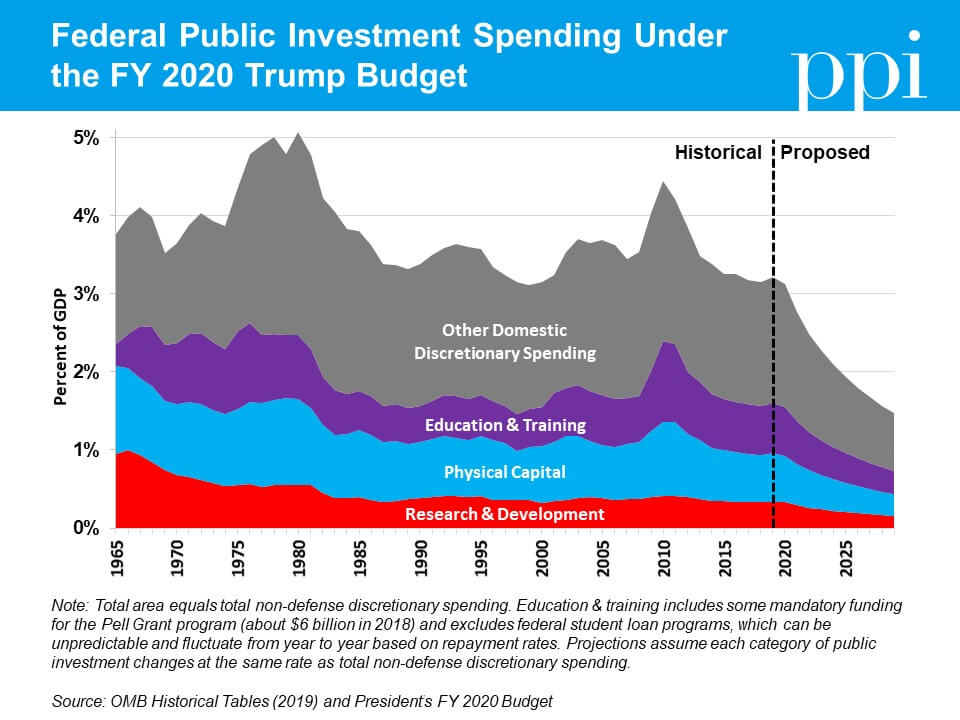
The most harmful aspect of Trump’s fiscal blueprint is its scheme for gutting investments in public goods that are core responsibilities of government. The administration proposes to reduce the share of gross domestic product devoted to non-defense (domestic) discretionary spending – the category of the budget that is annually appropriated by Congress and includes most federal spending on infrastructure, education, and scientific research – by more than half over the next decade. The result is deep cuts to all three of these important investments that provide the foundation for long-term economic growth.

Continue reading at Forbes.


Bledsoe for USA Today, “Trump border emergency is fake and climate crisis is real. Guess which just got funded?”

Donald Trump funds ’emergency’ border wall but relief for victims of wildfires, storms and other climate change-fueled catastrophes must wait.

One emergency, the border wall, is fake, invented by a rogue president desperate for a political win no matter the price. Another, the climate crisis, is real, with tens of millions of citizen victims around the country. Guess which one got funded?

President Donald Trump is risking a constitutional crisis by declaring a false national emergency to fund a border wall that his own government experts say isn’t needed and won’t work, and of which he himself says, “I didn’t need to do this.”

Meanwhile, the bill Trump signed last week to keep the government open leaves out tens of billions of dollars of relief for American citizens who are victims of hurricanes, wildfires and other disasters made worse by climate change.

This should not be a shock to anyone paying close attention. Acting White House Chief of Staff Mick Mulvaney, reacting to earlier reports, last week pointedly denied that the administration would raid relief funds designated for victims of storms and wildfires to get money for Trump’s dubious border wall.

The president, who denies basic climate science and is rolling back key climate protections, would have been taking money from its victims to escape the consequences of his own manufactured government-shutdown crisis — all to build a wall that will be ineffective and even counterproductive in improving border security.

A firestorm of criticism prevented that. Yet here we are about a month later with much the same outcome.

Continue reading at USA Today.

Bledsoe for Forbes, “Green New Deal Must Grow Up Fast To Influence Bills Congress is Already Writing”

Little noticed in the media circus surrounding the mere introduction of a non-binding Congressional resolution on the Green New Deal was the deletion of much-criticized and plainly unachievable mandates contained in previous GND versions.

Gone was the impossible diktat requiring 100% renewable energy for the entire economy by 2030. Missing was the politically suicidal and practically infeasible flat-out prohibition on fossil fuels in little more than a decade. Even extraneous language on guaranteed jobs in the resolution had been watered down from earlier texts, and would of course never be a legal requirement in actual climate legislation that passes Congress in any event.

In fact, the more extreme provisions in the GND have served largely to provide Trump and other Republican anti-climate action forces with irresistible political fodder. Republicans hope to scare the American people into opposing sensible climate actions by invoking GND extremism, and have already produced ads with these themes.

Continue reading at Forbes.

PPI Launches Series of New Ideas for a ‘Do-Something’ Congress

Dear Democratic Class of 2018,

Congratulations on your election to the U.S. House of Representatives! In addition to winning your own race, you are part of something larger – the first wave of a progressive resurgence in U.S. politics.

The midterm elections gave U.S. voters their first opportunity to react to the way Donald Trump has conducted himself in America’s highest office. Their verdict was an emphatic thumbs down. That’s an encouraging sign that our democracy’s antibodies are working to suppress the populist virus of demagoguery and extremism.

Now that Democrats have reclaimed the people’s House, what should they do with it? Some are tempted to use it mainly as a platform for resisting Trump and airing “unapologetically progressive” ideas that have no chance of advancing before the 2020 elections. We here at the Progressive Policy Institute think that would be huge missed opportunity.

If the voters increasingly are disgusted with their dissembling and divisive president, they seem even more fed up with Washington’s tribalism and broken politics. For pragmatic progressives, the urgent matter at hand is not to impeach Trump or to embroil the House in multiple and endless investigations. It’s to show Democrats are determined to put the federal government back in the business of helping Americans solve their problems.

We think the House Democratic Class of 2018 should adopt this simple mantra: “Get things done.” Tackle the backlog of big national problems that Washington has ignored: exploding deficits and debt; run-down, second-rate infrastructure; soaring health and retirement costs; climate change and more. And yes, getting things done should include slamming the brakes on Trump’s reckless trade wars, blocking GOP efforts to strip Americans of health care, as well as repealing tax cuts for the wealthiest Americans.

PPI, a leading center for policy analysis and innovation, stands ready to help. We’re developing an extensive “Do Something” Agenda. Today, we are releasing the first in a series of concrete, actionable ideas designed expressly for Democrats who come to Washington to solve problems, not just to raise money and smite political enemies.

As you get settled into your new office, we’ll look for opportunities to acquaint you and your staff with these pragmatic, common-sense initiatives, and to discuss other ways we might be of service to you. That’s what we’re here for.

Regards,


Will Marshall
President
Progressive Policy Institute


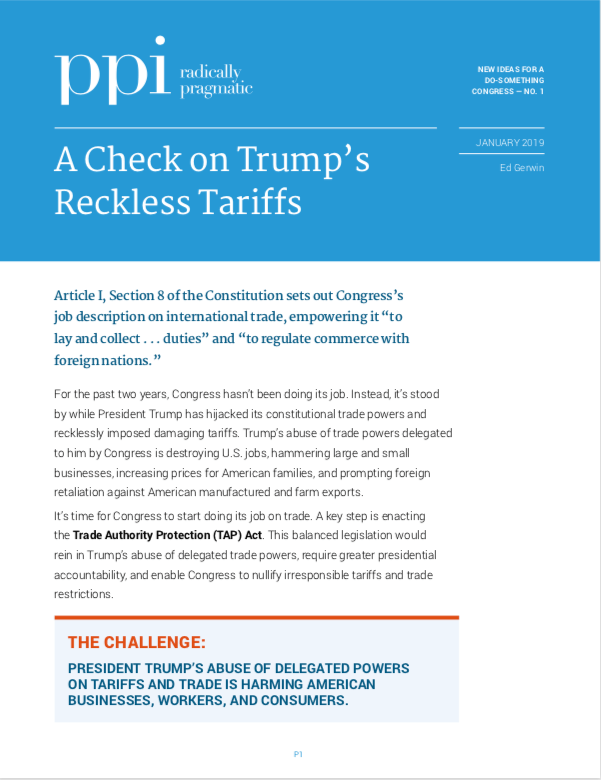
New Ideas for a Do-Something Congress No. 1: “A Check on Trump’s Reckless Tariffs”

First and foremost, it’s time for Congress to start doing its job on trade. A key step is enacting the Trade Authority Protection (TAP) Act. This balanced legislation would rein in Trump’s abuse of delegated trade powers, require greater presidential accountability, and enable Congress to nullify irresponsible tariffs and trade restrictions.


A Radically Pragmatic Idea for the 116th Congress: Take “Yes” for an Answer on Net Neutrality

For the last two decades, different versions of net neutrality have bounced between Congress, the Federal Communications Commission, the courts – and most recently the states – but the issue remains unresolved.

It is time for Congress to solve this problem for good by enacting a strong, pro-consumer net neutrality law – an outcome that is politically possible even in this era of maximalist gridlock and deeply divided government, given the broad consensus that has formed around the vital issue of ensuring an open internet.


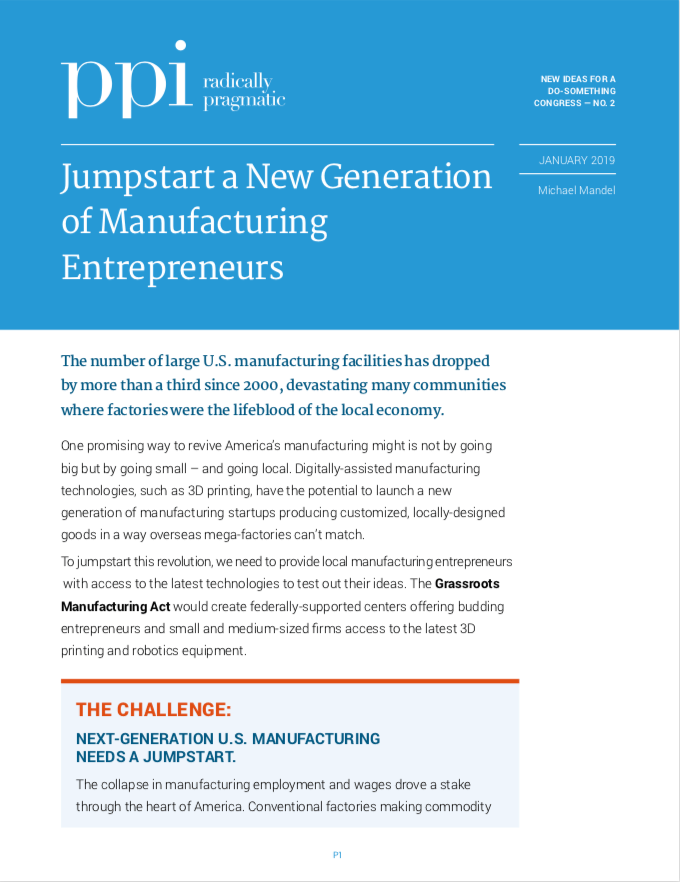
New Ideas for a Do-Something Congress No. 2: “Jumpstart a New Generation of Manufacturing Entrepreneurs”

The number of large U.S. manufacturing facilities has dropped by more than a third since 2000, devastating many communities where factories were the lifeblood of the local economy.

One promising way to revive America’s manufacturing might is not by going big but by going small – and going local. Digitally-assisted manufacturing technologies, such as 3D printing, have the potential to launch a new generation of manufacturing startups producing customized, locally-designed goods in a way overseas mega-factories can’t match. To jumpstart this revolution, we need to provide local manufacturing entrepreneurs with access to the latest technologies to test out their ideas. The Grassroots Manufacturing Act would create federally-supported centers offering budding entrepreneurs and small and medium-sized firms access to the latest 3D printing and robotics equipment.


New Ideas for a Do-Something Congress No. 3: “End The Federal Bias Against Career Education”

As many as 4.4 million U.S. jobs are going unfilled due to shortages of workers with the right skills. Many of these opportunities are in so-called “middle-skill” occupations, such as IT or advanced manufacturing, where workers need some sort of post-secondary credential but not a four-year degree.

Expanding access to high-quality career education and training is one way to help close this “skills gap.” Under current law, however, many students pursuing short-term career programs are ineligible for federal financial aid that could help them afford their education. Pell grants, for instance, are geared primarily toward traditional college, which means older and displaced workers – for whom college is neither practicable nor desirable – lose out. Broadening the scope of the Pell grant program to shorter-term, high-quality career education would help more Americans afford the chance to upgrade their skills and grow the number of highly trained workers U.S. businesses need.


New Ideas for a Do-Something Congress No. 4: “Expand Access to Telehealth Services in Medicare”

America’s massive health care industry faces three major challenges: how to cover everyone, reduce costs, and increase productivity. Telehealth – the use of technology to help treat patients remotely – may help address all three. Telehealth reduces the need for expensive real estate and enables providers to better leverage their current medical personnel to provide improved care to more people.

Despite its enormous potential, however, telehealth has hit legal snags over basic questions: who can practice it, what services can be delivered, and how it should be reimbursed. As is the case with any innovation, policymakers are looking to find the right balance between encouraging new technologies and protecting consumers – or, in this case, the health of patients.

Telehealth policy has come a long way in recent years, with major advances in the kinds of services that are delivered. Yet a simple change in Medicare policy could take the next step to increase access and encourage adoption of telehealth services. Currently, there are strict rules around where the patient and provider must be located at the time of service – these are known as “originating site” requirements – and patients are not allowed to be treated in their homes except in very special circumstances. To expand access to Telehealth, Congress could add the patient’s home as an originating site and allow Medicare beneficiaries in both urban and rural settings to access telehealth services in their homes.


New Ideas for a Do-Something Congress No. 5: Make Rural America’s “Higher Education Deserts” Bloom

As many as 41 million Americans live in “higher education deserts” – at least half an hour’s drive from the nearest college or university and with limited access to community college. Many of these deserts are in rural America, which is one reason so much of rural America is less prosperous than it deserves to be.

The lack of higher education access means fewer opportunities for going back to school or improving skills. A less educated workforce in turn means communities have a tougher time attracting businesses and creating new jobs. Congress should work to eradicate higher education deserts. In particular, it can encourage new models of higher education – such as “higher education centers” and virtual colleges – that can fill this gap and bring more opportunity to workers and their communities. Rural higher education innovation grants are one potential way to help states pilot new approaches.


New Ideas for a Do-Something Congress No. 6: Break America’s Regulatory Log-jam

Regulation plays a critical role in refereeing competition in a free market economy. But there’s a problem: Each year, Congress piles new rules upon old, creating a thick sludge of regulations – some obsolete, repetitive, and even contradictory – that weighs down citizens and businesses. In 2017, the Code of Federal Regulations swelled to a record 186,374 pages, up 19 percent from just a decade before. PPI proposes a Regulatory Improvement Commission (RIC), modeled on the highly successful Defense Base Realignment and Closure (BRAC) process for closing obsolete military installations. Like the BRAC process, the proposed RIC would examine old rules and present Congress with a package of recommendations for an up-or-down vote to eliminate or modify outdated rules.


New Ideas for a Do-Something Congress No. 7: Winning the Global Race on Electric Cars

Jumpstarting U.S. production and purchase of Electric Vehicles (EVs) would produce an unprecedented set of benefits, including cleaner air and a reduction in greenhouse gas emissions; a resurgence of the U.S. auto industry and American manufacturing; the creation of millions of new, good, middle class manufacturing jobs; lower consumer costs for owning and operating vehicles; and the elimination of U.S. dependence on foreign oil. U.S. automakers are already moving toward EVs, but the pace of this transition is lagging behind our foreign competitors. A dramatic expansion of tax credits for EV purchases could go a long way toward boosting the U.S. EV industry as part of a broader agenda to promote the evolution of the transportation industry away from carbon-intensive fuels.


New Ideas for a Do-Something Congress No. 8: Enable More Workers to Become Owners through Employee Stock Ownership

More American workers would benefit directly from economic growth if they had an ownership in the companies where they work. To help achieve this goal, Congress should encourage more companies to adopt employee stock ownership plans (ESOPs), which provide opportunities for workers to participate in a company’s profits and share in its growth. Firms with ESOPs enjoy higher productivity growth and stronger resilience during downturns, and employees enjoy a direct stake in that growth. ESOP firms also generate higher levels of retirement savings for workers, thereby addressing another crucial priority for American workers.


New Ideas for a Do-Something Congress No. 9: Reserve corporate tax cuts for the companies that deserve it

Americans are fed up seeing corporate profits soaring even as their paychecks inch upward by comparison. Companies need stronger incentives to share their prosperity with workers – something the 2017 GOP tax package should have included.

Though President Donald Trump promised higher wages as one result of his corporate tax cuts, the biggest winners were executives and shareholders, not workers. Nevertheless, a growing number of firms are doing right by their workers, taking the high road as “triple-bottom line” concerns committed to worker welfare, environmental stewardship and responsible corporate governance. Many of these are so-called “benefit corporations,” legally chartered to pursue goals beyond maximizing profits and often “certified” as living up to their multiple missions. Congress should encourage more companies to follow this example. One way is to offer tax breaks only for high-road companies with a proven track record of good corporate citizenship, including better wages and benefits for their workers.

Bledsoe for Forbes, “As U.S. Emissions Spike Under Trump, Democrats Will Pursue Real Climate Policies-Not Just Green Talk”

Leading researchers today released a report finding that U.S. greenhouse gas emissions rose by more than 3.4% in 2018, the first annual increase since 2006 and the largest rise in 20 years. This news comes both as President Trump continues to rollback greenhouse gas reduction policies for power plants, vehicles and other sectors—and as domestic climate change-related impacts, from hurricanes, floods, fires and sea-level rise, cost US consumers and taxpayers hundreds of billions of dollars a year.

The data clearly show that additional measures will be needed to cut long-term US greenhouse gas emissions, above and beyond overturning Trump’s rollbacks of  auto fuel efficiency rules and regulations on power plants emissions. These additional policies must include some combination of a zero-carbon energy standard for the electricity sector, renewed incentives to electrify the US vehicle sector, funding for clean energy technology breakthroughs, and the reduction of super greenhouse pollutants like methane and HFCs.  In time, they will also require a carbon tax.

House Democrats are entirely aware of this imperative. Energy and Commerce Chairman Frank Pallone has indicated that he will take up a series of measures aimed at cutting US emissions, likely to include most importantly a zero-carbon energy standard that will require greater amounts of clean energy in the economy. Such a standard should include all types of zero-carbon electricity production, including not only wind, solar and hydro-power, but also nuclear generation and coal and natural gas with carbon capture.

House Democrats should also consider a series of tax and other measures aimed at dramatically speeding up the transition to electric vehicles by providing more robust and reliable consumer and industry incentives.

In addition, Democrats must advance a clean energy infrastructure plan that provides the charging stations necessary to support tens of millions of clean electric vehicles that will be appearing on American roads, and many other features aimed at using advanced technology to cut emissions, and increase energy efficiency in every sector. And the House Appropriations Committee must at least double funding for clean energy technology breakthroughs like large scale electricity storage that could be game changers, allowing the U.S. to deeply cut its domestic emissions while creating new jobs and lucrative export markets for American industry.

Continue reading at Forbes.

Bledsoe for the New York Times, “Going Nowhere Fast on Climate, Year After Year”

Three decades after a top climate scientist warned Congress of the dangers of global warming, greenhouse gas emissions keep rising and so do global temperatures.

Thirty years ago, a NASA scientist, James Hansen, told lawmakers at a Senate hearing that “global warming is now large enough that we can ascribe with a high degree of confidence a cause-and-effect relationship with the greenhouse effect.” He added that there “is only 1 percent chance of accidental warming of this magnitude.”

By that, he meant that humans were responsible.

His testimony made headlines around the United States and the world. But in the time since, greenhouse gas emissions, the global temperature average and cost of climate-related heat, wildfires, droughts, flooding and hurricanes have continued to rise.

This fall, the United Nations Intergovernmental Panel on Climate Change released an alarming report warning that if emissions continue to rise at their present rate, the atmosphere will warm up by as much as 2.7 degrees Fahrenheit (1.5 degrees Celsius) above preindustrial levels by 2040, resulting in the flooding of coastlines, the killing of coral reefs worldwide, and more catastrophic droughts and wildfires.

To avoid this, greenhouse gas emissions would need to fall by nearly half from 2010 levels in the next 12 years and reach a net of zero by 2050. But in the United States, the world’s second-largest emitter of greenhouse gases, President Trump continues to question the science of climate change, and his administration is rolling back emissions limits on power plants and fuel economy standards on cars and light trucks, while pushing to accelerate the use of fossil fuels. Other major nations around the world aren’t cutting emissions quickly enough, either.

So what has happened over the last 30 years? Progress has been made in fits and starts, but not nearly enough has been done to confront the planet-altering magnitude of what we have unleashed. Here’s a look at some of what has occurred:

Continue reading at the New York Times.

Bledsoe for The Hill, “Takeaway from Poland: Climate success requires action by global leaders – including US president”

The biggest takeaway from two weeks of climate negotiations in Poland is simple, if breathtaking: climate change is such a massive and existential issue that it can only be effectively dealt with by major nation heads of state, not just a collection of 195 environment ministers.

Yes, the basic rules for accounting, monitoring and verification of emissions were agreed to in Poland. These are important, so that all nations can judge whether other countries are on track to make emissions cuts as they have pledged. Ministers deserve real credit for delivering on this. But getting “the Paris rules” right, while necessary, does not begin the harder work of actually cutting emissions, and so is hardly sufficient progress to address the climate crisis, for two key reasons.

First, the largest emitting nations are not even close to on track to meet their Paris pledges. In fact, rather than falling, global CO2 emissions grew by 1.6 percent in 2017 and are projected to increase by 2.7 percent this year. The world’s largest emitter, China, saw its CO2 emissions grow by about 5 percent in 2018. And after steadily falling in previous years under President Obama, U.S. emissions are set to rise by 2.5 percent this year under President Trump. E.U. CO2 output did fall by about 1 percent this year, but rose in 2017 by an equal amount, and Indian emissions rose by more than 6 percent, as did emissions of many other countries.

Second, even if all the Paris emissions pledges were achieved, they would still push global average temperatures up at least 3.5 Celsius, far above even remotely safe levels. In fact, new science is showing us that temperatures that high will be catastrophic, leading to massive sea level rise, agricultural disruptions, more droughts, floods, fires, infectious disease and other extreme impacts.

Continue reading at The Hill.