
New data shows that young people who don’t fit within the current college system are facing great hardship in today’s workforce. This sheds valuable insight into the debt-free college debate, the charge for injecting more money into the federal student aid system at the top of Democrat’s 2016 election talking points.
With outstanding student loans topping $1.2 trillion, it’s little wonder that Democrats from Bernie Sanders, Martin O’Malley, Elizabeth Warren, and even Hillary Clinton are choosing to make tackling student debt a priority.
But student debt is the biggest problem for non-completers, who are increasingly unable to find decent work. Good job options have become so limited for non-graduates that the millions of young Americans who do not perfectly fit into the standard college mold now find themselves at an inherent disadvantage.
Indeed, my analysis of the latest labor force data highlights the plight of young people with some college but no degree. Since 2000, young people aged 16-24 neither enrolled in school nor in the labor force in June with some college or an Associate’s degree has increased by 700,000, or about 120%. (Overall, young people aged 16-24 neither enrolled in school nor in the labor force in June increased by 1.4 million, or 27%, since 2000.) This chart considers June to get best sense of underlying trends in young people not in school.*
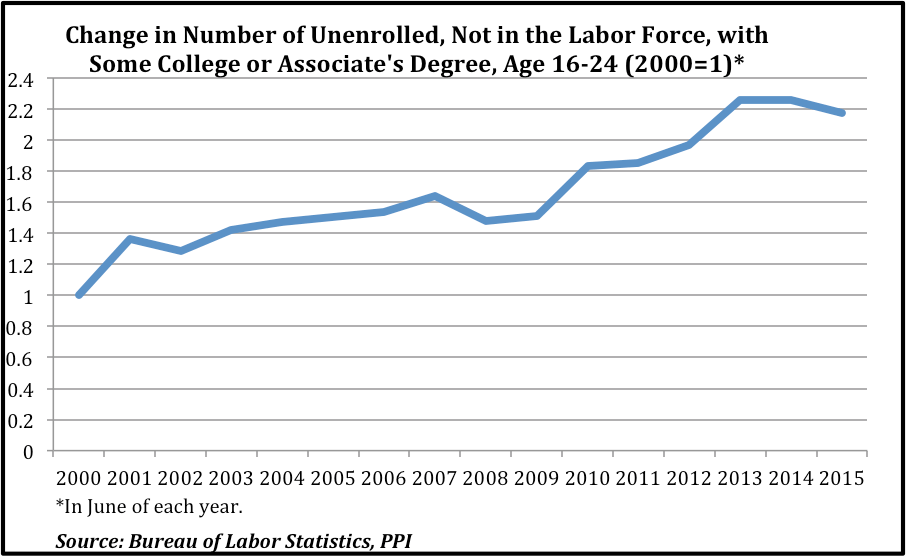
The implication is that we need better workforce preparedness options for those without a college degree, not simply debt-free college. The policies that comprise “debt-free college” merely throw more resources at propping up the current higher education system. For Bernie Sanders, that means free tuition. For Martin O’Malley, it means regulating tuition and expanding federal grants to schools and students. For Hillary Clinton, it’s just a conceptual endorsement that everyone should graduate college, and without debt.
Such policies are short-sighted. Rising student debt is a symptom not of inadequate federal funding, but of a broken federal financial aid system and of a higher education system in need of a shake-up. Greater transfers of money from taxpayers to students and schools will only exacerbate the challenges young people face in today’s labor market, by discouraging needed innovation in higher education. It quickly turns into an expensive and inefficient way to match workers with jobs.
Indeed, with the falling costs of information-sharing, thanks to the proliferation of high-speed broadband, and promising rise of innovation in education technology, there should be a downward pressure in college tuition. And with more people than ever graduating college, we should see an overall rise in real earnings. Yet college costs continue to rise at a faster pace than inflation, and the real earnings of young graduates have fallen 12% in the last decade.
By perpetuating the status-quo, policies that comprise debt-free college will not enhance opportunity and social mobility for those who need it – it will only widen the gap between young Americans with and without a degree. The barriers to innovation in higher education will remain, along with a lack of incentive to provide higher education more efficiently and effectively. Instead of introducing productivity-enhancing reforms to deal with rising enrollments and falling state funding, such as customized education or hybrid learning, higher education institutions can continue to use federal student aid to fill budget holes. In fact, groundbreaking new research from the NY Federal Reserve directly ties increases in federal student aid eligibility to increases in tuition.
Without serious reform, we cannot possibly hope to realize the enormous potential coming from the tech sector to transform the design and delivery of higher education and workforce training. Happily there is promise for real progress: a Senate HELP hearing last week focused on need for breaking down barriers to innovation in higher education. Still, until Democrats move past the “debt-free college” approach, and the notion that college degrees are the only answer, 2016-themed rhetoric on college affordability will be little more than that.
*Note: Enrollment and labor force figures in June have been comparable with those in July over time, for those who are interested in complete mid-summer analysis.

