EXECUTIVE SUMMARY
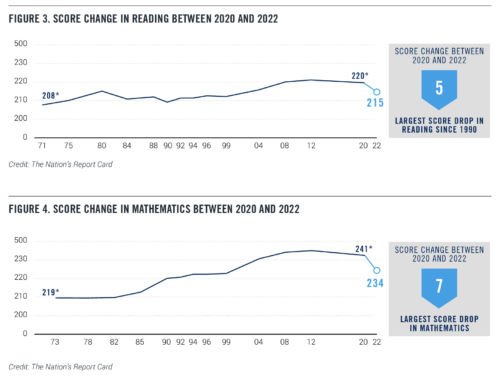
In August, the National Assessment of Education Progress (NAEP) released the grimmest “Nation’s Report Card” in 20 years. Between 2020 and 2022, America’s students dropped five points in reading and seven points in math. That bad news almost — but not quite — drowned out the summer’s other major, alarming education news: Teachers, burned out or just plain disgusted, were quitting in droves. As the predominant narrative went, many of the nation’s classrooms might be leaderless come fall.
It’s common knowledge that effective, committed teachers are critical to students’ success. At a time when there is empirical evidence that America’s students are struggling — the NAEP scores are just one indicator — it seems timely to take a deeper dive into the widely reported teacher shortage. One needn’t look very far to find many indicators that our current systems of public schools are not serving teachers well. There is no reason to think things will improve (i.e., increased teacher job satisfaction, increased teacher retention, revived talent pipelines, etc.) unless there is an evolution in the underlying systems where teachers work.
This report will examine the current teacher shortage. There is controversy about its severity and data is missing from several states. There is, however, a plethora of data to learn from regarding teachers’ attitudes toward their profession. Not surprisingly, one thing that teachers have often complained about, micromanagement or, put another way, lack of autonomy in the classroom, remains an issue.
But not all teachers work in school settings where their judgement is distrusted or their opinion is unwelcome. Schools that operate independently from a traditional central district office “command and control” model often place more authority in teachers’ hands and more value on their opinions. In some instances, this behavior is the natural result of freedom from central office edicts and the corresponding independence to engage in school-based decision-making. After all, if decisions are being made at the school level, input from the school’s members is a resource too valuable to dismiss.
In still other cases, “teacher power” is a feature of a school’s mission and vision. At the conclusion of the report’s discussion about the teacher shortage and teachers’ job dissatisfaction, we will make the case that America’s traditional “top down” central office model has outlived its usefulness. Given teachers’ perennial unhappiness about being micromanaged, the teacher shortage offers one more reason to move away from it now. The report will also suggest and describe three models of autonomous or semi-autonomous schools where the current teacher shortages have reportedly not been so keenly felt.
Finally, the case will also be made for evolving the nature of more American school systems into a “portfolio model” so that more teachers have the opportunity to flex their autonomy. In school systems that are already successfully engaged in this work, the districts’ central offices place more emphasis on accountability and performance rather than daily micromanagement of its schools’ classrooms. Expensive, alternative schemes currently underway to recruit and retain teachers are also offered for comparison.
Finally, the report will examine some common roadblocks (and some pragmatic strategies to get around them) to creating 21st century autonomous schools. These schools are more likely to provide teachers with enhanced opportunities to innovate in the classroom in the quest of student success. Given the Nation’s Report Card and other serious fallout from our response to the pandemic, there is no time to lose.
I. THE 2022 TEACHER SHORTAGE
The national outcry over teacher shortages was earsplitting by the time nearly 50 million American schoolkids trekked back to the classroom for the 2022-2023 school year. America’s teacher shortage is widely portrayed as a code red crisis that will get worse before it gets better.1 The nation’s largest teachers union, the National Education Association (NEA), claims that the country is short 300,000 teachers. The Wall Street Journal quoted one New Jersey school district human resource director who characterized competition between districts for teachers as a “dog-eat-dog” struggle. The fear and outrage sparked by the prospect of leaderless classrooms across the country is a clear indicator that systemic change is needed — even if the teacher shortage is exaggerated.
To be clear, even one shortage of a qualified teacher that shortchanges a child’s education or makes another educator’s workload more burdensome is a real problem. But there is also skepticism about the narrative around the severity of current teacher shortages. Recent data from a RAND Corporation survey indicates that while two-thirds of public school districts expect shortages this school year, 58% of them characterize their teacher shortages as “minor.” In short, it appears that the jury is still out. Despite the popular media’s embrace of the teacher shortage “catastrophe,” education researchers and writers say there is a lack of granular government data on a countrywide teacher shortage. District Administration reports that just 19 states have released teacher vacancy data for the 2021-22 school year, and only 13 have information for the 2020-21 school year.
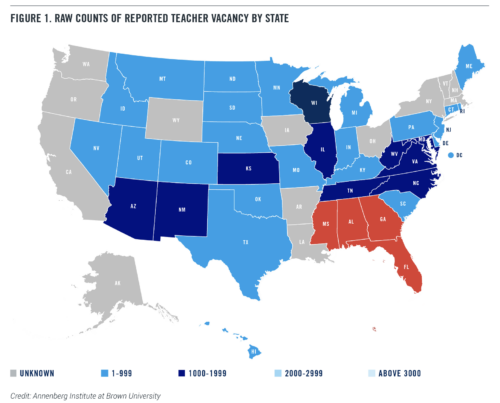
The Annenberg Institute at Brown University spearheaded research on the shortage controversy, producing a 76-page report released in August 2022. The report includes a map raw counts of teacher vacancies by state. Nine states are shaded in grey, which indicates no official data was available from those states’ education departments — including the country’s most populous state, California, and its fourth most populous state, New York.

The incomplete data Annenberg crunched (through no fault of its own) indicates the country’s most severe teacher vacancies are in the South. But it’s more nuanced than that. Even in states with relatively lower teacher shortages, there are major variations between districts with similar student demographics.
For example, on Annenberg’s map, Connecticut shows relatively low teacher vacancies. But in the state’s urban capitol, the Hartford Public School District, which has 91.8% minority students, of which 61.8% are low-income, had filled only 86% of its teacher positions by midAugust. It reported large numbers of vacancies in special education, speech and language, math, English and elementary education. Michigan is also a “low” vacancy state, but in urban Detroit, the Detroit Public School District, which has a student population that is 97.6% minority and where 78% of students are eligible for “free or reduced lunch,” was fully staffed when classes started in August.
Given disparities in salaries, cost of living, and the robustness of local teacher pipelines, it’s not surprising that teacher shortages — like the weather and politics — vary widely from place to place, even when school districts otherwise share similar characteristics.
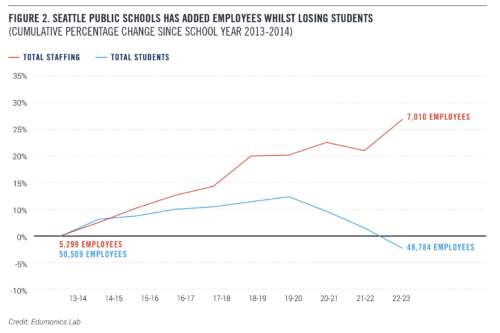
Some researchers also suspect this year’s teacher vacancies are inflated due to some districts adding additional positions funded by COVID relief dollars. RAND researcher Heather Schwartz told the Hechinger Report that 77% of schools went on a hiring spree in 2021-22 as $190 billion in federal pandemic funds started flowing, according to a survey RAND released in July. Among those is the Seattle Public Schools (SPS), where, despite a dramatic decline in enrollment, the district’s staffing is at its highest in nearly 10 years, including 462 added teaching positions during that period.

For the 2022-2023 school year, SPS has budgeted for an additional 501 teacher aide positions, at the demand of its teachers union. But even that wasn’t enough to keep the teachers in the classroom. The union went on strike on what would have been students’ first day of school.
II. TEACHER DISSATISFACTION
This, perhaps is the crux of the matter. While hard data on teacher vacancies is spotty — a state of affairs that should be rectified — teachers’ state of mind is pretty clear. Survey after survey demonstrate many teachers are disillusioned by working conditions in our nation’s school districts. Teachers’ attitudes about their jobs may be even contributing to a vicious cycle exacerbating the teacher shortage problem. After each survey, the media trumpets the miserable nature of today’s teaching profession. In fact, 74% of teachers surveyed say they would not recommend the profession to others. Couple the media coverage with rhetoric from union leaders who claim nearly uniform mistreatment of teachers, and it’s no wonder young people are choosing any career but one in a K-12 classroom. This, however, doesn’t mean that classroom teachers’ unhappiness is manufactured, or should not be addressed with systemic change.
Consider: A Merrimack College Teacher Survey commissioned by EdWeek Research Center in early 2022, found that only a little more than half of teachers are satisfied with their jobs, and just 12% said they’re “very satisfied” with their jobs. An American Federation of Teachers’ (AFT) survey of its union members in June painted an even bleaker picture, with only 2% reporting high job satisfaction. A full 74% described themselves as dissatisfied, with 46% reporting “high” job dissatisfaction.
Both job satisfaction studies also included, among other concerns, teachers’ attitudes about salaries, poor student discipline, and the degree of control or autonomy their jobs afford them. Teacher autonomy refers to teachers’ self-direction, capacity, and freedom, which are often limited by institutional factors in traditional school districts. With regards to autonomy, only a third of teacher-respondents to the Merrimack study said they have much control over their school’s policies, and only 57% said they have a lot of control over the curriculum they teach.
In a separate May 2022 AFT survey, teachers were specific about the types of restraints that add to their stress on the job. For example, 60% cited a lack of autonomy to select the supplies and resources needed for their classrooms as one of their biggest challenges as educators.
An employer’s trust in an employee is usually a prerequisite to a grant of autonomy; HR Daily advises that trust can also go a long way toward building employee satisfaction and loyalty, thus improving retention. Yet, in AFT’s June survey, 88% of respondents complained of not being given “the trust needed to meet their professional responsibilities.”
The link between teacher job satisfaction and autonomy is not exactly news. A 1997 National Center for Education Statistics statistical analysis report found that 86.9% of elementary teachers and 77.3% of high school teachers who describe themselves as “highly” or “moderately” satisfied agreed with the statement that “Teachers in their school have a great deal of influence over school policy.”
Current public education leadership at the very top is also clued in to the correlation between teacher agency and teacher stress. During a September 1, 2022, “back-to-school town hall meeting,” U.S. Secretary of Education Miguel Cardona declared that schools need to improve working conditions, including ensuring that teachers have agency and autonomy. Secretary Cardona emphasized, “They are professionals; let’s start treating them like professionals.”
During that same town hall meeting, many of the panelists spoke of the need for America’s teacher to be treated with “more respect.” Miriam Webster defines respect, in part: “to refrain from interfering with.” A study by Swedish researchers from Uppsala and Stockholm Universities published in Current Sociology in 2012 drilled down further, concluding, “The overall impression from our analysis is that participants viewed respect as [behavior] primarily targeted at another person’s ascribed agency.”
Yet, too many traditional school systems seem oblivious to the fact that nobody in their right mind would love working in a place where their agency is disrespected while at the same time, they are held accountable for things over which they have no control. Districts that have failed to respond to teachers’ oft-expressed desires for more professional agency and autonomy should not be surprised, in this tight labor market, that they are struggling to retain educators. Mass teacher resignations — NEA says 55% of teachers say they are within a hair’s breadth of quitting — would indeed plunge our schools into crisis.
III. THE CRITICAL NEED TO SOLVE THE TEACHER MORALE PROBLEM
Teachers’ job satisfaction is an important policy issue because teacher satisfaction is associated with teacher effectiveness, which ultimately affects student achievement. To f ix America’s teacher morale problem, the school district norm of top down, centralized control over classroom practices needs to evolve, pronto. Even if teachers don’t outright quit (researchers tell The Atlantic that for every three teachers who tells a pollster they want to quit, only one actually does), miserable, frazzled teachers likely aren’t very effective in the classroom.
Unfortunately, there is irrefutable proof that education labor disruptions during two and a half years of pandemic have taken a terrible toll on students’ learning. In early September, the National Assessment of Education Progress (NAEP), or as it’s more commonly known, “the Nation’s Report Card,” released the first test scores since COVID-19 disrupted America’s classrooms. The report card assesses basic skills among nine-year-old students, comparing that age group over long periods of time. The 2022 results were historically bad, as seen in Figures 3 and 4.

With 20 years of educational progress wiped out, we cannot tolerate any condition in the classroom that might create more erosion of student achievement. One solution to this problem is to create more autonomous public schools that grant teachers more authority in the classroom as well as a greater say in shaping school policies — and ensure strong accountability measures for such schools. The federal government sent $190 billion in COVID recovery dollars to America’s public schools. Much of it has yet to be spent. Accelerating a reimaging of the traditional school district model into a decentralized, portfolio model of independent schools would be a good use for some of it.
IV. CENTRALIZED COMMAND & CONTROL: A MODEL THAT HAS OUTLIVED ITS USEFULNESS
The great irony here is that while teachers yearn for more autonomy, their unions often stand in the way of their getting it. Union contracts largely determine both the major policies and the minutia of how school districts operate their schools — often down to bell schedule and the number of teaching minutes permitted in the school day. Such bargaining agreements are at the heart of the model that keeps decisions both large and small centralized in district central office bureaucracies. A more professional, pragmatic scheme would be to empower local school employees — the people who see students day in and day out — to do what’s best to optimize teaching and learning.
Consider that the central district office “command and control” organizational structure is virtually unchanged since the late 1800s. It rarely permits school principals to choose their own teaching staff and classroom curricula. Instead, the central office issues binding rules that regulate almost all school policies and operations, including critical policies around hiring, retention, teacher placement, and curriculum mapping. No doubt it’s easier for a local bargaining unit to negotiate with a single school district board rather than individually with the leaders of dozens of schools in that district. But the collateral damage from this centralized model is hamstrung school principals, unhappy, stifled teachers, subpar academic outcomes for students, and a lack of choices for parents.
If one accepts the oft quoted definition of insanity as “doing the same thing over and over and expecting a different result,” it makes no sense to try to return America’s public education systems to their lackluster pre-pandemic status quo. The proof points are in: teachers say they are desperately unhappy, student learning has severely backslid, and the disastrous response to the pandemic has eroded parents’ trust by epic measure. Parents are voting with their feet, causing traditional school district enrollment to plunge – which is a harbinger of financial woes ahead. Even the $190 billion Washington D.C. poured into K-12 education likely can’t fix all of that if the underlying organization of our school systems don’t change.
A better use of federal dollars, in part, would be to aid in the rapid adoption of alternative models, that have already proven they can prevent or even reverse a downward spiral. It will require a willingness, courage even, to innovate and to relinquish centralized power. Such reforms have already been implemented with success in cities as diverse as Indianapolis, Washington D.C., New Orleans, and Denver, among others.
V. AUTONOMOUS SCHOOLS: AN OPPORTUNITY TO REINVENT PUBLIC SCHOOLS
If we want to make teachers happier and more effective in the classroom (and we should — RAND research shows that teachers are estimated to have two to three times the effect on students of any other school factor, including services, facilities, and leadership) now is the moment to seize the opportunity to move away from the antiquated, overbearing command and control model of school management, and evolve into the portfolio model of independent schools that are both more easily adaptable to changing times and that afford educators more flexibility to innovate in the classroom without central office interference. These benefits are in addition to those that school systems’ end-users — students and parents — would experience from having a variety of autonomous schools with a diversity of models and programs from which to choose the best fit. And principals and teachers would have bigger variety of workplace cultures from which to select their best fit, too!
We should start with by embracing the notion that principals need autonomy to hire the best teachers they can find, rather than having to make do with teachers randomly forced upon them by a distant central office. This would empower principals to lead a staff that is bought into his or her school’s mission, strategies, and goals for its students. In other words, teachers who really want to teach in that particular school. There are a variety of autonomous school models. What they have in common is freedom to empower teachers. And when those teachers are given true control of their classrooms and the respect that comes from having a voice in school policymaking (along with decent pay and benefits, of course) teacher retention likely won’t be as problematic as it now is. The profession will look a lot more professional, and perhaps the pipelines will begin to fill more naturally once more.
Teacher-Led Schools: Power, Autonomy and Respect
One intriguing model is teacher-led or “teacher-powered” schools. Teacher-powered is a type of school governance structure where teams of educators are entrusted with the autonomy to design, create, and make final decisions in areas impacting student success. Among these schools, there is no one way to “do” or “be” teacher-powered. Many have formal leaders such as principals who help coordinate the team; some do not. Many have teachers in a union; others do not. Some are district schools; others are charter schools. Some make most decisions as a full team; others divide up their decisions among staff positions or committees. Each school looks different because each team has found a form of teacher-powered that works for their students, educators, and community.
Education Evolving is a Minnesota-based nonprofit that has helped more than 250 schools in 20 states implement the teacher-led model. Education Evolving helps its member schools’ staff fully understand the autonomies their school has from normal from district policies, and trains teachers how to use them to make classroom learning more effective. The vast majority of Education Evolving schools use project-based learning and have a focus on social justice. The organization says many teachers choose to work for its teacher-led schools because they want to teach in schools that consciously seek to meet student needs that district schools weren’t meeting. The result is more empowered teachers teaching in more rewarding environments, less frustration and burnout, and stronger intent to stay in the profession.
Education Evolving is currently conducting a teacher retention study from 2017 through this summer. So far, the patterns indicate that teacher-led schools in places as far flung as Ypsilanti, Michigan, Portland, Maine, and San Diego are seeing only a “slightly” higher turnover this summer than normal. As Executive Director Amy Junge put it, “A school that might normally have zero turnover might be seeing one teacher retire.” That compares favorably to turnover at the traditional schools in the districts they sit in.
For example, since 2019-2020, the number of teachers in San Diego County has dropped by more than 8,000 countywide. At the start of the 2017-2018 school year, 2,420 new teachers entered classrooms in San Diego County. At the beginning of the current school year, those same districts had been able to hire just 1,858 new teachers.
In the state of Maine, as of late August, more than 200 teachers were employed in the state’s public schools on an “emergency certification” basis as a stop gap measure to fill open positions. But the state’s first teacher-led, teacher-governed school, Portland’s Howard C. Reiche Community Elementary School, had only one opening — for a custodian. By contrast, districtwide in July, Portland was advertising for 24 teachers and educational technicians and 15 student support positions. Every traditional school in Portland’s 6,523 students district except one was short at least one educator.
Junge says the key is giving teachers power through “collective governance” that determines important school-based decisions. In other words, teachers are treated as professional partners to school administrators through a democratic process where they vote on decisions about school policies and classroom practices. In some schools, teachers’ autonomy might mean they have decision-making authority over three or four policies; in other places, teachers might have authority over as many as 15 policies. In all cases, however, the teacher-led schools have returned to the original philosophy that fueled the charter school movement: Decisions that affect school policy should be made as close to the educator as possible.
In the student-centric model that Education Evolving supports, teachers are attracted by the practices that focus students’ academic needs and their socioemotional health, according to Junge. She described teachers as feeling effective and empowered by having control to ensure they can adapt those practices as needed to have a positive impact on their students.
“In our schools our teachers are respected,” Junge said. “Teachers know that they are the education experts and we naturally turn to them for answers, just like we would a doctor for a medical question or a lawyer with a legal problem.”
The teacher-led, student-centric approach should be music to the ears of parents frustrated by overly-delayed COVID-era school re-openings that were, ever more obviously as time went by, more closely linked to the power and influence of union leaders in a given location — Los Angeles and Chicago come to mind — than they were to virus‐related safety concerns. It’s no surprise, then, that the Los Angeles Unified School District’s non-charter schools lost about 43,000 students over the past two school years. Enrollment in the Chicago Public Schools (CPS) dropped by about 25,000 during the same period. In 2019, according to the Chicago Tribune, CPS had a 14:1 student teacher ratio.44 If that’s accurate, that’s 1,785 teachers who would theoretically no longer be needed.
Semi-Autonomous Schools
The “portfolio district” model is another way to decentralize school district management that is being implemented in various locations across the country. Similar to charter schools, some schools in portfolio districts operate autonomously, to varying degrees depending on location. These autonomous or semiautonomous schools are known by a variety of names: innovation schools, renaissance schools, iZone schools, 1882 schools, and so on. In some places they remain zoned neighborhood schools that only accept students from outside the zone if there is a surplus of seats. In other places they are schools of choice open to any student who opts to enroll, using lotteries to determine admission when there are more applicants than seats.
Both the key and the commonality to the model is that while these schools have the autonomy to make most decisions at the school and classroom level, rather than being dictated to by the central office or school board, they remain part of the district, usually in a district building. As a result, when these schools improve, they lift the district scores as well.
The current “gold standard” for these schools is the Indianapolis Public Schools’ (IPS) innovation schools. There, the school district office has given up much of its traditional role in setting policy at the school level. The district office — and through it, the school board — instead act as partners to IPS’s portfolio of independent schools. IPS also performs the critical function of holding those autonomous schools accountable for improved academic performance and sound financial management of district funds. It can, and has, declined to renew operating agreements with schools who fail to meet their performance metrics.
CASE STUDY
Innovation Schools: Keeping Teachers Motivated and Improving Student Outcomes
The teacher-led approach in Education Evolving’s member schools — which are a mix of district, semi-autonomous innovation schools, and charter schools — is not the only model that is showing high teacher retention rates. A small network of autonomous innovation schools that are part of Texas’ Fort Worth Independent School District (FWISD), the Leadership Academy Network (LAN), also had little trouble filling its teacher ranks with qualified educators during the COVID era.
A partnership between the FWISD and Texas Wesleyan University, LAN is not controlled by FWISD’s school board or superintendent, but rather, it answers to an advisory board selected by its managing partner, Texas Wesleyan. LAN’s Senior Officer was allowed to hand pick her principals, who, because of their dynamism and drive, attract all sorts of talented people who want to work for them.
To ensure that teachers’ job satisfaction (and their drive to meet improved student outcome requirements) didn’t waver during difficult recruiting times, LAN adjusted its budget and schedule to give the teachers a full half day of collaboration time each Friday afternoon. Gathered together, without students to monitor, LAN’s teachers compare notes about teaching strategies, plan for the next week’s demanding pace, and recharge each other’s batteries. These sessions also put teachers squarely in front of school leaders, where they can voice concerns and ideas. Called “Everybody Grows,” the time is made possible because LAN’s autonomy gives it the flexibility to partner with external affiliates — artists, dance studios, theaters, museums, zoos, etc. — who rotate in and out to keep students busy and engaged with enrichment activities while teachers collaborate.
Because of its autonomy from the district, LAN also had the flexibility to become an early adopter of the state’s new “Teacher Incentive Allotment,” program, which provides state-funded teacher bonuses to schools who implement a merit-based, Texas Education Agency (TEA) approved teacher evaluation system. More and more Texas school districts are now gravitating to that pot of state money, but being able to bump teachers’ salaries on the state’s dime early on gave LAN a competitive advantage to recruit and retain top teachers when it was most needed.
The LAN prioritizes hiring highly-qualified teachers because its mostly low-income, minority students were academically far, far behind and it takes talent to turnaround low-performing schools. In fact, the TEA had rated all six LAN schools as “Improvement Required” (IR) for a number of years. One of them was IR seven out of the eight years leading up to the turnaround project. When FWISD embarked upon the turnaround initiative, at one elementary school, third grade reading proficiency was at just 7%, and at three others, 21% or fewer third grade students were reading at grade level.
Now, based on 2021-2022 test scores, all LAN schools have achieved enormous academic growth, with every campus rated an “A” or “B” (except for one, which the TEA did not rate). The schools’ TEA ratings met or exceeded the performance requirements set by FWISD as a condition for LAN’s continued autonomy. Black and Hispanic students did particularly well. For example, at the Leadership Academy at Mitchell Boulevard, 96% of African American students met or exceeded the State of Texas Assessment of Academic Readiness (STAAR) Progress Measure in reading, and 92% of those students did so in math.
Hispanic LAN students also showed greater gains in the percentage proficient at grade level compared with their peers across Texas. Statewide, there was an 8% increase in Hispanic students meeting grade level proficiency in math. At LAN, the increase was 17%. For reading, there was a 9% increase in the state’s Hispanic students proficient at grade level; LAN had an increase of 12%.
FWISD Superintendent Ken Scribner credits “incredible” teachers for their students’ growth, while LAN’s Senior Officer, Priscilla Dilley gives credit to the expertise and resources provided by managing partner Texas Wesleyan University. She also heaped praise on her highly motivated educators. Dilley said, “They went to extraordinary lengths to keep students up to speed during remote learning — designing easy-to-navigate online lessons, providing packets for scholars who struggled with virtual learning, and staggering lessons to accommodate families with limited internet connectivity.”
Autonomous Charter Schools
The oldest and best known model of autonomous school are fully independent public charter schools. These free, publicly funded schools operate independently from the school board. They abide by all federal and state regulations, and are required to follow state academic standards. However, they are free to select their mission and model. And the best ones really do have a mission they adhere to, whether it’s college readiness, career and technical education, STEM focused, dual language immersion, arts integrated teaching and so on. Some are culturally relevant schools, such as those designed for Native American children. Others design their programs for a specific population, for example: high school students who are already parents themselves or students who already know they want to pursue a specific career path like nursing.
Whatever their model, public charter schools are usually governed by their own boards of directors, and they must meet the performance metrics in their charter — academic achievement, fiscal accountability, enrollment diversity targets, etc. — in order to have their charter renewed by an authorizer empowered by the state. In states that have a rigorous authorizing and charter renewal process, (Colorado, Minnesota and New York, to name a handful) the result is highly accountable schools. These schools offer parents choices to match their child with a school that can meet their needs better than a cookie-cutter, one-size-fits-all centrally-operated district school.
Charter schools are so popular with parents that many have long waiting lists for a seat. This year, the New Jersey Charter School Association reports 60,000 charter school enrollees, while 20,000 additional students languish on wait lists. North Carolina’s Annual Charter School Report says that 73% of the state’s charter schools have waiting lists, while 70 out of 78 charter schools in Massachusetts have waiting lists totaling about 18,000 individual students.
VI. ROADBLOCKS TO AUTONOMY
Unfortunately, teachers’ unions greet most autonomous public schools — regardless of the model — with skepticism if not outright hostility. For example, in an effort to cap charter school growth, the United Teachers of Los Angeles (UTLA) in 2019 staged the first strike in that city in 30 years. Teachers picketed for six days until the district agreed to ask state lawmakers to impose a moratorium on new charter schools in the area. During COVID, UTLA demanded that charter schools be shut down as a condition for re-opening traditional district schools to in-person learning. (District officials refused to meet that demand.)
While unions have historically provided teachers with support and voice in their workplaces, they should modernize to better meet the needs of the workers they currently represent. By opposing non-traditional school districts and innovative teaching models, they may be losing talent that they can’t afford to lose. If teachers quit legacy public schools in droves, parents will have no choice but to turn to alternatives such as private schools, public charter schools, homeschooling, or remote learning. In fact, that’s happened throughout the pandemic.
Today 1.2 million fewer students are enrolled in public schools nationwide than when the pandemic began.65 Meanwhile, public charter school enrollment increased during the 202021 school year in at least 39 states, growing by nearly a quarter of a million students. In 18 states that shared data through the current school year, the number of homeschooling students increased by 63% in the 2020-2021 school year, then fell by only 17% in the 20212022 school year — for a net increase of 46% of homeschoolers. If the trend continues, the unions could see their membership decline.
All of this is evidence that rather than blindly propping up a trouble status quo, all of the relevant K-12 education decision makers — school boards, superintendents, labor leaders, state legislators, and parents — should embrace modern, innovative school models organized around the principles of parental choice, autonomy and accountability for results. There’s a twofold opportunity for traditional school districts here: first, to demonstrate to teachers that their mental health and happiness matters to district management; and second, to embrace the still-important role of being the entity authorized to set broad educational policy, while shedding the never-ending challenges of micromanaging individual classrooms.
VII. (EXPENSIVE) ALTERNATIVE SOLUTIONS
While Texas officials structured their Teacher Incentive Allotment bonus program (see case study, above) to be financially sustainable, many states are spending buckets of money, at least in the short term, to lure new teachers. For example, several districts in Michigan are offering teachers $10,000 “signing bonuses.” But that type of one-time windfall is not guaranteed to hold teachers in the longer term in places where the cost-of-living is increasingly exorbitant. For example, Colorado’s teacher salaries have increased by 25% over the past seven years. Yet today, only one in five teachers who educate Colorado’s 900,000 students can afford to own a home there, and rental housing is rapidly becoming increasingly unaffordable across the state.
That problem has led some similarly situated communities to get creative. In California’s pricy Silicone Valley region, Jefferson Union High School District in Daley City routinely lost a quarter of its 500 teachers each year. In an attempt to retain more teachers, the district in 2017 came up with a plan to build a $75 million housing complex for teachers and staff to encourage them to stay in the district. The housing is not free, but rents are scaled to employees’ salaries so that they can live within walking distance to work in a community they otherwise could not afford.
Texas’ Rankin Independent School District, which is not too far from Odessa (by Texas standards), is also using housing as a strategy to recruit and retain teachers. This November, voters will be asked to approve a $123 million bond that would, in part, support building or buying 10-to-12 houses per year over the next 10 years for teacher housing.
In another instance, a teachers union even pitched in. In partnership with the state, the AFT helped open “Renaissance Village” housing for teachers in Welch, West Virginia, so that teachers could live close to schools in a poor community that was devastated by the shuttering of local coal mines.
Rather than just focusing on strategies to retain current teachers in the district, other places are reaching far, far outside district borders — and the nation’s — to recruit talent. Nevada State Superintendent of Public Instruction Jhone M. Ebert revealed during a recent Education Commission of the States’ webinar that her office is recruiting from multiple foreign countries to bring teachers to Nevada on U.S. J-1 visas, which are visas designed to promote educational and cultural exchange. She said that other sectors such as engineering and tech “routinely do this” when they can’t find enough qualified American workers. Since there are not enough teachers to go around, these foreign educators can hardly be accused of taking American jobs.
And there are organizations active in trying to help schools meet their students’ human capital needs. One such organization, Global Educator, has created a teacher pipeline in partnership with the Mexican state of Guanajuato, which is home to several colleges of education and has an abundance of under-employed, bilingual teachers. Global Educator is facilitating J-1 visas for school teachers to temporarily come to the U.S. to fill gaps, then matching them with districts, public charter schools, and private schools that are experiencing shortages. It also provides bilingual, Mexico-based remote teachers and tutors to schools who need an affordable strategy to combat teacher shortages.
Employing these teachers, who have a far lower cost of living south of the border, for tutoring or extra lessons via live video sessions is a strategy for short-handed schools to bulk up their ranks as they seek to accelerate students’ recovery from COVID-era learning loss. The strategy can be especially effective for students who speak English as a second language and may only hear and speak Spanish at home.
There is a point to cataloging a few of the creative, sometimes expensive and complicated strategies that education agencies are embarking upon in this period of teacher shortages. That point is that it costs nothing to grant teachers and teacher leaders more autonomy to innovate. It’s also worth noting that desperation in some places has resulted in some questionable schemes, like Arizona’s plan to let schools hire high school graduates as public school teachers without a college degree, for example.
While autonomy, authority and respect are free, in Michigan — where the teachers unions are strong — the new education budget includes $430 million for various teacher recruitment plans, including grants, a “grow your own teacher” project, and so forth. In Tennessee, which is short 2,000 teachers statewide, the Tennessee Department of Education is partnering with the University of Tennessee on a $20 million teacher pipeline project.
High quality teacher development pipelines are an important investment that is urgently needed in the U.S., but there is also some pressing public relations work to be done to drive significant numbers of students into these new programs.
Teachers unions — especially during contract negotiations — habitually paint teachers as overworked and underpaid. They claim that teachers are routinely disrespected by school district management, parents, students, and society at large. The near hysteria over “teacher burnout” during COVID has resounded in every corner of the nation for more than a year. Many of the complaints are highly credible — there is no doubt some teachers have been attacked in the recent, Republican ginned-up culture wars over masking, “critical race theory,” and book banning. And America’s underinvestment in teacher salaries and school infrastructure far predates the pandemic-era, even becoming a topic for Congressional hearings, to little avail. But the unions habitually present these very real problems as affecting every teacher in every school, which simply cannot be the case.
When inundated with continual hyperbole, why would young people, in the numbers needed nationwide, turn to the “miserable” profession of teaching?
VIII. LEGISLATING PROGRESS: NUDGING STUBBORN DISTRICTS IN THE RIGHT DIRECTION
Some state legislatures have taken matters into their own hands — mandating or incentivizing school districts to innovate to improve perennially substandard schools. Today, Indiana’s statute is considered by many to be the best legislative guidance for implementing the autonomous portfolio school model because its autonomous schools program provides a blanket grant of autonomies to innovation schools. However, Texas gets extra points because its statute comes with extra funding from the state.
Known as the “1882 schools” after the 2019 Texas Senate Bill that created the funding stream, the legislative intent of the bill, in part, is to encourage districts with struggling schools to partner with qualified, independent education nonprofits. The legislation directs districts and the nonprofits to enter a contract whereby the nonprofit assumes day-to-day school operations in order to improve them.
Once the TEA approves the 1882 partnership — by ascertaining that the autonomies the district is granting to the nonprofit are a sufficient relinquishment of district control — the district qualifies for extra per pupil funding. In cases where the goal of an 1882 is turning around a struggling school, the extra money from the state is specifically intended to support the turnaround effort. The Texas legislature wisely recognized that school improvement can be very expensive to sustain, especially when students need an extended school day and year, or extra wrap around services.
Happily, more states are adopting this type of portfolio model. Most recently, in July 2022, the New Mexico Public Education Department announced it is starting an “innovation zone” pilot project for 20 high schools across the state, where “the traditional education model will be transformed to improve the high school experience and academic outcomes to best serve the local community.” The schools accepted into the pilot project will be provided with additional flexibility to shift to a Career and Technical Education (CTE) focus, should they determine that is a better fit for the families they serve. While this program is brand new, it follows that the fledgling innovation zone schools will have autonomy to select teachers that meet the schools’ new missions.
New Mexico’s new initiative demonstrates that education agencies and organizations don’t necessarily need to wait for the state legislature to act before turning to autonomous innovative options for students and teachers. While a state law that guarantees and protects innovation schools’ autonomies is a “best practice” scenario, the idea of forging ahead without waiting for the legislature to act is not new.
In the case of the previously discussed teacher-powered Reiche school in Portland, Maine, teachers saw an opening and grabbed it. Reiche’s successful and popular school principal departed in 2011, leaving behind a results-oriented, turnaround school culture. Teachers didn’t want the district to assign a new principal who might implement a sea change that would possibly drag the school backward, so they appealed to the district to become a teacher-led school.
Operating at first under a Memorandum of Understanding (MOU) with the Portland School district, Reiche became not only the first teacher-led school in the state, it also became the nation’s first existing school in the country to convert from a traditional district to an independent, teacher-powered school.
According to teacher-leader Dave Briley, who has been at Reiche since its transformation 11 years ago, what makes both the school’s academic success and its democratic management model sustainable is Reiche’s teachers’ autonomy to control hiring and retention. In an interview, Briley described the teachers’ accountability to one another as a far more powerful force than any top-down accountability that could be imposed by a board or a superintendent. In a culture of such strong accountability, Briley said, “We are upfront about it — we make job applicants ‘sip the Kool-Aid’ so they know what they are getting into and are comfortable with it before we consider hiring them.”
Reiche no longer uses an MOU to define its relationship with the district. Maine passed an innovation school statute in 2014, which is a best practice recommendation for regions new to autonomous innovation schools. Maine’s statute means Reiche is now protected from whims of both the local and state school boards, whose makeups will change periodically and could become filled with anti-school choice members who might strip the school’s teachers of the autonomy and authority they’ve enjoyed for more than a decade.
This happened in the Denver Public Schools (DPS) after the teachers union invested heavily in successive school board election cycles. As a result, the union-endorsed DPS school board spent much of the 2021-2022 school year trying to strip DPS’s innovation zone schools of their hard won autonomies. Specifically, the Board passed a measure that prevented innovation zone schools from opting out of the teachers union contract as they have been able to do for many years. Ostensibly, this was to prevent teachers from being “overworked during the pandemic.” However, the DPS innovation zone schools weren’t clamoring for such an action — the union was. After strong pushback from teachers, parents and even some district staff, the Board has walked back some of the more odious provisions of the regulation, but damage was done. Colorado’s innovation school statute, passed in 2008, prevented the DPS Board from doing even more.
This is why Indiana’s innovation statute is the gold standard. It flatly guarantees innovation schools a blanket grant of autonomy from the district — there is no wrangling over “this autonomy” as opposed to “that autonomy,” and so on.
Legislators who have gotten an earful from parents who are angry about how school districts managed instruction during the pandemic or who are concerned about perennial teacher shortages should consider seizing the opportunity to respond by introducing an innovation school bill. If a state already has an autonomous school statute, consider legislation to amend it to require a blanket grant of autonomy, like in Indiana. Passing a state innovation school statute is a way for state lawmakers to take decisive action to support both families and teachers. If a district stubbornly refuses to give up control of substandard schools or refuses to listen to a majority of teachers in a particular school who want the authority to lead their school — or if the unions won’t allow the district to act — an innovation statute can force pragmatic change.
Passing such bills would kill two birds with one stone: It would further professionalize teaching by creating more schools that afford teachers autonomies to make adjustments and have more credibility with students; and it would mean happier teachers in the classroom, which just might keep more students in public schools. This should be an appealing proposition in many, many districts where parents are “voting with their feet,” and dragging enrollment down.
CONCLUSION
The debate is still on about the seriousness of America’s current teacher shortage, but there is no doubt that our teacher pipelines are insufficient. Even the White House recognizes the problem, and has recently undertaken new efforts to strengthen the teaching profession and support schools in their effort to address teacher shortages.
District and state teacher recruitment and retention efforts are reaching creative new levels in many places, but the cost of these efforts may not be sustainable. More states and districts should grab an under-utilized tool in their human resources toolbox: autonomous schools. The post-COVID era is opportunity to improve school systems nationwide by freeing schools from nation’s antiquated central office command and control model.
As parents “vote with their feet” and traditional public school district enrollment plunges, it’s beyond time for the pragmatic solution of adopting the portfolio district model with its variety of autonomous or semi-autonomous school models. This will require the bold but necessary step of recasting the central office as the quality control agent, not the school and classroom level decisionmaker.
Decades of research show that when teachers are granted trust, and the autonomy that flows from that trust, they are happier and ultimately more effective teachers.86 For those who doubt, watch an inspiring video (see URL in footnote 87) of Indianapolis teachers who teach in autonomous innovation schools. Over the course of seven minutes, they make their passion for autonomy from burdensome district rules and regulations quite clear. While combatants in the culture wars demonize teachers and heavy-handed collective bargaining agreements stifle them (whether the teacher themselves realize it or not), policymakers should take steps that will allow teachers to have more control over their classrooms and more influence over school policies, as is more common in autonomous schools.
Fostering growth in autonomous schools is a sustainable strategy for encouraging teachers to rethink leaving the profession. Teachers who have a passion for their students’ academic success and socio-emotional health must be respected and encouraged to stay in America’s classrooms — even if it means rethinking the system, passing legislation, or taking bold, pragmatic administrative policy steps to keep them there.