Introduction
The Biden Administration and the Democratic-controlled Congress have earned plaudits for enacting unprecedented funding for clean energy incentives and climate protection. These include provisions in the bipartisan infrastructure law (IIJA), the U.S. competitiveness legislation (CHIPS), sections of the Inflation Reduction Act (IRA), and other legislation, totaling approximately $514 billion in new spending on clean energy and climate, not including other related infrastructure funding.[1] Taken together, these new laws represent the greatest investment in new U.S. energy infrastructure in nearly a century.
And yet, because of regulatory roadblocks and nuisance litigation, it is unclear that this new funding will deliver on its two policy goals:
1) Rapid, low-cost build out of a powerhouse, world-leading U.S. clean energy sector.
2) Large reductions in domestic greenhouse gas emissions (GHG) necessary to put the U.S. in a vanguard position to force emissions reductions by other key emitting nations globally.[2]
America must lead the world as a whole toward a rapid clean energy revolution and decarbonization. But a big obstacle stands in our way:
A broken domestic U.S. energy permitting system that imposes tremendously high costs in time and money to build clean energy infrastructure projects, if they get built at all.
Ironically, in the name of environmental protection, a perverse process has set in whereby often unnecessary and duplicative government reviews and nuisance lawsuits have pushed average time for permitting to 4.3 years for transmission, 3.5 years for pipelines, and 2.7 years for renewable energy generation projects. Notably, these numbers don’t include those many hundreds of projects that are abandoned and never built because costs — often in the millions or tens of millions — and delays have become too burdensome for developers. These long, costly delays and false starts are simply not consistent with a rapid and cost-effective build out of U.S. clean energy generation and transmission, new hydrogen and carbon management infrastructure, or deep reductions in domestic GHG emissions in keeping with U.S. policy goals and climate science. In fact, initial studies note that without permitting and regulatory reforms, projected climate and economic benefits of these recent laws would be artificially limited and fail to meet policy goals.[3],[4]
Equally, the potential economic and climate upsides for the U.S. of the actions recommended in this report are tremendous. Multiple studies[5],[6] show the IIJA, CHIPS and especially IRA new laws hold remarkable U.S. economic promise, including:
Growing the overall U.S. economy and new clean energy sector worth trillions each year;[7] creating millions of good, new jobs;[8] reducing consumer and business energy costs by 4% or $50 billion by 2050, while saving the average households hundreds of dollars each year;[9] and expanding U.S. technology and energy exports.
Reducing U.S. greenhouse gas emissions approximately 40% by 2030 below 2005 levels;[10],[11] the IRA bill alone would enable the U.S. to close 50% to 66% of the emissions gap between business-as-usual emissions and the Biden goal of 50% emissions reduction by 2030.[12] Together, the three new laws will help cut the near and long-term costs of climate change impacts and lower threats to public safety; protect worker productivity; improve public health and reducing health care costs; [13] enhance national and global security; and increase long-term U.S. competitiveness in the fast-growing global clean energy economy that will be worth tens of trillions of dollars during the 21st century.
But major studies that find large economic, clean energy, and climate benefits all assume significant improvements in clean energy project permitting and regulatory streamlining. Respected analysis also finds that to ensure these major benefits occur, and to maximize all potential economic and climate benefits[14] will require additional actions by the Administration and Congress.
When Senators Joe Manchin, D-W.Va., and Chuck Schumer, D-N.Y., announced that they had come to an agreement to pass the investments in energy and healthcare that became the Inflation Reduction Act, they also agreed to push for reforms aimed at speeding up the lengthy federal environmental review and permitting process. A draft summary of the deal proposes a prioritization process for strategically important projects, changes to review timelines and litigation rules, and reforms for certain projects and project-types.
The Manchin-Schumer proposal offers a path forward for the crucial reforms amid a narrowing window of opportunity for action this Congress. Leading Democratic climate hawks in the Senate, including Senators Brian Schatz, D-Hawaii, Martin Heinrich, D-N.M., and Ron Wyden, D-Ore., who helped designed the clean energy tax credit package that formed the core of the IRA’s climate component, have endorsed the call for swifter regulatory review and permitting of clean energy projects.
Unfortunately, however, the proposal has drawn fire from some far-left environmental groups and progressive activists. In the House, 77 members, most members of the left-wing Progressive Caucus, signed a letter arguing that permitting reform should not be included as part of a must-pass government funding bill, and may undermine efforts to improve environmental justice. Several senators, including Senators Ed Markey, D-Mass., and Bernie Sanders, I-Vt., have leveled similar concerns. Such fears are overwrought. There’s a growing consensus among environment analysts that slow regulatory review in fact creates environmental as well as other costs, and that slowing climate change is the most crucial goal of environmental justice.[15] Many of the key Manchin-Schumer proposals regarding NEPA administration, electric transmission, and hydrogen merely extend the benefits of existing law on infrastructure permitting, widening the scope of FAST-41 support through the Permitting Council to cover more energy projects and provide additional resources to coordinate and complete their reviews efficiently at a time where timely energy infrastructure deployment is of the utmost economic, political, and climate importance.[16]
The Manchin-Schumer proposals would not eviscerate environmental protections. Rather, in most cases, it will simply codify existing NEPA and other provisions, like those allowing simultaneous agency reviews, and greater use of the categorical exclusion process, already allowed under current law, as noted by leading Democratic siting expert Daniel Adamson.[17]
The proposal would also bring the U.S. in line with other advanced countries, notably the EU and Canada, which have high levels of environmental protection while maintaining firm deadlines for environmental reviews. [18],[19]
For years, most Republicans have advocated reforms not dissimilar to Manchin-Schumer, but Congressional Republicans are so far withholding support for the pending proposal, appearing wary of giving Democrats an additional legislative accomplishment. Now Senate Republicans, led by Senator Shelley Moore Capito, R-W.Va., have unveiled a new permitting reform blueprint, supported by 38 GOP senators. Their approach gives states “sole authority” over regulations on fracking on federal land and would allow states the right to “develop energy resources” on federal land within their boundaries. In general, the Republican approach only indirectly and insufficiently improves problems with renewables or transmission siting while taking a much more aggressive stance on oil and gas development on public lands, banning the Biden administration’s interim Social Cost of Carbon estimate, and codifying many of the Trump administration’s attempted changes to undermine environmental regulation.[20] These provisions are therefore not serious attempts to further the U.S. clean energy transition or limit greenhouse gas emissions in keeping with needed climate protection.
Our report describes in depth the ways in which our current regulatory systems are fundamentally broken, and concludes with the following recommendations to Congress for accelerating government reviews and permitting, including:
Pass the Manchin-Schumer Permitting Proposal:
The quickest and best step available to speed up permitting immediately and unleash the investments made in the IIJA, CHIPS, and IRA package is to pass the Manchin-Schumer proposal. This must include Reforming Energy Project Permitting and Streamlining Regulatory Hurdles, including under the National Environmental Policy Act (NEPA), as envisioned in pending legislation, specifically for major high voltage electric power lines to carry renewable energy from remote areas of generation to regions of strong demand; Natural gas and CO2 pipelines; Electricity Storage projects; Electric and other advanced vehicle charging and fuel infrastructure; Carbon Capture and Storage and Direct Air Capture technologies; Advanced Nuclear Power; Advanced Geothermal, and many other new technologies.
Study and Consider Adopting Successful Permitting Reforms — including 2-Year “Shot Clock” — from Other Sectors:
Congress should authorize the study of successful permitting reform in other parts of the economy, including the Federal Communications Commission’s adoption of time limiting “shot clocks” for the siting of cell phone and communications towers, with an eye toward adopting this time limit for appropriate energy projects. Applying these procedures to key green projects like grid-scale solar, wind turbines, battery storage, and transmission lines on public lands will ensure developers of rapid government decision-making that can increase certainty, reduce costly delays, and help speed up deployment. With all of the new resources available to agencies for permitting in the IRA, quick decisions will not undercut thorough examination of any localized impacts from these well-understood and environmentally critical projects.
Pass the SITE Act:
This bill, written by Senator Sheldon Whitehouse, D-R.I., and cosponsored by leading climate advocates Senators John Hickenlooper, D-Colo., and Martin Heinrich, D-N.M., and others in the House, would empower Federal Energy Regulatory Commission as the siting authority for transmission projects that are currently forced to go through lengthy and fragmented approval processes and improve eminent domain procedures. Ideally, these provisions would be included in reform legislation passing Congress this year.
Maximize Exclusions and Programmatic Reviews:
A Categorical Exclusion (CE) is a group of actions that a federal agency has determined, after review by White House Council on Environmental Quality, do not individually or cumulatively have a significant effect on the human environment and for which, therefore, neither an environmental assessment nor an environmental impact statement is normally required. Legislation should seek to expand the use of CE whenever possible, requiring use of the fasted possible review process available under law.
Reforms at the State and Local Levels:
At the state and local levels, policymakers should look for parallel opportunities to reform slow or outdated review, siting, and permitting procedures that in many cases are just as onerous, costly, and counterproductive as federal regulations. State and local jurisdictions are host to many crucial opportunities for clean energy deployment that will not rise to the federal level, including distributed renewable generation, local transportation networks, and denser forms of housing development. In New York, a new Office of Renewable Energy Siting established in 2020 has already improved on the older, more arduous approval process by consolidating and expediting siting and review requirements and empowering the State to override local restrictions on renewable energy that are “unreasonably burdensome”; this model should be emulated more widely by other states, especially California, whose California Environmental Quality Act is notoriously for many years of delaying needed energy infrastructure.
Prevent New Regulations from Hindering New Technology:
New permitting hurdles or regulatory bottlenecks may also emerge as innovative technologies like direct air capture, carbon capture, utilization and storage, CO2 pipelines, hydrogen hubs, advanced nuclear, and advanced geothermal wells scale up. These and other new clean energy technologies may require additional regulatory actions as they are more widely commercialized; however, federal policy makers in Congress and the Executive Branch must guard against the imposition of new unnecessary regulatory burdens especially those that delay needed infrastructure buildout.
A Broken Permitting System and Regulatory Gridlock
With the incentives to deploy clean energy technologies in place following the passage of IIJA, IRA, and partially-funded CHIPS, these permitting reforms are crucial for ensuring maximum economic and climate benefits. In fact, initial studies find that without permitting and regulatory reforms, projected climate and economic benefits of these new law would be severely limited and fail to meet policy goals.[21],[22] Congress should work quickly to pass them as proposed and continue to search for additional ways to speed up deployment.
The federal environmental review, siting, and permitting process (hereafter summarized as “permitting”) is a complex collection of requirements that oblige project sponsors to submit lengthy documents outlining the project’s impact on the environment and analyzing potential alternative projects. Depending on the type of project, federal law may require analysis under the 1969 National Environmental Policy Act, or NEPA, which can take several forms depending on the type of project and its expected impact. NEPA review can take one of three forms, increasing in stringency from Categorical Exclusions, which are intended to exempt unimpactful projects from unnecessary scrutiny, Environmental Assessments, or EAs, a sort of intermediate review after which a project can be declared to have no significant impact (FONSI), submit a “mitigated FONSI” that lays out steps taken to reduce the project’s impact and ensure that it stays below the threshold for further review, or sent up to the highest level of review, an Environmental Impact Statement, or EIS.[23],[24] Large projects with expected significant impacts go straight to the EIS stage. Only after the Final EIS is issued can federal agencies make final decisions regarding the project, including determinations made along the way on 64 different types of permit that might be required depending on the nature of a project.[25]
While initial NEPA reviews were generally brief documents produced quickly, the intervening decades have seen a marked increase in the completion time and page counts of NEPA review documents. In 2020 the CEQ released a report finding that recently published EISs took 4.5 years to complete from formal Notice of Intent to final Record of Decision and ran for an average of 661 pages — not counting the average 1,042 pages of appendices.[26] And while Categorical Exclusions and Environmental Assessments are quicker and shorter, the federal government is responsible for issuing many more of them, somewhere on the order of 10,000 EAs and 100,000 CEs per year, and so while a comprehensive assessment of their time and financial cost to the government does not exist, the cumulative resources dedicated to them are significant.[27]
Permitting Council data for a representative sample of energy sector projects from 2010 to 2017 bears out the finding that permitting adds years to these crucial projects: the average time from formal start to final decision averaged 4.3 years for transmission, 3.5 for pipelines, and 2.7 years for renewable energy generation projects.[28],[29] These reports are costly to produce for both the government and for private developers, not just in staff and consultant salaries, but also by adding years of delay where investment is tied up but cannot be deployed productively.[30]
These average review times obscure the occasionally devastating impact that NEPA review and equivalent requirements from state governments can have on clean energy infrastructure and other pro-environment projects. Cape Wind, an offshore project that would have been the first of its kind in the U.S., was caught up in litigation for 16 years; another Massachusetts project, Vineyard Wind, is finally going ahead after years of NEPA review and Trump administration-imposed delays.[31],[32],[33] On land, a wind project in Wyoming took 11 years for approval.[34] New York City’s congestion pricing program, a valuable attempt to incentivize cleaner alternative transport modes and disincentivize traffic that clogs Manhattan’s streets, is being put off for NEPA review as well.[35] At a time when climate change is exacerbating extreme weather phenomena and brutal wildfires rage in the Western U.S., NEPA delays USFS wildfire prevention by an average of 3.6 to 7.2 years depending on the project type.[36] Recent analysis finds that U.S. coal fired power plants that have been scheduled to close are staying open, in many cases in order to stabilize regional electricity grids, which are running into regulatory and permitting roadblocks in expanding intermittent wind and solar power.[37]
Sadly, the problem of environmental review bogging down environmentally critical projects is not exclusive to federal law. At the state level, regulations, such as California’s CEQA, have proved a similar barrier to green projects like high-speed rail between San Francisco and LA and to San Francisco’s bike lanes.[38],[39],[40] Climate-beneficial projects in other states have also encountered this problem, such as the rezoning of Minneapolis to allow denser and more climate-efficient forms of housing which was successfully sued under MERA, Minnesota’s state-level NEPA equivalent.[41] In Iowa, one analysis has found that local ordinances restricting wind turbines may obstruct more than half of future wind power development needed in the state for U.S. net-zero 2050 goals.[42] While this paper is focused on federal reforms, many of the issues discussed here also apply to this patchwork of varied and occasionally stifling state permitting processes that require reform as well.
Energy Permitting and the Deployment Challenge
The ability of the new programs laid out in the IIJA, CHIPS, and IRA to achieve their goals and maximize the public benefit depends on our ability to build the infrastructure and technologies they fund. This means rapid buildout of vast new low-carbon electricity generation, which in turn will require significant changes to our electricity grids in the form of long-distance transmission, large-scale storage, and resilience upgrades, along with new technologies to turn this clean energy into useful applications for industry, transportation, and buildings. Now, the funding is in place to make significant progress on this buildout, but the fraction of costs spent on bureaucratic paperwork and time spent waiting with NEPA review, siting decisions, and permits pending remain to be determined.
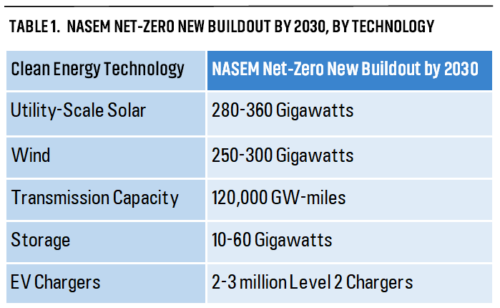
Just how much new energy infrastructure will be required? The National Academies report, Accelerating Decarbonization of the U.S. Energy System, lays out the scientific consensus on what the U.S. will need to deploy to reach net-zero emissions: far more than is currently in operation.[43] And all of this new deployment must happen at an accelerating pace.

Expert energy systems modelers have estimated that the IRA will accelerate renewable deployment significantly: The REPEAT Project at Princeton University’s ZERO Lab has projected that, absent permitting and siting obstacles, the IRA could spur 39 GW of wind and 49 GW of grid-scale solar per year by 2025 and 2026.[44] Energy Innovation, another modeling group, projects that the cumulative wind and solar generation on the grid could reach between 795-1053 GW by 2030 thanks to the IRA funding.[45] Both modeling reports, however, explicitly call out permitting and transmission capacity as potential bottlenecks that could limit this deployment.
Compared against historical renewable deployment rates, achieving this acceleration and ambitious net-zero targets will be a huge lift. For the last two decades, wind and solar generation have grown rapidly in the U.S. as technology improved, costs declined, and public policy support generally expanded. Between 2001 and 2021, the U.S. installed a total of 130 GW of wind and 95 GW of solar (including distributed and thermal solar — utility-scale PV generation is smaller, and in 2020 nameplate capacity for all of the U.S. was only 46.6 GW).[46],[47] Annual net capacity additions for the last 10 years in the same data averaged 9 GW each of wind and solar.
In that time, projects as small as 0.1 GW (10 MW) of solar and as large as 3 GW of wind were subject to NEPA reviews counted in the FPISC review, where renewable project permitting times stretched for an average of 2.7 years each. If each fraction of a gigawatt takes almost 3 years to secure federal permits, and the transmission upgrades needed to carry that power to consumers takes over 4 years per project, the modeled effects of the IIJA and IRA will never come to pass. Instead of rapid progress on clean energy, the funding appropriated in these laws will pay for slow-moving projects and countless person-hours of duplicative, unnecessarily burdensome reviews.
And for newer clean energy projects on the cutting edge of technology, like new advanced nuclear power, advanced geothermal, hydrogen hubs, and carbon management infrastructure in the form of capture and storage, direct air capture, and CO2 pipelines will struggle even harder. Because these technologies are newer, they may present novel environmental impact questions that take longer to sort out at first. All the more reason, then, to ensure that permitting staff are able to focus on these new technologies rather than clogging up their agenda with well-understood and environmentally vital renewable energy and transmission projects.
Passage of the Infrastructure Investment and Jobs Act and the Inflation Reduction Act’s clean energy provisions has committed the nation to deploy renewable generation capacity and battery storage at several times the historic pace. Permitting reform can help us step up the tempo of installing new solar panels, wind turbines, and other clean generation; upgrading aging transmission grids and ensuring reliable supplies; millions of new EV charging stations funded with $7.5 billion in the IIJA, improving energy efficiency in mass transit and buildings; and launching innovative new carbon management and clean hydrogen regional hubs. We should demand the highest possible public benefits from these investments.
Modest Steps Forward
The permitting problem is not new and several previous attempts to speed up approvals have helped incrementally improve the process.
Through executive action as well as legislation, the Biden Administration has pushed to speed up the federal permitting process without getting bogged down in controversies that stymied his predecessor’s efforts. The Biden Administration’s permitting timelines have improved by an average of almost four months due to more efficient bureaucratic management.[48] While an updated set of CEQ regulations is partially complete, the Biden White House released a Permitting Action Plan this past spring that emphasizes efficient processing, coordination across agencies and with relevant state, local, and Tribal governments, and leveraging tools like the Permitting Dashboard and FAST-41 authorities.[49]
The major infrastructure and clean energy legislation passed this Congress also include beneficial steps on permitting. The IIJA included key improvements to existing reform initiatives, turning the Permitting Council from a temporary body under FAST-41 into a permanent program and establishing two-year review goals, shorter documents for surface transportation project reviews of under 200 pages (with exceptions for unusually complex projects), single-document EISs, shorter deadlines for final Records of Decision after the completion of a Final EIS, allows for expanded eligibility for existing Categorical Exclusions, and allowing for the inclusion of a wider range projects on the Council’s Permitting Dashboard.[50] Many of these changes reinstated aspects of the “One Federal Decision” framework while avoiding some of the more contentious aspects of the Trump administration’s reforms.
The IRA tackled permitting delays from a different angle: As part of its overall clean energy spending package, $735 million will be appropriated to federal agencies to help hire staff, upgrade technical systems, and develop new tools to improve review quality and speed up the process.[51] The funding is split between the Department of Energy, Interior, EPA, CEQ, FERC, NOAA, the Permitting Council, and the FHWA. This funding is especially important from an efficiency standpoint because the federal agencies responsible for producing and reviewing NEPA documents and issuing permits will need sufficient technical expertise and workforce capacity if the government is to successfully speed up the process in practice. But without firm deadlines, enforcing the expectation that these new resources are used to speed up reviews, the funding will be spent on managing the existing paperwork burden that maintains the status quo to little public benefit.
All of these steps are commendable, but the sheer scale of the clean energy transition requires moving beyond incrementalism. Senators Manchin and Schumer are on the right track with their outlined proposal to take a next step, and Democrats should get on board to match the fiscal commitments the U.S. has made to unleash clean energy abundance with regulatory reforms to enable these investments to translate into rapid progress on the ground.
Recommendations to Congress on Permitting Reform
As of this writing, an official text of the Manchin proposal has not been released. A one-page summary lists a new procedure for designating high-priority energy projects, firmer enforcement of NEPA review timelines, changes to litigation, categorical exclusions, and some sector-specific changes.[52]
- High Priority Projects: The President would be responsible for designating at least 25 “high priority energy infrastructure projects” of “strategic national importance” for expedited review among a “balanced list of project types, including: critical minerals, nuclear, hydrogen, fossil fuels, electric transmission, renewables, and carbon capture, sequestration, storage, and removal.”
- Timeline Cap: Maximum timelines of 1 year for EAs and 2 years for EISs.
- Litigation Reform: Limit litigation delays by shortening the statute of limitations and requiring quicker responses by agencies in NEPA lawsuits.
- NEPA Exclusions: Actively evaluate potential new Categorical Exclusions to NEPA.
The summary also suggests changes for certain project types and one specific project:
- Interstate electric transmission reforms: Grants new ability to the Energy Secretary and FERC to designate projects of national interest, requires FERC to allocate transmission project cost to benefiting consumers, and allows payments to transmission host jurisdictions.
- Clean Water Act Section 401 reforms
- Hydrogen infrastructure placed under clear FERC jurisdiction
- Approving the Mountain Valley natural gas pipeline
This proposal would work well with the steps laid out by the Biden Administration and those taken in the IIJA and IRA to help move the ball forward on clean energy deployment that is absolutely necessary to meet U.S. climate goals. Transmission is a particularly important area for reform due to the changing needs of U.S. electricity grids pursuing decarbonization in a rapidly changing climate. The Manchin-Schumer proposal includes several tools that could strengthen landowner protection and retain State input while spurring nationally vital deployment, and we suggest further action to spur grid upgrades below by incorporating the SITE Act into the deal. The proposal would also ensure that U.S. natural gas exports are available to energy-constrained allies in Europe and Asia. At a crucial time in energy markets, U.S. gas exports would be poised to meet global demand with exceptionally low-methane supply thanks to the IRA’s new methane fee and methane reduction funding, helping to avoid the worst-case scenarios of increased coal combustion or severe energy shortages.[53]
Viewed with skepticism by some on the left — who view any new fossil fuel infrastructure as anathema — the growth of U.S. natural gas exports should be viewed as the best available course of action given the current circumstances of global energy markets. For European allies struggling to replace cut off Russian supplies, the U.S. is effectively the only producer who can scale up to meet their urgent needs. And in the global view, the U.S. has a continued role to play as a supplier of natural gas with less leakage upstream.
This pragmatic approach to position the U.S. as a green supplier in energy markets is not at all limited to natural gas. As the world pushes to expand battery supply chains for new electric vehicles and grid storage facilities, or mine copper, steel, and aluminum for renewables and transmission construction, the energy transition will require growth in all sorts of raw materials production. Rather than use NEPA review as a delay mechanism to try and limit the first-order emissions of U.S. extractive industries, we should look at global supply chains in their totality and expand domestic production or production among like-minded allies with comparable labor and environmental protections to see where we can produce the maximal amount of new clean energy technology at minimal environmental impact.
- Pass the Manchin-Schumer Permitting Proposal with Strengthened Timeline Goals: The quickest and best step available to speed up permitting and unleash the investments made in the IIJA, CHIPS, and IRA package is to pass the Manchin-Schumer proposal. Firming up shorter review timelines and simultaneously dedicating new resources to conduct thorough reviews quickly will help orient the federal government toward meeting the deployment challenges that come with these new investments. While the IIJA’s permitting provisions established 2-year average timeline goals, we recommend 2 years be set as the final goal for key energy projects and commend steps taken to ensure timely litigation and dispute resolution to further reduce uncertainty. Better prioritization will ensure that staff time and contracting funds are spent more efficiently, both by provisioning additional resources to reviews of strategically important projects (that tend to be the most complex) and by expanding eligibility for Categorical Exclusions for projects that ought to require less time under review.
- Study and Consider Adopting Successful Permitting Reforms — including 2-Year “Shot Clock” — from Other Sectors: Congress should authorize the study of successful permitting reform in other parts of the economy, including the Federal Communications Commission’s adoption of time limiting “shot clocks” for the siting of cell phone and communications towers, with an eye toward adopting this time limit for appropriate energy projects. Applying these procedures to key green projects like grid-scale solar, wind turbines, battery storage, and transmission lines on public lands will ensure developers of rapid government decision-making that can increase certainty, reduce costly delays, and help speed up deployment. With all of the new resources available to agencies for permitting in the IRA, quick decisions will not undercut thorough examination of any localized impacts from these well-understood and environmentally critical projects.
- Pass the SITE Act: The Streamlining Interstate Transmission of Electricity Act, introduced by Senator Sheldon Whitehouse, D-R.I., and cosponsored by Senators Martin Heinrich, D-N.M., and John Hickenlooper, D-Colo., (along with Representatives Mike Quigley, D-Ill., Sean Casten, D-Ill., and Scott Peters, D-Calif., in the House),[54] would empower FERC as the primary siting authority for transmission projects that are currently forced to go through lengthy and fragmented approval processes, and would also grant the ability to use a new eminent domain process for transmission that is updated to include stronger transparency and landowner protections than existing eminent domain authorities for other projects. Transmission deployment will also need to work its way through complex planning and approval processes at the private level, whether through transmission systems operators (RTOs and ISOs) or through utilities, that may benefit from further policy support and political engagement.
- Maximize Regulatory Exemptions and Programmatic Reviews for Clean Energy Projects: The Biden Administration should build on its record of successful permitting improvements and continue to prioritize project delivery with all available administrative tools. Between the new ability to apply some existing Categorical Exclusions more broadly and the Manchin-Schumer proposal’s provision to expand CEs more generally, federal agencies should look for all available opportunities to speed up clean energy projects. Implementation of the Administration’s Permitting Action Plan, especially the use of programmatic reviews that can cover broad areas of analysis to be reused efficiently by individual projects rather than doing individual reviews on a project-by-project, can also ensure that agency resources are dedicated to speeding up project delivery and improving environmental outcomes. IIJA and IRA funding to clean up legacy pollution and provide technical assistance to disadvantaged communities will also help improve outcomes in line with the Biden Administration’s environmental justice goals for new energy deployment and ensure that meaningful public input, especially from disadvantaged communities, occurs early in review processes rather than serving as a source of uncertainty and delay through the courts later.
- Reform at the State and Local Levels: At the state and local levels, policymakers should implement parallel reforms to slow or outdated review and permitting procedures. State and local jurisdictions are host to many crucial opportunities for clean energy deployment that will not rise to the federal level, including distributed renewable generation, local transportation networks, and denser forms of housing development. In New York, a new Office of Renewable Energy Siting established in 2020 has already improved on the older, more arduous approval process by consolidating and expediting siting and review requirements and empowering the State to override local restrictions on renewable energy that are “unreasonably burdensome”; this model should be emulated more widely by other states.[55] These actions could unlock even further clean energy investment, emissions mitigation, and economic growth opportunities for ambitious states and localities in the coming decades.
- Prevent New Regulations from Hindering New Technologies: New permitting hurdles or regulatory bottlenecks may also emerge as innovative technologies like direct air capture, carbon capture, utilization and storage, CO2 pipelines, hydrogen hubs, advanced nuclear, and advanced geothermal wells scale up. In new industries, a light regulatory hand can help avoid stifling fast-emerging opportunities out of undue precaution. Congress and the Biden Administration should continue to keep their eye on the ball to seize on new opportunities to speed up deployment, help nurture these new industries, and provide U.S. energy workers and households with abundance.
Conclusion
Domestic Permitting Reforms Needed for U.S. Clean Energy and Climate Success
The unprecedented new levels of U.S. clean energy investment enacted in the last two years hold vast potential for the overall U.S. economy and will spur a new clean energy sector worth trillions each year, creating millions of good, new jobs, saving consumers and business tens of billions in energy costs, and expanding U.S. technology and energy exports. But as this report has demonstrated, these benefits will only accrue fully if sweeping new permitting reforms are enacted quickly, including both in Congressional pending legislation this year and additional federal and state reforms over time.
Meanwhile, if the recommendations in this report are adopted, they can also dramatically improve and increase overall U.S. and global climate protection, reducing U.S. greenhouse gas emissions by approximately 40% by 2030 below 2005 levels, cutting the near and long-term costs of climate change impacts and lower threats to public safety, protecting worker productivity; improving public health and reducing health care cost, and enhancing national and global security. More broadly, they will set the stage for far more effective U.S. and global climate protection.
Equally, however, if these reforms are not adopted, chances are we will face trillions of dollars in annual climate change impact costs in the U.S. and globally, and climate change impacts increasingly undermining domestic and global economic growth and security. The U.S. has made the initial policy investments to set the stage for clean energy and climate change success — now we must help ourselves, and the world, finish the job. No policy actions are more important.
APPENDIX:
SUMMARY OF KEY CLEAN ENERGY AND CLIMATE PROVISIONS IN IIJA, CHIPS, AND IRA BILLS:
The first two years of the Biden Administration and the 117th Congress have come together to produce a remarkable slate of energy and climate investments across three bills, two passed with significant bipartisan support. Tallied together, the Infrastructure Investment and Jobs Act, CHIPS and Science Act, and Inflation Reduction Act will infuse our energy systems and economy with approximately $514 billion in new funding (though the process is incomplete for CHIPS: In legislative terms, the spending laid out in the bill has been authorized but not yet appropriated). Working in concert, the investments in infrastructure, research and development, demonstration projects, and deployment incentives will help spur investment in technologies at various stages of innovation from basic research to commercialization and mass adoption across a wide cross-section of the U.S. economy.
The three bills work in complementary ways. The IIJA provides investment in infrastructure like the electricity grid, EV charging networks, and rail. The IRA provides broad funding and incentives to mobilize public and private capital together to build out clean energy generation and electrified end-use applications for businesses and households. And CHIPS, while primarily focused on semiconductors and basic science, may end up dedicating a significant portion of its funds to research and development in energy and climate tech that could keep the U.S. at the frontier of energy innovation. Together they represent a triumph for clean energy, American workers and consumers, and the fight against climate change — just how big of a triumph, though, will depend on our ability to turn those investments into new physical infrastructure and clean tech on the ground.
Infrastructure Investment and Jobs Act
Not just a roads and bridges bill, the IIJA will direct tens of billions to lower carbon transportation, innovative climate programs in hydrogen and carbon management infrastructure, and electric grid improvements and innovations. Funding for public transit, passenger and freight rail, ports, and water infrastructure will also bring climate or other environmental benefits such as lower air pollution and cleaner drinking water to the American public.
Out of the $550 billion in new spending, $65 billion will go to electric grid upgrades and energy supply chains like battery materials processing, $47 billion to resilience projects, $7.5 billion for EV chargers, and $7.5 billion for cleaner school buses and ferries. Aging nuclear plants will receive $6 billion in funding to prevent retirement along with $700 million for legacy hydropower. Clean energy research and demonstration projects will receive $21.5 billion in total, split between $8 billion for clean hydrogen, $10 billion for direct-air capture, carbon capture, and storage, and $2.5 billion for advanced nuclear power generation.
Outside of the energy system investments, the IIJA also funds infrastructure programs with other important environmental implications. $105 billion will go to rail and transit. School energy efficiency will receive $2.5 billion in funding and the Weatherization Assistance Program for low-income homes is increased by $3.5 billion. Also important for environmental justice benefits are $1 billion for a “Reconnecting Communities” program to address negative impacts of legacy infrastructure and $21 billion for brownfield remediation.
The climate effects of these spending programs are more difficult to estimate than those of the Inflation Reduction Act, but Princeton’s ZERO Lab expects that the IIJA would reduce emissions by over 100 million metric tons per year in 2030.[56] Part of this finding stems from the difficulty of modeling the specific programs included, but another factor that leads these models to underestimate the emissions reduction effects of the IIJA’s programs is that they will be working in concert with the IRA by providing the infrastructural foundation for all of the new clean energy generation, transmission, and other technologies funded by the latter bill’s tax credits and new spending programs. For the IIJA programs themselves, the ability to start construction on all of these new infrastructure projects will depend on the effectiveness of the collective effort to reform permitting, including measures in the bill itself discussed below and future steps needed including Senator Manchin’s Proposal. With the right steps on review, siting, and permitting, however, the Infrastructure Investment and Jobs Act is poised to make transformative progress on U.S. infrastructure development in both “traditional” and new clean energy projects.
Inflation Reduction Act
The Inflation Reduction Act, passed by Congress in August of this year, will spend $369 billion to fund new clean energy, transportation, building, and manufacturing programs, as well as new conservation, agriculture, resilience, and air pollution initiatives. The funding is split between tax credits for individuals and businesses and direct government-funded programs. A methane fee will provide oil and gas producers with a strong incentive to reduce upstream emissions of the extremely potent greenhouse gas in their supply chains, and a program to fund methane reduction technologies will help too.
The IRA envisions major climate and energy progress through a suite of new clean energy tax credits. Many of the tax credits build upon existing tax code provisions but extend, expand, and make them technology-neutral so as to encourage the most efficient uptake possible. Financial tweaks to enable direct-pay for some eligible organizations and improved transferability will enable broader uptake of these credits as well. Many of the credits are structured so that the maximum incentives are available only after meeting domestic content and labor requirements.
Zero-carbon generation in the form of solar, wind both on and offshore, existing and advanced nuclear, and geothermal, will all be eligible for the credits. New or expanded tax credits will also be made available for carbon sequestration, existing nuclear power, clean hydrogen, and “advanced manufacturing” of key clean energy tech components. Energy efficiency incentives for individuals and businesses are expanded as well. In transportation, the law seeks to boost the entire supply chain for electric vehicles, encouraging expansion of domestic production in mining and processing raw battery materials, assembling batteries, producing the vehicles, and providing adoption incentives for consumers. All told, JCT estimates that the total expenditure on these credits will total $148 billion through 2031.
On the direct government spending side, the IRA is ambitious. The EPA will receive $27 billion to create the GHG Reduction Fund, a lending facility for green projects. The DOE’s Loan Programs Office, a similar lending program for innovative energy demonstration and commercialization, advanced vehicle manufacturing, and Tribal energy programs, receives major increases in both funding, with roughly $17 billion in new appropriations, and vastly expanded lending capacity. The methane fee will disincentivize leakage of that potent greenhouse gas, which will also be mitigated with $1.5 billion in methane reduction funding. Ports will receive $3 billion to reduce air pollution. In transportation, domestic auto manufacturing is allocated $2 billion in grants to retool for production of EVs, hybrids, and other alternative clean fuel vehicles and $1 billion in grants will be available to state and local governments for heavy-duty vehicles like buses and garbage trucks. Rural energy systems will receive significant upgrades, with $10 billion appropriated for rural electricity cooperatives and $2 billion for clean energy adoption through the Rural Energy for America Program. Conservation, agriculture, and forests receive $20 billion all together, as well.
The climate and energy implications of the IRA are staggering, and modelers agree that the law will enable major emissions reductions over the coming decade. Estimates vary based on assumptions about fossil fuel costs and tech adoption, so each model provides a range of estimates that each vary slightly: Rhodium Group projects 32-42% reductions, Energy Innovation estimates 37%-41%, and Princeton’s ZERO Lab preliminary reports suggests that emissions could fall by an average of 42% across scenarios.[57],[58],[59]
Crucially, these models estimate economically optimal responses by individuals and industries covered by the bill’s programs and do not incorporate frictions posed by local siting conflicts or any permitting delays. Much like the goals of the Infrastructure Investment and Jobs Act, the climate and energy outcomes of Inflation Reduction Act depend on the ability of its funds to be spent on the clean energy technologies themselves rather than spending high proportions of project cost on lengthy federal reviews. As will be discussed below, the IIJA and IRA contain limited progress on this front, but work remains for Congress and the White House.
CHIPS and Science Act
The CHIPS and Science Act, touted primarily for its role in bolstering the domestic semiconductor industry and seeking to enhance U.S. competitiveness against China, also contains an underappreciated share of support for research in energy and climate. According to an estimate by the Rocky Mountain Institute, as much as $54 billion of the law’s $280 billion overall spending might flow to energy innovation.[60] Importantly, though, this funding has only been authorized and must still be appropriated by Congress before these funds will be spent.
The CHIPS and Science Act did not include explicit legal changes to permitting, but subsequent moves have acknowledged the importance of reducing permitting barriers in the bill’s policy area. After its passage in August, the Biden administration announced the creation of an interagency working group to coordinate permitting for high-tech manufacturing in light of the issue’s importance for achieving the bill’s goals.[61] Congress, too, has acted to reduce permitting barriers for high-tech industries, passing a companion bill to CHIPS that allows tech projects such as semiconductor fabs, data storage, and others to take advantage of the FAST-41 process.[62]
As a science and technology bill, the CHIPS programs are focused on the earliest stages of innovation rather than incentivizing the buildout of market-ready tech like wind turbines or electric vehicles. Instead, the climate contributions in CHIPS flow to important research hubs like the Department of Energy’s ARPA-E program, a newly established Directorate of Technology, Innovation, and Partnerships, and labs like the National Renewable Energy Laboratory along with provisions for STEM education and workforce development. Working through government research labs, universities, regional tech hubs, and in partnership with private-sector entrepreneurs, the law funds basic energy science, storage, advanced nuclear, clean steel, energy materials, and other research programs with the aim of keeping U.S. researchers at the cutting edge of the energy technology frontier. If fully funded and successful in this aim, the CHIPS and Science Act may end up being viewed as the most important move this Congress made for climate action in the period stretching from 2032 onward.
References and Notes:
[1] Lachlan Carey and Jun Ukita Shepard, “Congress’s Climate Triple Whammy: Innovation, Investment, and Industrial Policy,” RMI, August 22, 2022, https://rmi.org/climate-innovation-investment-and-industrial-policy.
[2] There are of course many other actions Congress and the Biden Administration can take to improve the economic and environmental outcomes and implementation of these major climate and energy bills. Three of these opportunities deserves specific mention here, even though they are not detailed topics of this paper: Enhancing workforce, education, and training to match worker skills to new high growth sectors, especially in clean energy. For U.S. workers to benefit maximally from these investments will require new workforce training regimes particularly those directly involving the private sector.
Improving investments in natural resource and agricultural policy, including forest, ocean, and land management. Efforts must increase to improve the role of the U.S. forest public lands and farms in helping to mitigate climate change emissions and impacts, including the potential for civilian Climate Conservation Corps. Finally, taken together these three major laws have very large fiscal and budgetary implications which cannot be separated from their other policy goals. The U.S. must continue to reduce our debt even as we make these investments.
[3] Jesse Jenkins et al., “Preliminary Report: The Climate and Energy Impacts of the Inflation Reduction Act of 2022,” REPEAT Project (Princeton University ZERO Lab, August 2022), https://repeatproject.org/docs/REPEAT_IRA_Prelminary_Report_2022-08-04.pdf.
[4] Megan Mahajan et al., “Modeling the Inflation Reduction Act Using the Energy Policy Simulator,” Energy Innovation, August 2022, https://energyinnovation.org/wp-content/uploads/2022/08/Modeling-the-Inflation-Reduction-Act-with-the-US-Energy-Policy-Simulator_August.pdf.
[5] Jenkins et al., “Preliminary Report.”
[6] Mahajan et al., “Modeling the Inflation.”
[7] Mahajan et al., “Modeling the Inflation.”
[8] Mahajan et al., “Modeling the Inflation.”
[9] Jenkins et al., “Preliminary Report.”
[10] Energy Innovation analysis estimated the IRA bill would reduce carbon emissions 37% to 41% below 2005 levels by 2030. (Mahajan et al., “Modeling the Inflation.”)
[11] The Rhodium Group study said the bill would cut emissions 31% to 44% in the same period. (Ben King, John Larsen, and Hanna Kolus, “A Congressional Climate Breakthrough,” Rhodium Group, July 28, 2022, https://rhg.com/research/inflation-reduction-act/.)
[12] Mahajan et al., “Modeling the Inflation.”
[13] Mahajan et al., “Modeling the Inflation.”
[14] Jenkins et al., “Preliminary Report.”
[15] Raul M. Grijalva and Bruce Westerman et al., “Letter to Nancy Pelosi and Steny Hoyer,” Committee on Natural Resources (U.S. House of Representatives, Washington, D.C.), September 12, 2022, https://naturalresources.house.gov/imo/media/doc/2022-09-12%20Group%20NEPA%20Letter%20to%20Pelosi%20and%20Hoyer%20UDPATED%202.pdf.
[16] Maxine Joselow and Vanessa Montalbano, “DNC Weighs Manchin’s Permitting Reform Deal,” The Washington Post, September 7, 2022, https://www.washingtonpost.com/politics/2022/09/07/dnc-weighs-manchin-permitting-reform-deal/.
[17] Daniel Adamson and Paul Bledsoe, “Streamline Power Line Permitting to Achieve Ira Climate Goals,” The Hill, August 18, 2022, https://thehill.com/opinion/energy-environment/3607335-streamline-power-line-permitting-to-achieve-ira-climate-goals/.
[18] “Article 10: Duration and Implementation of the Permit Granting Process,” Regulation (EU) 2022/869) of the European Parliament and of the Council (Official Journal of the European Union, June 3, 2022), 152/70-71, https://eur-lex.europa.eu/legal-content/EN/TXT/PDF/?uri=CELEX:32022R0869&from=EN.
[19] Impact Assessment Agency of Canada, “The Impact Assessment Process: Timelines and Outputs,” Government of Canada, March 24, 2021, https://www.canada.ca/en/impact-assessment-agency/services/policy-guidance/the-impact-assessment-process-timelines-and-outputs.html.
[20] Senator Shelley Moore Capito, “Capito Leads Colleagues in Introducing Comprehensive Regulatory and Permitting Reform Legislation,” September 12, 2022, https://www.capito.senate.gov/news/press-releases/capito-leads-colleagues-in-introducing-comprehensive-regulatory-and-permitting-reform-legislation.
[21] Jenkins et al., “Preliminary Report.”
[22] Mahajan et al., “Modeling the Inflation.”
[23] “A Citizen’s Guide to NEPA,” Council on Environmental Quality, January 2021, https://ceq.doe.gov/docs/get-involved/citizens-guide-to-nepa-2021.pdf.
[24] “National Environmental Policy Act,” Environmental Protection Agency, last updated July 2022, https://www.epa.gov/nepa.
[25] “Federal Environmental Review and Authorization Inventory,” Federal Permitting Improvement Steering Council, September 10, 2021, https://www.permits.performance.gov/tools/federal-environmental-review-and-authorization-inventory.
[26] “Length Of Environmental Impact Statements (2013-2018),” Council on Environmental Quality, June 12, 2020, https://ceq.doe.gov/docs/nepa-practice/CEQ_EIS_Length_Report_2020-6-12.pdf.
[27]“Regulatory Impact Analysis for the Final Rule, Update to the Regulations Implementing the Procedural Provisions of the National Environmental Policy Act,” Council on Environmental Quality, June 30, 2020, https://ceq.doe.gov/docs/laws-regulations/ceq-final-rule-regulatory-impact-analysis-2020-06-30.pdf.
[28] “Recommended Performance Schedules,” Permitting Dashboard (Federal Permitting Improvement Steering Council, April 6, 2020), https://www.permits.performance.gov/fpisc-content/recommended-performance-schedules.
[29] “Baseline Performance Schedules for Environmental Reviews and Authorizations,” Federal Permitting Improvement Steering Council, April 8, 2020, https://www.permits.performance.gov/sites/permits.dot.gov/files/2020-04/FPISCRecommendedPerformanceSchedules2020_04062020.pdf.
[30] While comprehensive cost assessments for the permitting process do not exist, a 2014 GAO report found that DOE contractor costs for NEPA documents prepared between 2003-2012 cost an average of $6.6 million.
“GAO-14-369, National Environmental Policy Act: Little Information Exists on NEPA Analyses” (United States Government Accountability Office, April 2014), https://www.gao.gov/assets/gao-14-369.pdf.; More recent DOE data through 2017 show similar figures, available at: “NEPA Lessons Learned Quarterly Reports, 2013-2017” (United States Department of Energy), December 2017, https://www.energy.gov/sites/default/files/2017/12/f46/2013-2017%20LLQR%20%28reduced%20size%20pdf%29.pdf.
[31] Katharine Q. Seelye, “After 16 Years, Hopes for Cape Cod Wind Farm Float Away,” The New York Times, December 19, 2017, https://www.nytimes.com/2017/12/19/us/offshore-cape-wind-farm.html.
[32] Colin A. Young, “Federal Review Will Further Delay Vineyard Wind,” WBUR News, August 9, 2019, https://www.wbur.org/news/2019/08/09/vineyard-wind-project-delayed.
[33] “Escalating Stakes in Battle for Ocean Wind,” Perkins Coie, February 2, 2022, https://www.perkinscoie.com/en/news-insights/escalating-stakes-in-battle-for-ocean-wind.html.
[34] Matthew Bandyk, “Largest Planned Wind Farm in US Gets Key Federal Approval,” Utility Dive, October 25, 2019, https://www.utilitydive.com/news/largest-planned-wind-farm-in-us-gets-key-federal-approval/565795/.
[35] Christian Britschgi, “New York City Was Supposed to Have Congestion Pricing in January. Federally Mandated Environmental Review Pushed the Start Date to 2023.,” Reason, August 24, 2021, https://reason.com/2021/08/24/new-york-city-was-supposed-to-have-congestion-pricing-in-january-federally-mandated-environmental-review-pushed-the-start-date-to-2023/.
[36] Eric Edwards and Sara Sutherland, “Does Environmental Review Worsen the Wildfire Crisis?,” Poverty and Environment Research Center, June 14, 2022, https://www.perc.org/2022/06/14/does-environmental-review-worsen-the-wildfire-crisis/.
[37] Myles McCormick, “‘Perfect Storm’ Energy Crunch Lengthens Life of Coal Power in U.S.,” Financial Times, August 31, 2022, https://www.ft.com/content/0be5163f-5ac4-4d0d-979a-ba97477f9cea.
[38] Jeff Davis, “Court Rulings May Delay California High Speed Rail,” Eno Center for Transportation, last updated August 4, 2017, https://www.enotrans.org/article/california-supreme-court-ruling-may-delay-high-speed-rail/.
[39] Ralph Vartabedian, “California Bullet Train Authority Gets U.S. Permission to Handle Its Environmental Reviews,” Los Angeles Times, July 27, 2019, https://www.latimes.com/california/story/2019-07-26/bullet-train-environmental-approvals.
[40] Matthew Roth, “SF Responds to Bike Injunction with 1,353 Page Enviro Review,” Streetsblog San Francisco, December 11, 2008, https://sf.streetsblog.org/2008/11/28/sf-responds-to-bike-injunction-with-1m-1353-page-enviro-review/.
[41] Susan Du and Liz Navratil, “Court Orders Minneapolis to Cease Implementation of 2040 Plan,” Star Tribune, June 15, 2022, https://www.startribune.com/court-minneapolis-ordered-to-cease-implementation-of-2040-plan/600182511/.
[42] Casey Kelley et al., “Hawkeye State Headwinds,” ClearPath, July 14, 2022, https://static.clearpath.org/2022/07/hawkeye-headwinds-2-pager.pdf.
[43] “Accelerating Decarbonization of the U.S. Energy System,” National Academies of Sciences, Engineering, and Medicine, (The National Academies Press, Washington D.C.), 2021, https://doi.org/10.17226/25932.
[44]Jenkins et al., “Preliminary Report.”
[45] Mahajan et al., “Modeling The Inflation.”
[46] “Statistics Time Series: US Electric Capacity Net Additions,” International Renewable Energy Agency, July 20, 2022, https://www.irena.org/Statistics/View-Data-by-Topic/Capacity-and-Generation/Statistics-Time-Series.
[47] “Table 4.3. Existing Capacity by Energy Source, 2020 (Megawatts),” U.S. Energy Information Administration, October 2021, https://www.eia.gov/electricity/annual/html/epa_04_03.html.
[48] Kelsey Brugger, “NEPA Reviews Moving Faster under Biden,” E&E News, February 22, 2022, https://www.eenews.net/articles/nepa-reviews-moving-faster-under-biden/.
[49] “Fact Sheet: Biden-Harris Administration Releases Permitting Action Plan to Accelerate and Deliver Infrastructure Projects on Time, on Task, and on Budget,” The White House, May 11, 2022, https://www.whitehouse.gov/briefing-room/statements-releases/2022/05/11/fact-sheet-biden-harris-administration-releases-permitting-action-plan-to-accelerate-and-deliver-infrastructure-projects-on-time-on-task-and-on-budget/.
[50] Infrastructure Investment and Jobs Act, H.R. 3684, 117th Congress (2021-2022), https://www.congress.gov/bill/117th-congress/house-bill/3684/text.
[51] Sections 40003, 50301, 50302, 50303, 60115, 60402, 60505, and 70007 of the bill are all dedicated to review and permitting funding: Inflation Reduction Act of 2022, H.R. 5376, 117th Congress (2021-2022), https://www.congress.gov/bill/117th-congress/house-bill/5376/text.
[52] Senator Joe Manchin and Senator Charles Schumer, “Energy Permitting Provisions ,” July 2022, https://www.manchin.senate.gov/imo/media/doc/energy_permitting_provisions.pdf?cb.
[53] Paul Bledsoe and Clayton Munnings, “The Role of Natural Gas in Reducing Asia’s Greenhouse Gas Emissions,” Progressive Policy Institute, July 2022, https://www.progressivepolicy.org/wp-content/uploads/2022/08/PPI-Asia-Emissions-Final-1.pdf.
[54] SITE Act, S. 2651, 117th Congress (2021-2022), https://www.congress.gov/bill/117th-congress/senate-bill/2651.
[55] “About Us,” Office of Renewable Energy Siting (New York State), accessed September 2022, https://ores.ny.gov/about-us.
[56] Jesse Jenkins et al., “Summary Report: The Climate Impact of Congressional Infrastructure and Budget Bills,” REPEAT Project (Princeton University ZERO Lab, February 28, 2022), https://repeatproject.org/docs/REPEAT_Summary_Report_022822.pdf.
[57] John Larsen et al., “A Turning Point for US Climate Progress: Assessing the Climate and Clean Energy Provisions in the Inflation Reduction Act,” Rhodium Group, August 12, 2022, https://rhg.com/research/climate-clean-energy-inflation-reduction-act/.
[58] Mahajan et al., “Modeling the Inflation.”
[59] Jenkins et al., “Preliminary Report.”
[60] Lachlan Carey and Jun Ukita Shepard, “Congress’s Climate Triple Whammy: Innovation, Investment, and Industrial Policy,” RMI, August 22, 2022, https://rmi.org/climate-innovation-investment-and-industrial-policy.
[61] “Fact Sheet: CHIPS and Science Act Will Lower Costs, Create Jobs, Strengthen Supply Chains, and Counter China,” The White House, August 9, 2022, https://www.whitehouse.gov/briefing-room/statements-releases/2022/08/09/fact-sheet-chips-and-science-act-will-lower-costs-create-jobs-strengthen-supply-chains-and-counter-china/.
[62] S. 3451, 117th Congress (2021-2022), https://www.congress.gov/bill/117th-congress/senate-bill/3451.