Stronger Automatic Stabilizers Would Make Timely Stimulus The Norm

Marshall for Newsweek: Biden Should Empower Local Governments, Not D.C. Bureaucracies

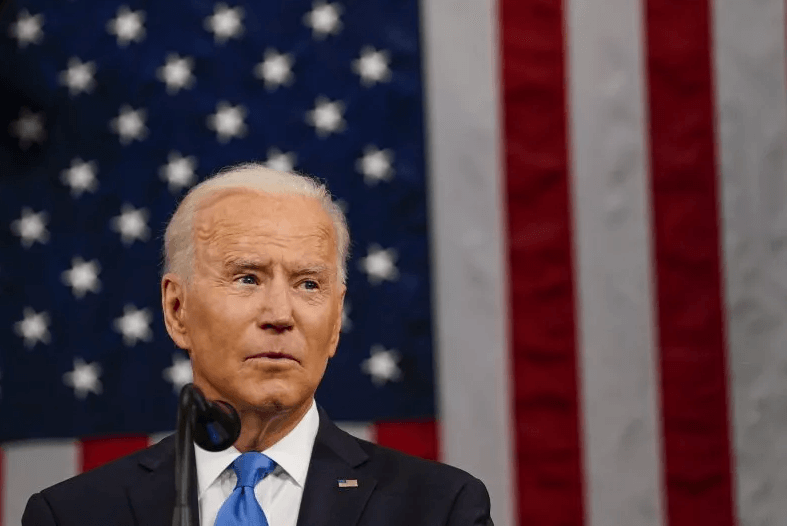
President Joe Biden has surprised his critics across the political spectrum with an audacious $6 trillion blueprint for national reconstruction. His resolve to “go big” reflects a palpable public desire for bold action after the enormous losses in lives, jobs and small businesses that America has suffered during the COVID-19 pandemic.

But whether the country at large is eager to welcome “big government” back from political exile—as some progressive politicians and reporters hopefully claim—is far from clear. In fact, surveys show most Americans remain deeply skeptical about Washington’s capabilities.

Fortunately, Biden has other problem-solving tools at his disposal. Specifically, he should look to local governments, which have emerged as American federalism’s star performers. Instead of concentrating more power in Washington, the White House should work to decentralize decisions and resources to creative city and county leaders.

This strategy—call it “metro federalism”—relies on three facts. First, economic innovation and job creation are concentrated in metropolitan regions. Second, citizens have more confidence in their local governments than they do in Washington. Third, the progressive outlook of most metro areas makes them natural allies for the Biden administration.

Read the full piece in Newsweek.

May The Fourth Be With You: Congressman Derek Kilmer Joins PPI’s Caleb Watney for a Star Wars Themed Episode

In a Star Wars Day-themed Radically Pragmatic podcast episode, Caleb Watney, Director of Innovation Policy at the Progressive Policy Institute, sits down with Rep. Derek Kilmer (WA-06) – Congress’ top Star Wars super-fan – for Star Wars trivia, and an exciting conversation on the future of technology innovation in America.

Caleb and Rep. Kilmer dig deep into their shared love of Sci-Fi, and talk about how fiction helps inspire technology improvements and innovations that can become a reality. Representative Kilmer also calls for more Science, Technology, Engineering and Math (STEM) education and apprenticeship opportunities and a reinvestment in research and development funding.

Carolina Postcard: Will NC Get Real on Climate Change?

By Gary Pearce

When I think about climate change, I think about my brother-in-law Tillman.

Tillman spent his career with Big Oil. He travelled the world finding places to drill, baby, drill. He’s now comfortably retired in Dallas, Texas. And he’s a Republican.

You may suspect he’s a climate-change denier.

Wrong.

Tillman has a PhD in geology from UNC. He’s smart and studious. Some years back, he delved into a study of climate change.

Like most geologists, he concluded it’s real – so real he tells his eight grandchildren that the family’s vacation home on North Carolina’s Outer Banks may be gone when they’re his age. “Act now,” he writes, “to slow the change and preserve this wonderful place.”

The question is whether we – the world, the nation and North Carolina – will get real about fighting climate change.

In North Carolina, environmentalists want Governor Roy Cooper to join Virginia and 10 other states to our north in the Regional Greenhouse Gas Initiative (RGGI, like “Reggie”). The other states are Connecticut, Delaware, Maine, Maryland, Massachusetts, New Hampshire, New Jersey, New York, Rhode Island and Vermont.

Under RGGI, a power plant has to buy an allowance for each ton of carbon dioxide pollution it emits into the atmosphere. Allowances can be bought and sold in a regional auction, which helps to keep costs down. The number of available allowances is reduced over time to reduce pollution.


Duke Energy’s Roxboro plant


The goal: reducing carbon emissions from power plants 70% from 2005 levels by 2030.

Advocates say RGGI is North Carolina’s least expensive and most efficient option – and the only action the Governor can take without the legislature. They fear the legislature will let Duke Energy adopt a less ambitious carbon-reduction plan.

The Southern Environmental Law Center, on behalf of Clean Air Carolina and the North Carolina Coastal Federation, has petitioned the state Environmental Management Commission to adopt rules so North Carolina can join RGGI:

“The threat to North Carolina from global climate change is real, it is present, and it is getting worse…. Sea levels have risen and continue to rise. Extreme precipitation has become more common and will be even more common in the future. The intensity of hurricanes and the frequency of other severe storms will increase. Flooding will increase, but so too will droughts and wildfires. Each of these changes will hit our most vulnerable residents hardest. Unabated, climate change will exact substantial costs on our environment, our economy, and the lives of all North Carolinians.”

President Biden has set an ambitious national goal: an overall 50% reduction in emissions from power plants and transportation by 2030. Joining RGGI would jibe with Biden’s goal and allow North Carolina to do our part, environmentalists say.

The New York Times said Biden’s plan “would require rapid and sweeping changes to virtually every corner of the nation’s economy, transforming the way Americans drive to work, heat their homes and operate their factories.”

Polls show that Americans, especially young people, believe climate change is real and that real action is needed. Yet, there is a stubborn resistance, much like the resistance to masks and Covid vaccines.

Climate-change deniers rely on scare tactics, not science. They claimed Biden’s climate plan cuts “90% of red meat from our diets by 2030.”

No, it doesn’t.

Biden framed his plan not as cutbacks and restrictions, but as an economic engine. He said it would create “millions of good-paying, middle-class, union jobs” – building a resilient electrical grid, cleaning up abandoned oil and gas wells and abandoned coal mines, building electric vehicles, installing charging stations and building clean-power plants.

And maybe saving the Outer Banks.


SELC’s full petition to the EMC and DEQ. Go to page 89 for an overview of how the climate crisis harms North Carolina. https://files.nc.gov/ncoah/documents/Rules/Petitions/2021-01-11-Environmental-Management-Commission-Petiton-for-Rulemaking-with-Attachments.PDF

Explainer video on RGGI: https://www.youtube.com/watch?v=OlNgAIyTDNc&t=278s.

What Should the Biden Administration Do on Health Care?

In his first joint address to Congress, President Biden made it clear that he plans to go big on many health care issues including expanding the Affordable Care Act (ACA), reforming drug pricing, and even “ending cancer as we know it.” But he was scant on details and Democrats in Congress are nervous that if he doesn’t act soon, the window for health reform will close with the 2022 midterms.

Everyone agrees that passing health care reforms won’t be easy with paper-thin Democratic majorities in the House and Senate – especially when Democrats themselves disagree over the course Biden should take. 

Last week, the pragmatic New Democrat Coalition urged the president to include in his American Families Plan several policies that would “strengthen and expand on the ACA:”

  • Making the American Rescue Plan’s increase and expansion of ACA subsidies permanent 
  • Giving holdout states 100 percent federal match if they expand Medicaid (meaning the federal government would cover the entirety of the cost)
  • Automatically enrolling those eligible for Medicaid and fully subsidized ACA plans

Meanwhile, a group of left-leaning and moderate Democrats led by Reps. Pramila Jayapal and Conor Lamb – are encouraging the president to:

  • Allow Medicare to negotiate drug prices
  • Lower the age for Medicare eligibility
  • Expand Medicare coverage of dental, hearing and vision benefits

Senator Sanders and 17 other Senators also signed a letter encouraging President Biden to push for these expansions saying that, “the time is long overdue for us to expand and improve this program so that millions of older Americans can receive the health care they need, including eyeglasses, hearing aids and dental care.”

Rep. Frank Pallone and Speaker Nancy Pelosi have re-introduced the late Rep. Elijah Cummings’s bill HR 3, which seeks to cap Medicare beneficiary out of pocket drug spending and overhaul how Medicare pays for drugs.

Democrats aren’t just debating the contents of the President’s health proposals, they also disagree about legislative tactics: Some want the president to include his larger health care priorities in the next reconciliation package, which requires only a simple majority to pass. Others worry that if only one Democratic Senator breaks ranks, that tactic will fail and leave them empty-handed.

One thing is clear: Other than on drug pricing, Democrats are not pushing for policies that would rein in health care costs. Adding benefits is easy; controlling costs is hard. 

The health care industry will always push back against measures that seek to limit health care spending.

But there is widespread support among corporate leaders and voters for more government action on health care costs. A new survey from the Kaiser Family Foundation and Purchaser Business Group found that corporate leaders think that the cost of health insurance will reach a breaking point in the next decade. To mitigate high health care spending, 83 percent said that a greater government role health care would be “better for business.” Specifically, the survey found support for:

  • Lowering Medicare eligibility age 
  • Creating a public insurance option
  • Capping hospital prices caps
  • Drug price negotiation
  • A broader federal role in health insurance coverage

There is also bipartisan support for Medicare drug negotiation: KFF found that 89 percent of survey respondents support allowing the federal government to negotiate with drug companies to get a lower price on medications.

But how does President Biden balance public demands with the political pressures of a divided Congress and strong health care industry lobby?

Given that the cost of health care is a top concern of the public and employers, President Biden should pursue pragmatic policies that would rein in spending which would allow his administration to pursue more ambitious coverage expansions.

  • Creating an early Medicare buy-in: A Kaiser Family Foundation analysis found that health spending for 60- to 64-year-olds would be lower under Medicare than under large employer plans. Allowing this group to buy into Medicare earlier at a premium that fully covers the cost of their coverage is a politically popular idea that would reduce health care expenditures for both employers and the federal government because of the employer sponsored health insurance tax exclusion.
  • Encouraging states to expand Medicaid: Medicaid expansion has been passed by voter referendum in even the most conservative states, such as Idaho. The Biden Administration should push hold out states and provide additional financial incentives for states to expand Medicaid. It is a cost-efficient way of providing health coverage to low-income people.
  • Expanding ACA subsidies only with other cost controls in health care spending: Expanding the ACA subsidies, while an important step in getting more people insurance coverage, is the most expensive way to do so. The per capita cost for subsidizing ACA plans is more expensive than the per capita costs of Medicare and Medicaid. Making the enhanced subsidies permanent would cost $200 billion, roughly one-fifth the cost of the entire 2010 Affordable Care Act.

The health care industry supports making permanent the ACA subsidy expansions included in the American Rescue Act. When more people have access to affordable health insurance, hospitals, doctors, and drug companies are more likely to get reimbursed for the services they provide. However, these subsides should only be made permanent with some tradeoffs to rein in costs – these could include Medicare drug negotiation, price caps or a public option to compete alongside private health plans, but the administration should not authorize $200 billion in new health care spending without finding ways to curb the health care cost growth curve. 

In general, it seems that most Democrats are tempering their expectations and pursuing realistic policy goals that can make it through a starkly divided Congress. But given the uncertainty of when the Democrats will have the trifecta of the White House, Senate and House again, they should use this time to pursue health care policies that will both expand coverage and reduce costs, making a real difference in people’s lives. 

Full Speed Ahead: Congressman Seth Moulton Joins Paul Weinstein to Discuss the Need for High-Speed Rail in America

On a bonus Radically Pragmatic Podcast episode, Paul Weinstein, Jr., Senior Policy Fellow at the Progressive Policy Institute, sits down with Rep. Seth Moulton (MA-06), for a special conversation about infrastructure development and high-speed rail. Congressman Moulton serves on the Transportation and Infrastructure Committee, as well as the House Budget and Armed Services Committees.

They discuss the need for more high-speed rail funding in the American Jobs Plan, the history of public and private investment in high-speed rail, and the potential for growth of high-speed rail projects across the country. Representative Moulton recently introduced a new bill, the American High-Speed Rail Act, which would invest $205 billion federal dollars into high-speed rail and create at least 2.6 million direct American jobs over five years.

INTERVIEW: Veronica Goodman Interviews Stanford Professor Maya Rossin-Slater on Paid Family Leave

On Friday, April 23rd, PPI Director of Social Policy Veronica Goodman spoke with Professor Maya Rossin-Slater, a paid leave expert at Stanford University about her latest paper, The Impact of Paid Family Leave on Employers: Evidence from New York, co-authored with Ann P. Bartel, Christopher J. Ruhm, Meredith Slopen, and Jane Waldfogel. Watch the full interview below.

Read Professor Rossin-Slater and her co-author’s paper here: https://bit.ly/3t6kWa2

Congresswoman Chrissy Houlahan Joins PPI’s Radically Pragmatic Podcast for a Joint Episode with PPI’s Mosaic Economic Project

On this week’s Radically Pragmatic Podcast, Crystal Swann, Senior Policy Fellow at the Progressive Policy Institute and Mosaic Economic Project lead and Hilary Abell, Mosaic Economic Project Cohort member and co-founder of Project Equity, sit down with Rep. Chrissy Houlahan (PA-06), a trained engineer, entrepreneur and veteran.

Congresswoman Houlahan serves on the House Armed Services Committee, the House Foreign Affairs Committee, and the House Small Business Committee. Additionally, she is the Chair and Founder of the Servicewomen and Women Veterans Congressional Caucus, is Co-Chair of the Women in STEM Caucus, and is a Whip in the New Democrat Coalition.

They discuss the role of women in the new post-COVID economy, removing barriers to childcare, supporting access to capital for women of color seeking to become entrepreneurs, expanding access to affordable health care and more.

“There’s a lot of different very good ideas on how to make healthcare more accessible, more affordable, and more portable for people. Those three things are issues one, two, and three in my community and many other communities. People – whether they are individuals who have health care, individuals who don’t have health care, entrepreneurs who are starting businesses or larger businesses who employ people – whatever one of those things you fit into, you all have issues with health care. So we need to be thinking about how to make our collective systems more efficient and more fair,” said Rep. Chrissy Houlahan on the podcast.

This podcast was in partnership with PPI’s Mosaic Economic Project.  The Mosaic Economic Project is a network of diverse and highly credentialed women in fields of economics and technology. Mosaic programming focuses on upskilling, connecting, and advocating for cohort participants’ meaningful engagement in  public policy debates, with a particular focus on engaging Congress and the media.

Listen here, and subscribe:


The Progressive Policy Institute (PPI) is a catalyst for policy innovation and political reform based in Washington, D.C. Its mission is to create radically pragmatic ideas for moving America beyond ideological and partisan deadlock. Learn more about PPI by visiting progressivepolicy.org.

Follow the Progressive Policy Institute.

Follow the Mosaic Economic Project.

###

Media Contact: Aaron White – awhite@ppionline.org

Marshall for The Hill: Biden and New Deal nostalgia

It’s been 89 years since Franklin D. Roosevelt was elected president in the depths of the Great Depression. But nostalgia for FDR’s New Deal dies hard.

Giddy Democrats are hailing President Biden’s ambitious plans for COVID-19 and economic relief and for rebuilding America’s physical and social infrastructure – which together are estimated to cost more than $4 trillion – as the second coming of the New Deal. The White House is tweeting out FDR quotes and photos.

Farther left along the spectrum, Rep. Alexandria Ocasio-Cortez (D-N.Y.) complains that Biden’s “once-in-a-lifetime investment in America” isn’t nearly enough to finance her vision for a “Green New Deal” that would re-engineer the U.S. economy from the top down.

Hardly a day goes by without some idea monger (me, for example) calling for a new New Deal to solve this or that pressing national problem. And why not? It’s hard to think of a better model than FDR for the bold and inventive leadership our country needs now.

As a universal metaphor for “going big,” the New Deal works pretty well. As a governing blueprint for today’s Democrats, it’s less useful. The real history of the New Deal was forged in a very different America, and its lessons are just as likely to challenge as reinforce contemporary progressive shibboleths.

Read the full piece in the Hill. 

MOSAIC MOMENT: Uplifting Women in a Post-COVID World with Congresswoman Chrissy Houlahan

On this week’s Radically Pragmatic Podcast, Crystal Swann, Senior Policy Fellow at the Progressive Policy Institute and Mosaic Economic Project lead and Hilary Abell, Mosaic Economic Project Cohort member and co-founder of Project Equity, sit down with Rep. Chrissy Houlahan (PA-06), a trained engineer, entrepreneur and veteran. Congresswoman Houlahan serves on the House Armed Services Committee, the House Foreign Affairs Committee, and the House Small Business Committee. Additionally, she is the Chair and Founder of the Servicewomen and Women Veterans Congressional Caucus, is Co-Chair of the Women in STEM Caucus, and is a Whip in the New Democrat Coalition. They discuss the role of women in the new post-COVID economy, removing barriers to childcare, supporting access to capital for women of color seeking to become entrepreneurs, expanding access to affordable health care and more. This podcast was in partnership with PPI’s Mosaic Economic Project. The Mosaic Economic Project is a network of diverse and highly credentialed women in fields of economics and technology. Mosaic programming focuses on upskilling, connecting, and advocating for cohort participants’ meaningful engagement in public policy debates, with a particular focus on engaging Congress and the media. Learn more about the Mosaic Economic Project here.

Learn more about the Progressive Policy Institute here.

WEBINAR: Preventing Failure to Launch: Creating More School-to-Work Pathways, with Rep. Chris Pappas (NH-01)

On Tuesday, April 27th, PPI’s Reinventing America’s Schools project hosted a webinar with special guest Rep. Chris Pappas on creating more school-to-work pathways for our students and young adults.

Keynote Speakers:

Rep. Chris Pappas (NH-01)

Jennifer Kemp, Director of Youth Services, U.S. Department of Labor; Office of Workforce Investment

Panel:

Veronica Goodman, Director of Social Policy at PPI
Tressa Pankovits, Associate Director of PPI’s Reinventing America’s Schools project
Jeanne Russell, Executive Director of the Centers for Applied Science and Technology
Cate Swinburn, President of YouthForce NOLA
Ryan Craig, Managing Director of Achieve Partners

Watch the event here. 

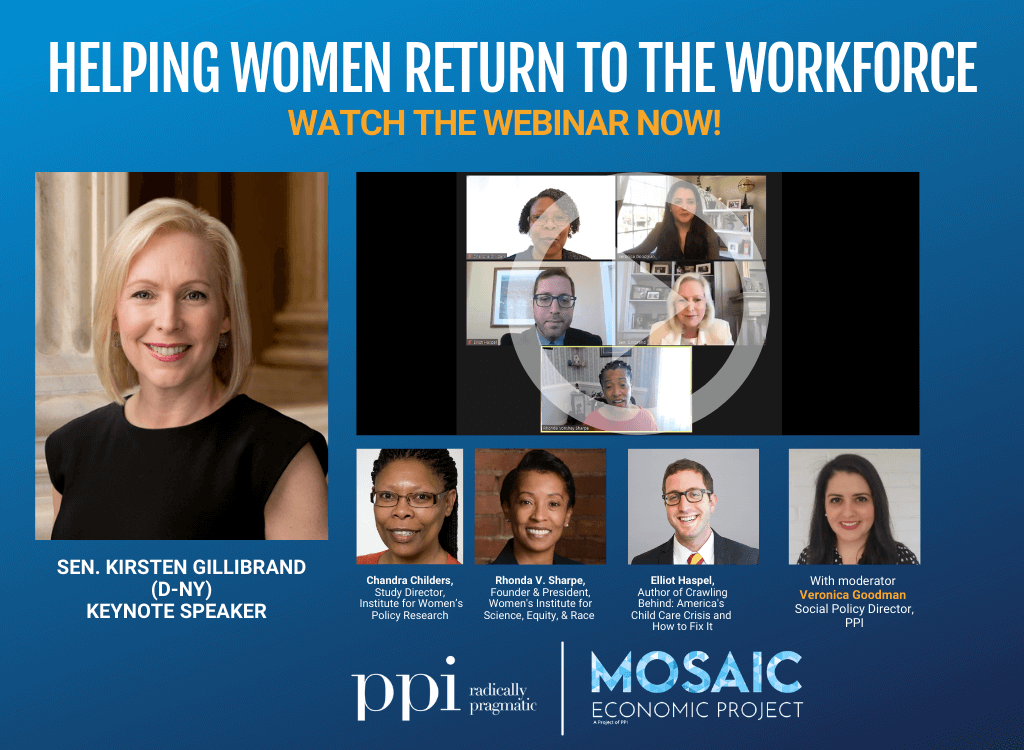
WEBINAR: Helping Women Return to the Workforce, with Senator Kirsten Gillibrand (D-NY)

On Tuesday, April 27th, PPI hosted a webinar with special guest Senator Kirsten Gillibrand on policies to help women return to the workforce following the devastating effect of the pandemic on women’s labor force participation. Our panel included policy experts on labor, child care, and gender equity.

Keynote Speaker:

Sen. Kirsten Gillibrand (D-NY)

Moderator:

Veronica Goodman, Social Policy Director, Progressive Policy Institute

Panel:

Chandra Childers, Study Director at the Institute for Women’s Policy Research
Elliot Haspel, Author of Crawling Behind: America’s Child Care Crisis and How to Fix It
Rhonda V. Sharpe, founder & president, Women’s Institute for Science, Equity, and Race

Watch the event here. 

PPI Hosts Event with Sen. Kirsten Gillibrand on Helping Women Return to the Workforce Post-Pandemic

Today, the Progressive Policy Institute and PPI’s Mosaic Economic Project hosted a webinar with special guest Senator Kirsten Gillibrand (D-NY) on policies to help women return to the workforce following the devastating effect of the pandemic on women’s labor force participation.

The panel included esteemed policy experts on labor, child care, and gender and racial equity, including Chandra Childers, Study Director at the Institute for Women’s Policy Research, Elliot Haspel, Author of Crawling Behind: America’s Child Care Crisis and How to Fix It, and Rhonda V. Sharpe, founder & president, Women’s Institute for Science, Equity, and Race.

“The pandemic recession threatens to erase decades of progress in women’s labor force participation, which hasn’t been this low since the 1980s. But we know that even before the pandemic, women and working mothers were not adequately supported and struggling to thrive. That’s especially true of Black and Hispanic female workers. As the White House and President Biden unveil the American Family Plan this week, we hope that policies to support women and working families are top of mind. We also thank Senator Gillibrand for being a tireless advocate for women and families throughout her time in Congress,” said Veronica Goodman, Director of Social Policy at PPI and moderator of the event.

The event covered a wide variety of roadblocks women face when returning to the workforce, including access to paid family leave, affordable child care, workforce development, and expanding apprenticeships and other educational and job training opportunities.

According to the Department of Labor, Black and Hispanic women workers were disproportionately impacted by the pandemic, as they are overrepresented in low-paying service sector jobs, which were slower to hire workers back as communities reopen and recover from the pandemic. As of March 2021, almost 1.5 million fewer moms of school-aged children were actively working than in February 2020, according to the U.S. Census Bureau.

Watch the event livestream here.

The Progressive Policy Institute (PPI) is a catalyst for policy innovation and political reform based in Washington, D.C. Its mission is to create radically pragmatic ideas for moving America beyond ideological and partisan deadlock. Learn more about PPI by visiting progressivepolicy.org.

The Mosaic Economic Project brings together a network of diverse women who are experts in economics and technology – fields where women’s perspectives are grossly underrepresented. Mosaic trains, connects, hosts and advocates for the network’s participation in meaningful policy influencing conversations, with a particular focus on Congress and the media.

Follow the Progressive Policy Institute.

Follow the Mosaic Economic Project.

###

Media Contact: Aaron White, Director of Communications: awhite@ppionline.org

PPI Hosts Event with Rep. Chris Pappas on Creating More School-to-Work Pathways for Students and Young Adults

Today, the Progressive Policy Institute and the Reinventing America’s Schools Project hosted a webinar with special guest Rep. Chris Pappas (NH-01) on creating more school-to-work pathways for our students and young adults. Congressman Pappas was joined by Jennifer Kemp, Director of Youth Services at the U.S. Department of Labor’s Office of Workforce Investment, and an esteemed panel of experts in the subject.

Today’s high school students and young adults face a difficult job market. The COVID-19 pandemic has been particularly hard on less educated workers without a college degree. The 10 million jobs lost by Americans at the pandemic’s onset disproportionately impacted young adults between the ages of 16-24 – especially Black and Hispanic workers. Some estimate that as many as 25% of our youth will neither be in school nor working when the pandemic ends.

Watch the event livestream here.

Panelists for this event included: Veronica Goodman, Director of Social Policy at PPI; Tressa Pankovits, Associate Director of PPI’s Reinventing America’s Schools project; Jeanne Russell, Executive Director of the Centers for Applied Science and Technology; Cate Swinburn, President of YouthForce NOLA; and Ryan Craig, Managing Director of Achieve Partners.

“The Biden administration, Congress, state and local policymakers have the opportunity to revamp our education system for a 21st-century workforce by creating a more diverse set of career pathways for today’s students. Connecting students to work — such as through career and technical education and work-based learning opportunities — before they graduate high school can be key to their future economic success. We thank Congressman Chris Pappas and Jennifer Kemp of the Department of Labor for all of their work to connect America’s youth to employment,” said Veronica Goodman and Tressa Pankovits of PPI.

This event builds off of PPI’s new report, Preventing Failure to Launch: Creating More School-to-Work Pathways for Young Adults, which argues schools across the country should be incorporating school−to−work models into their curriculums in order to ensure that teens and young adults are set up for success in the workforce. Report authors Veronica Goodman, Tressa Pankovits, and Tess Murphy analyze a number of case studies to provide evidence showing that there are better models for helping students find their economic footing as they transition to jobs and adulthood.

Read the report here.

The Progressive Policy Institute (PPI) is a catalyst for policy innovation and political reform based in Washington, D.C. Its mission is to create radically pragmatic ideas for moving America beyond ideological and partisan deadlock.

The Reinventing America’s Schools Project inspires a 21st century model of public education geared to the knowledge economy. One model, charter schools, are showing the way by providing autonomy for schools, accountability for results, and parental choice among schools tailored to the diverse learning styles of children.

Follow the Progressive Policy Institute.

Follow the Reinventing America’s Schools Project.

###

Media Contact: Aaron White, Director of Communications: awhite@ppionline.org

Infrastructure and Coronavirus Relief, a discussion from the perspective of the US Virgin Islands with Rep. Stacey Plaskett

On this week’s Radically Pragmatic Podcast, PPI President Will Marshall and Center for New Liberalism Policy Director Jeremiah Johnson sit down with Rep. Stacey Plaskett, Delegate to the United States House of Representatives from the United States Virgin Islands’ at-large congressional district. Congresswoman Plaskett serves on the House Ways and Means, Agriculture and Budget Committees, and is a leadership member of the New Democrat Coalition.

They discuss the New Democrat Coalition’s 100 Days Agenda, and the need for continued coronavirus relief and recovery measures – especially for regions like the Virgin Islands. Additionally, Congresswoman Plaskett outlines the critical nature of the American Jobs Plan, and the need to invest in long-term resiliency measures like job training, infrastructure development and clean energy.

PODCAST: Rep. Stacey Plaskett Talks Infrastructure and COVID-19 Recovery on Radically Pragmatic

On this week’s Radically Pragmatic Podcast, PPI President Will Marshall and Center for New Liberalism Policy Director Jeremiah Johnson sit down with Rep. Stacey Plaskett, Delegate to the United States House of Representatives from the United States Virgin Islands’ at-large congressional district. Congresswoman Plaskett serves on the House Ways and Means, Agriculture and Budget Committees, and is a leadership member of the New Democrat Coalition.

They discuss the New Democrat Coalition’s 100 Days Agenda, and the need for continued coronavirus relief and recovery measures – especially for regions like the Virgin Islands. Additionally, Congresswoman Plaskett outlines the critical nature of the  American Jobs Plan, and the need to invest in long-term resiliency measures like job training, infrastructure development and clean energy.

Listen on Anchor.

Listen on Spotify.

Listen on Apple Podcasts.