Gerwin for The Hill, “Democrats’ trade plan tries to ‘out-Trump’ Trump – bad idea”

With the rollout of their new “A Better Deal” agenda, congressional Democrats have a chance for a reset with American voters. And nowhere do they need a reset more than on trade.

Unfortunately, with their recent announcement of “A Better Deal on Trade and Jobs,” Democrats missed a key opportunity to offer a balanced trade plan that backs both stronger enforcement and trade’s constructive role in supporting millions of good jobs.

In launching their new trade agenda, Washington Democrats doubled down on the hard-edged protectionist rhetoric heard from both parties in 2016 — rhetoric that casts trade as a threat and focuses largely on traditional manufacturing and the decade of undeniable economic damage caused by Chinese competition. It’s hardly surprising, then, that the “Better Deal” trade program is mostly an exercise in limiting global trade and investment.

Continue reading at The Hill.

Trump Wrongly Claims Amazon Hurting Retail

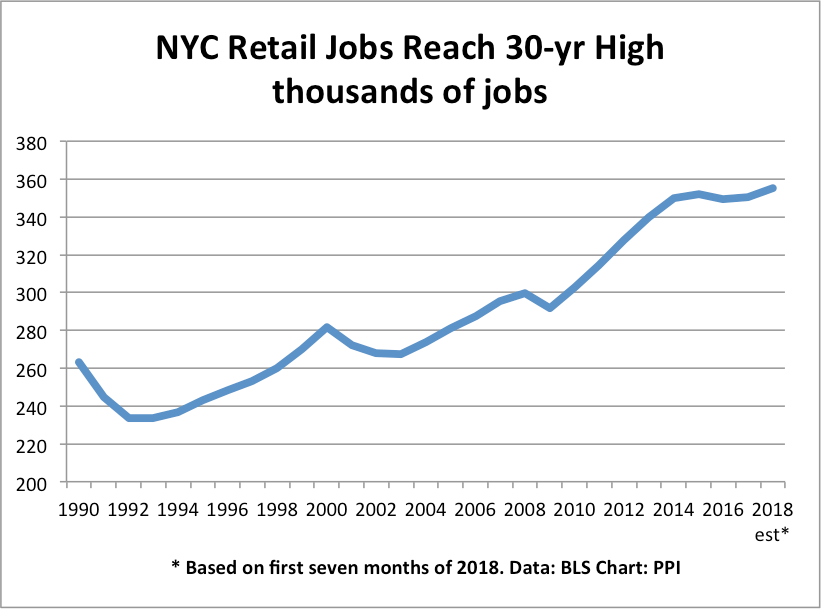
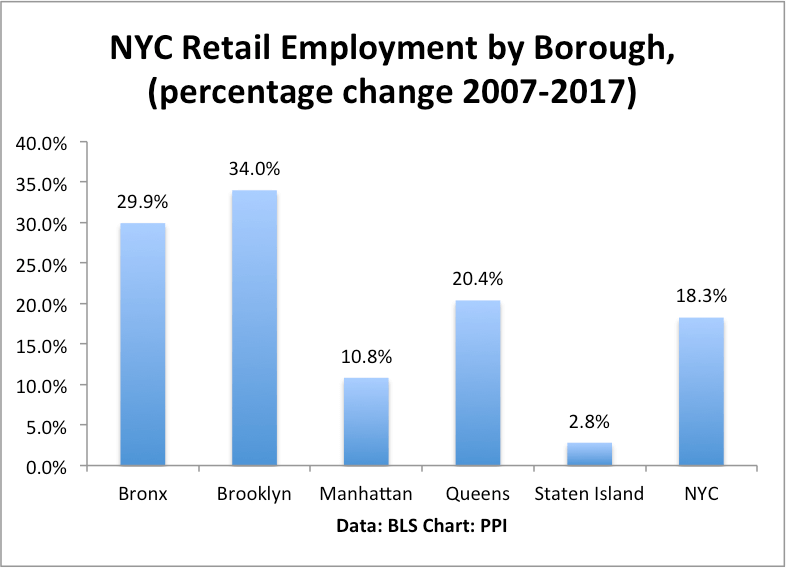
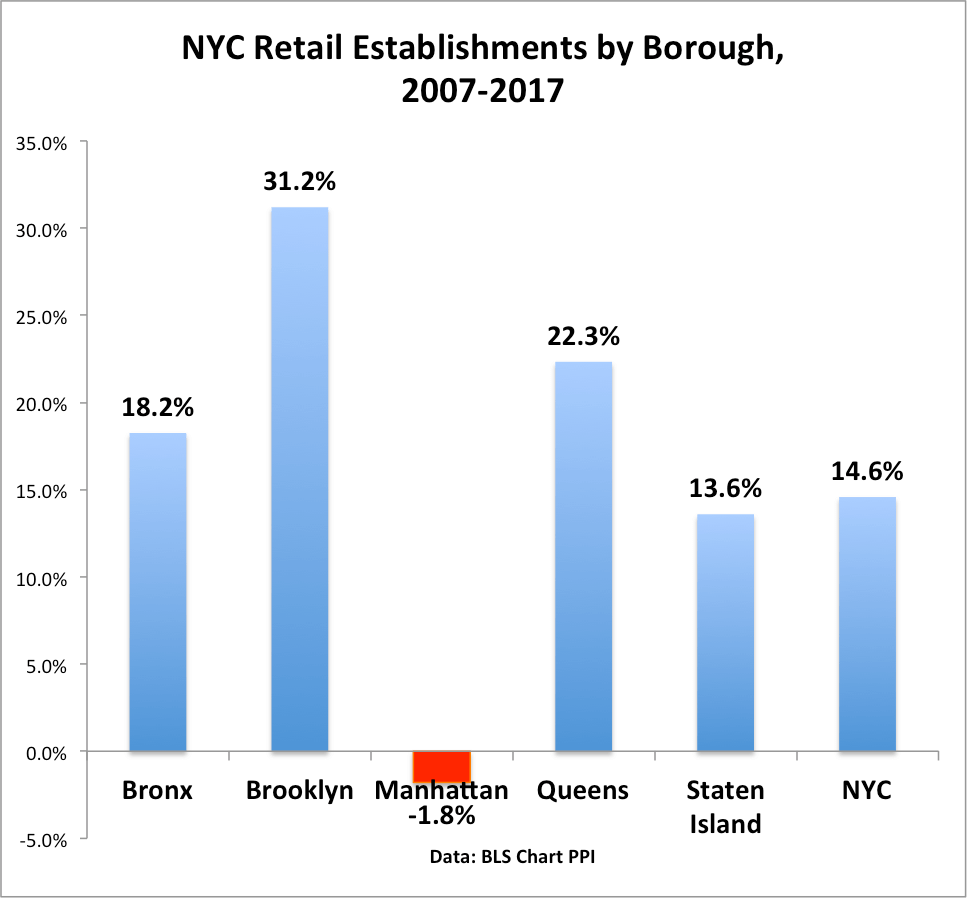
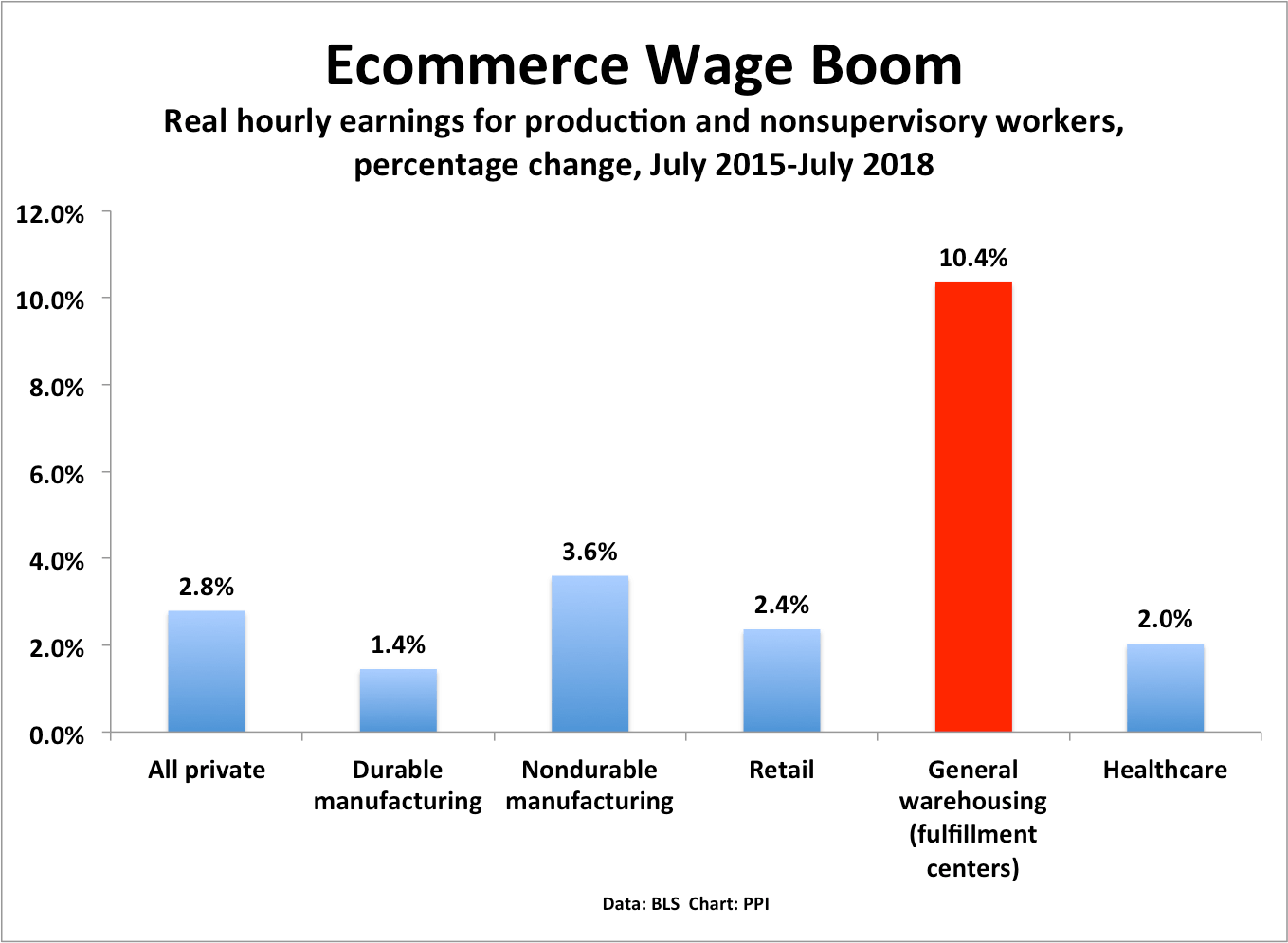
Yesterday, President Trump accused online retailer Amazon of “doing great harm to tax paying retailers” and “many jobs being lost.” Unfortunately, this is another fact-free claim by the president. New research by PPI economist Michael Mandel shows that ecommerce is actually expanding retail jobs.

Mandel wrote last month, “According to the latest BLS employment report, employment at brick-and-mortar retail is down by only 7,000 jobs over the past year, a mere rounding error for an industry that employs over 15 million workers. At the same time, employment in the ecommerce sector has risen by 61,000 over the past year, more than making up for any erosion in brick-and-mortar retail.” Indeed, ecommerce is a job-producing addition to the retail sector, not a job-killer.

Asbestos Litigation Reform That Helps Victims And Businesses

In New York and around the country, we count on judges and juries to get things right, but there is no way they can do their jobs if they are blindfolded from the facts. In the past few years, judges have exposed a national trend of plaintiffs’ lawyers hiding critical facts when suing over asbestos injuries. These tactics must be stopped. They yield inflated damage awards, hurt the local businesses sued, and deprive future victims of access to justice.

Our court system is one of our greatest public goods, and we need to protect it from those who threaten its integrity. In asbestos litigation, this threat seems to come regularly from a few personal injury lawyers who look for ways to game the system. The opportunities for mischief are vast because decades ago construction, shipyard, and other industrial workers were exposed to many asbestos products. Some diseases take decades to develop, so people are still getting sick and suing today. When a few inventive lawyers started filing asbestos claims for people who were not even sick 15 years ago, courts and legislatures took corrective action.

The new trick is to withhold evidence from juries about the many different companies’ asbestos products a plaintiff was exposed to in order to inflate awards against only one or two of them. This gamesmanship is made possible by the fact that people who get sick from asbestos exposure can be compensated through two independent systems.

Continue reading at Forbes. 

Bledsoe for The Hill, “US can boost gas exports, cut global emissions in one fell swoop”

Infamously, Donald Trump has called climate change a hoax, but the rest of the world knows better. In fact, the main reason European and Asian nations are interested in importing U.S. natural gas is to displace coal and cut greenhouse gas emissions that cause climate change.

If the Trump administration truly cares about expanding U.S. gas exports, as they claim, they should maximize the competitive advantage that lower-emitting U.S. natural gas has over not only coal, but also over higher-emitting Russian gas.

This means the administration should stop the Environmental Protection Agency’s (EPA) attempt to rollback domestic regulations of methane emissions from gas development, and perhaps use the threat of sanctions against Russian gas pipelines (as allowed under the new Russia sanctions law) to expand U.S. markets.

Continue reading at The Hill.

Weinstein for US News, “The Last Chance for Relevance”

The curtain is about to come down on Paul Ryan’s run as a major force in Washington politics. Should Democrats gain control of the House of Representatives next year Ryan would lose his speakership (and he would likely be forced to step down as Republican leader as well). If Republicans hold onto the House by a few votes, the Republican majority will be even more dependent on the Freedom Caucus, which will want one of their own as speaker. Either way, Ryan’s window to enact any of his major legislative priorities is rapidly dwindling.

It seems it was just yesterday that Ryan was viewed as the future of the Republican Party. He was hailed as one of the GOP’s true, big policy thinkers and his so-called talents were rewarded with a series of plum jobs normally held aside for more seasoned members of Congress. Ranking member of the House Budget Committee at 37, his party’s vice presidential nominee at 42, chairman of the powerful Ways and Means Committee at 45, and then speaker shortly thereafter.

Continue reading at U.S. News & World Report.

Gerwin for The Hill, “The bitter harvest of Trump’s protectionist stance”

Donald Trump is infatuated with the 2016 election map, which underscores his dominance in red-coded rural counties. Candidate Trump repeatedly promised to “take care” of America’s rural voters who, in return, provided some of his biggest vote margins.

It’s ironic, then, that on issues from budgets to healthcare, America’s heartland stands to become an early and particular victim of Trump’s misplaced priorities. Nowhere is this more evident than with Trump’s wrongheaded, protectionist approach to trade.

Continue reading at The Hill.

A Listening Tour Through Trump Territory: Public Policy and the Towns in Between

This is a challenging time to study public policy, given the bitter political divisions in the United States. Competing world views challenge our sense of common national purpose. The electoral shocks of November 8, 2016 have made this a hard time to teach public policymaking skills: data analysis, coalition building and use of legislative precedents. At the public policy school where I work, we need to teach these skills to the next generation of public servants. Students need insights about how to assist communities where voters feel left behind by the forces of globalization and changing job markets.

There are many ways to take the pulse of the country. Supposedly scientific polls have failed us in recent elections—too many have been dead wrong. They miss too many voters. They fail to capture the motives, the hopes and fears behind the choices voters make.

After months of struggling to explain the Trump agenda in my University of Virginia classrooms, I decided that to become a better teacher, I needed to take a road trip. I’ve crisscrossed the country enough times to visit almost every state. Yet, I’ve rarely ventured south of Richmond. So the route was designed to take me through the small towns of southwestern Virginia, eastern Tennessee, clear down to the Alabama River and Selma, then run north through upcountry South Carolina to the Smoky Mountains. Avoiding the interstates, I would loop back and forth to towns from Marion, Virginia to Maplesville, Alabama to Black Mountain, North Carolina. The laptop was left behind and the IPhone turned off. The primary news source for nine days was going to be hard copies of the disappearing local dailies. The Bristol News-Courier and the Asheville Citizen-Times offer insights into community concerns you won’t get from cable news.


Estimating the Impact of Ecommerce On Productivity Growth

In an earlier post, I estimated that the expansion of ecommerce since 2007 is saving American households 64 million hours per week in shopping time.  What impact does this have on measured productivity? This is not an easy question. Unpaid shopping hours are part of  “household production,” which is generally excluded from official calculations of GDP. That omission is a problem, because it undervalues the unpaid time that people contribute to their households, ranging from cooking and childcare to commuting.

The best  way to tackle the impact of ecommerce on productivity is to build up a consistent set of national accounts integrating  both the increased importance of data for economic growth (See Moving Beyond the Balance Sheet Economy), as well as shopping as an economic activity requiring both market hours (the retail worker) and nonmarket hours (driving to the store, choosing items from the shelves and so forth).  For our purposes here, though, we are going to do a back of the envelope calculation to estimate the impact of ecommerce on productivity growth.

According to the BLS, the number of hours worked by employed workers in the nonfarm business sector rose by 2.1% from 2007 to 2016, or an increase of 79 million hours of work per week.* Suppose that we adjust for the reduction in household shopping hours, on a 1-to-1 basis.**  Then total weekly hours only rise by 15 million from 2007 tp 2016, or only a 0.4% gain in hours. The annual percentage growth in hours goes down from 0.2% to virtually nothing.

This calculation suggests that factoring in ecommerce could raise measured productivity growth in the nonfarm business sector by 0.2 percentage points from 2007 to 2016. This is a significant difference, but obviously not enough by itself to reverse the slowdown in productivity growth. However, the relative gains in productivity should continue as the market share of ecommerce increases.

This type of productivity analysis, which integrates the impact of the data-driven economy on both market and household production, can be extended to other innovations as well, such as autonomous vehicles and artificial intelligence.


*The BLS reports annual hours in the nonfarm business sector, which I divided by 52 to get weekly hours.

**We could make a case for the adjustment factor to either be higher or lower than 1-to-1. We could value the household hours at the minimum wage, in which case they are less valuable than retail and fulfillment center worker hours. Or we could say that being stuck in traffic driving to the mall or waiting on checkout lines is really annoying, which would make those saved hours more valuable.


How Should We Think About Pro-Growth, Pro-Job Competition Policy?

We think of the United States as a low-inflation economy, with an overall price increase of 36% since 2000, or less than 2% a year.  But the fact is, the inflation  performance of different industries has varied greatly since 2000.  For example, the price of construction has gone up more than 100% since 2000, as measured by the BEA’s implicit value-added price index. The price of educational services has gone up by 80%, and the price of air travel has gone up by 76%.

By comparison, according to the BEA, the value-added price of broadcasting and telecom services has fallen by 22% since 2000, while the price of computer and electronic products has fallen by 62%.

The high-inflation industries tend to be on the physical side of the economy. As they get more expensive, they eat away at living standards. Think about it. Americans spend only 6% of their consumption dollars on tech/telecom goods and services, as measured by the BEA.  Other areas, such as housing, health, food, and transportation, are far more important for consumer spending.

That’s why we are suggesting a different way of prioritizing where we should focus our competition policy. Take a look at the 2×2 matrix below, where we categorize industries by whether they are high-inflation or low-inflation, and high-innovation or low-innovation.


Competition Policy Matrix

High innovation Low innovation
Rapid price increase


Air travel, construction, education
Slow price increase Tech/telecom


We suggest that progressive competition policy should focus on the upper right-hand quadrant–those industries where prices are increasing rapidly and innovation has been slow. There are two issues in these industries. First, has market power pushed up prices and held back innovation? Second, is government regulation helping support that market power?

Moreover, it also often turns out that high-innovation, low-inflation industries produce more jobs than low-innovation, high-inflation industries. Take a look at the table below, which just focuses on performance since 2007. The value added price index for air travel has risen almost 55% since 2007, according to the BEA. Meanwhile, prices for the tech/telecom sector has fallen more than 6%. And tech/telecom is clearly more innovative than air travel.

Over the same period, jobs have grown three times as fast in the tech/telecom sector as in air travel (including supporting services).


Comparing Performance
change since 2007
Air travel tech/telecom
Price change 54.5% -6.4%
jobs (thousands) 16.5 498.5
jobs (percent) 2.5% 7.6%


We suggesting that tackling market power in high-inflation, low-innovation industries could help boost growth, raise living standards, and create more jobs.

Democrats Take A Wrong Turn

Which one is not like the others?

Since 2000, American households have been hit by price increases which far exceed their ability to pay. Necessities like housing and food have skyrocketed in prices. Child care is 81% more expensive, passenger fares for foreign travel are up 63%, financial fees are higher by 41%. Even beer, perhaps a necessity for some, is up 40%.

In an era of low inflation, these price increases are worrisome, and have gone a long way to drag down real incomes. From this perspective, the proposal from Congressional Democrats to stiffen antitrust enforcement–part of the “Better Deal” plan they unveiled today–is a good idea. They identify sectors such as airlines, food, beer, and financial services as ripe for closer antitrust scrutiny. We agree.

But Democrats are unfortunately honing in on one target that makes no sense: The data-driven telecom and tech sector. Let’s start with telecom first, which is specifically mentioned in the Better Deal proposal. According to data from the Bureau of Economic Analysis, the price of personal telecom services—cable, landline and mobile phone, and Internet—has risen only 6% over the past 16 years. That’s far below the 33% average for all consumer goods and services.

Moreover, the share of personal spending going to personal telecom services is only 2.7%, no higher than it was in 2000. Despite the enormous surge in smartphones and Internet usage, the spending burden of personal telecom services has not risen, according to data from the BEA.

More broadly, the entire tech/telecom/content sector has produced much lower price increases and higher consumer welfare gains than the rest of the economy. In 2016, tech/telecom/content consumer goods and services absorbed 6% of consumer spending, no higher than it was in 2000.*

Moreover, tech and telecom companies have turned into big job producers across the whole country. By our analysis, the tech/telecom sector has produced over 800,000 net new jobs since 2007, including decent-paying ecommerce jobs for high school graduates in states such as Kentucky, Indiana, and Tennessee.

If Democrats are concerned by price increases that hurt consumers and workers, there are plenty of other places to look. For example, the price of parking fees and tolls has gone up 96% since 2000, according to the BEA. The price of spectator sports has gone up 83%, and funeral and burial services are 70% more expensive, driven in part by a surprising 104% increase in the wholesale price of burial caskets.

On a more prosaic level, the price of construction has doubled since 2000, propelled in part by large increases in prices of construction materials like asphalt. Are there local monopolies in these industries that drive up prices? It’s worth looking into.

If we want to use competition policy as a tool for growth, we should primarily focus on low-innovation sectors that have big price increases. These are the sectors that are draining consumer purchasing power and undercutting real income growth. Outside of healthcare, these are also the industries producing fewer jobs.

Conversely, we should place a lower competition policy priority on high innovation sectors and companies. That’s the only way to help all Americans.

*Calculations available on request.


A Lesson in Lotteries from the District

Under Chancellor Antwan Wilson, the children of current and former public officials will no longer receive preferential placement in the District’s infamously competitive school enrollment system. The move follows a report from the D.C. Inspector General that former Chancellor Kaya Henderson had allowed the children of several top public officials to bypass the My School DC lottery system and enroll directly in the District’s most coveted schools.

Adopted to replace a chaotic system of individual lotteries and applications (and the occasional donated brownies), My School DC is a common lottery for a majority of the District’s public and charter schools. A computerized system uses a student’s stated preferences and randomized lottery number to determine which students receive the most demanded seats.

My School DC – and its Denver, New Orleans, and Newark counterparts – was designed for efficiency, transparency, and impartiality. A database of participating schools saves parents hours of researching, and a single, online form replaces mountains of paperwork. Information can be provided in several languages, and the process is fairly simple.

Though it can be complicated by high demand and shrinking class sizes, the lottery in theory is neutral. Those who govern it, however, are not.

Chancellor Henderson authorized the transfers under a regulation introduced during Chancellor Michelle Rhee’s tenure, which predates the district-wide lottery system in place today. Such discretionary transfers are only valid if “in the best interests of the student, and that the transfer would promote the overall interests of the school system.”

The enrollment of a high-profile student in DCPS may spur confidence in the quality of the District’s public offerings. But the condition of their enrollment—bypassing waitlists nearly 1,000 students long—undermines DCPS’s commitment to the common lottery system. In a district already troubled by intense competition, each line-jumper only deepens public distrust of DCPS’s ability to provide for all students.

As growing 21st Century School Systems implement their own lottery systems, the vulnerability of the District’s system to favoritism and Chancellor Wilson’s ban on preferential enrollments for the children of public officials should stand as both a warning and a lesson.

No system of school choice is absolutely fair. But the combination of a lottery system and similar preemptive policies can level the playing field for students regardless of social standing or parental activism.

Rotherham for US News, “Challenge Students, Don’t Shield Them”

Tap Tapley, the legendary Outward Bound instructor, is said to have described the crux of the experiential outdoor experiential learning school’s approach as “inducing anxiety and then releasing it in a constructive manner.”

And for a half century, Outward Bound courses have done just that – putting students in challenging and uncomfortable situations with real and immediate consequences. Students find themselves climbing mountains, paddling rivers, exploring remote canyons, traveling in the wilderness in winter conditions or sailing. Students learn skills to survive and thrive in these settings. But more importantly they learn about themselves; compassion and empathy for others; their capabilities; and tenacity and resiliency in pursuit of challenging goals.

But this model is pretty much the exact opposite of the scene at many residential colleges today, especially our most elite ones. Instead of challenge, much of the debate on college campuses today turns on ideas about intellectually “safe” spaces, where students don’t have to encounter ideas that make them uncomfortable or engage with those with whom they disagree.

Just last week, Harvard University, a school regarded as a breadbasket of future American leaders, decided that free association, allowing its students to decide what clubs they want to join, threatened its ideas about inclusivity. (Yes, obviously richly ironic, given what it takes to get into Harvard in the first place.) Meanwhile, the college curriculum has at many schools become basically an a la carte experience, where students can gravitate toward courses that reinforce rather than challenge their worldview.

Read more at US News.

Union’s Retrograde Report Earns Failing Grade: A Response to the NEA’s Policy Statement on Charter Schools

Last week, the National Education Association (NEA) voted to adopt a new policy statement[1] on public charter schools. Ignoring mounting evidence that the best charter systems are finally giving urban children a shot at a decent education, the NEA calls for a moratorium on the creation and expansion of public charter schools.

The NEA says it based this new statement on yearlong research conducted by its Charter Taskforce. Unfortunately, the taskforce report[ii] is a shoddy piece of work that echoes the same old falsehoods about public charter schools, including that the schools “counsel out” the worst students and that they increase segregation. The former has been heavily refuted[iii]. The latter is also unproven. Charter schools’ demographics are not significantly different than their neighborhood public schools[iv] (They do, however, produce significantly better academic results with a similar student composition[v]).

And, of course, the NEA beats its favorite drum, claiming that public charter schools drain resources from public schools—which is impossible, since charters are public schools. The report concludes that charter schools are a “failed and damaging experiment.”

This is fear mongering worthy of a prize. But it’s the NEA that’s actually afraid – for its future. The NEA no doubt fears that a growing charter sector means a shrinking teachers’ union. That need not be the case, however, if the union evolves to fit into 21st century school systems rather than block the progress of charter schools with policy statements and moratoriums.


21st Century School Systems Need Effective Authorizers

When I was in high school, I had a teacher everyone loved: Mr. C.

Mr. C told us stories about traveling, he talked about baseball, and he let us sit with our friends and socialize. We completed worksheets; we earned As in the class. We were happy, and our parents were happy with our grades.

When the A.P. Exam results came in, only two students out of our class of twenty-five received passing scores.

The problem with Mr. C. wasn’t that he was a bad person. The problem was that he wanted to be our friend first and our teacher second. Our test results showed that we had learned none of the course content, and, ultimately, Mr. C did a disservice to us as students, regardless of how much we liked him.

Extend that scenario to an entire school: The school creates a comfortable and safe environment. Students are happy with their teachers, and parents are happy with their children’s grades. But the students perform abysmally on standardized tests. Despite the overall satisfaction of parents and students with the school, there’s evidence that the students aren’t learning.

In the new book Charting a New Course: The Case for Freedom, Flexibility & Opportunity Through Charter Schools, Jeanne Allen, Max Eden, and others argue for the end of results-based accountability for charter schools, at least as far as standardized testing is concerned.

The charter sector they envision is one where authorizers no longer carefully screen charter operators prior to issuing a charter, and they no longer shut down schools based on the results of test scores. The free market guarantees quality control: if the customers are happy, the school stays open. If enough families desert it, it runs out of money and closes.

But this would ultimately do a disservice to students, regardless of how much they and their families liked their schools.

Schools are first and foremost places of learning. If we’re going to spend taxpayers’ money on them, we need objective evidence that students are learning.

Of course, test scores should not be the only relevant factor in determining the success or failure of a school, and no good charter authorizer judges schools on test scores alone.

Chester Finn, senior fellow at The Fordham Institute, explains that effective authorizers are also looking at various gauges of student growth, as well as graduation rates, pupil and teacher attendance and persistence, and more (e.g., Advanced Placement scores, dual credit results, where kids go to high school after leaving the charter middle school, etc.). Good authorizers also do site visits and pay attention to school climate.

We need authorizers who investigate charter operators prior to allowing them to open schools, then conduct in-depth evaluations of schools based on a variety of factors, including test scores, and finally close or replace those whose students are falling far behind.

Not all parents have the ability to assess schools, and those parents trust regulating bodies to ensure that the schools available to their children are high quality. Parents and students have a right to choice, but we need to make certain that they choose from a selection of effective schools.

In 21st century school systems, we need well-authorized charter sectors in which strong authorizers scrutinize charter operators, shut down failing schools, and invite successful schools to replicate, so we have no doubt that our students are learning. Otherwise, we’re simply replacing one failing school system with another

Stangler for Real Clear Markets, “Renewed Optimism As the Start-Up Geography Divide Narrows”

Over the past several years, even as the national fervor over startups has continued unabated, there has been a string of negative findings about the state of American entrepreneurship. The Economic Innovation Group, among others, chronicled a long-term decline in business creation as well as ever-increasing concentration in where businesses are being created. Only five metro areas, they found, accounted for half of the nation’s increase in new businesses between 2010 and 2014. Other researchers have found similar declines across several indicators of economic dynamism—fewer and fewer Americans, for example, work for new and young firms.

Happily, a recent report by Michael Mandel at the Progressive Policy Institute (PPI) highlighted a potential reversal of these trends. (Full disclosure: I have a PPI affiliation.)

Using government data, Mandel charts a “revival of economic dynamism” since 2015 that is fairly widespread: by last year, the “growth gap” between tech hubs in Silicon Valley, New York, Boston, Austin had disappeared.

Read more at Real Clear Markets.

The Economic Impact of Data: Why Data Is Not Like Oil

The saying “data is the new oil” is at times referenced by analysts working to assess whether our increasingly digital and data-driven world generates positive impact for our economy and society. However, this saying is imprecise. Data should not be compared to oil – it is not a scarce commodity, is nonrival, and cannot be monopolized.

With regards to privacy, the analogy further weakens. While regulations for traditional commodities like oil seek to protect individual rights to ownership of resources (an individual’s oil), the same regulations for the data-driven sector can have negative impact on the economy overall. This is because, when it comes to data, economic value creation is driven by the analysis of data in conjunction with other information. Thus, laws that quite rightfully protect individual rights to data can be at odds with innovation and economic growth.

overview: Power-of-Data-One-Pager