Weinstein Jr. for Forbes: Kamala Harris Breaks With The “College For All” Orthodoxy

By Paul Weinstein Jr.

“As president, I will get rid of the unnecessary degree requirements for federal jobs to increase jobs for folks without a four-year degree.” Those words from Vice President Kamala Harris signal a major shift in higher education policy, one which recognizes that earning a college degree costs too much, and not every job should require one.

Since the late 1960s, progressives have supported the expansion of financial aid for college in the belief that a college degree was the key to expanding the American Dream. Pell Grants, student loans, and college tax incentives were all enacted and expanded under Democratic Administrations.

For many years this strategy worked. College enrollments dramatically increased, rising from 8.5 million in 1970 and peaking at around 21 million in 2010. In addition, there are now more women undergraduates than men and some 45% of students come from diverse populations.

Keep reading in Forbes.

Trade Fact of the Week: “Sometimes countries make big and fateful choices … and sometimes their big and fateful choices go badly wrong.”

FACT: “Sometimes countries make big and fateful choices … and sometimes their big and fateful choices go badly wrong.”

THE NUMBERS: U.S. hourly-wage and comparable workers, 2023* –
Total Employed: 161.0 million
Hourly wages or equivalent   80.5 million
“Industrial” hourly-wage workers**   15.7 million
“Non-industrial” hourly-wage workers   64.8 million

*  Bureau of Labor Statistics, full-year averages
** “Industrial” includes 8.9 million manufacturing workers, 5.7 million in construction, 0.3 million in energy and mining, and 0.8 million in agriculture. Top “non-industrial” categories include 12.5 million workers in health and social assistance, 10.9 million in retail, and 7.3 million in restaurants and other food service jobs.

WHAT THEY MEAN:

PPI’s newest report, Trump’s Folly, Harris’ Opportunity: Trade and the Blue-Collar Worker, opens with a warning:

“Sometimes countries make big and fateful choices. …  And sometimes big and fateful choices go badly wrong. American isolationism in the 1920s and 1930s helped make World War II possible. The ‘America First Committee’ policies*, had the U.S. adopted them in 1940, might have caused its loss. Hoover’s 1930 tariff hikes, advertised as a way to keep U.S. wages high and jobs at home, provoked retaliations and a deepened economic contraction, leaving exporters bankrupt and workers unemployed. These ideas’ return in 2024 presages a time in which American influence falls abroad, the cost of living soars at home, the U.S. and global economies grow more volatile, and the risks of world politics rise.”

Now as in the past, the best response to bad and dangerous ideas is to reject them and propose good ones instead. As Mr. Trump and Sen. Vance try to re-animate 1920s/1930s isolationism, Vice President Harris is creating a modernized, Roosevelt-like alternative. Starting from the basic conviction that American leadership can make the world safer and better, she affirms core U.S. alliances and support for Ukraine, and directly attacks on Mr. Trump’s neo-Hooverite tariff obsession:

“He wants to impose what is, in effect, a national sales tax on everyday products and basic necessities that we import from other countries.   That will devastate Americans.  It will mean higher prices on just about every one of your daily needs: a Trump tax on gas, a Trump tax on food, a Trump tax on clothing, a Trump tax on over-the-counter medication.   …  Donald Trump’s plan would cost a typical family $3,900 a year.  At this moment when everyday prices are too high, he will make them even higher.” 

Harris’ concise takedown perfectly matches George Orwell’s appeal for clarity and brevity (“use the fewest and shortest words necessary to carry your meaning”) in Politics and the English Language.  From a different angle (Bipartisan Infrastructure Act seaport investments), Transportation Secretary Buttigieg does the same in explaining the benefit Americans can draw from opening markets abroad and lowering the costs of trade: “keep prices down, shelves stocked, and American farms and businesses selling their goods around the world.”

What, then, should replace Mr. Trump’s national sales tax? The report — the fourth in PPI’s “Campaign for Working America” series this year, with others on housing, non-college career paths, and competition — assesses the limitations of “Bidenomics”’ honorable-but-not-quite-successful effort to create a “worker-centred trade policy, and then suggests ways to connect trade policy to blue-collar aspirations and concerns, organized around a “guidepost and four policy themes. A precis:

Guidepost: Per data from the Bureau of Labor Statistics, about half of last year’s 160 million working Americans were “blue-collar” men and women earning hourly wages or an equivalent type of income. Just under 16 million are “industrial” workers in factories, on construction sites, or in mining or farm work; the other 65 million are “non-industrial” workers in health and caregiving, retail, restaurants and bars, repair shops, bus routes, and similar jobs. A successful policy has to consider the interest of the non-industrial workers as well as the industrials.

Theme 1: Bring home goods prices down by purging junk tariffs. Reduce the cost of living by purging the 11,414-line tariff system of lines — for groceries, for clothes and shoes, for small appliances, and table silverware – which raise prices, discriminate against women and lower-income families, and don’t protect any jobs.  The launch for this is the Fletcher/Pettersen Pink Tariffs Study Act introduced by Reps. Lizzie Fletcher and Brittany Pettersen this spring.

Theme 2: Help workers find better jobs by creating more export opportunities. Data from the Census and BEA illustrate the high quality of jobs in exporting firms. As just one example, African American-owned exporting firms average 10 more employees and $10,000 more in payroll per worker than the U.S. business community generally.  Here the next president can build on some creative Biden team policy launches — see Secretary Raimondo’s launch of the Global Diversity Exporter Initiative — and combine this with revived Obama-era themes of opening markets, pooling strengths, and building relationships with friends and allies.

Theme 3: Make the right exceptions. President Biden’s “industrial strategy” program is still a work in progress. Its most ambitious projects, in particular the hope to shift the $180 billion U.S. auto industry toward lower-emissions EV production, are still in their early phases. Here, the Biden team’s decision to use tariffs has a reasonable foundation.  With China having gotten to mass-market, low-price EV first (after a very large barrage of its own subsidies), U.S. battery and plant factories should have some time to catch up. This probably shouldn’t be permanent but it’s the appropriate type of exception.

Theme 4: Give workers more help. By 2028, all dislocated workers — and long-term unemployed, young people looking to move to a second job, workers with mediocre jobs imagining something better ‚ should be able to design a tailored set of supports that fit their needs, from training, career services, apprenticeships, to temporary wage subsidies for older workers.

More detail on each of these in the report, of course. Returning, though, to the big choice ahead, here’s a final thought on risk and an optimistic close:

“The Trump campaign’s attempted resurrection of isolationism — its resurrection of “America First” political isolationism, its economic Hooverism, its disdain for America’s allies and international leadership — is full of risk. Risk of repeating the awful mistakes of the 1930s, risk of new economic shocks and volatility, risk of conflict as America’s friends are demoralized, and aggressive dictators grow bolder. Once made, such a choice takes decades to undo.

“Vice President Harris is right to reject it. She is right to insist on the centrality of alliances among democracies, right to highlight the costs higher tariffs will impose on families, and right to use her early speeches and September debate victory to explain the risks Trumpism poses on both counts. She can cap this, and underline her own optimism and strength, with a clear and appealing alternative that lowers costs, helps workers find new and better job opportunities, and strengthens security in both personal and national senses. That is the alternative hourly-wage Americans and the nation as a whole need, as their large and fateful choice approaches.”

* The “America First Committee,” founded in 1940, was a group organized to stop the Roosevelt administration from providing “Lend-Lease” military aid to Britain as it fought alone. See below for a book rec.

FURTHER READING

Trump’s Folly, Harris’ Opportunity: Trade and the Blue-Collar Worker.”

Reading List –

Harris’ North Carolina economic speech.

Buttigieg on port investments, prices, shelves, and exports.

And Orwell’s “Politics and the English Language” (1946).

Precursors: isolationism and internationalism – 

Susan Dunn’s 1940: FDR, Willkie, Lindbergh, Hitler – the Election Amid the Storm, has background on the people and goals of the “America First Committee.”

Herbert Hoover pitches tariff increases, 1928.

Roosevelt launches postwar trade negotiations, 1945.

More from PPI’s “Campaign for Working America” series – 

… Taylor Maag on better non-college options for young workers.

… Richard Kahlenburg on housing.

… Diana Moss on competition.

And blue-collar data –

The Bureau of Labor Statistics reports on working America; see Table 45 for hourly-wage workers by occupation.

ABOUT ED

Ed Gresser is Vice President and Director for Trade and Global Markets at PPI.

Ed returns to PPI after working for the think tank from 2001-2011. He most recently served as the Assistant U.S. Trade Representative for Trade Policy and Economics at the Office of the United States Trade Representative (USTR). In this position, he led USTR’s economic research unit from 2015-2021, and chaired the 21-agency Trade Policy Staff Committee.

Ed began his career on Capitol Hill before serving USTR as Policy Advisor to USTR Charlene Barshefsky from 1998 to 2001. He then led PPI’s Trade and Global Markets Project from 2001 to 2011. After PPI, he co-founded and directed the independent think tank ProgressiveEconomy until rejoining USTR in 2015. In 2013, the Washington International Trade Association presented him with its Lighthouse Award, awarded annually to an individual or group for significant contributions to trade policy.

Ed is the author of Freedom from Want: American Liberalism and the Global Economy (2007). He has published in a variety of journals and newspapers, and his research has been cited by leading academics and international organizations including the WTO, World Bank, and International Monetary Fund. He is a graduate of Stanford University and holds a Master’s Degree in International Affairs from Columbia Universities and a certificate from the Averell Harriman Institute for Advanced Study of the Soviet Union.

Read the full email and sign up for the Trade Fact of the Week.

PPI Releases New Report on Trade Policy and Its Impact on Hourly-Wage Workers

WASHINGTON — The Progressive Policy Institute (PPI) today released a new report, “Trump’s Folly, Harris’ Opportunity: Trade and the Hourly-Wage Worker,” authored by Edward Gresser, Vice President and Director for Trade and Global Markets at PPI. This report highlights Vice President Kamala Harris’s strong critique of former President Donald Trump’s tariff increases, points out the harm Trump’s 1930s-style isolationism would impose, and offers ideas for trade policy with particular benefit for hourly-wage workers’ cost of living, job opportunities, and security.

This new publication is the fourth in a series of papers published in PPI’s Campaign for Working America, which was launched earlier this year in partnership with former U.S. Representative Tim Ryan of Ohio. The Campaign aims to develop and test new themes, ideas, and policy proposals that help Democrats and other center-left leaders make a compelling economic offer to working Americans, bridge divides on culturally sensitive issues like immigration and education, and rally public support for the defense of democracy and freedom globally.  Other papers cover career paths for non-college workers, housing, and competition.

The report notes that Harris has taken a clear and forceful position against Trump’s trade isolationism in recent speeches and her September debate — an approach quite different and sharper than the softer, “blur-the-difference” tactics Hillary Clinton chose for trade issues in 2016 and the Biden political team adopted in early 2023.

“As Vice President Harris has said, Trump’s proposed tariffs would act as a national sales tax, raising prices on everyday goods like food, fuel, and medicine, which would hit working families the hardest,” said Gresser. “She now has the opportunity to offer an alternative that lowers costs, helps to improve job quality, and strengthens international partnerships.”

The report outlines the risks posed by Trump’s isolationist economic policies, which include higher consumer prices and decreased global influence for the United States. It also offers ideas for a trade policy under Harris with particular though not exclusive attention to blue-collar interests, with one “guidepost” and four themes:

Guidepost: Take the interest of all workers into account, including non-industrial workers worried about rising costs of living, exporting workers, and workers competing against rising competition from China and other producers,

• Theme 1: Cut families’ living costs by purging the U.S. tariff system of outdated but expensive tariffs.

• Theme 2: Improve job opportunities by promoting exports and opening markets.

• Theme 3: Ensuring that tariffs are applied temporarily when justified for emerging or transition industries, as in the case of electric vehicles, but as unusual exceptions with known disadvantages rather than frequent resorts.

• Theme 4: Improve opportunities for all displaced workers to get the services and support they need.

“The Trump campaign’s attempted resurrection of isolationism is full of risk. Vice President Harris is right to reject it. She can underline her own optimism and strength, and Trumpism’s defeatism and risk, with a clear and appealing alternative that lowers costs, helps workers find new and better job opportunities, and strengthens security both for families and for the country,” Gresser concluded.

Read and download the report here.

Ritz for Forbes: No, Welfare Isn’t ‘What’s Eating The Budget’ – This Is

By Ben Ritz

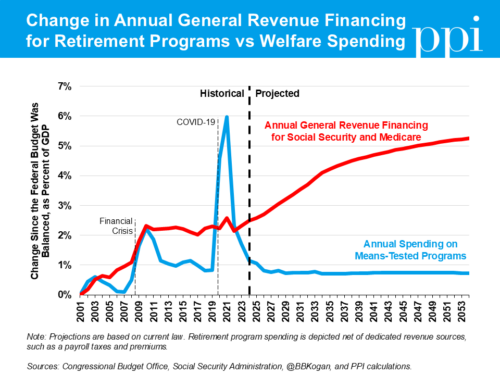
column in the Wall Street Journal last week by House Budget Committee Chairman Jodey Arrington (R-Texas) and former Senator Phil Gramm (R-Texas), titled “Welfare is What’s Eating the Budget,” argued that “means-tested programs, not Medicare and Social Security, are behind today’s massive debt.” And it’s profoundly wrong.

To make their argument, Arrington and Gramm rely upon a measure called “unobligated general revenue,” which they define as “total revenue net of Medicare and Social Security payroll taxes and premiums and mandatory interest on the public debt.” They argue that means-tested “welfare” programs – those that provide benefits only to people below a certain income threshold – claim a higher share of this revenue than Medicare and Social Security, making them the bigger fiscal challenge facing the federal government. Even if this metric were the appropriate one for comparison (and I’ll explain why it isn’t), it wouldn’t support the assertion that welfare is a bigger contributor to today’s budget deficits than Medicare and Social Security.

The chart below shows the change in total spending on means-tested programs and general revenue used to cover the gap between dedicated revenue and spending on Medicare and Social Security benefits each year since 2001 – the last year in which the federal budget was balanced. In almost every year, the increase in annual welfare spending relative to 2001 levels was less than or equal to 1% of gross domestic product (GDP). The only exceptions were the years following the 2008 financial crisis and COVID-19 pandemic, both of which were times in which unemployment sharply increased and so more people fell into the social safety net. By comparison, the same measurement for general revenue used to pay for Medicare and Social Security was roughly twice that amount in every one of the last 15 years.

Keep reading in Forbes.

Trump’s Folly, Harris’ Opportunity: Trade and the Hourly-Wage Worker

Introduction

Sometimes countries make big and fateful choices, and one is coming soon. Eighty years after the birth of postwar liberal internationalism, with its system of alliances among democracies, trade liberalization, and international law, Donald Trump’s 2024 campaign aims to recreate the policies of Franklin Roosevelt’s isolationist predecessors and opponents.

Lifting the name and ideology of the “America First Committee” — a group organized to oppose military aid for Britain as it fought alone in 1940 — Trump’s program implies rupturing NATO and other core alliances, and ending aid to Ukraine. Matching this political retreat, it attempts to resurrect the economic isolationism Herbert Hoover ran on in 1928, proposing tariffs of 10% or 20% on all goods — energy, cars, peaches, OTC medicine, all the rest — and of 60% on Chinese-made goods.

And sometimes big choices go badly wrong. American isolationism in the 1920s and 1930s helped make World War II possible. The “America First Committee” policies, had the U.S. adopted them in 1940, might have caused its loss. Hoover’s 1930 tariff hikes, advertised as a way to keep U.S. wages high and jobs at home, provoked retaliations and a deepened economic contraction, leaving exporters bankrupt and workers unemployed. These ideas’ return in 2024 presages a time in which American influence falls abroad, the cost of living soars at home, the U.S. and global economies grow more volatile,
and the risks of world politics rise.

The right response to bad and dangerous ideas is to reject them and propose something better. Vice President Harris has made a very good start on this as nominee. Politically she has chosen continuity, underlining the importance of NATO and U.S. alliances generally, and maintaining military aid to Ukraine. Economically, from an August economic speech to the first volley of her September debate victory over Trump, she has replaced the soft, “blur-the-differences” approach Hillary Clinton took in 2016 by opposing President Obama’s Trans-Pacific Partnership and the Biden administration adopted in early 2023 with a direct attack on Trump’s Hooverite tariff obsession. Here’s the speech version, which calmly and precisely explains Trumpism’s cost for working families:

“He wants to impose what is, in effect, a national sales tax on everyday products and basic necessities that we import from other countries. That will devastate Americans. It will mean higher prices on just about every one of your daily needs: a Trump tax on gas, a Trump tax on food, a Trump tax on clothing, a Trump tax on over-the-counter medication. … Donald Trump’s plan would cost a typical family $3,900 a year. At this moment when everyday prices are too high, he will make them even higher.”

Here, Harris accurately describes Trumpist economic isolationism and connects it to a core public concern. The next step is to offer a choice between Trumpism’s risks and resentments on one hand, and on the other a plan to lower costs for families, strengthen relations with America’s friends, and help workers raise their pay and improve their jobs. To envision what it might
be, keep the basics in mind, assess the places in which “Bidenomics” fell short, and look at a model of the way clear and simple language can help organize thought and policy.

Read the full report.

Ainsley in The Times: Kamala Harris told to woo ‘hero voters’ by Starmer’s strategist

There is a very strong sense among these voters that the American middle class is in decline, she added. “They feel that the deal of middle-class aspiration is over, and almost a sense of betrayal by the political classes.”

Mattinson carried out her research alongside Starmer’s former director of policy, Claire Ainsley, who now works for the US-based Progressive Policy Institute.

Ainsley, who went with Mattinson to Wilmington, added: “Hero voters told us they want stability. They don’t want the chaos of Trump particularly, but they do want to know what is the change that [Harris] is going to bring about for them.

“The research also confirmed the centre-left can’t duck immigration,” she added. “This is also a really big priority for people. So a signature policy on immigration that she could speak to, perhaps around border control, would be important.”

Mattinson and Ainsley’s work is the latest example of ever closer co-operation between the Labour Party and the Democrats. Other key party figures have also flown over recently to share knowledge with Harris aides, such as Morgan McSweeney, Starmer’s head of political strategy in No 10, and the former shadow cabinet minister Jonathan Ashworth.

Read more in The Times.

Mandel for The Hill: It’s official: America’s real wages are up under Biden-Harris

By Michael Mandel

With inflation easing, the wages of working-class Americans are finally moving into the plus column. Average hourly pay for production and nonsupervisory workers — who make up four-fifths of employees — hit $30.27 in August, according to the latest report from the Bureau of Labor Statistics.

According to my organization’s analysis, working-class Americans’ wages, adjusted for inflation, have just edged higher than they were on Election Day, 2020. The average working-class American can now answer “Yes” to the question, “Are you better off now than you were under Donald Trump?”

That’s obviously important for political symbolism. But the milestone for real wages also explains a lot about why Americans have felt so badly oppressed by inflation up to now. The price of food and housing matters, but they matter more if price increases exceed wage gains.

Keep reading in The Hill.

PPI Releases New Report on Uncompetitive Markets and Their Impact on Working Americans

WASHINGTON — The Progressive Policy Institute (PPI) today released a new report, “Fixing Uncompetitive Markets: Protecting Working Americans from the High Costs of Market Power,” authored by Diana L. Moss, Vice President and Director of Competition Policy at PPI. This report offers an in-depth analysis of how concentrated market power in key sectors harms working-class Americans by driving up prices, reducing choice, pushing down wages and benefits, and limiting economic mobility.

This new publication is a key output of PPI’s Campaign for Working America, which was launched earlier this year in partnership with former U.S. Representative Tim Ryan of Ohio. The Campaign aims to develop and test new themes, ideas, and policy proposals that help Democrats and other center-left leaders make a compelling economic offer to working Americans, bridge divides on cultural issues like immigration and education, and rally public support for the defense of democracy and freedom globally.

“The lack of competition in critical sectors — such as food, health care, and transportation — has placed an enormous strain on working families,” said Moss. “This report lays out a roadmap for policymakers to more vigorously enforce antitrust laws, promote competition, and prioritize the economic interests of consumers and workers over the dominance of powerful market players.”

The report highlights the urgent need to address harmful mergers and anticompetitive practices that increase costs for essential goods and services. Moss emphasizes that robust antitrust enforcement in highly concentrated markets will foster consumer, worker, and entrepreneurial freedom. Protecting consumers from harmful, deceptive practices such as drip pricing and junk fees, particularly in sectors with limited competition, is also a focus.

“Working Americans deserve a fair shot at economic success, and that starts with ensuring they are not burdened by uncompetitive markets that work against them,” Moss added.

Read and download the report here.

The Progressive Policy Institute (PPI) is a catalyst for policy innovation and political reform based in Washington, D.C. Its mission is to create radically pragmatic ideas for moving America beyond ideological and partisan deadlock. Learn more about PPI by visiting progressivepolicy.orgFind an expert at PPI and follow us on Twitter.

###

Media Contact: Ian O’Keefe – iokeefe@ppionline.org

Fixing Uncompetitive Markets: Protecting Working Americans From the High Costs of Market Power

Competition Matters to Working Americans

Competition is the lifeblood of a market system. Access to markets, choice, and fair prices and wages preserves consumer, worker, and entrepreneurial freedom. The benefits of this are tangible. Competition keeps the engines of economic activity and growth at a fuller throttle, promotes a more equal distribution of income and wealth, and a better standard of living. Moreover, markets rest on fundamental democratic principles that are essential for preserving economic freedom and opportunity.

The prospect of anything but hard-nosed competition in the markets that make up the U.S. free-market economy should trouble working Americans. The 2024 Democratic Party Platform recognizes the importance and role of competition in our political economy. It prioritizes promoting competition in markets that matter to working-class Americans, ranging from retail grocery, to agriculture, healthcare, drugs, fuel, transportation, finance, and construction.

An important reality is that market activity is largely fueled by consumers, workers, and entrepreneurs. For example, almost 70% of spending in the U.S. economy in the first quarter of 2024 was attributable to personal consumption expenditures. Small businesses were responsible for almost 45% of U.S. gross domestic product (GDP) in the mid-2010s. And labor contributed almost 70% to U.S. GDP in 2019. These are big numbers. They make clear the high costs to the U.S. economy of a lack of competition if consumers do not spend due to high prices, small businesses do not get a foothold because of an unlevel playing field, and workers lose their bargaining power to powerful employers.

Antitrust enforcement referees the markets. Without it, prices, wages, choice, and the quality of goods and services are dictated by powerful firms, not the rough and tumble of the competitive process. Working Americans are the first to recognize the importance of robust market competition. But for the last several years, consumers have grown frustrated by high prices for food, housing, healthcare, energy, and transportation. Small businesses are restrained by the high walls they must scale to get into some markets that are dominated by powerful firms. And workers can be limited by anticompetitive restraints on their mobility, wages, and benefits.

These limitations force some of the most important market participants to make tough choices about what to buy, where to work, and whether to start a business. With limited government resources to promote competition through antitrust enforcement and procompetitive regulation, policymakers must also make hard choices. These choices should reflect what is important to working-class Americans to help them live better, not ideological trends or political interests of the day. This segment of PPI’s Campaign for Working America takes on the question of how to best promote competition enforcement to reduce the cost of living and improve the lives of working Americans.’

Read the full report.


Marshall in The Associated Press: Dick Cheney was once vilified by Democrats. Now he’s backing Harris. Will it matter?

In the process, they are giving Harris a critical opening to broaden her base of support.

“It’s easier for prominent Republicans like Cheney and Gonzales to say, ‘I support Kamala Harris’ because, in effect, their old home has been ransacked and destroyed,” said Will Marshall, the founder of the Progressive Policy Institute, a center-left think tank. “The ties of partisanship, which are always strong in both parties, are attenuated by the fact that Trump has made today’s Republican Party absolutely unwelcome for prominent Republicans who served in previous administrations.”

Bush himself will not follow suit. A spokesperson says the former president has no plans to make endorsements or say publicly how he will vote.

Harris has embraced the backing of Republicans with whom she shares little common ground and whose endorsement likely has more to do with opposition to Trump than support of her policy positions. She frequently mentions that more than 200 Republicans have endorsed her, and her campaign said in an email playing up Gonzales’ backing that it welcomed into the fold “every American – regardless of party – who values democracy and the rule of law.”

Read more in The Associated Press.

Ainsley in The Washington Post: U.K. Labour strategists advise Harris on winning from the center left

“British pollster Deborah Mattinson, a former top adviser to Starmer, and Claire Ainsley, Starmer’s former director of policy, jointly briefed Harris campaign staffers this past week on a target demographic they call “hero voters.

In Britain, Ainsley told The Washington Post, these tended to be voters who had traditionally backed Labour but who had supported the 2016 Brexit referendum and the “Get Brexit Done” election campaign of Boris Johnson’s Conservative Party in 2019.

They were struggling with daily living costs and wanted change. “They felt like hope for a better life was getting out of reach,” said Ainsley, who now works with the Progressive Policy Institute (PPI) think tank in Washington.”

Keep reading in The Washington Post.

Kahlenberg in The New York Times: Affirmative Action Was Banned. What Happened Next Was Confusing.

“Any drop in an already small number can dramatically impact the campus environment for students of color, and students are already reporting negative effects,” the group said.

But some experts put a positive spin on the new data. It shows a way forward for diversity under the new regimen, argued Richard Kahlenberg, director of the American Identity Project at the Progressive Policy Institute.

“There were predictions that the Black population could fall to 2 percent at some universities and 6 percent at Harvard, and that did not happen,” Mr. Kahlenberg said. “I want there to be racial diversity on campus. I think it showed it was possible to achieve that without racial preferences.”

One area for litigation could be the personal essay. The court allows admissions officers to consider race in the personal essay, if it was germane to some life experience. Mr. Kahlenberg said that it could become problematic if essays are used as a way to elevate the applications of only certain groups. If, for example, equal consideration were not given to Asian American students who had overcome discrimination or to white students who had overcome poverty.

Read more in The New York Times.

Marshall for The Hill: Protesters, media must stop normalizing terrorism

By Will Marshall

The U.S. Justice Department disclosed last week that it had charged six Hamas leaders with terrorism in February for organizing the Oct. 7 massacre of approximately 1,200 people in Israel — including more than 40 U.S. citizens.

Although none of those charged are likely to ever appear in a U.S. courtroom — three have since been killed and Israeli forces are hunting down the rest — the unsealed indictments are a crucial expression of American solidarity with terrorism victims everywhere.

Attorney General Merrick Garland drove home the horror of the Oct. 7 bloodbath in a statement justifying the charges: “During the attack, Hamas terrorists murdered civilians who tried to flee, and those who sought refuge in bomb shelters,” he said. “They murdered entire families. They murdered the elderly, and they murdered young children. They weaponized sexual violence against women.”

Hamas also seized about 240 hostages and recently killed six more of them to pressure Israel to stop the fighting and leave Gaza.

Keep reading in The Hill.

Ainsley in Politico Magazine: What Keir Starmer’s Advisers Told Democrats in Washington

When the British political strategist Deborah Mattinson heard Vice President Kamala Harris boast in the presidential debate about prosecuting transnational gangs, she thought the message was spot on — and that Harris needed to deliver it many, many, many more times.

The former head of strategy for Prime Minister Keir Starmer, who won a landslide election in July, Mattinson was in Washington the week of the debate to meet with Democrats, including advisers to the Harris campaign, and share lessons from the Labor Party’s smashing summer victory. She and Claire Ainsley, Starmer’s former head of policy, urged Democrats to focus intently on winning back working-class voters who had drifted to the right in recent years — toward right-wing populists who seemed more in touch with their economic frustrations and cultural grievances.

“For voters, cost of living and immigration are the two biggest issues,” Ainsley said. “And that’s where they need to focus their attention.”

POLITICO spoke with Mattinson and Ainsley as they were wrapping up their visit to Washington. Harris, they said, was on the right track. But with only weeks left until the election, there was still plenty of work for her to do to defeat former President Donald Trump.

Their advice was not just based on intuition or interpretation of the recent U.K. election. Ainsley is a leader of the Progressive Policy Institute, where she directs a transnational effort to revitalize center-left parties. As part of that effort, the think tank shuttled Labour politicians to Washington earlier this year and the Democratic convention in August, and conducted polling and focus groups in American swing states over the summer.

Read more of their interview in Politico Magazine.

Harris’ Pledge: Affordable Health Care and Reproductive Rights

Health care costs and reproductive health were key topics in Tuesday night’s debate. Vice President Harris presented concrete solutions for managing costs — such as addressing insulin and prescription drug prices and strengthening the ACA — while criticizing Trump for failing to deliver an alternative to the ACA despite promises since 2016. Additionally, Harris delivered impactful critiques by emphasizing Trump’s central role in undermining American women’s reproductive rights. This focus is particularly relevant, given the ongoing strain of high health care costs on American households and Trump’s continued efforts, alongside Republicans, to undermine reproductive health.

A recent Progressive Policy Institute poll reveals that working-class Americans are deeply concerned about soaring health care costs, which they largely blame on drug manufacturers, insurance companies, and hospitals. Key issues include opaque hospital pricing and high drug prices. In response, Harris has pledged to address these concerns as part of her health care platform, which was highlighted in the debate. Her proposals include capping insulin prices, limiting cost-sharing for generic drugs, and expanding Medicare’s ability to negotiate drug prices.

Harris’s evolution from support for Medicare for All to these more prosaic concerns is welcome.  This pragmatic approach is likely due to the political decision to tamper the announcement of any major policy reform that would be targeted by the Trump campaign. Harris intends to instead protect and bolster the Affordable Care Act (ACA), along with making the Biden-Harris tax credit enhancements permanent, which are reducing health care premiums by an average of around $800 annually for millions of Americans.

Meanwhile, Trump’s inconsistent stance on repealing and replacing the ACA underscores his lack of seriousness and leadership on the issue, as evidenced by his vague statement during the debate: “I have a concept of a plan” to address or alter the law. Thanks to the ACA, a record percentage of Americans (92%) have access to health insurance. The Biden-Harris admin made an important contribution to this achievement by including enhanced subsidies for the ACA marketplace in its landmark Inflation Reduction Act. A record 21 million people enrolled through the ACA this year alone, reducing the uninsured rate from 16% in 2010 to under 8% today. But health care costs remain exorbitantly expensive, forcing working families to reprioritize their immediate financial needs over preventive or ongoing medical care.

Meanwhile, reproductive health care access remained a critical focus for Harris throughout the debate, as she vowed to reinstate Americans’ reproductive rights that were undermined when Trump’s Supreme Court justices overturned Roe v. Wade. Harris promised to seek national legislation to restore the legal right to abortion; enhance access to contraception; safeguard a woman’s right to access IVF, and repeal the Hyde Amendment. She also promised to continue to advocate for access to FDA-approved abortion drugs and select judges who uphold reproductive freedom.

Trump proved once again that he and the Republican Party are completely out of touch with working-class Americans who are increasingly distressed about the state of abortion access since the end of Roe. Refuting his record and providing faltering answers on reproductive access, Harris swung back, reiterating that Trump should “not be telling a woman what to do with her body.”

In PPI’s Winning Back Working America poll, 56% of participants said they are concerned about abortion access. Trump’s relentless effort to curtail access to reproductive health care is directly opposed to the majority of Americans’ wishes, eroding the foundation of democracy and their personal liberty. Harris and Democrats are aptly appealing to working-class voters, including Independents and Republicans, who are anxious about the fragile state of access to reproductive care in the 2024 election and beyond.

Harris’ focus on reducing health care costs and enhancing reproductive health access in the debate and in her campaign represents a refreshing shift that addresses the concerns of working-class voters. Even those with coverage often encounter substantial out-of-pocket expenses. Similarly, despite some states protecting reproductive freedom, individuals still face barriers and threats from Trump and Republicans seeking to undermine these protections. Harris and Democratic lawmakers present a promising vision for working Americans seeking relief from harmful Republican policies that threaten to increase costs and reduce access to care.

New PPI Report Highlights Role of Foreign Direct Investment in Revitalizing U.S. Manufacturing Amid Nippon Steel’s Bid for U.S. Steel

WASHINGTON — As the U.S. seeks to bolster its domestic manufacturing, the role of foreign direct investment (FDI) is more critical than ever, particularly from trusted allies. This insight is at the heart of a new report from the Progressive Policy Institute (PPI), titled “The U.S. Wants Manufacturing to Drive Growth. Foreign Friends Can Help.” The report examines the converse of U.S. “friendshoring” in friendly countries: the potential for allied nations like Japan, South Korea, Canada, the UK, and Germany to support U.S. economic growth through investment in sectors ranging from electric vehicles to biopharmaceuticals.

The report, authored by Yuka Hayashi, is the second in a two-part series. The first, “Behind Japan’s U.S. Steel Bid: An Aging, Shrinking Home Market,” provides a fresh perspective on Nippon Steel’s proposed acquisition of U.S. Steel and closely examines the economic realities behind Nippon Steel’s pursuit of the American industrial icon.

The new report highlights how these investments can create high-paying jobs, drive technological innovation, and strengthen America’s position in the global economy. Drawing on examples from states like Ohio, Michigan, and North Carolina, where Japanese companies have built major manufacturing hubs, the study argues that such partnerships are essential to America’s economic future.
“If the U.S. wants to strengthen domestic manufacturing, promoting foreign investment from friendly countries is a smart strategy,” said Hayashi. “Not only does it create good-paying jobs and spur innovation, but it also deepens our economic ties with trusted allies, ensuring that critical industries remain secure.”

The report stresses that the U.S. must be strategic in welcoming investment from allied nations, especially in the context of growing tensions with China. As part of this strategy, the report calls for expanding “friend-shoring” partnerships — moving supply chains to allied nations to ensure resilience and stability.

In light of the Inflation Reduction Act and the CHIPS and Science Act, both passed in 2022, PPI’s report underscores the opportunity for the U.S. to attract even more foreign investment, particularly in green technology and semiconductor manufacturing. It also warns that protectionist policies could deter friendly nations from further investing in the U.S. economy.

Read and download the report here.

The Progressive Policy Institute (PPI) is a catalyst for policy innovation and political reform based in Washington, D.C. Its mission is to create radically pragmatic ideas for moving America beyond ideological and partisan deadlock. Learn more about PPI by visiting progressivepolicy.orgFind an expert at PPI and follow us on Twitter.

###

Media Contact: Ian O’Keefe – iokeefe@ppionline.org