The rapid rise of AI has created great uncertainty about the future of the job market globally, ranging from forecasts of a sharp plunge in white-collar employment to predictions of job gains. Taking the middle ground, one recent report showed no evidence that AI adoption in the European Union was reducing employment in the short run.
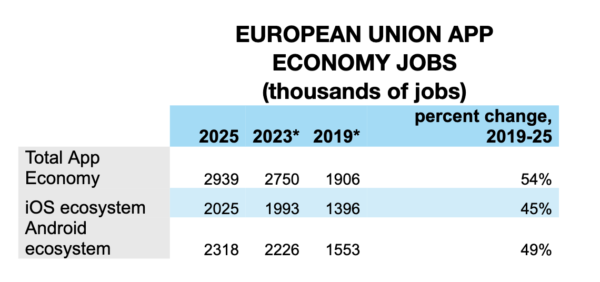
In this blog, we focus on one labor market topic in particular: The growth of App Economy jobs in the EU. PPI has been tracking EU App Economy jobs since 2016. Our last published comprehensive estimates of EU App Economy jobs were released in November 2023, a year after the release of ChatGPT. To summarize our results, PPI finds an estimated 2.94 million App Economy jobs in the EU as of 2025, up from a revised 2.75 million jobs in 2023 and 1.91 million in 2019.
The AI revolution has triggered a massive surge in mobile app submissions to the Apple App Store and Google Play. According to Appfigures, the number of new app submissions to the App Store rose by 24% in 2025. The trend has accelerated into 2026. In the first half of 2026, new apps doubled compared to a year earlier, according to the New York Times.
The wave of new app creation is being driven in part by AI coding tools, which make it easier than ever for anyone to become an app developer. Equally important, more and more apps are incorporating AI as part of their essential functionality, which requires app developers to exercise their creativity and knowledge.
For example, earlier in 2026, Vivino, the world’s leading wine app, was looking for an iOS engineer in Copenhagen to help build AI-powered product features into the app. Zing Coach, an AI-powered fitness application, was looking for an Android Engineer in Poland. Climate tech startup autarc was looking for a senior iOS engineer in Berlin to join their AI team, building apps that help energy installers speed up the process of designing and deploying customized heat pump and photovoltaic systems.
Based on our analysis of job postings, combined with Eurostat employment data for “information and communications technology professionals,” PPI finds an estimated 2.94 million App Economy jobs in the EU as of 2025, up from a revised 2.75 million jobs in 2023 and 1.91 million in 2019 (table). For this analysis, a worker is in the App Economy if he or she is in:
- An IT-related job that uses App Economy skills — the ability to develop, maintain, or support mobile applications. We will call this a “core” app economy job. Core app economy jobs include app developers; software engineers whose work requires knowledge of mobile applications; security engineers who help keep mobile apps safe from being hacked; and help desk workers who support the use of mobile apps.
- A non-IT job (such as sales, marketing, finance, human resources, or administrative staff) that supports core app economy jobs in the same enterprise. We will call this an “indirect” app economy job.
- A job in the local economy that is supported either by the goods and services purchased by the enterprise, or by the income flowing to core and indirect app economy workers. These “spillover” jobs include local professional services such as bank tellers, law offices, and building managers; telecom, electric, and cable installers and maintainers; education, recreation, lodging, and restaurant jobs; and all the other necessary services.
To estimate the number of core App Economy jobs in the European Union, we combine multiple
sources of information in a systematic process, including an estimate of the share of tech job postings that use App Economy skills. We use the various country-specific job databases found at Indeed.com/worldwide. Indeed, which bills itself as “the No. 1 job site in the world,” offers a searchable, continually updated database of job postings for more than 60 countries.
We also use Eurostat’s estimates of the number of information and communications technology (ICT) professionals in EU countries, which rose by 2.7% in 2025. Then we use a conservative multiplier of indirect and spillover jobs to estimate overall App Economy jobs. A more detailed description of the original methodology is found in “The App Economy in Europe: Leading Countries and Cities, 2017” (October 2017) and “The App Economy in India” (September 2019).
Our methodology also allows us to estimate the number of App Economy jobs associated with different mobile operating systems. We find that in 2025 the EU had 2.0 million jobs associated with the iOS ecosystem, and 2.3 million jobs associated with the Android ecosystem. (The two add up to more than the total number of App Economy jobs because many jobs belong to both ecosystems.)