Creating jobs: Democrats need to stop business bashing and praise corporate investors

Economic calamity begets radical politics. America’s worst financial panic and recession since the 1930s gave birth to the tea party and Occupy Wall Street. Now Occupy seems to be fizzling out, but tea party Republicans are plunging America into budget crises this fall.

The GOP’s surrender to fiscal anarchism gives President Obama and his party an opportunity to seize the high ground on jobs and economic growth. For that to happen, however, Democrats will need to eschew ritual business-bashing, embrace the productive forces in U.S. society and honor companies that are investing in America’s future.

The nation’s job drought is really an investment drought. Real government spending on productive assets from highways and bridges to computer equipment (net of depreciation) is down by half compared to the average level of the 2000s. Private sector investment is doing better but still falls well short of what the country needs. Many companies are still hoarding cash — about $2 trillion — or spending it on stock buy-backs, and investment outside of housing remains 20 percent below its long-term trend.

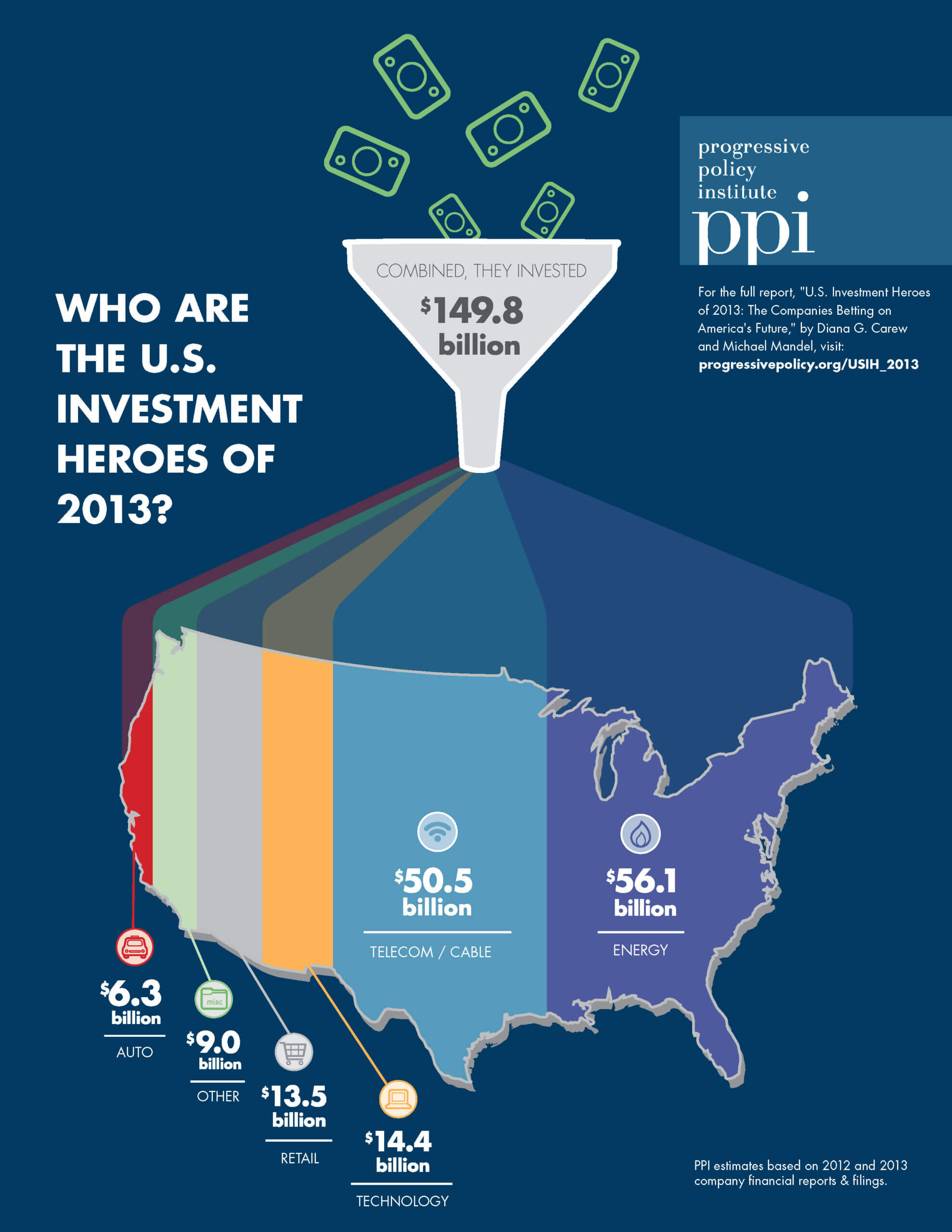
But many companies are investing at home. For the second year running, the Progressive Policy Institute has ranked the top 25 companies that are making the biggest bets on America’s economic future. These “Investment Heroes” invested nearly $150 billion last year in new plants, buildings and equipment (figures do not include investments in research and human capital).

Continue reading at the San Jose Mercury News.

Stumping Patent Trolls On The Bridge To Innovation

President Obama brought much needed attention this June to “patent trolling,” a growing area of litigation abuse vexing America’s high-tech industries. In these lawsuits, shell businesses called Patent Assertion Entities (PAEs) or Non-Practicing Entities (NPEs)—some of which have been nicknamed “patent trolls”—game the patent and litigation systems. They purchase dormant patents, wait for others to independently develop comparable technology, and assert patent infringement suits. As the President explained, PAEs “don’t actually produce anything themselves.” Their quest is to “see if they can extort some money” by claiming they own the technology upon which the other companies’ products are built.

An attorney who used to defend these claims, Peter Detkin, is generally credited with popularizing the “patent troll” moniker. For software, consumer electronics, retail and the many other companies on the receiving end of these lawsuits, PAEs are reminiscent of the mythical trolls that hide under bridges they did not build, but nevertheless require people to pay them a toll to cross. Patent trolling, it turns out, is a better path to the holy grail than hiding under bridges. An oft-cited economic study pegged the overall impact of PAEs in terms of “lost wealth” at $83 billion per year, with legal costs alone amounting in 2011 to $29 billion, up from $7 billion in 2005. At least fifteen PAEs are now publicly traded companies.

This policy brief seeks to address three questions: what caused this recent and rapid rise in PAE litigation, what can be done to stop it, and what is the role for progressives? First, it identifies the confluence of factors that have come together in the past two decades to create the patent equivalent of a 100-year flood, focusing mostly on the explosion of new, widely used technologies, increasing ambiguity in the boundaries of today’s patents, and a litigation system incentivizing “ransom” settlements for even questionable infringement claims.

The brief then examines the adverse impact PAE litigation is having on the development and use of innovation, as well as on traditional patent cases brought by inventors the patent system was created to protect. It discusses the rich history of progressives in leading efforts to stop litigation prospecting, concluding that progressives should be at the forefront of this reform too. It then explores specific proposals the President, Senators Schumer and Leahy, and others have offered to safeguard the patent system from trolling abuse.

Download the memo.

Why Boehner’s to Blame

The government of the United States of America is closed for business today, courtesy of the Republican Party. It’s a national embarrassment, like a scene from the Marx Brothers’ classic 1933 satire “Duck Soup,” only without the anarchic humor.

Hail Freedonia!

Who produced today’s farce? Was it the Tea Party hotheads, 50 or so House Republicans who love ideological combat but hate governing? Or was it Sen. Ted Cruz, perhaps the most cunning demagogue America has produced since Joe McCarthy?

All played their discreditable parts. But the man in the director’s chair is John Boehner, who is bidding for the title of worst House speaker in U.S. history.

Why Boehner? Because he knows better, and could have prevented the shut-down. And because, as America’s third-ranking constitutional officer, after the President and vice president, he is supposed to serve America’s interests — not the febrile demands of his party’s most rabid partisans. That’s Eric Cantor’s job.
.
Read the entire piece at the New York Daily News.

Government Investment Falls Off a Cliff

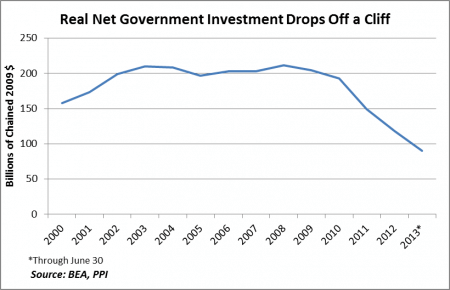
Thanks to massive budget and deficit cutting, government investment is free-falling off a cliff. Net real government investment – by federal, state, and local governments after depreciation and adjusting for inflation – was just $91 billion in the first half of 2013. This is less than half of what it was when the recovery began in 2009.

Government investment is what goes into maintaining and building our nation’s infrastructure, which includes highways, bridges, and ports.  It also includes investment in equipment, and intellectual property. The chart below shows what government investment was in our nation’s infrastructure, equipment, and intellectual property after depreciation, and after adjusting for inflation. Since 2009, real net government investment has fallen by about $114 billion, or 56 percent.

The drastic fall-off in real net government investment is quite startling. Worse, the sharp fall-off in real net government investment across the federal, state and local government appears to be accelerating. Current real net government investment is now at levels not seen since 1983 – a historic low.

The largest drop-off in real net government investment has been in structures, which comprises the majority of government investment. Real net government investment in our nation’s physical infrastructure has fallen by an astonishing 53 percent, or $78 billion, since 2009.

Such little investment in our nation’s infrastructure will certainly add to the slow recovery going forward. And with more spending cuts almost assured, the end of this story is not looking bright.

America’s job crisis: What entrepreneurs say

The worst economic downturn since the Depression is behind us, but the great American job machine keeps sputtering. Four years into “recovery,” too many Americans are still unemployed, underemployed, on disability or out of the workforce altogether.

What are U.S. political leaders doing about the nation’s jobs emergency? Next to nothing.  Instead, House Republicans have plunged Washington into another senseless round of fiscal brinksmanship, jeopardizing economic recovery in their Ahab-style quest to destroy the great white whale of Obamacare.

Imagine, instead, that we had a functioning political system. What could Congress and the White House do to goose the pace of job creation?

Instead of turning to the usual (partisan) experts and Beltway interest groups for answers, why not put that question directly to U.S. job creators themselves? That inspired suggestion comes from John Dearie of the Financial Services Roundtable and Courtney Geduldig of Standard & Poor, who hit the road two years ago to do exactly that.

They present the findings of this unique survey in a new book, Where the Jobs Are: Entrepreneurship and the Soul of the American Economy.  It’s based on the authors’ intensive conversations with over 200 entrepreneurs who attended roundtables in 12 cities. What results is a concrete and practical blueprint for policy changes that can help entrepreneurs launch new businesses, expand existing ones and create the good “breadwinner” jobs that can support middle class families.

There are no blinding revelations here; most of their prescriptions are familiar to Washington policy hounds like me. But this only underscores that job creation isn’t some arcane branch of economics that only Nobel laureates can fathom. U.S. policymakers mostly know what to do – which makes their failure to act all the more tragic.

Continue reading at The Hill.

Energy is an Important Driver of U.S. Investment

Given the ongoing boom in oil and natural gas production, it’s no surprise that U.S. and non-U.S. energy companies are among the top companies investing in America. Still, the sheer magnitude of the investments by these companies means the contribution of the energy sector to economic growth should not be ignored or discounted in the larger conversation.

Of the U.S. companies highlighted in our new U.S. Investment Heroes report, eight of our top 25 U.S. Investment Heroes of 2013 were energy companies. Together, we estimate these eight companies invested a total $56 billion over the last year in plants, property, and equipment in the United States, comprising almost 40 percent of the total $150 billion invested by the top 25 companies. Exxon Mobil, the top energy company on our list, invested over $12 billion in the U.S. in 2012 alone.

Due to incomparability across financial statements, our non-U.S. Investment Heroes report separately considered companies in energy production, automotive manufacturing, and industrial manufacturing.

Still, our research found that of the three categories, energy companies were by far making the biggest bet on America’s future.  Global energy giant BP was the top non-U.S. Investment Hero out of all the companies we considered across the three categories, putting a combined $19.3 billion into the U.S. economy in 2011 and 2012. (To the best of our knowledge, these funds did not include any payouts related to the Deepwater Horizon oil spill.) Together, the top four energy non-U.S. energy companies we considered invested an estimated $58.7 billion in 2011 and 2012.

At a time of weakness in other industries, these studies highlight that energy production is a bright spot for U.S. business investment. That this message is clear in both our U.S. Investment Heroes and non-U.S. Investment Heroes reports suggests energy will continue to be a driver of U.S. growth and job creation.

FDA Finds the Right Note in Mobile Medical Apps

I’ve been critical of the FDA in the past. But now that the FDA has released its long-awaited guidance for “Mobile Medical Applications,”  I’m pleasantly surprised at the stance the agency has taken. Basically, the FDA has done exactly what it should do–gotten out of the way of innovation, while reserving the right to jump back in if circumstances warrant.

To put it a different way,  rather than being annoyingly ambiguous, the FDA has marked a big section of the beach and said “go play in the water, kiddies! Have fun, and we’ll be watching to make sure that no one drowns.” This is the right approach to maximizing both progress and safety. In fact, other regulators should follow the same path.

The issue when it came to mobile medical apps was in some sense simple. Clearly some mobile apps worked just like regulated devices, and therefore needed to come under the same scrutiny. No one disagreed with that. But then there was a whole set of other apps–including ones that provide simple coaching and prompting to diabetics and other people who needed to follow regular schedules–which could have been regulated as medical devices under a strict interpretation of the rules.

But in the guidance, the FDA was extremely clear that it would exercise “enforcement discretion” for these sorts of medical apps. The agency was even kind enough to give a long list of such apps, opening up a clear pathway for innovators. Some examples:

  • “Apps that provide simple tools for patients with specific conditions or chronic disease (e.g., obesity, anorexia, arthritis, diabetes, heart disease) to log, track, or trend their events or measurements (e.g., blood pressure measurements, drug intake times, diet, daily routine or emotional state) and share this information with their health care provider as part of a disease-management plan.”
  • “Apps specifically intended for medical uses that utilize the mobile device’s builtin camera or a connected camera for purposes of documenting or transmitting pictures (e.g., photos of a patient’s skin lesions or wounds) to supplement or augment what would otherwise be a verbal description in a consultation between healthcare providers or between healthcare providers and patients/caregivers.”
  • “Mobile apps that help asthmatics track inhaler usage, asthma episodes experienced, location of user at the time of an attack, or environmental triggers of asthma attacks;”

And so forth and so on. You get the idea.

Other regulatory agencies should adopt the same tack. In a world of rapid innovation, regulators cannot and should not engage in pre-emptive regulation. Instead, they should stand back and watch closely, stepping in as necessary. That’s the best way to insure the


Can the Internet of Everything Help Cities?

Local governments are about delivering services and getting things done: Fixing highways, running buses, picking up trash, ensuring public safety, educating children. To do their job in an era of tight finances, what’s needed are technologies that make public services better and cheaper, and improve the quality of life for urban Americans without increasing costs.

So far the Internet and the shift to digital has boosted the efficiency of smart local governments, increased transparency, and made it easier to communicate with local residents. In many cities and towns it’s possible to look up property tax records online, for example; download essential forms and documents; or learn when the town dump is open. New York City is a leader in this area: its “OpenData” catalog contains more than one thousand data sets available to the public.

But the mere upload and download of data is not enough to get cities and towns out of their fiscal squeeze. That’s why, if we want to truly transform the delivery of public services, we need to look to the coming wave known as the  “Internet of Everything.”

What is the “Internet of Everything?” As I write in my new report, the Internet of Everything (IoE) is about:

…building up a new infrastructure that combines ubiquitous sensors and wireless connectivity in order to greatly expand the data collected about physical and economic activities; expanding ‘big data’ processing capabilities to make sense of all that new data; providing better ways for people to access that data in real-time; and creating new frameworks for real-time collaboration both within and across organizations.

In other words, IoE links things in the physical world with data, people, and processes, so that better decisions can be made in real-time.

On a national level, IoE can provide a tremendous boost to growth. We estimate that the Internet of Everything could raise the level of U.S. gross domestic product by 2%-5% by 2025. If this gain from the IoE is realized, it would boost the annual U.S. GDP growth rate by 0.2-0.4 percentage points over this period, bringing growth closer to 3% per year.

Part of these gains from the Internet of Everything would show up in the form of better and cheaper services provided by local governments. The key here is better decisions in real-time. One clear example comes out of the horrific flooding in Colorado. Having been hit by a devastating flood in 1997, the city of Fort Collins, CO, maintains a network of rainfall gauges and stream sensors which deliver real-time information on the potential for flooding both to a city website and to smartphones via an app. This connection with real time sensors enables both city officials and local residents to make better real-time decisions about when and whether to evacuate.

Cities can also use the Internet of Everything to help improve the mundane service of trash pickups. As my report notes:

The ‘smart’ trash and recycling stations from BigBelly Solar can sense how full or empty they are, and communicate wirelessly with the trash collection agency. Armed with this information, pickup trucks can go directly to the bins that are full, while skipping trash and recycling stations that are empty. The result: Cleaner streets, lower fuel usage, and fewer greenhouse gas emissions.

An essential service that is usually handled at the local level is transportation. Already more and more cities are using GPS systems to track buses and provide the information to passengers via apps. The next stage is to provide sensors that monitor waiting passengers, with the possibility of rerouting buses or having them skip stops in order to provide better service.

Or consider noise complaints, one of the most pervasive problems of big city living.  Noise can often be intermittent, making it very hard for local governments to adequately respond. However, smartphones are able to measure local noise levels, making it possible to build ‘noise complaint apps.’ Alternatively, low-cost sound sensors could help track troublesome noises in real time.

Finally, there is the most crucial local service of them all, education. Let’s focus on career/technical education. Businesses continue to complain about not getting enough skilled workers, but schools have been cutting back on CTE. Moreover, what they do offer is less directly relevant to today’s rapidly changing workplace, because it’s too expensive for most school districts—and CTE teachers–to keep up to date.

The Internet of Everything offers the possibility of lowering the cost of career/technical education by building sensors right into the equipment, which can offer immediate feedback to students. One offbeat example comes from Cisco, which built sensors into a basketball. In theory, that means someone trying to learn to play the game can automatically get corrections about how to shoot the basketball, enabling them to learn faster. The same principle can eventually be applied to career/technical education, lowering costs and speeding learning.

City officials face a historic challenge, and a historic opportunity.  With less resources, can they provide better services at lower cost? The Internet of Everything is no panacea, but it can assuredly help.

Continue reading at Techonomy.

The New Politics of Production: A Progressive High-Growth Strategy

Will Marshall’s piece, excerpted here, was part of the Policy Network’s recent publication “Progressive Politics after the Crash: Governing from the Left.”

The US is struggling to find a way out of overlapping economic crises. One is cyclical: a painfully slow, jobless recovery from a recession magnified by the 2008 financial crash. The other is structural: US economic output and job growth have fallen well off the pace of previous decades. Although liberal commentators seem preoccupied with rising inequality, America’s fundamental economic problem is slow growth.

Even before the recession struck, the once-mighty American job machine was sputtering. Between 2000 and 2007, the US posted its worst job creation record in any decade since the Great Depression. Not only have many good jobs vanished, but also real wages have fallen or turned stagnant for all but the top US earners.

Overall economic growth has been declining steadily since the halcyon years after World War II, when the babies boomed and GDP grew at a robust average of 4 per cent per year. National output fell to 3 per cent during the 1970s and 1980s, before picking up in the late 1990s. Since 2000, the economy has downshifted again, averaging under 2 per cent growth per year. Research from the Kauffman Foundation also suggests a loss of entrepreneurial verve. The number of business start-ups, which Kauffman says generate most of US net job growth, has plummeted by about a quarter since 2006.

If there is a bright spot in the US economy, it is the rebound of corporate profits and stock prices since 2009. Yet these gains also highlight a stark inequity: returns to capital are up, but returns to labour are down.

In President Kennedy’s day, US prosperity really did lift all boats. Today, however, productivity gains do not automatically translate into higher pay for workers, especially people with middling skills. ‘This is America’s largest economic challenge’, says the economist Robert J.  Shapiro. ‘People can no longer depend on rising wages and salaries when the economy expands.’

Amid such dismal conditions, Obama’s re-election by a comfortable margin (5 million votes) was an astounding political feat. Despite Republican challenger Mitt Romney’s claims that Obama fumbled the recovery, swing voters credited the president with having prevented the economy from capsizing during the perfect storm of 2008–9. It helped too that Romney offered no theory of his own for rekindling growth beyond hackneyed calls for lower taxes and regulation.

Unfortunately, little has happened since Obama’s victory to dispel the pall of economic pessimism that hangs over America. A late spring poll, for example, found that nearly 60 per cent of Americans worry about ‘falling out of (their) current economic class over the next few years’. No doubt subpar job growth is chiefly responsible for such unwonted gloom. According to preliminary figures, the number of people with jobs grew by only 28,000 (0.02 per cent) during Obama’s first term.

And there is little relief in sight. The Congressional Budget Office forecasts weak GDP growth and abnormally high unemployment persisting to the end of Obama’s second term. America is stuck in a slow-growth rut. While liberal Keynesians are calling for more shortterm spending to kick-start the pace of recovery, what progressives really need is a bolder plan for overcoming structural impediments to more robust growth.

Instead of devising one, Obama is bogged down in Washington’s endless trench warfare over taxes, spending and debt. True, the president won a tactical victory in averting the ‘fiscal cliff ’ and forcing Republicans to swallow higher tax rates on wealthy households. Yet this modest blow for tax fairness did little to fix the nation’s debt or stimulate growth. In fact, distributional politics distracts progressives from a truly historic opportunity to lay new foundations for US prosperity in the twenty-first century.

To inspire hope for such a change, the US president must broaden his message from fairness to growth: he must put America back on a highgrowth path. By setting audacious goals – say, doubling the growth rate and halving unemployment by the end of his second term – Obama
would convey the requisite sense of national urgency

A clarion call for renewed growth would create political space for progressive initiatives – public investments in training and education, broad tax reform – intended to spread economic gains more widely. And, by fanning hopes for a reversal of America’s economic decline, such a call could help Democrats make inroads among white working-class voters.

These voters, once the backbone of Democrats’ New Deal–Great Society coalition, have since defected en masse to the Republican camp. A conscious campaign to start winning them back, while retaining the Democrats’ strong advantages with young and minority voters, is the key to building a durable progressive majority and ending the 50:50 polarisation that has paralysed Washington.

Read the entire piece by Will Marshall.

Textiles and apparel are not “thriving”: Why the U.S Still Needs A Production Economy

The NYT just ran a story entitled “U.S. Textile Plants Return, With Floors Largely Empty of People.”  You might read that story and think, hey, the U.S. has no production problem. But I will show you here that the story left out important statistics which demonstrate that there has been no significant recovery  in textile and apparel production whatsoever in recent years.  The implication: If production did rebound, we could produce significant good jobs in these industries even with robotics.

The story was relentlessly upbeat about the return of domestic textile and apparel production, as contained in the following line (my emphasis):

the fact that these industries are thriving again after almost being left for dead is indicative of a broader reassessment by American companies about manufacturing in the United States.

Thriving, huh? Here are four  facts you might find interesting:

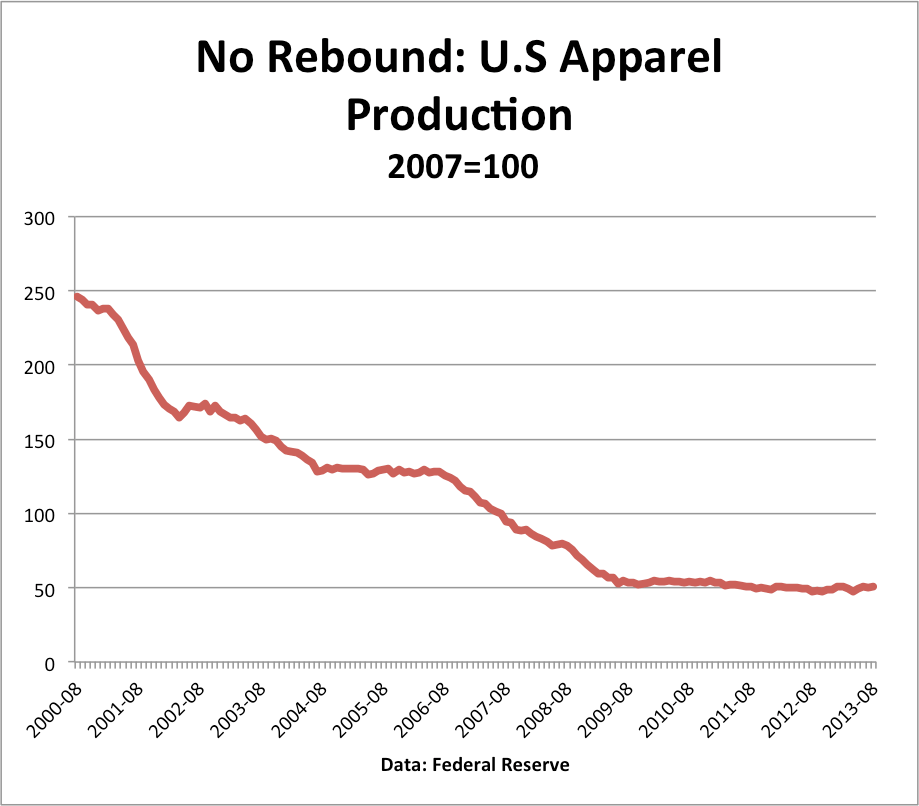
  • Domestic apparel production today is lower than it was in 2009, at the depths of the recession.
  • Compared to 2007, domestic apparel production is down about 50%
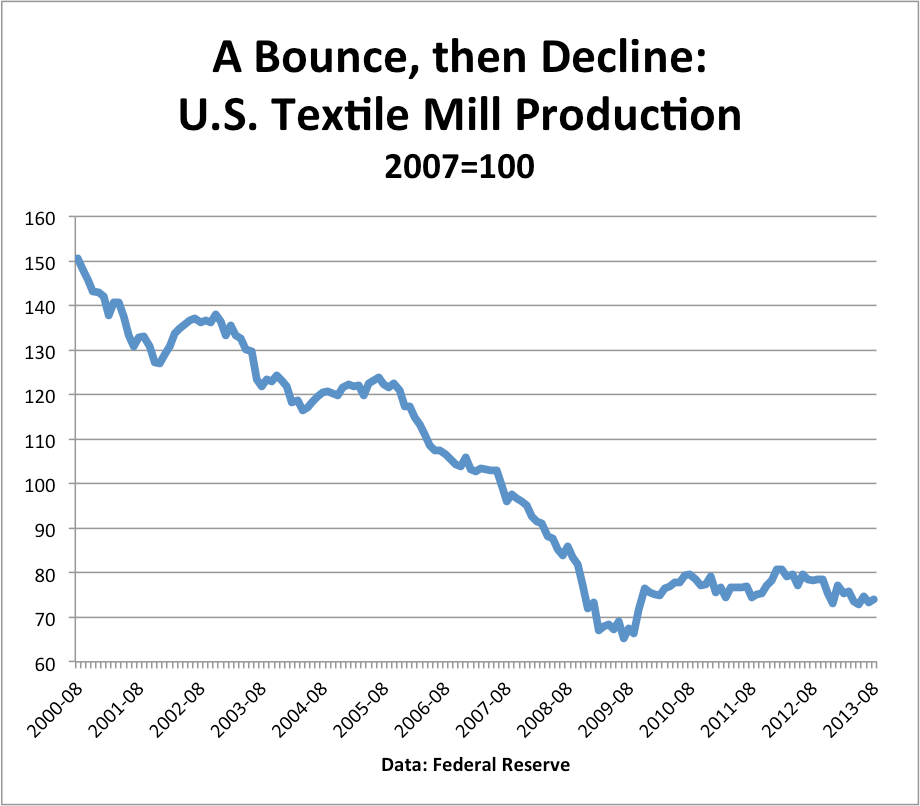
  • Domestic textile mill production today is 5.5% lower than it was a year ago.
  • Compared to 2007, domestic textile mill production is down about 25%.

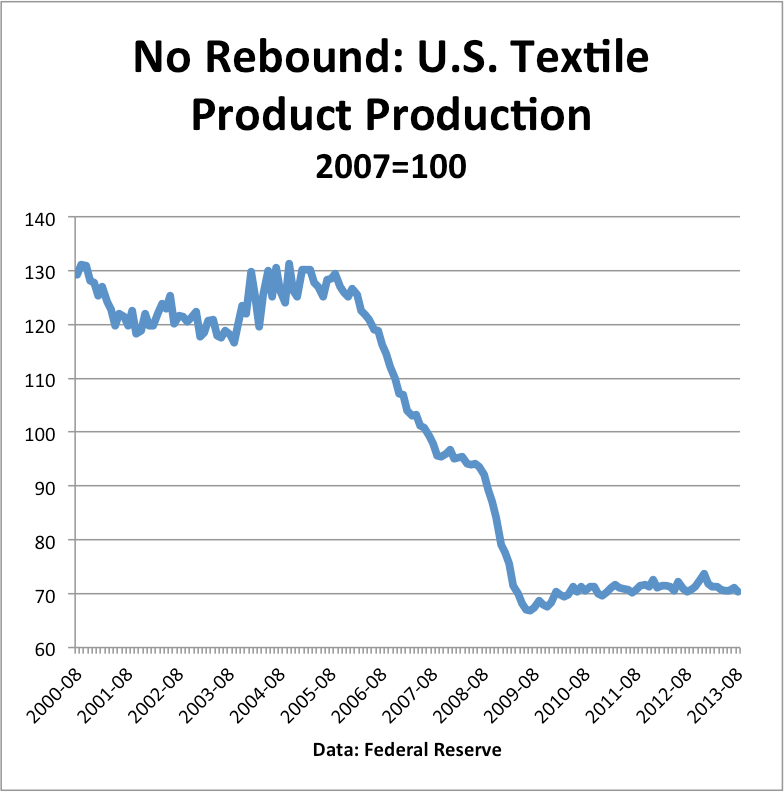
And for those of you who are gluttons for punishment, here are the charts of  apparel production, textile mill production, and textile product production  (drawn from Federal Reserve data). The bottom line–there is no sign of a production rebound or recovery in any of these industries, robots or no.

Now, there’s a lot of questions we could ask here. Did the NYT editors and reporters know these numbers, and just decided to not put them in because they fought the story? And what about wage and productivity stats for these industries, or even import statistics to put some context on the one upbeat number about textile and apparel exports? Here’s what the story said:

In 2012, textile and apparel exports were $22.7 billion, up 37 percent from just three years earlier.

Here’s what the story didn’t say: The trade deficit in textiles and exports was wider in 2012 ($92.7 billion) than 2007 ($91.2 billion).  Exports rose, but imports rose more.

The fact is, if the story is right and U.S. firms are cost competitive with Chinese firms, then there’s plenty of room to expand production in U.S and create jobs. This mainly requires investment,which ties into the recent PPI Investment Heroes paper. It also may require new technology to dramatically change the whole business model, including 3D printing and aspects of the Internet of Eveything.


Who are the U.S. Investment Heroes of 2013?

In our newest report, “U.S. Investment Heroes of 2013: The Companies Betting on America’s Future,” we highlight the top U.S. Investment Heroes of 2013, as ranked by their U.S. investment.

PPI’s ranking of U.S. Investment Heroes for 2013 is led by AT&T, which invested almost $20 billion in the U.S. in 2012. The top five are rounded out by Verizon, Exxon, Chevron, and Intel, and together these five companies invested over $66 billion in the U.S. during the last year.* Total U.S. investment by the top 25 companies amounted to almost $150 billion last year, spent on high-speed broadband deployment, oil and natural gas production, and new corporate and retail facilities.

Telecommunications and cable, energy, and technology dominated this year’s Investment Heroes list, comprising 18 out of our top 25 companies. The fact that these three sectors are driving U.S. private fixed investment reflects their importance in driving U.S. economic growth.

Given the importance of investment as a path to sustainable growth, it is essential our economic policies make domestic business investment a priority. In our report we put forward four ways to encourage more U.S. investment: simplify the corporate tax system, invest in workforce training, don’t over-regulate innovative industries, and free up more spectrum.

*See full report for complete methodology and definitions.


U.S. Investment Heroes of 2013: The Companies Betting on America’s Future

For too long, U.S. policymakers have focused narrowly on boosting consumers’ buying power, assuming that the productive end of the economy will take care of itself. Yet the last decade of slow growth shows that debt-driven consumption is not a sustainable strategy for expanding economic opportunity or lifting U.S. living standards. In contrast, a high-growth strategy requires strong investment—private and public—in our nation’s productive and knowledge capacities.

It’s time for progressives to rebalance the consumption-investment equation. Total domestic investment fell drastically during the recession and has yet to fully recover. A big part of the problem is the public sector. With gridlock in Washington and financial troubles at the state and local level, government real spending on productive assets from highways and bridges to computer equipment, net of depreciation, is down by half compared to the average level of the 2000s.

Investment by the private sector is doing better, but taken as a whole still falls way short of what the country needs to generate jobs and growth. As shown in Figure 1, business investment, outside of housing, is still 20 percent below its long-term trend. There are several reasons why private business investment is failing to reach its potential. Globalization, weak demand, deleveraging and a shortage of workers with technical skills all contributed to the investment fall-out and subsequent investment gap. And as PPI has documented elsewhere, the sheer accumulation of regulations over time can discourage capital investment and innovation.

Within this gloomy picture, however, are some bright spots—companies that continue to place big bets on America’s future, creating jobs and raising productivity in the process. Surprisingly, in a world of information overload, identifying these major contributors to the U.S. economy is not an easy task, since most companies do not break out their domestic capital spending. That’s why we undertook our second annual report on “U.S. Investment Heroes,” making a systematic analysis of publicly available information to rank nonfinancial companies by their capital spending in the U.S.

PPI’s ranking of U.S. Investment Heroes for 2013 is once again led by AT&T, which invested almost $20 billion in the U.S. in 2012. The list then follows with Verizon, Exxon, Chevron, Intel and Walmart. Together, we estimate these companies invested almost $75 billion in the U.S. in 2012, an astonishing total almost twice the GDP of Wyoming. Over the last year, these companies have poured capital investment into the deployment of high-speed broadband, oil and natural gas production, and new corporate and retail facilities.

As a general principle such spending provides both direct and indirect benefits to Americans. For example, a variety of studies suggest that investment in fixed and mobile broadband creates jobs. In fact, PPI Chief Economic Strategist Michael Mandel estimates that since Apple introduced the iPhone in 2007, the economy has created over 750,000 jobs related to mobile apps.

Indeed, telecommunications and cable companies are a major driver of U.S. investment today, sparking the rise of what we call “the data-driven economy.” The digital transformation of the U.S. economy would not be possible if high-speed fixed and mobile broadband networks were not in place. That’s why encouraging private investment in our nation’s broadband infrastructure is rightly a major priority for the Obama administration. Beyond that, robust private investment in smart devices, sensors, and “big data” analytics is sparking the emergence of the “Internet of Everything,” which could boost productivity and job creation in ‘physical’ industries such as manufacturing and transportation.

Our ranking of U.S. companies investing in America also shows the tremendous role energy—oil and natural gas production and power generation—has on U.S. economic growth. The shale oil and gas boom has turned old assumptions about energy scarcity on their head. It is lowering input costs for U.S. chemical companies and helping to revive U.S. manufacturing. It may also turn the United States into a major energy exporter, while creating jobs at home.

This report is the third in PPI’s “Investment Heroes: Who’s Betting on America’s Future” research series. That so many companies are choosing to invest elsewhere—or not at all—makes it all the more important to recognize those that are placing their bets on America’s future.

Download the memo.


The Atlantic: Could the ‘Internet of Things’ Really Save the U.S. Economy?

The Atlantic‘s Tim Fernholz wrote an article referencing PPI’s Chief economic strategist Michael Mandel and his opinion on the Internet of Things being the key solution to saving America from “economic ruin”:

The “internet of things”–the increasing number of machines equipped with internet-connected sensors–will expand the US economy by $600 billion and $1.4 trillion in 2025, roughly the equivalent of boosting GDP by 2% to 5% over the intervening time period. That could be the difference between so-so growth to the kind of stable growth that drives down debt and unemployment.

Fernholz also quoted Michael Mandel on his hope that America could make “on-the-job-training easier by making machines more responsive to their users”.

Read the entire article on The Atlantic website here.

Can the Internet of Everything bring back the High-Growth Economy?

The United States and the other major advanced economies are currently stuck in a seemingly endless twilight of slow growth. The numbers are ugly: The April 2013 forecast from the International Monetary Fund predicts that economic growth in Europe will average only 1.7% over the next five years. Japan is projected to average only 1.2% growth. Germany, held up as a paragon of success, is expected to grow at only 1.3% annually.

The United States is doing better than Europe and Japan, but not by much. The nonpartisan Congressional Budget Office is currently projecting that the underlying growth rate of the U.S. economy—the so-called ‘potential’ growth—is around 2.2% annually, compared to an average of roughly 3.3% in the post-war period.

Both Democrats and Republicans in Washington, miles apart on most issues, have accepted the slow growth scenario. That helps explain, in part, the political gridlock in Washington. An economy growing at barely over 2% per year doesn’t generate enough income to pay for everything that Americans need: Social Security and Medicare for the aging population, defense spending sufficient to handle critical threats, and support for essential government investment in basic research, education, and infrastructure. The longer that the slow-growth assumption gets locked in, the more it becomes a self-fulfilling prophecy.

Yet we are not stuck with the slow-growth scenario and the endless and frustrating Washington policy debates about dividing a shrinking pie. Over the past year, a series of studies from research institutes and industry have laid out a compelling new vision of a highgrowth future—one that that could revolutionize manufacturing and energy, create employment for the jobless generation, and bring back rising living standards.

These new studies—from organizations such as the McKinsey Global Institute, GE, Cisco, and AT&T—describe the economic potential of a new wave of technological innovations known as the Internet of Everything (IoE)—also sometimes called the Internet of Things, the Industrial Internet or Machine to Machine. (Though as discussed below, the Internet of Everything is a broader, more accurate concept than the other terms, encompassing much more than just ‘things’.)

Taking the McKinsey projections as a base, we estimate that the Internet of Everything could raise the level of U.S. gross domestic product by 2%-5% by 2025. This gain from the IoE, if realized, would boost the annual U.S. GDP growth rate by 0.2-0.4 percentage points over this period, bringing growth closer to 3% per year. This would go a long way toward regaining the output—and jobs—lost in the Great Recession.

Equally important, from the macro perspective, the result will be a shift to growth that is not just faster, but higher quality. Rather than being fueled by consumption and borrowing, the Internet of Everything will lead to an economy built on production and investment, with much more extensive education and training built right into the fabric of the economy rather than being separated out.

Download the memo.

Let Everyone Bid in the Spectrum Auction

In our new paper released today, we examine the economics and policies related to an upcoming spectrum auction by the Federal Communications Commission, illustrating that a more efficient regulatory system that facilitates competition and innovation can also provide essential consumer protection.

The auction, which the FCC hopes to conduct next year, is designed to enable continued expansion of mobile broadband and other wireless services by buying back spectrum now belonging to TV broadcasters and making it available to wireless service providers. As often happens in Washington, there’s a fight over how the auction should be structured—specifically a push by some smaller competitors to limit bidding by the largest providers, AT&T and Verizon. Such limits would effectively set aside a portion of low-frequency spectrum for the smaller rivals at discounted prices.

But we argue that such regulatory structures would needlessly complicate the auction process, undermine competition in the overall broadband marketplace, and make it difficult to meet consumers’ expectations for wireless service. Moreover, putting a thumb on the scales of the auction process is unnecessary. Rather than achieve the goal of enhanced innovation, we show that the rules proposed by smaller competitors could make innovation more difficult. Continue reading “Let Everyone Bid in the Spectrum Auction”