


issue: Foreign Policy & Defense
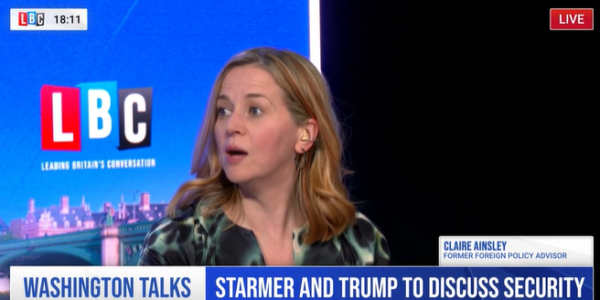
Ainsley in CNN: Trump has been flirting with Putin. Can Keir Starmer woo him back to the West?
“The stakes couldn’t be higher,” Claire Ainsley, Starmer’s former executive director of policy who now works at the US-based Progressive Policy Institute think tank, told CNN. “(The visit) is a big test for the relationships between Europe and the United States, and Europe and the United Kingdom.”
Keep reading in CNN.
Jacoby for Forbes: Ukrainian Defense Forum Underscores The Need For Western Investment
There were few, if any, people in the room who weren’t aware of the meeting under way that afternoon in Saudi Arabia—Russian and American diplomats talking about the future of Ukraine with no Ukrainian input. But none of the 3,000 attendees at the defense forum in Kyiv—a combination conference and expo designed to bring startups, investors, soldiers, and government officials together to discuss Ukraine’s burgeoning defense industry—mentioned the proceedings in Riyadh.
Even if a peace deal is signed in coming months, the world-class weapons industry that has emerged in Ukraine since Moscow’s invasion in 2022 is likely to play a pivotal role in the country’s future—both as a deterrent against future Russian aggression and an export-driven pillar of the Ukrainian economy.
The sprawling expo showcased just how much the fighting in Ukraine has transformed war as we know it. The four or five dozen companies present ranged from fledgling startups to established manufacturers producing at scale for the Ukrainian armed forces. Exhibition booths featured every conceivable type of drone, large and small, for use in the air, at sea, and on the ground. Also on display was a range of electronic-warfare jamming and spoofing devices.
PPI Lays Out a Bold Democratic Foreign Policy Vision: Preparing Now for a Post-Trump World
WASHINGTON — President Trump has fundamentally altered America’s global stance after just one month — alienating key allies, dismantling vital treaties, and embracing America’s adversaries. As the damage unfolds, Democrats must prepare now for the consequences of four years of weakened U.S. leadership.
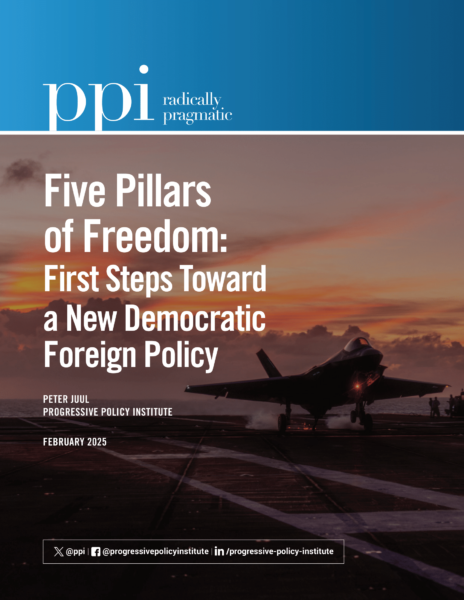
In response, the Progressive Policy Institute (PPI) today released “Five Pillars of Freedom: First Steps Toward a New Democratic Foreign Policy,” a report by Peter Juul, PPI’s Director of National Security Policy. The report outlines a principled, proactive, and pragmatic Democratic foreign policy that prioritizes defending freedom, strengthening alliances, and advancing strategic economic engagement in a world reshaped by a second Trump presidency.
“Any Democrat who succeeds Donald Trump in 2029 will inherit a world that is more dangerous, more unpredictable, and more hostile to American interests than at any time in recent history,” said Juul. “This roadmap provides a path for Democrats to rebuild America’s standing, defend democracy, and protect our national security in an increasingly unstable world.”
Juul argues that Democrats must abandon outdated approaches and embrace a bold, forward-looking strategy rooted in five key pillars:
- Defending Freedom: America must lead the global fight against authoritarianism and stand with democracies under threat.
- Investing in a Strong National Defense: Democrats must overcome outdated skepticism about defense spending and ensure America’s military is prepared for 21st-century threats.
- Rebuilding and Strengthening Alliances: From NATO to the Indo-Pacific, the U.S. must repair and reinforce strategic partnerships.
- Leading on Economic Statecraft: Free and fair trade agreements with allies must replace Trump’s chaotic, self-defeating trade wars.
- Projecting Strength and Resolve: A new Democratic foreign policy must reject excessive caution and be willing to take risks in defense of American values.
Juul warns that a second Trump presidency is already dismantling U.S. alliances, emboldening autocratic regimes, and undermining international institutions that have safeguarded global stability for decades. In his first weeks back in office, Trump has already bullied NATO allies, cozied up to Vladimir Putin, and proposed dangerous policies that weaken America’s strategic position.
Read and download the report here.
Founded in 1989, PPI is a catalyst for policy innovation and political reform based in Washington, D.C. Its mission is to create radically pragmatic ideas for moving America beyond ideological and partisan deadlock. Learn more about PPI by visiting progressivepolicy.org. Find an expert at PPI and follow us on X.
###
Media Contact: Ian O’Keefe – iokeefe@ppionline.org
Five Pillars of Freedom: First Steps Toward a New Democratic Foreign Policy
Introduction
Come January 20, 2029, any Democrat who succeeds Donald Trump as president must be prepared to confront the very different and much more dangerous world Trump will almost certainly create. The Democratic Party must begin thinking seriously about a new foreign policy approach now — one based on the party’s best internationalist traditions and the defense of freedom worldwide, not fantasies of “restraint” conjured up by progressive isolationists or the timid, managerial approaches of the Obama and Biden years.
Democratic foreign policy would have required a serious refresh even had Kamala Harris prevailed in November 2024. But Trump’s return to the presidency makes matters even more urgent: Unconstrained by more experienced and sober national security voices that understand the value of America’s alliances, Trump appears ready and willing to let his deepest and most destructive foreign policy impulses run wild — as became clear during his first weeks back in office. Long-standing American allies and friends have already found themselves treated as enemies, threatened with and subjected to economic and military pressure, while adversaries and autocrats find themselves welcomed as comrades and given leave to act as they please.
Like prudent military strategists who plan for every possible contingency, Democrats need to prepare for world more hostile to American interests and liberal values than at any point in living memory — and an America much weaker and far less able to defend them. Dictators in Moscow and Beijing will see their power and influence grow, possibly with Ukraine as a de facto Russian vassal state and Taiwan under China’s thumb. Other democracies could well follow America’s example and elect illiberal, far-right governments of their own, a task made all the easier by Trump’s gutting of USAID and the vital support it provides to those fighting for freedom and democracy abroad. NATO and other American alliances may either cease to exist altogether or stumble ahead shadows of their former selves, effectively unable to deter conflicts or defend their members. Future American promises and commitments will lack credibility, particularly when it comes to issues of trade and security.
Indeed, in his first month in office alone, Trump bullied two NATO allies — Canada and Denmark— with threats of tariffs and territorial annexation while sitting down one-on-one with Vladimir Putin’s Russia to discuss the fate of Ukraine. He similarly promised to levy tariffs on Mexico, another neighbor and trading partner, while Secretary of State Marco Rubio falsely claimed Trump’s threats wrested concessions from the Panamanian government over access to the Panama Canal. Trump also publicly backed crimes against humanity when he floated a preposterous scheme to depopulate the Gaza Strip, seize the Palestinian territory for the United States, and transform it into “the Riviera of the Middle East.”5 The loud and repeated endorsement of gangster-style extortion, territorial conquest, and rank imperialism by the president of the United States will have lasting and calamitous global consequences.
It will, therefore, not be possible for a future Democratic president to proclaim, as President Joe Biden did, that “America is back” and restore the world as it was before. Institutions and relationships demolished, degraded, and debased by a second Trump presidency, both at home and abroad, cannot simply be resurrected as if nothing had happened over the previous four years. Reconstruction and rebuilding, not restoration and refurbishment, will be the order of the day for any future Democratic foreign policy worthy of the name — and it will need to be done at a moment when America finds itself in its most precarious strategic position since before the Second World War.
So what should a future Democratic foreign policy look like?
First, it’s important to note that it’s hard to predict just how much damage Trump will do to America’s national security and foreign relations over the next four years — making specific policy proposals and positions less relevant than a broader intellectual and moral framework for thinking about foreign policy. Indeed, less than two weeks into his second term in office, Trump and his minions have already attempted to liquidate the U.S. Agency for International Development, purge the CIA and FBI of professional intelligence and law enforcement officers, and gut public scientific research institutions like the National Science Foundation, NASA, and NOAA.
What Democrats need is not a suite of detailed policy blueprints on this or that specific issue, but a general orientation and set of attitudes toward foreign policy — an animating spirit to guide them as they navigate the world moving forward.
That starts with a clear understanding of enduring global strategic realities and abiding American national interests — realities and interests that won’t change no matter who happens to occupy the Oval Office.
As Democratic Presidents Woodrow Wilson and Franklin D. Roosevelt recognized, the dramatic scientific, technological, and industrial breakthroughs of the late nineteenth and early
twentieth century transformed the world in fundamental and irreversible ways.10 From steamships, the telegraph, and internal combustion engines to aviation, the radio, and rocketry, these advances made it impossible for geography to insulate the United States from threats across the Atlantic and Pacific. The political, economic, and diplomatic fate of this vast geographic expanse would now determine and define the sort of world in which America and other nations would live.
These profound changes required Americans to think about their national security in global terms, not just continental or hemispheric ones. As Roosevelt reminded his fellow citizens in his December 1940 fireside chat, “The width of those oceans is not what it was in the days of clipper ships.” Rapid technological progress since the Second World War — jet airliners, nuclear weapons, satellite telecommunications, and the internet, among other innovations — have only made Roosevelt’s central argument more compelling. Today, America’s own safety, prosperity, and freedom remains, as it has for more than a century, intimately and inextricably bound up with that of Europe and East Asia.
This essential national interest in the stability, security, and freedom of Europe and East Asia remains constant and objective; it can be denied and downplayed by isolationists on both left and right, but it cannot be altered, eliminated, or wished away. Now and for the foreseeable future, this interest is threatened by a pair of global gangster powers — Vladimir Putin’s Russia and Xi Jinping’s China — that aim to dominate these two vital regions and dictate their own terms to the rest of the world. In this endeavor, moreover, Moscow and Beijing receive both material and moral support from lesser gangster states like Iran and North Korea. The frontiers of America’s own national security, in other words, now stand at Ukraine’s Dnipro River and in the Taiwan Strait.
For a future Democratic foreign policy to fully succeed, however, the pursuit of America’s national interest must proceed hand in hand with the pursuit of higher ideals and moral values that represent America at its best — namely, a stalwart defense of freedom and democratic self-government against the depredations of despots, dictators, and international gangsters.
A strong and forthright defense of freedom at home and abroad ought to sit at the heart of a future Democratic foreign policy, serving as its crucial central pillar and main organizing principle. As America learned during the first half of the twentieth century, a world dominated by unfree powers is one that’s manifestly unsafe for the United States. It ultimately remains up to America to defend freedom around the world — there is no other nation or group of nations that can assume the same mantle of moral leadership as the United States or possesses the necessary geopolitical heft. Without a power as strong and influential as America to stand for them, freedom and liberal values will find themselves with no real or effective champion on the global stage. In short, the fate of freedom around the world depends in no small part on America’s own active involvement in the world.
Democrats should also make clear that they want the United States to defend freedom where it already prevails — however incomplete and fragile it may well be in certain places — against bullying, intimidation, and outright invasion by gangster powers like Russia and China. America remains the only nation with the capacity and ability to organize an effective, durable defense of democratic self-government where it now exists against such powers. It’s not some abstract rules-based international order that Democrats want America to defend, then, but actual living-and-breathing societies like Ukraine and Taiwan who wish to live free from the very real threat of military bullying and political domination by their more powerful and predatory neighbors.
Four additional pillars support and flesh out in more practical terms this main animating principle of a future Democratic foreign policy:
- Provide for a strong defense capable of meeting present and future challenges.
- Alliances amplify American power and help secure American interests.
- Free and open trade with friends and allies around the world.
- A willingness to take risks and use American power to defend freedom overseas.
Read the full report.
Jacoby in News Nation: Zelenskyy to Visit White House Friday

Jacoby for Washington Monthly: Donald Trump and the End of American Global Leadership
The United States strove for more than 100 years—since we entered World War I in April 1917—to hold its own as leader of the free world. It took Donald Trump precisely one month to abdicate that leadership, destroying everything his predecessors—from Woodrow Wilson to Franklin D. Roosevelt and Ronald Reagan—had built through two global conflicts, the Cold War and the creation of the post-World War II Western alliance. Trump thinks he is strong and making America stronger. But his bullying of Ukraine and capitulation to Vladimir Putin make us immeasurably weaker—a loss of reputation and power never likely to be regained.
Americans sympathetic to Ukraine have long worried that Trump would turn against the country on the receiving end of Russia’s brutal aggression. But the president’s behavior in the last week stunned even the Trump worriers. His ingratiating overture to the Kremlin, his preemptive giveaways—suggesting Ukraine should cede one-fifth of its territory and renounce joining NATO before Moscow even asked for those concessions—and his administration’s rush to meet a Russian delegation without Ukraine or our European allies, all of that was stunning enough.
But now the American president has sunk to baseless insults, calling Ukrainian President Volodymyr Zelensky a “modestly successful comedian,” a “dictator,” and a thief. Zelensky’s measured response, telling Ukrainians that he was counting on their unity and courage and “the pragmatism of America,” showed up the president’s barbs for the schoolyard taunts they were.
Read more in Washington Monthly.
German Election Preview: Implications for the Global Center-Left
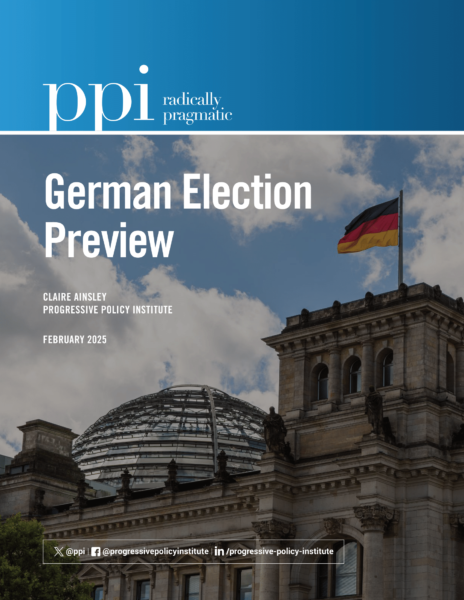
WASHINGTON – As Germany prepares for its snap federal election on February 23, the Progressive Policy Institute (PPI) has released a “German Election Preview,” authored by Claire Ainsley. The report provides a deep dive into the electoral landscape, key policy debates, and the broader lessons for center-left parties globally.
The election marks the first since Olaf Scholz’s Social Democrats (SPD) won the Chancellery in 2021, ending years of Christian Democrat Union (CDU) dominance. However, as Germans return to the polls, the CDU is poised to reclaim power, while the SPD struggles in third place behind the far-right Alternative for Germany (AfD), which has doubled its support since 2021.
“The German election is not just a national event — it has global significance,” said Claire Ainsley, Director of PPI’s Center-Left Renewal Project. “The SPD’s difficulties mirror the broader challenges for center-left parties in balancing economic credibility, climate ambition, and voter concerns over immigration. Their experience provides crucial lessons for Democrats in the U.S. and Labour in the U.K. as they navigate similar political headwinds.”
Key findings from the report include:
- A Weakened SPD and a Surging Right: The SPD’s coalition with the Greens and Free Democratic Party (FDP) has fractured, following economic stagnation, unpopular climate policies, and a contentious debate over immigration.
- CDU’s Dilemma: If the CDU wins, it must decide whether to maintain Germany’s long-standing firewall against cooperating with the far-right AfD, and balance political risk by forming another three-party coalition.
- Economic and Climate Challenges: Germany’s strict “debt brake” has constrained public investment, while the handling of climate policies has fueled voter backlash and who pays for climate ambitions.
- Immigration as a Defining Issue: Immigration has overtaken the economy as voters’ top concern, with a YouGov poll showing 80% of Germans believing migration levels have been too high in the past decade.
The report argues that the SPD’s struggles highlight a larger challenge for center-left parties worldwide: the need to deliver tangible economic benefits to working people while avoiding policies that deepen voter alienation.
“With working-class voters moving away from the center-left in multiple democracies, leaders must focus on delivering real results — whether on economic security, immigration, or energy affordability,” said Ainsley. “Otherwise, these voters will continue to look elsewhere, as we’ve seen in the U.S. and across Europe.”
After the U.S. navigated its own electoral challenges in 2024 and focuses on the future, PPI’s report offers critical insights into how progressive parties can adapt and rebuild durable political majorities.
Read and download the report here.
PPI’s project on Center-Left Renewal was launched in January 2023 to catalyze and create a renewal of the center-left, sharing ideas, strategies, and research around the world. Since its inception, the project has facilitated a shared exchange between center-left parties, contributing new ideas and analysis designed to further the prospects of the center-left. The project’s outputs are shared by PPI here: www.progressivepolicy.org/project/project-on-center-left-renewal/. Sign up to our project mailing list at info@ppionline.org.
Founded in 1989, PPI is a catalyst for policy innovation and political reform based in Washington, D.C. Its mission is to create radically pragmatic ideas for moving America beyond ideological and partisan deadlock. Learn more about PPI by visiting progressivepolicy.org. Find an expert at PPI and follow us on X.
###
Media Contact: Ian O’Keefe – iokeefe@ppionline.org
German Election Preview
INTRODUCTION
On 23 February 2025, Germans will head to the polls in the first federal election since Olaf Scholz’s Social Democrats (SPD) came from third to first to win the Chancellery in October 2021, following the departure of Chancellor Angela Merkel and a long period of Christian Democrat Union (CDU) dominance.
In 2021, the SPD became the lead party in a coalition government with the Green Party and Free Democratic Party (FDP), agreeing on an ambitious government programme based on their ‘four missions for the future’ outlined in the SPD’s winning manifesto.
Yet Sunday’s election looks set to provide a very different outcome, with the CDU back in pole position, and the ruling SPD trailing in a low third with the Greens just behind them in fourth. Second place in the polls is the Alternative for Germany (AfD), a far-right challenger party that has doubled its support since the 2021 federal election, when it came fifth with 10% of the vote.
As attention turns to this historic election, what might we expect from the results? And what lessons can center-left parties elsewhere draw from the German experience?
Read the full report.
Jacoby in The Washington Monthly: Trump Provokes Fear in the Western Alliance
Donald Trump’s push for peace in Ukraine has left the West aghast and with good reason. The man expected to pull America off the world stage seems determined to have a hand in every conflict. The candidate who campaigned on fear of World War III is set on upending the rules that prevented it for 80 years. The self-styled master negotiator is giving away the game before it begins, ceding Moscow’s main demands before Vladimir Putin even agrees to come to the table. Long-time American allies—including in all the capitals of Europe—have been left out of talks about Ukraine.
The outcome in Ukraine is to be determined, but what is certain is the damage to the international order—perhaps permanent damage. Tensions between Washington and Europe dominated this weekend’s Munich Security Conference, and on Monday anxious European leaders will gather in Paris to plan a collective response.
The administration’s diplomacy is inscrutable. First, Secretary of Defense Pete Hegseth said one thing—that there could be no return to Ukraine’s prewar 2014 borders, no Ukrainian membership in NATO, and no American peacekeeping troops in Ukraine. John Coale, America’s deputy envoy to Ukraine, said the opposite: the U.S. had not ruled out NATO membership or restoring Ukrainian territory. Then, Vice President J.D. Vance dramatically shifted the tone, threatening increased sanctions on Russia and sending U.S. troops to Ukraine, as Secretary of State Marco Rubio tried to reassure Kyiv, declaring that the U.S. has “a stake in Ukraine’s long-term independence.”
Read more in The Washington Monthly.
Jacoby for The Bulwark: What USAID Really Did in Ukraine
Amid the tide of bilge—lies, personal smears, conspiracy theories, and other drivel—offered by the Trump administration in the last two weeks as an alleged rationale for shutting down USAID and ending America’s decades-long tradition of foreign aid, one legitimate question stands out: How exactly is foreign aid in America’s interest? Or, to put it another way: How and to what extent do we benefit from spending money to improve conditions and better lives in other countries?
Consider USAID’s portfolio in Ukraine, which expanded sharply after Russia’s invasion in 2022—from $200 million in 2021 to $16 billion in 2023, adding up to some $35 billion in the past three years. USAID has served as the primary funnel for America’s nonlethal support for Ukraine, now the agency’s largest recipient worldwide.
The expansion of assistance to Ukraine originally enjoyed strong bipartisan support. According to a public “exit memo” by Biden administration USAID Administrator Samantha Power, the agency leveraged a three-to-one match by other donors, including the private sector and allied countries. Funding was spread across an array of projects, from humanitarian aid for elderly residents holding out in the rubble of ruined frontline cities to digital innovation designed to reduce corruption and keep government services running.
Keep reading in The Bulwark.
Jacoby for Washington Monthly: As Ukraine Fights, Echoes of Historic Meetings in Yalta and Helsinki Abound
The anniversary of the Yalta Conference, which ended 80 years ago this week in a Soviet-occupied Crimean resort on the Black Sea, has a special significance in central and eastern Europe—and not just because it took place in a Ukrainian city that Russian soldiers once again occupy.
At the time, in the U.S and allied countries, the agreement between Franklin D. Roosevelt, Winston Churchill, and Josef Stalin was hailed as a historic breakthrough, one step away from the end of World War II and proof positive that the U.S. and the Soviet Union would continue to cooperate in the postwar era. The countries in what would soon be known as the Soviet sphere of influence felt no such euphoria. They understood right away, as Americans would learn in coming months, that the upshot of the conference was to cement Soviet control over a broad swath of eastern Europe—countries from Ukraine to Estonia, more than a thousand miles north.
It’s an anniversary that holds important lessons for Donald Trump, unlikely as it is that he is reading history as he prepares to sit down with Vladimir Putin and perhaps once again carve up the territory in this much-contested corner of Europe.
Read more in the Washington Monthly.
Jacoby for Washington Monthly Podcast: Ukraine’s Survival on the Brink
Co-hosts Anne Kim and Garrett Epps speak with Tamar Jacoby, who is living and working in Kyiv as Director of the Progressive Policy Institute’s New Ukraine Project. She speaks about the future of Ukraine, the changing face of warfare, and Vladimir Putin’s potential ambitions in Europe.
You can also watch the full conversation on YouTube.

Jacoby for Forbes: European Investment In The Ukrainian Defense Industry Threatened By Personnel Shuffle
In mid-2024, as the war in Ukraine ground into a third year and Western military aid showed ominous signs of flagging, Kyiv and its friends in Europe began moving toward a different approach: producing weapons closer to the fighting, on Ukrainian soil. This would require help from Europe and the U.S.—significant funding and oversight. But it promised in the long haul to reduce Ukrainian dependence on the West and, after the war, to provide a powerful new arsenal for Europe.
Denmark was the first country to participate, followed by other northern European nations, and early efforts were promising. Altogether in 2024, what became known as the “Danish model” provided more than a half billion dollars for Ukrainian weapons production, and the approach was warmly welcomed in Kyiv, with President Volodymyr Zelensky and others calling for its expansion in 2025.
Then, astonishingly, in late January, Ukrainian Defense Minister Rustem Umerov suspended the well-regarded director of the agency that had made the new approach possible by bringing transparency and accountability to the agency that purchases weapons and ammunition for the Ukrainian army.
Read more in Forbes.
Jacoby for Forbes: Amid A National Conscription Crisis, One Ukrainian Unit Takes A Different Approach
Denys Rizhov, 21, stumbled on the Third Assault Brigade’s drone school, Kill House, by accident—a random link to a YouTube video. A soft-spoken, reserved young man with a ponytail, bored by college, working odd jobs and uncertain what his future would bring, Rizhov was intrigued enough to follow up on the web. The more he learned, the more he liked, and he decided to start saving the $190 it would cost for a week of classes in the technology and tactical use of unmanned aerial vehicles.
He scrimped and saved for months, and when he finally took the course, he couldn’t have enjoyed it more. Now he’s planning to go back for further training—a second week of drone school and then the Third Assault Brigade’s intensive seven-day course that tests volunteers interested in joining the unit.
At a time when the lion’s share of Ukrainians is frightened of joining the armed forces or actively resisting it—hiding from recruiters and scheming to flee the country illegally—Rizhov is increasingly drawn to enlisting in an elite combat unit, attracted by evolving drone technology and what he’s seen of the Third Brigade’s bracing ethos.
Continue reading in Forbes.
Jacoby for Washington Monthly: In Ukraine’s Army, the “Heavenly Punishment” Battalion’s Morale is Unwavering, Its Blows Punishing
A half dozen officers from Ukraine’s 54th Mechanized Brigade hover around the table in what was once a modest civilian home on the outskirts of Sloviansk, a small, war-torn city just behind the front line. The table is heaped with a holiday feast—meat, rice pilaf, salads, and even smoked salmon canapés. We’re waiting for the colonel, code-named Khors, a career officer in his early 50s with a Cossack haircut—shaved on the sides to show off a long, flaxen topknot. When he arrives, we sit down to eat.
No one speaks of the battle a few days before—a close encounter with more numerous and better armed Russian forces. The Ukrainians mounted a robust defense, and the men now seem eager to put it behind them. But when I ask about morale, their faces grow longer. “People are tired,” Khors says, staring into the middle distance. “Especially the commanders. And the winter doesn’t help.”
After nearly three years of all-out combat, the war in Ukraine is heading into what could be a pivotal few months. The Russians have been moving forward on the eastern front, throwing troops at the fight and losing as many as 2,000 a day, but still advancing yard by yard into Ukrainian territory. Intensifying bombardments terrorize cities far from the battlefield. Over half the country’s electricity-generating capacity has been destroyed; some households experience daily outages. Ammunition is somewhat more plentiful than when U.S. aid stalled a year ago, but many units complain they are short of manpower.
Perhaps most uncertain is what a Trump presidency will bring. Will the new American leader try to make good on his promise to end the war in one day? Will Vladimir Putin heed his call to come to the negotiating table? And what kind of peace deal might they strike, with or without Ukrainian approval?