Supporting Research and Development Means Fixing The System, Argues New Report from PPI’s Innovation Frontier Project

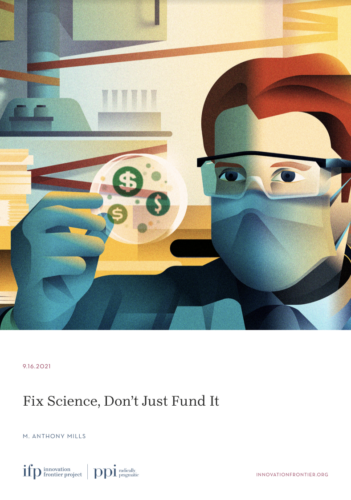
As Congress prepares to boost public spending on domestic research and development (R&D), policymakers must simultaneously address mounting concerns regarding our scientific institutions, argues a new report from the Progressive Policy Institute (PPI)’s Innovation Frontier Project. The report, authored by M. Anthony Mills and titled “Fix Science, Don’t Just Fund It,”  highlights inequities in the distribution of federal R&D funding, stifling bureaucratization across disciplines, and the “replication crisis” of integrity in the scientific enterprise.

“Thanks to revitalized support and interest from Congress, science agencies may soon benefit from a transformative increase in federal funding, signifying a critical first step in supporting American science and innovation. But, as M. Anthony Mills identifies in this must-read report, further action must be taken to address the interrelated issues plaguing the scientific enterprise if we’re going to advance innovation for generations to come,” said Jack Karsten, Managing Director of the Innovation Frontier Project at PPI.

Mills argues that most current proposals for supporting R&D involve substantial increases in federal spending — without institutional guardrails to address issues like highly concentrated distribution, a constraining bureaucratic apparatus, and the prevalence of scientific findings that cannot be independently confirmed.

Mills’ report suggests several proposals for helping policymakers better understand the problems concerning American R&D, including:

  • The OMB should establish the Research Policy Board (RPB), as it was instructed to do in the 2016 Cures Act. The board is by statute set to expire at the end of this month.
  • In addition to reauthorizing the RPB, Congress should consider expanding its scope and purview to include a multi-stakeholder assessment of best practices for R&D funding generally.
  • Congress should direct science agencies to establish a “second look” program for federal science grants to experiment with alternative funding mechanisms.
  • Congress should direct federal agencies to set aside a fixed percentage of new R&D funding for institutions of higher education for a block grant program.
  • Congress should direct the NIH to grow and expand the scope of its Director’s Pioneer Award, Specifically, the program should be expanded to include researchers from basic scientific fields in the natural sciences.
  • These new or expanded funding programs should be pursued in tandem, using a portfolio approach in order to gather evidence of effectiveness. To accomplish this, Congress should establish appropriate feedback mechanisms in coordination with relevant scientific agencies.


Read the report and the expanded policy recommendations here:


Based in Washington, D.C., and housed in the Progressive Policy Institute, the Innovation Frontier Project explores the role of public policy in science, technology and innovation. The project is managed by Jack Karsten. Learn more by visiting innovationfrontier.org.

The Progressive Policy Institute (PPI) is a catalyst for policy innovation and political reform based in Washington, D.C. Its mission is to create radically pragmatic ideas for moving America beyond ideological and partisan deadlock. Learn more about PPI by visiting progressivepolicy.org.

###

Media Contact: Aaron White; awhite@ppionline.org

Aiming Drug Price Reform at the Right Target

By Dr. Michael Mandel, Chief Economic Strategist; and Dr. Robert Popovian, Senior Fellow at PPI

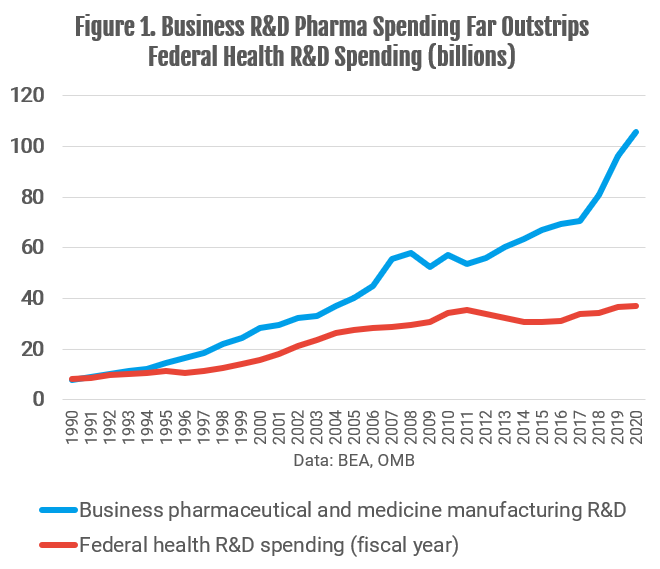
As Congress is considering the shape of the $3.5 trillion reconciliation bill, one of the biggest flash points is drug pricing reform.   Drug price reform is very popular, but when you look closely at the data, as we did in our February 2021 report, the evidence for out-of-control drug price increases becomes much less compelling.  Spending on drugs, net of rebates and discounts, is basically flat as a share of GDP over the past decade. At the same time, the pharma industry has boosted spending on R&D much faster than the federal government. In 2020, the U.S. pharma industry spent $106 billion on R&D, almost triple the $37 billion in health R&D coming from the federal government (Figure 1).

Equally important, pharma manufacturers’ revenue, net of discounts and rebates, increased by only 11%, or $36 billion, between 2016 and 2020, according to a report from the IQVIA Institute. Taking the industry as a whole, all of that revenue gain went into increased R&D spending.

That’s not to say that some people aren’t hurting. In 2018, only 1 percent of Americans paid more than $2,000 in out-of- pocket drug expenses, not including Part D premiums, according to our analysis. That’s a small percentage, but a significant number of people in the aggregate.

Moreover, data analyzed by PPI and others suggest that the major issue irritating most American families is the insane number of copays that people have to pay as they get older. On average, the typical American between the ages of 50 and 60 fill almost thirty prescriptions per year, while the typical American over 65 and over fill almost 50 prescriptions per year. Most drugs are covered by insurance, but even when each copay is small, these numbers add up quickly and are a growing drag on household budgets. In an October 2019 report, we call this the prescription escalator, since the number of prescriptions — and copays — rises sharply with age.

The problem is that the centerpiece of the drug pricing reform proposal–broad Medicare drug price negotiation–will almost definitely hurt R&D and new drug development without actually addressing most of the co-pays that Americans pay. A recent CBO study estimates that drug price reform (similar to what has been proposed) would lead to 59 fewer new drugs over the next three decades.  Moreover, key lines of drug development may never even be funded, leading to missed opportunities for saving lives and reducing medical costs in the future. That’s unfortunate, coming after a year when the industry outperformed the rest of the world by developing “gold standard” vaccines in record time.

Given the current levels of R&D spending, excessively squeezing the revenues received by pharma companies will inevitably translate into fewer new drugs. That implies Democratic Representatives Scott Peters (D-Calif.), Kathleen Rice (D-N.Y.) and Kurt Schrader (D-Ore.), who voted against the drug pricing proposal in the House Energy and Commerce Committee markup process, have solid grounds for worrying that such legislation will undercut investment in innovative drugs.

The drug pricing proposal being considered does contain some good features, including reforming Medicare Part D to cap catastrophic spending. But from a political perspective, it should also deal with the prescription escalator problem that is a key driver of the negative feelings towards drug prices. That means capping out-of-pocket drug expenses, not just for Medicare Part D but for all medical insurance. We examined this in our February 2021 report, “Memo to President Biden: A Reality-Based Approach to Drug Pricing.” In that paper, we support a cap on out-of-pocket costs for drugs, including copays, similar to legislation proposed in 2018. We also support a shift to point-of sales rebates, which should benefit consumers and align their incentives with actual net prices. Getting more transparency into the system is essential.

Finally, we need a better payment scheme for new drugs, especially potential cures for major diseases that are socially beneficial and cost-saving over the long run, but expensive to develop. The most straightforward solution is a shift to outcome-based pricing, which will get new drugs to market faster while having the pharma companies absorb more of the risk.


Senator Hickenlooper Joins PPI Event with Energy Experts on the Future of U.S. Clean Energy 

Today, the Progressive Policy Institute hosted an event with U.S. Senator John Hickenlooper (D-CO) and a panel of energy experts, focused on expanding power line capacity to enable renewable energy deployment.

“Senator Hickenlooper has forged a compelling record as a leader on clean energy and the fight against climate change, from his service as Governor of Colorado to the U.S. Senate. PPI was grateful to have facilitated this engaging roundtable with the senator and our panel of distinguished experts, centering the goals of maintaining the integrity of the electrical grid, expanding capacity while lowering consumer costs, and aggressively confronting climate change with innovative, forward-thinking solutions. Prioritizing these efforts will deliver benefits from public health, to climate, to cost reduction — while protecting our environment and driving job creation,” said Paul Bledsoe, PPI Strategic Advisor and moderator for the event.

Watch the event livestream here:

Senator Hickenlooper serves on the Senate Committee on Energy and Natural Resources.

“There are lots of benefits from this. It’s going to provide revenue and jobs in rural communities — in other words, this is going to really tie together the country,” said Senator Hickenlooper during the event. “…By investing in transmission and the grid, we’re going to get a level of resiliency that, based on what we’ve seen this year, is sorely lacking in the existing system.”

This event’s panelists included Donnie Colston, Director of Utilities for IBEW; Bob Kump, President of Avangrid; Sue Tierney, energy analyst and author of the National Academy Sciences Report; Macky McCleary, energy consultant and former Rhode Island Utility regulator; and Bill Parsons, Chief Operating Officer for the American Council on Renewable Energy.

The Progressive Policy Institute (PPI) is a catalyst for policy innovation and political reform based in Washington, D.C. Its mission is to create radically pragmatic ideas for moving America beyond ideological and partisan deadlock. Learn more about PPI by visiting progressivepolicy.org.

Follow the Progressive Policy Institute.

###

Media Contact: Aaron White – awhite@ppionline.org

Census Bureau Report Finds that Poverty Fell in 2020 Thanks to Government Support

By Veronica Goodman

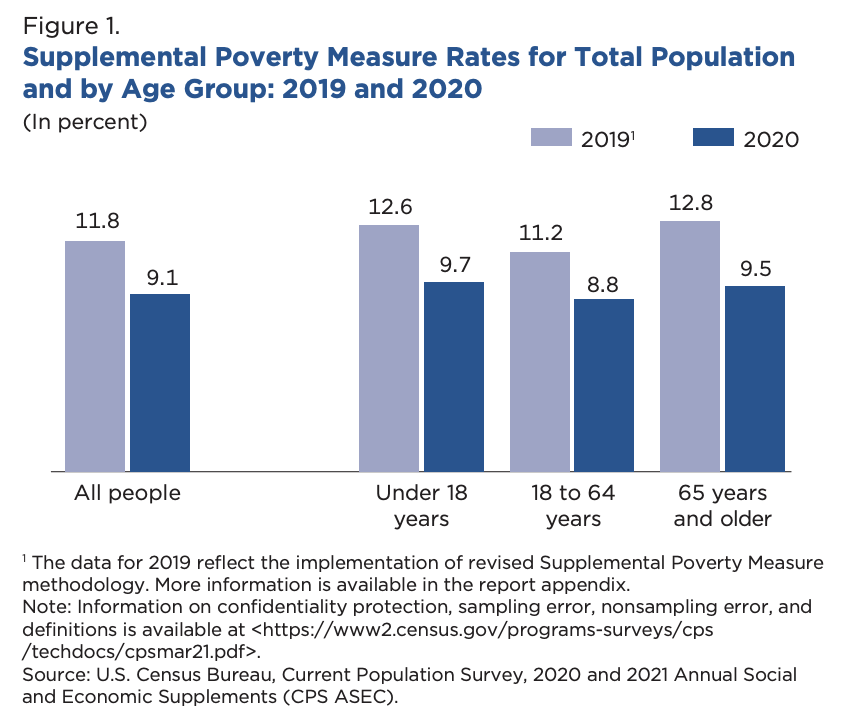
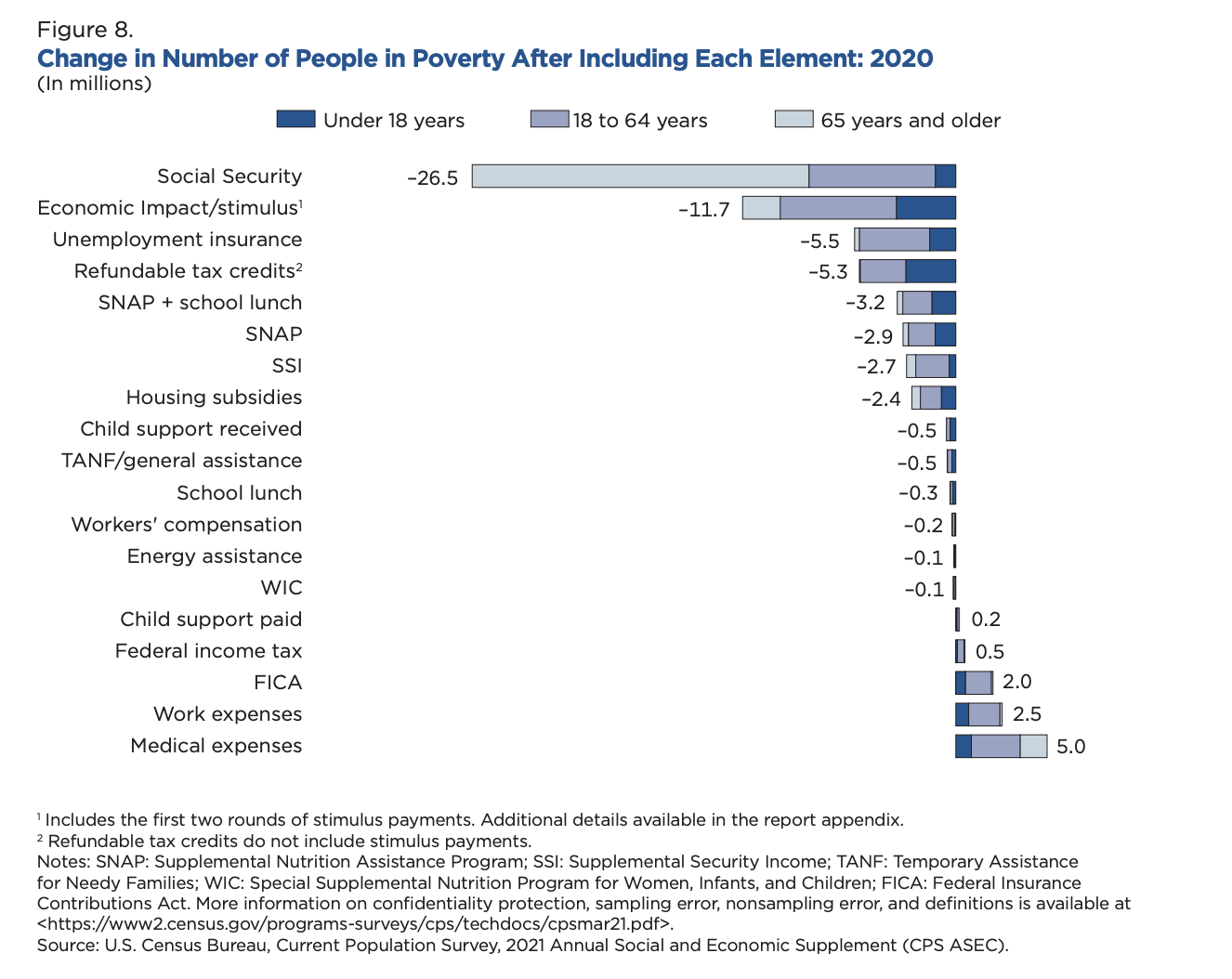
Today’s U.S. Census Bureau Supplemental Poverty Measure release for 2020 underscores that despite COVID-19 and high unemployment, government support kept millions from falling into poverty over the past year. The poverty rate that takes into account government aid fell to 9.1% from the SPM rate of 11.8% in 2019. According to the authors, this is the lowest rate since estimates were initially published for 2009.


The stimulus checks moved an estimated 11.7 million individuals out of poverty and Unemployment Insurance prevented 5.1 million from falling into poverty. Notably, poverty decreased across all ages, races and ethnicities, and educational attainment levels.


Source: Census Bureau

The Future of AI with Congressman Bill Foster

On this week’s Radically Pragmatic Podcast, Dr. Michael Mandel, Chief Economic Strategist at the Progressive Policy Institute (PPI), sits down with Representative Bill Foster (IL-11), to discuss artificial intelligence (AI) and the future of work.

Dr. Mandel and Representative Foster discuss the diffusion of technological innovations for individual consumers and small businesses, the role of government in privacy, and the work Congress is doing to advance pro-growth policies that will help spur innovation. In particular, they underscored the urgent need to help small businesses adopt AI and meet the numerous challenges they face.

Learn more about the Progressive Policy Institute here.

Rep. Bill Foster Joins PPI’s Radically Pragmatic Podcast to Discuss the Future of Artificial Intelligence

On this week’s Radically Pragmatic Podcast, Dr. Michael Mandel, Chief Economic Strategist at the Progressive Policy Institute (PPI), sits down with Representative Bill Foster (IL-11), to discuss artificial intelligence (AI) and the future of work.

“Twenty years ago, when the web was the big new thing, everybody was going to have to learn HTML. And so a whole generation of kids were taught how to program in HTML. And now, of course, we have billions of people who program in HTML without knowing it, they just maintain their Facebook page. And so I think what’s going to happen is that we’re going to have very advanced tools where there will be millions of people using AI but they won’t have any idea what’s underneath the hood and that’s okay,” said Rep. Foster on the podcast.

Representative Foster is a member of the New Democrat Coalition. He represents Illinois’ 11th Congressional District, and is the only PhD physicist in Congress. Rep. Foster serves on the House Science, Space and Technology Committee, the House Select Committee on Coronavirus, and House Financial Services Committee, where he chairs the Committee’s task force on AI.

In the podcast, Dr. Mandel and Representative Foster discuss the diffusion of technological innovations for individual consumers and small businesses, the role of government in privacy, and the work Congress is doing to advance pro-growth policies that will help spur innovation. In particular, they underscored the urgent need to help small businesses adopt AI and meet the numerous challenges they face. Pre-COVID, nearly six in every ten small businesses closed doors within the first five years of operation. Artificial intelligence can help small businesses thrive by:

      • Saving time on tasks like payroll;
      • Analyzing data and forecasting future cash flows;
      • Easing the compliance process for local, state, and federal rules and regulations.

Listen here and subscribe:

The Progressive Policy Institute (PPI) is a catalyst for policy innovation and political reform based in Washington, D.C. Its mission is to create radically pragmatic ideas for moving America beyond ideological and partisan deadlock. Learn more about PPI by visiting progressivepolicy.org.

Follow the Progressive Policy Institute.

###

PPI’s Reinventing America’s Schools Project Releases New Report on Methods to Hold Failing Schools Accountable

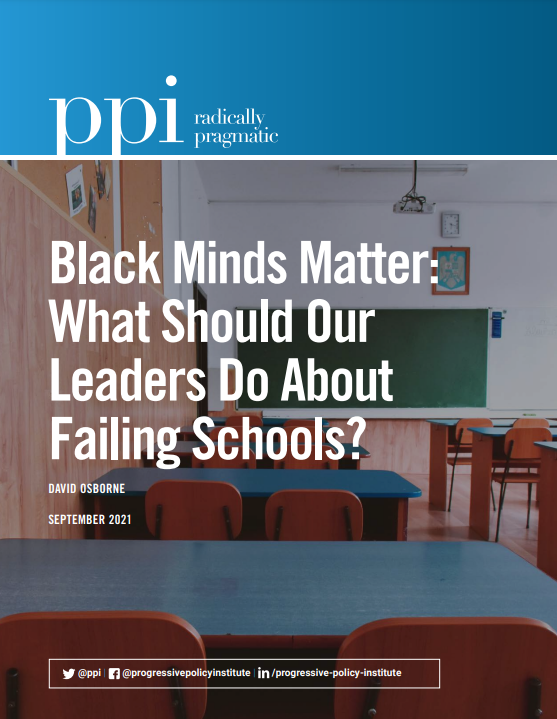
Today, the Progressive Policy Institute’s Reinventing America’s Schools project released a new report titled, “Black Minds Matter: What Should Our Leaders Do About Failing Schools?”  The report is authored by David Osborne, Director Emeritus of the Reinventing America’s Schools project. To sum up its argument:

“The task for state policymakers is simple: They must give districts a tool they can use, in the form of legislation to allow innovation zones, and incentives to use that tool. If they ignore this opportunity, they will sentence millions of poor children to inadequate educations that, for most, will result in lifetimes of poverty. That is the true civil rights issue of our time,” said David Osborne in the report.

Millions of children — many of them Black or Brown — languish in low-performing schools, where they are less likely to develop the skills or habits necessary to get into college or the military. Since 1989, 29 states have passed legislation allowing state takeovers of failing school districts, but most have not been very successful.

The report urges state leaders to create “innovation zones,” in which schools have the flexibility they need to improve and are held accountable for student learning. Osborne suggests appointing a zone oversight board that can replace schools and/or administrators if they fail or help them replicate their education models if they succeed. He outlines different innovation school models and provides actionable recommendations for zones and local leaders to support learning for all students.

Read the report:

The Progressive Policy Institute (PPI) is a catalyst for policy innovation and political reform based in Washington, D.C. Its mission is to create radically pragmatic ideas for moving America beyond ideological and partisan deadlock. Learn more about PPI by visiting progressivepolicy.org.

The Reinventing America’s Schools project inspires a 21st century model of public education geared to the knowledge economy. One model, charter schools, are showing the way by providing autonomy for schools, accountability for results, and parental choice among schools tailored to the diverse learning styles of children. The project is co-led by Curtis Valentine and Tressa Pankovits.

Follow the Progressive Policy Institute.

Follow the Reinventing America’s Schools Project.

###

Battleground Poll Highlights Reconciliation Challenges

As House Democrats start work today on a massive, $3.5 trillion reconciliation bill, a new Expedition Strategies poll offers timely insights into how a pivotal group of voters view President Biden’s ambitious “Build Back Better” agenda.

The findings suggest Biden and Congressional Democrats should focus public attention on the broad economic benefits of the reconciliation bill rather than social equity and be flexible about the ultimate size and cost of the spending package.

Commissioned by the Progressive Policy Institute, the poll surveyed voters in 44 battleground House Districts and eight states likely to have competitive Senate races in next year’s midterm elections. “What happens in these critical swing districts and states will determine whether Democrats can enlarge their slender House and Senate majorities or yield control to the Republicans,” said PPI President Will Marshall.

“There’s encouraging news for President Biden and the Democrats here, but also grounds for proceeding cautiously on the reconciliation spending package,” he added. “Battleground voters are worried about piling up debt on young working families.”

This report, the first of a series based on this extensive poll’s findings, can be found here. Here are some key takeaways:


  • Battleground voters overwhelmingly (73-27) support the president’s bipartisan infrastructure bill. Even more (83-17) approve of his determination to work with Republicans to get it done, and 85% say it’s a “major investment” in strengthening the U.S. economy.
  • These voters also favor Biden’s proposed “human infrastructure” or social investment package, but by a much narrower margin, 54-46.
  • In general, these voters respond more favorably to arguments that the package will create jobs and economic opportunity and reward work than to arguments that it’s necessary to reduce economic inequality.”

Battleground district and state voters rank deficits and debt as their second highest economic concern. By 88-12, they say the national debt is a “serious problem.”

  • These voters favor paying for these initiatives with a mix of tax hikes and public borrowing rather than just adding them to the deficit. By a solid 57-43 margin, they favor increasing taxes on the wealthy and corporations to pay for new public investments. Two-thirds of voters believe inherited income should be taxed at the same or higher rate than earned income.
  • Republican supply side nostrums may be losing their potency. A variety of Democratic arguments that offer an activist economic alternative are more appealing to these voters than the traditional Republican mantra of cutting taxes and regulation.
  • However, Democrats should be wary of claims that these voters will reward “bold” action on spending. When asked if the federal government should make investments but be careful about how much spending and the national debt increases or make bold and significant new investments and address the impact on the debt later, 63% say to be careful while just 20% say be bold and worry about the debt later.
  • In a warning to Democrats, three-in-four (73%) voters say they are concerned that “Democrats in Congress want to spend too much money without paying for it.” In addition, 74% said they are worried that these bills may lead to inflation. 


The Progressive Policy Institute (PPI) is a catalyst for policy innovation and political reform based in Washington, D.C. Its mission is to create radically pragmatic ideas for moving America beyond ideological and partisan deadlock. Learn more about PPI by visiting progressivepolicy.org.

Follow the Progressive Policy Institute.

###

Media Contact: Aaron White – awhite@ppionline.org

Goodman for Regulatory Review: Modernizing SNAP After the Pandemic

By Veronica Goodman

The pandemic has served as a metaphorical earthquake that has stress tested the United States’ social safety net, especially federal anti-hunger programs.

Some of the most startling and grim images from the beginning of the COVID-19 pandemic were the miles-long lines outside of food banks as the economic toll of the crisis began to spread across the country. As schools closed down and businesses were shuttered, unemployment rates spiked to levels even higher than those during the Great Recession­—and many families who had never struggled to put food on the table found themselves in desperate need of help.

In August, the U.S. Department of Agriculture announced that the Thrifty Food Plan, which is used to calculate monthly SNAP benefits, will get a long-overdue update to better reflect the cost of a nutritious diet. Yet, millions of eligible households each year do not apply for benefits and research suggests that administrative burdens and barriers to applying for benefits account for those gaps in participation.

Read the full piece in Regulatory Review.

Bledsoe for NYDN: Climate devastation is upon us. Congress must act.

By Paul Bledsoe

Last week, on the 16th anniversary of Hurricane Katrina, Hurricane Ida unleashed 150 mile-an-hour winds and slammed into New Orleans, super-fueled to huge size and rain-making power by the Gulf of Mexico whose temperatures are 3 to 5 degrees higher than the average just 30 years ago. In its wake, more than a million people in Louisiana and neighboring states have been left without water, power or air conditioning amid stifling hundred-degree heat. Then the remnants of Hurricane Ida delivered torrential rain and flooding in Pennsylvania, New Jersey and New York so intense it killed at least 40 people across the region while paralyzing New York City. Even before the Northeast flooding, economic costs from Ida were estimated to be $80 billion.

Meanwhile, on the other side of the country, another devastating year of fire fueled by climate change-exacerbated drought and high temperatures keeps getting worse. The massive Caldor fire, already more than 200,000 acres, has been roaring through the Lake Tahoe area, sending tens of thousands of citizens fleeing in chaos. Caldor was only the second fire in history to begin on the western slope of the Sierra Nevada mountains and cross to the eastern side. Last year alone, five of the ten largest fires in California history occurred, burning over 4.2 million acres, killing 30 people, and shockingly becoming the new normal.

Read the full piece in New York Daily News.

Ritz for Forbes: Trustees Report Spells Trouble For Bernie’s Misguided Medicare Expansion

By Ben Ritz

When Congressional Democrats began the legislative process to enact President Biden’s Build Back Better agenda last month, Sen. Bernie Sanders insisted on adding a costly expansion of Medicare benefits to the bill. But a new report from the program’s trustees makes clear that this expansion would be unwise: Medicare is already expensive and growing faster than the revenues needed to finance it, resulting in unsustainable deficits. Before Washington considers adding benefits that would further increase costs, it must find a way to pay for the promises it’s already made. Otherwise, critical public investments in young Americans and working families in greater need could be crowded out.

Read the full piece in Forbes.

The State of Broadband Funding

PPI has long advocated robust federal support for broadband expansion. The infrastructure bill passed by the Senate provides that essential support. More than $42 billion would go to the states to fund broadband network deployments. Another $14 billion would fund a broadband subsidy program for low-income Americans. And almost $3 billion would go for digital inclusion.

Added to previous money already appropriated for broadband expansion and support since the pandemic started, this funding will take the United States a long way toward closing the digital divide, both in rural and urban areas. True, we could quibble with some of the details of how the money is distributed.  Nevertheless, the bipartisan Senate bill would accomplish important progress on broadband.

From this perspective, there isn’t any need to address broadband again in the upcoming reconciliation process. Over the past year and a half, billions of dollars has been appropriated for broadband expansion and support, even before the infrastructure bill. The states also have a huge amount of funding from the American Rescue Plan to use for broadband if they want.

As documented in the our June 2021 report, “A Radically Pragmatic Agenda to Connect Rural America,” history shows how easy it can be for federal spending to be misspent in ways that do not contribute to closing the digital divide. We don’t want to repeat history. The key now is to focus on successful implementation of the resources in the infrastructure bill and already in the pipeline — that’s the way to get the biggest broadband bang for the buck.

TALK POLICY: Administrative Burdens with Pamela Herd and Don Moynihan

Read the full transcript of this episode here.

On the latest segment of Talk Policy, Director of Social Policy Veronica Goodman sits down with Georgetown University McCourt School of Public Policy professors Pamela Herd and Don Moynihan, whose research focuses on public policy and improving social program design, performance, and outcomes. They discuss how administrative burdens prevent those in need from receiving critical welfare benefits and what effect the pandemic has had on these systems.

What changes need to be made? What needs to be done to remove the red tape and simplify these processes? How can policymakers make a positive difference? Listen to find out!

Read Pamela Herd and Don Moynihan’s book, “Administrative Burden” here.

Learn more about the Progressive Policy Institute here.

McDermott for The Hill: Why a permanent child tax credit expansion costs so much — and how to make it cheaper

This piece was first published in The Hill.

As part of the American Rescue Plan (ARP) they passed in March, Democrats increased the maximum child tax credit (CTC) parents can claim in 2021 for each of their children under 18 years old to $3,000, or $3,600 for each child under age six, and made the full value of the credit available to families with no income for the first time ever. The expansion lifted three million children out of poverty in its first month alone, which will improve their educational, health and economic outcomes throughout their lives if the policy is continued.

Democrats have made extending this policy a centerpiece of their $3.5 trillion Build Back Better agenda. But despite its success, Democrats are only proposing to extend the expanded CTC through 2025 at the latest because the annual cost of continuing the current expansion will roughly double after related policies from the GOP’s 2017 tax law expire. Fortunately, they can resolve this problem making those related policies permanent.

The GOP tax law temporarily doubled the maximum CTC to $2,000 and made more high-income parents eligible for the credit as part of a broader effort to consolidate family tax benefits. Previously, parents could claim a CTC worth up to $1,000 for each of their children, and all households could reduce their taxable income by $4,050 for each “personal exemption” they claimed for themselves and their dependents.

Taxpayers could also choose to either deduct the cost of specific expenses from their taxable income or claim a “standard deduction” that was the same for everyone. The GOP tax law temporarily repealed personal exemptions but increased the CTC (which replaced exemptions for children), doubled the standard deduction (which replaced exemptions for taxpayers themselves) and created a $500 non-refundable credit for non-child dependents.

To keep their bill from adding to the deficit after 10 years, which would have prohibited them from passing it via the filibuster-proof “reconciliation” process, Republicans scheduled these, and many of their bill’s other provisions, to expire after 2025. Those expirations are what would make a formal score of the cost of the Democrats’ CTC expansion spike after that year.

The official scorekeepers at the Joint Committee on Taxation and Congressional Budget Office score the fiscal impact of all proposals over a 10-year window relative to their “current law baseline,” or the levels of spending and revenues that would occur if Congress did not pass any new laws. Since the GOP tax law scheduled the CTC to shrink after 2025, the gap between the Democrats’ proposed spending levels and current law would grow. The expiration would add roughly $530 billion to the expansion’s 10-fiscal year cost. Should the Democrats’ expanded CTC be made permanent, families in 2026 would be eligible for both the enlarged CTC and the larger per-child exemption that existed in 2017, meaning the tax benefit per child would be even greater than it is today.

Rather than create an unintended bonus benefit that raises the CTC expansion’s cost, Democrats should simply make the changes to personal exemptions and the standard deduction permanent. Based on figures from the Tax Foundation, PPI estimates that permanently repealing personal exemptions while retaining the increased standard deduction and credit for dependents not eligible for the CTC would reduce the net cost of the Democrats’ CTC expansion by more than $100 billion each year after 2025.

As a result, Democrats may need only about $800 billion in additional offsets over the 10-year window to make the current CTC permanent (and even less if they are willing to consider a slightly smaller expansion). Although this figure could be a slight underestimate, since the Office of Management and Budget projects the CTC expansion would cost roughly 10 percent more than Tax Foundation does, the cost of this package is still likely to be only around half the $1.6 trillion cost of making the expanded CTC permanent on its own.

Making these reforms permanent would not only help pay for the CTC expansion but also give Democrats ownership of one of the few progressive components of the GOP’s tax law. The CTC expansion is more progressive than exemptions for dependents because credits directly reduce a taxpayer’s final liability, while exemptions lower their taxable income, which gives a bigger benefit to those in high tax brackets than those in low brackets. Meanwhile, the increased standard deduction only benefits households that do not itemize their deductions, which are disproportionately low- and middle-income households. Making this progressive benefit consolidation permanent now would prevent Republicans from using the continuation of middle-class tax cuts as a vehicle to enact more tax cuts for the rich in 2025.

Democrats do not want their most consequential anti-poverty policy in a generation to expire less than four years from now. When polls show that a majority of voters support the current CTC expansion but are skeptical of continuing it post-pandemic, lawmakers cannot necessarily count on their successors to keep a temporary extension from expiring. Rather than jeopardizing these important benefits to circumvent budget scoring rules, Democrats should protect their policy achievement and help pay for it by extending other family tax provisions in place today along with it.

Brendan McDermott is a fiscal policy analyst at the Progressive Policy Institute’s Center for Funding America’s Future.


Black Minds Matter: What Should Our Leaders Do About Failing Schools?

INTRODUCTION

For much of the last two decades, beginning with the passage of No Child Left Behind (NCLB) in 2002, our top political leaders have shown concern about children stuck in failing public schools. NCLB required districts to do something — not enough, but something — about those schools. Presidents George W. Bush and Obama both called education “the civil rights issue of our time.” And President Barrack Obama’s Race to the Top and School Improvement Grants created incentives for states and districts to act.

Some states went further than others. New Jersey and Massachusetts took over entire school districts. Louisiana created a Recovery School District (RSD) to take failing schools from their districts and hand them to charter operators. Indiana passed a law allowing the state Department of Education to do the same. Tennessee, Michigan, North Carolina, and Nevada emulated Louisiana’s RSD, to one degree or another.

Predictably, the bureaucracy fought back. School boards, district administrators, and teachers unions all objected. Adult jobs were at risk, after all, and adults vote, while children don’t. In 2015 Congress backed down, replacing NCLB with the Every Student Succeeds Act (ESSA), which, despite its name, significantly reduced the pressure on districts to do anything meaningful about failing schools. As the teachers unions ramped up their pressure, Michigan killed off its takeover district, Georgia’s governor tried to create a takeover district but was defeated at the polls, Nevada killed off its Achievement School District, and North Carolina’s Innovative School District took over just one school. Just recently, the Indiana legislature repealed its legislation authorizing the state to take over failing schools.

Yet millions of children still languish in low-performing schools, where they are less likely to develop the skills or habits necessary to get into college or the military or succeed in anything but low-paying jobs. Most of them are from low-income families, many of them Black or Brown.

This should be a national scandal. In the era of Black Lives Matter, it should be the civil rights issue of the day. But with the glare of publicity focused on other, equally appalling problems — on police officers who kill unarmed Blacks and legislatures that restrict voting rights — it is not. That’s a tragedy, because Black minds matter, too.

If you are a governor, legislator, education commissioner, or district leader who wants to help low-income and minority children get a decent education, what can you do? We still have far too many schools that fail their students year after year. Is increased “support” of the kind suggested by ESSA enough to generate significantly better outcomes? Not often, according to the research data.

Takeover districts with wholesale replacement of existing schools can work, but the political backlash they unleash makes elected leaders leery of them. In their absence, state leaders should do two things. First, make it painful for districts to let their worst schools stagnate, by closing them, handing them to nonprofit operators, or appointing a new school board. Experience shows that district leaders will scramble to avoid such outcomes. Second, give districts an attractive path to turn those schools around by encouraging them to create “innovation zones,” in which schools have the flexibility they need to change, and ensuring that those schools are accountable for performance by appointing a zone oversight board that can replace them if they fail or help them replicate if they succeed. The zone board’s job would be to do whatever it takes to turn the schools around: bring in new principals, replace staff — replace everyone at the school, if needed — even bring in a proven outside operator, such as a charter management organization, to run the school. States should encourage this with a carrot: roughly $1,000 extra per pupil, per year, for zone schools, for the first three-to-five years.

An independent, appointed zone board, organized as a not-for-profit 501(c)3 organization, would ensure that when schools continue to struggle, something is done about it. Typically, when this happens, boards replace principals. If failure continues for several years, they should have the authority to replace entire schools. Elected school boards have proven reluctant to replace schools, for fear of the blowback. Turnout at school board elections is often under 10%, which means a few hundred angry voters can defeat a board member. And nothing creates angry voters quite like closing and replacing a familiar neighborhood school, even if it’s doing a poor job.

We have learned, over the past three decades, that with few exceptions, real change will not occur unless it is driven by local leaders. Innovation zones are locally owned: They require approval by the elected school board, their members are usually prominent local civic, community, and philanthropic leaders, and some of the schools remain in the hands of local principals. The zones give local leaders a workable structure, and the carrot and stick give them an incentive to act. Such zones are succeeding in cities as diverse as Springfield, Massachusetts, South Bend, Indiana, Los Angeles, and several Texas cities: Waco, Ft. Worth, and Lubbock. Other places are even using them to help a group of decent schools go from good to great.

Creating effective innovation zones is not necessarily easy. But after decades of trying different strategies to help children trapped in failing schools, it appears to be our best bet.


WHAT HAS NOT WORKED

Between 1989 and 1995, New Jersey pioneered a new strategy to deal with districts full of failing schools: state takeover of school districts in Jersey City, Paterson and Newark. Since 1989, 29 states have passed legislation allowing such takeovers, and at least 22 have tried it. Most have not been very successful. Only in cases where those appointed by the state have a clear improvement strategy and the political power to impose it has takeover yielded significant improvement.

Massachusetts had some success when it helped Boston University take over Chelsea’s school system in the late 1980s. Almost 25 years later, the state took over the Lawrence schools and also produced significant improvement. In contrast, New Jersey’s takeover districts languished for decades. Only when the state embraced rapid expansion of charter schools as its strategy in Newark did that district begin to turn around. New Jersey then pursued the same strategy in Camden, with equally significant results.

But most takeovers come with no coherent strategy and achieve little. Legislators in both parties are pushing to repeal Ohio’s takeover law, and in most states, the current political climate makes takeover a non-starter.

In 2003, Louisiana pioneered another approach. Its legislature created the Recovery School District (RSD), a statewide school district to take over failing schools and hand them to charter operators. After Hurricane Katrina in 2005, it voted to place more than 100 New Orleans public schools — all those performing below the state average — in the RSD. As I documented in Reinventing America’s Schools, this strategy produced the most rapid improvement of any city in the nation.

Governors and legislators in other states took note, and soon there were bills to emulate the RSD in a handful of other states. In Michigan, the governor created the Educational Achievement Authority in 2011, but he could never persuade the legislature to authorize it or fund it properly, so it remained small and unsuccessful, until the legislature killed it. Virginia passed a bill creating an Opportunity Education Institute in 2013, but the courts ruled it unconstitutional, “because it was created by the general assembly rather than by the state board of education, and because it superseded local district control,” as one analyst summed it up. Nevada passed an Achievement School District in 2015, but it was underfunded and the Democrats abolished it as soon as they took control of the legislature in 2019. North Carolina passed a similar bill in 2016 but limited the new district to five schools, and by 2021 it had taken charge of only one school, amid considerable pushback from districts. Georgia Governor Nathan Deal proposed an “Opportunity School District” and secured a two-thirds vote in the legislature to put it on the ballot as a constitutional amendment in 2016. But after an expensive campaign against it by the teachers unions, 60% of voters opposed it.

The one robust effort to emulate the RSD occurred in Tennessee. In 2010, Tennessee’s legislature created an Achievement School District (ASD), to take over the state’s worst schools. The bill also allowed districts to create innovation zones for low-performing schools and grant them significant flexibilities. Because this strategy showed such promise in its early years, it is worth examining its experience in some detail.


TENNESSEE’S ACHIEVEMENT SCHOOL DISTRICT AND INNOVATION ZONES

Tennessee’s strategy was particularly aggressive in Memphis. By 2016 the ASD had taken over 29 of Memphis’s more than 150 district-operated schools. The ASD turned 23 of these schools over to charter operators, recruited from all over the country, and ran six itself. Unlike Memphis’s other charters, ASD charters were neighborhood schools, not schools of choice. Their students were among the poorest in the district, both in terms of finances and academic performance.

Meanwhile Shelby County Schools (SCS), Memphis’ school district, had moved 21 schools into an Innovation Zone, on its own initiative. In its “iZone”, as it quickly became known, the district lengthened the school day by an hour, using federal School Improvement Grant funds to pay for it. After that money ran out before the 2015-16 school year, the district turned to grants, donations, and its regular budget.

District leaders recruited their best principals to take over iZone schools and gave them the authority to hire staff, and those principals recruited the best teachers they knew. Teachers could earn bonuses based on student performance, and their schools provided intensive support and coaching. Principals were not constrained by union contracts, because Tennessee teachers no longer had collective bargaining rights. All teachers had to re-apply for their jobs once their school entered the iZone, a reality that led to hundreds of layoffs. But once a teacher was rehired and had tenure, firing was still difficult.

There were other limits on autonomy: iZone schools had only about half the autonomy a charter school enjoyed. Principals didn’t control most of their budgets, for instance, and they could choose their own curricula and assessments only if their first-year test scores were above a certain threshold.

But both the ASD and the iZone thrived in their first three years. ASD schools struggled during their first year with high student turnover and discipline issues, but later improved. Tennessee uses a Value-Added Assessment System (TVAAS) to measure student growth, which factors in students’ socioeconomic status. It rates schools on a scale of one (slowest growth) to five (fastest). In 2015, second- and third-year ASD schools averaged level five, while first-year schools averaged level one.

Innovation Zone schools showed faster academic growth than the ASD for their first two years, but in 2014-15 the ASD outpaced them. By 2016, seven iZone schools had improved enough to jump off the “priority list” — the bottom 5% of schools in the state, by performance. Unfortunately, those results came at the expense of district schools that lost talented principals and teachers to the iZone. Predictably, they showed declining performance.

Still, the combination of the iZone and the ASD gave Memphis a more aggressive strategy to deal with its worst public schools than almost any other city. Of the 69 priority schools identified in Memphis in 2012, by 2016 only a handful had escaped some intervention: 28 had been taken over by the ASD, 21 had been moved into the iZone, and 13 had either been closed or consolidated with other schools.

But taking over schools and closing schools generates fierce political resistance, and Memphis was no exception. As a result, according to Chris Barbic, the ASD’s first superintendent, by 2015 Governor Bill Haslem had retreated from his initial support for such aggressive strategies. Disappointed, state Education Commissioner Kevin Huffman departed, and his successor, Candice McQueen, was more intent on mollifying superintendents and principals than taking over schools. Reading the tea leaves, Barbic left the ASD in early 2016. The commissioner never allowed Barbic’s replacement to follow through on ASD plans to spin off its direct-run schools into a new charter management organization, nor to replace struggling ASD schools with stronger operators. Nor did the state place any more failing schools in the ASD. Its performance stagnated — some ASD schools excelled, others lagged far behind. Within a few years, many in the state considered it a failure.

Read the full report.


TALK POLICY: Administrative Burdens with Pamela Herd and Don Moynihan [Transcript]


Talk Policy with PPI is a podcast series of discussions with leading policy experts and policymakers on relevant topics in the news. For this latest episode of Talk Policy, PPI’s Director of Social Policy Veronica Goodman sat down with Professors Pamela Herd and Don Moynihan of Georgetown University’s McCourt School of Public Policy. They are the authors of the book, “Administrative Burden,” and their research focuses on public policy and improving social program design, performance, and outcomes. They discuss how administrative burdens prevent those in need from receiving critical welfare benefits and what effect the pandemic has had on these systems. What changes need to be made? What needs to be done to remove the red tape and simplify these processes? How can policymakers make a positive difference?

The full podcast is available here and below as a transcript. Purchase Pamela Herd and Don Moynihan’s book, “Administrative Burden” here. Other episodes of Talk Policy can be found here.


Radically Pragmatic, a PPI Podcast
TALK POLICY: Administrative Burdens with Pamela Herd and Don Moynihan

Progressive Policy Institute (0:10)
You’re listening to Radically Pragmatic, a podcast from the Progressive Policy Institute. We talk with lawmakers, policy experts and thought leaders about the issues driving the news nationally and internationally. The Progressive Policy Institute is a catalyst for policy innovation and political reform with offices in Washington, D.C., and Brussels. Its mission is to create radically pragmatic ideas for moving America beyond ideological and partisan deadlock. We encourage analytical conversations, not your typical partisan talking points.

Veronica Goodman (0:44)
Hi there and welcome to Radically Pragmatic, a PPI podcast. My name is Veronica Goodman, and I’m PPI’s Director of Social Policy. For this segment of Talk Policy, I sat down and talked with Pamela Herd and Don Moynihan, professors at Georgetown University’s McCourt School of Public Policy. They’re the authors of the book “Administrative Burden,” and their research focuses on public policy and improving social program design performance and outcomes. Be sure to subscribe wherever you listen and enjoy the episode.

Veronica Goodman (1:23)
Hi, I’m Veronica Goodman, Director of Social Policy at the Progressive Policy Institute. I first want to thank professors Pamela Herd and Don Moynihan of Georgetown University, here with us today to discuss administrative burden and public policy. And we’ll take some time to discuss exactly what that means and why it’s important. They’re the authors of the book on this topic, appropriately named “Administrative Burden,” which I can’t recommend enough for policymakers and experts or anyone interested in improving public policy. And then in your book, you cover different case studies to show how these administrative burdens can manifest differently depending on the situation and circumstances from the ways that families access food, through the Supplemental Nutrition Assistance Programs, to the way that people vote. And so I think there’s a really exciting conversation that’s been taking place during the pandemic and as the Biden Administration, with Democrats in Congress, have been hard at work, providing relief and you know, trying to shore up economic recovery. And really how we build back the safety net better from all of the social spending programs of the American families and jobs plan. So things like food assistance, and income support for families with children, paid family leave. And I think given the nature of the pandemic, we’ve had to rethink how we provide aid to families or how people interact with the government and government programs. So I think that the concept of administrative burdens continues to be extremely relevant to the discussion. And thank you for taking the time to join me today.

Don Moynihan (2:51)
Thank you. So glad to be here.

Pamela Herd (2:53)
Happy to be here.

Veronica Goodman (2:54)
Thank you. And so just to get started, if you could please both just briefly introduce yourselves and your motivation for having written this book. And Pam, maybe you can go first and also explain what we mean when we use the term “administrative burden.”

Pamela Herd (3:08)
Sure, my name is Pam Hurd. I’m a Professor of Public Policy at Georgetown University and the McCourt School of Public Policy. So the the term administrative burden kind of encompasses three kinds of costs, right, like, broadly speaking, it’s the onerous experiences that we might have when we interact with government. So typically, what people think of is like the three hour wait at the Department of Motor Vehicles to get their license. But we mean, this writ large across a range of different government policies. And we think about those costs in three different ways. So the first are kind of learning costs, like figuring out whether or not you’re eligible for a program, whether there’s a program out there that might help you, for example, if you’re struggling to find health insurance, compliance costs are I think, stereotypically, what we think about when we think about administrative burden or red tape, right, it’s the paperwork, it’s the interviews, it’s the effectively the amount of time on in some respect, as part of this in terms of those encounters with government to access benefits or services. The final category, though, of costs that we think about our psychological costs, and these are the kinds of stresses stigma, and kind of the sense of being overwhelmed, for example, that people experience when they’re trying to access really critical supports or any supports, right, like you get really frustrated at the DMV. But then imagine yourself in a situation where you’re trying to access health insurance for a sick child, and you’re encountering, you know, bureaucratic obstacle after obstacle. And so those kinds of moments are just really scary. I think one quick example right now that we point to that’s probably terrifying for a lot of people is, you know, we’re going to face this, is evictions. And meanwhile, there’s an enormous amount of money just sort of lying around that the federal government allocated so that people wouldn’t be evicted. But actually accessing those resources is turning out to be, you know, really difficult with those processes. So imagine yourself in that situation where you’re trying to not get evicted, and you’re just met with obstacle after obstacle. Those are the kinds of psychological costs that we, you know, we really worry about in terms of their impacts on people.

Don Moynihan (5:31)
And I’ll follow up. So I’m Don Moynihan. I’m the co-author of the book. I’m also a professor at the McCourt School of Public Policy at Georgetown University. And I think another way of thinking about the motivation we had writing the book was trying to fix these different types of communication gaps we’ve observed in the policymaking world. One is between people’s experience of government and maybe the ways in which policymakers talk about it. And so the types of experiences people have, where they can’t get access to something, or they find an administrative process to be complicated and frustrating, we can all relate to those we’ve all had those experiences, but they don’t seem to be often at the forefront of policymakers’ minds. And we think that’s partly because an issue relabeling, there’s also within this policy researcher community, sort of a Babylon effect going on where we might be studying the same sorts of things, but we call them different things. And so economists might call them ordeal mechanisms or public administration. In fact, you might call them red tape or you might not have a particular language to think about them. And the third type of communication gap is that we see the same sorts of administrative burdens occur across lots of different policy areas. And so in our book, we talk, we start with voting, and then we talk about abortion. And then we talk about health policy and social policy and Social Security. So you know, the part of the point is that these might seem idiosyncratic and specific to a particular policy area, but actually do reoccur all the time in lots of different spaces. And by naming and recognizing them, we have a better handle on being able to explain why they occur, whether they’re worthwhile, or what we might do about them.

Veronica Goodman (7:33)
Great, thank you for that. And I guess I’m now sort of having a good understanding of the concept. You lay out in your book, different case studies and why it matters for all of these different areas of policy. But how is it in particular maybe more relevant, even in the pandemic, to the way that some of these programs function?

Pamela Herd (7:53)
Yeah, I mean, the pandemic, in many ways, right, exposed a lot of large failures in the U.S. And it also exposed a bunch of kind of weaknesses or failures within the social welfare system in the U.S. So I do think that what became really obvious during the pandemic, basically, was the extent of these burdens and social welfare policies, right. So the big one that people point to is unemployment insurance, right. And so at the beginning, we saw this sort of huge surge in applications, we saw state agencies completely overwhelmed and unable to process those applications. And I think in the beginning, people just sort of thought, well, it’s just this like, once in 100 year event, like of course they weren’t going to be able to manage this. But once it kind of dug beneath the surface, what we saw was, well, that’s certainly not insignificant, but a lot of what was going on was kind of a fundamentally broken system to begin with. It’s a system basically the unemployment insurance system, it’s really a system that is kind of more effectively designed to prevent fraud than it is to actually provide access to benefits for people who are eligible for them. So I think you know, that being a striking example, but just to get beneath the surface even further, a little bit, I think one of the the second things basically, that the pandemic exposed on is not just the generic failure, for example of the UI system. But I think what it showed is that, you know, UI didn’t hold up well, other programs did it. Right. So I think we saw SNAP, for example, food stamps hold up pretty well, administratively, during the pandemic, Medicaid held up pretty well. What was the difference? Right, why did one collapse, but programs like Medicaid and SNAP held up much more effectively? Part of the answer to that, in terms of those burdens, is the degree of federal control over programs. So this is pretty much systematically true where the federal government has a ton of control. Over these programs, they typically have somewhat less burden than when that control is largely devolved to the state. And there’s a bunch of other examples I could give you. But I think that’s a couple of things to really point out from the pandemic, at least in terms of design and what we saw kind of happen. You know, I think that the second thing that’s really important to point out from the pandemic, in terms of what we learned, is actually just the learning, meaning that a lot of people don’t actually access these social welfare systems. But we had a moment where all of a sudden, all at once a lot more people were trying to access the system, and actually realized what it was like to interact with it. And I think that was really jarring for a lot of people and kind of an eye opening moment, in terms of thinking that, yeah, you know, what, we kind of need to work on this, like, this isn’t a well functioning system. And these burdens are unnecessary, they’re onerous. And they really undermine the fundamental goals of these programs, right? If the goal of the unemployment insurance system is to protect people during spells of unemployment, but people can’t access those benefits, the program doesn’t work. It doesn’t matter how large the benefits are, it doesn’t matter how many people we say should be eligible to them. For them, if people aren’t actually getting them, the program doesn’t work. And I think it was a bit eye opening for some policymakers, some activists, and even policy researchers, I think, to kind of take a closer look at this issue.

Don Moynihan (11:39)
Yeah, I think one of the big lessons for folks is that policy design and implementation really matters. And so you know, if you’re an advocate, and your goal is to get a piece of legislation passed, the one thing you learn in the last couple of years is that there might be no guarantee that the money that might flow from that legislation gets into the pockets of people that need it. And sometimes those processes of policy implementation are designed not to work, right. And, you know, we have these sort of remarkable moments during the pandemic, where the Governor of Florida Ron DeSantis, was talking about pointless roadblocks that his Republican predecessor had put in place for unemployment insurance is almost unthinkable. And I think we also saw moments where people could see these really big differences between programs that seem to work and seem to not work. So Pam mentioned rental assistance, which has just been stymied by sort of multiple layers of government that are involved in delivering that complex processes. But on the flip side of that, if you think about the stimulus checks that were mailed out, that was a burden free experience for the vast majority of people, you know, you essentially had the federal government trying to help people and doing it in that case, in the most straightforward way possible, where they said, we’re gonna have these really simple eligibility rules, you know, how many dependents do you have? What what’s your income? And based on that, we will send you a check. If there’s no big application process, you don’t have to demonstrate how many assets you have. You don’t have to apply for this. And so that was an example I think of when the federal government said, how can we use administrative data to sort of move burden away from individuals and onto the state and make the experience easier. We’re seeing some of that now, with the child tax credit, which I think is another, you know, we might think of this as a pandemic, your program, its expansion to reach a lot more people. But there’s also a contingency on that point that maybe we can talk about more, which is that for something like 86% of people are getting the expanded payments each month without having to do anything, but people who are less connected to the tax system because they haven’t been paying income taxes because their income is so low, they have to negotiate the administrative processes of applying for those benefits. And so they are having a different experience. And so I think that is one other point arise out of this is that a program I worked pretty well for some groups, but then still be experienced as owner as product groups.

Veronica Goodman (14:36)
Agreed. And I’m so glad that you know, you brought up the child tax credit because Pam and I were talking before the podcast about how that’s really a great case study in terms of what happens when administrative burdens are really low and you’re trying to focus on reaching as many people as possible with you know, the ultimate policy goal just being to get help to families who are struggling. And I’m glad that you mentioned SNAP, because it’s a program that I’ve studied in depth. And it’s one of the big case studies in your book. And really in particular, I thought it was great that you looked at the way that the burdens affect different groups disproportionately. So you have the elderly who have some of the lowest take up rates, just given sort of the hoops that they have to jump and the and the way that the administrative burdens are really complex in terms of recertification windows. So, I love that if you could talk a little bit more about that case study and just generally how the administrative burdens of these programs might affect groups and, and perpetuate inequities and outcomes.

Pamela Herd (15:43)
Yeah, the food stamp example is a nice one, actually, in terms of thinking about, you brought up older adults, and we do we have this huge take up issue with older adults in the foods in terms of food stamps, in terms of the you know, in meaning that the fraction of older adults eligible for the program who actually receive it as a relatively low, I believe it’s still hovering around 60%. And so why is that? Well, it really is, it’s a simple calculation, which is burden. And the central issue for older adults, actually, is that the way older adults basically are more likely to qualify for food stamps, because they have extraordinarily high out of pocket health care costs. So low income older adults can spend 20% to 30% of their income on out-of-pocket health care costs. And so that’s how you’re supposed to be able to apply that basically to reduce your income threshold to become eligible for the program. But it’s just an incredibly complicated process that varies by state. And so as a result, a lot of older adults who really are desperate like they’re literally making the trade off between the eating and accessing health care, are not getting these benefits. And so it’s a really nice example of kind of within a program, how we can see disproportionate impacts. Whereas actually, for children and adults, we don’t don’t do quite as badly, we see much higher take up rates probably between 80% and 90%, that you mentioned the child tax credit. And I do want to go back to that as well, though one thing in terms of thinking about disproportionate impact, and that I mean one of the reasons people who studied poverty were so excited about this expansion was because we know deep poverty has accelerated basically over the past 20 years. And so one of the things that child tax credit expansion could do is actually reduce deep poverty. The catch here is that the degree to which that program is burdensome is it’s largely burdensome for that population. So the people who kind of most need that benefit, are also the people who are most likely to struggle actually accessing it. And the Biden Administration is clearly aware of this. They’re working actually, for example, with Code for America right now to kind of do some redesign on their website for people. For people who are not automatically basically getting it in terms of trying to access it, they’re clearly aware of this. Advocates: there’s a lot of advocates out in the field who are doing a lot of work trying to do outreach. But it’s you know, it’s a meaningful problem. And the one thing I would sort of step back, big picture and say, you asked at the beginning, like how did you come to this? Why did you get interested in this, the policy that they kind of started with it, my dissertation was on was actually Social Security, retirement, and social security retirement right. Like it is our most effective social welfare program, in terms of poverty reduction, it is our largest, and it is our most popular, it’s basically the definition of social welfare policies success, it also has basically 100% take up, and it doesn’t have 100% take up, because it’s not complicated. The eligibility, having written a benefit eligibility calculator is a part of my district, the eligibility process is complicated. Like if we actually put that burden on individuals and said, okay, document, your earnings history to qualify for this program. And for us to figure out your benefit size, you’d have like 50% take up in the program at best. It’s simply the way that we designed it. And so when we say params, I think for those of us who focus on poverty, or folks who focus on property, they look at an 80% take up, they look at 90% take up and they say, That’s amazing. We’re doing really well. I do kind of want to shift that lens a little bit and say, no, not amazing. Amazing is 100%. Not even amazing, that’s actually effective. Like that’s what we should expect from these programs, because we know we’re capable of doing that. So that’s the only thing I would add in terms of thinking big picture about how do we really reduce inequality? How do we make it so that it doesn’t disproportionately fall on certain populations? The model is Social Security, basically. And we think about program design and implementation and burden that way. And so then when you get to food stamps, when you get to the child tax credit, that becomes the expectation of what we can do.

Don Moynihan (20:18)
So I think in an ideal world, we would like policymakers to ask themselves the questions of who was missing out from these programs? And why now is that you know, the sort of traditional econ perspective from ordeal mechanisms, the answer would be, well, they don’t deal with the hassles, that means they don’t value the benefits. Whereas I think some of the the arguments we’ve tried to promote is that if people are struggling with the processes, and maybe for a myriad of reasons, including, you know, intense poverty, the experience of scarcity, other life challenges going on, like poor health or being evicted from your house might affect your ability to manage administrative burdens. And then finally, you know, what are policy makers doing about it, right, if you can just sort of look at a program that has 50% take up and not pay attention to the 50% of people are not taking up those benefits, you should be looking at their motivations, their barriers, and our ways to deal with sorts of bottlenecks that they face.

Veronica Goodman (21:29)
So one of our Fellows at PPI is Joel Berg, who’s also the CEO of Hunger Free America, who does hunger advocacy all over the country. And he actually just completed a road trip across the country. And he stopped at certain SNAP offices, where people would go to sort of fill out the applications and try to get aid in person. And he said, for a lot of them, they weren’t open or you know, the hours coincide with people’s work schedules, so they’d be missing a day of work. Or even just once he got the application, it would be over 20 pages, which would be really difficult for somebody to navigate on their own. So one of the one of the things that we look at at PPI is how do we sort of combine the applications for all these programs and make them you know, sort of a one stop shop, there’s legislation on the Hill called the HOPE Act, which would try to make it be one application for all of these programs and see how your eligibility would be right there in the online application so that people would have a very straightforward idea of what they’d be getting, which I hope is sort of the future, but sort of as we’re talking about the child tax credit, and how the conversation has been moving to things being automatic and direct, and an administrator federally, you know, I guess, what do you sort of, do you expect that this will be the new trend? And how programs are designed? Or do you think it will be done in a sort of bipartisan way?

Don Moynihan (22:59)
It should be done in a bipartisan way. I mean, I think there isn’t any deep philosophical reason why conservatives and liberals wouldn’t agree that they want our government to work well, and simply and effectively and respectfully for the citizens that they serve. And, you know, in many respects, some of our critiques embedded in the book could be read about the need for bureaucracies to just constantly monitor their performance, because without that sort of monitoring, they will tend to slide into maybe prioritizing the needs of the bureaucracy over the people that they’re serving. And so the you know, the core idea at the heart book is that human beings deal with these government processes. And so we should think about that when we’re designing and implementing these processes. I think they’re, you know, there’s a much longer conversation to be had about why then these potential coalition’s break down, in particular policy areas. And you know, the shorter version of that conversation that we document in the book is that if, if your party is generally opposed to a particular policy, it’s likely that you’re going to support imposing more burdens and barriers in that policy, or if it serves a constituency or group that you don’t particularly care for, or that don’t come out and vote. But immigrants don’t because they can, right there, you’re more apt to be subject to the negative face of administrative power. But the hope with this project is that simply by exposing how important these administrative burdens are, you could build this sort of general bipartisan consensus that you once The law was passed, and we agree that people are eligible for benefits or that we’re going to serve them, we try to do it in a reasonably competent way that takes into account the actual challenges people have in their lives and treat them as real people.

Pamela Herd (25:15)
On a hopeful note, right, like the you look at the, you look at the food stamp program. And, you know, it was under George W. Bush, when he was president, that they really put a huge effort into reducing barriers and burdens in that program. So, you know, it’s not futile, like there is there is oftentimes actually, I think, some consensus around reducing those burdens there, but politics mattered, you know, and so that will be sort of a part of the part of the picture, too. You know, I think we clearly document throughout the book, I mean, the most obvious place you see this, this, especially around abortion policy, where it’s really different burdens are really driven by politics. We saw some of it during the Trump administration and around programs like Medicare, Medicaid, and food stamps like these, these burdens, because they couldn’t get changes passed in Congress. So there’s some back and forth. But I would actually argue that the overall picture at this point is a bit more hopeful, in terms of the acknowledgement of how much of a problem this is, in most places, and the willingness to try to kind of fix and reduce them.

Don Moynihan (26:27)
Let me add one more point to that, which is that what we’ll talk about in the book is the ways in which burdens grow and become more powerful when they’re kept in the dark. They’re sort of like a fungus. So when they’re kept in the shadows, and people don’t talk about our effects, you’re more likely to become prominent, if you if you flip the script around and think about the way in which people talk about fraud as a concern, and push that to the front of the policy discussions, have hearings in legislature about the potential for fraud point to individual cases that may not be terribly representative, and then make policy on the basis of that. That’s an example of the ways in which values shape our policy and implementation choices. And that’s fine, values should do so. But we should pay attention to the potential trade-offs between one approach versus another. And so if you’re only making policy to limit fraud, you can drive fraud down to zero by building a policy implementation system that’s essentially impossible for anyone to navigate. And what we want is just for policymakers to have those two ideas in mind, if I’m going to do wax, how’s this gonna affect access to this particular program?

Pamela Herd (27:51)
And I do think in terms of the awareness, journalists have been covering this, like nothing I’ve ever seen before. And I think that really matters, you know, in terms of the degree to which they’re putting this out for people who may not encounter burdens in these programs, who are kind of shocked, like if you saw the response to the Annie Lowery piece in The New York Times, I’m sorry, in the Atlantic around the time tax. I mean, when you listen to people’s responses to that, they were like, really surprised, disturbed, we need to do something about this. So to that point about increased visibility has to help. I think that’s true. And I do think that journalism, actually journalists, have been doing a really good job of late really covering it.

Veronica Goodman (28:38)
Yeah, absolutely. And that that was really an excellent piece by Annie Lowery. You know, as you were mentioning, Don has how some of our values guide, sometimes disproportionately the conversation, Pam, I can’t help but think about some of the things you were tweeting lately about the FDA decision around the vaccines for kids. We’re a very captive audience here in our household because we have a five-year-old and a two-year-old, desperately want them to be vaccinated, of course, and so it would be great if you could talk a little bit about how that’s also coming about.

Pamela Herd (29:16)
Do you mean the burdens and…

Veronica Goodman (29:17)
Yeah, the burdens from, yeah, the process of everything.

Pamela Herd (29:21)
So we also have an eight year old who is unvaccinated. I’m deeply sympathetic. Yeah. I mean, actually, the vaccines are really interesting when you think about it in terms of burdens. So we often start to talk about administrative burden by actually saying burdens actually aren’t always bad. So on the one side with vaccines, one thing that we’ve seen are mandates, right, that there’s burden and like I had to at Georgetown, we have a vaccine mandate, so I had to obviously get the vaccine, and then I had to upload my documentation. But that kind of burden arguably is an okay burden. Because what Don was talking about in terms of weighing the costs and benefits of these burdens, I think it’s a really clear case where whatever cost, I’m entailing with that burden is far outweighed by the health benefits, right, of making sure that people are vaccinated. I think that the where we’ve seen burdens as bad with vaccines is Yeah, I think it’s reasonable to say, we know, actually, there are, there are actually a lot more people out there willing and wanting to get vaccinated, but in fact, are impeded by barriers. So some of it is kind of learning. You know, a lot of people are just starting out where the vaccine is free, basically, because nothing in our health care system is free. Or if you go to see the CVS website, for example, to try to get a vaccine, you’re met with a screen that initially just asked you to provide your health insurance probably stops a lot of people right there, right? Because they just don’t get it free. So there’s been some coverage of that. How accessible is it really, so we hear a lot of this. Well, you can get it anywhere. But you know, what, if you work in an unstable employment, where your schedule is constantly changing, where I know, theoretically, you’re supposed to get sick leave. But in practice, we know that actually doesn’t happen. It’s a real cost to you to try to figure out when you can get the vaccine to avoid causing problems with your work schedule. Whereas we’ve seen efforts when people just show up, you know, at low wage workplaces, for example, they get a ton of people vaccinated. So I do think one of the things that we’ve seen with the vaccine rollout is that we were not taking seriously enough the actual burden involved, for particular sub populations, low income populations, immigrant populations, and that’s have real consequences for us in terms of the fraction of people actually vaccinated.

Veronica Goodman (32:04)
Sure, and so I guess, looking forward for both of you, are there any topics you’d like to see more research on in this space, or what you’re hoping to focus on in the future?

Pamela Herd (32:16)
One quick area I mentioned before Don’s time is done is I’m looking for a greater understanding actually, about not just the impact these kinds of burdens have on people’s like access to programs, but their actual mixture, their health, their psychological well being, and their views of government. So one thing that we haven’t really talked about is how these really negative interactions with government actually impact people’s views about what government can do, and then what they’re willing to support in terms of kind of government intervention on the thing that I always point to, right, was that billions of dollars in aid that was hugely beneficial during the pandemic, but for a certain group of people, for not an insignificant group of people. Despite all that money being spent, they were left with really negative feelings, actually, because it was inconsistent, it was hard to access. So those kinds of feedback mechanisms. So I would like to understand a lot better in terms of how it actually affects people’s views of government. How does it affect people’s willingness to support going forward kind of more social welfare policy intervention to do things like reduce poverty and increase access to health insurance?

Don Moynihan (33:31)
Yeah, I think I’d reiterate what Pam said. I think there’s also like a class of research that is much more at the intersection of just practical design and academic research, that I hope to see a lot more of where governments will routinely experiment with a new way of doing things maybe by doing data matching, or by combining forms as you talked about, or by simplifying processes in some way. And even if they don’t run a full randomized control trial, that they do some sort of tracking to get feedback on whether that worked or not. Because some of the times administrative burdens occur in the public sector is simply because we’ve had an administrative process in place to do things a certain way for a long period of time. We become wedded to that. People might understand it’s not perfect, but they don’t have a systematic incentive to examine and improve those processes. So I think there’s a huge opportunity. And I think the Biden Administration is moving in this direction. But to do this for a practical, experimental approach to research where you just systematically and routinely look at potential problems, try something else, get feedback. And if that doesn’t work, try something else again. So I think that’s one type of research, I’m excited to see a lot more of. And then there’s sort of another type of research, which is more to do with sort of structural issues, that you know, why is it harder for some people more than others? Right, you know, issues of like human capital, health, financial resources, race, where you live? I think those are sort of fascinating, deeper issues. Why, as Pam also referred to, why might these processes matter to how you think of yourself as a citizen, as a member of society? Like, what are the sort of policy feedback processes that lead you to come out of a mundane experience, like going to the DMV, and feel happy or unhappy about that, to a more fundamental or important experience, like, you know, trying to get a benefit that’ll affect whether you get stay in your house or not? Right? And do you still see yourself as engaging in sort of a social contract in those processes where government is there to help you? Well, government is, instead, not being particularly useful to you. I think this sort of deepers or questions, then whether the American state can still do big and important things? Whether people see government as a positive force in our lives, and whether they feel like they are a player in this process, as opposed to simply being the subject to this sort of whims of market and governmental powers? So I think that, you know, you have these multiple levels of research opportunities here. It’s very exciting, right? There’s more than anyone can do. As well as like, there’s lots of different policy areas where, as I said at the start of our conversation, pretty much anyone can talk about your experiences of these administrative burdens. And so pretty much in any policy area, there’s also an opportunity to do this type of research.

Veronica Goodman (37:07)
I think that’s a that’s a great note to end on. I’ll add that I saw in the recent memo from the Office of Management and Budget, that they’re making administrative burdens a priority in terms of how they’re thinking about equity, which I think it’s just fantastic. But thank you so much. This has been really interesting. And thank you to both of you for taking the time to discuss your research and your work with me today. I hope folks take the time to read the book “Administrative Burden,” I will link it to the recording for this conversation, and thanks very much. It was a pleasure. Thank you. Thank you.

Progressive Policy Institute (37:42)
Thanks for listening. Want to learn more about the Progressive Policy Institute? Follow us on Twitter, at @PPI and on Facebook, at Progressive Policy Institute, or go to our website, at progressivepolicy.org. Be sure to subscribe wherever you listen and check back for new episodes. We’ll talk with you soon.

[End]