Tech Opportunity for Minorities and Women: A Good News, Bad News Story

Can tech jobs be a source of economic opportunity and upward mobility for an increasingly diverse American population?

Yes—consider two key facts about the labor market recovery, both of which show the potential for tech jobs to empower communities and bring shared prosperity.

First, since the recovery began in 2009, tech has created almost as many jobs for college graduates as healthcare. Tech jobs, here defined as all computer and mathematical occupations across industries, include computer systems analysts, network architects, and statisticians. Over 2009-2014, these tech jobs added about 730,000 college-educated workers. By comparison, healthcare occupations—which include everything from doctors and nurses to lab technicians and therapists—added 787,000 workers with a college degree.

This near parity in tech and healthcare job creation is significant given healthcare has long been regarded as the most dependable force for job creation. A growing and aging U.S. population, alongside rising medical costs, are widely seen as keeping healthcare jobs in high demand.

Second, we find that college-educated blacks and Hispanics have benefited enormously from the tech jobs boom. From 2009 to 2014, blacks with a college degree gained slightly more tech jobs than healthcare jobs—employment rose by 79,000 in computer and mathematical occupations (a 58% increase), compared to 76,000 gain in healthcare occupations (an 18% increase). The number of Hispanics with a bachelor’s degree increased by 104,000 in the healthcare occupations (a 40% increase), not so far ahead of the 81,000 gain in computer and mathematical occupations (an impressive 103% increase).

Indeed, the opportunity tech jobs are creating for non-Asian minorities defies conventional stereotypes. That’s because the tech/info jobs boom is much broader than in Silicon Valley. Tech jobs are increasingly found across all industries and the country. Tech jobs are in finance, education, and government, and urban tech clusters are forming in U.S. cities such as New Orleans, New York, and Denver.

Download “2015.04_Mandel-Carew_Tech-Opportunity-for-Minorities-and-Women_A-Good-News-Bad-News-Story/”


Jobs and Millennials: How are They Faring?

Economists everywhere are scrambling to determine how today’s weak jobs report impacts the strong recovery story of 3.2 million jobs created over the last year. But when it comes to millennials in the labor force, the monthly numbers are only a small part of the story. That’s why I’ve done some number crunching to see what’s really going on with my generation.

My research highlights two factors that are holding millennials back: too many are not completing college, and too many that do have skills that are not well-matched to labor market demands.

When it comes to young workers, aged 25-34, the gap in labor force participation for those with and without a degree is now roughly 10 percentage points – and the gap is widening.* The chart below illustrates this stark reality – having a college degree could make the difference in whether or not millennials find a job.

LaborForceMillennials

However, my research also shows that in today’s labor market, having a college degree may not be enough. That’s because, in addition to completing college, the economic prospects of millennials depends on having high-wage skills employers demand.

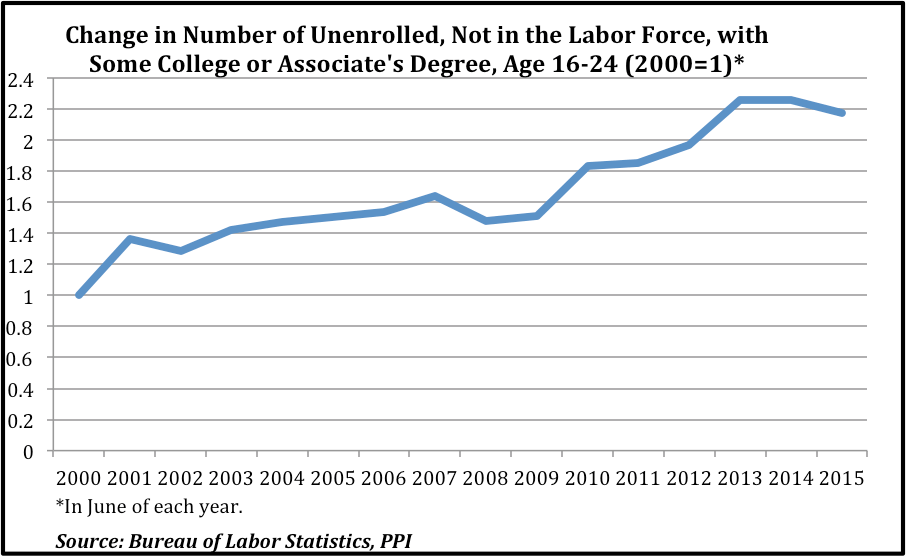
Since the recovery began in 2009, college graduates’ outcomes have diverged. Some have seen great success in the economic recovery, while others have floundered at the expense of their less educated peers. I call this phenomenon the “Great Squeeze,” and I have previously written on it here. That real average annual earnings for young college graduates fell by 12 percent over the last decade reinforces this divergence between workforce success and underemployment.

CollGoneWrong

It turns out that what you study matters, as not all graduates are struggling. Graduates in high-skill, high-demand fields such as computers and mathematical occupations, for example, are doing just fine. The most recent Conference Board data shows the ratio of unemployed workers to advertised jobs for computer and mathematical occupations is just 0.17.

The skills mismatch helps in part to explain why too many college graduates find themselves underemployed well after graduation. Our higher education system has not adjusted to the changing shape of the labor market, one where job creation is focused at the high and low end of the skills spectrum.

That’s why it is not obvious that while some postsecondary credential is necessary, a college degree for everyone is the right fix. Instead, these charts suggest we need to look outside status quo higher education, to encourage more pathways into the workforce that provide young people with the skills employers demand.

*Note: Few in the aged 25-34 cohort are enrolled in school, and both men and women with a high school diploma or some college, no degree had significantly lower labor force participation rates than college graduates.

Rotherham: No Congressional District Left Behind

In an op-ed today for U.S. News & World Report, Andrew Rotherham, cofounder and partner at Bellwether Education Partners, intriguingly argues that the best school reform idea is to fix the gerrymandering of legislative districts:

One of the interesting things about my job is that wealthy people ask me for ideas about how best to use their resources to improve America’s schools. There are plenty of important issues demanding attention: overhauling the sorry state of teacher preparation and teacher policy (I wrote an entire guidebook about that), giving low-income Americans more educational choice and improving educational finance are three obvious ones. But, to the consternation of colleagues in the education world, I don’t first suggest those or other specific education issues. Instead, I urge donors to support efforts to reform congressional redistricting. We won’t be able to genuinely improve our schools (or address a host of other issues) until we create legislative districts based on geography rather than gerrymandering.

Read the op-ed in its entirety at U.S. News & World Report. 

Weinstein: March Madness at Time Magazine

Time Magazine (courtesy of the New America Foundation) recently re-published a new way to rank NCAA tournament winners according to their graduation success rates. According to the Time bracket, some pretty prestigious academic universities fair pretty poorly. Harvard, Georgetown, Texas, Wisconsin, and UCLA all lose in the first round followed by Virginia in round two. Among the top ten institutions on the list, seven had graduation rates for their basketball teams of 100 percent. In each of these cases, the rates for the basketball teams were higher than for the male population as a whole. In addition, the University of Kentucky’s (UK) Men’s Basketball team finished 20th on the list, with a team graduation rate of 89 percent compared to an overall male student graduation rate of 55 percent. That might be odd to some basketball aficionados given the large number of “one and done” players at UK (players who go professional after one year of college ball).

So what explains the discrepancy? Is UK really graduating 89 percent of its players? Is the Time Magazine bracket accurate? The answer for both is no.

It is important to understand that Time are not actually using graduate rates (how many entering students get their degrees) with regards to college basketball players. Rather, they have chosen to utilize the NCAA’s questionable bogus Academic Progress Rate (APR), which does not count many “one and done” players who leave to go onto the pros (NBA or elsewhere)

How does APR work? The system awards one point for each scholarship athlete in good academic standing and one for each one who either stays in school or graduates. So if a team has 10 scholarship players, and one drops out and is not on track to graduate, but all the others keep their grades up and either stay in school or graduate, then the team would earn a very good APR score (18 out of 20 points).

Now, it might seem that with all the early departures, Kentucky’s APR would take a big hit. However, if a scholarship athlete in good academic standing leaves to pursue a professional career, there is an adjustment to the APR so that there is no penalty.

So schools like Kentucky, which in reality graduate very few basketball players, get ranked high on Time’s list, while schools that actually graduate most of its players like the University of Virginia, University of Wisconsin, and Georgetown University look poor in comparison (disclosure, I graduated from Georgetown University in 1985).

Second, the comparison of APR and graduation rates for the male student populations at large is not “apples to apples” because APR does not include all dropouts but a graduation rate does. This makes the bracket pretty worthless in terms of usefulness.

Finally, there is the question of whether or not the APR data provided is even accurate. As recent scandals have underscored (see Syracuse University and the University of North Carolina), some institutions may be using a number of tactics (in violation of NCAA rules) to help student-athletes stay in good academic standing.

Maybe Time and New America should leave the prognosticating to the professional bracketologists.

Paul Weinstein Jr. is a Senior Fellow at PPI and directs the Graduate Program in Public Management at Johns Hopkins University.

U.S. News & World Report: Why Charter Schools Work — Or Don’t

Nothing frosts me more than Diane Ravitch and her friends’ charge that charter schools amount to “corporate reform.” This is such nonsense. The charter movement was launched in the 1990s by public activists and state legislators – most of them Democrats – while business conservatives were busy pushing standards or vouchers.

The critics also love to repeat that charters perform no better than other public schools. This statement may have been true in 2009, if one accepts the critics’ favorite study, from Stanford’s Center for Research on Education Outcomes or CREDO. But a closer look at those results reveals a deeper truth. Where charter authorizers do their jobs, charters vastly outperform traditional public schools, with far less money. Where authorizers fall down on the job, letting failing charters live on just like traditional schools, the average charter performs no better, and sometimes worse.

The original charter idea was to open the public school monopoly to competition from new schools, operated on contract by other organizations: nonprofits, teacher cooperatives, universities, even for-profit businesses. The charter was usually a five-year performance contract, laying out the results expected from the school. Charter authorizers – typically school districts or state boards of education – would reject charter applications from groups that did not appear equipped to succeed, and they would close schools if students did not learn as promised.

Continue reading at U.S. News & World Report.

Press Release: Osborne to Lead PPI Project on Reinventing America’s Schools

For Immediate Release
January 21, 2015

OSBORNE TO LEAD PPI PROJECT ON REINVENTING AMERICA’S SCHOOLS

WASHINGTON, D.C.—David Osborne, co-author of Reinventing Government and other highly regarded books on public sector reform, will direct a new Progressive Policy Institute (PPI) Project on Reinventing America’s Schools. The project will examine K-12 innovation, with a special focus on the emergence of new governance arrangements that allow for more school and teacher autonomy, tailored instruction to diverse student needs, and greater accountability to the public.

“As one of America’s leading experts on public innovation, David is uniquely suited to lead our work on public school reinvention,” said PPI President Will Marshall. “As our political leaders turn their attention to reducing economic inequality, it’s hard to imagine a more urgent priority than closing the achievement gaps in our K-12 system.”

“I am delighted to be working again with PPI, which played a pioneering role in the public school choice and charter school movements,” said Osborne. “We believe that creating a public education system of charter and charter-like schools is the key that will unlock the door to dramatic improvement, as it already has in cities such as New Orleans, Washington, D.C. and Denver. Our hope is that this research will speed the transformation of school districts throughout the country.”

In an op-ed for last Sunday’s Washington Post, Osborne argued that giving teachers more control would improve school performance and help retain quality teachers in the classroom.

Osborne is the author of the forthcoming book, Reinventing America’s Schools: Creating a 21st Century Education System, and the co-author of five books including: The Price of Government: Getting the Results We Need in an Age of Permanent Fiscal Crisis (2004), The Reinventor’s Fieldbook: Tools for Transforming Your Government (2000), Banishing Bureaucracy: The Five Strategies For Reinventing Government (1997), and Laboratories of Democracy (1988). He has also authored numerous articles for the Washington Post, the Atlantic, the New York Times Magazine, Harpers, The New Republic, Governing and other publications.

In 1993, Osborne served as a senior advisor to Vice President Gore, to help run what the Vice President often called his “reinventing government task force,” the National Performance Review. He was the chief author of the September 1993 NPR report, which laid out the Clinton Administration’s reinvention agenda, called by Time “the most readable federal document in memory.”

The Project on Reinventing America’s Schools is made possible by generous support from the Walton Family Foundation and The Eli and Edythe Broad Foundation.

###

Washington Post: To improve schools, let teachers run them

Walk through a typical public school, and you see students, sitting in rows of identical desks, listening to teachers talk. Unless the teacher is particularly inspiring, half of the students are zoning out. This isn’t just a problem for teachers, half of whom leave the profession within their first five years. It’s also a problem for their pupils: Disengaged teenagers do not make the best students.

Now imagine if students were instead encouraged to work on projects they chose: building robots, writing plays, researching why bees are dying off by the millions.

When teachers run their own schools, they often make such changes. “We’re competing against Xbox 360, and over-scheduled days with soccer practices and very dynamic lives,” says Kartal Jaquette, one of 10 teachers who run the Denver Green School. “Are you almost as interesting as a video game? Are you getting almost as much attention as a soccer coach might? Is it as much fun? Because if not, they’re going to tune you out.”

Teachers are in charge of at least 70 public schools in 15 states; most, but not all, are charter schools. Ten more teacher-run schools, including one in Maryland’s Prince George’s County, are in the planning stages. These schools are not only redesigning the learning process to better engage students, they’re improving student performance. On top of that, they’re stemming the high dropout rate among teachers.

Continue reading at the Washington Post.

The Hill: For free community college, completion is key

President Obama’s proposal for free community college is an ambitious effort to address critical gaps in America’s post-secondary education and career training systems. However, it may fall flat before it even gets off the ground, and that’s not just because of its high price tag. It’s because community college success depends not on how many students enroll, but how many complete.

Under President Obama’s proposal, all Americans will have access to two years of free tuition at our nation’s public community colleges. The only requirements are to maintain at least C+ grades and to be making “steady progress” toward a degree. It calls for the federal government to cover three-quarters of the estimated $60 billion cost, with states covering the rest.

Certainly, increasing community college enrollment is a good start for boosting youth employment prospects. Young Americans without a post-secondary degree are not faring well in today’s workforce. My own research shows how they have been gradually pushed down and out of the labor market, in a phenomenon I call the “Great Squeeze.”

Continue reading at The Hill.

Earnings for Young Americans: Which City Tops the List?

For young Americans, Washington, D.C. may have more to offer than government jobs and free museums.  It may also provide more opportunities to get a raise than any other top 10 U.S. city.

According to my analysis of new Census data on young Americans, Washington, D.C. was the only top 10 U.S. city, by population, where young workers saw an increase in real median earnings since 2000 (in addition to having the highest real median earnings overall).  Young workers in every other top 10 U.S. city experienced sizable declines.  More than half – six – of the top 10 cities saw declines greater than 10 percent, with young workers in Miami and Atlanta enduring real declines of more than 15 percent.

The table below shows the 2000-2013 change in real median earnings for young Americans age 18-34 working full-time by major U.S. city, where 2013 is measured as a five-year average over 2009-2013. Data for 2000 comes from the 2000 Census long form, and data for the 2009-2013 five year average comes from the American Community Survey 2009-2013 five-year estimate.

Median Earnings for Young Americans Aged 18-34 in the Ten Most Populated Metro Areas

  2013 Median Earnings         (in 2013$)* 2000-2013 Change           (in 2013$)** 2000-2013 Percent Change** Percent of 18-34 year-olds with a college degree or higher, 2013**
Washington, D.C. 47,380 1,560 3.4% 38.9
Boston 44,548 -2,196 -4.7% 38.9
New York City 42,108 -3,216 -7.1% 33.3
Philadelphia 39,413 -3,582 -8.3% 28.5
Houston 33,674 -4,082 -10.8% 21.0
Los Angeles 33,667 -4,200 -11.1% 23.6
Chicago 38,415 -5,111 -11.7% 30.2
Dallas 33,369 -5,660 -14.5% 22.6
Miami 30,728 -5,683 -15.6% 20.6
Atlanta 34,573 -7,203 -17.2% 25.4
US Average 33,883 -3,472 -9.3% 22.3
*Full-time, year round workers aged 18-34, where 2013 is the average median real earnings over 2009-2013
**Where 2013 is the five-year average over 2009-2013
Source: 2000 Census Long Form, 2009-2013 American Community Survey, PPI

That real median earnings increased in Washington, D.C. while falling elsewhere might help explain why the nation’s capital has become an increasingly popular place to be for young people. The number of 18-34 year-olds living in the D.C. metro area has increased by 19 percent, or 226,000, since 2000, compared to one percent increases in Chicago and New York, and 9 percent nationally. Washington, D.C. also has a high share of employment dependent on the federal government, and a highly educated youth population, both of which may have been less affected by the economic downturn. (Houston, however, was the top city for youth inflows in spite of falling real median earnings, which saw its 18-34 year-old population increase 25 percent since 2000.)

Still, falling real median earnings across the board outside Washington, D.C. suggests the underlying issues affecting young workers is not solely about educational attainment or geography. Other major cities with a higher than average share of young college graduates, such as New York and Chicago, also experienced a decline in real median earnings. This is consistent with my previous research, which shows falling real average earnings for young college graduates at a time when many are questioning the value of a college degree.

Overall, the sharp decline in real median earnings for young workers is troubling. It suggests young Americans continue to face strong financial headwinds during their professionally formative years. Moreover, it could hinder young people’s ability to fully participate in the greater economy long-term. That has significant implications for politicians on both sides of the aisle, especially Democrats who care about creating a more convincing pro-growth agenda.

LA Times: Professor floats idea of three-year B.A. to cut college costs

A report by PPI Senior Fellow Paul Weinstein, Give Our Kids a Break: How Three-Year Degrees Can Cut the Cost of College, is the subject of an LA Times article today.

In his paper, Weinstein found that a four-year degree at a public school costs, on average, $35,572 in 2013. A three-year degree at a similar institution would cost $26,679 — a 25% savings.

Weinstein’s idea isn’t original. Some campuses, including Bates College in Maine and Wesleyan University in Connecticut, have instituted similar programs, but widespread implementation is rare, Weinstein said. In the last five years, 22 private, nonprofit colleges have begun offering three-year degrees, according to the National Assn. of Independent Colleges and Universities.

Read the article in its entirety at LA Times.

RealClearEducation: Cut College Costs: Make 3-Year Degrees the Norm

In an op-ed for RealClearEducation, PPI Senior Fellow Paul Weinstein argues that three-year college degree programs can slash the cost of gaining an undergraduate degree by 25 percent, unlike most higher-education reform ideas that simply expand financial aid and allow colleges to continue to raise prices at will.

“As I recently wrote in a report for the Progressive Policy Institute, the Three-Year Degree policy would require any college or university that has students who receive federal aid to make earning a bachelor’s degree in three years the norm. If combined with a proposal to simplify and streamline the alphabet soup of federal grant programs and tax incentives into a single grant (Simplified Higher Education Grant) worth $3,820, these two reforms could cut the financial burden for graduates by over $20,000 at public institutions (in-state) and by as much as $41,000 at private schools, with no new federal spending.”

Read the entire op-ed on RealClearEducation.

Is the CFPB Committing Regulatory Overreach?

The Consumer Financial Protection Bureau (CFPB) is touted as one of the crowning achievements of the Dodd-Frank Act. But a new CFPB report on student loans is highly flawed, raising doubts about its regulatory reach over the private student-loan market.

The CFPB was created to bring all consumer financial products under one regulatory umbrella. It oversees everything in the financial sector that affects consumers — from credit cards, to mortgages, to auto and student loans. In its short history, the agency has responded so quickly and forcefully to allegations of consumer harm that few have questioned its expanding authority or overlapping jurisdiction with other federal regulators.

Last week, the CFPB issued its third annual report on student loan complaints. The agency first created a platform for student loan complaints in 2012, and embarked on a massive solicitation for general comment on private student loans in 2013. Shortly after, CFPB brought private non-bank loan servicers under its oversight authority.

At first glance, the report paints a picture of student borrowers victimized by unscrupulous private lenders and loan servicers. Complaints regarding loans and loan servicers are up 38 percent year over year, with many complaints indicating private lenders and servicers “provided no options [to modify repayment plans], leading the borrower to default.” Complaints against student loan giant Navient (formerly Sallie Mae) were up a staggering 48 percent, with the entire rise dubiously occurring in the month of December. An unwary reader could easily conclude that the private student-loan market is the heart of the student debt crisis, squeezing hardworking young college graduates of every dollar.

But a closer look reveals the report is fundamentally flawed. Although such a database is valuable for identifying concerns and promoting accountability, it should never be used as stand-alone justification for new regulation or policy. Yet that is exactly what this report does — it is basing policy recommendations simply on a compilation of unsubstantiated complaints.

Worse, the report is misleading in two big ways. First, the report makes the private student-loan market seem entirely to blame for the growing student debt crisis. And second, it offers no analytical evidence that private student lenders are unwilling to work with struggling borrowers.

Continue reading at The Hill.

Washington Examiner: Think Tanks: College graduates struggle in current economy

In a collection of think tank reports on employment for recent college graduates, the Washington Examiner extensively quoted PPI Economist Diana G. Carew’s blog post “Surprising New Data on Young College Graduates.”

Diana Carew for the Progressive Policy Institute: Despite falling unemployment and a recovering labor market, young college graduates continue to struggle in today’s economy.

Analysis of new data reveals the real wages of young college graduates surprisingly fell in 2013, by 1.3 percent. The decline reverses a slight uptick in 2012, and continues along a 10-year trend in which real average earnings for young college graduates have fallen by a sizeable 12 percent since 2003.

Read the rest of the piece on Washington Examiner.

ABC Action News: To cut college costs – cut college

ABC Action News interviewed PPI Senior Fellow Paul Weisntein regarding his recent policy report, Give Our Kids a Break: How Three-Year Degrees Can Cut the Cost of College. By promoting the three-year degree and consolidating all higher ed tax breaks into a single grant, Weinstein argues, policymakers can go a long way in making the college affordability dream a reality all while improving graduation rates and making sure our universities remain the most competitive in the world.

While the a year of college is irreplaceable in terms of frat parties and tailgates, Weinstein said most students are continuing their education in graduate school. Taken alongside a masters or doctorate, a lost year of undergraduate study may be a drop in the bucket.

“We need to acknowledge that when more people feel the need to get a masters or more, this is not the end of school,” Weinstein said.

College costs have soared in large part because states cut funding to their public colleges, which are attended by about half of university students.

Read more at ABC Action News

Surprising New Data on Young College Graduates

Despite falling unemployment and a recovering labor market, young college graduates continue to struggle in today’s economy.

Analysis of new data reveals the real wages of young college graduates surprisingly fell in 2013, by 1.3 percent. The decline reverses a slight uptick in 2012, and continues along a ten-year trend in which real average earnings for young college graduates has fallen by a sizeable 12 percent since 2003. The chart below shows real average annual earnings for college graduates aged 25-34 working full-time with a Bachelor’s degree only.

realearningsfallchart

This troubling trend presents significant political and economic challenges that policymakers can no longer afford to ignore. As consumers and taxpayers in their prime earning years, young college graduates represent one of the most important segments of the working population.

Politically, the continued struggle of well-educated Millennials sends a clear warning to progressives to support a more convincing growth agenda. A pro-growth agenda must be based on investment and innovation, instead of redistribution and more of the same debt-driven consumption of the last decade. Otherwise, young Americans, the vast majority of which voted overwhelmingly for Obama in 2008 and 2012, may change parties or stay home on Election Day.

Economically, falling real wages for young college graduates is resulting from what I call The Great Squeeze. That is, more young college graduates are finding themselves underemployed – taking lower skill jobs for less pay at the expense of their less educated peers. The continuation of this trend, five years after the Great Recession, suggests this problem is more than just temporary. (While this is for BA only, the trend is the same for those with a BA or higher.)

The Great Squeeze is rooted in demand-side and supply-side factors. On the demand-side, the high underemployment plaguing young college graduates is connected back to the slow-growth economy. Our education, tax, and regulatory policies have failed to adapt to the realities of a data-driven world, keeping investment and high-wage job creation on the sidelines. Here simply having a college degree is not enough to guarantee success. In fact, a recent study from the Federal Reserve found that one-quarter of college graduates earned the same amount as those with a high school diploma or GED.

And on the supply-side, colleges are failing to adequately prepare college graduates for the high-skill, high-wage jobs that are being created in fields like data analytics and tech. For example, although far more women were awarded degrees in 2013 than men, most majored in business, health-related disciplines, education, and psychology.* It is hardly surprising that more data and tech employers are turning to alternative training models to meet their workforce needs. Yet in spite of the mismatch, if anything, our federal student aid system is exacerbating the imbalance.

In short, there are two main takeaways here for policymakers: (1) we need better policies in place to encourage employers to invest and create jobs domestically, and (2) young Americans need a postsecondary education system that is better aligned with the shifting nature of the labor force.

*Author’s tabulation of 2013 IPEDS data.

Daily Record: The three-year bachelor’s degree?

In an article on education reform, The Daily Record discussed PPI Senior Fellow Paul Weinstein’s paper on three-year college degrees:

What if the traditional four-year undergraduate degree went away?

What if getting a bachelor’s degree in just three years became the norm?

That’s the proposal put forth by Paul Weinstein, director of the public management program at Johns Hopkins University.

Weinstein suggests that moving to three-year degree programs would solve many of higher education’s ills, namely the soaring cost of a college education and the staggering levels of student loan debt.

The Progressive Policy Institute in Washington recently published Weinstein’s proposal in a paper titled “Give Our Kids a Break: How Three-Year Degrees Can Cut the Cost of College.”

“For generations of Americans, earning a college degree was considered the surest way to achieve the American Dream,” he writes. “But the rising cost of college and the tremendous debt burden it will place on our children is now threatening to derail that track to prosperity. While many policymakers have focused on ways to augment financial aid, the question of how to cut the actual cost of getting a degree has been largely ignored. We can no longer afford to discount that crucial second question.”

Continue reading at The Daily Record.