Two bills introduced in Congress, H.R. 6370 and S. 3508, ‘‘Disaster Protection for Workers’ Credit Act of 2020’’ would impose a moratorium on credit reporting of “adverse information” for the duration of the coronavirus crisis. Credit scores are an integral part of the consumer credit underwriting process as their power to predict the likelihood of borrower default is well-established empirically. Consequently, lenders have come to heavily rely on the integrity and information content of credit scores as a critical measure of a borrower’s creditworthiness.
Economic theory suggests that in the absence of viable mechanisms to effectively distinguish between high and low risk borrowers, lenders will ration credit. Under a credit reporting moratorium, the reliability of credit scores to distinguish between borrower risks would come into question. Lenders would respond to the proposed credit reporting moratorium by raising minimum credit score requirements and/or raising borrowing rates as a credit uncertainty premium to offset the risk they face from the moratorium. During the 2008 financial crisis, lenders raised credit score minimums on FHA loans, for example, beyond those set by the agency as a response to uncertainty over indemnification provisions that posed significant costs to lenders. And today, during the coronavirus, a number of Ginnie Mae originators have raised credit scores to blunt some of the risk they face due to requirements to pass-through mortgage payments to investors, including those in default or subject to forbearance.
Join Paul Weinstein, Jr., Senior Fellow at the Progressive Policy Institute in Washington, D.C., and Joanne Gaskin, Vice President of Scores and Analytics at FICO, for a discussion on the changes FICO has made to its models, and how they may impact credit scores, particularly for millennials and GenZ.
Or listen to the full audio here without a Spotify account:
Join Paul Weinstein, Jr., Senior Fellow at the Progressive Policy Institute in Washington, D.C., and Joanne Gaskin, Vice President of Scores and Analytics at FICO, for a discussion on the changes FICO has made to its models, and how they may impact credit scores, particularly for millennials and GenZ.
Or listen to the full audio here without a Spotify account:
Some are concerned that subprime auto loans – which offer higher interest loans to riskier borrowers – pose a threat to the stability of the global economy in much the same way that the subprime mortgage market contributed to the Great Recession. Democratic presidential candidate Elizabeth Warren, in particular, has raised the warning flags as part of her campaign. But these worries are ill-founded and based on misleading data and faulty analogies.
In particular:
Auto loans account for a relatively small percentage of the increase in nonfinancial debt over the past five years;
Americans are spending less of their budgets on car purchases today, including finance charges, than they were before the recession;
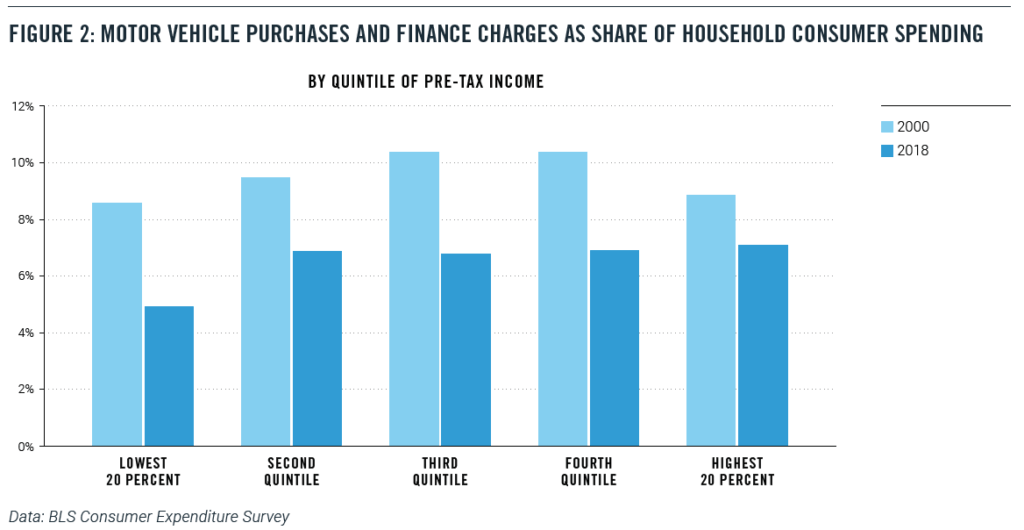
Low-income households saw motor vehicle purchases and finance charges fall from 8.5 percent of household budgets in 2000 to 4.9 percent in 2018;
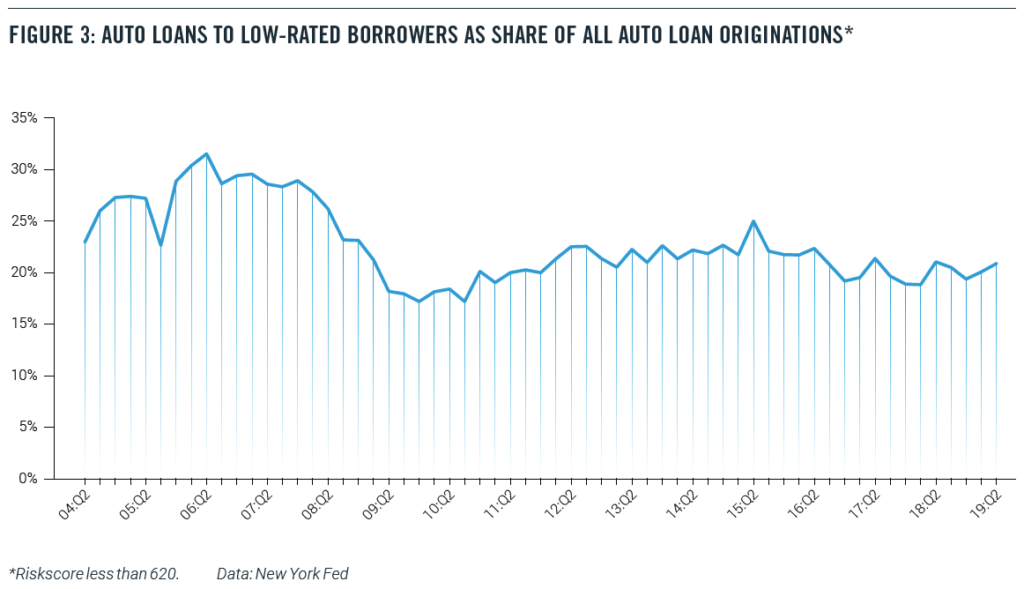
Over the past five years, the share of new auto loans going to low-credit borrowers has remained relatively constant. There are no signs that low-credit borrowers are either being frozen out of the market or becoming too large a share of loans;
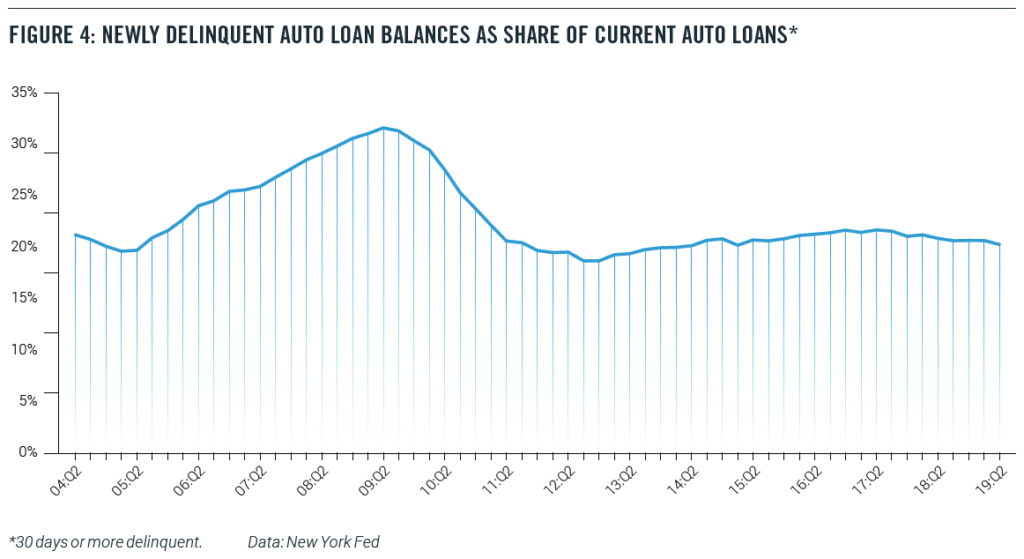
Newly delinquent auto loans, as a percentage of current balances, have been falling over the past two years; and
Subprime auto loans differ significantly from subprime mortgages in key respects that make them less likely to pose a serious threat to financial stability
Risk-based pricing of auto loans appears to be working so far, keeping low-income borrowers in the market without driving up delinquencies or to low-income consumers, while not posing the same risk that the subprime mortgage market.
Introduction
To purchase a vehicle, Americans with low or non-existent credit scores often use auto loans with higher interest rates than loans to prime borrowers. Some market watchers have indicated concern about “subprime” auto-loan trends and the potential for a crisis similar to the subprime mortgage crisis that heralded the last recession.
The subprime mortgages and the related mortgage-backed bonds remain the classic case of a poorly executed financial innovation. The initial impetus behind the idea was a good one. Housing is a key element of middle-class wealth, so expanding the system of mortgage finance to help lower-income households buy homes seemed like a positive. However, the subprime mortgages and bonds were designed in such a way that they assumed rising housing prices. When housing prices started to fall, the subprime mortgage system collapsed and contributed to the financial crisis.
Will subprime auto loans create the same problems? In a recent essay, Democratic presidential candidate Senator Elizabeth Warren raised the warning flag:
Auto loan debt is the highest it has ever been since we started tracking it nearly 20 years ago, and a record 7 million Americans are behind on their auto loans — many of which have similar abusive characteristics as pre-crash subprime mortgages1 .
Warren is not alone in her worries. In late 2016, for example, the Office of the Comptroller of the Currency warned that auto-lending risk was increasing and that banks (and other investors in securitized assets) did not have sufficient risk-management policies in place. Fed Governor Lael Brainard pointed to subprime auto lending as an area of concern in a May 2017 speech, while analysts worried about “deep subprime” auto loans2. Some groups used the term “predatory” auto lending.3
But these concerns are misplaced. As we will show later in this paper, the statistic cited by Senator Warren does not reflect the current state of the auto loan market, as it includes old loans from much weaker economic times. Perhaps most fundamental to understanding the problem with drawing a parallel between the mortgage crisis and today is the fact that subprime mortgages and subprime auto loans are very different products.
Naturally, lower-income households with low credit scores or limited credit history may have fewer financial resources and be inherently riskier borrowers. Moreover, the fact that motor vehicles depreciate over time means that the collateral for the loan becomes less valuable.
Nevertheless, the ability to own a car and, therefore, access credit is crucial for this population. Risk-based pricing charges low- rated borrowers higher interest rates, but in return, offers them the opportunity to borrow money to buy a vehicle that might otherwise be financially inaccessible.
For many lower-income households, their vehicle is the single biggest asset they own.
While vehicles do not appreciate in value as homes do, vehicles are income-producing assets in the sense that they are often essential for commuting to work, especially in non-urban areas. As one report noted, “Owning a car is the price of admission to the economy and society in much of America.”4
In this paper, we analyze the auto loan market, paying particular attention to auto loans made to low-income Americans and to people with bad credit. We find that:
Auto loans account for a relatively small percentage of the increase in nonfinancial debt over the past five years;
Americans are spending less of their budgets on car purchases today, including finance charges, than they were before the recession;
Low-income households saw motor vehicle purchases and finance charges fall from 8.5 percent of household budgets in 2000 to 4.9 percent in 2018;
Over the past five years, the share of new auto loans going to low-credit borrowers has remained relatively constant. There are no signs that low-credit borrowers are either being frozen out of the market or becoming too large a share of loans;
Newly delinquent auto loans, as a percentage of current balances, have been falling over the past two years; and
Subprime auto loans differ significantly from subprime mortgages in key respects that make them less likely to pose a serious threat to financial stability.
Risk-based pricing of auto loans appears to be working so far, keeping low-income borrowers in the market without driving up delinquencies or threatening the financial system. We conclude that the subprime auto loan market is beneficial to low-income consumers, while not posing the same risk that the subprime mortgage market did before the financial crisis. While it will be instructive to observe subprime auto loan trends going forward, current trends do not indicate significant instability concerns in this market.
Recent Patterns in Debt Accumulation
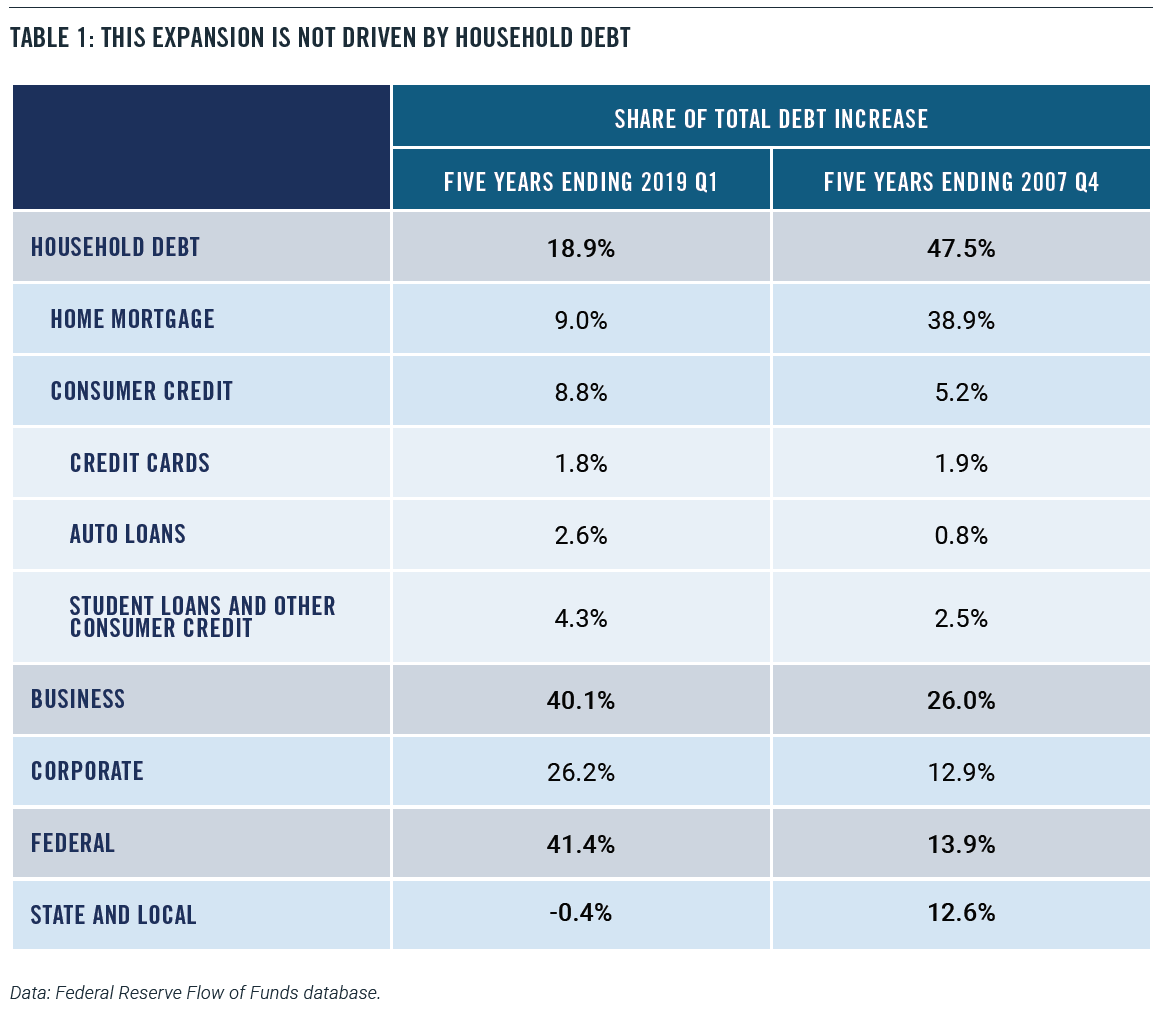
Recent patterns in debt accumulation are very different from those that preceded the financial crisis and Great Recession. Non-mortgage consumer credit – including auto loans, credit cards, and student debt – has risen by $900 billion over the past five years, according to Federal Reserve data. While that figure sounds substantial, that increase amounts to less than 9 percent of the total increase in domestic nonfinancial debt – that is, all debt except borrowing by financial institutions. The rise in consumer borrowing is dwarfed by the increase in business debt ($4.1 trillion) and federal debt ($4.2 trillion) over the same period. Those two categories together account for 82 percent of the increase in domestic nonfinancial debt (Table 1). The leading contributors to business debt growth are mortgages and corporate bonds.
Indeed, businesses have taken the greatest advantage of low-interest rates. Nonfinancial corporations have almost doubled their outstanding corporate bonds since the end of 2007 when the last recession started. Meanwhile, household debt has risen by only 10 percent.
Taking home mortgages into account, households have only accounted for 19 percent of the increase in domestic nonfinancial debt since 2014. By contrast, in the five years leading up to the Great Recession, households accounted for 48 percent of the debt increase. In other words, the financial boom in the pre-recession years was heavily driven by household borrowing, while households have only contributed a small portion to the current debt increase.
A skeptic could argue that, given derivatives and financial engineering, it’s possible for a relatively small portion of the debt market to drive an outsize increase in risk for the whole system. Indeed, that’s what happened ahead of the 2008 financial crisis. In May 2007, then-Chairman of the Federal Reserve Ben Bernanke famously said, “We believe the effect of the troubles in the subprime sector on the broader housing market will be limited, and we do not expect significant spillovers from the subprime market to the rest of the economy or to the financial system.”5 At the time, the value of subprime mortgages was about $1.3 trillion, which was only 10 percent of the mortgage market and an even smaller share of total borrowing. Bernanke and other policymakers figured that the problems in subprime mortgages could be easily contained.
What Bernanke and others failed to reckon with, however, was how the subprime mortgages had been designed to make sense only in a rising real estate market. Subprime mortgages were constructed effectively to subsidize interest rates with the possibility of appreciation. These financial instruments would offer low upfront rates that enabled lower-income borrowers to qualify. When the teaser rates eventually reset to much higher levels, the assumption was that the borrower could refinance into a new mortgage.
Moreover, the subprime mortgages were then securitized and used to build complicated financial derivative products. And when the subprime mortgages failed because of declining home prices, so did the derivatives. In other words, problems in a relatively small financial sector could be amplified and have a much larger effect on the rest of the economy.
Despite this concern, there is evidence to suggest that subprime auto lending is not a substantial risk to the broader economy. Auto loans are only 7.4% of household debt, which is the 40-year historical average.6 Moreover, the auto asset-backed securities (ABS) market is likewise dwarfed by the mortgage-backed securities (MBS) market. As of the second quarter of 2019, there was a mere $264 billion in auto-related securities, which included only $55 billion in subprime auto securities. By comparison, the amount of outstanding mortgage-related securities came to almost $10 trillion.7
Further, subprime auto loans don’t work the same way that subprime mortgage loans did in the pre-crisis era. Cars and trucks depreciate steadily over time, so the value of the collateral diminishes. That means lenders can’t afford to offer teaser rates, or excessive levels of negative equity, to buyers with low credit scores. They must charge higher rates, properly pricing risk. As one article put it, “the very nature of a real estate loan is very different from an auto loan. Real estate is an investment that typically appreciates over time. During the bubble years, consumers and lenders falsely believed appreciation would bail them out from poor judgment. Vehicles, on the other hand, depreciate. There is no false hope of higher values in the future to bail out a borrower or a lender.”8
The Auto Market
Despite the relatively small role that consumer debt is playing in the current debt expansion, some people can’t shake the idea that Americans are over-spending and over-borrowing to maintain a particular lifestyle. Consider this quote from an April 2019 piece from Business Insider:
The fact that America’s top-selling vehicle — a Ford truck with a price starting at nearly $30,000 – and many like it cost nearly half the median household income hasn’t stopped people from buying them and hasn’t stopped lenders from facilitating loans.9
Over the past five years, the price of new motor vehicles has risen by only 1.1 percent, according to estimates by the Bureau of Economic Analysis (BEA).10 By contrast, the overall price level of consumer goods and services have risen by 6.7 percent over the same stretch.11 In other words, the relative price of new motor vehicles has fallen over this period.
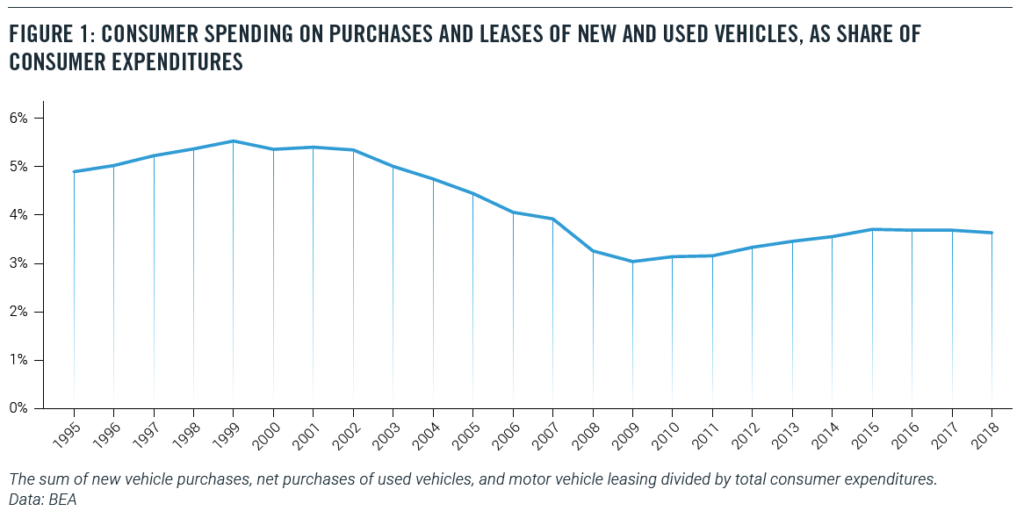
Not surprisingly, the share of consumer spending on new and used vehicles has fallen as well. In 2000, 5.4 percent of consumer spending went to purchases and leases of new and used vehicles. Today, that share is down to 3.6 percent (Figure 1).12
The BLS Consumer Expenditure Survey tells the same story. In 2000, motor vehicle purchases and finance charges amounted to 9.7 percent of household outlays. As of 2018, the last year for which full data is available, the share of vehicle purchases and finance charges fell to only 6.7 percent of household outlays.13 In part, this decline may represent a lengthening of the term of auto loans.14 (These figures would not be changed much by including automobile lease-related payments, which amount to about 10 percent of automobile purchase-related payments in 2018.)
The State of the Low-Income Auto Market
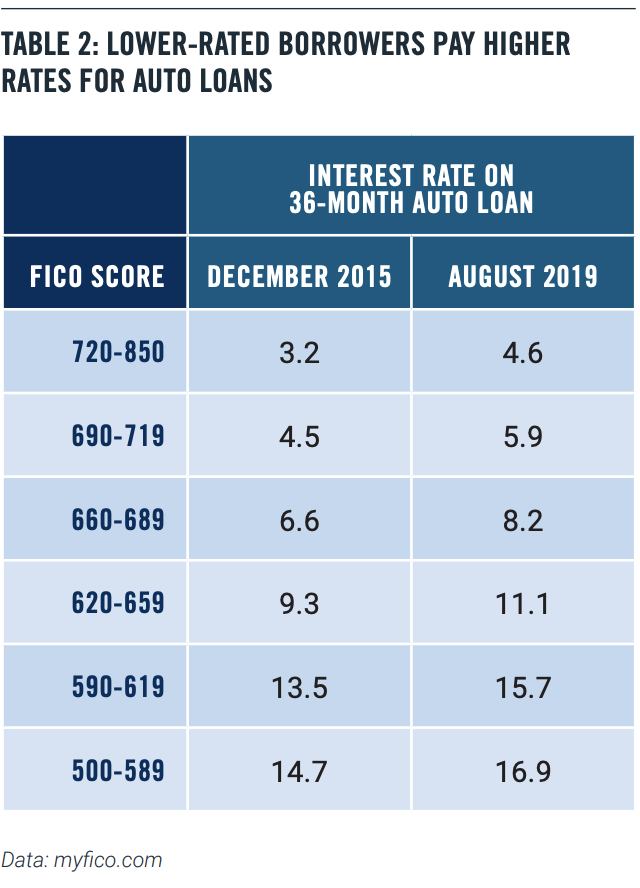
It’s not surprising that lower-rated borrowers pay more for their auto loans. Table 2 below shows interest rates for a 36-month new car loan at different credit rates for December 2015, which was close to the bottom of the credit cycle, and August 2019 (Table 2).
We can see that rates have risen for all credit-rating levels, but more so for the low-rated borrowers.
This risk-based pricing means that low-rated borrowers are not frozen out of the auto loan market. That’s good news, since, in many parts of the country, a car or truck is a necessity, even for low-income households. There is little or no public transit outside of densely populated urban areas, and ride-sharing services are not viable alternatives in many places. So, it is unsurprising that the share of low-income (the bottom quintile) households with a vehicle hold steady at 66 percent in both 2000 and 2018.
At the same time, low-income households saw motor-vehicle purchase and finance taking a smaller share of their budgets. In the bottom quintile of pre-tax income, motor vehicle purchases and finance charges fell from 8.5 percent of household budgets in 2000 to 4.9 percent in 2018 (Figure 2), a drop of almost four percentage points.15
Similar data from the New York Fed’s Household Debt and Credit Report confirm that low-income households are not being uniquely stressed financially by automobile borrowing. Figure 3 shows the share of all auto loan originations that are going to low-rated borrowers (with a Riskscore of less than 620). Before the financial crisis, about 30 percent of new auto loans were going to low-rate borrowers, a startlingly high percentage. That share fell to 20 percent after the crisis and shows no signs of rising (Figure 3).16
The biggest piece of negative news has come from the New York Federal Reserve’s well-publicized finding in February 2019:
…(T)here were over 7 million Americans with auto loans that were 90 or more days delinquent at the end of 2018. That is more than a million more troubled borrowers than there had been at the end of 2010 when the overall delinquency rates were at their worst since auto loans are now more prevalent.18
This startling number, while impressive, simply doesn’t mean what it seems to suggest. This figure includes anyone who still has an old, bad auto loan on their credit record, even if the loan was made and written off years earlier.19 In fact, even after the lender writes off the loan, the loan servicer could continue to report the account to the credit bureaus.
The recent economic history of the United States helps to explain this figure. The number of nonfarm jobs did not return to pre-recession levels until 2014, while the employment-population ratio for Americans with a high school diploma but no college did not bottom out until 2015. As a result, today’s subprime borrowers are carrying around bad loans from the days when the labor market for less-educated workers was still struggling.
Indeed, in an August 2019 blog item, New York Fed economists recommend that anyone interested in the current performance of debt should look at the transition into delinquency- that is, a chart such as Figure 4.20 And by that measure, auto loans are doing far better than in the pre-recession years.
Conclusion
In the event of a recession or a significant economic slowdown, auto loan delinquencies will predictably rise. Subprime auto borrowers, who are more likely to have fewer resources, will be likely to fall behind in their payments when times turn bad.
Nevertheless, a careful look at the data does not suggest that either the origination of subprime auto loans or the exposure of the broader macroeconomy to the auto loan market is a cause for concern. In particular, the subprime auto-loan market looks nothing like the mortgage market before the Great Recession.
Newly delinquent auto loans, as a percentage of current balances, have been falling over the past two years, and the fact that a record number of Americans have a bad auto loan on their credit record is a testimony to economic history more than current loan practices and economic conditions, particularly given the rapid rise in total car sales during this period.
Indeed, risk-based pricing in the auto loan market appears to be supplying a steady flow of credit to low-rated borrowers without imposing excess stress on the financial system.
About the Authors
Michael Mandel is Chief Economic Strategist of the Progressive Policy Institute.
Douglas Holtz-Eakin is President of the American Action Forum.
Thomas Wade is Director of Financial Services Policy of the American Action Forum.

In recent days, Sen. Bernie Sanders and his campaign surrogates have accused former Vice President Joe Biden of being dishonest about his views on Social Security. Although much has been written about Biden’s position, far less scrutiny has been applied to what Sanders proposes to do with the nation’s largest federal spending program. That’s a problem, because Sanders’ agenda isn’t honest about Social Security’s financial condition and would gravely harm the young voters powering his presidential campaign if enacted.
Here are the facts: both Biden and Sanders, as well as nearly every other Democrat running for president in 2020, have proposed to expand Social Security benefits during the campaign. Nobody is championing benefit cuts in this election. The only real difference among the candidates’ proposals is for whom benefits would be expanded. Biden has targeted his benefit expansions to low-wage workers and window(ers), two groups of older Americans that are statistically more likely to be left in poverty by our retirement system. These are the folks who need Social Security the most. Sanders, meanwhile, has proposed across-the-board benefit increases that would increase benefits for even the wealthiest retirees regardless of need.
Unfortunately, no one is talking about the elephant in the room: Social Security doesn’t even have the capacity to pay out the benefits already scheduled. Every year since 2010, the program has spent more money on benefits than it has raised in payroll taxes. The U.S. Treasury is currently covering that shortfall, because it borrowed from previous surpluses and is now paying that debt back. But once those funds are exhausted in 2035, Social Security would be legally required to cut benefits across the board by roughly 20 percent. Even Sanders has acknowledged the program has “been adjusted before, and adjustments will have to be made again.”
IRS Free File and VITA programs should be improved not discarded.
According to the Internal Revenue Service (IRS), 90 percent of taxpayers hire paid tax preparers or utilize tax preparation software to file their taxes.
For low-income families the cost of tax preparation can significantly reduce the value of their refunds. A 2016 study by the Progressive Policy Institute (PPI) found that low-income taxpayers in the Washington-Baltimore metropolitan areas can expect to spend between 13 and 22 percent of the average Earned Income Tax Credit (EITC) refund when using tax preparation services.
One way working families can give themselves a “tax break” is to take advantage of the IRS Free File program. This public private partnership between the IRS and the software industry makes free online tax preparation and electronic filing available to 70 percent of the taxpaying population, and together with the Volunteer Income Tax Assistance (VITA) program serve between 2.5 to 3 million needy taxpayers a year.
In recent years some have criticized these programs for low enrollment rates and encouraging deceptive business practices. But a recent third-party report commissioned by the IRS shows that the Free File program (while in need of improvement) has saved taxpayers $1.6 billion and is responsible for 53 million free returns since 2002.
One way working families can give themselves a “tax break” is to take advantage of the IRS Free File program or the Volunteer Income Tax Assistance program. The Free File program, public-private partnership between the IRS and the software industry, makes free online tax preparation and electronic filing available to 70 percent of the taxpaying population and currently serves 2.5 to 3 million taxpayers annually. The Volunteer Income Tax Assistance (VITA) program helps another 3 to 3.5 million taxpayers file every year.
If you think your credit report is accurate, there is a good chance you are wrong. According to the Federal Trade Commission (FTC), one in five Americans has a potentially material error in their credit file, and one of the biggest contributors is medical bills—with half of all medical bills containing an error.
In fact, mistakes on credit reports have become so pervasive that around a third of all complaints filed annually to the Consumer Financial Protection Bureau (CFPB) resulted from problems with consumer credit reports.
Credit report errors are a serious threat to the financial well-being of American families. As Senator Elizabeth Warren has noted, “credit reports regularly contain errors that can make it harder for families to access credit, find jobs, and get housing.” And as many consumers know all too well, it’s very difficult to get those errors corrected.” (1)
Under the Fair Credit Reporting Act, the company that furnished the information to the credit bureau must conduct an investigation to verify the information and correct a mistake, if they find one. Unfortunately, consumers who want to try to fix mistakes on their credit report face three daunting obstacles.
First, the system put into place by the credit reporting agencies heavily favors creditors and other data furnishers. Credit bureaus almost exclusively depend on lenders (such as banks, credit unions, credit card providers, and mortgage underwriters).
Consumers contacted the credit reporting agencies approximately eight million times in 2011 to initiate a credit dispute. But only a small fraction of those disputes was resolved internally by credit bureau staff. According to the CFPB, 85 percent of credit report disputes are passed on to data furnishers (the lenders) to investigate and resolve. (2) Unfortunately, in most cases the disputes are then shelved unless the consumer perseveres.
Second, the credit report agencies earn their profits by providing services such as credit checks to the very entities that provide the data used to create the credit reports – banks, mortgage lenders, credit card companies, retailers, and other businesses that provide credit. This creates a serious conflict of interest.
Third, despite several notable efforts to try to empower consumers, trying to correct errors on your credit report is still tedious, confusing, and time consuming.
CREDIT REPAIR ORGANIZATIONS AND COMPANIES
Because the system is rigged against them, many consumers turn to credit counseling agencies or credit repair companies. The dispute system designed to help consumers fix the problem favors the position of the debt collector over the consumer. Specifically, the credit bureau is only legally required to check with the creditor or debt collector and ask them whether they stand by their claim. As long as the creditor says you owe money, the dispute is resolved in their favor. As the National Consumer Law Center concludes: “Credit bureaus have little economic incentive to conduct proper disputes or improve their investigations.” (3)
Credit counseling agencies are typically a free resource from nonprofit financial education organizations that review your finances, debt and credit reports with the goal of teaching you to improve and manage your financial situation.
A credit repair company is a firm that offers to improve your credit in exchange for a fee. Unfortunately, the quality of these firms varies greatly. Some credit repair firms are highly reputable and follow best practices. Unfortunately, a significant cohort of credit repair firms are not good actors and, in some cases, have committed outright fraud. In 2016 the Consumer Financial Protection Bureau (CFPB) stated that “more than half of people who submitted complaints with the CFPB about credit repair chose the issue ‘fraud or scam’ to describe their complaints.”
There are some telltale signs for consumers trying to separate the bad actors from legitimate credit repair firms. Companies should be avoided that:
Demand an upfront payment.
Don’t provide a written agreement that includes cancellation rights for consumers.
Guarantee they’ll raise your credit score or fix an error.
Have multiple complaints against them with the Consumer Financial Protection Bureau or the attorney general’s office in the state where they operate.
Suggest they can remove legitimate negative information.
Offer to create a new credit profile based on a new employer identification number, rather than your Social Security number.
In contrast, responsible credit repair companies not only follow federal and state law but also:
Offer a free consultation
Have a track record and consistently solid reviews from past clients.
Have an attorney on staff.
Are licensed, bonded and insured.
WHAT NEEDS TO CHANGE?
To protect consumers, some policymakers have suggested new regulations to further police the credit repair industry. They note that credit repair firms don’t do anything someone with a bad credit report couldn’t do on their own. Anyone can dispute credit errors on their own behalf. But the Do-It-Yourself approach can be dauntingly complicated and time-consuming for harried families.
In essense, paying for credit repair assistance is really no different than paying an accountant or purchasing software to do your taxes – something 90 percent of Americans do according to the Internal Revenue Service.
It is important to note that there is already existing legislation to regulate the credit repair system. The Credit Repair Organizations Act (CROA) was signed into law in 1996 to protect consumers from the unscrupulous practices commonly used by several credit scammers.
Because of CROA, credit repair organizations are not permitted to misrepresent the services they provide, including guaranteeing the removal of negative credit listings. Credit repair organizations are also not permitted to attempt to create a “new” credit file or advise you to lie about your credit history. The Act also bars companies offering credit repair services from demanding advance payment, gives consumers certain contract cancellation rights as well as the right to sue a credit repair organization that violates CROA. (4)
CROA is a sensible law, and despite criticisms that it does not go far enough in regulating the credit repair industry, the law does provide consumers with protections against bad actors in the credit repair sector without eliminating legitimate credit repair firms. CROA needs strengthening, not in the form of new regulations but rather more effective enforcement.
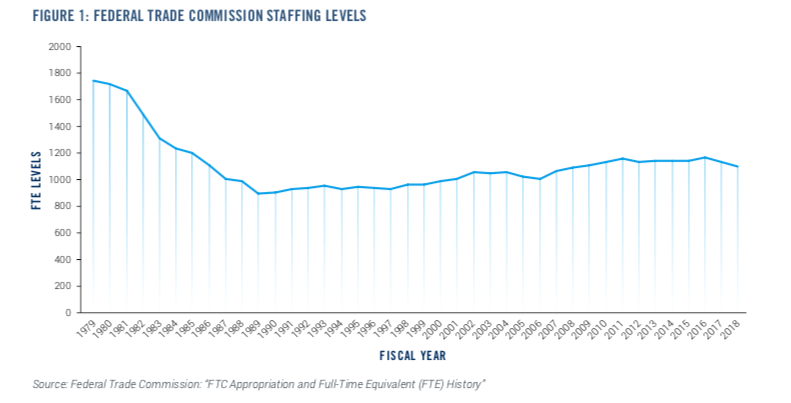
Under CROA, the Federal Trade Commission (FTC) is the primary enforcement body at the federal level. The problem is the FTC is severely underfunded and understaffed. In a Senate hearing last year Commissioner Rebecca Slaughter said the FTC’s staff level is 50 percent below its level at the beginning of the Reagan administration in 1981. Senators Jerry Moran (R-Kan.) and Catherine Cortez Masto (D-Nev.) agreed the FTC needs more resources and is “understaffed.” (5)
As Table 1 confirms, FTC staffing levels dropped dramatically during the 1980s and have never really recovered. Yet, over the same time, the responsibilities of the agency have dramatically changed and expanded. Today the FTC has to address some 2.7 million complaints a year in areas from debt collection, to identify theft, to imposter scams. (6)
Better enforcement of CROA would obviate the need to pile on new rules. Unfortunately, in fact, Congress has added to the FTC’s workload even as its workforce has shrunk. The simplest solution is to provide the FTC with additional resources dedicated to enforcing CROA and protecting consumers from those credit repair companies that have acted fraudulently or in bad faith.
To pay for this increase in supervisors, a small annual fee could be placed on the credit reporting agencies (Equifax, TransUnion, and Experian). To create an incentive for these agencies to be more responsive to consumer complaints about credit reporting agencies, the fee could be lowered or raised in synchronization with the number of consumer complaints about their credit reports.
OTHER REMEDIES
Another approach to fixing the current system is to go to the source of the problem, eliminating some of the causes for the extraordinary amount of errors made by the credit reporting industry. As Aaron Klein of the Brookings Institution has noted, there are three major reasons why credit scores are so inaccurate: “size, speed, and economic incentives of the system.”
One way to change the incentive structure would be to create some consequences for credit rating companies that frequently give lenders inaccurate data about borrowers. Lawmakers could consider legislation that would penalize credit reporting agency error rates above a certain level. Klein’s approach would use a random sample method (5 to 10 percent of complaints) to review credit rating firms’ performance. Another approach would be to grade the credit bureaus on their error and response rates.
CONCLUSION
While it is tempting to lump all credit repair firms into the same basket, many of these firms act in good faith and follow CROA to the letter of the law. Yet there is no doubt that a significant number of these companies are misleading consumers and sometimes acting fraudulently. If lawmakers really want to crack down on these bad actors, however, the first step should be strengthening enforcement of existing law.
Otherwise, spawning new laws and regulations would likely enmesh all credit repair firms in new layers of regulatory complexity and compliance burdens, making it even harder for consumers to detect and correct errors on their credit reports. In CROA we have the consumer protection law we need, now it’s time to focus on oversight and enforcement.
PPI’s Ben Ritz joined an expert panel on Capitol Hill last week to discuss the recently published report by Social Security’s trustees. The annual report projected that the program’s trust funds face insolvency within the next 16 years, after which point beneficiaries face the prospect of an across-the-board cut of 23 percent. All panelists encouraged policymakers to close the gap between Social Security’s revenues and spending sooner rather than later, which Ben noted is critical for ensuring the changes are fair to younger and older Americans alike.
In the movie series “Nightmare on Elm Street” the words “He’s back” indicated that the antagonist – Freddy Krueger – was not dead after all. The tax reform equivalent to Freddy Krueger is the so-called “return-free tax system” that would make the IRS the nation’s tax preparer. As Tax Day came around, Freddy’s ‘Return-Free’ slashed its way back onto the airwaves once again.
When this proposal is described by academics and political figures, it all sounds too good to be true – and it is. Supporters point to examples in California and Great Britain as successful, and yet the truth is quite different.
In California, where millions of taxpayers were sent pre-populated government returns each year, an average of little better than 2-3% of the state’s taxpayers ever accepted it. Eventually, the experiment fell of its own weight and California quietly abandoned it.
Some proponents have also claimed the idea originated with the 1998 IRS Restructuring and Reform Commission, which I co-chaired, and to the subsequent statute enacted that year that implemented the commission reforms. This is simply not true. The 1998 act did instruct the Treasury Department to study the proposal. Their conclusion was that Congress would have to enact radical changes in our tax laws before it could conceivably be feasible. Question asked and answered.
The much-praised “simpler’ system in Great Britain was examined in a recent study by the British Parliament which reports that the efforts by government to implement an EITC-type tax credit in their return-free tax system were initially a disaster. The reason was because the blue collar taxpayer in the UK is not involved in determining their own taxation, and government did not have the information needed to accurately qualify taxpayer eligibility for the credit. After the initial failed effort at an EITC-like welfare-to-work credit, the British no-return tax system moved to Plan B.
Now British workers are required to prepare a pre-return tax submission, reporting extensive personal and family information to the government, in order to claim tax credit eligibility. This lengthy pre-return filing – which looks like an American 1040 tax return – then enables the government to determine the citizen’s tax liability, so the taxpayer doesn’t have to prepare and file a tax return. This circular logic, and layered complexity, is what passes for a “return-free” tax system in practice in the real world.
The UK Parliament’s post-mortem analysis summed up the true myth-buster reality:
“The Right Honourable Alan Milburn, a former Labour Chief Secretary to the Treasury during Prime Minister Blair’s Premiership, described the reason for the inaccurate and significant overpayments as a result of the state not having enough information about people’s lives to accurately determine tax credit eligibility….”
This is the return-free tax system that is most frequently held up as the one we should adopt to replace American voluntary compliance. And yet the conclusion of the UK study states the obvious:
“The only party that has all the relevant information about an individual’s economic and family circumstances pertinent to his taxation is the individual himself, not the government and not the individual’s employer….”
The alternative to taxpayers preparing and filing pre-returns would of course be for the IRS to just independently collect extensive additional personal information about the private, personal lives of our taxpayers and their families, in order to make the false assertion true that the Government has all the information it needs to prepare people’s tax returns for them. However, in American culture, such an expansion of the role of government in our society would trigger a host of civil liberty and individual privacy questions. Some might describe this as a chilling prospect.
The fact is the American system of income taxation has become, over many decades, a central instrument of national economic policy. A significant proportion of the complexity we all rail about in our income tax system emanates from the public policy objectives we have asked the tax system to carry, from Welfare-to-Work (EITC) to Retirement (IRA’s) to Energy Conservation to Education. The implementing regulations alone have added enormous complexity, and require voluminous information.
One more problem with Freddy Krueger’s return-free system: the implications for national security. I have not heard a single expert in cyber security say that we should not worry about the risk of replacing a highly decentralized, diversified tax system with one characterized instead by over-concentration and centralization of systems and data, and the associated risks of attack by cyber criminals and determined nation-state adversaries. We should shiver when Freddy tells us there’s nothing to worry about.
Another basic question would seem a rather straightforward one: What do the people want? The suggestion that the American public is clamoring for Congress to enlarge the role the tax collector plays in their personal lives is nonsensical. And that simple truth has been consistently and overwhelmingly demonstrated in national polling over many years. The idea that the American public would welcome the tax collector as their new best friend is seriously disconnected from reality. And that is compounded by another reality — that the IRS is already understaffed, technologically struggling, and under-funded for its core mission.
It is time for a reality check. True tax reform and simplification is very much needed, and it will be hard work. But it does not begin with getting the taxpayer out of the room where their tax liability is being determined. In fact, the direct involvement of our citizens in their own tax system is much too valuable to lose. Rather than curtailing the role of the taxpayer, we should leverage the annual engagement of our people by helping them develop basic financial literacy, including learning how to save, and the importance of doing so, for their own financial well-being.
The tax refund, for many families, is the largest paycheck they see all year. The reality is that the “tax time moment”, as many economists call it, is an invaluable national economic policy asset, far too valuable to kick to the curb, regardless of whether the theoretical objective is tax administration expediency, or a strategy to increase revenue collections to pay for public spending.
And so, my sincere advice for what to do as the Freddy Krueger return-free advocates try to slash their way back into our lives this Spring like clockwork: Just wake yourself up, look outside
at the real world, and apply common sense. There is no good reason for this nightmare to ever become a reality.
(To read the full text of Senator Kerrey’s tax policy analysis, click here.)
Despite the low unemployment rate, productivity growth is still stuck in slow gear. Non-farm business output per hour increased by 1.3 percent from the third quarter of 2017 to the third quarter of 2018 – well below the post- war average of 2.2 percent.1 Other countries around the world are also grappling with this slowdown in productivity growth.2 Productivity growth is the primary factor in boosting wages and living standards.
The continued lack of productivity growth arises from several causes. One important issue is a growth shortfall in the amount of capital relative to the amount of labor, where capital represents investment in equipment, structures, software, and other intellectual property.
The Bureau of Labor Statistics (BLS) calculates a measure it calls “capital intensity,” which measures the services produced by capital assets relative to the number of labor hours worked in the non-farm business sector. As shown in Figure 1, capital intensity has grown much more slowly over the past 10 years than in previous 10-year periods.
There has been much debate over the reasons for this shortfall. Some have suggested that corporate managers and stock market investors have become myopic and too focused on short-run returns. Others blame excessive regulation.
But, no matter the reason for the investment shortfall, we think it’s important to identify those companies that are bucking the trend. Starting with our 2012 “Investment Heroes” report, and continuing through this report, we have focused on identifying those companies making the largest capital investments in the United States. By expanding the capital stock, these companies are helping boost productivity and wages, and creating new jobs.
The Progressive Policy Institute’s (PPI) Investment Heroes report provides an exclusive estimate of domestic capital spending for major U.S. companies. Currently, accounting rules do not require companies to report their U.S. capital spending separately. To fill this gap in the data, we created a methodology using publicly-available financial statements from non-financial Fortune 150 companies to identify the top companies that were investing in the United States. That methodology, with small modifications, has been used in each year’s report since the first in 2012.
It would be better to go cashless, while creating new low-cost banking options for poor residents
Is cash a bane or a boon?
The underlying trends are clear. Across the country, from high-end salad chain Sweetgreen to the new Amazon Go stores, more and more retailers are going cashless as technology improves. For a company like Amazon, doing without cash means speeding or eliminating the checkout process, including getting rid of long lines at peak times. For small retailers, the advantages are fewer losses from cash theft and much simplified operations, especially in high-crime areas.
In response, New Jersey is considering new legislation that would require all brick-and-mortar stores to accept cash. Similar bills have been introduced in Chicago, Washington, D.C. and Philadelphia. Supporters say that such legislation is important to protect poor Americans who don’t have access to credit cards or bank accounts.
This move to lock in the status quo is a mistake. The shift to cashless stores is a positive for poor Americans and small retailers, if combined with a concerted effort to bring low-cost banking to poor Americans. Moreover, regulations requiring cash are likely to reduce the competitiveness of brick-and-mortar stores against e-commerce.
Online finance providers have supplied an innovative source of capital for small businesses after a credit gap opened up in the wake of the Great Recession. However, while disclosures such as annual percentage rate (APR) are required by federal law for consumer loans, they are not for small business loans and credit products. The result has been costly for small business owners, with some providers charging exorbitant but undisclosed rates. Research by Opportunity Fund found the average monthly payment for some small businesses was about double what they could afford to pay.
New Jersey has an opportunity to be a leader in extending commonsense consumer protections to the small business credit market. Proposed legislation currently being debated calls for standardized terms such as APR, the payment schedule, and the minimum payment to be applied to small business loans or credit products up to $100,000.
Access to financing is often one of the biggest hurdles small business owners face, particularly for the smaller loan amounts many new or very small businesses seek: 86 percent of minority-owned businesses and 88 percent of woman-owned business bring in less than $100,000 per year.[i] Supporting the financial health of these businesses is often critical to supporting the financial health of the communities they serve as well.
That’s why the Progressive Policy Institute (PPI) commends State Senator Troy Singleton and Representative Clinton Calabrese for introducing this important legislation requiring greater transparency in the small business lending market. California was recently the first state in the nation to enact a similar law. The New Jersey bill closely tracks a proposal detailed in a recent PPI policy report, “Shining a Light on Small Business Credit: Promoting a Transparent Marketplace” by Jessica Milano, the former Deputy Assistant Secretary for Small Business, Community Development, and Housing Policy at the Treasury Department under the Obama Administration.
Milano calls for legislation to extend the Truth in Lending Act disclosure requirements to small business loans or credit products under $100,000. While no one likes reading fine print and filling out loan documentation, a recent poll by Small Business Majority found that 74 percent of small business owners support regulating online lending to ensure small businesses are protected from predatory practices. Simple disclosures including a few key metrics—especially APR—would allow a small business owner to “comparison shop” and easily analyze loan prices and terms across multiple credit providers, whether they are a bank, a payment processor, or an online lender.
According to the research by Opportunity Fund, some online lenders charge businesses average APRs of 94 percent, without ever disclosing those rates to the borrower. These companies argue that disclosing APR will discourage customers from taking their loans, causing the small business credit gap to widen further. That’s like arguing that if your doctor told you smoking was dangerous you might not do it, which in turn would hurt tobacco companies, so better not to know. If your doctor kept information that was vital to your health from you, he could be accused of malpractice, so why doesn’t the same principle apply to financial health as well?
As Singleton and Calabrese recognize, disclosing APR at the time of offering and acceptance of a loan would equip small business owners with a transparent metric to make an apples-to-apples comparison between products and choose the best option for them.
Public investment spending could fall to lowest level in modern history by 2026
WASHINGTON — Young Americans are having their future mortgaged by Washington lawmakers who are slashing critical public investments in future generations while simultaneously burying these generations under a mountain of debt, according to a new report published today by the Center for Funding America’s Future (CFAF) at the Progressive Policy Institute.
The comprehensive report documents these trends and explores how the reckless policies of the current administration and its predecessors will drain America’s economic strength and seriously harm young Americans for decades to come if no action is taken to change course.
“America’s current fiscal trajectory is on a dangerous path,” said Ben Ritz, director of the CFAF and author of the report. “By 2029, the national debt as a percent of gross domestic product is projected to surpass the all-time high it reached at the end of World War II, if current policies remain in place. Meanwhile, annual interest payments would explode from $316 billion today to nearly $1 trillion in 2028. That’s $1 trillion every year we could be using to build bridges and railroads, find a cure for cancer, train a next-generation workforce, strengthen our armed forces, or cut taxes for middle-class workers. Instead, it will be spent servicing past debts.”
Instead of tackling these problems, President Trump and the Republican-controlled Congress are making them worse, Ritz argues. While virtually every other developed country is paying down their debts post-recession, they enacted $2 trillion in tax cuts and abandoned spending caps that Republicans demanded be imposed at a time when most economists believed it was far more perilous to cut spending than it is today.
As America racks up debt thanks to irresponsible fiscal policies, public investments are being starved. According to the report, federal spending on public investments in education, infrastructure, and scientific research was just over $300 billion in 2017 – less than 1.5 percent of GDP. Between 1965 and 1980, total federal spending on public investments regularly equaled about 2.5 percent of GDP (roughly $470 billion in 2017). If current policies continue, public investment spending is projected to fall to its lowest level in modern history as a share of the economy by 2026.
The unaffordable tax cuts enacted over the past year can and should be reversed, writes Ritz, but even if federal taxes were immediately raised to their highest level since WWII and remained there indefinitely, deficits and debt would still be growing significantly faster than the economy. It is critical that policymakers also control the costs of Medicare, Medicaid, and Social Security, which are growing on autopilot faster than the economy due to America’s aging population.
By abandoning any pretense of fiscal responsibility, today’s policymakers are placing fiscal handcuffs on the elected officials of future taxpayers. By 2048, the report estimates Congress will have the authority to appropriate just 18 cents out of every dollar spent by the federal government, compared to 66 cents in 1968. This erosion of fiscal freedom robs future elected officials of their ability to respond to the changing policy priorities of their constituents and address unforeseen national emergencies, such as natural disasters and economic recessions.
Republicans’ fiscal mismanagement gives Democrats a unique opportunity to offer the electorate a compelling alternative: a new progressivism that invests in our country without leaving the bill to young Americans. But instead of holding Republicans accountable, some Democrats seem determined to outdo them. Many on the left now propose tens of trillions of dollars in new social spending on top of the unfunded promises the federal government already has made, without offering credible ways to pay for either.
Fixing our fiscal policy won’t be easy, but it is necessary. Ritz argues that the next Congress and President must modernize federal health and retirement programs to reflect an aging society and enact pro-growth tax reform that raises the necessary to renew public investments in the foundation of our economy. Only then can policymakers ensure America has a bright economic future.
Policymakers who have chosen to slash critical public investments in future generations while simultaneously saddling these generations with a mountain of debt are jeopardizing the long-term economic health of the United States. Failure to correct course could have serious consequences for the economy and the American people, including lower incomes, fewer high-quality jobs, and a reduced ability for future policymakers to address new challenges.
America’s deteriorating fiscal condition should be a central issue in the 2018 midterm and the 2020 presidential elections. As Republicans in Congress and the White House abandon any pretense of fiscal responsibility, the time is right for Democrats to offer a new progressivism that invests in our country without leaving the bill to young Americans.
The goal of this report is to alert the public and policymakers to the problem and highlight the actions our elected leaders must take to avoid fiscal ruin, which include renewing public investments in the foundation of our economy, modernizing federal health and retirement programs to reflect an aging society, and enacting pro-growth tax reform that raises the revenue necessary to support both of these critical government functions.
DEBT AND DEFICITS THREATEN PUBLIC INVESTMENTS (PP. 5-11):
• By 2029, the national debt as a percentage of gross domestic product is projected to surpass the all-time high reached at the end of World War II if current policies remain in place. And on that trajectory, the national debt would grow to more than double the size of the U.S. economy within the next 30 years.
• All this borrowing comes at an enormous cost: if current policies remain in place, annual interest payments would rise from $316 billion today to nearly $1 trillion in 2028. At that point, annual interest costs would be twice the projected federal spending on public investments in education, infrastructure, and scientific research combined.
INSTEAD OF ADDRESSING THE PROBLEM, TODAY’S POLICYMAKERS ARE MAKING IT WORSE (PP. 12-17):
• While virtually every other developed country from Germany to Japan is paying down their debts, self-proclaimed “king of debt” Donald Trump and the Republican-controlled Congress have been making ours bigger. In the span of just two months, they enacted $2 trillion in tax cuts and abandoned spending caps that Republicans demanded be imposed at a time when most economists believed it was far more perilous to cut spending than it is today.
• The last time the national unemployment rate was as low as it was for most of 2018, the Clinton administration was in its fourth consecutive year of budget surpluses. But, thanks to the GOP’s borrow-and-spend policies, the next presidential election in 2020 – and potentially every election thereafter – will occur against the backdrop of an annual budget deficit of over $1 trillion.
PUBLIC INVESTMENTS ARE BEING STARVED BY BAD BUDGETING (PP. 17-21):
• Between 1965 and 1980, total federal spending on public investments in education, infrastructure, and scientific research regularly equaled about 2.5 percent of GDP (which would have been roughly $470 billion in 2017). But misguided cuts imposed by policymakers seeking to reduce deficits have taken their toll: Federal spending on public investment was just over $300 billion in 2017 – less than 1.5 percent of GDP.
If current policies are continued, public investment spending is projected to fall to its lowest level in modern history as a share of the economy by 2026. Public investment spending is likely to be cut even more in the future if policymakers are unwilling or unable to tackle the main drivers of growing deficits.
SECURING PUBLIC INVESTMENTS REQUIRES FIXING HEALTH CARE AND RETIREMENT PROGRAMS (PP. 21-29):
• While spending on public investments shrinks, spending on Medicare, Medicaid, and Social Security is growing on autopilot due to an aging population. Spending on these programs relative to the size of the economy is projected to grow by half over the next 30 years (from about 10 percent of GDP today to nearly 16 percent of GDP in 2048).
• In 1965, there were 5.4 working-age Americans (those between the ages of 18 and 64) who could pay taxes to finance the health care and retirement benefits of each American aged 65 and older. But by 2050, the U.S. Census Bureau projects the ratio of working-age to retirement-age individuals could be as low as 2.6 to 1 – less than half what it was in 1965.
• There are no easy substitutes for tackling the growth of federal health and retirement spending. The unaffordable tax cuts enacted over the past year can and should be reversed, but even if federal taxes were immediately raised to their highest level since WWII and remained there indefinitely, deficits and debt would still be growing significantly faster than the economy.
THE SHORTSIGHTED STATUS QUO IS SHORTCHANGING YOUNG AMERICANS (PP. 29-31):
• Current policies are unfair to young Americans, who are already starting from a worse financial position than their parents and grandparents did. The federal government is spending nearly six times as much per elderly American (those aged 65 and older) as it is per child, even though children have a poverty rate nearly twice that of the elderly.
• The shift in priorities – from annually appropriated discretionary spending to formula-driven mandatory spending – will leave future politicians with less say over how their constituents’ tax dollars are spent. Whereas the Congress of 1968 had the authority to appropriate 66 cents out of every dollar spent by the federal government, the Congress of 2048 will have the same authority over just 18 cents on our current trajectory. This erosion of “fiscal freedom” robs future democratically elected officials of their ability to respond to the changing policy priorities of their taxpaying constituents.
• Growing debt and interest costs also have the potential to make future generations poorer, reducing the size of our economy by up to $6,000 per person per year in 2048.
The longer we wait to address these problems, the harder they will be to solve. Neither progressives (who want more social spending) nor conservatives (who want lower taxes) will benefit from a federal budget that has no room for either because it is stuck paying for the policies of the past. As Republicans in Congress and the White House abandon any pretense of fiscal responsibility, the time is right for Democrats to offer a new progressivism that invests in our country without leaving the bill to young Americans. Voters must demand our leaders enact the policies necessary to lay the fiscal foundation for a better world tomorrow.
Amid the daily drama of President Trump’s tweets and scandals, it can be hard to focus on the most important issues for our future. An unfortunate consequence of this purposeful turmoil is that few serious solutions are being offered for addressing two of the greatest threats facing the United States: runaway climate change and unsustainable budget policies.
The resignation of EPA Administrator Scott Pruitt may end his days of plundering the environment and public treasury, but the Trump administration will continue doing both even in his absence, risking long-term national well-being for temporary political benefits. It’s critical that Democrats offer credible alternatives, especially if they hope to inspire younger voters who will bear the burden of these problems, because we cannot afford to dither on either issue much longer.
We speak from experience. One of us is a baby boomer who has spent most of his career working on energy and climate policy; the other is a millennial focused on the federal budget. Although our two fields may seem unrelated, both these existential challenges require our generations to work together to solve.
U.S. social policy traditionally has emphasized supporting income for low-income families, to the neglect of wealth-building strategies.1 While income supports are essential for covering daily expenses, upward mobility depends on saving and building personal assets, especially completing post-secondary education, purchasing a home, or creating a business.2
Moreover, inequality of wealth in America is worse than income inequality. That’s why it’s time for a new approach to empowering low-income and working Americans. U.S. social policy in the 21st century should stress social investment and wealth creation, not just income transfers to support consumption. This report proposes a new policy – American Development Accounts (ADAs) – intended to help younger workers and blue-collar households rise into the middle class by enabling them to save and accrue assets.