The finance industry has, until recently, taken a collective approach to climate change, showing a united front in addressing one of the great challenges of our time. But that groupthink approach is evolving, as seen by recent third-party engagement modifications made by top asset managers such as BlackRock, JPMorgan Asset Management, and State Street Global Advisors. These coalition changes, especially in how they interact with Climate Action 100+, a climate-focused, investor-led program that was introduced in 2017 that recently announced an evolution in focus known as “phase 2,” (described by the organization as “markedly shifting the focus from corporate climate-related disclosure to the implementation of climate transition plans”), indicate a subtle recalibration as opposed to a retreat from environmental commitments.
The decision of State Street and JPMorgan to reallocate resources elsewhere, together with BlackRock’s decision to transfer its involvement to its overseas arm, demonstrate the difficult balancing act these multinational behemoths face. They find themselves at a crossroads where they must continue to carry out their fiduciary responsibilities in the face of shifting market and regulatory environments while attempting to pilot the maiden voyage toward environmental sustainability. This shift demonstrates a wider trend in the financial sector: the path to a low-carbon, sustainable future is complex and calls for a flexible multimodal strategy that respects global decarbonization targets while navigating a patchwork of regulatory frameworks and client preferences.
In its announcement, BlackRock previewed the launch of a new stewardship option that will provide clients additional decarbonization engagement and proxy voting options. Furthermore, the introduction of programs such as Decarbonization Partners by Temasek and BlackRock highlights a consistent commitment to creative solutions to climate-related problems. This pledge to make strategic investments in next-generation businesses that are necessary to achieve a net-zero global economy by 2050 is an example of how the investment landscape is changing in terms of how it approaches climate action, and- to be blunt- a more efficient use of institutional resources and expertise being applied to climate efforts. (and yes, potentially profitable.)
The shift towards proactive participation is also shown by JPMorgan Chase’s Center for Carbon Transition (CCT), which offers bespoke assistance and in-house expertise to worldwide clients as they navigate the low-carbon transition. This project, which aims to match the company’s finance portfolio with the goal of net-zero emissions by 2050, demonstrates an understanding and actionable willingness to address the challenges associated with making the transition to a sustainable energy future.
State Street Global Advisors has demonstrated its active involvement in influencing policy directions that promote sustainable investment practices by continuing to invest in research and content platforms to interact with policymakers on decarbonization and the clean energy transition. This proactive approach to innovation and policy formation shows a dedication to the ultimate objective of realizing a path to a low-carbon economy.
These calculated realignments show the extent to which the financial industry understands the challenges and opportunities associated with the shift to more sustainable energy sources. (It is also a tacit acknowledgement that a “one size fits all” approach itself, isn’t sustainable.) Rather than indicating a turnback, these organizations are improving their tactics to more effectively advance the decarbonization of the world economy. This sophisticated approach highlights the value of flexibility, client autonomy, and active participation in the dynamic field of climate action.
Ultimately, these tactical changes, however, continue to underscore a collective, if changing, commitment to helping the global energy transformation as the financial world continues to work through the great unknown of the energy transition. This journey, characterized by thoughtful analysis, demonstrates the industry’s willingness to make the tough decisions posed by a sustainable, environmentally conscious future.
Washington, D.C. — In 2010, the Durbin Amendment was enacted as part of the historic banking bill, the Dodd-Frank Act, and established a ceiling on debit card interchange fees — the cost that merchants pay each time a customer makes a purchase using a credit or debit card. While this legislation was intended to lower costs for consumers, when studied, the expected price reductions never came to pass, and in some cases, prices actually rose.
The report, written by Paul Weinstein Jr., Senior Fellow at PPI, outlines how numerous studies found no evidence that the cap on debit card interchange fees has led to savings for consumers. Furthermore, there is considerable evidence that extending the Durbin Amendment to credit cards would not only fail to provide consumers with any savings, it could actually leave them worse off.
“Despite how well-intended the Durbin Amendment was, the fact remains that the law had little or no impact on prices, and in some cases, may have even led to higher costs for consumers,” said Paul Weinstein. “Extending the Durbin Amendment to credit card interchange fees could ultimately hurt consumers by ending access to rewards offered by credit card providers, and increase security risks for cardholders.”
The Progressive Policy Institute (PPI) is a catalyst for policy innovation and political reform based in Washington, D.C., with offices in Brussels, Berlin and the United Kingdom. Its mission is to create radically pragmatic ideas for moving America beyond ideological and partisan deadlock. Learn more about PPI by visiting progressivepolicy.org.
One of the greatest challenges for policymakers is the “unexpected negative consequence” of a change in law or regulation. There is a well-documented history of proposed policies that have achieved successes, but not without negative externalities. Prohibition in the 1920s United States,originally enacted to suppress the alcohol trade, drove many small-time alcohol suppliers out of business and consolidated the hold of large-scale organized crime over the illegal alcohol industry.
Tradeoffs in pursuit of greater benefits to society are worth the cost if the positives are greater than the negatives. But if the negative consequences of a policy change outweigh the benefits — or actually make the problem worse — then that policy can only be described as problematic and worth reconsidering. The “Durbin Amendment, enacted as part of the Dodd-Frank Wall Street Reform and Consumer Protection Act of 2010, has been cited by some as an example of a policy that did not achieve the goals of the authors of the policy while imposing new costs on the financial and debit exchange sectors. Yet despite its mixed record, some in Congress want to extend the Durbin Amendment to interchange fees for credit cards.
In the wake of the collapse of crypto exchange platform FTX, the Progressive Policy Institute (PPI) today sent a letter to leadership of the House Committee on Financial Services and the Senate Committee on Banking, Housing and Urban Affairs calling for a functional and modern regulatory regime for digital assets.
Efforts to provide clarity to the regulatory framework of stablecoins have advanced in the House Committee on Financial Services, albeit slowly. The crash of FTX is yet another example of customers losing their savings due to the failure of unregulated institutions, highlighting the need for quick action from federal policymakers on digital assets. PPI urges the leadership of the House Financial Services and Senate Banking Committees to come together in a bipartisan way and advance regulation that balances both the benefits and risks of digital assets for investors and future consumers.
The Honorable Maxine Waters Chair U.S. House Committee on Financial Services Washington, DC 20515
The Honorable Patrick McHenry
Ranking Member
U.S. House Committee on Financial Services
Washington, DC 20515
The Honorable Sherrod Brown Chair U.S. Senate Committee on Banking, Housing and Urban Affairs Washington, DC 20515
The Honorable Pat Toomey
Ranking Member
U.S. Senate Committee on Banking, Housing and Urban Affairs
Washington, DC 20515
Dear Chair Waters, Ranking Member McHenry, Chair Brown, and Ranking Member Toomey:
The collapse of crypto exchange platform FTX underscores the need for a modern, clear, and well functioning regulatory regime for digital assets. In a moment where uncertainty for cryptocurrency investors is rising — with customers losing their savings in the failures of unregulated institutions — the need for legislation to protect investors in the market for digital assets has never been more clear. But protecting investors while enabling the innovation that drives progress will require a balanced approach.
Stablecoins can mitigate the risk of volatility associated with other cryptocurrencies and capitalize on the benefits of digital assets, such as allowing for faster and more efficient transmission of money. However, without a regulatory definition of ‘stablecoins,’ other tokens call themselves stablecoins and are listed as such but are not truly stable, hurting consumers who invest in them. The industry has seen so-called-stablecoins lose value almost overnight, as evidenced by the collapse of TerraUSD in May 2022.
Bipartisan legislative efforts by House Financial Services Committee Chair Maxine Waters and Ranking Member Patrick McHenry have sought to address the need for regulatory clarity in the realm of stablecoins. These efforts can be an important building block in the effort to provide sensible protections for investors.
In the wake of the failure of FTX, regulation may need to be expanded to a broader scope. Fundamentally, though, regulation must both ensure stability and liquidity, and put appropriate measures in place to protect consumers when that is not the case. In regard to stablecoin regulation, a first step is defining a stablecoin as something backed by dollars, allowing consumers to determine legitimate value of digital assets in the market. Additional measures could include enforceable reserve requirements for stablecoins, transparency, and disclosure requirements for the assets backing those stablecoins, compliance with anti-money laundering/counter-terrorism financing rules, and clear rules regarding the timely redemption of payment from the sale of stablecoins.
Innovative payment systems like stablecoins bring competition to the banking and money transmission industries and can provide less expensive, more efficient payments. But legislation is needed to make this system more sustainable. It is crucial that Congress move forward to regulate digital assets, including stablecoins, in a way that balances their benefits and risks.
The Progressive Policy Institute (PPI) is a catalyst for policy innovation and political reform based in Washington, D.C. Its mission is to create radically pragmatic ideas for moving America beyond ideological and partisan deadlock. Learn more about PPI by visiting progressivepolicy.org.
The future of Social Security and Medicare has unexpectedly become a central point of contention in the final week before the 2022 midterm elections. As the two biggest non-emergency spending programs in the federal budget and the foundation of retirement security for nearly all American workers, it makes perfect sense to have a conversation about Social Security and Medicare during election season – particularly since both programs face serious financial challenges as our population ages. Unfortunately, the debate currently playing out on the campaign trail is devoid of the serious substance voters deserve, and it’s abundantly clear that neither party has a good plan to secure these programs for current and future beneficiaries.
Sen. Rick Scott (R-Fla.), who leads the GOP’s Senate campaign arm, kicked off the discourse when he released a proposal that would allow all federal programs – including Social Security and Medicare – to expire if not reauthorized every five years. Sen. Ron Johnson (R-Wis.), a far-right senator who is up for re-election next week, then suggested requiring the programs be reauthorized annually. Such a radical change that would enable these essential programs to suddenly vanish every few years would be catastrophic for American workers, who must plan their retirements around them years or even decades in advance.
ESG-oriented investing (Environment/Social/Governance) is a key market-oriented mechanism for using the financial system to assess material risk around generally agreed upon societal goals that go beyond profit-maximization. Environmental goals can include such factors as carbon emissions and water usage. Social goals can include diversity, labor standards, and data protection. Governance goals can include executive compensation and board composition.
Assessing the ESG-related performance of a company or country is an extremely data-intensive enterprise. Investors usually end up relying on one of a number of different companies that provide ESG ratings (also called scores or assessments), such as Sustainalytics (a Morningstar subsidiary) and MSCI (listed on the S&P 500). Parent companies of credit rating agencies (CRA) have also moved into the business of providing ESG scores, even as the credit rating agency arms of those companies increasingly incorporate ESG considerations into their credit ratings with greater transparency and consistency.
Considering how new the practice of non-financial evaluations is, ESG ratings from different firms often give very different results, depending on which measures are factored into the scoring process and how they are prioritized. One study suggested only a 31% correlation between ESG ratings produced by Sustainalytics and MSCI. While divergence of views can often be healthy, this degree of difference suggests a lack of shared data and a lack of agreement about the key drivers of ESG risk. By comparison the credit ratings market — another example of an “information market” — has had much more time to agree on many drivers of credit risk.
We applaud the recent proposal by the SEC to require more disclosure by public companies of climate-related risks. That is a good step that will provide investors with more information, help improve the ESG ratings process, and lead to more robust ESG ratings. We will also be able to better determine the connection between ESG ratings and financial performance.
The SEC is also looking at the potential for conflicts in this new area. The agency’s 2022 staff report on Nationally Recognized Statistical Ratings Organizations (NRSRO) raised questions about credit ratings produced by NRSROs, particularly those with ESG affiliates. The report noted that:
….in incorporating ESG factors into ratings determinations, NRSROs may not adhere to their methodologies or policies and procedures, consistently apply ESG factors, make adequate disclosure regarding the use of ESG factors applied in rating actions, or maintain effective internal controls involving the use in ratings of ESG-related data from affiliates or unaffiliated third parties. The Staff also identified the potential risk for conflicts of interest if an NRSRO offers ratings and non-ratings ESG products and services
The SEC was doing its job by raising these questions of methodology and potential conflicts as part of its regulatory oversight. Notably, the inspections did not produce any evidence of actual problems. Yet these concerns can easily be overstated, as they were in recent articles by the Wall Street Journal and Responsible Investor. It’s important to note that such issues of conflicts of interest and consistent application of methodologies arise in any market for information. In a data-driven world, companies that use data to provide third-party assessments of products, services, and other companies will always be under pressure to modify their assessments by those being assessed or with something to gain from the assessment. As I wrote in a January 2021 policy brief, available on the Progressive Policy Institute website:
In every part of the economy, the Information Age has made an exponentially increasing amount of data available to everyone. The difficult problem is extracting useful signals from the noise, especially when some market participants are actively taking advantage of opportunities to manipulate data, or to create false signals.
The key is to develop a set of processes and incentives that help manage new conflicts of interest. That’s certainly not an insurmountable problem, as the credit ratings agencies have shown. Indeed, credit rating agencies are known for their ability to apply their methodologies in a consistent and transparent fashion. In fact, that’s the essence of their business model. As I wrote in the policy brief:
The agencies assess the creditworthiness of the bonds according to published and detailed methodologies. In fact, there is literally nowhere else in the private sector that gives this level of transparency into the intellectual property of an organization, or that so rigorously documents their internal methodology for making decisions (imagine a newspaper committing itself publicly for how it chooses stories or does reporting, including reporting on advertisers).
True, the credit rating agencies came under criticism for their role in the 2008-2009 financial crisis. But the aftermath of the crisis, SEC oversight of CRAs was greatly increased. As Jessica Kane, then director of the SEC’s Office of Credit Ratings, noted in a 2020 speech: “In the span of 15 years, the credit rating industry has gone from being largely unregulated to being subject to a robust disclosure and examination regulatory regime.” As a result, the CRAs consistently produce strong signals that are useful for market participants. ESG ratings firms should strive to do the same.
This week, the Progressive Policy Institute hosted an event with Rep. Jake Auchincloss (MA-04) and an esteemed panel of experts on the potential regulatory options for cryptocurrency, and the merits and drawbacks of several proposed approaches.
“My job…is to uphold market integrity, to protect consumers from fraud and abuse, and to create a regulatory sandbox in which industry can thrive. In which participants in a marketplace can transact with confidence. And in which the United States can lead the world in innovation,” said Rep. Jake Auchincloss during the event.
“I’d also like to keep this pre-partisan. Right now we haven’t yet put on the jerseys about what side is what for crypto regulation. And I think that’s healthy, because there’s no need for this to become a political football. This is something that thoughtful Members on both sides of the aisle should be able to roll up their sleeves and work together on. I’m certainly working in that fashion, and would like to see that we can get Democrats and Republicans on board with a long term regulatory architecture…” Rep. Auchincloss continued.
Cryptocurrency has taken the world by storm. Depending on the day, digital currencies are now cumulatively valued at several trillion dollars. Financial and nonfinancial corporate executives, once dismissive, increasingly understand the importance of cryptocurrency and related technologies for the future. However, the federal government is only in the early stages of deciding how to regulate cryptocurrency, which could have enormous implications going forward. PPI explored these challenges and heard from thought leaders on how to navigate this new and challenging technology.
Watch the livestream of the event here:
Representative Jake Auchincloss serves as Vice Chair on the House Committee on Financial Services and the House Committee on Transportation and Infrastructure. He has a deep background in technology and cybersecurity work.
In addition to Rep. Auchincloss, this event’s esteemed panelists included Dante Disparte, Circle’s Chief Strategy Officer and Head of Global Policy; Kirsten Wegner, CEO of the Modern Markets Initiative and a PPI Mosaic Project cohort member; and Michael Katz, Director of Legal for the Digital Currency Group. The event was moderated by Dr. Michael Mandel, Vice President and Chief Economist of PPI and featured Colin Mortimer, Director of PPI’s Center for New Liberalism.
The Progressive Policy Institute (PPI) is a catalyst for policy innovation and political reform based in Washington, D.C. Its mission is to create radically pragmatic ideas for moving America beyond ideological and partisan deadlock. Learn more about PPI by visiting progressivepolicy.org.
While the system of credit scoring used by Fannie Mae and Freddie Mac (the Enterprises) has been in effect for some time, Congress recently asked them — along with the Federal Housing Finance Agency (FHFA) — to review their credit scoring model to determine if additional models could be used to increase competition. But as Fontenot explains, the incorporation of a flawed new model could have unforeseen impacts and potentially drive up borrower costs.
The report concludes that the Enterprises have used a current credit scoring model that has produced necessary liquidity in the market in both good and difficult times — and that as the FHFA oversees the next phase of testing alternative credit score models, it should ensure that the models are subjected to scrutiny concerning the cost and market affects any change would have.
Read the full paper, expanded conclusion, and questions for consideration here.
Brodi Fontenot is President of Fontenot Strategic Consulting LLC. Mr. Fontenot was previously appointed by President Obama to be the Department of the Treasury’s Assistant Secretary for Management and was nominated to serve as Treasury’s Chief Financial Officer. Fontenot also served in a variety of senior roles at the Department of Transportation, including Assistant Secretary for Administration, Chief Human Capital Officer (CHCO), and Senior Sustainability Officer (SSO).
The Progressive Policy Institute (PPI) is a catalyst for policy innovation and political reform based in Washington, D.C. Its mission is to create radically pragmatic ideas for moving America beyond ideological and partisan deadlock. Learn more about PPI by visiting progressivepolicy.org.
The Federal Reserve made clear in its December 2021 meeting that it intends to raise interest rates in 2022. Interest rate changes flow through the economy and affect the rates borrowers pay on all types of loans. In particular, the increases in interest rates may place greater pressure on home mortgage rates and the credit scores that are used by financial institutions to determine who qualifies for loans.
In the area of housing finance, how credit scores are used by key market players has received attention for some time. The better the credit score, the more likely a borrower will qualify for a mortgage at the best possible rate, saving the borrower money over the life of the loan. There has been debate, however, over the models used to create those scores — should there be more competition and, more important, can new models lower costs for home buyers and ensure equity of access to loans.
Two of the most important entities in housing finance are the nation’s housing government sponsored enterprises — Fannie Mae and Freddie Mac (Enterprises) — which are now under government conservatorship overseen by Federal Housing Finance Agency (FHFA). As a result, many policymakers and elected officials have encouraged the FHFA to take steps to promote more competition in the credit scoring models used by the Enterprises to help lower costs to consumers and give greater access to credit for previously underserved individuals.
These are important goals and should be pursued. However, some reforms presented would have had a less than optimal effect — decreasing competition and potentially driving up mortgage costs rather than lowering them. The Enterprises have used a valid credit score model for over 20 years. Introducing competitive reforms has merit, but it must be done in a way that does not create unfair advantages. FHFA has a clear mandate to keep the Enterprises solvent and help homeowners, as witnessed by their recent COVID assistance. But FHFA must ensure that any reforms maintain competition and keep prices low for consumers.
This paper reviews how credit scores are presently used by the Enterprises and discusses some of the issues that can be addressed to keep competition in the credit score market. This paper also discusses some of the pitfalls associated with some proposed reforms to credit score markets.
ENTERPRISES HAVE USED PROVEN CREDIT SCORE MODELS FOR OVER TWO DECADES
Fannie Mae and Freddie Mac (Enterprises) are commonly known as housing government sponsored enterprises. Somewhat unique in their structure, they were originally chartered by Congress, but owned by shareholders, to provide liquidity in the mortgage market and promote homeownership.[1] The Enterprises maintained this unique ownership structure until their financial condition worsened during the financial crisis of 2008, when they were placed in government conservatorship under the leadership of the Federal Housing Finance Agency (FHFA).
The Enterprises do not create loans. They purchase loans made by others (such as banks), and then package those loans into securities which are then sold on the secondary market to investors. The loans purchased by the Enterprises can only be of a certain size and home borrowers must have a minimum credit score to qualify. The Enterprises use these and other criteria to minimize the risk that the loans they purchase will not be paid back (default) — an important step because it is this step of buying loans from banks and other lenders, thereby providing them with replenished funding that allows further home lending.
The loans purchased by the Enterprises then are packaged into securities that have specific characteristics which are told to investors — including the credit scores on the loans in the security. According to FHFA, the Enterprises use credit scores to help predict a potential borrowers likeliness to repay and has been using a score developed from a model, FICO Classic,[2] for over 20 years.[3] In discussing FICO Classic, FHFA points out that it “and the Enterprises believe that this score remains a reasonable predictor of default risk.”[4]
While the current system has been in effect for some time, Congress recently asked FHFA and the Enterprises to review their credit scoring model to determine if additional credit scoring models could be used by the Enterprises to increase competition. Specifically, FHFA was to “establish standards and criteria for the validation and approval of third-party credit score models used by Fannie Mae and Freddie Mac.”[5] Advocates of using alternatives to FICO Classic said, at the time, that using other validated credit scoring models would lead to more access.[6] While a worthy goal, incorporating a flawed new model, could have impacts and potentially drive-up costs.
CONFLICT OF INTEREST COULD LEAD TO DECREASED COMPETITION
Beginning in 2017, FHFA proposed a rule which would set the stage for reviewing the Enterprises’ credit score models. The rule FHFA finalized in 2019 directed the Enterprises to review and validate alternative credit models in the coming years.
Section 310 of the Economic Growth, Regulatory Relief, and Consumer Protection Act of 2018 (Pub. L. 115–174, section 310) amended the Fannie Mae and Freddie Mac charter acts and the Federal Housing Enterprises Financial Safety and Soundness Act of 1992 (Safety and Soundness Act) to establish requirements for the validation and approval of third-party credit score models by Fannie Mae and Freddie Mac.[7]
At the time of the proposed rule, some thought that alternative credit scores could open access to a larger group of homeowners.[8][9] While an admirable goal, and in keeping with FHFA’s mission for the Enterprises even now, a major issue was left unresolved. The proposed rule “would have required credit score model developers to demonstrate, upon applying for consideration, that there was no common ownership with a consumer data provider that has control over the data used to construct and test the credit score model.”[10]
The proposed rule would have created a separation between those who create and control the data, from those in charge of the model creating the scores — an important goal. Not surprisingly, the proposed rule received significant comments. Sadly, the final rule did not adopt this important provision which required those submitting models to not have a conflict of interest or “common ownership with a consumer data provider that has control over the data used to construct and test the credit score model.”[11] This lack of clear independence could set the stage for a lack of competition in the future.
While the rule was being proposed, former FHFA director Mel Watt in 2017 said, “how would we ensure that competing credit scores lead to improvements in accuracy and not to a race to the bottom with competitors competing for more and more customers? Also, could the organizational and ownership structure of companies in the credit score market impact competition? We also realized that much more work needed to be done on the cost and operational impacts to the industry. Given the multiple issues we have had to consider, this has certainly been among the most difficult evaluations undertaken during my tenure as Director of FHFA.”[12]
Several at the time of the proposed rule pointed out that having one dominant player possibly replaced by another, would not further competition but could further consolidate it. One commentator stated, “to push for alternative scoring models may simply trade one dominant player (FICO) for another (Vantage),”[13] in referring to legislation which would ultimately be incorporated into the bill where the proposed rule was developed. The Progressive Policy Institute (PPI) held an expert panel discussion at the time which also discussed the problems with adopting VantageScore due to conflict of interest.[14] “The reason? Because the owners of Vantage control the supply of information currently used by FICO to make its determination. And given the history of monopolies, it would not be surprising to see Equifax, Experian, and TransUnion use that leverage to the advantage of Vantage, and eventually force FICO out of business.”[15]
The proposed rule points out that “VantageScore Solutions, LLC is jointly owned by the three nationwide CRAs. The CRAs also own, price, and distribute consumer credit data and credit score. This type of common ownership could in theory negatively impact competition in the marketplace.”[16] Another writer at the time, also acknowledged the potential conflict of interest provision of the proposed rule.[17] While these issues were not resolved in the final rule, they still matter and can affect not only competition but also costs in the residential mortgage marketplace.
Competition is key to innovation and inclusiveness is important to further homeownership. Using alterative data, rent payments, utility payments, bank balances, all could potentially be used help complete the credit picture and increase access to credit.[18] Other research organizations have acknowledged that FICO has improved models and incorporated alternative sources of data that are available,[19] which would not have the conflict of interest that VantageScore would have. FHFA must ensure that competition is maintained, without creating unfair advantages.
LACK OF REAL COMPETITION COULD INCREASE COSTS
Before any changes can happen, however, FHFA must articulate all costs to consumers, lenders, the Enterprises, and investors of any change. COVID-19 proved a real-world laboratory for the Enterprises under stress. FHFA’s recent Performance Report lays out the series of actions the Enterprises took to help borrowers affected by COVID-19, including payment deferrals, forbearance, and evictions suspensions.[20] These actions likely kept many homeowners in their homes during a difficult period, and kept the Enterprises functioning. The relief provided was important and was balanced against the risk to the Enterprises — but it did come at a cost.
FHFA made their first announcement on COVID assistance to homeowners in March 2020.[21] A few months later in August 2020, FHFA announced that the Enterprises would charge a fee of 50-baisis points per refinancing to help make up for any potential losses the Enterprises might experience.[22] An initial estimate put the projected losses at $6 billion. Thankfully the Enterprises saw declining rates of loans in forbearance and the fee was ultimately ended in July 2021.[23]
Changes at the Enterprises have affects across the industry. Just as the potential increases in interest rates by the Federal Reserve this year could raise interest costs to home buyers, at time of the proposed rule, former FHFA Director Watt knew that changes to the credit scoring model could raise costs and even stated “much more work needed to be done on the cost and operational impacts to the industry,”[24] before changes were made. Clearly, the FHFA realizes that any changes to its credit scoring models will also likely have increased costs to the housing finance sector. As an aside, the related issue of changes to issues such as mortgage servicing have led to increased costs in the home purchase ecosystem.[25]
Changes to the credit scoring models could also affect prices in the secondary market for mortgage-backed securities (MBS) and credit risk transfers (CRT). As the FHFA pointed out, investors “in Enterprise MBS and participants in Enterprise CRT transactions would need to evaluate the default and prepayment risks of each of the multiple credit score options.”[26] While the FHFA in the final rule did not address the costs of these evaluations, incorporating multiple credit score options could raise the cost investors demand and ultimately increase the costs to home buyers via the fees the Enterprises would need to pass on.
Others have pointed out that changes to credit scoring models could have cost impacts for banks, investors, pension funds, and others.[27] These issues of cost and operational impacts need to be given serious consideration, because as the recent Enterprise actions related to COVID-19 made clear — they matter. The lending industry was upset when the Enterprises raised a temporary fee to help ensure Enterprises’ soundness through the difficult period.[28] What would the costs be with a wholesale change to the credit score model system? And who would ultimately pay those costs? These are questions the FHFA must address as they review any changes to the credit scoring model.
One of the FHFA’s current core goals is to “Promote Equitable Access to Housing.”[29] To ensure that the Enterprises can undertake their important role in addressing long standing issues of equity, they need to be in the best place possible financially to do that. A question that FHFA needs to address as they review credit scoring models is, would using a model with a conflict of interest hurt their goal of equity? Would changes raise prices or worse, limit access for those FHFA is looking to provide access into the market?
CONCLUSION AND QUESTIONS FOR CONSIDERATION
The crisis of COVID-19 and its effects on the housing market were serious, but thankfully not detrimental due to prudent planning and oversight of the Enterprises and FHFA. The Enterprises have used a current credit scoring model that has produced necessary liquidity in the market in both good and difficult times. As FHFA oversees the next phase of testing alternative credit score models, it should ensure that the models are subjected to the criteria laid out in their final rule — with emphasis placed on the cost and market affects any change would have. The Enterprises were called upon to help homeowners during the recent crisis and could do so with minimal disruption to the consumers and housing finance stakeholders. The Enterprises and FHFA should take seriously how any further changes would impact competition, soundness of the Enterprises, and how those changes could increase the costs for everyone in housing finance.
REFERENCES
[1]“Fannie Mae and Freddie Mac in Conservatorship: Frequently Asked Questions,” Congressional Research Service, July 22, 2020, https://crsreports.congress.gov/product/pdf/R/R44525.
[2] “Selling Guide: B3-5.1-01, General Requirements for Credit Scores,” Fannie Mae, September 2021, https://selling-guide.fanniemae.com/Selling-Guide/Origination-thru-Closing/Subpart-B3-Underwriting-Borrowers/Chapter-B3-5-Credit-Assessment/Section-B3-5-1-Credit-Scores/1032996841/B3-5-1-01-General-Requirements-for-Credit-Scores-08-05-2020.htm.
[3] “There’s More to Mortgages than Credit Scores,” Fannie Mae, February 2020, https://singlefamily.fanniemae.com/media/8511/display.
[4] “Credit Score Request for Input,” FHFA Division of Housing Mission and Goals, December 20, 2017, https://www.fhfa.gov/Media/PublicAffairs/PublicAffairsDocuments/CreditScore_RFI-2017.pdf.
[5] “FHFA Issues Proposed Rule on Validation and Approval of Credit Score Models,” Federal Housing Finance Agency, December 13, 2018, https://www.fhfa.gov/Media/PublicAffairs/Pages/FHFA-Issues-Proposed-Rule-on-Validation-and-Approval-of-Credit-Score-Models.aspx.
[6] “Validation and Approval of Credit Score Models,” Federal Housing Finance Agency, August 13, 2019, https://www.fhfa.gov/SupervisionRegulation/Rules/RuleDocuments/8-7-19%20Validation%20Approval%20Credit%20Score%20Models%20Final%20Rule_to%20Fed%20Reg%20for%20Web.pdf.
[8] Karan Kaul, “Six Things That Might Surprise You About Alternative Credit Scores,” Urban Institute, April 13, 2015, https://www.urban.org/.
[9] Michael A. Turner et al., “Give Credit Where Credit Is Due,” Brookings Institution, June 2016, https://www.brookings.edu/wp-content/uploads/2016/06/20061218_givecredit.pdf.
[12] Melvin L. Watt, “Prepared Remarks of Melvin L. Watt, Director of FHFA at the National Association of Real Estate Brokers’ 70th Annual Convention,” Federal Housing Finance Agency, August 1, 2017, https://www.fhfa.gov/Media/PublicAffairs/Pages/Prepared-Remarks-of-Melvin-L-Watt-Director-of-FHFA-at-the-NAREB-70th-Annual-Convention.aspx.
[13] Paul Weinstein Jr., “No Company Should Have a Monopoly on Credit Scoring,” The Hill, December 7, 2017, https://thehill.com/opinion/finance/363755-no-company-should-have-a-monopoly-on-credit-scoring.
[14] “Updated Credit Scoring and the Mortgage Market,” Progressive Policy Institute, December 4, 2017, https://www.progressivepolicy.org/event/updated-credit-scoring-mortgage-market/.
[16] “Validation and Approval of Credit Score Models: Final Rule,” Federal Register, August 16, 2019, https://www.federalregister.gov/documents/2019/08/16/2019-17633/validation-and-approval-of-credit-score-models.
[17] Karan Kaul and Laurie Goodman, “The FHFA’s Evaluation of Credit Scores Misses the Mark,” Urban Institute, March 2018, https://www.urban.org/sites/default/files/publication/97086/the_fhfas_evaluation_of_credit_scores_misses_the_mark.pdf.
[18] Kelly Thompson Cochran, Michael Stegman, and Colin Foos, “Utility, Telecommunications, and Rental Data in Underwriting Credit,” Urban Institute, December 2021, https://www.urban.org/research/publication/utility-telecommunications-and-rental-data-underwriting-credit/view/full_report.
[19] Laurie Goodman, “In Need of an Update: Credit Scoring in the Mortgage Market,” Urban Institute, July 2017, https://www.urban.org/sites/default/files/publication/92301/in-need-of-an-update-credit-scoring-in-the-mortgage-market_2.pdf.
[21] “Statement from FHFA Director Mark Calabria on Coronavirus,” Federal Housing Finance Agency, March 10, 2020, https://www.fhfa.gov/Media/PublicAffairs/Pages/Statement-from-FHFA-Director-Mark-Calabria-on-Coronavirus.aspx.
[22] “Adverse Market Refinance Fee Implementation Now December 1,” Federal Housing Finance Agency, August 25, 2020, https://www.fhfa.gov/Media/PublicAffairs/Pages/Adverse-Market-Refinance-Fee-Implementation-Now-December-1.aspx.
[23] “FHFA Eliminates Adverse Market Refinance Fee,” Federal Housing Finance Agency, July 16, 2021, https://www.fhfa.gov/Media/PublicAffairs/Pages/FHFA-Eliminates-Adverse-Market-Refinance-Fee.aspx.
[25] Laurie Goodman et al., “The Mortgage Servicing Collaborative,” Urban Institute, January 2018, https://www.urban.org/sites/default/files/publication/95666/the-mortgage-servicing-collaborative_1.pdf.
[27] Pete Sepp and Thomas Aiello, “Risky Road: Assessing the Costs of Alternative Credit Scoring,” National Taxpayers Union, March 22, 2019, https://www.ntu.org/publications/detail/risky-road-assessing-the-costs-of-alternative-credit-scoring.
Are Americans obsessed with their credit score? They have good reason to be worried, as there is much that ails the credit reporting industry.
Information at risk. As the Equifax breach in 2017 highlighted, the industry is vulnerable to cyberattacks that give hackers access to personal data and financial information.[1]
Reporting errors. According to a study by the Federal Trade Commission (FTC), one in five Americans had an error on their credit report.[2]
Credit reports are discriminatory. A study by the Consumer Financial Protection Board (CFPB) found that 45 million Americans have no (or an un-scorable) credit history — with the largest cohort of individuals residing in communities of color or low-income areas.[3]
Consumers have too little control over their credit reports. Historically, Americans have lacked any real control over their credit reports and credit reporting agencies have put in place barriers that make it very difficult to challenge errors in those reports.
Unfortunately, the leading legislative fix — creating a public credit reporting agency — would fail to remedy these serious problems.
The government has not proven to be a better guardian against cyberattacks any more than the private sector. Over 22 million Americans had their information stolen in the course of two separate attacks launched on the U.S. Office of Personnel Management between 2012 and 2015.
Error rates are common in government data, and trying to get them fixed is hardly simple. Anyone who has ever dealt with their local Department of Motor Vehicles (DMV) can attest to that. Furthermore, a public entity would be relying on the same data inputs as the private sector credit reporting agencies. So any errors in the data will still spoil the results.
Ensuring the algorithms used in credit scoring don’t have discriminatory impacts is long overdue. But the government doesn’t need to replace private credit agencies to ensure non‐traditional sources of data like rental history and utility bills are used to determine a fair credit report. Congress could just require it and give the FTC and CFPB the resource and staff to enforce the rules.
While well-intentioned, the proposal to create a public credit reporting agency is an example of a classic problem in policymaking, the misalignment between the policy problem and the policy solution. That’s a shame, because anyone who has ever dealt with the credit reporting agencies (basically everyone over the age of 18) knows the present system is rife with problems. But there are some ideas that could improve the credit reporting.
To safeguard private information, the credit reporting agencies should be required to adopt the latest and most effective anti-cyberattack protections — and be subject to fines and other penalties if they fail to do so. And if someone’s information is stolen, credit agencies should provide a free and seamless way to freeze and un-freeze their credit reports — as often as they want.
To help consumers keep tab on their credit report, Congress should enact legislation that requires the credit reporting agencies to continue the practice started during the Covid-19 pandemic — to provide free credit reports on a weekly basis.
Finally, to help reduce the discriminatory impacts of the credit ratings, Congress should enact a Community Reinvestment Act (CRA) type law for the credit reporting industry. Such a law would give the FTC and the CFPB the ability to limit the credit reporting agencies from using discriminatory data and to add non-traditional sources of information. The law would also would require the FTC and the CFPB to issue an annual report tracking the efforts of credit reporting agencies to reduce the discriminatory impacts.
America’s credit reporting system needs fixing. But success means we need to put in place the right policies. If we don’t, we will have missed a historic opportunity to protect consumer information, reduce errors, and eliminate discrimination in credit reporting.
Paul Weinstein Jr. is a PPI Senior Fellow and Director of the MA in Public Management at Johns Hopkins University.
[1] “Equifax Data Breach Settlement,” Federal Trade Commission, January, 2020.
[2] Michelle Black, “Millions of Americans have errors on their credit reports — do you?” bankrate.com, May 13, 2019
[3] Kelly Holland, “45 million Americans are living without a credit score,” CNBC, May 5, 2015
Authors: Caleb Watney, Lindsay Milliken, and Doug Rand
Entrepreneurship is the engine of long-term economic growth and dynamism. For the United States in particular, foreign-born entrepreneurs have made up an extraordinary share of our most successful companies and technological achievements. To encourage the vitally important flow of immigrant entrepreneurs, and to accommodate the growing need for an entrepreneur-specific pathway into the country, the Department of Homeland Security (DHS) adopted the International Entrepreneur Rule (IER) in early 2017.
The rule was quickly put on hold by the incoming Trump Administration, but was never removed from the Code of Federal Regulations. With support from the new Biden Administration, the IER could quickly become an essential pathway to attract and retain foreign-born entrepreneurs who seek to build their businesses within the United States.
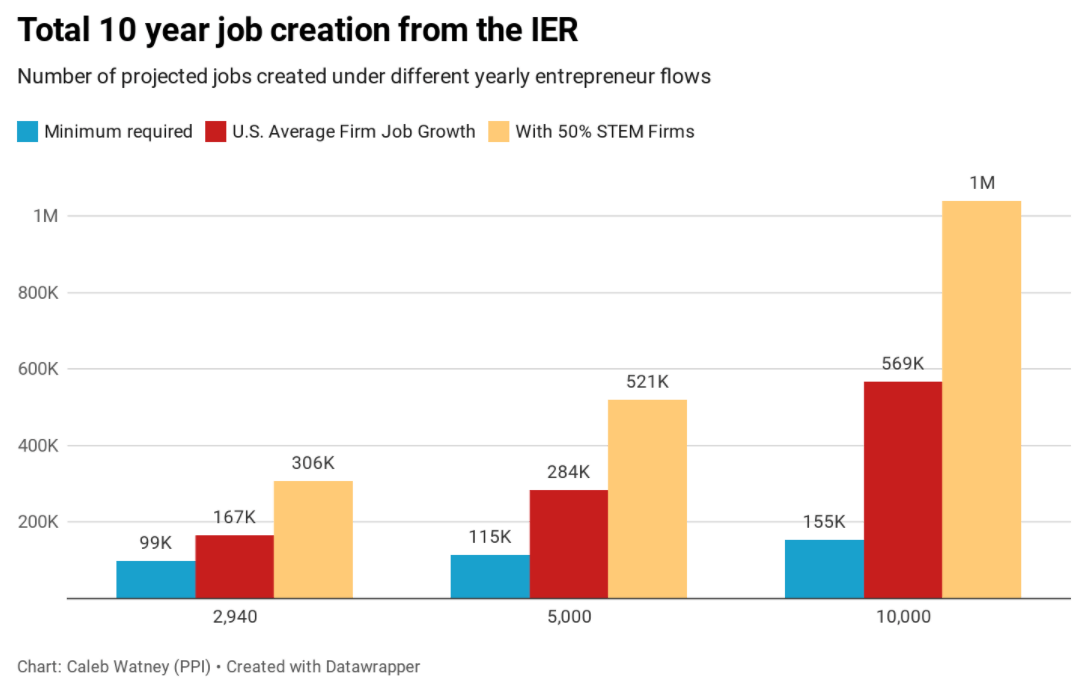
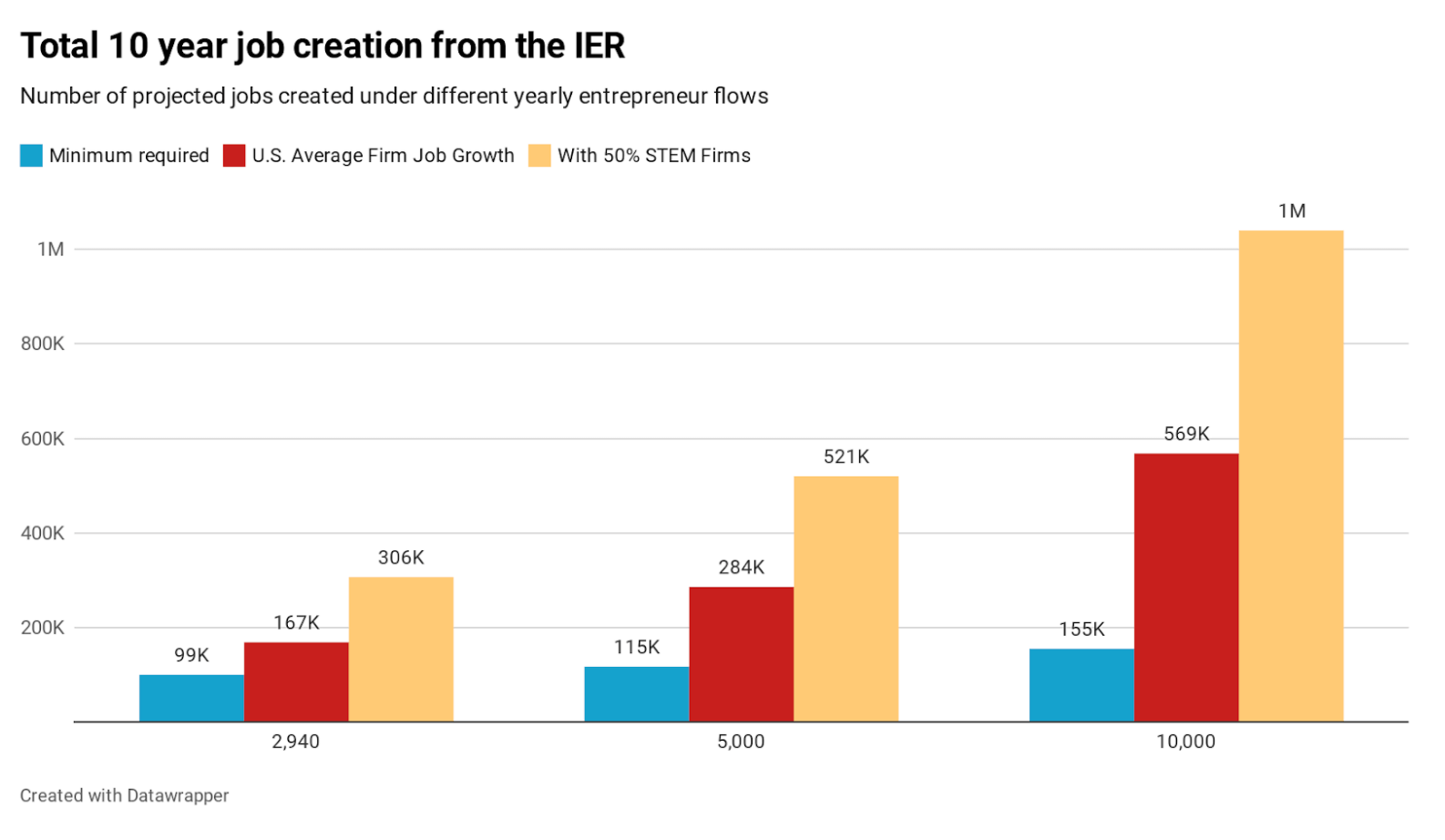
Using the DHS estimate that 2,940 entrepreneurs per year would come to the country through the IER, after adjusting for expected business failure rates, we project these entrepreneurs would produce approximately 100,000 jobs over ten years if they produce only the minimum number required for parole extension. If they mirror the average job growth of firms their age, we project more than 160,000 jobs over ten years. If 50 percent of them are high-growth STEM firms, we project more than 300,000 jobs over ten years.
If the number of yearly entrepreneurs is larger than DHS projected, job growth could be considerably higher:
This paper proposes the following recommendations for the new administration, both immediate and longer-term:
Publicize the International Entrepreneur Rule and credibly signal to stakeholders that the IER will receive agency attention and resources
Issue new guidance documents to agency adjudicators to clarify evidentiary standards and make it reasonably straightforward for investors to prove they meet qualifying criteria
Issue new guidance directing U.S. Citizenship and Immigration Services (USCIS) and U.S. Customs and Border Protection (CBP) to grant beneficiaries the full initial 30 months of parole, absent extraordinary circumstances
Issue future rulemaking to improve the IER based on feedback from stakeholder groups
Pursue a long-term legislative solution to stabilize immigration pathways for entrepreneurs
Introduction
More than half of America’s billion-dollar startups were founded by immigrants, and 80 percent have immigrants in a core product design or management role. Though immigrants make up only 18 percent of our workforce, they have won 39 percent of our Nobel Prizes in science, comprise 31 percent of our Ph.D. population, and produce 28 percent of our high-quality patents. To be clear, this is not because immigrants are inherently smarter than the average native-born worker, but instead because of strong selection effects wherein many of the talented and entrepreneurial people from many countries are the individuals most likely to emigrate in search of new opportunities.
Importantly, global competition for this population of international entrepreneurs is heating up rapidly. Countries like Canada, Australia, and the U.K. have adopted versions of a startup visa to create a dedicated pathway for international entrepreneurs, while other countries like China have elaborate talent recruitment programs to try and bring back talented students and workers who are living internationally.
In contrast to this global trend, the United States does not have a statutory startup visa category, and trying to use traditional pathways such as the H-1B visa can be very difficult for an entrepreneur, if not impossible. Other pathways for highly skilled immigrants, including the O-1, EB-1, and EB-2 visas, rely on a strong record of prior accomplishments and are not a good fit for entrepreneurs whose potential accomplishments lie in the future. Entrepreneurs like Steve Jobs or Bill Gates had little track record of success before founding Apple and Microsoft; if they had been born in another country, it is unlikely that traditional employment-based U.S. immigration pathways would have let them start their respective firms here. This inability to recognize prospective success is one of the core deficiencies in our immigration system that the IER was designed to address.
Unfortunately, much damage has been done to the United States’ reputation as the prime destination for the world’s inventors and technical practitioners over the last four years. It is vitally important that under the new administration, we begin attracting this valuable global talent again and opening pathways for their legal residence. The IER has the advantage of already existing⸺quite literally⸺in the federal rulebook, and so it can be revived immediately. For policymakers looking to quickly re-establish the United States as the top stop for international entrepreneurs, strengthening the IER should be an appealing first step.
The Biden administration has made it clear that immigration makes the U.S. a stronger, more dynamic country. Nowhere is this more obvious than with international entrepreneurs who very directly grow the pie of economic opportunity for native-born Americans. The political moment is ripe for action on immigration with public support for increasing immigration at record highs⸺ high-skill immigration is especially popular receiving support from 78 percent of the U.S. population.
Importantly, this proposal is complementary with the wide array of immigration proposals already being pursued by this administration. The IER operates through parole authority that does not impact existing visa caps for other programs, and not needing legislation or immediate regulatory action to operate means the IER is low-hanging fruit from an administrative perspective.
A Brief Primer on the International Entrepreneur Rule
The IER was finalized at the end of the Obama Administration as a way for the federal government to attract entrepreneurs to launch innovative startups in the United States. It is a federal regulation that was developed by DHS, rooted in the DHS Secretary’s statutory authority to grant parole on a case-by-case basis for “urgent humanitarian reasons or significant public benefit.” (In the context of immigration law, “parole” simply means temporary permission to be in the United States; it has nothing to do with “parole” in the context of criminal law.)
The Secretary’s discretionary parole power has historically been used for those with serious medical conditions who must seek treatment in the United States, individuals who are required to testify in court, individuals cooperating with law enforcement agencies, and volunteers who are assisting U.S. communities after natural or other disasters. Recipients of this temporary parole, however, do not have an official immigration status. They are merely permitted to stay in the United States for an amount of time determined by DHS, after which they must leave the country.
With the International Entrepreneur Rule, DHS first articulated its use of parole for individuals who could provide a “significant public benefit” by starting innovating businesses with high potential for growth in the United States. In the rule, DHS outlined the requirements for the types of entrepreneurs and startups that would be considered eligible for entry into the United States with parole. To be considered for parole, entrepreneurs must:
Have “recently formed a new entity in the United States that has lawfully done business since its creation and has substantial potential for rapid growth and job creation”;
Possess at least 10 percent ownership in the entity at the time of adjudication;
Have “an active and central role in the operations and future growth of the entity, such that his or her knowledge, skills, or experience would substantially assist the entity in conducting and growing its business in the United States”; and
Meet one of these thresholds:
Raise at least $250,000 from qualified U.S. investors with established track records;
Win at least $100,000 in grants or awards from federal, state, or local government agencies; or
Provide other “reliable and compelling” evidence that the startup will deliver a “significant public benefit.”
Up to three entrepreneurs per startup can qualify for IER parole. If an entrepreneur (or entrepreneurs) and their startup meet these requirements, DHS may grant them parole for up to 30 months. After this period, the entrepreneur can apply for a single extension of parole for at most another 30 months, if the startup continues to provide a “significant public benefit” as proven by increases in capital investment, job creation, or revenue.
It is important to note that U.S. Citizenship and Immigration Services (USCIS) processes IER applications and U.S. Customs and Border Protection (CBP) officially grants IER parole at a port of entry. When an IER petition is approved, USCIS recommends that CBP grant the beneficiary entry into the United States for a certain amount of time up to 30 months. Then CBP can decide whether to follow that recommendation, or grant entry for a shorter period.
While the IER is not a typical immigration pathway, it fills a gap for entrepreneurs that more common immigration statuses cannot satisfy. Other statuses have lengthy processing times or backlogs which are incompatible with launching a startup (H-1B and EB-2), require a significant amount of personal wealth (EB-5), necessitate establishing the business in another country first (L-1, E-1, and E-2), or require the entrepreneur to already be at the top of their field (O-1 and EB-1), which is uncommon for most startup founders.
The IER is currently the only path to work in the United States that was designed specifically for attracting talented startup entrepreneurs, and should be reimplemented swiftly so it can achieve its full potential. In addition, the IER gives U.S. investors a strong interest in ensuring that the entrepreneurs are successful and that they integrate well while in the United States. Qualified investor organizations are highly motivated to put their money into strong teams with a high capability to execute.
A Rocky Start: Key Takeaways from the Last Four Years
Unfortunately, implementation of the IER has had a host of issues. On January 17, 2017, the final rule for the IER was published in the Federal Register, just days before President Trump was inaugurated. It was supposed to come into effect on July 17 of that year. On July 11, however, DHS delayed the effective date with the stated intention of rescinding the IER completely, thus dissuading potential applicants from taking advantage of it. The Trump Administration was against any expansion of parole authority and directed its energy to reducing immigration levels to an unprecedented extent.
In December 2017, however, the U.S. District Court for Washington, DC ordered DHS to stop delaying and to begin accepting IER applications. It did so, grudgingly, warning applicants that the administration still sought to eliminate the program.
Then, in May 2018, DHS issued a proposed rule in the Federal Register to formally rescind the IER, creating even more confusion and casting another cloud over the program. Even though this rescission rule was never finalized and therefore never took effect, the contentious early history of the IER stunted its potential and convinced an untold number of entrepreneurs to look elsewhere to start their businesses.
For those few who nevertheless chose to pursue entrepreneurship in the United States via the IER, the application process was grueling. Attorney Elizabeth Goss, one of the few immigration lawyers in the country who had a client approved for IER parole thus far, notes that many of the difficulties she faced during the application process were likely related to the unfamiliarity DHS had with implementing the rule. The two biggest pain points were the difficulty of obtaining investment history information from her client’s investors and the discretionary nature of IER parole length.
First, in order to be approved, the applicant must provide proof that their investors are “qualified” as defined in the IER. This includes having the investor organization prove that it has invested in startup entities worth no less than $600,000 over a five-year period and that at least two of these startups created at least five full-time jobs and generated at least $500,000 in revenue with an average annualized revenue growth of at least 20 percent—all information that is not commonly shared with outside parties.
Next, after compiling all of the necessary evidence and fielding requests for additional information from the agency, Goss’ client was only granted a year-long parole by CBP instead of the full 30 months. The entire application process itself took one year.
Former USCIS Deputy Chief of the Adjudications Law Division Sharvari Dalal-Dheini, who observed the initial implementation of the IER within the agency, echoed some of Goss’ points about the difficulty of obtaining IER parole. She agreed that the standards in the IER regulations are very high and have likely dissuaded potential entrepreneurs from applying. In particular, the requirements to be considered a qualifying investor are restrictive, as the investor organization must be majority-owned by U.S. citizens or permanent residents. It is not uncommon, however, for high-profile investor organizations to have foreign investors.
That said, many groups have strongly advocated for the IER, noting that there is no other adequate pathway for startup entrepreneurs. Greg Siskind, another leading immigration lawyer, explained in a public comment that IER parole is no less risky than holding a nonimmigrant work visa, at least as long as USCIS has rescinded its policy of deference for prior determinations for status renewals. He also outlined how other immigration pathways are inadequate for startup entrepreneurs, a summary of which can be found in the table below.
Table 1: A comparison of alternative pathways for startup entrepreneurs and their drawbacks
Potential pathway for entrepreneurs
Requirements
Reasons pathways are not adequate for startup entrepreneurs
L-1 – Intracompany transferee (temporary status)
The business must be operating both inside and outside the U.S. for a year.
The executive, manager, or specialized knowledge employee must be employed abroad full-time for one year prior to transfer to the U.S.
The startup must be founded in another country and expand to the U.S., negating the benefits of starting a business in the U.S.
The entrepreneur must already have significant funding and a founder already in the U.S.
H-1B – Specialty occupation worker (temporary status)
Employers must be able to pay the candidate the prevailing wage according to the geographic area in which the business is located.
The number of H-1Bs is capped at 85,000 per year.
H-1B holders must legally be an “employee” who does not have sole decision-making authority, which can be difficult to structure as a startup founder.
Startup founders regularly underpay themselves to ensure more money goes to the business.
Startups often lose money in the first few years, making it difficult to prove that the business would be able to pay an employee the prevailing wage.
O-1 – Extraordinary ability or achievement (temporary status)
This status is reserved for those with extraordinary abilities “sustained by national or international acclaim.”
Current standards used to judge “extraordinary ability” are very high and create a bias towards those with very documentable awards/accomplishments, typically not recognizing investor funding.
This may help a small number of accomplished entrepreneurs, but renders many young professionals with innovative ideas ineligible.
E-1 and E-2 – Treaty traders and investors (temporary status),
These visas are only available for the countries which have signed certain treaties with the U.S.
To be eligible, investments must be made by those from the same country in which the business started.
The founder must have at least 50 percent ownership of the business.
This excludes entrepreneurs from many countries that do not have treaties with the U.S., including India, China, and Russia, among others.
It is common for startups to have founders from more than one country, or also have an American founder, rendering them ineligible.
It is necessary to give small portions of ownership to investors in each funding round, quickly making it very difficult for a startup founder to maintain at least 50 percent ownership.
EB-1 – First preference, employment-based (permanent residency)
One type of EB-1has requirements that are similar to O-1s in that beneficiaries must “demonstrate extraordinary ability.”
EB-1s for “multinational managers or executives” are for those who have been employed outside the U.S. for at least one year with a business that has been active in the U.S. for at least one year.
Many early-career entrepreneurs will not meet the extraordinary ability requirements.
The executive/manager pathway for EB-1s is inadequate as well, because the startup would have to be founded in a different country, negating the economic benefits of its launch in the U.S.
EB-2 – Second preference, employment-based (permanent residency)
Beneficiaries must have an advanced degree or 10 years of work experience
National Interest Waivers (NIWs)—which remove the requirement for a lengthy labor-market test—are only granted to those with exceptional ability and whose employment would “greatly benefit the nation.”
This high level of work experience may work for some founders but does not allow those earlier in their careers or without advanced degrees to benefit.
NIW adjudications also take up to a year, which is too long for an entrepreneur looking to launch a startup.
EB-3 – Third preference, employment-based (permanent residency)
Approval requires an individual labor certification from the Department of Labor.
Founders cannot obtain an individual labor certification because they have ownership or control over the business and cannot conduct a typical market test for the position.
EB-5 – Immigrant investor program (permanent residency)
To be eligible, the beneficiary must invest at least $900,000 or $1.8 million (depending on the location) and create or preserve at least 10 full-time jobs for U.S. workers.
Only entrepreneurs who are independently wealthy would qualify for an EB-5, which is rare.
Processing times can also extend to over two years, with consular processing taking another six months, which is too long to wait to found a startup.
The Road Ahead: Getting the Most Out of the International Entrepreneur Rule
The IER, if allowed to work properly, fills an important gap in the immigration system. The Biden Administration has an opportunity not only to revive the IER but to address some of the implementation difficulties of the last several years and make the program more effective. There are three levels of changes that can be made to strengthen the IER:
Improve marketing and outreach to make it clear to practitioners and stakeholders that the IER is available and workable.
Implement non-regulatory changes such as improving program operations and issuing updated policy guidance to make evidentiary standards clearer.
Solidify the program through new regulations, such as adding a more durable qualified investor status.
Program marketing and outreach improvements
At the broadest level, for the IER to live up to its full potential, it needs the credible backing of the administration, publicly committing to the rule and its improvement based on feedback from the broader community. Immigration lawyers play a vital role in guiding their clients through the labyrinthine process of navigating various immigration channels and they are unlikely to recommend their clients pursue the IER unless they believe that it is a “real” program with well-articulated standards and a reasonable processing timeline.
This can be achieved in a number of ways. First, vocal support and recognition of the program by the White House and high-ranking administration officials will raise the profile of the IER and indicate that the program will be actively administered and improved over time.
Second, DHS can make a concerted effort to market the program, highlight the IER specifically as an option for qualified candidates, compare the different pathways for legal residence for talented international students, and be sure to circulate such information with U.S. colleges and universities where many potential entrepreneurs will be studying.
With the IER being a relatively new program, it is likely to face additional implementation barriers that are difficult to anticipate beforehand. Accordingly, it will be important to create and maintain real-time feedback mechanisms that allow external stakeholders to flag unnecessary bureaucratic hurdles or improperly targeted eligibility criteria. One option for facilitating feedback would be to use an existing DHS council under the Federal Advisory Committee Act (FACA) to get real-time implementation suggestions from such stakeholders as immigration lawyers, venture capital firms, and international student groups—for example, the Homeland Security Academic Advisory Council (HSAAC). Questions regarding the optimal investment size minimum, the structure of qualified investment groups, and the process for U.S. border entry will be better addressed with the buy-in and input of the communities that are most impacted by them.
Guidance documents and operational improvements
Given the fairly wide scope for agency discretion in the administration of the IER, there are many ways of improving implementation simply by issuing new guidance documents and streamlining operations, among other subregulatory actions that do not require altering existing regulations.
As described above, past applicants to the IER program were approved by USCIS but granted entry by CBP for a shorter period of time than the full 30 months. This increases uncertainty for future applicants and makes it much more difficult for an entrepreneur to launch a startup and cultivate its success prior to the parole period ending. In addition, to obtain a renewal IER status, the startup must meet stringent requirements, and shortening the amount of time the entrepreneur has to satisfy those requirements adds a significant burden—dissuading future applicants and forcing entrepreneurs with innovative ideas out of the country prematurely. This could be mitigated by issuing internal guidance that directs USCIS and CBP to grant beneficiaries the full 30 months of parole, absent extraordinary circumstances.
In addition, one of the biggest pain points during the application process is proving that an entrepreneur’s investors are qualified. Often the information that is required is not publicly available or is proprietary. For Goss’ client, it took an entire year to gather the right information to satisfy the investor requirements. USCIS could simplify the process, making it clearer what documentation is necessary, and making it easier for investing organizations to provide information without compromising sensitive financial data in certain cases. In addition, once an investing organization has proven to USCIS that it is qualified, it should be allowed to refer back to its previous documentation for future IER approvals for a period of time (e.g. three years). This would encourage more U.S. investors to become willing participants in the IER program, since the bureaucratic hurdles would be viewed as more a one-time cost rather than a recurring issue.
An alternative approach to streamline the process of verifying qualified investor status would be to look to the “accredited investor” process adopted by the Securities and Exchange Commission (SEC) for private placements. Rather than have investors submit sensitive financial data to the SEC, the agency allows investors to submit a sworn affidavit that indicates the investor meets the standards for accreditation under penalty of perjury. This process is much simpler for investors and the SEC alike, and would surely save DHS both time and resources.
Lastly, DHS could issue further clarification on what would satisfy the “alternative evidence” standard for IER eligibility. If an entrepreneur does not have $250,000 in investor funds or $100,000 in government grants or awards, they can still qualify for IER parole if they can prove that their startup has “significant potential for rapid growth and job creation.” USCIS guidance in a Policy Memorandum could encourage adjudicators to place particular weight on evidence that the startup will:
Be headquartered and creating jobs in a rural area or region with high unemployment;
Commercialize new technologies in high-priority industries for the nation, such as cybersecurity, biotechnology, and artificial intelligence;
Tackle societal issues such as racial or economic disparities; or
Create not just a sufficient number of jobs to satisfy the minimum requirements of the IER, but also jobs that are sufficiently high-paying or high-quality as measured by salary or necessary skills.
Regulatory improvements
While guidance documents can be a useful near-term tool to improve the functioning of the IER and allow flexibility for the agency, ultimately the program will have more stability if long-term changes are established in regulation.
First, new rulemaking should be used to formalize guidance once the agency has worked out more definitive and objective standards around a more durable definition of “qualified investor” and evidentiary standards for “rapid growth and job creation.” Increasing stakeholder certainty in the long-term viability of the rule will be key to its uptake and success.
Second, new rulemaking should be used to help bridge the gap between the IER and existing immigration pathways for permanent residence. It would be a perverse outcome if successful entrepreneurs were forced out of the country after their parole term concluded. Policymakers should identify natural “bridge” statuses for individuals on the IER to graduate into, and make the operation of a growing U.S. business an explicit criterion for eligibility. For instance, the EB-2 green card overlaps well with the skill sets and purpose of the IER, as it is meant for a “foreign national who has exceptional ability.” Almost by definition, the successful launch of a growing U.S. business should demonstrate exceptional ability. Modifying the EB-2 and National Interest Waiver rules, as described in Table 1, to explicitly include entrepreneurship as a qualifying criterion will provide a natural on-ramp to permanent residence and the continued long-term operation of the entrepreneur’s business.
The role of Congress
Finally, it is important to note that while the IER is a promising tool for making the United States a welcoming home to international entrepreneurs in the immediate term, even with all the proposed changes above, it may not be sufficient. The uncertainty around long-term permanent resident status in the United States, which cannot be granted through parole alone, and uncertainty around future political changes to (or suspension of) the program could prevent the IER from being maximally effective. Over the longer term, Congress should pass more enduring startup visa legislation, expand the number of green cards available, and reform existing immigration pathways such that they would be more suitable for an international entrepreneur seeking to start a firm in the United States.
In fact, not one but two statutory pathways for entrepreneurs were already passed by the Senate in its bipartisan 2013 comprehensive immigration bill. Congress should consider reintroducing these pathways, updating them with the best parts of the IER while maintaining DHS’ flexibility. Such changes include:
Removing the 2013 bill’s requirement for applicants to submit a business plan, which DHS adjudicators are unlikely to have adequate time and expertise to review—unlike professional investors with “skin in the game”;
Allowing a simplified process to evaluate the qualifications of the startup’s investors, with deference to previous approvals;
Providing a more explicit way for adjudicators to account for the value of a startup being accepted into an exclusive accelerator program as evidence of its potential for rapid growth; and
Granting DHS the flexibility to adjust investment and revenue thresholds to account for changing industry standards.
In addition to these changes, Congress should make a point to gather stakeholder feedback on the details, particularly on the definition of a qualified investor, to ensure that no legitimate investors are barred from participating.
What is the potential impact of a fully implemented IER?
Baseline job creation estimate
We have developed a few baseline estimates as to the number of jobs that could be created through the IER by using a similar methodology as the one used by the Kauffman Foundation in their earlier paper estimating the job impacts of a statutory Startup Visa.
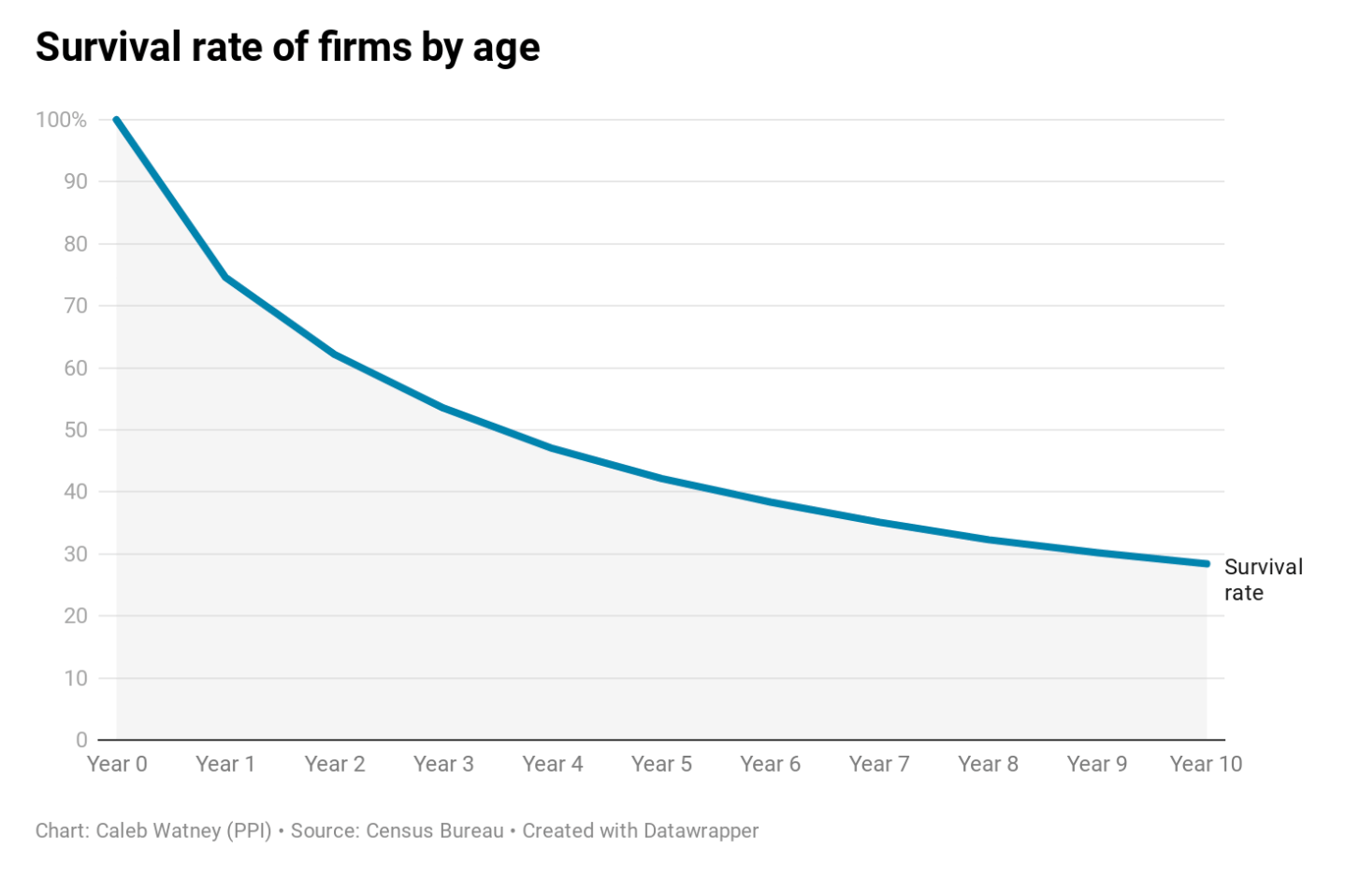
To begin with, we use the DHS estimate that the IER will attract 2,940 entrepreneurs per year with one founder for each firm. However, starting a business is difficult, and some percentage of firms will fail each year. Using the Business Employment Dynamics (BED) dataset from the U.S. Bureau of Labor Statistics, we can see the percentage of firms starting in 2010 that survived from year to year among the “Professional, scientific, and technical services,” category which we believe to be the closest analogue for the types of firms likely created under the IER.
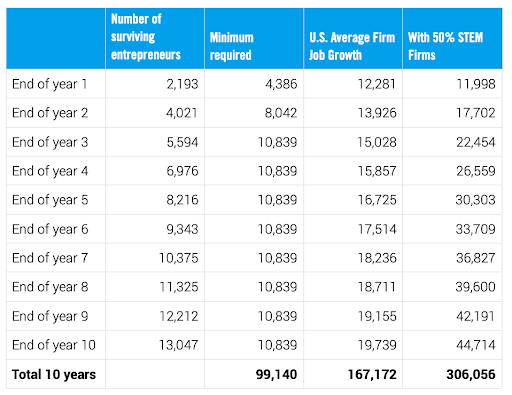
Then, we can create an estimate for the total number of surviving entrepreneurs that remain in the country that entered through the IER and add the addition of a new entrepreneur class that joins each year.
Finally, we can apply a simple job creation rate under a number of scenarios. Under the most conservative scenario, we estimate the number of jobs created if surviving firms create only the required 5 jobs over a 30 month period to satisfy the terms of the program and be eligible for parole renewal. We then assume no further job growth while the firm survives.
In the second scenario, we estimate job growth under the assumption that each of these firms mirrors the average job creation rate of a U.S. firm its age so long as it survives. To estimate this we used the BED dataset and the average employment of firms at age 1, age 2, age 3, and so on starting in 2010.
Finally, we consider the scenario in which 50 percent of these firms are in STEM fields and have a corresponding higher rate of job growth. We use the estimate of Vivek Wadhwa from a prior Kauffman study, which found that the average immigrant technology or engineering startup in their sample from 2006 – 2012 had 21.37 employees. The other 50 percent of firms are assumed to mirror the average U.S. job creation rate for a firm that age. Fundamentally, this third scenario is trying to capture the idea that while the average US firm begins to slow down the rate of job creation after the first several years, the types of entrepreneurs and investors likely to make use of the IER are those disproportionately in the” high-growth young firm” category that will sustain fast rates of job growth overtime.
The table below shows these three scenarios applied to the projected entrepreneur population:
After 10 years, the IER could bring in more than 13,000 new businesses and create more than 300,000 jobs in the United States. While this projection is already promising, the IER has the potential to contribute even more to the economy.
Reasons for optimism
The above job creation projections are all based on the assumption by DHS that a fully implemented IER will attract 2,940 entrepreneurs per year—but there is good reason to expect a much higher level of uptake. Entrepreneurs, investors, and local communities are all responsive to potential opportunities, and if they perceive that the IER program is workable and stable for the immediate future, they are likely to adapt their own practices to better utilize this pathway.
➤ Venture capitalists
For instance, firms and individuals that have a proven track record of investing in international entrepreneurs through the IER may begin to specialize in such cases and seek out promising potential entrepreneurs from around the world and encourage them to apply for IER status in the first place. Today a few groups like Unshackled Ventures specialize in finding, investing in, and bringing international entrepreneurs to the United States through the limited immigration pathways that already exist. With a dedicated path to entry for international entrepreneurs, many more such firms would likely come to exist. Similarly, major venture capital groups with significant foreign investment may reorganize their structure to ensure that their U.S. investment arms are majority-owned and controlled by U.S. citizens and permanent residents, thereby satisfying the eligibility requirements for qualified investors under the IER.
➤ State and local governments
States and local governments frequently award competitive research grants on a wide range of R&D and business development topics, and would likely expand these efforts if they also entailed a legal path to residence for international entrepreneurs. Legislative proposals like the Economic Innovation Group’s “Heartland Visa”—largely endorsed by the Biden presidential campaign—would have Congress create a new immigration pathway to promote regional economic development through state- and city-sponsored visas. Essentially, a pilot version of this proposal could be pursued immediately through the IER as states and localities that award at least $100,000 to promising international entrepreneurs could thereby ensure the creation of a new startup in their region.
➤ International students
In addition, international students studying here would know ahead of time that a path exists for those starting a successful business, and could organize their studies and plans accordingly. This could end up having a very large impact, given the startling finding that foreign-born STEM PhDs are not currently founding or working for U.S. startups at the rate we would expect given their stated career interests.
Economists Michael Roacha and John Skrentny found that immigration barriers are a significant deterrent in these PhD graduates’ ability to realize their startup career interests, compelling them to either leave the country or work at larger U.S. firms where visa pathways are more well-established.
“Foreign PhDs are as likely as U.S. PhDs to apply to and receive offers for startup jobs, but conditional on receiving an offer, they are 56 percent less likely to work in a startup. This disparity is partially explained by differences in visa sponsorship between startups and established firms and not by foreign PhDs’ preferences for established firm jobs, risk tolerance, or preference for higher pay. Foreign PhDs who first work in an established firm and subsequently receive a green card are more likely to move to a startup than another established firm, suggesting that permanent residency facilitates startup employment. These findings suggest that U.S. visa policies may deter foreign PhDs from working in startups, thereby restricting startups’ access to a large segment of the STEM PhD workforce and impairing startups’ ability to contribute to innovation and economic growth.”
This is further evidence that America has a latent population of foreign-born entrepreneurial talent that could be effectively unlocked by creating better pathways for them to stay in the United States while launching or working for a startup.
In short, the prior estimate of IER leading to 100,000 – 300,000 jobs over 10 years, generated by fewer than 3,000 startups per year, is likely a lower bound. Consider that angel investors in the United States fund about 63,000 startups per year, most of them in STEM fields. Roughly one quarter of tech startups have at least one foreign-born founder, who was able to stay in the United States, thanks to an immigration pathway not designed for entrepreneurs.
With a permanent, predictable pathway for international entrepreneurs, it is reasonable to expect far more than 3,000 additional founders to choose the United States over other alternatives, leading to significant job creation in the aggregate. If we instead adjust the number of incoming immigrant entrepreneurs to 5,000, more than 500,000 jobs could be created over 10 years. And if 10,000 immigrant entrepreneurs came each year, more than a million jobs could be created over 10 years.
It is also worth remembering that today’s startup can become tomorrow’s industry-shaping giant. Among America’s first four trillion-dollar companies, one was co-founded by an immigrant (Google), two were founded by the children of immigrants (Amazon and Apple), and one is run by an immigrant (Microsoft). These four companies alone employ over 676,000 people in the United States.
The bigger picture
In addition to the direct job gains, adding more international entrepreneurs could help reverse the decades long decline in American economic dynamism. Fewer American firms are being started, fewer firms are exiting, and the resulting slowdown has coincided with a slowdown in productivity growth.
Stimulating the U.S. economy with more international entrepreneurs would very directly increase the number of firms started in the country, but increased competition could also force U.S. incumbents to become more nimble and adopt new technologies and products to survive and thrive.
As concern continues to build on both the right and the left that the United States may be losing its status as the world’s leader in science and technology, one of the easiest ways to solidify this lead would be to allow international entrepreneurs to build their companies in the United States rather than in competitor nations. For emerging technologies like artificial intelligence, drones, quantum computing, and biotechnology, this is especially important.
Conclusion
Countries all over the world are competing to attract the best talent to their shores. These efforts include developing an environment that supports the establishment and growth of promising startups. The United States, however, has no statutory immigration pathway designed for entrepreneurs. To address this unnecessary handicap, DHS established the International Entrepreneur Rule in 2017 to welcome foreign-born entrepreneurs with innovative ideas with high growth potential. Unfortunately, the IER was never fully implemented by an administration determined to eliminate it.
IER has survived, however, and now is the time to strengthen it. This paper provides a suite of recommended improvements to bolster the IER and ensure that the United States is better positioned to attract international entrepreneurs. Tens of thousands of entrepreneurs and subsequent economic growth are at stake. The IER is a valuable tool in the economic toolbox—not only for the federal government but for states and localities as well—which can attract entrepreneurs to settle throughout the United States. It should be fully implemented and reinforced. The United States has a renewed opportunity to solidify its reputation as the best place on Earth to start and grow a new company.

Colin Mortimer, the Director of the Center for New Liberalism, is joined by two special guests. First is Adam Hartke, the co-owner of a music venue in Wichita, Kansas, and the co-chair of the advocacy committee at the National Independent Venues Association. We talk about what it has been like to be a music venue owner during this pandemic, suffering the brunt of the economic fallout. Second, PPI’s Chief Economic Strategist Michael Mandel comes on to talk about how an obscure tax cut that expires in December might make the recovery for music venues, bars, restaurants, brewers, and others even more difficult than it was already expected to be.
The federal government is on track to run a record-shattering $4 trillion budget deficit in 2020, in large part due to its aggressive fiscal response to the pandemic-induced recession. Some on the right have raised alarm about this borrowing, despite their support for budget-busting tax cut and border-control policies over the last three years. The hypocritical chorus will likely only grow louder if Democrat Joe Biden is elected president in November.
But temporary deficits are an invaluable tool for mitigating the damage caused by economic downturns, as government spending replaces a drop in demand from the private sector. The long-term fiscal costs of failing to support an economy with a double-digit unemployment rate would far exceed those of even the most overzealous stimulus measures. Necessary fiscal support should therefore continue as long as the economy remains hobbled by the coronavirus, no matter the cost.
However, Washington also faces structural deficits that will persist long after the pandemic has been contained. Thanks to the Trump administration’s reckless borrowing binge at a time when the unemployment rate was below 5 percent, the federal government was already projected to spend over $1 trillion more than it raised in revenue even before the pandemic hit. This structural deficit will only grow worse in the coming years because our nation’s aging population is causing federal spending on health-care and retirement programs to grow significantly faster than the revenues needed to finance them. The Trump administration did not create these problems, but it did make them significantly worse with its pre-pandemic fiscal policy and its disastrous handling of the public health crisis.
In the two years following the 2008 financial crisis, the national debt grew from less than 40 percent of gross domestic product to more than 60 percent of GDP. In 2020 alone, the debt will likely surpass the all-time high it reached following the end of World War 2 (106 percent of GDP). The rising cost of servicing this growing debt threatens to crowd out critical public investments that lay the foundation for long-term growth after the recession ends.
The federal government spent more money servicing the national debt last year than it spent on critical public investments in education, infrastructure, and scientific research combined. Although interest rates are low now, they eventually will rise as the economy recovers. Allowing interest payments on our debt to further crowd out these investments – which have already fallen by nearly 40 percent in real terms since the 1980s – would have disastrous consequences, including lower incomes, fewer high-quality jobs, and reduced economic mobility.
It is therefore essential to pay down the debt during expansions to create fiscal space for the necessary surge in short-term borrowing during recessions. Unfortunately, Washington has often waited too long to enact sufficient stimulus in response to recessions, and then failed to summon the will to narrow the structural gap between taxes and spending when the economy rebounds.
To make our economy more resilient against downturns, PPI proposes the federal government adopt a “fiscal switch” that automatically balances out the business cycle by increasing spending during recessions and recouping the cost during subsequent periods of economic growth. This switch would trigger based on economic variables such as the unemployment rate and operate through three mechanisms: a rebalanced relationship between federal and state governments, a more dynamic and progressive tax code, and phased-in reforms to mandatory spending programs driving our structural deficits. Implementing these automatic mechanisms, as recommended here and in PPI’s Emergency Economics report earlier this year, takes politics out of these decisions and ensures stimulus or deficit reduction will be implemented as warranted by economic conditions.
The first step is to better leverage the federal government’s unique borrowing capacity, which is unavailable to the vast majority of state and local governments required by law to balance their budget each year. Many government programs, including Medicaid, infrastructure, and education spending, are partnerships in which the federal government provides matching grants for state and local spending.
Some of these partnerships could be improved by allowing matching rates to adjust up or down automatically based on a state’s unemployment rate. This would prevent state and local governments from having to cut essential services during a downturn while asking them to shoulder a greater share of program costs when their budgets are healthy.
Other programs that currently function as a federal-state partnership but whose costs fluctuate significantly with the business cycle would benefit from becoming more nationalized. For example, when Congress tried to ensure that unemployment insurance replaced a minimum percentage of lost wages for everyone who was laid off in the early days of the coronavirus recession, lawmakers found they were unable to do so because of outdated operational infrastructure in a messy patchwork of 50 different state programs. As a result, policymakers were forced to settle for a controversial across-the-board benefit increase of $600 per week that gave some laid-off workers even more income from unemployment benefits than they lost in missed wages, while failing to make others whole. Even worse, Congressional squabbling over how long to maintain this benefit increase allowed them to lapse temporarily in the midst of an economic crisis.
Moving the operations of unemployment insurance and similarly-situated safety-net programs off state balance sheets and onto the federal government’s, in addition to automatically making benefits more generous during downturns and phasing them out in recoveries, would leverage Washington’s fiscal firepower in recessions when it’s needed most.
The second step is to make the income tax code more progressive, which serves as a strong automatic fiscal stabilizer by boosting average tax rates when incomes rise in expansions and lowering them when incomes fall in recessions. This objective could be accomplished by closing tax preferences for the wealthy, such as lower tax rates on inherited income and income from capital gains, while expanding the Earned Income Tax Credit and other pro-worker tax incentives. PPI also favors replacing the antiquated payroll tax with a dynamic value-added tax – which has a rate that automatically falls during recessions and rises during expansions – to encourage hiring and consumption when the economy needs it most and reclaim substantial revenues during economic expansions.
Finally, lawmakers must take additional measures to rein in the drivers of underlying structural deficits automatically when the fiscal switch calls for a pivot away from stimulus. Social Security and Medicare – the two largest programs in the federal budget – both face the prospect of becoming insolvent within the next decade, potentially leading to sudden and across-the-board benefit cuts for millions of seniors if lawmakers take no action to close the growing gap between dedicated revenue and scheduled benefits. Significant deficit reduction that takes effect in the middle of a recession could be catastrophic, but lawmakers should put in place a process now to develop and phase in a balanced package of revenue increases and benefit changes as the economy recovers. PPI’s Progressive Budget for Equitable Growth offers policymakers a model for how they can modernize these programs to strengthen work incentives, retirement security and financial sustainability in a way that is fair to both younger workers and older beneficiaries.
The right fiscal policy in a recession is not the right fiscal policy for an expansion, and vice versa. Washington politicians are often too slow or ideologically beholden to react sufficiently swiftly to changing economic circumstances. Taking these steps and creating a two-sided fiscal switch will give our government the tools it needs to manage the economy through both the ups and the downs of the business cycle.
Millions of America’s smallest businesses have been severely affected by the COVID-19 crisis. They’ve seen revenue evaporate and have been forced to lay off millions of workers. Over two million small businesses had simply disappeared by June 2020. The U.S. economy now finds itself in a deep hole, with millions of small businesses gone for good—and a dried-up pipeline of new business creation.
By the end of June, the American economy also was without tens of thousands of new “employer” businesses (those with employees) that normally would have been started. The pandemic and economic crisis have wreaked havoc on existing small businesses and the new start-ups that the economy depends on for job creation and innovation.
Meanwhile, the Trump administration’s implementation of the Paycheck Protection Program (PPP), authorized by Congress to provide billions in loan guarantees through the Small Business Administration (SBA), has been flawed. The Treasury department has provided insufficient, and constantly changing, guidance to lenders and businesses. The SBA’s own Inspector General found that the administration did not adhere to Congressional intent in deploying PPP funds.
Even before COVID-19, the Trump administration had proven itself incapable of inspiring entrepreneurial confidence. Business formation had trended steadily downward over the previous two years. According to a PPI analysis of Census Bureau data earlier this year, new business applications fell steadily from the middle of 2018, after rising more or less interrupted since 2012. Business applications that have a “high propensity” of turning into employer businesses had also fallen since the middle of 2018.
The picture gets worse the deeper you dig. The pandemic recession has disproportionately affected female, Black, and Latinx business owners. By April, the number of female-owned businesses had fallen by 25 percent (compared to 20 percent for male-owned businesses). The number of Black- and Latinx-owned businesses had shrunk by, respectively, 41 and 32 percent (compared to 17 percent for white-owned businesses).
These are astonishingly high losses and they come on top of a small business landscape already tilted against minorities and women. According to Census data, going into the crisis, Blacks owned just two percent of employer businesses in this country, despite comprising 13 percent of the population. Latinos and Latinas, making up 18 percent of the population, owned six percent of businesses. Male-owned businesses were larger and with higher revenues than female-owned businesses.
What’s needed now is a major national push to reinvigorate business creation and address underlying demographic disparities in business ownership. For women and minorities, when it comes to entrepreneurship, returning to the pre-crisis status quo is simply not an option. It shouldn’t be an option for the country, either. Greater business creation and ownership among women, Blacks, Latinx, and others will accelerate recovery and strengthen resilience.
Over the last 40 years, new businesses have, on average, created about six jobs per year, per company. If one million new Black and Latinx businesses opened (replacing the ones that have closed permanently) and were joined by half a million additional new businesses, we could see about nine million new jobs created. Not all these companies would survive—in the “normal” course of economic activity—but a significant subset of them would not only survive but also thrive. Young companies that survive and grow drive the lion’s share of net new job creation each year.
Public policy should seek to help stimulate new business creation and support the survival and growth of young businesses. The focus of this effort should be on women- and minority-owned businesses. Vice-President Joe Biden has proposed renewing the State Small Business Credit Initiative (SSBCI), an Obama-era program, to focus on these businesses. Evaluations of the SSBCI found positive effects in terms of investment and job creation, but a much larger effort is likely needed. The federal government has many tools at its disposal to be leveraged in support of new business formation and to aid specific types of entrepreneurs.
PPI believes the federal government should launch a National Start-Up Initiative that aims to spur creation of at least two million new businesses as our country recovers from the pandemic recession. It would include the following key actions:
Create a startup visa for founders of new companies. These would include foreign students graduating from a U.S. university, those transitioning out of Optional Practical Training, or any H1B visa-holder after three years. The foreign-born start companies at disproportionately high rates; encouraging them to do so would give a significant boost to overall business creation. This could be accompanied by incentives for business creation in specific geographic areas or neighborhoods.
Leverage federal research funding to reform technology commercialization processes at universities. America’s research universities are the best in the world at knowledge creation, yet their ability to turn knowledge into innovation and new companies has been declining. Many promising entrepreneurial ventures get stuck in bureaucratic processes. The federal government, which provides billions of dollars to support university research, should create new incentives for those institutions that devise more effective commercialization practices and generate new businesses for their communities.
Create a new “Start-Up Tax Credit” to encourage new businesses to grow into large businesses. Modeled on the Earned Income Tax Credit, the Startup Credit is designed to help these businesses avoid the scale-up trap unintentionally posed by tax breaks and regulatory exemptions for new enterprises. For example, businesses with fewer than 50 employees are exempt from the employer shared responsibility payment of the Affordable Care Act and providing unpaid leave. While these “carveouts” certainly help small businesses get off the ground, they impose an implicit tax when those companies grow past a certain threshold. The Startup Tax Credit would mitigate that tax.
As proposed by PPI economist Elliott Long, the Startup Tax Credit would be tied to the number of employees and payroll at a small business. Firms that have been operating for fewer than five years would be eligible for a credit equal to half the employer-side payroll tax they pay on their first 100 employees, up to a maximum credit of $1,200 per employee in 2020 (indexed to inflation). The proportion of payroll taxes offset by the credit and the maximum credit per employee would then gradually phase down as businesses grow until phasing out entirely once the business reaches 500 employees. PPI estimates this proposal would cost roughly $150 billion over 10 years.
PPI has also supported the New Business Preservation Act, introduced by Sen. Amy Klobuchar (D-MN). This would allocate $2 billion in federal funding to match private investments in areas of the country bereft of startup equity investments.
These steps would help seed the ground for new business creation, just as our country needs to create millions of them to provide jobs to U.S. workers whose previous jobs vanished in the pandemic shutdown. They would also create conditions that would make America’s entrepreneurial culture more vibrant and resilient against future public emergencies of all kinds.
As Covid-19 wreaks havoc in Southern and Sunbelt states, America’s battered economy faces a new round of shutdowns, bankruptcies and layoffs. Yet one sector seems strangely buoyant – the financial markets. From its all-time high in mid-February, the S&P 500 plummeted 34%, only to recoup all its losses by mid-June.
What explains Wall Street’s remarkable resilience while Main Street endures a punishing pandemic recession?
Although the three economic relief packages Congress has passed since the crises began no doubt have played a supportive role, the answer mainly lies in bold intervention by the Federal Reserve. The Fed played a similar role in staving off a financial collapse following the 2007-08 housing crisis. With a robust toolkit at its disposal, from slashing interest rates, purchasing securities, lending money directly and backstopping unstable markets, the Fed allayed investor fears about the impact of the Covid-19 lockdown on corporate profits and debts.
While Fed action to keep capital markets afloat is essential to prevent a wider economic implosion, it does have the unfortunate consequence of aggravating economic inequality. Only about 55% of Americans own stocks, and the top 1% percent own 50% of all equities. Pushing up stock prices, in other words, helps the rich get richer.
The progressive response to this distributional dilemma is not to let financial markets crash, but to democratize capital ownership in America.
U.S. policymakers therefore should emerge from the Covid-19 crisis resolved to tackle a growing “wealth gap” that is largely defined by race and ethnicity. According to the Urban Institute, the median wealth of white families in 1963 was $45,000 higher than the median wealth of nonwhite families. By 2016, the median wealth of white families had climbed to $171,000, or $132,600 more than the median wealth of black families ($17,400) and of Hispanic families ($21,000).
The strategy for narrowing the nation’s wealth gap has three key parts: Reduce racial and ethnic wage disparities, expand home ownership, and create new opportunities for Americans now locked out of capital markets to build financial assets that allow them to take advantage of the power of compound interest.
Focusing here on the third element, PPI endorses a radically pragmatic idea for democratizing capital ownership: Create lifetime savings accounts for all newborns, tied to voluntary national service. Here’s how these new “America Serves” investment accounts would work:
At birth, the federal government would stake every U.S. child to a $5,000 investment account similar to a government Thrift Savings Plan or a 401k. The money would be invested in a market index or target date fund to ensure the high average returns of investing in equities rather than low-return T-bills. With one stroke, this action would put America on the road toward universal capital ownership.
Families could also contribute post-tax earnings to their children’s accounts. No one could touch the funds in the account until the children turned 18. An “asset waiver” would also protect the account, preventing the income from being counted toward means testing for financial aid, food stamps, Supplemental Security Income (SSI), Social Security Disability Insurance (SSDI) or Medicaid.
Upon turning 18, account owners would face a choice. If they agree to perform a year of national service before they turn 25, they would be deemed 100% vested and could tap their funds after serving for specified purposes at tax advantaged rates. These include: post-secondary tuition, down payment on a first home, or starting a business.
Our goal is to start by engaging one million young adults in qualified domestic and international service programs (including active military), out of the roughly four million who turn 18 every year. Those who choose not to serve would be entitled to only the returns (and principal) on half the original stake — $2,500. The other half of their accounts would revert back to the taxpayers via the U.S. Treasury.
Although the governments’ upfront investment is considerable, over the long-term costs of America Serves accounts will likely decline. We estimate that the first 10 years would cost $230 billion, and a 25-year timeline sees total outlays of just under $700 billion.
It’s even possible that after 25 years, the program could become self-financed, depending on how many people choose to serve. Our projections are based on the assumption that one in four newborns will receive the full government contribution via service.
We use a historic average return rate on the S&P 500 of 8% for our assumptions. That means the $5,000 initial taxpayer contribution invested in the market grows to $34,250 after 25 years (See tables below). Assuming that one in four account holders choose to serve, the rest will be required to return to the U.S. Treasury half their savings – $17,125 (half the original government contribution plus market earnings.) That would be enough to stake three newborns with $5,000 contributions.
By creating a strong incentive to serve, this proposal – in the spirit of the World War II G.I. Bill — would link the opportunity to start building significant financial assets to civic responsibility. It would help to scale up voluntary national service and make it a more potent tool for public problem solving. Volunteers, for example, could assist in contact tracing during future pandemics, provide services to the swelling population of older Americans, help tutor low-income children, clean up public spaces, and much more.
A large national service program would also help our divided society bridge its class, racial and cultural divisions by bringing together youths from all backgrounds to engage in a common civic enterprise.
The organizing framework already exists: AmeriCorps and Peace Corps and other volunteer programs that operate under the aegis of the Corporation for National and Community Service (CNCS). The 75,000 yearly volunteers in these civilian service programs are in addition to the approximately 180,000 Americans who join the active duty military each year, and who would also qualify for full “America Serves” investment accounts.
The idea of expanding national service already enjoys bipartisan support in Congress. Senators Chris Coons, (D-DE), Roger Wicker (R-MS) and Cincy Hyde Smith (R-MS) recently introduced the CORPS ACT, which would increase from 75,000 to 150,000 in year 1, and up to 300,000 in years 2 and 3, the number of civilian national service slots.
“As we work to recover from the dual challenge of a public health crisis and an economic crisis, national service presents a unique opportunity for Americans to be part of our response and recovery while earning a stipend and education award and gaining marketable skills,”
Sen. Coons has said. “Expanding these programs to all Americans who wish to serve should be a key part of our recovery effort.” Another sponsor of the bill, Sen. Tammy Duckworth (D-IL), a Purple Heart military veteran gravely wounded in action, notes that “Just as picking up a rifle to defend our country is ‘American Service,’ so is helping out a food pantry for those at risk of hunger, assisting students with remote education and helping patients make critical health care decisions.”
WHY INVEST FUNDS IN THE MARKET?
Simply put, stock markets have been the most reliable generator of long-term wealth accumulation in history, and financial capital grows traditionally faster than wages. There have also been a series of innovations that have helped underpin the ability to efficiently and safely invest for the long term.
These include Index based, passive investing in target date ETF’s (Exchange Traded Funds), which essentially invest in a diverse basket of stocks or other assets such as commodities or bonds, and manages risk according to a future “target date” – usually when someone plans to retire. This passive investment approach diversifies the risk of any single stock plunging in value, and uses the ETF structure with minimal fees as opposed to active management models that assess much higher fees. Small investors get access to higher returns with less risk and keep more of their money as it grows.
To illustrate how “America Serves” investment accounts could grow, consider these projections of possible returns over 18, 25, and 65 years from an initial $5,000 contribution:
Let’s look at the standard market benchmark of the S&P 500, which since adopting 500 stocks to the index in 1957 has produced an annual return of 8% (through 2018). Yet, since stocks and bonds fall as well as rise in value, it is worth looking at the largest “drawdown” (market pullback) since that time. According to S&P Dow Jones Indices:
“the most significant market downturn occurred in the early 1970s, coinciding with the U.S. economy reeling from double-digit inflation courtesy of a quadrupling in oil prices. During this period, the S&P 500 declined by 45% over a 21-month period and took three and a half years to return to its previous local peak.”
This means that should the market be down in any given year, history shows us the largest pullback only took about 5 years to regain all its lost value. What that means is that by ensuring that every American has an opportunity to build a significant financial asset, this proposal would enhance their economic security and resilience in economic downturns from whatever sources.
CONCLUSION
The pandemic has thrown a harsh light on America’s economic and racial inequities. The government’s otherwise commendable efforts to keep the comatose U.S. economy from flatlining have had the unintended effect of making these disparities worse. By giving every newborn child a capital stake in America’s future, we will put our economy on a higher growth trajectory while also making it fairer. And by linking the accounts to service, we will create a powerful new incentive for young Americans to give back to their communities and their country.
(Note: The author would like to thank Alan Khazei, a longtime PPI friend and co-founder of Boston’s City Year voluntary service program, who with the late Harris Wofford and other leading national service advocates originally envisioned the link between “service bonds” and service.)
Consumers are getting turned down for all sorts of financial products, from personal and auto loans to credit cards. The Wall Street Journal, using Equifax data, reports that credit card approvals totaled 483,000 in the week ending May 10, down from 856,000 in the week ending March 22. To compare to the year prior, weekly card approvals in 2019 “rarely fell below 1.2 million,” according to The Wall Street Journal.
But as banks are tightening their lending requirements, a new tool is trying to prevent lenders from cutting off consumers’ access to credit.
Fair Isaac Corp., the data analytics company behind the FICO credit score, has just launched the FICO Resilience Index, a new scoring model designed to help lenders better assess consumers’ sensitivity to financial stress by looking at their capacity to survive financially though a downturn.
“The FICO Resilience Index, used in conjunction with a FICO Score, allows card issuers to limit access less than they otherwise would have because they can now identify borrowers who are more resilient to the economic downturn,” Sally Taylor, VP of FICO Scores, tells CNBC Select.
FICO defines resilient borrowers as “consumers that are more likely to pay as agreed in the event of a recession.”
The new scoring model ranks consumers’ resiliency on a scale of 1 to 99. The higher your score, the higher the risk you will default on your payments; the lower your score, the more likely you are to make on-time payments even when the economy experiences a downturn.