Popovian for Clinical Leader: Patients Need Faster Access To Approved FDA Vaccines. What Can We Do?

By Robert Popovian

There are times when a significant lag between the FDA approval of vaccines and the Centers for Disease Control and Prevention (CDC) recommendation of those vaccines throws any newly approved vaccines into patient access purgatory. Such action has occurred several times in the last few years, as guidance from CDC has taken several months or years to come to fruition after FDA approval.1,2

Unlike medicines or devices, patients and healthcare professionals don’t partake in the benefits of vaccines unless CDC provides guidance on who may receive the vaccines at what specific interval or, at times, provides guidance that does not align with FDA-approved usage. This leaves patients and healthcare professionals in a regulatory twilight zone since the FDA has approved the vaccine as safe and effective while CDC has failed to provide prompt guidance for its use or has provided recommendation contradicting the FDA-approved indication(s).

Keep reading in Clinical Leader.

An Exclusive with Delaware LG Bethany Hall-Long on Working Families and Health Care Policy

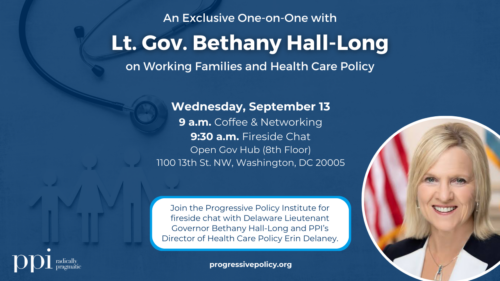
An Exclusive One-on-One Conversation with Lt. Gov. Bethany Hall-Long on Working Families and Health Care Policy

Wednesday, September 13, 2023

9:00 a.m. Coffee & Networking
9:30 a.m. Fireside Chat

Open Gov Hub
1100 13th St. NW (8th Floor), 4th Floor, Washington, DC 20005

About this event

On Wednesday, September 13 at 9 a.m., join the Progressive Policy Institute (PPI) for an exclusive one-on-one with Delaware Lieutenant Governor Bethany Hall-Long and PPI’s Director of Health Care Policy Erin Delaney as they discuss some of the top issues facing Delaware’s working families, including how to expand access to quality maternal health, how to strengthen Delaware’s health care workforce, and how to best address Delaware’s child care crisis. Lt. Gov. Hall-Long will share how she plans to build a stronger economy and create better health outcomes for all of Delaware.

Prior to the fireside chat, join us for coffee and pastries and network with other policy advocates and experts in the field. The fireside chat will begin promptly at 9:30 a.m.

Register Here

‘Honest Billing’ is a Step Forward, But No Substitute for Site-Neutral Payments

One of the greatest contributors to America’s rising high health care costs is bloated hospital bills for simple procedures. We hear plenty of stories about how patients are increasingly confused by the shockingly expensive bills they receive from their providers, especially when their medical care shifts from an outpatient to a hospital-based setting.

Both Medicare and private health insurances pay hospital-owned facilities higher rates than independent medical practices and other outpatient facilities for the exact same services. These higher payment rates create an incentive for hospitals to acquire these independent practices, resulting in higher prices charged to patients. Clinic visits are the most commonly billed service under Medicare, which only reimburses $116 for each visit to an outpatient hospital clinic doctor and $46 for the same level visit for an independent doctor.

Congress is considering two different approaches — site-neutral payment reform and “honest billing” for creating greater price transparency and lowering hospital costs. Both have attracted bipartisan support, but site-neutral payment reform holds greater promise for lowering patients’ medical bills and saving taxpayers money.

Making payments “site-neutral” means reimbursing providers by the same amount regardless of where they provide medical services to patients. For example, several bills would apply that principle to Medicare reimbursements. This would save the federal government billions of dollars and reduce premiums for seniors.

​​Another set of proposals that fall under an “honest billing” category, would not make any changes to Medicare reimbursement and instead focuses on billing hospitals separately for each off-campus outpatient department. While these other “honest billing” proposals present a step forward in advancing site-neutral payment reform to cut costs, they don’t fully move towards equalization of reimbursing hospital versus non-hospital settings and thereby don’t truly implement site-neutral payments. These bills give insurers more transparency about where services are being performed, but they wouldn’t meaningfully reduce costs.

Both the House Education and Workforce (E&W) and House Energy and Commerce (E&C) Committees have separate bills that were recently marked up in committee and fall under the “honest billing” category. The House E&W bill, H.R. 4509, the Transparency In Billing Act, would require hospitals and their hospital outpatient departments (HOPDs) to provide unique health identifiers to insurers for the location where the service was provided to ensure that insurers can bill appropriately. If not, then insurers wouldn’t be required to pay the claims. However, this would only apply to the group market and would require the Department of Labor to issue rulemaking and establish a process for reporting violations. The House E&C bill, H.R. 3237, would also require each provider’s department to include a unique identifier number for claims and services on any billing and requires hospitals to attest every two years that it is in compliance.

The House Committee on Ways and Means held their markup yesterday to consider their own legislation to implement site-neutral payments, which included consideration of H.R. 4822, the Health Care Price Transparency Act. The bill was approved by the Committee in a party-line vote: Democrats opposed the bill due to a removal of a provision to address private equity acquisitions of hospitals and nursing homes, while Republicans all voted in favor.

Similar to the House E&C proposal, this bill would require all off-campus outpatient departments to have a separate national provider identification (NPI) number to bill Medicare. The bill would equalize payments between off-campus hospital outpatient services and physician practices for only drug administration services. On-campus hospitals would still be able to charge more than physician offices for performing the exact same service, which would leave most of the potential savings from site-neutral payments unrealized.

Meanwhile, the Senate Committee on Health, Education, Labor, and Pensions (HELP) postponed their markup scheduled for this week of a health workforce package that contains several additional health reforms, including a provision that would regulate hospital facility fees. Different from the other “honest billing” proposals, the provision would prohibit hospitals from charging facility fees for services provided by off-site physicians and prohibits both the hospital and physician from separately billing for services. Notably, it would cap both the hospital and physician fees at “the median amount the health plan or issuer pays when those services are provided in a physician’s office.” Hospitals would also be prohibited from charging facility fees for on-site primary care, telehealth, and low-complexity services that could be provided in an ambulatory setting.

This type of proposal is a more promising approach than the “honest billing” policies that are under consideration since it would directly affect patient health care costs since facility fees are billed directly to the patient and “honest billing” only addresses NPI numbers for insurance coding. While there are other issues with the bill that likely make it a nonstarter for Republicans, Senator Bill Cassidy has signaled that he’s open to the facility fee provision in another context which is a hopeful sign for future bipartisan support.

Hospitals have countered attempts by Congressional efforts to curb the rising costs of hospital-based care, claiming that any reform to reduce payment rates for hospital outpatient departments would lead to negatively impacting their financial stability. However, a recent study released by the JAMA Network that evaluated hospital financial performance before and during the COVID-19 pandemic shows that 75% of hospitals had a net positive operating income during 2020 and 2021. This was partly due to the COVID-19 relief funding dedicated to aiding hospital net operating margins, resulting in an all-time high in profitability for those hospitals. The study concludes that the relief funds received during COVID-19 were likely larger than necessary for many hospitals.

Congress needs to focus on implementing targeted policies that equalize payments across the three types of facilities, including outpatient departments, off and on campus departments, and ambulatory surgical centers, to save the most for patients and the federal government. It’s abundantly clear that Americans should not be paying more out of pocket for medical services — like chemotherapy, cardiac imaging, and colonoscopies — because of where they received the services at, especially at a time when most hospital profits are at an all time high.

PPI Applauds FDA’s Approval of Over-the-Counter Birth Control Pill

Erin Delaney, Director of Health Care Policy at the Progressive Policy Institute (PPI), released the following statement on the Food and Drug Administration’s (FDA) decision to approve an over-the-counter (OTC) birth control pill:

“PPI applauds the FDA for its approval of Opill, the first daily OTC birth control pill, after decades of advocacy to make birth control more accessible. Allowing the sale of OTC birth control pills means that the more than 19 million women of reproductive age living in contraceptive deserts could have access to the health care they need. This is a historic victory for public health and health equity as we continue to fight for reproductive access and freedom, especially in the wake of Roe.

“Now that this step has been taken, it is critical to ensure that OTC birth control pills are affordable, covered by insurance, and are available in all pharmacies — including independent pharmacies — to ensure rural access. While OTC medications are typically less expensive than prescription, the cost of Opill is not yet known and health plans are only encouraged, not required, to cover OTC birth control pills without cost-sharing. Currently, most private health insurers cover prescription birth control pills thanks to the Affordable Care Act, and all five major insurers cover different forms of OTC birth control.

“To ensure equitable access to Opill and future OTC birth control pills, PPI endorses the Affordability is Access Act, sponsored by Senator Patty Murray (D-Wash.), that would require all private health insurance plans to fully cover OTC birth control without any out-of-pocket costs to the patient.

“PPI will continue to support efforts to broaden access to comprehensive reproductive health care for all Americans.”

The Progressive Policy Institute (PPI) is a catalyst for policy innovation and political reform based in Washington, D.C. Its mission is to create radically pragmatic ideas for moving America beyond ideological and partisan deadlock. Learn more about PPI by visiting progressivepolicy.org.

Follow the Progressive Policy Institute.

###

Media Contact: Amelia Fox – afox@ppionline.org

PPI Statement on the Anniversary of the Supreme Court Overturning Roe v. Wade

Erin Delaney, Director of Health Care Policy at the Progressive Policy Institute (PPI), released the following statement ahead of the one-year anniversary of the Supreme Court’s ruling on the Dobbs decision:

“Marking this tragic anniversary would not be necessary if not for the relentless mobilization of Republican extremists to curtail access to abortion and reproductive freedom.

“Forcing abortion bans against the wishes of the majority of Americans chips away at the foundation of democracy. As the Democratic Party continues to fight for federal protections, they must also turn their focus to state legislatures. Democrats must win back seats and expand their majorities by appealing to Independent and Republican voters who don’t want to see their personal liberties stripped away.

“PPI will continue to fight against far-right extremism, defend abortion rights and work to expand access to comprehensive reproductive health care for all Americans.”

The Progressive Policy Institute (PPI) is a catalyst for policy innovation and political reform based in Washington, D.C. Its mission is to create radically pragmatic ideas for moving America beyond ideological and partisan deadlock. Learn more about PPI by visiting progressivepolicy.org.

Follow the Progressive Policy Institute.

Find an expert at PPI.

###

Media Contact: Amelia Fox – afox@ppionline.org

Popovian, Delaney, and Mandel for Medium: Are we on the cusp of a new drug pricing paradigm?

By Dr. Robert Popovian, Erin Delaney, and Dr. Michael Mandel

We may be on the verge of a titanic shift in how drug prices are set. It’s been led by a dramatic decline in insulin prices, but it’s spreading to other brand drugs as well. This new paradigm is the unintended but welcome result of legislative, regulatory, and market pressures exerted on the biopharmaceutical industry.

The big change: the three major insulin manufacturers decided to sell their medicines at a set low out-of-pocket price for all patients. The previous list prices offered for insulin were bloated by all manners of rebates, discounts, and fees necessary for the byzantine rebate contracting model promoted by the pharmacy benefit managers (PBM) and state Medicaid programs. The new list prices are stripped of all the extraneous baggage and now closely reflect the actual net payments received by manufacturers. In other words, with a straightforward move, pharmaceutical companies LillySanofi, and Novo Nordisk cut out the middlemen, the PBMs, and others who benefit handsomely by keeping some or all of the rebates, discounts, and fees provided by those companies.

But that’s not all: another brand manufacturer has started selling its brand-name diabetes medicine directly to patients at a significant discount through an innovative retail pharmacy outfit. The reduced price is 50% of the drug’s average retail price. This move helps patients saddled with substantial deductibles and co-insurance since those out-of-pocket costs are calculated based on the inflated retail prices when they utilize their insurance benefit — not the significantly lower prices negotiated by the PBMs that never reach the pocketbook of patients who are consuming those medicines. Furthermore, patients can continue to benefit from patient assistance programs offered by biopharmaceutical manufacturers.

Read more in Medium.

PPI joins coalition letter in support of site-neutral payment reform

The Progressive Policy Institute joined a coalition letter with 21 organizations and policy experts that supports site-neutral payment reform in Medicare and transparency in service billing in commercial insurance. PPI has long been supportive of site-neutral payment reform and legislative efforts to address this issue.

Medicare — and in many cases, commercial insurers — actually pay hospital-owned facilities higher rates than independent medical practices and other outpatient facilities for the exact same services. The letter explains that these higher payment rates actually create an incentive for hospitals to acquire these independent practices, resulting in higher prices charged to patients and taxpayers:

“Between 2013 and 2018, the share of physician practices that were hospital-owned more than doubled from 14 percent to 31 percent. By 2020, over half of physicians worked directly for a hospital or worked at a physician practice that was owned by a hospital, according to the AMA…An analysis by Northwestern University found the price of physician services increases 14 percent after a hospital purchases a physician practice.”

The Congressional Budget Office (CBO) estimates that these reforms would generate more than $140 billion in savings for taxpayers over ten years.

Hospitals are integral parts of our communities, but hospital care accounts for the largest health spending category in the United States. Americans should not be paying more out of pocket for medical services — like chemotherapy, cardiac imaging, and colonoscopies — because of where they received the services at. Implementing targeted site-neutral policies that promote hospital competition while still protecting rural hospitals and patient access will be critical as Congress considers advancing legislation on site-neutral payments and billing transparency.

Read the full letter here.


U.S. Black Maternal Mortality is a Human Rights Crisis

Black Maternal Health Week is a week-long initiative that raises awareness of the diminished maternal outcomes for Black women in America, who experience higher rates of pregnancy- and childbirth-related deaths. Alarmingly, Black women are three to four times more likely than white women to die from pregnancy-related causes. The CDC lists multiple factors that lead to increased rates of mortality for Black mothers, including implicit bias and discrimination, variation in quality of health care, and underlying health conditions. While differences in coverage and access to care certainly contribute to poorer health outcomes for Black women, they are still facing disparities in maternal and infant health regardless of their socioeconomic circumstances, including their education level or income. While Black women of any background should not be subjected to such poor maternal health outcomes, this starkly demonstrates how racism and discrimination factor into Black women’s maternal health experiences. Worse, Black women had the highest maternal mortality rates across racial and ethnic groups during the pandemic in 2020 and 2021 and had the largest increase when compared to data from 2019. Overall, the United States ranks worse in overall maternal health outcomes than all of our Organisation for Economic Cooperation and Development (OECD) counterparts. Additionally, the only countries with rising maternal mortality rates are the United States, Afghanistan, and Sudan.

Compounding the Black maternal health crisis in the U.S. is the Supreme Court decision to overturn Roe v. Wade. Now, 26 states have fully banned some or basically all access to abortion care, forcing millions of women of reproductive age to navigate their health care options where it is essentially impossible to obtain an abortion care.

Black women are disproportionately harmed by abortion restrictions and bans, which will likely widen the already stark disparities in maternal and infant health in this country. We know that teen birth rates declined over the last several decades thanks to expanded access to reproductive health care, but were higher among Black, Hispanic, American Indian and Alaska Native, and Native Hawaiian and other Pacific Islander teens compared to their white counterparts.

Meanwhile, the recent ruling by a Trump-appointed Texas District Court Judge to take back its approval of mifepristone, a drug for inducing abortions, used safely in this country for 23 years, is threatening to worsen U.S. Black maternal mortality. More than half of all U.S. abortions are done through medications. Mifepristone has been used by nearly 5 million people in the U.S. since it came to the market and is proven to be safer than Tylenol or Viagra. With this ruling, 40 million more could lose access to abortion care, stripping away their ability to make their own choices about their health care because of the egregiousness of one unelected, right-wing judicial activist. One in four women will have an abortion in their lifetime, and the average person who seeks abortion care is a woman of color who is already a mother and lives below the federal poverty line.

While access to abortion care will not fix the maternal health crisis in this country, restricting it will most certainly contribute to worsen America’s devastating maternal mortality crisis. Per the UN General Assembly, carrying a pregnancy to term against a person’s will is, by definition, a violation of human rights. Research confirms that women who are denied access to abortion care are more likely to experience poorer health outcomes. For example, abortion is one option for treatment for gestational diabetes and gestational hypertension, which are contributors to eclampsia. Preeclampsia is one of the most common disorders during both pregnancy and postpartum, and occurs at a 60% higher rate for Black women than white women. Because of the increased maternal mortality for Black women, it is particularly unconscionable to force them to continue an unwanted pregnancy.

Concurrently, this country has also seen a disturbing increase of maternity care deserts. In fact, 36% of U.S. counties are now maternity care deserts, meaning that 7 million women across the country live in these areas where access to maternity health care services is limited or nonexistent. Per a March of Dimes report, American counties classified as deserts increased by 2% since their 2020 report. Overall, one in eight babies born in the U.S. were born in maternity deserts, and one in six Black babies are born in areas with limited or no maternity care services. We are witnessing, in real time, a full on split of this country into abortion and maternal health deserts, prohibiting millions of Americans from accessing lifesaving care.

The Biden administration has taken some significant steps to addressing the maternal mortality crisis. In October 2022, the Department of Health and Human Services (HHS), through the Centers for Medicaid and Medicare (CMS), announced that through the American Rescue Plan (ARP) that was enacted in March 2021, more than half of all states have expanded Medicaid and the Children’s Health Insurance Program (CHIP) to provide 12 months of extended coverage after pregnancy. An estimated 418,000 Americans have now gained this coverage in combination with previously approved state extensions. If remaining states all approved this expansion, an estimated 720,000 Americans would be guaranteed Medicaid and CHIP coverage for 12 months postpartum. Last June 2022, the Biden administration released a blueprint for addressing the maternal health crisis, which offers a broad vision and call to action to address the maternal health crisis.

The most visible effort to address Black maternal mortality in Congress is the Momnibus Act of 2021, sponsored by Congresswomen Alma Adams (D-N.C.), Lauren Underwood (D-Ill.), and Senator Cory Booker (D-N.J.) and other members of the Black Maternal Health Caucus. The Momnibus Act of 2021 is a package of 12 bills that builds on existing legislation to address various issues within the Black maternal health crisis, including: making critical investments in social determinants of health as well as for community-based organizations, providing resources to diversity the perinatal workforce, invests in telemedicine and innovative payment models, and provides support for mothers with maternal mental health conditions and substance use disorders, among others. The Protecting Moms Who Served Act, which supports the Department of Veterans Affairs in studying the unique maternal health risks facing pregnant and postpartum veterans, became the first of these bills to become law in November 2021. The Momnibus Act is highly popular, with support from 72% of registered voters.

The intersection of the curtailing of abortion access and the growing Black maternal mortality crisis in this country, while a preventable and unnecessary circumstance, is a political and policy choice. What does it say about the state of this society and the future of this country if we cannot care for all life givers, especially Black mothers, to ensure that at the very least, they live through their birth experiences? Black mothers deserve to thrive; they deserve to return home to their families, to rest and heal from the life-altering experience of giving birth, to receive support and care from their communities and health care providers. Black women deserve so much more than the bare minimum of surviving pregnancy — they should be able to decide how, when, and whether to grow their families and should receive high quality health care that is accessible, safe, respectful, and culturally competent.

Trump Judge Escalates Right’s Assault on Reproductive Freedom

Last week, a Trump-appointed Texas District Court judge ordered the U.S. Food and Drug Administration (FDA) to take back its approval of mifepristone, a drug for inducing abortions, used safely in this country for 23 years. Despite abortion access being a winning issue with voters, the Republican Party is continuing to use legislation and right-wing judges to strip away bodily autonomy and the ability for Americans to make their own choices about their health care.

Erin Delaney, PPI’s Director of Health Care Policy, outlines the impact and consequences this decision has on the entire country in her latest post on Medium. She notes that with this latest ruling, 40 million more women could lose access to abortion care by removing a drug that has been proven safer than Tylenol or Viagra.

Erin writes, “Not only does it [the decision] abet the drive by Republican extremists to strip Americans of their reproductive rights, it sets a terrible precedent in which activist right-wing judges overrule the nation’s top health authorities for purely ideological reasons. Judge Kacsmaryk’s atrocious ruling hits a MAGA trifecta — at once undermining personal liberty, medical science, and the Constitution’s separation of powers.”

Read the full piece here.

The Progressive Policy Institute (PPI) is a catalyst for policy innovation and political reform based in Washington, D.C. Its mission is to create radically pragmatic ideas for moving America beyond ideological and partisan deadlock. Learn more about PPI by visiting progressivepolicy.org. Follow the Progressive Policy InstituteFind an expert at PPI.


###

Media Contact: Amelia Fox; afox@ppionline.org

Delaney for Medium: Texas Court Rules to Pull Abortion Drug, Showing the Right’s Next Move in their Anti-Choice Playbook

By Erin Delaney

On Friday, a Trump-appointed Texas District Court judge unsurprisingly ordered the U.S. Food and Drug Administration to take back its approval of mifepristone, a drug for inducing abortions, used safely in this country for 23 years. U.S. District Judge Matthew Kacsmaryk also put a weeklong stay as part of his ruling, making mifepristone still available in all states at this time, unless his ruling stands. Nonetheless, last Friday’s ruling in Amarillo by Judge Kacsmaryk in Amarillo is shockingly dangerous.

Not only does it abet the drive by Republican extremists to strip Americans of their reproductive rights, it sets a terrible precedent in which activist right-wing judges overrule the nation’s top health authorities for purely ideological reasons. Judge Kacsmaryk’s atrocious ruling hits a MAGA trifecta — at once undermining personal liberty, medical science, and the Constitution’s separation of powers.

Prior to his appointment to the federal bench, Judge Kacsmaryk was a fixture of the radical right known for his attacks on contraception, abortion, gay marriage and protections for LGBTQ people. Although he promised in his Senate confirmation to set aside his personal views, there’s little evidence of a judicial temperament in his mifepristone ruling.

At the same time on Friday afternoon as his decision was released, Judge Thomas Rice from the U.S. District Court of Eastern District of Washington came out with a ruling challenging the FDA’s decision to impose restrictions on mifepristone prescribing and dispensing through the Risk Evaluation and Mitigation System (REMS) and that the restrictions imposed by the FDA are unnecessary and limit access. This ruling orders the FDA to maintain access to mifepristone in 17 states and Washington, D.C. Almost immediately after Judge Kacsmaryk’s decision, the Department of Justice filed a notice of appeal to the U.S. Court of Appeals for the 5th Circuit to request a stay while this appeal is considered to maintain access to mifepristone. If this stay is not granted by the 5th Circuit, then the FDA will likely appeal to the Supreme Court to block this ruling throughout the appeals process with the 5th Circuit. Unfortunately, if both courts do not provide a stay during the appeals process, then distribution of mifepristone could be halted across the country.

Read more in Medium.

PPI Applauds North Carolina Medicaid Expansion Passage

North Carolina has officially become the 40th state to expand Medicaid under the Affordable Care Act (ACA), which is expected to be implemented in 2024 after the state budget is approved, likely this summer. Once implemented, an estimated 600,000 people will be eligible for coverage under the expansion. PPI applauds Governor Roy Cooper for his persistent leadership to garner bipartisan support to ensure North Carolinians have the health care access they deserve through Medicaid expansion. The North Carolina House passed expansion in an 87-24 vote last week, with nearly two-thirds of House Republicans voting in favor.

The path to expansion in North Carolina was no simple feat, as North Carolina Republicans have been staunchly opposed to expansion for over a decade since it’s a policy that was implemented by the Obama administration through the ACA 13 years ago. In fact, GOP members of the North Carolina legislature were so opposed to expansion that they passed a law in 2013 to prevent the governor from even seeking expansion without approval from the General Assembly. The GOP attitude on preventing expansion in North Carolina began to change once they realized Congressional Republicans were not going to succeed in repealing or replacing the ACA in 2017, or raising the state match that coverage requires. Additionally, in May 2022, longtime expansion opponent, State Senate Leader Phil Berger, publicly expressed his support for expansion and framed it as a sensical budget move and one that would help those who fall in the coverage gap whose income is too high to qualify for Medicaid, but too low to benefit from highly subsidized private insurance.

Both chambers of the North Carolina legislature initially passed Medicaid expansion in 2022 but were unable to reach an agreement on the specifics of the state’s Certificate of Need (CON) regulations. An agreement was reached to loosen the CON regulations this year, which also helped pave the way for the expansion’s passage. Notably, the American Rescue Plan (ARP), the $1.9 trillion stimulus package that was passed by Congress and signed into law by President Biden in 2021, allows newly expanded Medicaid states to receive additional federal Medicaid funding for their non-expansion population. North Carolina will now receive this additional funding from the ARP for the first two years of the expansion.

Under the ACA, Medicaid coverage was expanded for adults with incomes up to 138% of the federal poverty level (FPL). This provision was initially a requirement, but became optional after the June 2012 Supreme Court ruling in National Federation of Independent Businesses v. Sebelius, permitting states to choose to opt into expansion or not. With North Carolina now expanding Medicaid, 40 states, including the District of Columbia, have expanded the program. Ten states remain as hold-outs: Alabama, Florida, Georgia, Kansas, Mississippi, South Carolina, Tennessee, Texas, Wisconsin, and Wyoming. Before North Carolina expanded, South Dakota recently expanded Medicaid in 2022 in a referendum, and will start implementation in July 2023.

How Medicaid expansion will benefit North Carolina:

  • 600,000 North Carolinians will be eligible for coverage;
  • North Carolina hospitals provide roughly $1 billion in uncompensated care each year. This amount will sharply decline once Medicaid expansion is implemented and the uninsured patients that can opt into Medicaid are covered;
  • North Carolina Medicaid expansion will create 40,000 new jobs in North Carolina and will help keep rural hospitals open;
  • North Carolina will receive $8 billion in annual federal funding with no additional cost to the state along with an additional $1.8 billion to support behavioral health, public safety support, rural health care and other needs. The state left $5.9 billion in federal funding by not expanding Medicaid in 2022.


This data clearly demonstrates what non-expansion states are missing out on. Medicaid expansion is a state revenue generator, a job creator, lowers health care system costs, and most importantly, provides access to health care for low-income and marginalized communities, decreasing health disparities. An estimated 3.7 million people, including non-Hispanic Black people, young adults, and women of reproductive age would gain coverage in 2023 if these remaining hold-out states expanded Medicaid eligibility. It’s high time for Republican lawmakers in non-expansion states to come to the consensus that Medicaid expansion is more than worth setting aside futile partisanship over the ACA. They should look to North Carolina as an example of what is possible when Republicans put aside their opposition to the ACA and reconsider the state budgetary and health benefits of expansion. Americans are still facing financial hardship, incalculable loss, and long-COVID illnesses and disabilities due to the COVID-19 pandemic, which also wreaked havoc on our health care system. Medicaid expansion can provide access to affordable health care and greater financial stability that many Americans desperately need now.

Popovian for InsideSources: A Federal Drug Discount Program for the Wealthy

By Robert Popovian and William Smith

For various factors, a single federal drug program that accounts for tens of billions in annual spending has hit a tipping point in its evolution. The combination of legal disputes, a growing data repository and investigative reports have necessarily put the 340B Drug Pricing Program under the microscope. Combined with the fact that the policy lacks any necessary guardrails to ensure transparency and integrity for patients, 340B has spiraled out of control to the point that no policymaker can ignore the need to look closer.

Recently, a federal appeals court in Philadelphia admonished the Department of Health and Human Services for requiring drugmakers to provide discounted drugs to an unlimited number of pharmacies that contract with hospitals or clinics eligible for such federally required drug discounts. Under the so-called 340B Drug Pricing Program, drugmakers must give deep discounts to certain nonprofit hospitals and clinics.

When the program began in the early 1990s, those hospitals and clinics that did not have an in-house pharmacy could sign a contract with one outside pharmacy to distribute their discounted drugs. In 2010, despite no statutory provision concerning contract pharmacies, HHS permitted hospitals and clinics to contract with an unlimited number of outside pharmacies, and the 340B program exploded.

Read more in InsideSources.

The Affordable Care Act at 13: Promises Kept and the Road Ahead

Thirteen years ago today, President Barack Obama and Democrats in Congress fundamentally transformed the U.S. health care system by providing health insurance coverage that curbed costs and expanded access to millions of Americans. While challenges remain to strengthen the legislation, the Affordable Care Act (ACA) remains entrenched as a permanent feature of America’s hybrid, public-private health care system, and continues to deliver on its promise to provide near-universal coverage to Americans at an affordable cost.

Since its enactment, the Republican Party has unleashed relentless attacks and legal challenges to health insurance coverage while repeatedly trying to repeal and replace the ACA despite widespread and growing support for the legislation. While Republicans tirelessly work to cut insurance coverage and raise health care costs for families across the United States, the ACA continues to serve as a milestone in the Democratic Party’s century-long struggle to create a universal health care system that leaves no one out.

As we look back on the successes and challenges of the Affordable Care Act, the Progressive Policy Institute (PPI) is marking the anniversary by releasing a policy brief examining the high-level benefits of the legislation’s implementation and additional policy solutions to bolster the law. The policy brief is titled “A Public Policy Success: The Affordable Care Act and the Road Ahead,” and is authored by PPI’s Director of Health Care Erin Delaney.

In tandem with the policy brief, Delaney sat down with former Health and Human Services Secretary Kathleen Sebelius to reflect on the landmark passage of the ACA and the critical role it played in providing essential coverage to millions of Americans during the COVID-19 pandemic. In a new interview, Delaney and Secretary Sebelius look back on the path — 13 years ago — that led to one of the most consequential pieces of health care legislation to be enacted in this country.

Download the policy brief here and listen to the full podcast episode here.

The Progressive Policy Institute (PPI) is a catalyst for policy innovation and political reform based in Washington, D.C. Its mission is to create radically pragmatic ideas for moving America beyond ideological and partisan deadlock. Learn more about PPI by visiting progressivepolicy.orgFind an expert at PPI and follow us on twitter.

###

Media Contact: Tommy Kaelin; tkaelin@ppionline.org

A Public Policy Success: The Affordable Care Act and the Road Ahead

INTRODUCTION

The Patient Protection and Affordable Care Act (ACA), signed into law by President Barack Obama in 2010, transformed the way the U.S. health care system provides health insurance coverage that curbed health care costs and modified how health care is delivered. On the 13th anniversary of the law, it’s clear that it advanced America closer toward universal coverage, but challenges remain. As lawmakers and key stakeholders address these systemic issues that contribute to more expensive, less accessible health care, it is critical that they focus on building on the law by prioritizing Medicaid expansion in non-expansion states, mitigating coverage loss from the unwinding of the public health emergency (PHE) declaration, ensuring the U.S. has the resources needed to respond to ongoing COVID-19 costs and future pandemics, boosting funding and state data infrastructure to strengthen efforts to address social determinants of health, and expanding postpartum Medicaid coverage.

The ACA has faced an obstacle-strewn path with countless legal and legislative challenges throughout the past 13 years. Only one House Republican voted for the ACA’s passage in 2010. Republicans have since been waging an implacable battle to repeal “Obamacare,” which they touted would undermine private insurance markets and raise premiums. Nearly every budget or fiscal plan of theirs since the law’s enactment has included repealing the ACA as well as cutting Medicaid. After President Donald Trump’s election, Republicans tried repeatedly to repeal and replace the ACA but failed, despite controlling both chambers of Congress. In a dramatic 2017 vote, Republicans fell one vote short of repealing the law. In the 2018 midterm elections, they lost control of the House in a Democratic sweep, attributed in part to growing public support for the ACA.

Simultaneously, the ACA has been subjected to more than 2,000 legal challenges since its implementation. The most recent notable case, California v. Texas, which was heard by the Supreme Court in June 2021, claimed that the lawsuit filed by Texas lacked standing. The Texas district court asserted that the reduction of the individual mandate in the 2017 Tax Cuts and Jobs Act to zero was justification for the ACA’s unconstitutionality as an improper use of Congress’s taxation powers. Legal experts, even those opposed to the ACA, agreed that the legal arguments to this case were absurd, as Texas ignored Congress’s decision to zero out the individual mandate but to leave the rest of the ACA in place, which is principally Congress’s decision, not the court.

Despite the at least 70 Republican attempts to repeal or modify the ACA, the law seems firmly entrenched as a permanent feature of America’s hybrid, public-private health care system. It has delivered on its promise to increase coverage and access for millions of Americans and played a key role in helping people who lost job-based insurance stay covered throughout the COVID-19 pandemic. The law also has been a milestone in the Democratic Party’s century-long struggle to create a universal health care system that leaves no one out. It’s brought our country very close to universal coverage, while also testing new ways to deliver health care and reduce its cost.

This policy brief will examine the benefits of the implementation of the ACA, how to build on the ACA’s accomplishments, and rein in high medical costs to improve community health.

READ THE FULL POLICY BRIEF


Popovian for National Review: Transparency Laws Are the First Step toward Creating a More Sustainable Health-Care System

By Dr. Robert Popovian, Senior Health-Policy Fellow for PPI;
and Catherine Barr Windels

For decades, lobbyists for the pharmacy-benefit-management (PBM) industry have been telling policy-makers, employers, and patients that PBMs (middlemen responsible for the administration of the prescription-drug benefit for various health-plan payers) save everyone money. They argue that opaque negotiation, rebate contracting, and vertical and horizontal integration are intended to help lower biopharmaceutical spending. Unfortunately, the promises of savings are a mirage, with no data-driven analysis to back them up. The PBM industry is thus staunchly opposed to laws that provide transparency into their business practices.

Fortunately, states and federal legislators are finally taking action. They have decided to scrutinize the flow of untold billions of dollars in discounts, fees, concessions, and rebates that are siphoned off from the biopharmaceutical industry by the pharmacy-benefit managers. The estimated total collected by the middlemen is over $200 billion annually, which makes up almost 40 percent of drug spending in the U.S. Unfortunately, because of a lack of transparency, no one, including federal and state governments, has a clue as to how much of that money provided by the pharmaceutical industry is kept by PBMs. At best, there are estimates by various governmental agencies of the amount of savings that is passed back to those who are supposed to benefit from the work of PBMs: the employers, the state and federal governments, and most importantly, the patients. It is important to note that such estimates are primarily based on modeling data, testimony by PBM officials, or incomplete information.

Read the full piece in the National Review.

PPI on the SOTU: Health

As the country continues to grapple with the consequences of the reversal of Roe v. Wade, the landmark Supreme Court case that guaranteed the constitutional right to an abortion for nearly half a century, it is critical for President Biden to reassure all Americans who can get pregnant that his administration will continue to work to restore abortion rights. President Biden needs to respond to Republicans doubling down on restricting and outlawing access to abortion as they ramp up their campaigns for the 2024 election by further expanding access to medication abortion drugs, including Mifepristone. The Biden administration should eliminate the pharmacy and prescriber certification requirements to dispense mifepristone, and assert the authority of the FDA to preempt state law for FDA-approved medications to prohibit states from banning access to medication abortion.

Now that the Biden administration has announced that the Public Health Emergency (PHE) declaration will end on May 11, President Biden needs to reassure Americans that the transition will not affect their access to coverage and affordable care. The PHE declaration that was issued by the Secretary of Health and Human Services in March 2020 provides flexibilities for the federal government to modify or waive certain requirements, including for Medicare, Medicaid, and the Children’s Health Insurance Program. Those who are vulnerable — children and those with chronic illnesses and disabilities — will need more assistance in navigating the administrative process to regain coverage once the PHE declaration ends. President Biden should call for relaxing eligibility requirements that were exclusionary before the PHE declaration was issued by reducing administrative burdens using administrative data and targeting assistance to those groups to keep eligible individuals and families enrolled.

Additionally, various provisions that were authorized by the Public Readiness and Emergency Preparedness (PREP) Act into the COVID-19 PHE declaration are set to expire next year. These provisions permitted pharmacists and pharmacy technicians to administer COVID-19, flu, and all recommended pediatric vaccines without a prescriber order, even in certain states that have laws that limit pharmacies from administering some vaccines to certain populations. If these provisions expire, 25 states where the authority for pharmacist-administered vaccines has not been made permanent will face the consequences of the expiration most acutely as states will return to restricting pharmacists to administer certain vaccines, including the COVID-19 vaccine. President Biden should call on states to adopt and codify the PREP Act declaration expanding pharmacist ability to vaccinate in state law, which governs pharmacist practice, to ensure Americans continue to have greater access to these life-saving vaccines beyond the end of the PHE.

This post is part of a series from PPI’s policy experts ahead of President Biden’s State of the Union address. Read more here