Key to a Stronger U.S. Manufacturing Sector is More Complexity, Argues New Report from PPI’s Innovation Frontier Project

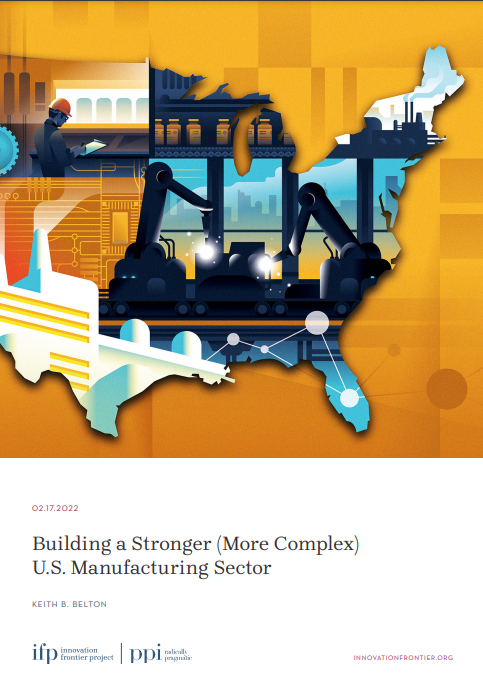
new report from the Progressive Policy Institute (PPI)’s Innovation Frontier Project, calls for United States policymakers to revamp our manufacturing sector to ensure the U.S. remains a leader in the global economy.

The report, authored by Keith Belton titled “Building a Stronger (More Complex) U.S. Manufacturing Sector,” provides policy recommendations, compares complexity in exports across several countries, and dives deep into theories behind manufacturing complexity, trade and competition.

“American manufacturing is on the decline, but we have a unique opportunity to kick this vital sector into high gear by making it more complex and diverse. We can strengthen it now with pragmatic legislation and look to our international competitors for a blueprint. With Keith Belton’s smart roadmap, our next generation of manufacturers could be working in a more secure, advanced and competitive manufacturing sector,” said Jack Karsten, Managing Director of the Innovation Frontier Project at PPI.

Belton argues that there are three public policy areas in which we can leverage complexity theory, including revising the national strategic plan for manufacturing at the White House Office of Science and Technology Policy, reviewing domestic supply chains, and establishing new statutory programs to strengthen the defense industrial base.

He also points to the need for the government to drive private sector investment in more complex manufacturing, which is being considered by Congressional leadership as the House and Senate reconcile the House-passed COMPETES Act with the Senate-passed United States Innovation and Competition Act (USICA). Global examples may be a launching point for the government as we look to replicate manufacturing competitiveness expansion in the next decade.

Read the report and expanded policy recommendations here:

Based in Washington, D.C., and housed in the Progressive Policy Institute, the Innovation Frontier Project explores the role of public policy in science, technology and innovation. The project is managed by Jack Karsten. Learn more by visiting innovationfrontier.org.

The Progressive Policy Institute (PPI) is a catalyst for policy innovation and political reform based in Washington, D.C. Its mission is to create radically pragmatic ideas for moving America beyond ideological and partisan deadlock. Learn more about PPI by visiting progressivepolicy.org.

###

Media Contact: Aaron White; awhite@ppionline.org

Tech and Telecom Prices Still Resist the Inflationary Surge

When we look back on this period, a big inflation story will be the dog that didn’t bark. While prices for traditional goods like energy, food, and autos have skyrocketed, digital economy inflation has remained almost non-existent.

This relative lack of inflation in the tech, broadband and ecommerce worlds — including ecommerce margins — is a stunning phenomenon that deserves a lot more attention than it is getting. Why are these companies holding the line on inflation when old-line industries are bingeing on double-digit price increases?

One real possibility is that innovation and investment in the digital sector may have a dampening effect on inflation. Basic economics tells us that when tech and telecom companies spend tens of billions of dollars to create new capacity and deploy new technology, it’s going to be hard for anyone to raise prices, including themselves. PPI’s Investment Heroes report from last year showed that eight out of the top 10 companies in terms of domestic capital spending — Amazon, Verizon, AT&T, Alphabet, Intel, Facebook, Microsoft and Comcast — were in the tech, ecommerce, and broadband sectors. PPI has not yet done the most recent Investment Heroes report, but it’s clear that massive spending on information technology, 5G networks, and ecommerce fulfillment centers is holding down digital prices.

Let’s take a look at the data from the January 2022 Producer Price report, released February 15. Overall, this report show relatively high inflation, with final demand prices up 9.7% over the past year, and the prices of final demand less food and energy up 8.3% (the last line of the table below).

But in the middle of this price surge, tech and telecom prices showed relative small increases or even decreases. The table below compares pre-pandemic inflation (January 2019 to January 2020) with the most recent year (January 2021 to January 2022).

We see that in the latest year, the producer price of cable and other subscription programming, internet access services, and data processing and related services are all falling. The producer price of wireless communications is basically flat (we note that the consumer price of wireless is down by -0.5% over the past year, consistent with the picture painted by the producer price data).

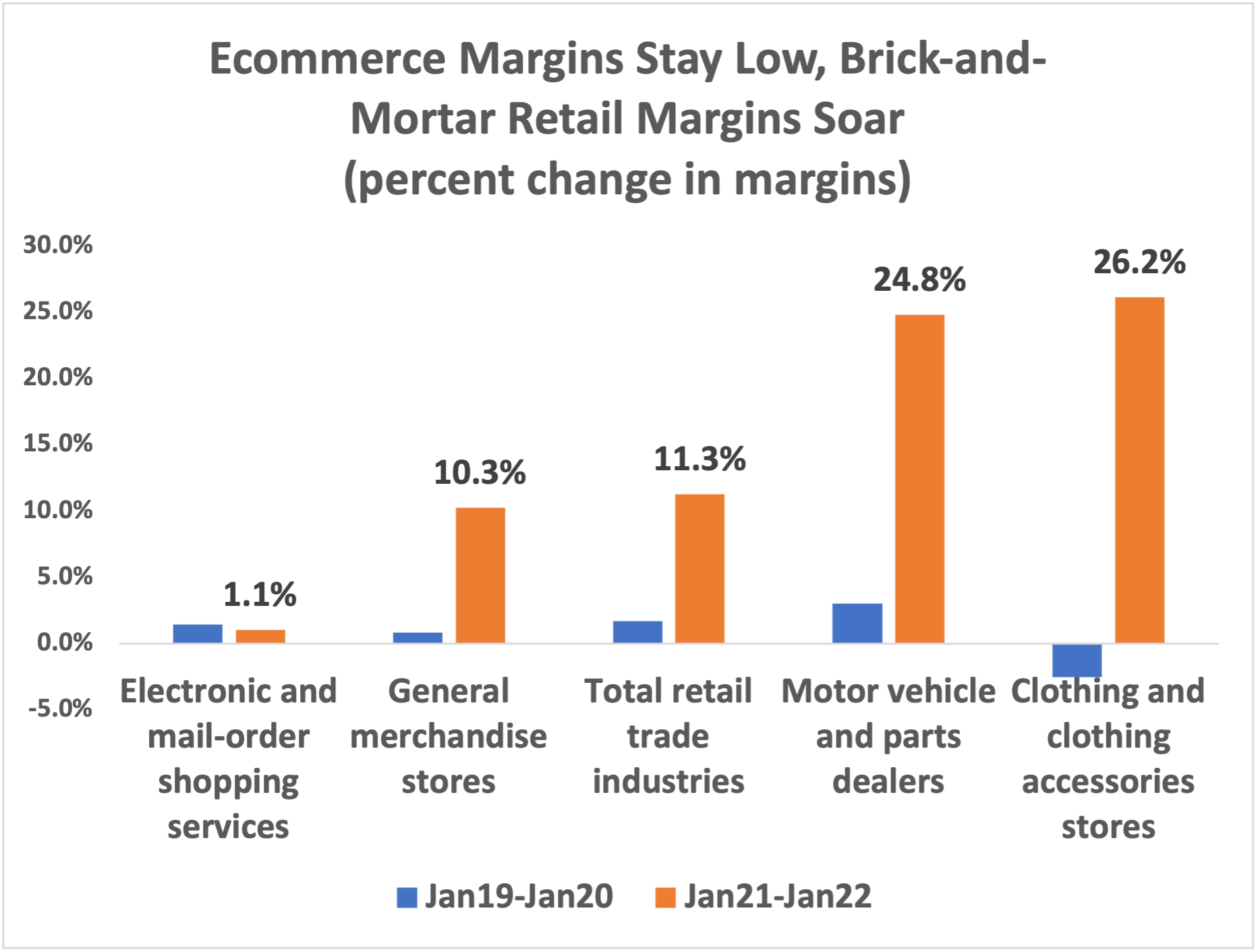
Margins for electronic and mail order shopping services are rising at only a 1.1% rate (we’ll discuss these further below). Prices for advertising sales by internet publishers and web search portals are rising at a 3.5% pace, only slightly faster than the pre-pandemic inflation rate of 3.4%.  Relative to January 2015, prices for advertising sales by internet publishers and web search portals are down by 16.9%.*

The one major exception to the low inflation story is the producer price of computer and electronic product manufacturing, which did take a substantial jump, probably in part because of supply chain disruptions.


Tech and Telecom Producer Prices Show Very Little Inflation
(change in producer prices)
Jan19-Jan20 Jan21-Jan22
Cable and other subscription programming 2.8% -1.8%
Internet access services 0.5% -1.3%
Data processing and related services 3.0% -0.3%
Wireless telecommunications carriers 0.2% 0.1%
Information technology (IT) technical support and consulting services (partial) 1.4% 0.9%
Electronic and mail-order shopping services 1.4% 1.1%
Software publishers -0.9% 1.1%
Wired telecommunications carriers 2.4% 2.6%
Internet publishing and web search portals – advertising sales 3.4% 3.5%
Computer & electronic product mfg 1.3% 4.1%
Comparison: Final demand for goods and services less foods and energy 1.6% 8.3%


For retail industries, the BLS collects “margin” prices, which is the selling price of a good minus the acquisition price of the good.  A bigger margin indicates that the retailer is either getting a higher profit, or having to cover increased costs for labor, energy, and other inputs.

The chart below shows that in the year ending January 2022, overall retail margins rose by 11.3%, a big jump over their pre-pandemic rate of 1.7%. General merchandise store margins rose by 10.3%, while the margins of motor vehicle and parts dealers rose by almost 25%.

Note that this increases could reflect the higher cost of running brick-and-mortar establishments during a pandemic, or they could reflect higher profits. But what is clear is that ecommerce margins have barely rose in the year ending January 2022.


*I looked at long-term trends in internet and print advertising prices in a 2019 paper, “The Declining Cost of Advertising: Policy Implications.”


Trade Fact of the Week: The U.S.-Canada trade relationship is the largest in world history

FACT:

The U.S.-Canada trade relationship is the largest in world history.


THE NUMBERS: 

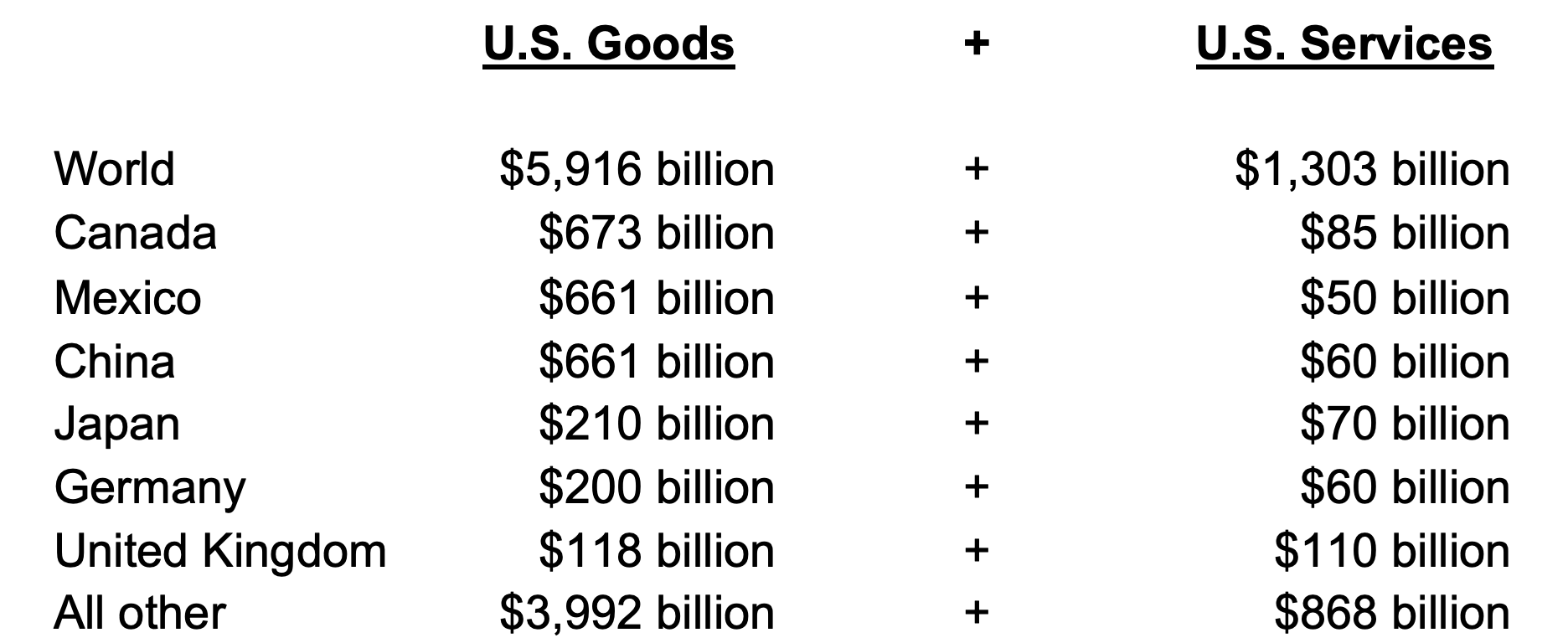
Top six U.S. goods + services trade partners in 2021*

* Estimates for services based on the nine months available data. Goods trade are full-year figures.


WHAT THEY MEAN:

Then-President Reagan in September of 1988, eloquently closing as he signs the U.S.-Canada Free Trade Agreement: “Let the 5,000-mile border between Canada and the United States stand as a symbol for the future. No soldier stands guard to protect it. Barbed wire does not deface it. And no invisible barrier of economic suspicion and fear will extend it. Let it forever be not a point of division but a meeting place between our great and true friends.”

A generation into this future:

(1)      Canada accounts for a ninth of all U.S. goods trade and (with some uncertainty as final services data aren’t yet in) about a fifteenth of services trade. The total places Canada slightly ahead of Mexico and China as top trade partner, and thus as the largest single trade relationship in the world.  Matching this against history is tricky — should one compare last year’s $740 billion in U.S.-Canada trade to the $95 trillion in world GDP? To the $20 trillion in trade flows? To something else? But in the simplest sense, counting the nominal value of paper dollars or shiny loonies, last year’s U.S.-Canada relationship was the largest two-way trade relationship ever.

(2)    Canada is the top U.S. export market for 29 states, and second-ranked for another 13. Canadians buy more American goods ($308 billion in 2021) than the 27 EU countries ($272 billion) combined; or, alternatively, nearly as much as China ($150 billion) plus Japan ($75 billion) plus Korea ($66 billion) plus Hong Kong ($30 billion) plus Taiwan ($37 billion). Only the U.K. is a larger buyer of American services.

(3)    President Reagan seems to have low-balled the border length a bit; by the International Border Commission’s estimate, it is 5,528 miles, including 4,000 along the “continental U.S.” northern border and 1,500 on Alaska’s western and southern frontier. Either way, as events elsewhere in the world continually remind us, a friendly, unguarded, border-cum-meeting-place, where the most troubling events are COVID-related tourism interruptions and temporary blockages of auto-parts shipments, is (a) a rarity in history, (b) something to greatly value, and (c) a heritage to protect.


FURTHER READING

Governments 

Then-President Reagan signs the U.S.-Canada FTA, September 1988.

USTR’s “USMCA” page, a generation later.

Trade section for the U.S. Embassy in Ottawa.

… and for the Canadian Embassy on vice versa.

Borders

Official data on state, provincial, and other border facts from the International Border Commission.

Wait times on the Ambassador Bridge, said to be the world’s single busiest international commercial crossing, from U.S. Customs and Border Patrol.

The Canadian Customs Border Services Agency tracks wait times at the 126 U.S.-Canada crossing points.

Exasperated comment from Michigan Gov. Whitmer.

The Missoulian reports on protests, blockages, and local reactions at the Sweetgrass (MT) crossing point.

Remarks from Deputy Prime Minister Chrystia Freeland regarding the blockades and the Emergencies Act


ABOUT ED

Ed Gresser is Vice President and Director for Trade and Global Markets at PPI.

Ed returns to PPI after working for the think tank from 2001-2011. He most recently served as the Assistant U.S. Trade Representative for Trade Policy and Economics at the Office of the United States Trade Representative (USTR). In this position, he led USTR’s economic research unit from 2015-2021, and chaired the 21-agency Trade Policy Staff Committee.

Ed began his career on Capitol Hill before serving USTR as Policy Advisor to USTR Charlene Barshefsky from 1998 to 2001. He then led PPI’s Trade and Global Markets Project from 2001 to 2011. After PPI, he co-founded and directed the independent think tank ProgressiveEconomy until rejoining USTR in 2015. In 2013, the Washington International Trade Association presented him with its Lighthouse Award, awarded annually to an individual or group for significant contributions to trade policy.

Ed is the author of Freedom from Want: American Liberalism and the Global Economy (2007).  He has published in a variety of journals and newspapers, and his research has been cited by leading academics and international organizations including the WTO, World Bank, and International Monetary Fund. He is a graduate of Stanford University and holds a Master’s Degree in International Affairs from Columbia Universities and a certificate from the Averell Harriman Institute for Advanced Study of the Soviet Union.


Read the full email and sign up for the Trade Fact of the Week

Marshall for The Hill: On Crime, Democrats Should Follow Eric Adams

By Will Marshall

The U.S. economy is rebounding vigorously from the COVID-19 recession. That ought to be lifting the public’s spirits, but Americans instead are increasingly preoccupied by two distressing pandemic legacies — soaring prices and gun violence.

In New York City, for example, serious crimes jumped by nearly 39 percent in January, prompting civil rights leader Al Sharpton to call the situation “out of control.” President Biden traveled to Manhattan last week for a high-profile confab with newly-elected Mayor Eric Adams, who has made public safety his top priority.

It was a smart move, because Adams is just what Biden and his party need now to refurbish their credentials as credible crime fighters. He’s a pragmatic Black mayor and former police officer who has been an outspoken critic of both police brutality and racial profiling as well as the activist left’s demands to “defund the police.”

Read the full piece in The Hill

Ritz for Forbes: MMT Isn’t Taking A Victory Lap – It’s On Its Last Legs

By Ben Ritz

In recent years, politicians on the far left have leaned on Modern Monetary Theory (MMT) to justify offering increasingly exorbitant spending proposals without plans to pay for them. Then roughly $6 trillion in deficit-financed stimulus approved by Congress in 2020 and 2021 provided policymakers a natural experiment to evaluate the claims proponents of MMT made. The results exposed the critical flaws in their approach, and rather than being able to take a victory lap, MMT is now on its last legs.

The idea that government should use deficit spending to support an economy in crisis is not unique to MMT – economists across the political spectrum supported an aggressive fiscal response in 2020. The core tenet of MMT is that a monetarily sovereign nation, like the United States, can always simply print however much currency it needs to buy whatever goods and services programs require. This is the lens through which proponents of MMT have argued that the only constraint on deficit spending should be inflation that materializes when the economy is utilizing all available resources.

Read more in Forbes.

Trade Fact of the Week: U.S. has lost 35,000 exporting businesses since the mid-2010s

FACT:

U.S. has lost 35,000 exporting businesses since the mid-2010s.


THE NUMBERS: 

U.S. export share of GDP:

2021:        10.8%
2020:       10.2%
2019:        11.8%
2018:        12.3%
2014:        13.5%


WHAT THEY MEAN:

Three Census Bureau reports provoke some thoughts on the U.S.’ export economy, workers and pay, growth with and without inflation, and the next three years of policy:

(1)  The “FT-900,” released Tuesday morning, is the Census’ regular monthly summary of the basic U.S. trade data, with figures on exports, imports, goods, services, countries, and so on. Tuesday’s edition covers December 2021, and is a good point for stock-taking as it covers the full year 2021, the Biden/Harris administration’s first year in office. This found U.S. exports at $2.53 billion: 2.1 million cars and $2 billion in sports and fishing equipment; 170 million cubic meters of liquefied natural gas; $59 billion in telecommunications, information, and computer services; 25 million tons of wheat; $5 billion in wine, liquors, and beer; $30 billion worth of medical devices, etc. This represents a $394 billion jump from $2.13 trillion in COVID-stricken 2020, which in one way is a very impressive pace of growth, unmatched since 2010 but in another way essentially brings exports back to the pre-COVID levels of $2.53 trillion in 2019 and $2.54 billion in 2018.

(2)  The second report, out last November, is “U.S. Exporting Firms by Demographics”.  This is a deep dive into the nature of the businesses that produce these things, using tax, trade, and other data for 2018 to provide a survey of the ownership, employment, payrolls, and foreign markets of 178,000* of that year’s 293,000 known U.S. exporters.  Some findings:

*    Exporters offer high employment and pay:  Exporting businesses averaged 274 workers, at payroll per worker of $69,000.  Non-exporters, by comparison, employed 14 workers on payroll at $44,000 per worker. About 16,500 exporting businesses are large, presumably publicly held forms (in Census’ terminology, “unclassifiable” by ownership type).  Dropping these from the tables, U.S. exporters averaged employed 54 workers, on payroll at $64,210 per worker. The comparable figures for “unclassifiable by ownership type” non-exporters were 10 workers and $41,027 per worker. The sharpest pay premium appears to be among the 23,500 women-owned exporters: They average 38 workers at $61,000 in payroll per worker, as against 9 workers and $38,000 in women-owned non-exporting businesses.

*    Diverse business ownership is a national asset:  An ethnically and racially diverse business community appears to help the U.S. find customers and income abroad.  As one example, about 1 in 12 U.S. exporters sell to Africa; for African American owned firms, the share is 1 in 7. A similar comparison from a different angle finds Hispanic-owned firms making up 5.5% of all U.S. exporters, but 10% of exporters to Latin America and 12% of exporters to Central America specifically.

(3)  Finally, “Profile of U.S. Importing and Exporting Companies,” also from this past November (though in “preliminary” form, pending a final count in April) counts the total number of exporting businesses as of early 2020.  It glumly reports 270,000 such firms, about 35,000 below the peak count of 305,000 in 2013/2014, and 23,000 below the 293,000 reported for 2016 and 2018. Mirroring this decline in numbers, the export sector’s place in the U.S. economy has diminished in recent years, falling as a share of GDP from a 13.5% peak in 2013 and 2014 to 11.8% in 2018, and then 10.3% of GDP in 2020 — the lowest level since 2006.


Against this long-term backdrop, the big jump in yesterday’s FT-900 is good news, but still leaves the U.S. exporting well short of the role it held five or 10 years ago.

What explains the erosion?  And will it last?  One obvious but presumably transient contributor is the impact of COVID-related economic closures (especially in the first half of 2020).  These affected almost all exporting sectors, and are still powerful in “transport” and “travel” services, whose exports remain far below pre-COVID levels. Another is recent policy choices: Trump-era tariffs provoked direct retaliations against U.S. exporters, and may also, by raising the cost of parts and materials for American manufacturers and farmers, be contributing to a slower erosion of export competitiveness.  Beyond this, and not yet felt, implementation of the Asia-based “Regional Closer Economic Partnership” — a 15-country Asia-Pacific trade agreement joining China, Japan, Korea, Australia, New Zealand, and the 10 ASEAN members, together accounting for about a third of all world imports outside the U.S. — presages a Pacific tariff tilt in favor of the cars, wines, fishing rods, wheat, etc. produced by U.S. competitors.

In sum, Census numbers say many good things about the U.S. export economy in 2021.  And they suggest some ways for exporters might contribute more to both workers and macroeconomic health in the next few years.  But they also offer grounds for concern, and reasons for energetic policy.

Note: PPI Trade and Global Markets staff thank Census staff for helping with interpretation of several of these releases, and more generally for their sustained excellence in statistical work in trade and other areas.


FURTHER READING

From Census 

The “FT-900” series has the basic monthly trade figures, updated Tuesday for full-year 2021.

… and the accompanying “Historical Series” has a convenient one-page annual summary of imports, exports and balances from 1960 through 2021.

And “U.S. Exporting Firms by Demographics” looks deeply into 178,000 of 2018’s 293,000 exporting businesses* by owner type: male/female; race and ethnicity (with white, African American, Hispanic, Asian American, Native American, and Pacific Islander); veteran ownership; and 200 export markets ranging in scale from “Vanuatu” and to “Africa” to “EU-27” and “All Countries.” Available with data for 2018, 2017, 2012, and 2007.

* The 115,000 whose ownership couldn’t be accounted for include non-employing firms, agricultural producers, and businesses located in Puerto Rico and the U.S. insular territories.

The “Profile of Importing and Exporting Companies” looks at exporters and importers by size, with state-by-state figures, SMEs, 25 countries, sectors, etc.

Also on exporters, from two of Census’ sister Commerce Department agencies

Writing for the Minority Business Development Agency in 2015, Sharon Freeman reviews export opportunities and challenges for African American, Hispanic, Asian American, and Native American small businesses.

And the International Trade Administration summarizes research on the count and nature of “jobs supported by exports.”

And overseas

ASEAN announces entry into force for RCEP.


ABOUT ED

Ed Gresser is Vice President and Director for Trade and Global Markets at PPI.

Ed returns to PPI after working for the think tank from 2001-2011. He most recently served as the Assistant U.S. Trade Representative for Trade Policy and Economics at the Office of the United States Trade Representative (USTR). In this position, he led USTR’s economic research unit from 2015-2021, and chaired the 21-agency Trade Policy Staff Committee.

Ed began his career on Capitol Hill before serving USTR as Policy Advisor to USTR Charlene Barshefsky from 1998 to 2001. He then led PPI’s Trade and Global Markets Project from 2001 to 2011. After PPI, he co-founded and directed the independent think tank ProgressiveEconomy until rejoining USTR in 2015. In 2013, the Washington International Trade Association presented him with its Lighthouse Award, awarded annually to an individual or group for significant contributions to trade policy.

Ed is the author of Freedom from Want: American Liberalism and the Global Economy (2007).  He has published in a variety of journals and newspapers, and his research has been cited by leading academics and international organizations including the WTO, World Bank, and International Monetary Fund. He is a graduate of Stanford University and holds a Master’s Degree in International Affairs from Columbia Universities and a certificate from the Averell Harriman Institute for Advanced Study of the Soviet Union.


Read the full email and sign up for the Trade Fact of the Week

Railroads, “Supply-and-Data Chains,” and the Forced Unbundling of Transportation Services

The Surface Transportation Board (STB) has resurrected a 2016 regulation on “reciprocal switching” that would require railroads to “unbundle” their transportation services and provide competitors with access to their infrastructure, at regulator-determined prices and service requirements. There are plenty of problems with this proposed regulation, including discouraging private sector investment and increasing operational problems. In this note, however, we will focus on the broader question of why forced unbundling of railroad transportation services is precisely the wrong regulatory strategy for today’s “Supply Chain Economy,” leading to the potential worsening of supply chain disruptions and an increase in inflation.

To understand why a 2016-vintage regulatory approach is totally wrong for the 2022 economy, we must first consider the underlying economics of supply chains. A supply chain consists of a flow of goods, of course, from producers to buyers and consumers, via transportation links such as railroads, container ships, airlines and truckers, and intermediaries such as importers and wholesalers. But equally important is the flow of data which allows all of this production and movement to be coordinated.

As I note in a forthcoming article in the Winter 2022 issue of The International Economy, it is better to think of a supply chain as a “supply-and-data chain.” In that spirit, supply-chain management has been defined by the Association of Supply Chain Management as the “design, planning, execution, control, and monitoring of supply-chain activities with the objective of creating net value, building a competitive infrastructure, leveraging worldwide logistics, synchronizing supply with demand and measuring performance globally.”

Today’s domestic and global economies are built around these “supply-and-data chains.” A retailer like Walmart uses its knowledge of expected U.S. consumer demand to place orders with factories around the world months ahead of when the goods are needed, and then coordinates the movements of these goods to its far-flung stores. At every point along the way, the goal is to use data to reduce costs and ensure a smooth flow of goods.

This “Supply Chain Economy” is very different than the classic picture of an economy consisting of a series of unbundled arms-length transactions. In an economy with forced unbundling, factories would have to commit themselves to production runs without knowing if the demand existed, and without knowing if the transportation capacity was available.

In a supply chain economy, companies compete on the basis of who can best use data to organize production and logistics across the global economy, lowering costs and increasing reliability. The key is to take a big picture view across a wide range of markets, rather than focusing on competition in individual markets.

From this perspective, forced “reciprocal switching” would divert resources away from the optimization of supply chains. Railroads would have to give a high priority to moving goods in a way that met the reciprocal switching requirements, rather than lowering costs and speeding goods to their ultimate customers. The result would be more supply chain disruptions, and higher inflation. That’s not an outcome that anyone wants right now.

Popovian for Inside Sources: We Need to Avert the Next Public Health Disaster

By Dr. Robert Popovian

Years from now, healthcare professionals, economists, public health officials, and policymakers will evaluate the true impact of the COVID-19 pandemic on the U.S. and the world. However, here in the present, the pandemic has shone a spotlight on both the negative and positive aspects of our current healthcare system. We confirmed that flaws in our healthcare system leave seniors and individuals living in low-income communities exposed to an excessive burden of illness and that ethnic and racial minorities of all ages have markedly diminished access to preventative care such as immunizations. But we also witnessed how healthcare professionals cared for the sick under tremendous pressure while sacrificing their health and saw how private and public partnerships can develop and deploy life-saving vaccines in record time.

Finally, we observed how the pandemic depressed routine childhood vaccinations across the U.S. When the country shut down in March 2020, pediatrician visits were put on hold. That inevitably led to kids falling behind on their vaccine schedules. The majority of recommended routine immunizations by the Centers for Disease Control (CDC) are for children at birth up until the age of six, with most vaccines given by age two. The successful administration of vaccines prevents diseases we rarely hear about anymore—mumps, measles, polio. However, because of significantly reduced routine immunization of children over the past two years, those diseases could become an unfortunate reality and a serious public health hazard we must deal with amid a pandemic. This will further delay a return to normalcy, which everyone is yearning for.

Read the full piece in Inside Sources.

PPI Report Deconstructs Modern Monetary Theory and Demands Advocates Prove Economic and Political Practicality

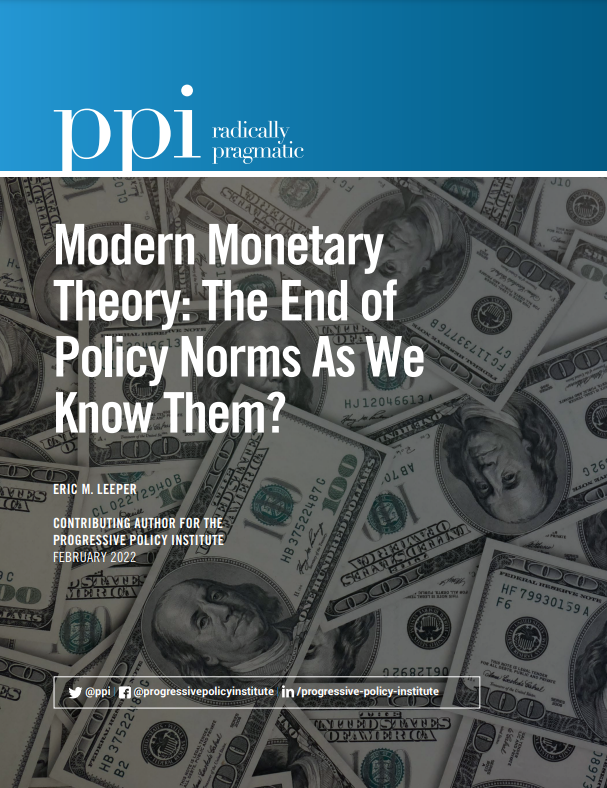
new report from the Progressive Policy Institute’s Center for Funding America’s Future dives into the economic and political debate around Modern Monetary Theory (MMT), looking closely at the challenges MMT advocates would have in delivering on their goals without drastically harming our economy. The report, authored by Dr. Eric Leeper of the University of Virginia, is titled “Modern Monetary Theory: The End of Policy Norms as We Know Them?”.

“Dynamic democracies should periodically reconsider existing policy norms to evaluate if they continue to serve policy goals well. If MMT seeks to change long-standing policy norms, the onus is on its advocates to persuade us that old norms do not serve us well and to communicate precisely what new norms will prevail and how they will affect the economy’s performance,” writes Eric Leeper in the report. “Until MMTers are ready to take these steps, their ideas must remain in the realm of guess and conjecture. In the meantime, we should apply to economic policy the basic principle we apply to health policy: follow the science. Economic science, such as it is, provides no support for MMT’s central claims.”

“For years, advocates of MMT have argued that policymakers should only care about budget deficits when the economy is facing inflation,” said Ben Ritz, Director of PPI’s Center for Funding America’s Future. “Now that inflation has finally materialized, they’ve moved the goalposts and left policymakers seeking answers about what to do in response. Dr. Leeper’s thorough deconstruction of MMT makes clear that they have none to offer. Democrats should reject this ‘supply-side economics’ of the left that is nothing more than a recipe for economic misery.”

For several years, politicians and leaders on the Far Left argued that a monetarily sovereign nation, like the United States, can simply print more currency needed to purchase goods and services for its constituents. As more exorbitant expensive spending programs were introduced and pitched to the American public, politicians often leaned on MMT to ensure voters that the economy could remain strong, even with deficit-financed spending. The only constraint on deficit spending, these advocates argued, was inflation.

This report breaks down several flaws in the economic thought behind MMT, including the constraints that ultimately finite resources place on governments, the inability of MMT to explain the relationship between inflation and demand when an economy is operating below its resource constraint, how it would overcome the structural and political challenges that prevent elected lawmakers from responsively managing inflation, and the indiscriminate approach it takes to the impact of different tax and spending policies, among others.

Mr. Leeper calls for the advocates of MMT to persuade the economic community that the standing norms of economic theory no longer serve us well, and to thoroughly evaluate the effects of the new economic theory with an eye on the practical and political implications of the proposal. He calls for the economic community, economic journalists, and policymakers to pause on active or passive exaltation of MMT until this evaluation is made, and continue to follow the science on economic theory and history – which unwaveringly points away from MMT’s fiscal financing plans.

Read the report here:


Eric Leeper a contributing scholar for the Progressive Policy Institute. He is also the Paul Goodloe McIntire Professor in Economics at the University of Virginia, a research associate at the National Bureau of Economic Research, director of the Virginia Center for Economic Policy at the University of Virginia, and a visiting scholar and member of the Advisory Council of the Center for Quantitative Economic Research at the Federal Reserve Bank of Atlanta.

The Progressive Policy Institute (PPI) is a catalyst for policy innovation and political reform based in Washington, D.C. Its mission is to create radically pragmatic ideas for moving America beyond ideological and partisan deadlock. Learn more about PPI by visiting progressivepolicy.org.

Launched in 2018, PPI’s Center for Funding America’s Future  works to promote a fiscally responsible public investment agenda that fosters robust and inclusive economic growth. We tackle issues of public finance in the United States and offer innovative proposals to strengthen public investments in the foundation of our economy, modernize health and retirement programs to reflect an aging society, and transform our tax code to reward work over wealth.

Follow the Progressive Policy Institute.

###

Media Contact: Aaron White – awhite@ppionline.org

Modern Monetary Theory: The End of Policy Norms As We Know Them?

By Eric Leeper
Contributing Author for the Progressive Policy Institute


EXECUTIVE SUMMARY

Modern Monetary Theory (MMT) gained popularity at a time when U.S. inflation was benign, income and wealth inequality was on the rise, and progressive politicians saw a political opportunity to pass big-ticket spending programs. To the nagging perennial question, “How do we pay for it?,” MMT serves up a tasty answer. You don’t need to raise taxes or reduce other spending. You don’t need to secure low-cost borrowing. A monetarily sovereign nation, like the United States, can create more currency to buy the goods and services that the programs require.

Large new spending programs often invoke in U.S. voters fears of persistent budget deficits and rising inflation. MMT delivers the reassuring message that those fears are grounded in defunct “orthodox” economic reasoning that limits the federal government’s capabilities: we have nothing to lose but our outmoded fiscal bromides and much to gain by replacing historic policy norms with fresh ideas. MMT explicitly ties itself to populist policies, self-labeling their plans “the birth of the people’s economy” [subtitle of Kelton (2021)]. Any sensible elected leader, whose vision is not impaired by conventional economic thought, would happily gobble up such a fiscal banquet.

MMT is the progressive counterpoint to supply-side economics. It supplants the claim that tax cuts pay for themselves with the claim that “…[federal] spending is self-financing” [Kelton (2021, p. 87), emphasis in original]. Both claims contain a germ of economic substance. Both claims are carefully crafted to provide elected officials seemingly plausible economic grounds to support their preferred fiscal policies (though at opposite ends of the political spectrum). Both offer policy makers an ideology freed of trade offs.

Because economic policy is too important to be reduced to catchy phrases and clever marketing, this essay analyzes MMT economics dispassionately. It does not assess the worthiness of MMT’s goals. Instead, it asks if MMT can achieve its goals without doing grave damage to America’s fiscal standing and, quite possibly, its economy. The answer: probably not.

MMT suffers from several flaws:


1. It denies a fundamental concept in economics: in a society with finite resources but unlimited wants, market prices adjust to induce individuals and policy makers to make trade offs that ultimately align supply and demand. Economics quantifies the costs and benefits of those trade offs to inform policy makers.

2. That denial leads MMT to see no need to offer a comprehensive theory of inflation. It maintains that inflation gets triggered when economy-wide demand for resources exceeds the economy’s resource limit, but has little to say about inflation and its determinants when, as it usually does, the economy operates below that limit.

3. MMT’s solution to inflation from high resource utilization is to raise “taxes,” without specifying which taxes. Governments have many tax instruments at their disposal—labor, sales, capital, wealth, and inflation—and each tax affects individuals and the macro economy differently. Generic advice to control inflation with higher taxes is vacuous until MMTers provide far more detail.

4. MMT does not acknowledge that even well-intentioned policy makers face incentives to use inflation to achieve employment or fiscal financing goals. Because those incentives to inflate are especially powerful for elected officials, many countries, including the United States, have adopted the norms of (i) independent central banks tasked with inflation control and macroeconomic stabilization and (ii) fiscal policies that largely pay for government spending with current and future taxes. Those policy norms have improved inflation performance and social welfare. MMT overthrows those norms to move inflation control and countercyclical policies from the Federal Reserve to Congress, to finance federal spending by creating new currency, and to subjugate monetary policy to fiscal needs.

5. It does not appreciate the central role that safe and liquid U.S. Treasurys perform in the global financial system. Neither does it apprehend the extent to which its policy proposals may destabilize financial markets and undermine the special status of Treasurys and the dollar in the world economy, a status that strengthens the U.S. economy.

The problems begin with the basic assumptions that underpin MMT. Its advocates attribute all unemployment to insufficient demand for workers and believe unemployment should be alleviated through a federal guaranteed jobs program. Weak demand frequently underlies unemployment, particularly during economic downturns. But workers themselves have a say in their employment status. During the COVID-19 pandemic, a broad cross section of workers left the labor market and voluntarily have not re-entered. From March 2020 to October 2021, labor force participation rates were depressed relative to the previous year: 2.5% for men, 2.6% for women, and 3.8% for workers 55 and older. Employers across the country have positions that remain unfilled. COVID is surely an unusual situation, but it serves to illustrate that employment outcomes are not always driven by insufficient demand.

MMT is at its weakest when addressing inflation, how it gets determined and how policies can control it. Its most common argument reduces to: inflation control is not a problem until it is. Problems arise when resource utilization reaches some limit, at which point higher taxes can keep inflation in check.  But resource utilization is not the only factor that affects inflation. In late 2021, consumer price inflation hit a 40-year high of over 6%, yet compared to their pre-COVID levels, employment, capacity utilization, and industrial production are lower, while the unemployment rate is higher. Inflation is not rising because the overall economy has hit its resource limit. To be sure, supply-chain issues have driven up some prices relative to others, but these issues are not what anyone means by economy-wide resource limits. MMT’s weak theory of inflation is stunning because the potential of the MMT agenda to trigger inflation is the most frequently voiced criticism of the theory [Summers (2019), Cochrane (2020), Hartley (2020), Mankiw (2020)].

The guaranteed jobs program points to a more general theme of MMT: the federal government can solve big problems once policy makers grasp the key tenets of MMT. Kelton (2021) identifies seven “deficits,” defined in terms of both quantity and quality, that MMT can help to close: good jobs, saving, health care, education, infrastructure, climate, and democracy. MMT promises to address each of these deficiencies by first altering policy makers’ understandings of fiscal financing matters.

MMT abandons two long-standing policy norms. The first came from Alexander Hamilton in 1790 and can be summarized as “federal budget deficits beget budget surpluses,” meaning that debt-financed spending is backed by future taxes. This norm has contributed to less costly financing and bestowed on U.S. treasurys status as the world’s go-to safe and liquid assets, enabling their critical role in global financial markets. The second norm evolved from the 1951 Treasury-Fed Accord to make monetary policy operationally independent. Legislation houses countercyclical policy primarily in the Federal Reserve with the mandate that the Fed achieve price stability, maximum sustainable employment, and low long-term interest rates, and facilitate financial stability.

MMT instead posits that a dollar of new government debt need not carry any assurance of tax backing. It regards treasury securities solely as a means for the central bank to achieve its interest rate target. MMT shifts responsibility for achieving full employment and controlling inflation from monetary policy to fiscal policy. The central bank’s primary tasks are to serve as the Treasury’s bank and to maintain zero interest rates. Despite MMT claims to the contrary, monetary policy is completely subservient to fiscal policy, tossing aside Federal Reserve independence and the social benefits that accrue from it.

Full embrace of MMT’s policy proposals and new norms—whatever they may be—carries significant risks. Those risks include higher and more volatile inflation and interest rates and financial market instability, which would disrupt and depress real economic activity and harm most the people MMT aims to benefit.


DOWNLOAD AND READ THE FULL REPORT


ABOUT THE AUTHOR

Eric Leeper is a contributing scholar for the Progressive Policy Institute. He is also the Paul Goodloe McIntire Professor in Economics at the University of Virginia, a research associate at the National Bureau of Economic Research, director of the Virginia Center for Economic Policy at the University of Virginia, and a visiting scholar and member of the Advisory Council of the Center for Quantitative Economic Research at the Federal Reserve Bank of Atlanta.*

* The author thanks Joe Anderson for many helpful discussions and insights and Campbell Leith, Jim Nason, and PPI staff for detailed comments.

Congress’ Anti-Tech Bills Will Not Prevent Algorithmic Harm to Consumers

new report from the Progressive Policy Institute (PPI) explains how the ubiquity of algorithms and their ever-expanding sophistication often come at a cost to consumers and the public at large. And Congressional proposals to break up Big Tech companies, rather than address the root causes of “algorithmic harm,” represent a solution in search of a problem — not a sober assessment of this highly problematic phenomenon. The report, “Breaking Up Big Tech Will Not Prevent Algorithmic Harm to Society,” is authored by Dr. Kalinda Ukanwa, Assistant Professor of Marketing at the University of Southern California’s Marshall School of Business.

“This paper argues that forcing Big Tech companies to sell parts of their businesses will not prevent algorithms at large from circulating extremist, incendiary, and other harmful content,” writes Dr. Ukanwa. “Algorithms are everywhere, and they all operate on the same two guiding principles. To attack the algorithm problem at its roots, society must implement policy that applies to all algorithms.”

Although the way in which algorithms circulate content may not appear problematic at first glance, as Dr. Ukanwa explains, the patterns of recycling and amplifying content categories that typify them are what create echo chambers, often to harmful effect. In service of their main objective — increased engagement and greater profits for developers — algorithms can promote everything from biased understandings of societal concepts to blatantly harmful content.

The report concludes that current bills proposed in Congress are ill-equipped to protect consumers from algorithmic harm because they fail to take into account algorithmic design principles and the wide-ranging nature of algorithmic activity.

Read the full paper and expanded conclusion here:


Dr. Kalinda Ukanwa is an Assistant Professor of Marketing at the University of Southern California’s Marshall School of Business. A quantitative modeler, Professor Ukanwa researches how algorithmic bias, algorithmic decision-making, and consumer reputations impact firms. She is the winner of the 2018 Eli Jones Promising Young Scholar Award and a finalist for the 2018 INFORMS Service Science Best Student Paper Award, 2019 Howard/ AMA Doctoral Dissertation Award, and the 2020 AMS Mary Kay Doctoral Dissertation Award.

The Progressive Policy Institute (PPI) is a catalyst for policy innovation and political reform based in Washington, D.C. Its mission is to create radically pragmatic ideas for moving America beyond ideological and partisan deadlock. Learn more about PPI by visiting progressivepolicy.org.

###

Breaking Up Big Tech Will Not Prevent Algorithmic Harm to Society

Algorithms are all around us. In the United States, a person could have hourly interactions with an algorithm and not even realize it. Some people use algorithm-driven devices like smartphones, digital clocks, or personal digital assistants (e.g., Amazon’s Alexa or Apple’s Siri) to wake them up in the morning. Others navigate to work, school, and other destinations with algorithmic GPS technologies, such as Google Maps, Apple Maps, Waze, or Garmin GPS devices. Many institutions use algorithms to decide whether applicants get jobs, places to live, seats at schools, loans from banks, insurance for medical bills, and public assistance benefits to feed themselves. In fact, when it comes to mobile or internet activity, almost every component of the digital world employs algorithms. Search engine results on Google, Bing, or Yahoo!, consumer product recommendations on Amazon or Netflix, customer service chatbots, and targeted digital advertisements are driven by algorithms. Using social media sites and mobile apps like Facebook, Twitter, TikTok, or Instagram means interacting with an algorithm. Their algorithms will monitor whether the content posted is appropriate or should be removed. They will determine whether posts will be featured or trending on other users’ feeds. At night, an algorithm may put people to sleep by reminding them that it is their bedtime based on their past sleeping behavior. Then algorithms wake us up again the next day, bright and early. It is easy to see why the claim that algorithms are everywhere is not hyperbole.

Regardless of what tasks algorithms are designed to accomplish, virtually all of them operate on two guiding principles: 1) optimize an objective they have been given, and 2) learn how they can best optimize that objective from historical data (i.e., training data).[1] For example, Facebook whistleblower Frances Haugen shared in interviews and congressional testimony that one of the biggest objectives of Facebook’s algorithms is to make money from the ads they display on their site. However, Ms. Haugen also testified that Facebook’s pursuit of this objective sometimes came at the cost of what was good for the public.[2]

After Haugen’s bombshell testimony about the harm Facebook’s algorithms enact against everyday people, there has been a groundswell of support for congressional action to reduce algorithmic harms by breaking up Big Tech — the collective of top tech companies that run many aspects of billions of consumers lives. The notion is that breaking up Big Tech companies like Facebook, Google, Apple, and Twitter will free society from the algorithmic echo chambers that endlessly and increasingly circulate harmful content.[3] However, breaking up Big Tech will not eradicate algorithmic harm. Why? Because virtually all algorithms operate on the previously mentioned two guiding principles: 1) optimize an objective, and 2) learn from training data how to best optimize that objective. Hence, the harrowing problems that algorithms perpetuate are not unique to algorithms deployed by Big Tech companies. Algorithms used by small companies, nonprofits, and governments operate the same way. While breaking up Big Tech could temporarily reduce the scale of harmful content, doing so will not stop algorithmic bias and echo chamber facilitation in its tracks. This is because other organizations deploying algorithms will fill the vacuum. As long as algorithms, in their current design, operate in the background of daily life, people will continue to suffer from harmful and biased algorithmic outcomes.

This is how algorithms work. To make money from an online ad, users must see or click on the ad. The ad within a page is surrounded by user-generated content. People are drawn to the page in the first place by the content posted. If Facebook’s algorithm is given the objective to maximize the number of views or clicks of the ad, then it will use information about user content and user viewing and clicking behaviors that led them to click on ads.

Algorithms continually evolve. Just as humans change as they learn new things, algorithms change by updating themselves as they learn from training data. In the case of the Facebook algorithm, to accomplish the objective of getting users to look at an ad and click on it, the algorithm must learn what kind of content users like. The algorithm accomplishes this task by inspecting the content users have typically viewed in the past. The algorithm seeks patterns in terms of content characteristics that increase user engagement (likes, clicks, and reshares of a post). Algorithms can also learn from patterns in content that users have posted themselves. For example, if a user frequently posts about, views, and engages with fashion, beauty, and weight loss content, the algorithm learns over time that the user is interested in those topics.

Algorithms often become even more advanced by learning which users have similar interests across an entire consumer base.[4] This algorithmic capability is often called “look-alike modeling.”[5] If the algorithm learns that the aforementioned user who seems to like beauty, fashion, and weight loss topics is a 16-year-old girl from a Columbus, Ohio, suburb, it may look at the behaviors of other teenaged girls who live in mid-western suburbs to discover general patterns that are common among them all. Then the algorithm exploits these learned similarities across users by sending them content they have not seen before about beauty, fashion, and weight loss. Because similar users are receiving in their content feed more of the same type of content that they may or may not have engaged with before, they stay longer on the site. Consequently, content and advertisement views increase.

Although this kind of content circulation might not seem problematic at first glance, this continual recycling and amplifying the same content categories to the same users is how echo chambers arise (scenarios where beliefs are reinforced and amplified inside a closed communication system).[6] If girls are clicking on harmful content that leads to feeling bad about or even harming their bodies, the algorithm may exploit that knowledge and amplify the volume of similar content directed to those girls through trends, news feeds, and highlights of posts by friends in their networks. If algorithms learn that young men who feel disenfranchised from society like to click on extremist hate content, then algorithms will direct more content to them based on the same topics. Such potentially harmful recommendation patterns serve the algorithm’s main objective: to increase average engagement with content and the amount of time users spend on the site so that users view and click more ads (and deliver more profit to the algorithm’s developers).

Algorithms can also be problematic if they inherit a biased understanding of societal concepts. If user behavior or content is imbued with inherent biases, then the algorithm will also learn and amplify those biases. For example, imagine that a website creates a social media post with a list of the smartest people in the world. Say the post features the 2021 Nobel Prize winners, and the post generates a lot of engagement (likes, reshares, reposts). An algorithm would learn that this type of content is engaging and would update its understanding of the content characteristics associated with “smart.” Though most would agree that Nobel Prize winners are indeed some of the smartest people in the world, 77% of the 13 Nobel Prize winners in 2021 are white and male.[7] The algorithm could learn from the website’s post and other widespread, highly engaging content that “smart” is associated with white and male. It will serve and boost similar content, and in doing so, produce mass-scale biased output that amplifies the idea that people who are not white and not male are not associated with “smart.”

Thoroughly solving the issues brought to light by Haugen first requires acknowledgement that algorithmic harm is not solely created by Big Tech. The algorithm problem spans across all sectors and organizations, large and small. An effective and feasible solution requires a tactical approach more closely aligned with the design and inner workings of algorithms. An effective solution must also consider the incentives at play for organizations like Facebook. For-profit firms will seek to maximize profit. They will consequently build profit maximization into the objectives of the algorithms they use. Therefore, one solution is to require that constraints be built into algorithmic objective functions to ensure that algorithms serve not only the firm’s goals, but also the public good. Research has shown that designing algorithms to maximize profits while minimizing social harm can be done.[8]

While free market and commercial rights advocates might decry this proposal, opponents should note that similar restrictions are commonplace in other sectors of business activity. For example, mainstream TV entertainment companies have had to follow the Federal Communication Commission’s (FCC) rules for decades that limit the types of content they can expose the public to.[9] It is plausible that TV entertainment companies could increase ratings and revenue if they included more hardcore pornographic or ultra-violent content in their entertainment products. But should they? Despite society’s regrettable predilections and companies’ constant pursuit of maximal profits, regulations successfully prevent viewers from seeing pornographic and ultra-violent content on mainstream TV in order to protect viewers from the social harm such content can cause. Importantly, there has been no need to break up big entertainment companies to achieve the objective of reducing social harm. Instead, regulators provide guidelines detailing what type of content was acceptable for viewers to be exposed to prevent public harm while also allowing companies to grow and flourish.

Regulators today can take a similar approach to reducing algorithmic harm. Algorithms can be reprogrammed to optimize their objective while fulfilling constraints designed to protect the public. For example, a Facebook algorithm could still identify and disseminate popular beauty content among teenage suburban girls, as long as the content does not contain glorification of anorexia, bulimia, or other body dysmorphic behaviors. Furthermore, Facebook could mitigate algorithmic bias in the beauty content served by incorporating characteristics that ensure content features a variety of beauty standards into their algorithm’s design.

To rebuild and reprogram algorithms with constraints requires substantial investment, resources, and research into algorithmic approaches that achieve company objectives while reliably minimizing societal harm. Modifying existing algorithms also requires firms to actively audit, monitor, and update their work because the algorithms learn from data and change constantly. To catalyze the process of algorithm redesign, a credible and capable third-party entity must be empowered to spur action. Fortunately, many of the large companies perpetuating algorithmic harm on a massive scale have the very resources required to successfully accomplish this task. The Big Tech companies in particular are best positioned to lead the way because they possess the knowledge, talent, and financial resources. In contrast, smaller companies with fewer resources may struggle to update their algorithms with the required restrictions, even if they possess the requisite knowledge.

CONCLUSION

Current bills proposed in Congress and the Senate are not well-equipped to protect consumers from algorithmic harm because the underlying policies do not take algorithmic design principles and the ubiquitous nature of algorithmic activity into account. Presently, the proposed legislation aims to ameliorate algorithmic harm by restricting the power that Big Tech platforms currently have over smaller home-grown competitive offerings. However, this article argues that forcing Big Tech companies to sell parts of their businesses will not prevent algorithms at large from circulating extremist, incendiary, and other harmful content. Algorithms are used by large companies and small, and by for-profits and nonprofits. Algorithms are everywhere, and they all operate on the same two guiding principles. To attack the algorithm problem at its roots, society must implement policy that applies to all algorithms. Breaking up Big Tech will not accomplish that objective.


DOWNLOAD THE REPORT


REFERENCES

[1] Stuart J. Russell and Peter Norvig, Artificial Intelligence: A Modern Approach, 4th ed., (Hoboken, NJ: Pearson, 2020).

[2] Seth Flaxman, Sharad Goel, and Justin M. Rao, “Filter Bubbles, Echo Chambers, and Online News Consumption,” Public Opinion Quarterly 80, no. S1 (2016): pp. 298-320, https://doi.org/10.1093/poq/nfw006.

[3] Cat Zakrzewski and Cristiano Lima, “Former Facebook Employee Frances Haugen Revealed as ‘Whistleblower’ Behind Leaked Documents that Plunged the Company Into Scandal,” The Washington Post, October 4, 2021, https://www.washingtonpost.com/technology/2021/10/03/facebook-whistleblower-frances-haugen-revealed/.

[4] Jun Yan et al.,  “How Much Can Behavioral Targeting Help Online Advertising?” ACM Proceedings of the 18th International Conference on World Wide Web, April 2009, https://doi.org/10.1145/1526709.1526745.

[5] Anna Mariam Chacko et al., “Customer Lookalike Modeling: A Study of Machine Learning Techniques for Customer Lookalike Modeling,” Intelligent Data Communication Technologies and Internet of Things: Proceedings of ICICI 2020, February 2021, pp. 211-222, https://doi.org/10.1007/978-981-15-9509-7_18.

[6] Kelly Hewett et al., “Brand Buzz in the Echoverse,” Journal of Marketing 80, no. 3 (May 2016): pp. 1-24, https://doi.org/10.1509/jm.15.0033.

[7] Niklas Elmehed, “All Nobel Prizes 2021 – NobelPrize.org,” Nobel Prize, https://www.nobelprize.org/all-nobel-prizes-2021/.

[8] Kalinda Ukanwa and Roland T. Rust. “Algorithmic Bias in Service,” USC Marshall School of Business, (November 2021), https://ssrn.com/abstract=3654943.

[9] “Obscene, Indecent and Profane Broadcasts,” Federal Communications Commission, accessed January 30, 2022, https://www.fcc.gov/consumers/guides/obscene-indecent-and-profane-broadcasts.

 

PPI Applauds Passage of America COMPETES Act

Today, the House of Representatives passed the America COMPETES Act, which will help ease supply chain tension, invest in American innovation, and strengthen our standing in the race to technological leadership.

Aaron White, Director of Communications for the Progressive Policy Institute (PPI) released the following statement:

“The Progressive Policy Institute is encouraged to see the House passage of the America COMPETES Act, a companion bill to the Senate’s bipartisan United States Innovation and Competition Act, which will invest in American innovation, ease the tensions on U.S. and global supply chains, and strengthen America’s standing in our race with China for technological leadership.

“This bill has the potential to spur long-term growth through significant investment in scientific innovation and new-age manufacturing and logistics advancements. The American technology sector has long been a leading global innovator; by investing in emerging technologies, research and development, the future workforce and the U.S. high-tech productive base, America can once again lead the world with a robust 21st century economy and expand opportunity for generations to come.

“Notably, it is unfortunate that House Republicans refused to vote for legislation that mirrored bipartisan bills and committee provisions, particularly given the Senate was willing to compromise and pass their companion bill on a bipartisan vote months ago. Important issues like supporting American innovation, technological leadership, and strengthening our economy should transcend partisanship, especially as we recover from the pandemic.

“We must acknowledge that there is still room for improvement. As the Senate and House begin the conference process for the United States Innovation and Competition Act and the America COMPETES Act, PPI encourages conference committee members to more closely examine the trade provisions within the final bill, and take the time needed — through hearings, public comments or other means — to consider the wide ranging implications for U.S. exporters and importers of several of the bill’s trade provisions.

“We also encourage the conference committee to consider reverse the Trump and GOP-era tax increase on scientific research that took effect this year. If left in place, this tax change threatens to undo much of the good that this legislation would do for American innovation. Finally, we hope lawmakers will wait for an official score from the Congressional Budget Office before voting on passage of the bill in its final form. Even if some public investments generate high enough returns to justify borrowing to pay for them, as PPI believes may be the case for some provisions in this bill, it is essential that our leaders have the necessary information to consider all the costs and tradeoffs.

“We thank Speaker Pelosi and Majority Leader Schumer for their continued work in advancing this legislative package, and congratulate President Biden for spearheading this historic advancement in American economic leadership. The finished product will be a major win for American workers, consumers, and manufacturers alike.”

###

New IFP Report Argues U.S. Faces New “Sputnik Moment”

U.S. Technological Innovation Needs Government Procurement to Succeed

Ongoing geopolitical pressures, primarily the modern rise of China, have brought American technological superiority back to the fore as a central political objective. By revitalizing corporate science and economic innovation through government procurement, policymakers can promote U.S. scientific leadership while protecting our national security, argues a new report from the Progressive Policy Institute (PPI)’s Innovation Frontier Project.

The report, authored by Sharon Belenzon and Larisa C. Cioaca of Duke University’s Fuqua School of Business, is titled “Government Procurement: A Policy Lever to Revitalize Corporate Scientific Research.” It details the history of government procurement from the 1957 Sputnik shock to the rise of China, along with evidence that an increase in procurement contracts leads firms to invest more in upstream R&D, especially when private market incentives are weaker.

“There’s no reason that America can’t lead the world again in science and technology. And as the authors of this report argue, the rise of China represents not only a threat, but an opportunity,” said Jack Karsten, Managing Director of the Innovation Frontier Project at PPI. “By bolstering corporate scientific research with the right targeted reforms to the procurement process, the U.S. government can constructively address the national security challenges it faces while reinvigorating domestic innovation.”

Belenzon and Cioaca call for the government to incentivize the participation of the private sector in procurement, while still responsibly and efficiently managing taxpayer dollars. They recommend that policymakers consider returning to the practice of rewarding firms that demonstrate technological superiority, encouraging domestic innovation while keeping us competitive abroad.

PPI releases this report as the U.S. House of Representatives considers the America COMPETES Act, a package meant to address supply chain issues, increase domestic production, and invest in American scientific and technological leadership. The legislation would appropriate $45 billion to prevent supply chain shortages and disruptions and $52 billion for semiconductor production in America, along with a collection of bipartisan science, research and technology bills.

Read PPI’s report and its full conclusion here:


Based in Washington, D.C., and housed in the Progressive Policy Institute, the Innovation Frontier Project explores the role of public policy in science, technology and innovation. The project is managed by Jack Karsten. Learn more by visiting innovationfrontier.org.

The Progressive Policy Institute (PPI) is a catalyst for policy innovation and political reform based in Washington, D.C. Its mission is to create radically pragmatic ideas for moving America beyond ideological and partisan deadlock. Learn more about PPI by visiting progressivepolicy.org.

###

Media Contact: Aaron White – awhite@ppionline.org

Living with COVID in the New Year and Beyond

As variants of the COVID-19 virus continue to emerge, it’s becoming more and more clear that this epidemic is becoming endemic. As the world continues to grapple with the reality that this virus is here to stay, how do we begin to live in our new normal, and how do we balance the tradeoffs between combating the spread of COVID-19 and letting normal life resume?

Last week, PPI’s Director of Health Policy Arielle Kane brought together an esteemed panel of experts, including Congresswoman Lori Trahan (D-MA) and Dr. Leana Wen, for a panel event to discuss living with COVID in the New Year and Beyond. This episode is a segment of their conversation.

Learn more about the Progressive Policy Institute here.

Telehealth helps low-income individuals access care, but disparities persist with video use

A new study found low-income people were more likely than other groups to use telehealth services during the pandemic, proving that telehealth does increase access to needed care for underserved people.

Telehealth use skyrocketed during the pandemic when restrictions around telehealth use were eased. In particular, Medicare expanded the number of services allowed to be delivered via telehealth and allowed greater flexibility with the acceptable technology platforms providers could use, even expanding audio-only services. However, though audio-only services are an important part of telehealth, video-enabled telehealth allows for a better patient interaction and may be better in many clinical situations.

The study found that people earning less than $25,000 were more likely to use audio-only services and less likely to have video appointments than other groups. Without addressing barriers like unequal broadband distribution and limited access to video-capable devices, telehealth won’t live up to its potential.

Using data from the Census Bureau’s Household Pulse Survey from April to October 2021, researchers at HHS’ office of Assistant Secretary for Planning and Evaluation (ASPE) found that a quarter of respondents reported using telehealth in the previous four weeks. While there was some variation across demographic groups, the most significant disparities were between those who used audio versus video telehealth services.

Video telehealth rates were higher among young adults ages 18 to 24 (72.5% reported using video telehealth), those earning at least $100,000 (68.8%), those with private insurance (65.9%), and white individuals (61.9%). Conversely, video telehealth use was lowest among those without a high school diploma (38.1%), adults ages 65 and older (43.5%), and Latino (50.7%), Asian (51.3%), and Black individuals (53.6%).

For people without access to broadband internet, phone visits can make it easier to access to care. But video appointments allow for more physical examination, better communication, and a more substantial patient-provider relationship. Further, a video connection allows a provider to have a glimpse into the patient’s home where some social indicators may increase understanding of a patient’s health condition.

But video appointments require video-capable devices, broadband access, software literacy, and often English proficiency. These all prevent barriers for older patients, lower-income patients, non-English speaking patients, and those who don’t have privacy in their homes.

The report underscores the urgency of bringing high-speed broadband to everyone, so that telehealth doesn’t become another example of health disparities where only the relatively affluent can take full advantage of the easy access and lower costs digital health enables. While Medicare has decided to permanently cover audio-only mental health visits if the patient doesn’t have access to video capable devices, a video connection allows for more expansive clinical evaluation for other types of care. Payers should not limit access to audio-only services at this time, but rather should push for broadband expansion so that more people can access video-enabled care.