McDermott for The Hill: Surrendering to COVID-19 is the wrong cure for inflation

McDermott for The Hill: Surrendering to COVID-19 is the wrong cure for inflation

By Brendan McDermott

Republicans hoping to capitalize on high inflation have proposed a surprising solution: ending COVID-19 restrictions. But surrendering to COVID is the wrong cure for inflation. It would endanger public health without addressing the supply-chain snarls that are pushing prices higher. Ending pandemic inflation requires making the global economy a safe place to spend, work and live by continuing the fight against the virus.

The United States is enjoying an exceptionally strong economic recovery thanks in part to the bold stimulus actions lawmakers took last March. But businesses are raising prices, some because they and their competitors are bidding up the cost of workers and materials, and others simply because strong demand means that they can. Consumer prices were 6.8 percent higher in November than they were a year before, and almost half of households say inflation is hurting their finances.

Read the full piece in The Hill. 

Strong Digital Growth in 2022 Swing States

Summary: Because of their mixed urban/rural nature, swing states are a magnet for digital “tech-ecommerce” jobs. Democrats should consider building their 2022 political narrative around support for the digital economy, which brings strong job growth, higher wages, and lower inflation to swing states.

1. This piece is primarily economic, not political. But to focus our analysis, we start with a list of eight potential 2022 Senate swing states: Arizona, Florida, Georgia, Nevada, New Hampshire, North Carolina, Pennsylvania, and Wisconsin. Adding or subtracting a state from this list doesn’t change the analysis appreciably.

2. For the most part, swing state employment is still below pre-pandemic levels, creating a handicap for the party in power. For example, Wisconsin had 260,000 fewer private sector jobs in November 2021 than in November 2019. The only swing state above pre-pandemic employment levels is Arizona.

3. Average hourly wage growth has significantly lagged national inflation in most swing states, That means real wages are falling on average in the swing states, an obstacle to making a positive economic argument. Once again, there is one exception, North Carolina.

4. However, voters in most swing states are benefiting from exceptionally dynamic job creation in the digital “tech-ecommerce” sector. The reason is not hard to understand. Swing states, by their nature, tend to have a mixed urban/rural character. Not surprisingly, ecommerce fulfillment centers are often sited in areas that are within easy driving distance of large populations but where land is relatively cheap, making them a good match for swing states. Similarly, software and internet operations looking to broaden out from the Bay Area and Boston will pick cheaper locations near to good urban amenities.

5. Digital employers gravitated to swing states during the Biden Administration. From the second quarter of 2020 to the second quarter of 2021, the most recent data available, swing states showed a 14% gain in tech-ecommerce jobs  By comparison, the rest of the country only showed an 8% gain in tech-ecommerce jobs over the same period.

6. We’ve bolded the key numbers in the table below, which lays out the job gains by digital industry.  Ecommerce fulfillment and warehousing jobs registered a 22% gain in the swing states, almost double the 12% gain in the rest of the country. The same thing held true for the electronic shopping industry (which mainly consists of those establishments that are in the technology end of electronic shopping but don’t do fulfillment). Also showing strong swing state growth was internet publishing, which also includes search and other “internet-type” companies.

By contrast, job growth in manufacturing and healthcare was weaker in the swing states than the rest of the country.  These states see their future in tech and ecommerce.

Table 1. Swing States Lead In Digital Growth
Employment change, 20Q2-21Q2
Swing states Other states
Computer and electronic manufacturing -1.6% -0.4%
Electronic shopping 18.5% 11.8%
Local delivery 12.4% 13.9%
Ecommerce fulfillment and warehousing 22.1% 12.3%
Software publishing 11.8% 8.7%
Data hosting 12.6% 6.1%
Internet publishing and other information services 14.6% 6.1%
Computer software systems 7.1% 3.5%
Tech-ecommerce (total) 14.0% 8.1%
Private 11.2% 10.6%
Manufacturing 5.0% 6.1%
Healthcare and social assistance 5.6% 6.4%


7.  What are the positive economic stories in individual swing states?  Digital employers in Arizona, Florida, Nevada, North Carolina, and Wisconsin are adding digital jobs at a faster rate than private sector jobs. Voters in North Carolina, for example, have benefited from 20% growth in tech-ecommerce jobs, almost double private sector job growth.


Table 2. Digital Jobs Drive Swing State Growth
Employment change, 20Q2-21Q2
Tech-ecommerce Private sector
Arizona   16.7% 8.6%
Florida   18.2% 10.8%
Georgia 8.6% 10.4%
Nevada   24.6% 21.4%
New Hampshire 8.4% 13.4%
North Carolina   20.3% 11.5%
Pennsylvania 7.8% 12.4%
Wisconsin   10.2% 9.1%
Swing states 14.0% 11.2%
All other states 8.1% 10.6%


8. A strong economic narrative around digital growth in the swing states depends on wages as well. On average, tech-ecommerce jobs pay significantly more than the average for the private sector in every swing state. For example, in the second quarter of 2021, tech-ecommerce workers in swing states got paid at an average annual rate of $81,000, 39% more than the private sector average of $58,000. This includes the full range of tech-ecommerce jobs, from software developers to fulfillment center workers.

Table 3. Workers in Digital Jobs Are Paid More on Average
Annual pay, thousands of dollars, based on 21Q2
Tech-ecommerce Private sector
Arizona 76 59
Florida 81 57
Georgia 83 60
Nevada 65 57
New Hampshire 111 71
North Carolina 86 57
Pennsylvania 81 62
Wisconsin 77 53
Swing states 81 58
All other states 123 66
All other states except California and Washington 96 62


9. The core of the tech-ecommerce job boom in the swing states is the expansion of ecommerce jobs. These jobs pay well for high-school educated workers. Amazon pays its starting distribution workers an average of $18 per hour. That’s roughly comparable to starting manufacturing wages in many parts of the country. Overall, ecommerce industries pay about 30% more than brick-and-mortar retail in swing states, on average. This is at the heart of a powerful political narrative of growth that creates better jobs.


Table 4. Ecommerce Industries Pay More than Brick-and-Mortar Retail
21Q2 pay in thousands at annual rates
Ecommerce industries Brick-and-mortar retail
Arizona 48 41
Florida 49 39
Georgia 45 36
Nevada 46 39
New Hampshire 57 38
North Carolina 40 35
Pennsylvania 51 34
Wisconsin 45 31
Swing states 47 37
Other states 62 38
Other states ex California and Washington 51 37


10. Democrats have a chance to build a powerful economic narrative around strong digital growth in swing states.  They should embrace this opportunity.


Ritz for Newsweek: Social Security Needs Solutions, Not Gimmicks

By Ben Ritz, Jason Fichtner, and Charles Blahous

Ben Ritz is Director of the Center for Funding America’s Future at the Progressive Policy Institute, Jason Fichtner is Vice President and Chief Economist at the Bipartisan Policy Center, and Charles Blahous is the J. Fish and Lillian F. Smith Chair and Senior Research Strategist at the Mercatus Center.

Despite repeated warnings from Social Security’s trustees that the program is facing a growing financial shortfall, lawmakers seem to have reached a bipartisan consensus to kick the can down the road. If they continue procrastinating until Social Security’s trust funds near depletion in the 2030s, it will be impossible to save the program without abruptly cutting benefits for retirees or significantly reducing the lifetime incomes of young workers. Americans who rely on Social Security cannot afford to wait much longer for lawmakers to enact corrections.

Unfortunately, a new proposal that was the subject of a congressional hearing earlier this month, Social Security 2100: A Sacred Trust, moves in the wrong direction. It would worsen intergenerational inequities by providing substantial benefit increases for those becoming benefit-eligible in 2022-2026, while passing the costs to everyone else, especially young workers already getting the short end of the stick under current law. There is no justification for such discriminatory treatment. In fact, those who would receive the proposed windfall already benefit from superior treatment under current Social Security law, relative to those who would pay for it.

Read the full piece in Newsweek. 

Ritz for The New York Times: Joe Manchin Has Given Democrats a Chance to Save Their Agenda

by Ben Ritz
Director of PPI’s Center for Funding America’s Future, for The New York Times

Mr. Ritz is the director of the Progressive Policy Institute’s Center for Funding America’s Future, which released a framework for paring down the Build Back Better plan in October.

Senator Joe Manchin of West Virginia seemingly dealt a terrible setback to President Biden’s agenda on Sunday, when he told Bret Baier of Fox News that he could not support the version of the Build Back Better Act passed by the House last month. Although Democrats were rightfully frustrated by the way in which Mr. Manchin expressed his concerns, he was raising a valid critique: This bill was deeply flawed, and the “compromises” his colleagues made did nothing to address the concerns he has been consistently raising since this summer.

Other Democrats may not realize it, but Mr. Manchin may well have given them a gift. They should’ve gone back to the drawing board months ago, when it first became clear that their budgetary gimmickry was turning the bill into a confusing mess. Now, they will have to — and if they revise the bill to cut the number of programs they propose while making the ones they do propose permanent and easier for Americans to navigate, it could deliver Democrats both lasting policy change and the political victory they so desperately need.

Read the full piece in The New York Times.

Trade Fact of the Week: Remittances from overseas workers to poor and middle-income countries are double the size of all foreign aid programs

FACT:

Remittances from overseas workers to poor and middle-income countries are double the size of all foreign aid programs.


THE NUMBERS: 

Central American GDP and international income, 2020

$200 billion       GDP
 $45.6 billion     Exports
 $25.3 billion*    Remittances from migrants
   $1.6 billion      Foreign aid
   $3.4 billion     Foreign Direct Investment

* Assuming about 95% of remittances to Central America came from the U.S. in 2020, as the World Bank has estimated for 2017 (most recent year available).


WHAT THEY MEAN:

Who changes the world? Governments, intellectuals, scientists, entrepreneurs, NGOs, and charities? Doubtless they do their part. But do not discount the power and generosity of humbler, less celebrated people. An example:

Small banks and wire services in Central American neighborhoods around the U.S. are busy this week, as Christmas money flows south from places like Maryland’s Wheaton or LA’s Pico Union to Chalatenango, Intipuca, and La Union. World Bank research suggests that these “remittance” flows to the five Central American republics totaled $25 billion in 2021, with about 95% of this total coming from the United States. About $55 million will likewise move from the homes of security guards and drivers in New Zealand to small Pacific island towns in Tonga and Samoa; $11.6 billion will arrive from the Gulf states to places like Medan and Dhaka, sent by Indonesian and Bangladeshi maids, clerks, nurses, and construction workers.

How significant is this? Three ways to answer the question:

(1)    In the economic lives of recipient countries, sometimes very large. Central America joins the Pacific Islands, Central Asia, and the Caribbean among the world’s most remittance-reliant regions, and so provides an illustrative (if somewhat extreme) example. The $25 billion in remittance flows at the north end of the wire make up about 12.5% of a $200 billion regional ‘GDP’ (combining Guatemala, El Salvador, Honduras, Nicaragua, and Costa Rica) with peaks of 24% of GDP for El Salvador and Honduras.  Meanwhile, in 2020 the five countries together (a) earned $45 billion from exports; (b) received about $1.6 billion in much-debated but relatively modest flows of foreign aid, and (c) received $3.4 billion in foreign direct investment from international businesses.  Thus at the macro end, remittances from migrant workers and their families rank below (but not far below) trade as a source of income, and are five times the combined value of aid and FDI.

Moving the lens back, the picture shifts but does not fundamentally change.  Twelve countries rely on remittances for more than 20% of GDP, with Tonga at 35% and then Somalia, Lebanon, South Sudan, Kyrgyzstan, Tajikistan, El Salvador, Honduras, Nepal, Haiti, Jamaica, and Lesotho.  If we combine all low- and middle-income countries (using the World Bank definition but excluding China, Russia, and EU members Bulgaria and Romania), trade is easily the largest earner, with remittances a fairly distant second and about equal to FDI and foreign aid combined:

$14,210 billion       GDP
$3,850 billion       Exports
$462 billion       Remittances
$267 billion       Foreign Direct Investment
$175-$250 billion*  Foreign Aid

* The aid total depends upon how one estimates Chinese aid programs.  The OECD reports $175 billion from OECD members, plus Saudi Arabia, the UAE, Taiwan, and several other non-OECD donors. The scale of Chinese aid programs is uncertain, but probably large, with private-sector estimates going up to a maximum of ~$80 billion depending on one’s definition of Belt and Road Initiative loans. 

(2)     From the donor perspective, quite a lot.  A Honduran-American population of about 1 million, for example, likely sent $5 billion in remittances this year.  The median income for adult workers, by a Pew Research estimate, is around $25,000, which suggests that workers spent as much as a fifth of their earnings on remittances.

(3)    From the recipient perspective, often of great value:  Remittances seem most valuable to the poor and lower-middle class.  Central America again provides some interesting examples.  About 20% of families in El Salvador families receive remittances.  A 2016 report for the Inter-American Development Bank reported that 70% of these recipients are women; that 47% live in rural provinces; that 70% have primary education or less, and that 79% are poor or “vulnerable”.

In this holiday season, one need not doubt the potential of thoughtful governments, energetic intellectuals and scientists, or entrepreneurs, NGOs and charities to change the world for the better.  But the populist force of quite humble communities of migrant workers — tens of millions of Salvadoran waitresses and construction workers, Filipina nurses, Indonesian maids, Haitian cooks and security guards, Nigerian taxi drivers and Jordanian accountants — looks to be at least their match.

Closing note:  PPI’s Trade Fact service will be closed next week and return in the New Year. We wish friends and readers a happy and peaceful holiday, grateful for our good fortune and mindful of those who have less.


FURTHER READING


Overview

The World Bank’s remittances page has figures by region and country for 2020; $701 billion in remittance flows, or about 1% of the world’s $75 trillion GDP.  Bank experts trace $471 billion back to the source, with $70 billion of this coming from the United States; by comparison, USAID reports $51 billion in official U.S. foreign aid.

The Inter-American Development Bank has a snapshot of Salvadoran remittance recipients (70% women, 47% rural, 70% with primary education or less, 79% poor or “vulnerable”).

The World Bank’s bilateral remittance tool, including figures for flows to and from all countries.

Pew Research has a statistical snapshot of Salvadoran-Americans and other Hispanic communities.


Countries & regions

The White House lays out its “root causes” program for Central American migration.

The Kingdom of Tonga (population 105,000, an hour’s flight southeast of Fiji when service is available) is the country most reliant on remittances, accounting for 48% of GDP, with money coming principally from New Zealand, the U.S., and Australia.

Miami-based Haitian Times on a COVID-era lifeline for Haiti.

$1 billion a year flows out of Hong Kong to recipients, many in the Philippines and Indonesia, read more about The Hong Kong Domestic Helpers Campaign.


For comparison: 

Exports: The WTO’s World Trade Statistical Review has export and import figures.

Aid: The OECD’s Development Assistance Council page details $175 billion from OECD members and other sources (though not China) in 2020 aid by recipient.

Aid: The U.S. Agency for International Development’s data dashboard has U.S. foreign assistance figures by country, project, and topic.

Investment: UNCTAD’s 2021 World Investment Report


ABOUT ED

Ed Gresser is Vice President and Director for Trade and Global Markets at PPI.

Ed returns to PPI after working for the think tank from 2001-2011. He most recently served as the Assistant U.S. Trade Representative for Trade Policy and Economics at the Office of the United States Trade Representative (USTR). In this position, he led USTR’s economic research unit from 2015-2021, and chaired the 21-agency Trade Policy Staff Committee.

Ed began his career on Capitol Hill before serving USTR as Policy Advisor to USTR Charlene Barshefsky from 1998 to 2001. He then led PPI’s Trade and Global Markets Project from 2001 to 2011. After PPI, he co-founded and directed the independent think tank ProgressiveEconomy until rejoining USTR in 2015. In 2013, the Washington International Trade Association presented him with its Lighthouse Award, awarded annually to an individual or group for significant contributions to trade policy.

Ed is the author of Freedom from Want: American Liberalism and the Global Economy (2007).  He has published in a variety of journals and newspapers, and his research has been cited by leading academics and international organizations including the WTO, World Bank, and International Monetary Fund. He is a graduate of Stanford University and holds a Master’s Degree in International Affairs from Columbia Universities and a certificate from the Averell Harriman Institute for Advanced Study of the Soviet Union.

Read the full email and sign up for the Trade Fact of the Week


Marshall for The Hill: Can France turn back the nationalist tide?

By Will Marshall

Brexit is done and U.S. voters have fired Donald Trump, but the neo-nationalist uprising that gave rise to both continues to shake up transatlantic politics. No country has seen its traditional political order more thoroughly fractured than France.

President Emmanuel Macron, who is running for reelection next spring, leads a centrist party he created in a tour de force of political improvisation after leaving the Socialist Party shortly before his 2017 election. Long France’s leading party of the left, the Socialists have been decimated. Their presidential candidate, Paris Mayor Anne Hidalgo, barely registers in the polls with about 4 percent support.

The wild card in the race is Eric Zemmour, a political neophyte many observers are calling the French Trump. He is a writer and television pundit whose best-selling book, “Le Suicide Francais,” contends that immigration, globalization and a fast-growing Muslim minority represent fundamental threats to French values and culture.

Read the full piece in The Hill. 

Ritz for Forbes: ‘Temporary’ Programs Threaten The Success Of Build Back Better

By Ben Ritz

As the U.S. Senate postpones its vote on the Build Back Better Act (BBBA) into next year, it’s becoming increasingly clear that lawmakers’ attempt to enact almost every major program proposed by President Biden on a temporary basis — rather than prioritize a few key programs or find enough revenue to sustainably finance all of his proposed programs permanently — threatens both the bill’s prospects for passage and the success of its core initiatives should the bill become law. Democrats must rethink and revise this approach to address the most urgent national needs and secure a successful legacy for President Joe Biden.

The problem became clear last week in part thanks to a new estimate from the nonpartisan Congressional Budget Office, which suggested that the policies in the House-passed version of the BBBA would cost over $4.7 trillion between now and 2031 if none of them are allowed to expire before then. CBO’s analysis has given pause to Sen. Joe Manchin (D-W.Va.), who has consistently said he would only commit to supporting a bill that increases federal spending by no more than $1.5 trillion over the next decade and fully covers offsets the additional cost. Manchin holds the crucial 50th vote needed to pass any bill through the Senate without Republican support, so the bill cannot move forward until his concerns are addressed.

Read the full piece in Forbes. 

Trade Fact of the Week: 1,400 satellites will go into orbit this year

FACT:

1,400 satellites will go into orbit this year.


THE NUMBERS: 

Satellites launched into orbit per year

1,400   2021

    115    2000-2010 average


WHAT THEY MEAN:

This month’s glamor rocket, rising next Wednesday from the Arianespace launch site in French Guiana, is an “Ariane 5”: a 170-foot tower weighing 780 tons and carrying 180 tons of liquid hydrogen/liquid oxygen fuel. Operated by the European Space Agency, its task is to lift the 44-foot, 7-ton, $9.7 billion James Webb Space Telescope off the Earth (pictured below), and direct it to “Lagrange 2,” a stable orbital a million miles from the Earth and well beyond the Moon. Successor to the Hubble, the Webb carries a 360-kilo, 21-foot-in-diameter mirror faced with ultra-polished beryllium, along with a set of four detection instruments designed at NASA’s Goddard Space Center in Maryland. For the next decade, these will analyze infrared radiation in hopes of understanding exoplanet atmospheres, observing star and galaxy formation, investigating “dark matter,” and examine the very early universe.

The Webb is very much in the Gemini, Apollo, Skylab, Voyager, and Mars Rover tradition: a government-led, big-science. international (NASA: the Webb is an “international collaboration among NASA, the European Space Agency (ESA), and the Canadian Space Agency (CSA) abstract-knowledge-and-benefit-of-humanity project. Around this newest example of a familiar tradition, however, are hundreds of illustrations of a quite different and much newer space concept — about 1,400 more satellite launches, the large majority by private-sector rocket companies carrying small satellites meant for very prosaic commercial use rather than scientific exploration or public policy. Examples from this month’s launch schedule include:

> RocketLab Electron, from Mahia in New Zealand, carrying two communications satellites for BlackSky’s earth observation satellite network. This provides imaging services via a network of two dozen small satellites — about 135 pounds, smaller than the 184-pound Sputnik satellite of 1957 — orbiting about 270 miles above the Earth.

> Virgin LauncherOne, launched not from a pad on the ground but from a converted Boeing 747 flown from California, carrying two “nano-satellites” weighing about 5 pounds for Polish firm SatRevolution (along with eight for the U.S military). SatRevolution eventually hopes for a network of 1,024 low-orbit nanosats providing imaging to agricultural, business, and government clients.

> Space Falcon 9 from Cape Canaveral, with 51 small satellites for SpaceX’s “Starlink” system, meant as part of a future network of 42,000 small satellites at 350 miles providing “video calls, online gaming, streaming, and other high data rate activities” to areas the global fiber-optic cable system that carries most Internet traffic does not reach, at a projected cost of $10 billion or so — that is, about the same as the Webb.

Wednesday’s launch, then, underlines the continuing strength and romantic appeal of the 65-year-old tradition of government-led, science-first space exploration. This year’s parallel launches of its hundreds of small private-sector cousins suggest that, for the first time, civilian commercial space industry now operates on the same scale.

* Official counts of satellites are surprisingly inconsistent. The UN’s count reports 8,089 man-made objects in orbit at the moment; the Union of Concerned Scientists says “more than 4,550.” Either way, adding 1,400 more in a single year is a lot.


FURTHER READING


NASA’s guide to the James Webb Space Telescope.

The EU’s Arianespace reports on progress toward launch.

The Canadian Space Agency’s guidance system and spectrographic instrument.


Private enterprise and civilian industry 


Calendar and count

Online journal Spaceflight Now tracks launches and payloads.

A United Nations index of 8,089 objects launched into space since 1957.


And last … 

As the Webb heads for its million-mile orbit and commercial satellite networks multiply, a burning question: Which generation-old sci-fi show saw the future best?  Two nominees:
  • “Boldly go”:  Deep space exploration, international cooperation, frontiers of knowledge, and the common good
  • “20 Minutes into the Future”:  Ubiquitous disposable low-orbit satellites, ruthless media competition, vast streams of addictive low-quality information, and social fracture


ABOUT ED

Ed Gresser is Vice President and Director for Trade and Global Markets at PPI.

Ed returns to PPI after working for the think tank from 2001-2011. He most recently served as the Assistant U.S. Trade Representative for Trade Policy and Economics at the Office of the United States Trade Representative (USTR). In this position, he led USTR’s economic research unit from 2015-2021, and chaired the 21-agency Trade Policy Staff Committee.

Ed began his career on Capitol Hill before serving USTR as Policy Advisor to USTR Charlene Barshefsky from 1998 to 2001. He then led PPI’s Trade and Global Markets Project from 2001 to 2011. After PPI, he co-founded and directed the independent think tank ProgressiveEconomy until rejoining USTR in 2015. In 2013, the Washington International Trade Association presented him with its Lighthouse Award, awarded annually to an individual or group for significant contributions to trade policy.

Ed is the author of Freedom from Want: American Liberalism and the Global Economy (2007).  He has published in a variety of journals and newspapers, and his research has been cited by leading academics and international organizations including the WTO, World Bank, and International Monetary Fund. He is a graduate of Stanford University and holds a Master’s Degree in International Affairs from Columbia Universities and a certificate from the Averell Harriman Institute for Advanced Study of the Soviet Union.

Read the full email and sign up for the Trade Fact of the Week


Low Digital Inflation, High Old Economy Inflation

Clearly Americans are concerned about inflation. Prices for most food and energy products are soaring, which hits them right in the wallet.  The Biden Administration finds itself on the political defensive, as prices increases are outstripping wage increases for most workers.

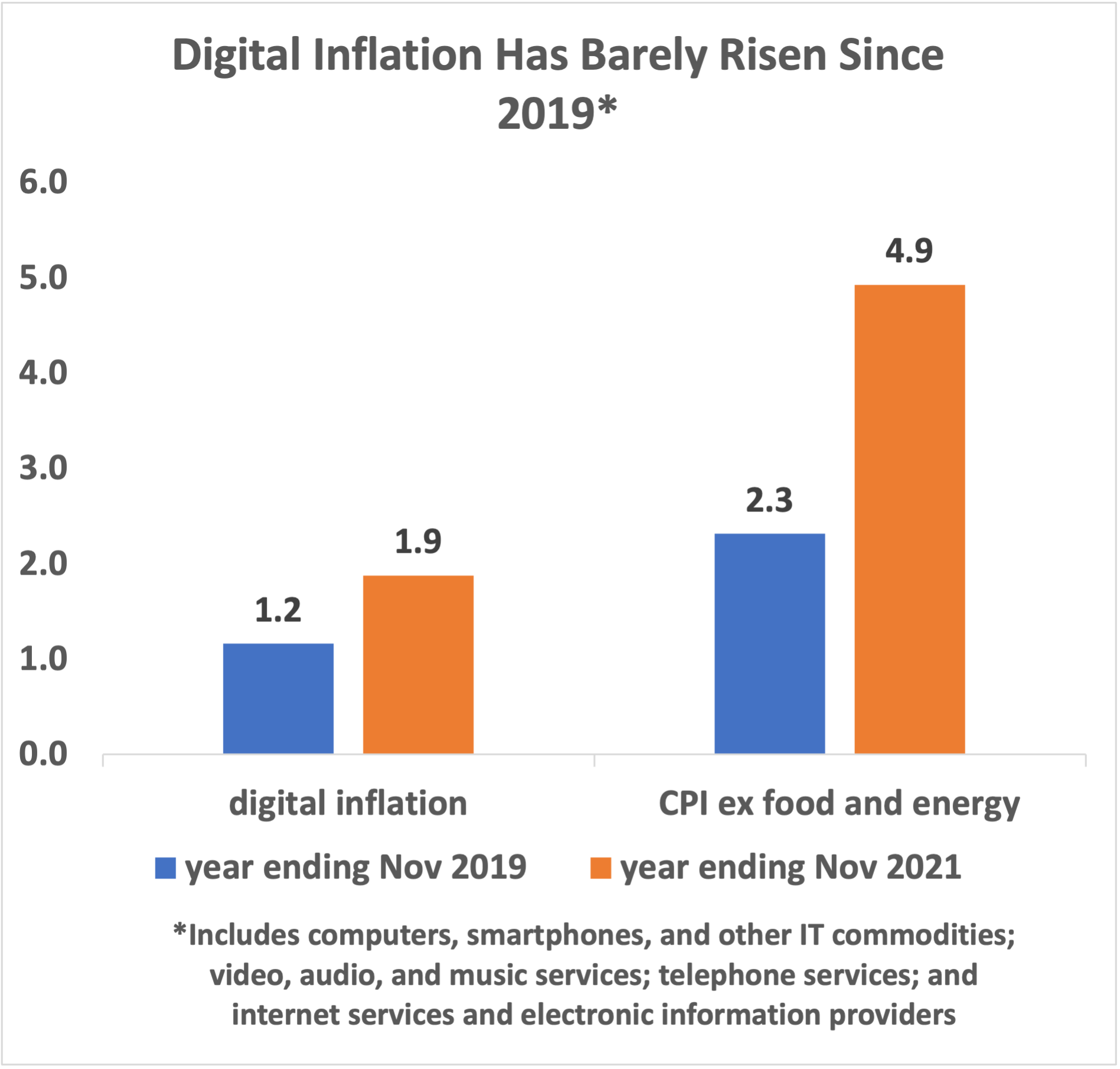
But here’s an important piece of good news that is not getting enough attention. Inflation remains low in the digital sector, even as it accelerates across much of the economy.  Start with consumer inflation (as measured by the CPI). Over the past year, prices for digital consumer goods and services tracked by BLS (see graphic) have risen by only 1.9% overall, compared to 4.9% for CPI ex food/energy and 6.8% for total CPI.

Digital consumer goods and services include computers, smartphones and other IT commodities; video, audio, and music services; wired and wireless phone services; and internet services and electronic information providers.

The chart shows that digital consumer inflation has risen only 0.7 percentage points (PP) compared to November 2019, while consumer inflation ex food/energy has risen 2.6 PP. For example, the inflation rate for “internet services and electronic information providers” has only risen by 0.7 PP (from 1.5% to 2.3%).

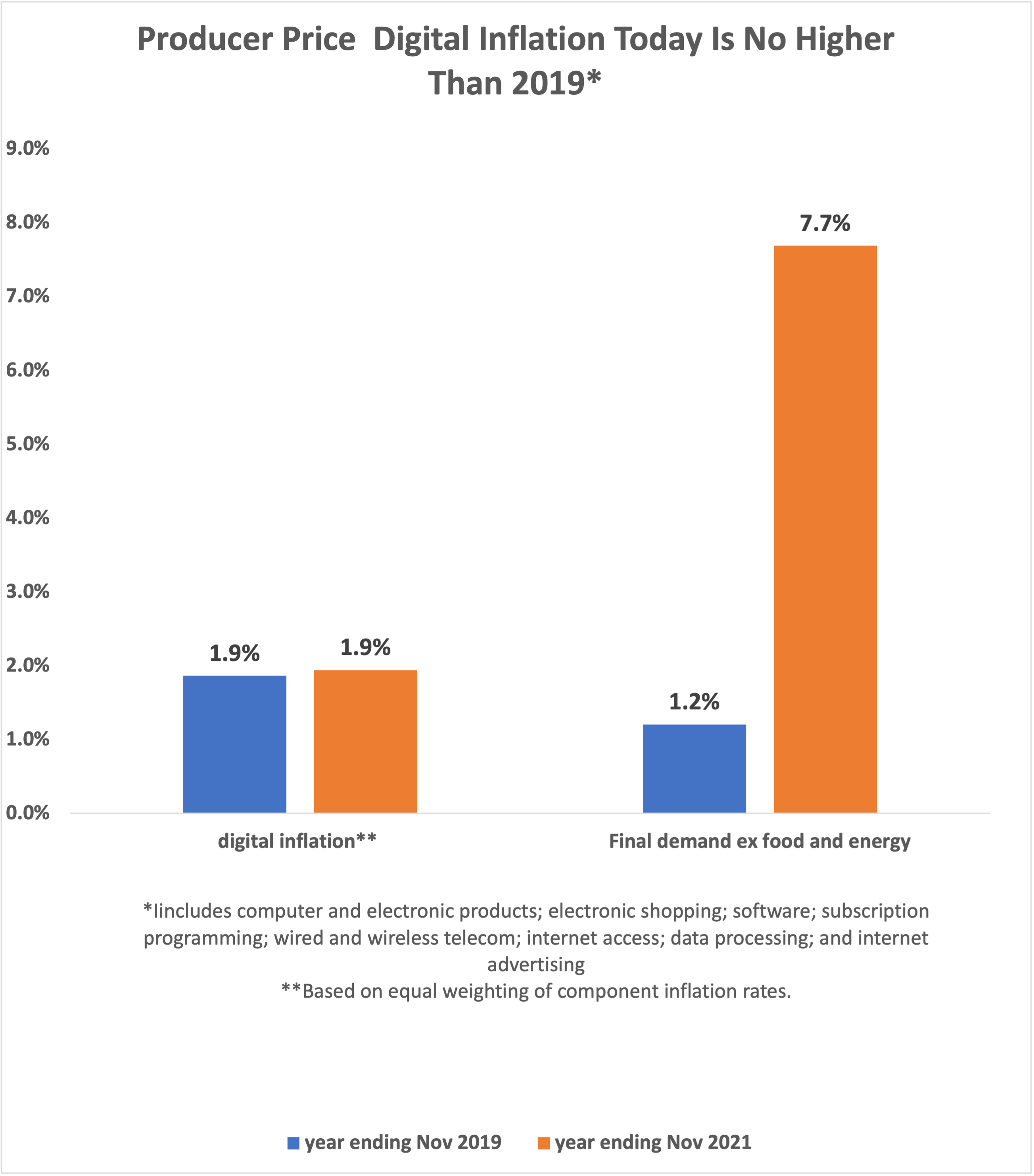
When we look at producer prices, we see a very similar phenomenon:Producer price inflation in the digital sector is no higher today than it was before the pandemic. Over the past year, producer prices for digital goods and services tracked by BLS (see graphic) have risen by only 1.9%, compared to 7.7% for final demand ex food and energy.

Final demand inflation (ex food and energy) accelerated from 1.2% in the year ending Nov 2019 to 7.7% in the year ending Nov 2021. But digital producer price inflation was roughly constant at 1.9% in both periods (this calculation was done giving equal weights to each component).


Digital producer prices include computer and electronic manufacturing; electronic and mail order shopping services; software publishers; cable and other subscription programming; wired and wireless telecom; internet access; data processing; and internet publishing and web search advertising.

Some examples: The producer price of internet access services rose by only 0.3% over the past year, up only slightly from the -0.3% rate in November 2019. The producer price charged by software publishers fell by 0.3%, a slightly bigger decline compared to two years ago. The producer price index for telecommunications, both business and residential, is running at a 1.1% rate, slightly down from the 1.2% rate in November 2019.

The digital sector is exerting a dampening effect on both consumer and producer price inflation, reflecting large productivity-enhancing capital investments by digital companies. Meanwhile productivity has lagged in sectors such as food processing, where prices are skyrocketing.

However, the digital sector is not getting enough “credit” in the overall numbers for holding down inflation. For example, there’s no doubt that the digital sector is much more important to Americans today than it was in pre-pandemic 2019. Yet the digital sector gets a smaller weight in the CPI today than it did in 2019, because spending on digital goods and services is a smaller share of the consumer basket. That’s good news, but it has a perverse effect on the calculation of the overall inflation rate.

We may have to move towards a time-weighted versus expenditure-weighted CPI. Certain tasks, like dealing with the DMV or health insurers, are more “costly” in time than money. Conversely, digital services save you time that doesn’t show up in the official stats.

Time-weighted CPI would take into account that digitizing tasks, including shopping, generally reduces time spent by consumers, while adding more regulations generally increases time spent.

A time-weighted approach to CPI would likely show higher inflation for rural and poorer Americans. It would allow us to think about how cutting government bureaucracy and saving the time of Americans actually reduces inflation.

From the political perspective, the Biden Administration can make a strong case that the digital goods and services that are so important to Americans these days are barely rising in price. And America’s digital leadership will continue to hold down price increases once the temporary supply chain issues abate.


Bledsoe for The Hill: Russian gas is a climate and security disaster

By Paul Bledsoe

With Russian troops massing on Ukraine’s border, and President Biden urging Russia’s Vladimir Putin not to invade, the geopolitics of Russian natural gas are growing increasingly intolerable. European gas imports are a mainstay of cash for Putin’s regime, with over one-third of Kremlin funding coming directly from oil and gas revenue, even as Russia increases repression at home, attempts to undermine democratic elections abroad and continues to use its gas as a geopolitical weapon against Europe.

If that weren’t enough, Russia is the world’s largest emitter of methane, a super climate pollutant whose mitigation is now crucial to global climate change efforts. The EU gets more than 25 percent of its total gas and half its gas imports from Russia’s leaky, antiquated gas production system with emissions of methane eight times higher than EU domestic gas. With methane leaks of at least 5 to 7 percent, the EU is addicted to Russian gas that increases warming twice as much as the coal it’s meant to replace.

Read the full piece in The Hill.

Johnson for The Hill: To tame inflation, Biden should cut tariffs

By Jeremiah Johnson

Despite a strong economy with unemployment falling and GDP rapidly growing, and despite steady progress on his ambitious agenda, President Biden’s popularity has fallen. Inflation is at a multi-decade high, and worries about the cost of food, gas and overall inflation are likely at the center of that dissatisfaction. Americans are concerned about the rising prices of the everyday things they need.

Biden is in a tough spot with regards to inflation. It’s not a realistic option to simply ignore it or tell voters not to worry about it. Blaming it on corporate greed, as Sen. Elizabeth Warren (D-Mass.) does, is self-evidently ridiculous (Did corporate greed disappear during all the years that inflation was low?) and doesn’t do anything to address the issue.

And while there are policies that can fight inflation, those often come with serious drawbacks. Fiscal and monetary policy responses are something Biden can’t do alone — those powers lie with Congress and with an independent Federal Reserve. And even if Biden could successfully pressure Congress and the Fed into anti-inflation policy, those policies often come with the side effect of slowing economic growth, something that no president wants to do. Luckily, there is a policy change that can be made without Congress and without harming growth — reducing tariffs.

Read the full piece in The Hill.

Marshall in The Atlantic: Democrats Are Losing the Culture Wars

Democrats Are Losing the Culture Wars

By Ronald Brownstein, for The Atlantic 

Read the full piece here. 

Maybe Bill Clinton got a few things right after all.

For years, Democrats have rarely cited Clinton and the centrist New Democrat movement he led through the ’90s except to renounce his “third way” approach to welfare, crime, and other issues as a violation of the party’s principles. Hillary Clinton, Joe Biden, and even Bill Clinton himself have distanced themselves from key components of his record as president.

But now a loose constellation of internal party critics is reprising the Clintonites’ core arguments to make the case that progressives are steering Democrats toward unsustainable and unelectable positions, particularly on cultural and social questions.

Just like the centrists who clustered around Bill Clinton and the Democratic Leadership Council that he led decades ago, today’s dissenters argue that Democrats risk a sustained exodus from power unless they can recapture more of the culturally conservative voters without a college education who are drifting away from the party. (That group, these dissenters argue, now includes not only white Americans but also working-class Hispanics and even some Black Americans.) And just as then, these arguments face fierce pushback from other Democrats who believe that the centrists would sacrifice the party’s commitment to racial equity in a futile attempt to regain right-leaning voters irretrievably lost to conservative Republican messages.

Today’s Democratic conflict is not yet as sustained or as institutionalized as the earlier battles. Although dozens of elected officials joined the DLC, the loudest internal critics of progressivism now are mostly political consultants, election analysts, and writers—a list that includes the data scientist David Shor and a coterie of prominent left-of-center journalists (such as Matthew Yglesias, Ezra Klein, and Jonathan Chait) who have popularized his work; the longtime demographic and election analyst Ruy Teixeira and like-minded writers clustered around the website The Liberal Patriot; and the pollster Stanley B. Greenberg and the political strategist James Carville, two of the key figures in Clinton’s 1992 campaign. Compared with the early ’90s, “the pragmatic wing of the party is more fractured and leaderless,” says Will Marshall, the president of the Progressive Policy Institute, a centrist think tank that was initially founded by the DLC but that has long outlived its parent organization (which closed its doors in 2011).

For now, these dissenters from the party’s progressive consensus are mostly shouting from the bleachers. On virtually every major cultural and economic issue, the Democrats’ baseline position today is well to the left of their consensus in the Clinton years (and the country itself has also moved left on some previously polarizing cultural issues, such as marriage equality). As president, Biden has not embraced all of the vanguard liberal positions that critics such as Shor and Teixeira consider damaging, but neither has he publicly confronted and separated himself from the most leftist elements of his party—the way Clinton most famously did during the 1992 campaign when he accused the hip-hop artist Sister Souljah of promoting “hatred” against white people. Only a handful of elected officials—most prominently, incoming New York City Mayor Eric Adams—seem willing to take a more confrontational approach toward cultural liberals, as analysts such as Teixeira are urging. But if next year’s midterm elections go badly for the party, it’s possible, even likely, that more Democrats will join the push for a more Clintonite approach. And that could restart a whole range of battles over policy and political strategy that seemed to have been long settled.

The Democratic Leadership Council was launched in February 1985, a few months after Ronald Reagan won 49 states and almost 60 percent of the popular vote while routing the Democratic presidential nominee Walter Mondale. From the start, Al From, a congressional aide who was the driving force behind the group, combatively defined the DLC as an attempt to steer the party toward the center and reduce the influence of liberal constituency groups, including organized labor and feminists.

The organization quickly attracted support from moderate Democratic officeholders, mostly in the South and West and also mostly white and male (critics derided the group alternately as the “white male caucus” or “Democrats for the Leisure Class”). After moving cautiously in its first years, the DLC shifted to a more aggressive approach and found a larger audience following Michael Dukakis’s loss to George H. W. Bush in 1988. Losing to a generational political talent like Reagan amid a booming economic recovery was one thing, but when the gaffe-prone Bush beat Dukakis, who had moved to the center on economics, by portraying him as weak on crime and foreign policy, more Democrats responded to the DLC’s call for change. “That’s when it clicked in brains that we just don’t have an offer [to voters] that can sustain majority support around the country,” Marshall, who worked for the DLC since its founding, told me.

The DLC responded to its larger audience by releasing what would become the enduring mission statement of the New Democrat movement. In September 1989, the Progressive Policy Institute, the think tank the DLC had formed a few months earlier, published a lengthy paper called “The Politics of Evasion.”

The paper’s authors, William Galston and Elaine Kamarck, were two Democratic activists with a scholarly bent, but on this occasion they wrote with a blowtorch. In the paper, they dismantled the common excuses for the party’s decline: bad tactics, unusually charismatic opponents, and the failure to mobilize enough nonvoters. Dukakis’s defeat meant that Democrats had lost five of the six previous presidential elections, averaging only 43 percent of the popular vote, and the party, Galston and Kamarck argued, needed to face the dire implications of that record. “Too many Americans,” they wrote, “have come to see the party as inattentive to their economic interests, indifferent if not hostile to their moral sentiments and ineffective in defense of their national security.”

The party had veered off course, they argued, because it had become dominated by “minority groups and white elites—a coalition viewed by the middle class as unsympathetic to its interests and its values.” Unless Democrats could reverse the perception among those middle-class voters that they too were profligate in spending and too permissive on social issues such as crime and welfare, the party was unlikely to win them back, even if a Republican president mismanaged the economy or Democrats convincingly tarred Republicans as favoring the wealthy. “All too often the American people do not respond to a progressive economic message, even when Democrats try to offer it, because the party’s presidential candidates fail to win their confidence in other key areas such as defense, foreign policy, and social values,” Galston and Kamarck wrote. “Credibility on these issues is the ticket that will get Democratic candidates in the door to make their affirmative economic case.”

The only way to prove to these disaffected middle-class voters that the party had changed, the pair suggested, was for centrists to publicly pick a fight with liberals. “Only conflict and controversy over basic economic, social, and defense issues are likely to attract the attention needed to convince the public that the party still has something to offer,” they declared.

Bill Clinton, who took over as DLC chairman a few months after “The Politics of Evasion” was published, “devoured these analyses of the Democrats’ difficulties as if they were so many French fries,” as Dan Balz and I wrote in our 1996 book, Storming the Gates. Clinton sanded down some of the sharpest edges of these ideas and adapted them into the folksy, populist style he had developed while repeatedly winning office in Arkansas, a state dominated by culturally conservative, mostly non-college-educated white Americans. But the basic prescription of the Democratic dilemma that Galston and Kamarck had identified remained a compass for him throughout his 1992 presidential campaign and eventually his presidency.

After a quarter century of futility, Clinton’s reformulation of the traditional Democratic message restored the party’s ability to compete for the White House. But after he left office, more Democrats came to view his approach as an unprincipled concession to white conservatives, particularly on issues such as crime and welfare. Compared with Clinton, Barack Obama generally pursued a much more liberal course, especially on social issues and especially as his presidency proceeded. Hillary Clinton, in her 2016 primary campaign, felt compelled to renounce decisions from her husband’s presidency on trade, LGBTQ rights, and crime (though not welfare reform). Similarly, in the 2020 primary race, Biden distanced himself from both the 1994 crime bill (which he had steered through the Senate) and welfare reform, without fully repudiating either. Even Bill Clinton, in a 2015 appearance before the NAACP, apologized for elements of the crime bill, which he acknowledged had contributed to the era of mass incarceration. With the DLC having folded a decade earlier, the PPI enduring only as a shadow of its earlier size and prominence, and other centrist organizations raising relatively fewer objections to the Democratic Party’s course, the rejection of Clintonism and the ascent of progressivism appeared complete as Biden took office.

Eleven tumultuous months later, the neo–New Democrats have emerged as arguably the loudest cluster of opposition to the party’s direction since the DLC’s heyday. But so far, the new critics of liberalism have not produced a critique of the party’s failures or a blueprint for its future as comprehensive as “The Politics of Evasion.” David Shor, a young data analyst and pollster who personally identifies as a democratic socialist, has promoted his ideas primarily through interviews with sympathetic journalists (taking criticism along the way for failing to document some of his assertions about polling results). Ruy Teixeira and his allies have advanced similar ideas in greater depth through essays primarily in their Substack project, The Liberal Patriot. Stan Greenberg, the pollster, summarized his approach in an extensive recent polling report on how to improve the party’s performance with working-class voters that he conducted along with firms that specialize in Hispanic (Equis Labs) and Black (HIT Strategies) voters.

These analysts don’t always agree with one another. But they do overlap on key points that echo central conclusions from “The Politics of Evasion.” Like Galston and Kamarck a generation ago, Shor, Teixeira, and Greenberg all argue that economic assistance alone won’t recapture voters who consider Democrats out of touch with their values on social and cultural issues. (Today’s critics don’t worry as much as the DLC did about the party appearing weak on national security.) “The more working class voters see their values as being at variance with the Democratic party brand,” Teixeira wrote recently in a direct echo of “Evasion,” “the less likely it is that Democrats will see due credit for even their measures that do provide benefits to working class voters.”

Also like Galston and Kamarck, Shor and Teixeira in particular argue that Democrats have steered off track on cultural issues because the party is unduly influenced by the preferences of well-educated white liberals. Like the pugnacious DLC founder Al From during the 1980s, Teixeira believes that Democrats can’t convince swing voters that the party is changing unless they publicly denounce activists advocating for positions such as defunding the police and loosening immigration enforcement at the border. Several Never Trump Republicans fearful that Biden’s faltering poll numbers will allow a Donald Trump revival have offered similar advice. (Shor also believes that Democrats must move to the center on cultural issues but he’s suggested that the answer is less to pick fights within the party than to simply downplay those issues in favor of economics, where the party’s agenda usually has more public support, an approach that has been described as “popularism.” “On the social issues, you want to take the median position,” he told me, “but really the game is that our positions are so unpopular, we have to do everything we can to keep them out of the conversation. Period.”)

In all this, the critics are excavating arguments from the Clinton/DLC era that had been either repudiated or simply forgotten in recent years. Teixeira sees a “family resemblance” between his views and the case that Galston and Kamarck developed. Shor has more explicitly linked his critique to those years. “When I first started working on the Obama campaign in 2012, I hated all the last remnants of the Clinton era,” Shor told one interviewer. “There was an old conventional wisdom to politics in the ’90s and 2000s that we all forget … We’ve told ourselves very ideologically convenient stories about how those lessons weren’t relevant … and it turned out that wasn’t true. I see what I’m doing as rediscovering the ancient political wisdom of the past.”

When I spoke with him this week, Shor argued that his generation had incorrectly discarded lessons about holding the center of the electorate understood by Democrats of Clinton’s era, and even through the early stages of Obama’s presidency. The electorate today, he said, is less conservative than in Clinton’s day but more conservative than most Democrats want to admit. “It took me a long time to accept this, because it was very ideologically against what I wanted to be true, but the reality is, the way to win elections is to go against your party and to seem moderate,” Shor said. “I like to tell people that symbolic and ideological moderation are not just helpful but actually are the only things that matter to a big degree.”

As Teixeira told me, most of today’s critics reject the Clinton/DLC economic approach, which stressed deficit reduction, free trade, and deregulation in some areas, such as financial markets. Even the most conservative congressional Democrats, such as Senator Joe Manchin of West Virginia, have signaled that they will accept far more spending in Biden’s Build Back Better agenda than Clinton ever might have contemplated. Shor remains concerned that Democrats could spark a backlash by moving too far to the left on spending, but overall, most in the party would agree with Teixeira when he says, “You don’t see that kind of ideological divide between tax-and-spend Democrats and the self-styled apostles of the market like you had back in those days.”

On social issues, too, the range of Democratic opinion has also moved substantially to the left since the Clinton years. No Democrat today is calling for resurrecting the harsh sentencing policies, particularly for drug offenses, that many in the party supported as crime surged in the late ’80s and ’90s. All but two House Democrats voted for sweeping police-reform legislation this year. Similarly, Biden and congressional Democrats have unified around a provision that would permanently provide an expanded child tax credit to parents without any earnings, even though some Republicans, such as Senator Marco Rubio of Florida, claim that that would violate the principle of requiring work in the welfare-reform legislation that Clinton signed in 1996. The Democratic consensus has also moved decisively to the left on other social issues that bitterly divided the party in the Clinton years, including gun control, LGBTQ rights, and a path to citizenship for undocumented immigrants.

All of these changes are rooted in the reconfiguration of the Democratic coalition and the broader electorate since the Clinton years. Compared with that era, Democrats today need fewer culturally conservative voters to win power. Roughly since the mid-’90s, white Americans without a college degree—the principal audience for the centrist critics—have fallen from about three-fifths of all voters to about two-fifths (give or take a percentage point or two, depending on the source). Over that same period, voters of color have nearly doubled, to about 30 percent of the total vote, and white voters with a college degree have ticked up to just above that level (again with slight variations depending on the source).

The change in the Democratic coalition has been even more profound. As recently as Clinton’s 1996 reelection, those non-college-educated white voters constituted nearly three-fifths of all Democrats, according to data from the Pew Research Center, with the remainder of the party divided about equally between college-educated white voters and minority voters. By 2020, the Democratic targeting firm Catalist, in its well-respected analysis of the election results, concluded that non-college-educated white Americans contributed only about one-third of Biden’s votes, far less than in 1996, only slightly more than white Americans with a college degree, and considerably less than people of color (who provided about two-fifths of Biden’s support). This ongoing realignment—in which Democrats have replaced blue-collar white voters who have shifted toward the GOP (particularly in small towns and rural areas) with minority voters and well-educated white voters clustered in the urban centers and inner suburbs of the nation’s largest metropolitan areas—has allowed the party to coalesce around a more uniformly liberal cultural agenda.

Shor, Teixeira, Greenberg, and like-minded critics now argue that this process has gone too far and that analysts (including me) who have highlighted the impact of demographic change on the electoral balance have underestimated the risks the Democratic Party faces from its erosion in white, non-college-educated support, especially in the Trump era. Although Democrats have demonstrated that they can reliably win the presidential popular vote with this new alignment—what I’ve called their “coalition of transformation”—the critics argue that the overrepresentation of blue-collar white voters across the Rust Belt, Great Plains, and Mountain West states means that Democrats will struggle to amass majorities in either the Electoral College or the Senate unless they improve their performance with those voters. Weakness with non-college-educated white voters outside the major metros also leaves Democrats with only narrow paths to a House majority, they argue. Shor has been the starkest in saying that these imbalances in the electoral system threaten years of Republican dominance if Democrats don’t regain some of the ground they have lost with working-class voters since Clinton’s time.

These arguments probably would not have attracted as much notice if they were focused solely on those non-college-educated white Americans who have voted predominantly for Republicans since the ’80s and whose numbers are consistently shrinking as a share of the electorate (both nationally and even in the key Rust Belt swing states) by two or three percentage points every four years. What really elevated attention to these critiques was Trump’s unexpectedly improved performance in 2020 among Hispanics and, to a lesser extent, Black Americans. The neo–New Democrats have taken that as evidence that aggressive social liberalism—such as calls for defunding the police—is alienating not only white voters but now nonwhite working-class voters.

If it lasts, such a shift among working-class voters of color could largely negate the advantage that Democrats have already received, and expect moving forward, from the electorate’s growing diversity. “You won’t benefit that much from the changing ethnic demographic mix of the country if these overwhelmingly noncollege, nonwhite [voters] start moving in the Republican direction, and that concentrates the mind,” Teixeira told me.

As in the DLC era, almost every aspect of the neo–New Democrats’ critique is sharply contested.

One line of dispute is about how much social liberalism contributed to Trump’s gains last year with Hispanic and Black voters. Polls, such as the latest American Values survey, by the nonpartisan Public Religion Research Institute, leave no question that a substantial share of Black and especially Hispanic voters express culturally conservative views. Greenberg says in his recent study that non-college-educated Hispanics and Black Americans, as well as blue-collar white voters, all responded to a tough populist economic message aimed at the rich and big corporations, but only after Democrats explicitly rejected defunding the police. “You just didn’t get there [with those voters] unless you were for funding and respecting, but reforming, the police as part of your message,” Greenberg told me. “The same way that in his era and time … welfare reform unlocked a lot of things for Bill Clinton, it may be that addressing defunding the police unlocks things in a way that is similar.”

Yet some other Democratic analysts are skeptical that socially liberal positions on either policing or immigration were the driving force of Trump’s gains with minority voters (apart, perhaps, from a localized role for immigration in Hispanic South Texas counties near the border). Stephanie Valencia, the president of the polling firm Equis Labs, told me earlier this year that Biden might have performed better with Hispanics if the campaign debate had focused more on immigration; she believes that Trump benefited because the dialogue instead centered so much on the economy, which gave conservative Hispanics who “were worried about a continued shutdown [due] to COVID” a “permission structure” to support him. Terrance Woodbury, the CEO of the polling and messaging firm HIT Strategies, similarly says that although Black voters largely reject messaging about defunding the police, they remain intently focused on addressing racial inequity in policing and other arenas—and that a lack of perceived progress on those priorities might be the greatest threat to Black Democratic turnout in 2022.

Other political observers remain dubious that Democrats can regain much ground with working-class white voters through the strategies that the neo–New Democrats are offering, especially when the Trump-era GOP is appealing to their racial and cultural anxieties so explicitly. Even if Democrats follow the critics’ advice and either downplay or explicitly renounce cutting-edge liberal ideas on policing and “cancel culture,” the party is still irrevocably committed to gun control, LGBTQ rights (including same-sex marriage), legalization for millions of undocumented immigrants, greater accountability for police, and legal abortion. With so many obstacles separating Democrats from blue-collar white voters, there’s “not a lot of room” for Democrats to improve their standing with those voters, says Alan Abramowitz, an Emory University political scientist who has extensively studied blue-collar attitudes.

Rather than chasing the working-class white voters attracted to Trump’s messages by shifting right on crime and immigration, groups focused on mobilizing the growing number of nonwhite voters, such as Way to Win, argue that Democrats should respond with what they call the “class-race narrative.” That approach directly accuses Republicans of using racial division to distract from policies that benefit the rich, a message these groups say can both motivate nonwhite intermittent voters and convince some blue-collar white voters. “We’re much better off calling [Republicans] out—scorning them for trying to use race to divide us so that the entrenched can keep their privileges—and laying out a bold populist reform agenda that actually impacts people across lines of race,” says Robert Borosage, a longtime progressive strategist who served as a senior adviser to Jesse Jackson when he regularly sparred with the DLC during his presidential campaigns and after.

For their part, first-generation New Democrats such as Galston and Marshall believe that the current round of critics is unrealistic to assume that neutralizing cultural issues would give the party a free pass to expand government spending far more than Clinton considered politically feasible. Too many Democrats “think it’s about the things government can do for you, but lots of working people of all races … want opportunity … They want a way to get ahead of their own effort,” Marshall told me.  Shor, unlike some of the other contemporary critics of progressivism, largely seconds that assessment. “There are things that people trust Republicans on and you have to neutralize those disadvantages by moving to the center on them, and that includes the size of government, that includes the deficit,” he said. “You have to make it seem that you care a lot about inflation, that you care a lot about the deficit, that you care about all of those things.”

Though Biden hasn’t directly engaged with these internal debates, in practice he’s landed pretty close to the critics’ formula. The president has overwhelmingly focused his time on trying to unify Democrats around the sweeping kitchen-table economic agenda embodied in his infrastructure and Build Back Better plans. He’s talked much less about social issues whether he’s agreeing with the left (as on many, though not all, of his approaches to the border) or dissenting from it (in his repeated insistence that he supports more funding, coupled with reform, for the police.) “I don’t know where his heart is on this stuff, but I think he’s a creature of the party and what he thinks is the party consensus,” Teixeira told me. “He doesn’t want to pick a fight.”

Yet despite Biden’s characteristic instinct to calm the waters, the debate seems destined to intensify around him. Galston, now a senior governance fellow at the Brookings Institution, has recently discussed with Kamarck writing an updated version of their manifesto. “Is there a basis for the kind of reflection and rethinking that was set in motion at the end of the 1980s? I think yes,” Galston told me. Meanwhile, organizations such as Way to Win are arguing that Democrats should worry less about recapturing voters drawn to Trump than mobilizing the estimated 91 million individuals who turned out to vote for the party in at least one of the 2016, 2018, and 2020 elections.

The one point on which both the neo–New Democrats and their critics most agree is that with so many Republicans joining Trump’s assault on the pillars of small-d democracy, the stakes in Democrats finding a winning formula are even greater today than they were when Clinton ran. “There’s a greater sense of urgency, I would say. Because if we had gotten it wrong in 1992, the country’s reward would have been George H. W. Bush, which wasn’t terrible at the time and in retrospect looks better,” Galston said. “This time if we get it wrong, the results of failure will be Donald Trump.”

Kane for Bloomberg: Would the U.S. Have Spotted Omicron as Fast as South Africa?

By Arielle Kane

President Joe Biden told Americans not to panic about the omicron Covid-19 variant because the U.S. has “the best vaccine in the world, the best medicines, [and] the best scientists.” What the U.S. doesn’t have, however, is the best data. Although the country’s virus DNA sequencing has improved, its data infrastructure still isn’t robust enough to handle this and future pandemics.

When Biden assumed office, the U.S. was sequencing the DNA and thus identifying the viral strains of roughly 8,000 positive Covid-19 tests a week. Ten months later, U.S. labs are sequencing about 80,000 a week. Last week that amounted to one in seven PCR tests. This isn’t enough.

Read the full piece in Bloomberg.

What Role Does Natural Gas Play in Meeting Global Energy and Climate Goals?

On this week’s episode, Paul Bledsoe, author of a new PPI report titled “The Role of Natural Gas in Limiting European Union Emissions: Key Opportunities to Cut Methane, Coal and CO2” sits down to explain the major implications for U.S. and global climate policy, as well as some of the key recommendations from the report.

The report calls for an international effort to accurately verify and monitor methane emissions from domestic and imported gas and then regulate emissions to as close to zero as possible. These actions, if taken together, could play a major role in reducing greenhouse as global emissions as renewable energy grows.

Read the full report here.

Learn more about the Progressive Policy Institute here.

PPI’s Trade Fact of the Week: Women head 25 trade and commerce ministries.

FACT:

Women head 25 trade and commerce ministries.


THE NUMBERS: 

Women serving as Trade or Commerce Minister:

196   Countries and territories in CIA World Leaders Directory

25     Countries with Women as Trade/Commerce Ministers, December 2021

25     Countries with Women as Trade/Commerce Ministers, March 2010


WHAT THEY MEAN:

At some future date — perhaps next spring — the World Trade Organization’s 12th Ministerial Conference will convene after two COVID-forced postponements. Known for short as “MC-12,” the event will join the Trade Ministers of the 164 WTO members (in principle; in practice some don’t show, and some members don’t have trade or commerce ministries) in hopes to agree on fishery subsidy reform, trade and health, and institutional reform. Whenever it meets, and whatever the outcomes, two things are for certain:

(1)    Dr. Ngozi Okonjo-Iweala (pictured below), appointed Director-General this past January, will be the first woman to convene a WTO Ministerial Conference. A former Nigerian Finance Minister, academic, and World Bank official, she is the first female Director-General among the 10 “DG’s” in the 73-year history of the WTO and its predecessor, the GATT (General Agreement on Tariffs and Trade).

(2)    Dr. Okonjo-Iweala won’t have a ton of female company among the assembled Ministers.  Using the CIA’s online “Directory of World Leaders” (a useful but somewhat shaky source; see below), PPI Trade & Global Markets staff count 19 women serving as Trade Minister around the world this month, plus at least six more with broader jobs — Ministers of Economy, Foreign Affairs, etc. — which also cover trade.  The 25-Minister total, representing about 12% of the world’s Cabinet-level trade positions, is identical to the count in a Trade Fact dating to 2010.

Why do so few women get these jobs? Posing the question this way is probably an error: Trade ministries are not an odd exception, but pretty typical. The CIA’s Directory finds women holding about 11% of the world’s defense ministries, 6% of finance ministries, 12% of health ministries, 15% of education ministries, and so on. Looking back, the last decade looks like one of stasis or even regression — women’s share of economic and law positions seems roughly stable; the share in health, culture, and education jobs fell from about 25% to 15%; and appointments in defense, police, and finance appointments remain particularly rare.

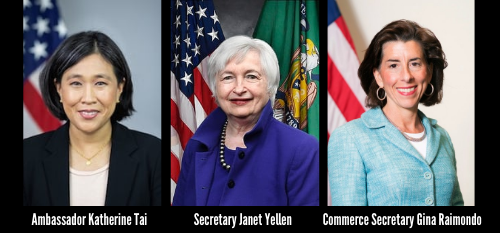
Overall, a pretty static and glum environment — but three bright spots. At the very top, publics appear at least a bit more open to choosing women as national leaders, with 25 serving as heads of government.  At home, the United States looks unusually good in economic diplomacy just now, with U.S. Trade Representative Katharine Tai representing the U.S. whenever MC-12 does convene; the Treasury Department run by Janet Yellen (also a former Federal Reserve chief and lead White House economist); and the Commerce Department by Gina Raimondo. And top-tier international organizations also show progress, if from a truly dismal base. As of 2010, no female had ever appeared among the lists of UN Secretaries-General, International Monetary Fund Managing Directors, World Bank Presidents, WTO and GATT Directors-General, or International Labor Organization Directors-General. The past decade has brought three such appointments (among eight total): those of Christine Lagarde in 2011 and Kristalina Georgieva in 2019 at the IMF, and most recently that of Dr. Okonjo-Iweala at the WTO.  She gets the last word: “Gender equality is a fundamental human rights issue and also an economic empowerment issue. We should all work harder.”


FURTHER READING


Dr. Ngozi Okonjo-Iweala in remarks for International Women’s Day (March 21), on the WTO, trade in the COVID-19 pandemic, the positive role trade integration appears to have on women workers, and pandemic lessons on women as national leaders.

Read about the UN on women’s leadership and political participation.


Three working women
 
U.S. Trade Representative Katharine Tai outlines the Biden Administration’s gender equity policy and trade contributions, and reflects on early life lessons, at the Summit of Democracies this morning.

Treasury Secretary Janet Yellen discusses opportunities and challenges for women in the economics profession with IMF Managing Director Georgieva (“many obstacles,” and “a cultural problem in the profession”).

And remarks from Commerce Secretary Gina Raimondo on competitiveness, workforce development, innovation, and equity.


From PPI, the Mosaic Economic Project

Mosaic provides training in media and publishing, network-building, and other services for two classes of 8-12 women in economics each year. Program Director Jasmine Stoughton explains on the Neoliberal Project podcast.

… Applications open for the February 2022 Mosaic cohort can be found here.… and 2021 Mosaic cohort member Aditi Mohapatra, Managing Director of Business for Social Responsibility, on next-decade agenda for private-sector hiring equity.


Around the world 

The inaugural “USMCA” Ministerial meeting joins Amb. Tai with Canadian Trade Minister Mary Ng and Mexican Economy Minister Tatiana Clouthier.

Khadija bint M’barek Fall on her work as Mauritania’s Commerce Minister.

Lithuania’s Ausrine Armonaite encourages girls to choose science careers.

Read about Colombia’s Maria Ximena Lombana Villalba.

Taiwan’s Economics Minister Wang Mei-hua pitches a bilateral trade agreement with the U.S. as potential solution to semiconductor shortages.

Kenya’s Cabinet Secretary for Commerce Betty Maina on Kenyan industry’s response to COVID.


A source note

The CIA’s online Directory of the world’s presidents, Cabinet ministers, Central Bank chiefs, and other great and wise is a valuable and possibly unique on-line public resource.  The Agency’s claim that it is “updated weekly”, however, is a bold overstatement.  As of today (Dec. 8) it still cites Benjamin Netanyahu as Israeli Prime Minister, though Naftali Bennett has had the job for 25 weeks.  The Directory likewise notes the dissolution of the Malaysian government in March 2021 but lists no Ministers at all.  It also skips some Ministers, such as Canadian Trade Minister Mary Ng and Mexican Economy Secretary Tania Clouthier.  Hopefully the IC knows the identity of Israel’s PM, is aware that Malaysia has a government, is familiar with the top trade negotiators for Mexico and Canada, and has just been busy with other important matters.  The percentages above rest on this Directory, though we’ve rechecked in general and updated our count of 25 Trade Ministers by examining national websites.  Nonetheless, apologies if we missed anyone. The CIA’s Directory of World Leaders and Cabinet Officers can be found here.


And last, returning to Geneva and the WTO for some (very) long-term perspective 

In 1558, two miles south down Quai Wilson and over the Rhone from Dr. Okonjo-Iweala’s office, Presbyterian Church father John Knox used a temporary Geneva base to write up his First Blast of the Trumpet Against the Monstrous Regiment of Women.  Mr. Knox’s 22,000-word bid for “worst book anywhere, ever” makes three arguments against government appointments, and especially against national leadership roles, for women:

   Selective Citation of Authority: The Bible does not place women in authority-roles; ergo, modern society also shouldn’t.  Except, Knox admits, for prophetess Deborah, queens Athaliah and Jezebel, and lots of others. He argues that, for various hand-waving reasons, they shouldn’t really count.
   Analogy:  Men are like the “head” of a family, and a country is like a family. If women are in charge, a country is metaphorically walking on its hands, with its “head” down and its “feet” on top.
   Verbal Abuse: A country ruled by women is “monstriferous,” and “contumely to God.”
   Knox’s rant can be read here.
   …and back in the 21st century, Dr. Okonjo-Iweala and former Australian PM Julia Gillard, joint authors of a February book on women in national leadership, discuss the topic at Brookings.
Special note: Research and drafting for this Fact by Lisa Ly, Social Policy Intern for the Progressive Policy Institute. Lisa is currently a Master of Public Policy candidate at The George Washington University.


ICYMI:
Clogged ports, empty truck cabs:
Good problems to have

by Ed Gresser, PPI Vice President
and Director for Trade and Global Markets
for New York Daily News

Looking out at the Pacific this year, worried farmers see giant cargo ships turning around empty, leaving their wine, butter and almond cargoes on the docks and at least $1.5 billion in exports lost. Meanwhile, 80-ship pileups off the coast of Southern California mean weeks or even months of delays unloading industrial inputs and consumer goods; and with truckers and warehouse workers quitting their jobs at record rates, full containers are piling up in fields and parking lots.

The port problems are complicated and serious enough to worry even President Biden, who has given speeches and put out policies to head off complaints about everything from empty shelves during Christmas shopping weeks to lost farm exports and inflationary bottlenecks.

READ MORE


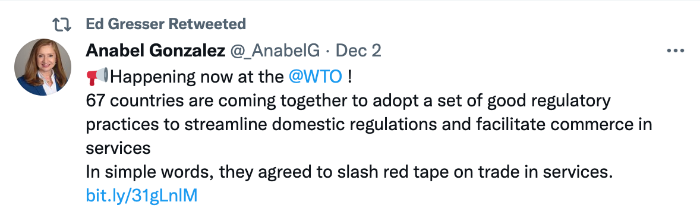
TOP TRADE RETWEET:


Follow the World Trade Organization


ABOUT ED

Ed Gresser is Vice President and Director for Trade and Global Markets at PPI.

Ed returns to PPI after working for the think tank from 2001-2011. He most recently served as the Assistant U.S. Trade Representative for Trade Policy and Economics at the Office of the United States Trade Representative (USTR). In this position, he led USTR’s economic research unit from 2015-2021, and chaired the 21-agency Trade Policy Staff Committee.

Ed began his career on Capitol Hill before serving USTR as Policy Advisor to USTR Charlene Barshefsky from 1998 to 2001. He then led PPI’s Trade and Global Markets Project from 2001 to 2011. After PPI, he co-founded and directed the independent think tank ProgressiveEconomy until rejoining USTR in 2015. In 2013, the Washington International Trade Association presented him with its Lighthouse Award, awarded annually to an individual or group for significant contributions to trade policy.

Ed is the author of Freedom from Want: American Liberalism and the Global Economy (2007).  He has published in a variety of journals and newspapers, and his research has been cited by leading academics and international organizations including the WTO, World Bank, and International Monetary Fund. He is a graduate of Stanford University and holds a Master’s Degree in International Affairs from Columbia Universities and a certificate from the Averell Harriman Institute for Advanced Study of the Soviet Union.

Read the full email and sign up for the Trade Fact of the Week


EU Imports of Methane-Heavy Russian Gas Undermine Climate Goals Finds New Report from PPI; New EU Methane Regs are Needed

Report Finds Opportunity for Lower-Methane U.S. LNG to Gain Market Share in EU and Globally While Reducing Emissions and Cutting Kremlin Revenue 

A new report authored by the Progressive Policy Institute’s Paul Bledsoe finds that the European Union’s huge reliance on high-methane emitting Russian gas undermines the EU’s climate goals. The report, entitled “The Role of Natural Gas in Limiting European Union Emissions: Key Opportunities to Cut Methane, Coal and CO2,” also has major implications for U.S. and global climate policy. Cutting methane from gas, first in the EU and U.S., then globally, can greatly reduce near-term emissions, speeding up the phase out of coal in the EU and Asia, and providing new market share for lower-methane U.S. liquefied natural gas exports. This report is the first of four reports on the role of natural gas in reducing emissions.

“Due to massive methane leaks in its production system, Russian gas is worse than coal for the climate, yet Europe, the world’s largest gas importer, gets 25% of its total gas supply from Russia right now. To meet climate goals, the EU must adopt regulations to require low methane gas, including from imports. This can provide a new opportunity for U.S. LNG exports to Europe to outcompete Russia on lower emissions, as strict U.S. methane regulations and the gas industry rapidly reduce methane from U.S. gas production,” said Paul Bledsoe, Strategic Adviser for the Progressive Policy Institute. “Russia also continues to use its gas as a geopolitical weapon against Europe, threatening Ukraine with impunity and handing Putin and Gazprom record profits because of the EU addiction to the Kremlin’s gas. The U.S. and EU each have strong climate and geopolitical incentives to limit natural gas emissions and Russia’s malign policies by displacing Russian gas with both cleaner gas and renewable energy.”

The dominance of Russia in the European gas market is troubling — with Russia providing nearly half of total EU gas imports in 2020. This Russian natural gas has extremely high rates of fugitive emissions of methane, a super-potent greenhouse gas, and is a leading factor in Russia being by far the world’s largest methane emitter.

However, new sources of gas, including liquefied natural gas (LNG) imports from the United States and other clean sources, can reduce the EU’s reliance on Russian gas. The United States has long had better methane and carbon dioxide reporting standards and measurements than other gas exporters, leading the world in both methane science and efforts to reduce methane emissions. And importantly, the Biden Administration, Congress, and the U.S. natural gas industry are beginning to undertake a series of strategic steps to make U.S. gas super-low emitting compared to gas from Russia and other major exporters.

PPI’s report calls for an international effort to accurately verify and monitor methane emissions from domestic and imported gas and then regulate emissions to as close to zero as possible. These actions, if taken together, could play a major role in reducing greenhouse as global emissions as renewable energy grows.

Select key recommendations from the report include:


  • The EU should put in place rigorous monitoring, reporting and verification rules covering all natural gas, both domestically produced and imported.
  • Over the next few years, the EU should require gas exporters to accurately verify lifecycle emissions of methane as a condition for gaining access to the EU market.
  • The EU and United States should harmonize their monitoring, reporting, and verification (MRV) regimes of lifecycle emissions from natural gas as a key interim step in this process. This step is crucial in setting a global benchmark for MRV emissions from gas.
  •  The EU should consider adopting stringent methane emissions regulations for domestically produced natural gas immediately, and then extend these requirements to imported gas at the earliest opportunity.
  • The EU should seek to diversify and expand its natural gas importation sources both to reduce gas prices to phase out coal and to pressure importers of all types to begin to cut its lifecycle methane and carbon emissions.
  •  The United States should accelerate its already significant measures to drive down U.S. methane emissions from natural gas production and transportation.
  • The EU should measure precisely the extent to which Russian gas with high fugitive methane emissions is undermining progress toward both EU and global climate change goals. Specifically, Brussels should study potential emissions from gas transported through the Nord Stream 2 pipeline before allowing the pipeline to become operational.
  • Over time, the EU should require all natural gas used in the EU achieve super-low methane and CO2 emissions, as gas will be needed to displace coal in the EU to meet climate goals.
  • Increasing low-emitting U.S. liquefied natural gas imports to the EU can play a key role in this process, and should be a domestic and international climate change policy priority for both the EU and U.S.
  • The EU should prioritize LNG port construction, access, and related infrastructure to spur a competition toward super-low emitting gas, and to displace Russian gas.
  • The EU can advance its own energy and security interests, as well as its climate goals, by acting on its stated policy of reducing its dependence on Russia gas, cutting imports by at least half during the current decade.


Read the full report:

Paul Bledsoe is a strategic adviser at the Progressive Policy Institute and a professorial lecturer at American University’s Center for Environmental Policy. He served on the White House Climate Change Task Force under President Clinton, at the U.S. Department of the Interior, as a staff member at the Senate Finance Committee and for several members of the U.S. House of Representatives. Read his full biography here.

The Progressive Policy Institute (PPI) is a catalyst for policy innovation and political reform based in Washington, D.C., with offices in Brussels and Berlin. Its mission is to create radically pragmatic ideas for moving America beyond ideological and partisan deadlock. Learn more about PPI by visiting progressivepolicy.org.

Follow the Progressive Policy Institute.

###