PPI Releases New Report Reimagining SNAP After the Pandemic

As Congress and the White House continue negotiations on the American Families Plan, PPI’s policy experts released a report today outlining new ways that policymakers and the U.S. Department of Agriculture (UDSA) should modernize the Supplemental Nutrition Assistance Program (SNAP) to make the program more accessible to families in need and more resilient in a future crisis. The report, titled “Reimagining SNAP After the Pandemic,” is authored by Veronica Goodman and Kaitlin Edwards.

“When it comes to nutrition assistance, we can’t return to business-as-usual after this pandemic. The post-pandemic era must mark the beginning of a new national dialogue on how to wipe out hunger and malnutrition in America,” said report authors Veronica Goodman and Kaitlin Edwards. “As the Biden administration and Congress begin to craft the American Families Plan, they should prioritize modernizing SNAP, a critical and often lifesaving program.”

Even prior to the COVID-19 pandemic, millions of American families faced food insecurity. In 2019, over 38 million individuals participated in SNAP, with nearly half – 44% – being working families with children.

Yet, about 16% of eligible individuals – which equates to millions of Americans – do not utilize the program. This rate is even higher among seniors and students. Research suggests a lack of information, barriers to applying for benefits, costs to applying, and stigma around needing food assistance account for most of the gaps in participation.

As the pandemic ravaged communities and shuttered businesses, many families and individuals were forced to wait in miles-long lines outside of food banks and nutrition assistance centers. Unemployment rates shot up to levels even higher than during the Great Recession, and many families who never struggled to put food on the table found themselves in desperate need of help. Throughout the pandemic, nearly 44 million individuals enrolled in SNAP, a more than 20% jump from about 36 million in 2019.

To modernize SNAP and increase its effectiveness as one of the most far-reaching hunger prevention interventions, PPI proposes the following reforms:

Reduce administrative burdens by streamlining the application process by creating a single application for multiple social safety net programs, and reduce barriers for eligible populations.

Ease the restrictions on what SNAP benefits can and cannot be used for, and remove restrictions for hot and prepared meals.

Reinforce SNAP as an “automatic stabilizer” in future economic downturns, triggering enhanced benefits and suspended work requirements when the economy enters a recession.

Fill in the gaps in nutrition by adopting the “child multiplier” proposal that would increase the benefit size for families with children under the age of five.

Reform counterproductive limits on savings and assets that dissuade families from creating even small rainy day funds.

Use information technology to modernize the program and reduce the administrative burden on low-income people, states, and retailers.

Read the full report here:

The Progressive Policy Institute (PPI) is a catalyst for policy innovation and political reform based in Washington, D.C. Its mission is to create radically pragmatic ideas for moving America beyond ideological and partisan deadlock. Learn more about PPI by visiting progressivepolicy.org.

Follow the Progressive Policy Institute.

###

Media Contact: Aaron White – awhite@ppionline.org

Reimagining SNAP After the Pandemic

EXECUTIVE SUMMARY:


The coming months present the Biden administration with an opportunity to rethink the structure and role of SNAP, our country’s largest anti-hunger program, to better address food insecurity in the United States. During the pandemic, policymakers eased rules around eligibility and access to make it easier to prevent widespread hunger resulting from the economic toll of the pandemic. Studying these changes can inform how we modernize SNAP for the post-pandemic future.

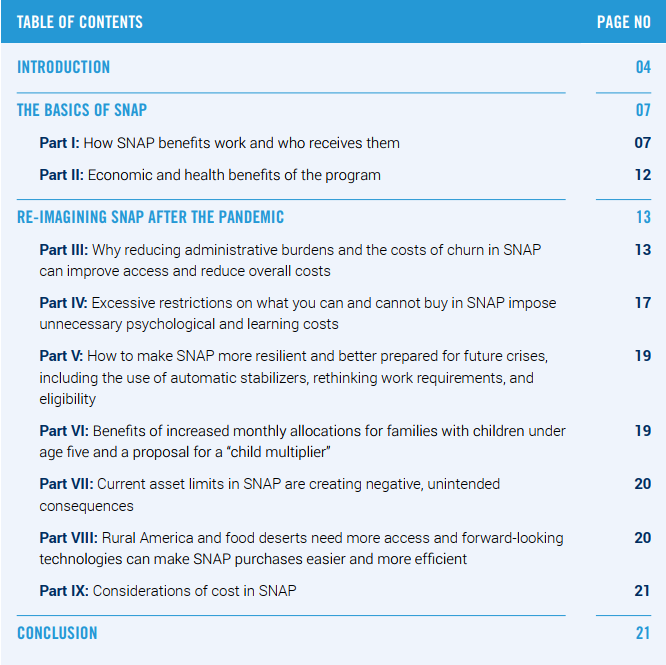
Even before the pandemic, hunger was an intractable problem faced by millions of Americans, and there is a wealth of evidence to support reimagining SNAP by building in more resiliency and making it easier to navigate for both consumers and retailers to strengthen our country’s food system. In this paper, we address recent developments related to SNAP and propose reforms to the program to reduce administrative burdens and churn, ease restrictions on what can be purchased with benefits, make SNAP more resilient for a future crisis as an automatic stabilizer, increase monthly allocations for families with young children, eliminate asset limits, and invest in technologies to increase access and improve participant experience, especially in rural communities. As the Biden administration looks ahead to major public investments, the modernization of SNAP should be included in the American Families Plan.


CONTENTS:


INTRODUCTION:


Last spring, one of the most startling and grim images from the beginning of the COVID-19 pandemic were the miles-long lines outside of food banks as the economic toll of the pandemic began to spread across the country. As unemployment rates shot up to levels even higher than during the Great Recession, many families who had never struggled to put food on the table found themselves in desperate need of help.


The sharp rise of hunger during the pandemic would have been immeasurably worse had the Trump administration succeeded in forcing states to impose work requirements on Supplemental Nutrition Assistance Program (SNAP) recipients, which would have kicked nearly 700,000 unemployed people out of the program. Fortunately, a federal judge blocked the attempt as “arbitrary and capricious.” The Trump White House also considered new federal requirements to drug test applicants and expand work eligibility — two ways of attempting to push more hungry families off of SNAP.


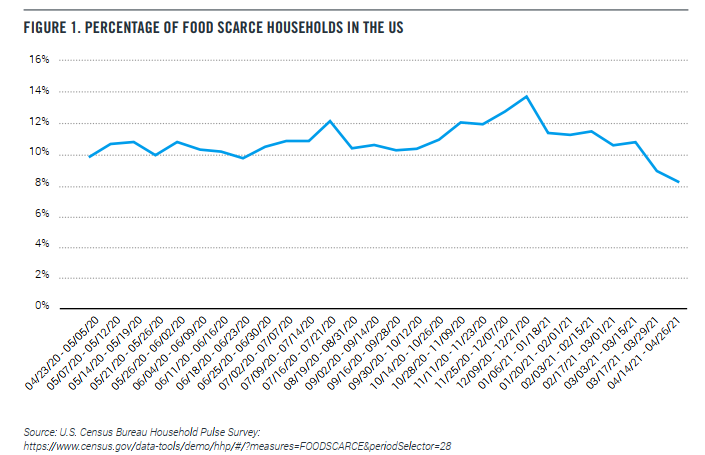
In contrast, President Joe Biden and Congress have made food assistance a top priority, providing aid to hungry families through stimulus and expanded anti-hunger funding, including through SNAP. These efforts have succeeded in reducing historically elevated levels of hunger in America. Recent data released from the U.S. Census Bureau for the end of April 2021 shows that, after multiple rounds of economic aid to struggling families, the percentage of Americans who reported they faced food insecurity was at its lowest point since the pandemic began — at 8.1%.


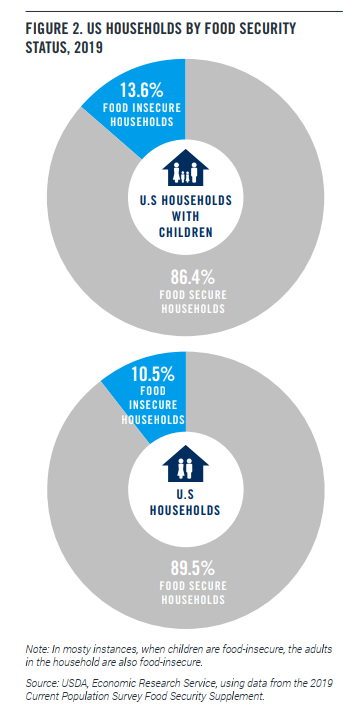
However, even prior to the pandemic, hunger was an urgent problem for many working families, and especially households with children. In 2019, according to the U.S. Department of Agriculture, as many as 10.5% of households were food insecure at some point during 2019, and that number was even higher for households (13.6%) with children under age 18.

While critical, more money alone won’t end hunger. The pandemic served as a metaphorical earthquake that stress-tested many of our social safety net programs, revealing stark vulnerabilities. SNAP is an essential program that needs to be made more resilient against future public emergencies.


SNAP (formerly known as the Food Stamp Program) is our country’s single most effective and wide-reaching anti-hunger program. It subsidizes food purchases for nearly half of all Americans at some point during their lives and an estimated one in nine Americans in any given month.
 In 2019 alone, there were 38 million participants who received SNAP benefits in the U.S, and 44% of SNAP recipients are children. The majority of SNAP recipients are also working families with at least one worker, as the program is structured to reward work with increased benefits.


While Republican politicians call for significant cuts to SNAP benefits and giving states more leeway to make it harder for people to apply, Americans broadly recognize the need for food assistance and support SNAP. A 2020 poll conducted by Hunger Free America, a national nonprofit, found that 58% want to increase funding for SNAP, with 32% of that group saying that the money should be boosted significantly. This included support from 40% of Republicans and 75% of Democrats. Historically, domestic hunger has been considered a bipartisan issue, though it has become more partisan over time.

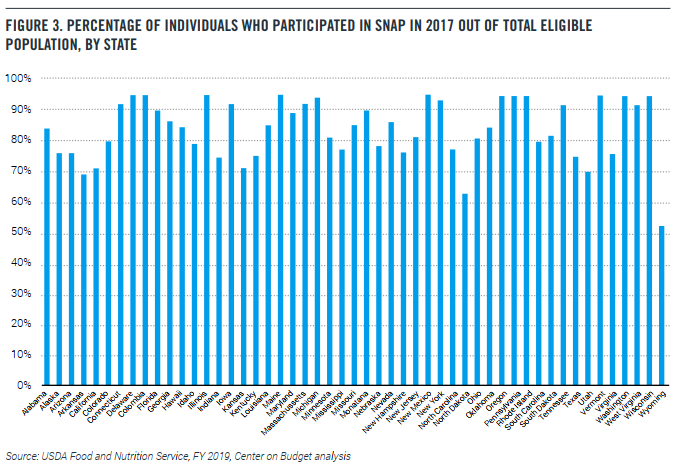
Yet millions of eligible Americans each year do not enroll in SNAP. In 2017, according to the USDA, the take up rate for SNAP was about 84%. Participation rates vary across states, with 52%, in Wyoming, being the lowest. Research suggests that a lack of information, barriers and costs to applying, and stigma around needing food assistance account for most of the gap in participation. For example, in New York City, approximately a quarter of households or
700,000 eligible people do not receive them.

A related challenge is keeping participants in the program. Administrative burdens and inflexibility in recertifying for SNAP benefits increase churn in the program at high costs.


To make it easier and faster to get meals to hungry families during the pandemic, the government relaxed some of the burdensome rules around applying for and retaining food assistance. As enhanced pandemic benefits expire in the coming months, policymakers should act to ensure that SNAP doesn’t revert to the onerous application requirements, poor customer service, and outdated enrollment systems that plagued it in the past. We propose that the Biden administration include the modernization and expansion of SNAP in the American Families package later this year given the state of food insecurity both before and after the pandemic.


KEY RECOMMENDATIONS: 
To modernize SNAP and increase its effectiveness as one of the most far-reaching hunger prevention interventions, we propose the following reforms:
• Reduce administrative burdens by requiring states to simplify and shorten SNAP applications to reduce barriers for eligible populations. In fact, U.S. policymakers should require states to create a single, straightforward application for multiple social safety net programs to reduce administrative burdens and barriers.
Policymakers should also streamline the burdensome process of applying to be an online retailer for SNAP benefits delivered to recipients’ homes.

• Ease the restrictions on what SNAP benefits can and cannot be used for. For example, recipients should be able to use SNAP benefits for hot and prepared meals. A better approach beyond restrictions would be for policymakers to employ lessons from pilot programs, such as the USDA’s Health Incentives Pilot in Massachusetts, to create incentives for recipients to use the benefits for more nutritious foods.

• Reinforce SNAP as an “automatic stabilizer” in future economic downturns by passing the Food for Families in Crisis Act, proposed by Senator Michael Bennet, D-Colo., that triggers enhanced benefits and relaxed work requirements when the economy enters a recession, and requires that states to use broad-based categorical eligibility (BBCE) for SNAP requirements.

• Fill in the gaps in nutrition by adopting the “child multiplier” proposal that would increase the benefit size for families with children under the age of five.

• Reform counterproductive limits on savings and assets that are having the unintended consequence of causing families to avoid rainy day funds and requiring the use of BBCE by all states would help reduce this harm. For example, the Allowing Steady Savings by Eliminating Tests, or ASSET, Act, introduced by U.S. Senators Chris Coons, D-Del., and Sherrod Brown, D-Ohio, would remove these harmful limits.

• Use information technology to modernize social service delivery and reduce the administrative burden on low-income people, states, and retailers. For example, Congress should enact the HOPE Act, which would create online accounts that enable low-income families to apply once for all social programs they qualify for, rather than forcing them to run a bureaucratic gauntlet.
Technology could also improve customer experience and the recertification process to reduce churn in SNAP, and these approaches should be tailored based on the particular barriers and vulnerabilities of certain groups, such as the elderly, rural communities, and college students. The Biden administration should also encourage the U.S. Department of Agriculture to invest in innovative payment systems beyond Electronic Benefit Transfer (EBT) that will allow SNAP recipients to use mobile wallets and chip cards to purchase food at stores.


READ THE FULL REPORT:


McDermott for The Hill: Taxing just the super-rich won’t fund America’s future

President Biden has proposed to finance his $4 trillion American Jobs and Families Plans by raising taxes exclusively on corporations and households that earn above $400,000 — the top 1.5 percent of taxpayers. Biden is right that the rich should pay more than they currently do given the staggering income inequality in America that’s been made worse by the COVID pandemic.

Almost 60 percent of Americans support funding Biden’s spending plans with his proposed tax increases — seven times the share that supports debt-financing them. But while taxing the rich is smart policy and politics, funding America’s future and realizing Biden’s policy vision will also require asking more taxpayers to contribute to the public good.

Read the full piece. 

PPI Celebrates Child Tax Credit Awareness Week

Thanks to an expansion of the Child Tax Credit enacted by President Biden and Democrats in Congress, millions of families with kids will begin receiving monthly payments on July 15th that are estimated to cut child poverty by half. This landmark program from the Biden administration will deliver automatic monthly payments of up to $300 for each child under six and $250 for each child under 18 to more than 36 million working families. However, because the credit is delivered through the Internal Revenue Service and based on 2020 and 2021 tax filings, millions of eligible households could be left out of receiving payments.

To address this issue, the IRS has begun sending letters to potentially eligible households to make them aware of the coming payments and has launched a non-filer sign-up tool for those families that don’t traditionally file taxes but have eligible children to send their information directly to the IRS. This subset of households usually have very little income and stand to benefit the most from the credit so getting them signed up is critical to the CTC’s purpose of reducing poverty.

Earlier this week, the IRS also announced partnerships with a national network of local non-profits and community organizations to help eligible taxpayers get registered and encouraged families without bank accounts to set up accounts online to receive the monthly payments faster via direct deposit.

There are remaining challenges to ensure that all eligible children reap the benefits of the CTC. For example, children in households with a student loan borrower in default on federal student loans could be penalized if this critical benefit is seized come next tax season. As the pandemic moratoriums are lifted as the economy bounces back, we hope that Congress takes action to ensure that the CTC and Earned Income Tax Credit, two well-targeted anti-poverty measures, are exempted from garnishment.

As CTC Awareness Week comes to a close, we hope that this is just the beginning of a concerted, targeted effort to spread the word and reach every eligible household to make them aware about this credit and get them signed up. Because the CTC was only passed for 2021, PPI also encourages lawmakers to pass a permanent and fiscally responsible expansion of the CTC that makes the credit fully refundable for low-income families and continues monthly payments beyond 2021.

Fixing What Ails Credit Reporting

Are Americans obsessed with their credit score? They have good reason to be worried, as there is much that ails the credit reporting industry.


    • Information at risk. As the Equifax breach in 2017 highlighted, the industry is vulnerable to cyberattacks that give hackers access to personal data and financial information.[1]
    • Reporting errors. According to a study by the Federal Trade Commission (FTC), one in five Americans had an error on their credit report.[2]
    • Credit reports are discriminatory. A study by the Consumer Financial Protection Board (CFPB) found that 45 million Americans have no (or an un-scorable) credit history — with the largest cohort of individuals residing in communities of color or low-income areas.[3]
    • Consumers have too little control over their credit reports. Historically, Americans have lacked any real control over their credit reports and credit reporting agencies have put in place barriers that make it very difficult to challenge errors in those reports.


Unfortunately, the leading legislative fix — creating a public credit reporting agency — would fail to remedy these serious problems.

The government has not proven to be a better guardian against cyberattacks any more than the private sector. Over 22 million Americans had their information stolen in the course of two separate attacks launched on the U.S. Office of Personnel Management between 2012 and 2015.

Error rates are common in government data, and trying to get them fixed is hardly simple. Anyone who has ever dealt with their local Department of Motor Vehicles (DMV) can attest to that. Furthermore, a public entity would be relying on the same data inputs as the private sector credit reporting agencies. So any errors in the data will still spoil the results.

Ensuring the algorithms used in credit scoring don’t have discriminatory impacts is long overdue. But the government doesn’t need to replace private credit agencies to ensure non‐traditional sources of data like rental history and utility bills are used to determine a fair credit report. Congress could just require it and give the FTC and CFPB the resource and staff to enforce the rules.

While well-intentioned, the proposal to create a public credit reporting agency is an example of a classic problem in policymaking, the misalignment between the policy problem and the policy solution. That’s a shame, because anyone who has ever dealt with the credit reporting agencies (basically everyone over the age of 18) knows the present system is rife with problems. But there are some ideas that could improve the credit reporting.

To safeguard private information, the credit reporting agencies should be required to adopt the latest and most effective anti-cyberattack protections — and be subject to fines and other penalties if they fail to do so. And if someone’s information is stolen, credit agencies should provide a free and seamless way to freeze and un-freeze their credit reports — as often as they want.

To help consumers keep tab on their credit report, Congress should enact legislation that requires the credit reporting agencies to continue the practice started during the Covid-19 pandemic — to provide free credit reports on a weekly basis.

Finally, to help reduce the discriminatory impacts of the credit ratings, Congress should enact a Community Reinvestment Act (CRA) type law for the credit reporting industry. Such a law would give the FTC and the CFPB the ability to limit the credit reporting agencies from using discriminatory data and to add non-traditional sources of information. The law would also would require the FTC and the CFPB to issue an annual report tracking the efforts of credit reporting agencies to reduce the discriminatory impacts.

America’s credit reporting system needs fixing. But success means we need to put in place the right policies. If we don’t, we will have missed a historic opportunity to protect consumer information, reduce errors, and eliminate discrimination in credit reporting.

Paul Weinstein Jr. is a PPI Senior Fellow and Director of the MA in Public Management at Johns Hopkins University.

[1] “Equifax Data Breach Settlement,” Federal Trade Commission, January, 2020.

[2] Michelle Black, “Millions of Americans have errors on their credit reports — do you?” bankrate.com, May 13, 2019

[3] Kelly Holland, “45 million Americans are living without a credit score,” CNBC, May 5, 2015

PPI Statement on Infrastructure Deal Breakthrough

Today, a bipartisan group of Senators and the White House reached a deal on a major $1.2 trillion infrastructure overhaul, which will help America recover economically from the pandemic and rebuild our failing roads, bridges and dams.

Will Marshall, President and Founder of the Progressive Policy Institute, released the following statement:

“The greatest challenge facing President Biden and his party is to show they can govern our country effectively after four wasted years of Donald Trump’s divisive and incompetent presidency. They need to prove to doubters here and around the world that democracy can deliver.

“Now the President has negotiated a deal with Senate Democrats and Republicans for a massive national push to modernize America’s aging economic infrastructure.

“The magnitude of this accomplishment should not be understated. The Bipartisan Infrastructure Framework would roughly double federal infrastructure spending over the next eight years, including a big and well-targeted investment in rural broadband. Crucially, it will lay new foundations for the inclusive innovation and growth our country needs to reduce inequality and win the contest with China for economic and technological leadership.

“The bipartisan deal also fulfills Biden’s central campaign pledge — to govern in the interests of all Americans, including those who didn’t vote for him. Democrats shouldn’t forget that Biden’s promise to bridge rather than deepen the nation’s political and cultural divides was key to his 2020 election.

“Nonetheless, Sen. Bernie Sanders has declared he won’t back the bipartisan deal. That’s his prerogative. But Democrats should stand with President Biden.

“We’re also disappointed that some important features of the White House’s original jobs plan were dropped in the difficult negotiations with Capitol Hill lawmakers. But that’s part of the normal give and take of representative democracy.

“We have no doubt that the President will continue to push for additional investments in scientific research, clean energy, and strengthening social programs for children in need. We hope that any reconciliation bill passed to supplement this agreement will be fiscally responsible and encourage the White House to consider a broader package of revenue-raising options.

“On the whole, however, we think it is good for the nation’s democratic health to see bargaining, horse-trading, and compromise return to Washington.

“Democrats shouldn’t heed the demands of left-wing purists who are better at making maximalist demands than winning majority support for them. It was the pragmatic Joe Biden, after all, who flipped five states from red to blue and soundly defeated Trump by more than seven million votes.

“He won the popular mandate, not his dogmatic critics. That’s why Democrats should give President Biden the benefit of the doubt and seize this opportunity to deliver concrete benefits to the American people.”

The Progressive Policy Institute (PPI) is a catalyst for policy innovation and political reform based in Washington, D.C. Its mission is to create radically pragmatic ideas for moving America beyond ideological and partisan deadlock. Learn more about PPI by visiting progressivepolicy.org.

Follow the Progressive Policy Institute.

###

California tech-ecommerce jobs and tax revenues

The large tech and ecommerce companies have become massive job generating and income creating machines, hiring hundreds of thousands of workers in the United States. This is one of the great hiring surges in history, providing well-paying jobs for an unprecedented number of workers.

But just looking at hiring by the tech giants themselves does not fully answer the question of their impact on the labor market. It could be that, like tall trees, they block the sunlight and keep other tech companies and ecommerce companies stunted.

This “ecosystem dominance” would manifest as weak job and income growth in the tech-ecommerce sector as a whole.  If true, this harm to workers becomes a powerful justification for strong regulatory and antitrust growth against the tech giants. In other words, chopping down the trees would help the rest of the forest grow.

Alternatively, strong job and income growth across all tech and ecommerce industries would show the tech giants–who invested a stunning $65 billion in the United States in 2020—are playing a crucial role in a thriving ecosystem that benefits workers, raises wages and generates tax revenues.  Indeed, from 2015 to 2020—a period that includes the pandemic—the tech-ecommerce ecosystem generated 1.7 million net new jobs and added $289 billion in labor income. By comparison, the whole private sector lost 360,000 jobs. In that case, common sense would call for regulatory prudence.  As the saying goes “if it ain’t broke, don’t fix it.”


California

For this blog post we will focus on the job, income, and tax impact of the tech-ecommerce sector on California, which is the headquarters of three out of the four tech giants. In addition, in the fourth quarter of 2020,  Amazon employed more workers in California (153,000+) than it does in Washington (80,000+).

Our analysis builds on PPI’s April 2021 paper, “Innovative Job Growth in the 21st Century: Has the Tech-Ecommerce Ecosystem Become the New Manufacturing?”. The tech-ecommerce ecosystem includes five tech industries and three ecommerce industries. The tech industries are computer and electronic production manufacturing (NAICS 334); software publishing (NAICS 5112); data processing and hosting (NAICS 518); Internet publishing and search, and other information services (NAICS 519); and computer systems design and programming (NAICS 5415). The three ecommerce industries are electronic shopping and mail order houses (NAICS 4541); local delivery (NAICS 492); and ecommerce fulfillment and warehousing (NAICS 493).

We draw on Bureau of Labor Statistics data from the Quarterly Census of Employment and Wages (QCEW). This dataset reports on all wages, salaries, and bonuses, including ordinary income from exercised stock options. We look at the five-year period from 2015 to 2020, which includes the pandemic year.


Table 1. Strong Job and Labor Income Growth in California’s Tech-Ecommerce Sector
Percentage change, 2015-2020
Tech-ecommerce sector California Core tech counties* Rest of California United States
Jobs 38% 30% 43% 31%
Total wage and salary income** 76% 77% 74% 56%
*San Francisco, San Mateo, Santa Clara
**Includes exercised stock options
Data: BLS QCEW


Table 1 shows the growth of jobs and labor income in California’s tech-ecommerce sector from 2015 to 2020.  Tech-ecommerce jobs rose by 38% over the five-year stretch in California, compared to 31% in the United States as a whole. Meanwhile, private sector jobs rose by 0.3% in California and fell by 0.3% nationally (not shown on table).

Wages and salaries in California’s tech-ecommerce sector rose by an astounding 76% from 2015-2020, compared to 56% nationally. Meanwhile, private sector wages and salaries rose by 31% in California, and 21% nationally.

Table 2 shows the importance of the tech-ecommerce sector for California’s economy. The tech-ecommerce sector added 350,000 jobs between 2015-2020 in the state, and $100 billion in additional wage and salary income. That means the tech-ecommerce sector accounted for 38% of the entire increase in private sector wages in the state over that period.


Table 2. Tech-Ecommerce Sector Powers California Income Growth
Tech-ecommerce sector California Core tech counties Rest of California United States
Increase in jobs, 2015-2020 (thousands) 350 113 237 1738
Increase in wage income, 2015-2020 (billions of dollars) $100 $62 $37 $289
Share of private sector wages, 2020 (percent) 21% 45% 11% 11%
Share of private sector wage growth, 2015-2020 (percent) 38% 56% 25% 22%
*San Francisco, San Mateo, Santa Clara
**Includes exercised stock options
Data: BLS QCEW


Note that Table 1 and Table 2 break out the core tech counties, San Francisco, San Mateo, and Santa Clara, from the rest of the state. Taken together, the two tables show that both the core tech counties and the rest of the state have shown roughly equal rates of income growth from the tech-ecommerce sector.

Table 3 looks specifically at ecommerce and retail jobs in California. Obviously, the pandemic forced a dramatic decline of brick-and-mortar retail jobs in the state. At the same time, the number of ecommerce jobs increased by more than enough to counteract the decline of brick-and-mortar retail. Moreover, the ecommerce jobs were substantially better paid on average.

As a result, when we combine brick-and-mortar retail with ecommerce industries in California, the number of net jobs rose by 28,000. Average annual pay rose by 22 percent.


Table 3. California’s Ecommerce Industries Create Net New Jobs and Boost Average Pay
Brick-and mortar retail Thousands of jobs Average annual pay
2015 1611 33229
2020 1475 40199
Change, 2015-2020 -136
Ecommerce industries
2015 207 54078
2020 372 55882
Change, 2015-2020 164
Brick-and-mortar retail plus ecommerce
2015 1819 35608
2020 1847 43360
Change, 2015-2020 28
Data: BLS QCEW


Finally, we turn to the question of the impact of the tech-ecommerce sector on personal income taxes in California. Tax collections have come in much stronger than expected, with personal income tax collections in the first nine months of the 2020-21 fiscal year running at 17% or $14 billion above forecast. Personal income tax revenues in the 2020-21 fiscal year are now forecast to be 54% about 2015-2016 levels.

How much of that gain is accounted for by the tech-ecommerce sector? There are several issues with making this calculation. The state government reports and forecasts tax revenue data on a fiscal year basis, while our data on the tech-ecommerce sector is on a calendar year basis and stops with 2020. Second, our definition of the tech-ecommerce sector includes a wide variety of industries, with average annual pay that runs from roughly $50,000 to well over $300,000. Third, much of the surge in personal tax revenues is coming from capital gains, which is directly connected with the success of the tech-ecommerce sector but is not reported in the BLS QCEW data.

Nevertheless, we can make a back-of-the-envelope estimate of the personal tax revenue generated by the tech-ecommerce sector. First, let’s start by looking the increases in personal tax revenues coming from wage and salary income (included ordinary income from exercised stock options) over the 2015-2020 period. By our estimate, the increase in tech-ecommerce wages and salaries accounts for roughly 37% of the increase in personal tax revenues from wages and salaries in the 2015-2020 period.

But of course, there has been a surge in capital gains revenues as well. If we attribute half the unanticipated increase in capital gains in 2020 to the tech-ecommerce sector, then tech-ecommerce accounts for roughly 42% of the increase in California personal tax revenues from 2015 to 2020.  This should be viewed as a rough estimate rather than a final number.

The Good, the Bad, and the Ugly in the House Judiciary Committee’s Tech Antitrust Bills

On Wednesday, the House Judiciary Committee is going to mark up five tech antitrust bills. Collectively, the bills mark a major departure from the traditional consumer welfare standard that has governed antitrust law over the last few decades. Instead of focusing on consumers, these new laws would single out just five large tech platforms and apply an entirely different set of standards. One bill would effectively ban them from making any future acquisitions, which might have the unintended consequence of reducing startup investment, and therefore reducing competition. Most concerningly, another one of the bills would lead to breakups of all five major tech companies. Vertical integration would effectively be prohibited because, according to the bill’s authors, it presents an irreconcilable conflict of interest.

But what this framing misses is all the consumer benefits that flow from integrated ecosystems. Many digital products are free to access because they are subsidized by ads elsewhere in the ecosystem. A hallmark of a seamless user experience is being able to switch between devices, websites, and apps without needing to re-enter all your information. Crucially, these integrated experiences are also safer for users because fewer players in the market have direct access to user data (which is why most government agencies do not allow federal employees to “jailbreak” their smartphone devices or sideload apps from unapproved app stores). And of course, private label goods on Amazon work just the same as they do in Walmart or CVS — they offer consumers similar quality to name brands at lower prices.

Here’s a more detailed breakdown of the five bills and what they would do to tech platforms (in order from most reasonable to least reasonable):

The Merger Fee Modernization Act sponsored by Representative Neguse

The budgets for the FTC and DOJ to conduct antitrust enforcement have fallen by 18% between 2010 and 2019, after adjusting for inflation. Over the same period of time, the economy has grown by 22%. To properly enforce the antitrust laws on the books, the DOJ and FTC need resources that match the scope of the problems they face. This bill would increase their enforcement resources by almost 30% and change the merger filing fee structure to fall more heavily on larger deals. There is significant bipartisan support for this bill and it is urgently needed.

For the next four bills, you need to understand what a “covered platform” is. All four bills define them the same way (and these new rules would only apply to covered platforms). A covered platform is a “website, online or mobile application operating system, digital assistant, or online service” that meets all three of the following conditions: (1) 50 million U.S.-based monthly active users or 100,000 U.S.-based monthly active business users; (2) greater than $600 billion in net annual sales or market capitalization; and (3) is a “critical trading partner” that can restrict business users access to customers.

As of today, there are only six companies in the U.S. that meet the $600 billion market capitalization threshold. Every commentator assumes Amazon, Apple, Facebook, and Google will qualify as covered platforms, and most agree that Microsoft will be included as well, considering it operates multiple large-scale platforms, such as Windows, Office, Xbox, and LinkedIn. It remains to be seen whether the “net annual sales” metric will be interpreted to cover financial services companies like Visa, JP Morgan Chase, and PayPal, which process a large volume of payments.

What seems clear, however, is that the subcommittee bills target big tech firms instead of probing economic concentration across the U.S. economy.

The Augmenting Compatibility and Competition by Enabling Service Switching (ACCESS) Act sponsored by Representative Scanlon

The ACCESS Act would require platforms to provide third parties with APIs, software that allows access to platform data. The bill leaves the definition of “data” up to the FTC to determine. Data portability done right can lower switching costs and improve competition in an industry. Consider the enormous success of telephone number portability in the telecom industry. Letting consumers own their telephone number lowers the cost of moving to a new provider. And because telephone numbers are a necessary and discrete piece of data that all carriers must use to operate a network, there was no risk of decreasing the incentive to invest in creating this data.

For tech platforms, there might be similar discrete, static, and critical data sets that should be subject to mandatory portability rules. For example, the social graph — the list of all your friends or connections on a social network — is a very important dataset for new startups to have access to. Users are more likely to use a new app if during the onboarding process they are able to share a social graph from another social network and find all their friends on the new platform with a single click.

However, the problem with this bill is that it is not narrowly tailored to discrete and critical data sets like the social graph. It merely says that “a covered platform shall maintain a set of transparent, third-party-accessible interfaces (including application programing interfaces) to enable the secure transfer of data to a user, or with the affirmative consent of a user, to a business user at the direction of a user, in a structured, commonly used, and machine-readable format.” The bill leaves it to the FTC to define what “data” means for the purpose of the bill. It would be very helpful if Congress offered more guidance on what kinds of data it intends to be covered by these rules.

If data is defined too broadly, then there might be unintended consequences for investment incentives. For example, tech companies are all racing to build the next great computing paradigm. Will it be virtual reality? Blockchain technology? Augmented reality? Smart devices? Or something else no one can predict? Regardless of which paradigm wins out, if the future winner is forced to give every one of its competitors access to all of its data, then that would decrease the incentive to invest in the next big platform today. The most tragic part of the scenario is that these will be unseen costs — we won’t know what we lost out on. The future will just be somewhat dimmer because a well intentioned policy backfired due to poor drafting and a rushed process.

Platform Competition and Opportunity Act sponsored by Representative Jeffries

The Platform Competition and Opportunity Act is effectively a ban on all mergers and acquisitions by platform companies. This bill would ban platforms from acquiring companies that:


  • “compete with the covered platform … for the sale … of any product or service”;
  • “constitute nascent or potential competition to the covered platform … for the sale … of any product or service”;
  • “increase the covered platform’s … market position”; or
  • “increase the covered platform’s … ability to maintain its market position”


Given how broad this language is, the bill would effectively ban all acquisitions by platform companies. Since more than 90% of startups provide a return for their founders, employees, and investors through an acquisition as opposed to going public, this bill has the potential to backfire and decrease investment in startups. A recent study found that “VC activity intensifies after enactment of country-level takeover friendly legislation and decreases following passage of state antitakeover laws in the U.S.” This bill would qualify as an antitakeover law.

American Innovation and Choice Online Act sponsored by Representative Cicilline

This bill is aimed at remedying the perceived conflict of interest by platforms and businesses that leverage those platforms to reach consumers. In essence, this bill bans self-preferencing by requiring platform owners to refrain from any conduct that gives their own products an advantage over competitors’ products. Section 2 of the bill makes it clear how all encompassing this rule aims to be (emphasis added):

“It shall be unlawful for … a covered platform … to engage in any conduct that … advantages [its] own products, services, or lines of business over those of any other business user, excludes or disadvantages the products, services, or lines of business of another business user relative to the covered platform operator’s own products, services, or lines of business, or discriminates among similarly situated business users.

The bill then provides 10 examples of discriminatory conduct, including tying, anti-steering provisions, retaliation, and restrictions on pricing.

But those specific examples aren’t really necessary when the bill includes a blanket ban on any conduct that “advantages” the platform’s products over those of third parties. While this attempt to fix a conflict of interest may seem intuitive at first glance (think of Elizabeth’s Warren’s baseball analogy), the more you think about the idea, the less it makes sense. For example, consider how this rule would apply to Apple. The iPhone runs on Apple’s proprietary iOS operating system. Apple wouldn’t be allowed to “advantage” its App Store in any way, which means it can’t be pre-loaded on devices and it can’t be the default app store unless users select it. This same logic applies to every layer of the tech stack. Apple makes dozens of popular first-party apps, including FaceTime, iMessage, Mail, and Music. As the bill is currently written, Apple would not be allowed to pre-install those apps on iPhone devices because that would “advantage” them over other video conferencing, messaging, mail, and music apps.

Now consider how this law would apply to Google. If a user typed in “restaurants near me” on Google, the search engine wouldn’t be able to directly offer map results at the top of the page from Google Maps because that would give it an “advantage” over other mapping services. Google would be forced to merely provide links to competitive mapping services rather than give consumers the answer to their question. The same rule would apply to Google Shopping if a user searched for sneakers. Instead of showing the user sneakers, Google would have to show users links to shopping websites that sell sneakers. This would represent a huge loss to consumer convenience that makes these products so popular (91% of Americans have a favorable opinion of Amazon, 90% have a favorable opinion of Google, and 81% have a favorable opinion of Apple).

Most concerningly, this bill would break the safety and security of many features of the iPhone. If Apple has access to a piece of hardware, such as a sensor or communications chip, then it has to give equal and fair access to that same hardware function to all third parties. That sounds like a laudable goal if you want more options when it comes to payments (i.e., access to the NFC chip) or location services (i.e., access to GPS) or the microphone (e.g., the way say Siri is always listening for “Hey, Siri”). But the flip side of more competition in this context is that every bad actor with the intent to defraud consumers or invade their privacy now also has access to sensitive data by law.

Lastly, some argue that the affirmative defense section of this bill would allow some pro-consumer conduct by the platforms to continue (such as continuing to pre-install apps on phones). The platforms can “advantage” their own products so long as they “would not result in harm to the competitive process by restricting or impeding legitimate activity by business users; or was narrowly tailored, could not be achieved through less discriminatory means, was nonpretextual, and was necessary to prevent a violation of, or comply with, Federal or State law; or protect user privacy or other non-public data.” But pre-installation and default settings clearly give a leg up to the products controlled by the platform owner and therefore might “result in harm to the competitive process.” If the intent of the drafters is not to ban this type of conduct, they should clarify this section.

Ending Platform Monopolies Act sponsored by Representative Jayapal

The most extreme and economically destructive of the five bills is The Ending Platform Monopolies Act. It tries to address the same problem as the American Innovation and Choice Online Act — conflicts of interest between platform owners and platform competitors. But instead of requiring platform owners to operate their platforms in a neutral fashion as the non-discrimination bill does, this bill bans vertical integration outright and would lead to the break up of every large tech company across multiple dimensions.

Google would have to spin off YouTube, Android, Chrome, the Play Store, and its apps (Gmail, Google Maps, Drive, etc.) into separate businesses. Of course, that would destroy Google’s current business model where revenue from search and display advertising is used to subsidize an ecosystem of free products for consumers. Post-breakup, the newly independent entities would likely need to start charging subscription fees or create their own advertising business from scratch (and add more ad units to their respective products).

Amazon would be forced to spin off its private label goods business (e.g., Amazon Basics) and Amazon Marketplace because those two lines of business compete with the traditional retailing model where Amazon takes inventory of the product from wholesalers and then resells it at a markup. Amazon would also be forced to spin off its Amazon Prime Video streaming service and Amazon Web Services.

It has not yet been properly appreciated that this bill is aimed at addressing the same alleged conflict of interest issue as the American Choice and Innovation Online Act. If they are passed together, this bill would obviate the other one. As independent technology analyst Ben Thompson pointed out, this could mean that Chairman David Cicilline is attempting to make his bill seem reasonable by comparison even though it also has radical implications for tech ecosystems. Legislators shouldn’t fall for this obvious gambit.

The DOJ and FTC desperately need more resources to adequately enforce the antitrust laws on the books, and a narrowly tailored data portability mandate could enhance digital platform competition. But blanket bans on acquisitions, self-preferencing, and vertical integration would destroy many of the consumer benefits that make the tech giants world leaders in their respective markets. Hobbling America’s tech giants without adequate evidence of consumer harm would be a capitulation to the populists on the far left and far right at a time when we need to be focused on economic recovery.

PPI Statement on House Judiciary Committee Markup of Anti-Innovation Bills 

Tomorrow morning, the House Judiciary Committee will mark up a series of antitrust bills that, taken together, would stifle digital innovation and hinder the United States in economic competition with China.

Alec Stapp, Director of Technology Policy at the Progressive Policy Institute (PPI) released the following statement:

“Economic concentration in many sectors of the U.S. economy is a serious issue that demands scrutiny and creative responses from lawmakers. Unfortunately these five bills fail to grapple responsibly with this challenge. Instead, they single out a handful of America’s most innovative and globally competitive tech companies for divestiture and draconian regulation. These bills would be a major blow to job creation and innovation even as our economy struggles to recover from the pandemic recession.

“We hope the Members of the House Judiciary Committee will stand up for American workers, consumers and entrepreneurs by refusing to join in an ideological crusade to dismantle “big tech.” While well-tailored regulation is certainly worth debating, the extreme provisions written into these bills would do more harm than good, and set us back in our fight against foreign dominance in the tech/e-commerce industry.”

Earlier this year, PPI released a new report on job growth in the tech/e-commerce sector, which found that this sector is now the top job creator in the U.S. economy. The sector generated more than 1.2 million net new jobs from 2016 to 2020, including during the pandemic. On average, pay in the tech/e-commerce ecosystem was 44% higher than average pay in the private sector and 21% higher than average pay in manufacturing nationally. The report also found that the growth of tech/e-commerce jobs has expanded beyond the coasts and regions known as tech innovation hot spots, including growth during the pandemic in Arizona, Ohio, Texas, Indiana, and Florida.

###

Congresswoman Sharice Davids Joins PPI’s Radically Pragmatic Podcast

On this week’s Radically Pragmatic Podcast, Crystal Swann, Senior Policy Fellow at the Progressive Policy Institute and Mosaic Economic Project lead, and Francella Ochillo, a Mosaic Economic Project Cohort Member, attorney and digital rights advocate, sit down with Representative Sharice Davids, D-Ks., to discuss the impact of the coronavirus on women business owners, entrepreneurs and workers.

“It’s been disheartening – although I don’t know that I would call it super surprising – to see that the pandemic and the impacts of a public health crisis, that has turned into also an economic crisis, has disproportionately impacted women…financially, in the workforce when it comes to child care, access to health care…Every single aspect of life has been disrupted by the pandemic.

“Particularly Black women and other women of color have been disproportionately negatively impacted. It’s something that – at least in the Democratic Caucus in Congress – we started talking about almost immediately. Because like I said, it’s disheartening and heartbreaking but it’s also not as surprising. And that’s because a lot of us know the negative impacts and disproportionate impacts that women experience anyway,” said Rep. Davids on the podcast.

Congresswoman Davids serves as a Vice Chair of the Committee on Transportation and Infrastructure, and also serves on the Small Business, Joint Economic, and the Steering and Policy Committees. Additionally, she is the New Democrat Coalition’s Member Services Vice Chair. She is currently serving in her second term of Congress.

In addition to the economic impact of the pandemic on communities of color and women, Rep. Davids and the hosts discuss the ongoing negotiations over the upcoming infrastructure legislative packages — the American Jobs Plan and the American Families Plan. They also dive into Rep. Davids’ background as a professional mixed martial arts (MMA) fighter.

Listen here and subscribe:

This podcast was in partnership with PPI’s Mosaic Economic Project.  The Mosaic Economic Project is a network of diverse and highly credentialed women in fields of economics and technology. Mosaic programming focuses on upskilling, connecting, and advocating for cohort participants’ meaningful engagement in  public policy debates, with a particular focus on engaging Congress and the media.

The Progressive Policy Institute (PPI) is a catalyst for policy innovation and political reform based in Washington, D.C. Its mission is to create radically pragmatic ideas for moving America beyond ideological and partisan deadlock. Learn more about PPI by visiting progressivepolicy.org.

Follow the Progressive Policy Institute.

Follow the Mosaic Economic Project.

###

Joint Episode: The Mosaic Economic Project Speaks with Congresswoman Sharice Davids

On this week’s Radically Pragmatic Podcast, Crystal Swann, Senior Policy Fellow at the Progressive Policy Institute and Mosaic Economic Project lead, and Francella Ochillo, a Mosaic Economic Project Cohort Fellow, attorney and digital rights advocate, sit down with Representative Sharice Davids, D-Ks., to discuss the impact of the coronavirus on women business owners, entrepreneurs and workers.

In addition to the economic impact of the pandemic on communities of color and women, Rep. Davids and the hosts discuss the ongoing negotiations over the upcoming infrastructure legislative packages — the American Jobs Plan and the American Families Plan. They also dive into Rep. Davids’ background as a professional mixed martial arts (MMA) fighter.

Learn more about the Mosaic Economic Project here.

Learn more about the Progressive Policy Institute here.

Carolina Postcard: What Boris Johnson Can Teach Democrats

By Gary Pearce, Guest Author

To many Americans, especially Democrats, Boris Johnson is a clownish British version of former President Trump. But Democrats might take a page from Johnson, especially on how to talk to people.

The party is going through self-analysis now. Yes, President Biden beat Trump and Democrats won a 50-50 split in the Senate. But they’d hoped to do much better; they want to get to the bottom of why the bottom fell out on their high hopes.

Democrats being Democrats, they think they need a stronger economic-policy message – and the right set of policy proposals.

Not so fast. There’s a reason most people avoid economics classes in school. Economics is boring. Economic policy proposals are boring.

Americans want specifics, but they yearn for hope and optimism. They’re listening more for tone: confidence, strength and persistence. They want to hear music, not just read lyrics.

Boris Johnson gets it. He says his goal as Prime Minister of the United Kingdom is “to recapture some of the energy and optimism that this country used to have.”

Democrats could use more energy and optimism – and less hectoring and lecturing.


Biden and Boris


Johnson’s style is analyzed in a new article in The Atlantic, “The Minister of Chaos: Boris Johnson knows exactly what he’s doing,” by Tom McTague. He wrote of Johnson, “To him, the point of politics—and life—is not to squabble over facts; it’s to offer people a story they can believe in.”

Johnson led the Brexit “Leave” campaign in 2016, just before Trump won the Presidency. McTague notes that the “two campaigns looked similar on the surface—populist, nationalist, anti-establishment.”

But Johnson’s story isn’t the same as Trump’s “American carnage.” Johnson says the UK, contrary to “claims of impending disaster…is a great and remarkable and interesting country in its own right’.”

Johnson is a former journalist. He knows the power of words. He says, “People live by narrative. Human beings are creatures of the imagination.”

The article added:

“Johnson understands the art of politics better than his critics and rivals do. He is right that his is a battle to write the national story, and that this requires offering people hope and agency, a sense of optimism and pride in place. He has shown that he is a master at finding the story voters want to hear.”

Writing the national story is the challenge Democrats face. Studying the UK makes sense; we share a mother tongue.

At this month’s G7 meeting in Cornwall, England, there was much talk about the “special relationship” between the US and the UK. There also has been, over the last 40 years, a rhythmic relationship between the two nation’s politics.

Ronald Reagan and Margaret Thatcher, both conservatives, came to power at the same time. So did New Democrat Bill Clinton and New Labour Tony Blair. Then came Trump and Johnson. Now Biden and Johnson.

Despite their parallels, Johnson isn’t a Trump clone. At the G7 meetings, he and President Biden agreed on climate change, women’s rights, sanctions against Russia and a middle-class economic agenda. Johnson’s compared Biden’s infrastructure bill to his promise of “leveling up” the economically struggling north of England with the more prosperous south.

He said, “When it comes to building back better, we’re totally on the same page. It’s been very interesting and very refreshing.”

As Democrats struggle to tell their story in today’s divided America, they might study how Johnson tells his. Sometimes he might be a clown. But sometimes clowns are on to something. And given today’s angry politics, it wouldn’t hurt to laugh and lighten up a bit.


Atlantic article: https://www.theatlantic.com/magazine/archive/2021/07/boris-johnson-minister-of-chaos/619010/

PPI Statement on Federal Recognition of Juneteenth

Today, PPI President Will Marshall released the following statement on the federal recognition of Juneteenth:


Happy Juneteenth!


With uncharacteristic dispatch this week, Congress passed and President Biden signed a new a bill establishing Juneteenth as a national holiday. It happened so quickly that PPI wasn’t quite prepared to observe it properly, but we will henceforth be closed for business on Juneteenth to commemorate this important date in U.S. history.


On June 19, 1865, Union Army Maj. General Gordon Granger proclaimed the liberation of 250,000 enslaved African Americans in Texas. This reminds us that slavery was the evil which sparked the Civil War. It also reminds us that hundreds of thousands of U.S. soldiers died to preserve the Union and make real the promise of Abraham Lincoln’s Emancipation Proclamation in 1863.


We were gratified and somewhat surprised to see the Juneteenth holiday approved overwhelmingly in Congress, a rare sign of political concord in these fraught times. But we can’t help noting a perverse irony: While most Congressional Republicans supported the bill, their counterparts in Texas and many other red states are working hard to make it harder for black citizens to vote.


This is an obscenity, and we hope the decent people of those states and their representatives in Congress will rally to stop and repeal these unAmerican anti-voting laws.”


About PPI:

The Progressive Policy Institute (PPI) is a catalyst for policy innovation and political reform based in Washington, D.C. Its mission is to create radically pragmatic ideas for moving America beyond ideological and partisan deadlock. Learn more about PPI by visiting progressivepolicy.org.

Follow the Progressive Policy Institute.

###

PPI Celebrates 30th Anniversary of First Charter Schools Legislation, Featuring a Special Video Message from President Bill Clinton

This week, the Progressive Policy Institute and the Reinventing America’s Schools Project hosted a webinar celebrating the 30th anniversary of the first charter school legislation. The event featured a panel of charter school advocates, experts, and trailblazers. Former President Bill Clinton, a longtime advocate of charters, provided a special video message for the event.

The panel discussed the most pressing issues facing charter schools, including what’s next for charter schools in America. The event was co-hosted by The 74 Million.

“Thank you to President Clinton for his leadership in supporting charter schools, and our esteemed panel of leaders and trailblazers for working to provide opportunities to generations of students. It’s because of these advocates that we can celebrate 30 years of charter schools, and look forward to many more years to come,” said Tressa Pankovits, Co-Director of PPI’s Reinventing America’s Schools project.

“Our panel discussion centered on educational equity because providing high quality school options to families of color, especially in America’s urban centers, is an enduring element of the legacy of the past 30 years,” continued Pankovits.

Watch the event livestream here:


The event was moderated by Tressa Pankovits, Co-Director of Reinventing America’s Schools project, and opening remarks were provided by PPI President Will Marshall. The Panelists for this event included:

Myrna Castrejón, President, California Charter Schools Association

Karega Rausch, President & CEO, NACSA

Ember Reichgott Junge, Former Minnesota State Senator

Paul G. Vallas, Founder, Vallas Group

The Progressive Policy Institute (PPI) is a catalyst for policy innovation and political reform based in Washington, D.C. Its mission is to create radically pragmatic ideas for moving America beyond ideological and partisan deadlock. Learn more about PPI by visiting progressivepolicy.org.

The Reinventing America’s Schools (RAS) project inspires a 21st century model of public education geared to the knowledge economy. One model, charter schools, are showing the way by providing autonomy for schools, accountability for results, and parental choice among schools tailored to the diverse learning styles of children. The project is co-led by Curtis Valentine and Tressa Pankovits. Learn more about RAS here.

Follow the Progressive Policy Institute.

Follow the Reinventing America’s Schools Project.

###

PPI Commends USDA on Strengthening Competition in Agricultural Markets

Last Friday, the U.S. Department of Agriculture announced three actions on rulemaking to strengthen enforcement of the Packers and Stockyards Act to reflect today’s market dynamics. Collectively, these regulatory updates should result in more competitive, healthy markets for consumers, farmers, ranchers, producers, and our overall agricultural system.

In a policy brief released earlier this year, the Progressive Policy Institute (PPI) called on the Biden administration to focus on stricter antitrust enforcement in the food industry to help consumers facing increasing prices for basic nutrition staples, such as meat and eggs.

Veronica Goodman, Director of Social Policy at PPI, praised the U.S.D.A. announcement:

“Market concentration in the agricultural industry has resulted in harm to farmers, ranchers, and consumers. The recent U.S.D.A. announcement will ensure our national food system is more equitable and competitive in today’s economy. We applaud the administration for working to strengthen competition in agricultural markets.”

The Progressive Policy Institute is a catalyst for policy innovation and political reform based in Washington, D.C. Its mission is to create radically pragmatic ideas for moving America beyond ideological and partisan deadlock. Learn more about PPI by visiting progressivepolicy.org.

Follow the Progressive Policy Institute.

###

Media Contact: Aaron White – awhite@ppionline.org

Investment Heroes Breakdown: An Audio Guide to PPI’s 2021 Investment Heroes Report with Michael Mandel and Alec Stapp

For the last 10 years, the Progressive Policy Institute has released an annual Investment Heroes report which lays out the top companies of the year who invested the most in capital expenditures. With 2020 being a year like no other, PPI’s Investment Heroes report looked unlike anything we have seen before and surprisingly, had a record broken for the biggest investment in the 10 years the report has been released.

Listen to Michael Mandel, Chief Economic Strategist and author of the report, and Alec Stapp, Director of Technology, walk listeners through the report and what it means for the future of the American economy.

Read the full 2021 Investment Heroes report here.