Ritz for Forbes: Don’t Make Young Americans Pay for Medicare Expansion

The $3.5 trillion budget blueprint unveiled earlier this week by Senate Democrats would fund many policies from President Joe Biden’s American Jobs and Families Plans not covered by the $579 billion Bipartisan Infrastructure Framework. But among many worthwhile public investments is a new proposal that should give lawmakers pause: a costly expansion of Medicare paid for entirely by young Americans. Although lawmakers should be open to thoughtful improvements to Medicare, any changes must be financed in a way that is fair to Americans of all ages.

There are two possible changes to Medicare that Sen. Bernie Sanders, I-Vt., the chairman of the Senate Budget Committee, wants to include in the next major spending bill. The first proposal is to offer vision, dental, and hearing services not currently covered by Medicare at no additional cost to beneficiaries. The second proposal is to give Americans ages 60-64 the option to enroll in Medicare with the same premiums and benefits currently available to those over age 65 (which are heavily subsidized by income and payroll taxes paid by younger workers).

The problem with these proposals is that Medicare is already struggling to pay for the current suite of benefits it offers. Medicare Part A, which offers hospital insurance that is supposed to be fully funded by payroll taxes, will face a 10% budget shortfall five years from now. The amount of general revenue needed to subsidize Medicare Parts B and D, which cover physician services and prescription drug benefits, is projected to nearly double as a percent of gross domestic product over the next 20 years. These costs will impose a significant burden on young Americans, either by crowding out investments in their future or requiring them to pay higher taxes than current retirees did when they were in the workforce.

Giving today’s seniors, who have collectively enjoyed greater gains in income and wealth than younger Americans, a suite of new benefits they didn’t finance over their working lives or in retirement would only compound the intergenerational inequity built into current policy. That’s especially true if the Senate blueprint foregoes some investments in clean energy or child welfare, such as a permanent expansion of the Child Tax Credit, to make room for this costly expansion of Medicare.

There are better alternatives. Americans ages 60-64 could be allowed to buy into Medicare at a premium that covers the full cost of their coverage rather than the heavily subsidized one currently paid by people aged 65 and over. This option would still be cheaper for most beneficiaries than private insurance because Medicare is able to negotiate lower prices for services than private insurers. Any new vision, dental, or hearing benefits should have a significant share of the cost covered by income-based premiums and co-pays, as is currently the case for Parts B and D. A broad-based consumption tax that is paid by all consumers regardless of age could also help finance benefits in a way that doesn’t place the burden on anyone generation. Lawmakers should also consider pairing or preceding any benefit expansion with measures to close the existing financial shortfall in Medicare, such as the bipartisan TRUST Act.

For too long, Washington has allowed the growth of retirement programs to crowd out critical public investments in infrastructure, education, and scientific research. The new budget agreement is a once-in-a-generation opportunity to right this intergenerational wrong. It would be shameful for lawmakers to choose affluent retirees over working families yet again. Any expansion of Medicare should require some contribution by those who would benefit, or it should be dropped from the budget agreement altogether.

Published originally on Forbes. Read it here.

PPI Hosts Event with Reps. Ami Bera and Gerry Connolly and MEP Reinhard Bütikofer on Creating a Stronger Transatlantic Response to China

Today, the Progressive Policy Institute hosted a virtual event with U.S. Representatives Ami Bera (D-CA) and Gerry Connolly (D-VA), and MEP Reinhard Bütikofer (Germany, Greens/European Free Alliance group). The event focused on how to craft a stronger transatlantic response to China as Beijing advances Chinese influence around the world.

“Following on President Biden’s visit to Europe, PPI is facilitating conversations between leading U.S. and European policymakers on how to present a unified transatlantic response to China’s multifaceted challenge to liberal democracy.  Today’s conversation focused on China’s suppression of freedom in Hong Kong, ethnic cleansing of the Uighur minority, predatory trade practices, and attempts to steal or force transfer of advanced technology to Chinese companies. It’s another sign that leading democracies are determined to resist China’s divide-and-conquer tactics and aggressive efforts to silence international criticism,” said Will Marshall, President of PPI and moderator for the event.

Watch the event livestream here.

Representatives Bera and Connolly are both members of the House Foreign Affairs Committee. Additionally, Rep. Bera serves on the House Committee on Science, Space and Technology. Representative Connolly also serves on the House Committee on Oversight and Reform. 

MEP Bütikofer is a member of the German Green Party. He chairs a European Parliament committee focused on EU relations with China, and has been the leading voice in Brussels for a tougher European response to China. He serves on the Committee of Industry, Research and Energy, and is a substitute member of the Committee on Foreign Affairs and the Subcommittee on Security and Defense.

The Progressive Policy Institute (PPI) is a catalyst for policy innovation and political reform based in Washington, D.C. Its mission is to create radically pragmatic ideas for moving America beyond ideological and partisan deadlock. Learn more about PPI by visiting progressivepolicy.org.

Follow the Progressive Policy Institute.

###

MORTIMER FOR NEW YORK DAILY NEWS: RAIL AGAINST BUSINESS AS USUAL: YES, THE U.S. NEEDS BETTER TRAINS, BUT IT MUST INNOVATE TO GET THEM

Previously Published on New York Daily News

As Congressional lawmakers continue to debate the eventual contents of an infrastructure bill, much focus has rightfully been placed on the rail transportation portions of the package. According to the White House, the bipartisan infrastructure framework, if passed into law, will be “the largest federal investment in public transit in history and is the largest federal investment in passenger rail since the creation of Amtrak.” All told, the framework proposes $49 billion in public transit spending, which includes mass rapid transit, and $66 billion in passenger and freight rail spending.

The importance of these provisions cannot be understated. The low cost of rail travel along certain routes means that it is one of the most equitable forms of transportation America has at its disposal. Along routes such as the Northeast Corridor, it is the most time-efficient. It is also one of the cleanest: According to the U.S. Department of Transportation, rail transit has on average less than one-third the carbon footprint of private automobile travel and less than half the carbon footprint of bus transit.

However, despite the promise of rail, for decades America has struggled to expand and invest in it efficiently and affordably. California’s high-profile attempt to build a high-speed rail line ended tens of billions of dollars over budget and hundreds of miles short of its original vision to connect San Francisco and Los Angeles. The cost-per-mile to expand commuter rail in New York City is the most expensive of any mass transportation system in the world. Amtrak’s marquee high-speed rail service, Acela, in fact takes longer to go from New York to D.C. than its predecessor Metroliner did decades ago.

Click here to read the full piece in New York Daily News

The Neoliberal Project Joins PPI to Discuss Their International Week of Action

On this week’s episode, the Neoliberal Project joined Radically Pragmatic, a PPI Podcast to talk about their week of action and the exciting events that are happening across the country and around the globe. Jeremiah Johnson, Policy Director for the Center for New Liberalism and Director of the Neoliberal Project, and Markose Butler, Organizing Director for the Neoliberal Project and the State and Local Outreach Director for PPI, joined Aaron White, Director of Communications for PPI, to explain who the Neoliberal Project is, what they do, and why the week of action is so important. The Neoliberal Project has over 70 local chapters in 12 different countries, many of which are participating in the week of action and promoting the exciting work the Neoliberal Project does year-round.

Learn more about the Neoliberal Project here.

Learn more about the Progressive Policy Institute here.

Washington tech-ecommerce jobs, incomes, and tax revenues

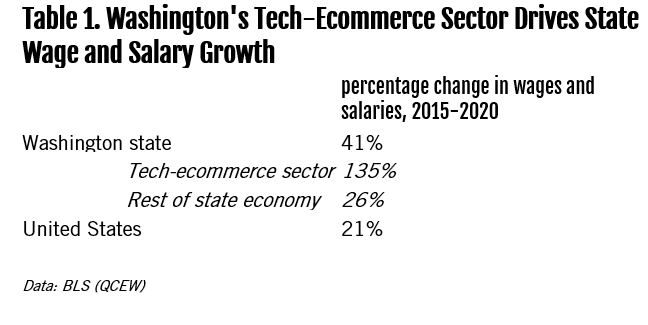
Between 2015 and 2020, total wages and salaries in Washington state rose by 41%, the biggest gain of any state, and almost double the 21% gain for the country as a whole. (See Table 1). This was not simply a pandemic effect, since Washington wage and salary growth was also first in the country in the 2014-2019 period as well.


To a large extent, Washington’s country-leading position in labor income is being driven by job and wage gains in the tech-ecommerce sector. Building on previous research and recent blog posts, we define the tech-ecommerce sector as including five tech industries and three ecommerce industries. The tech industries are computer and electronic production manufacturing (NAICS 334); software publishing (NAICS 5112); data processing and hosting (NAICS 518); Internet publishing and search, and other information services (NAICS 519); and computer systems design and programming (NAICS 5415). The three ecommerce industries are electronic shopping and mail order houses (NAICS 4541); local delivery (NAICS 492); and ecommerce fulfillment and warehousing (NAICS 493). We draw on Bureau of Labor Statistics data from the Quarterly Census of Employment and Wages (QCEW). This dataset reports on all jobs in each industry, as well as wages, salaries, and bonuses, including ordinary income from exercised stock options.

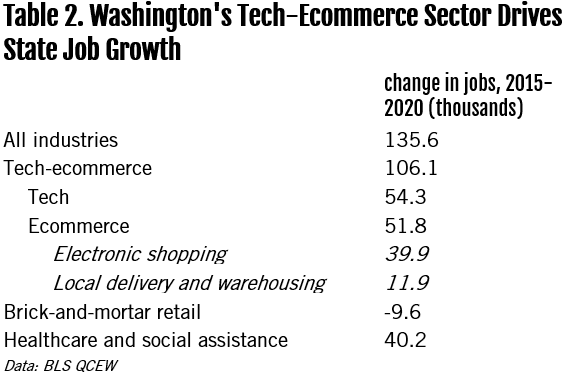
Let’s look at jobs first. From 2015 to 2020, the tech-ecommerce sector added over 100,000 new jobs to the Washington economy. Tech-ecommerce accounted for more than three-quarters of total job creation over that span, far outpacing the contribution of the healthcare and social assistance sector, which has long been the most dependable source of job growth (table 2).

Within the new jobs created by tech-ecommerce, roughly about half of those were in tech industries, and about half were in ecommerce industries (note that the BLS generally assigns establishments to industries according to the type of work being done at that establishment, not the industry of the parent company. So that an ecommerce fulfillment center is typically categorized in warehousing, no matter who owns it).

It’s important to note that the roughly 52,000 jobs being created in ecommerce over the past five years far exceeds the 10,000 jobs lost in brick-and-mortar retail in Washington.  Average annual pay in the local delivery and warehousing industries in Washington came to about 30% higher than average annual pay in brick-and-mortar retail in the state. That’s the typical spread we found nationally in past research.


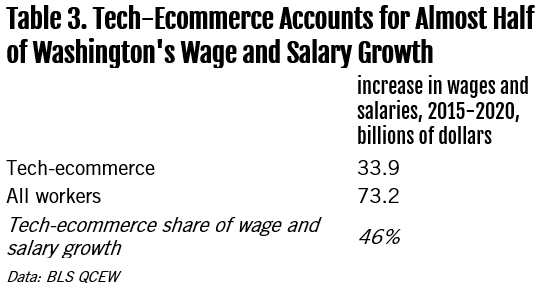
Now consider labor income in the state. Total wage and salary payments in Washington’s tech-ecommerce sector rose by $34 billion from 2015 to 2020, according to BLS data. That’s compared to the $73 billion increase in total wage and salary payments across the state. To put it another way, the tech-ecommerce sector accounted for 46% of the increase in wages and salaries in Washington from 2015 to 2020. (Table 3)


Finally, we turn to the question of the impact of the tech-ecommerce sector on state tax revenues in Washington. Tax collections have come in much stronger than expected, with forecasts repeatedly being raised.  In particular, taxes for the 2020-21 fiscal year are currently forecast to come in 13.4% higher than the 2019-2020 fiscal year, and roughly 60% above 2014-2015 levels (See June 2021 Revenue Review from the Washington State Economic and Revenue Forecast Council, page 27).

How much of that gain is accounted for by the tech-ecommerce sector? There are several issues with making this calculation. The state government reports and forecasts tax revenue data on a fiscal year basis, while our data on the tech-ecommerce sector is on a calendar year basis and stops with 2020. In addition, states with a personal income tax have a direct connection between wage and salary payments and state tax revenues Washington, however, has no personal income tax, and relies instead on a variety of other taxes, including a retail sales taxes, a business and occupation tax, a property tax, and a real estate excise tax.

Usually we think of taxes like these as being less immediately responsive to changes in wages and salaries than an income tax would be. Indeed, there was a stretch, around the time of the financial crisis and the years after, when the state’s “General Fund” tax revenues languished, even as the state’s wages and salaries started to rebound.

In recent years, however, the combined and diverse flows of tax revenues into the state’s coffers appear to be rising more or less in parallel with the QCEW wage and salary measure, when adjusted for fiscal years. That makes it plausible that we can use the tech-ecommerce share of wage and salary growth as a proxy for tech-ecommerce share of tax revenue gains.

There are two possible tax revenue measures we can use for our back-of-envelope calculations — either “General Fund” taxes, or a somewhat broader category of state tax revenues, which starts with “General Fund” taxes and then adds in several taxes earmarked for education and training. That broader tax concept has been growing somewhat faster in recent years. Noting that Washington is on two-year budget cycles (also known as “Bienniums”), General Fund tax revenues rose by $17.1 billion from the 2013-15 budget cycle to the 2019-21 budget cycle, while the broader measure of tax revenues rose by $18.9 billion.

We then apply the 46% tech-ecommerce share of wage and salary growth to the increases in the two measures of tax revenues. We estimate that the growth of tech-ecommerce jobs and incomes accounts for $8.0-8.8 billion in higher tax revenues funding the 2019-21 budget cycle compared to the 2013-15 budget cycle.  This should be viewed as a roughly estimate and not a final figure.

Conclusion and Implications

The tech-ecommerce sector is a massive positive for jobs, incomes and taxes in the state of Washington. That suggests Washington-headquartered Amazon and Microsoft, rather than “blocking the sunlight” for other companies in the state, play a central role in a thriving ecosystem that benefits workers, raises wages and generates tax revenues. As the saying goes “if it ain’t broke, don’t fix it.”


Why It’s Still Premature to Panic on Inflation

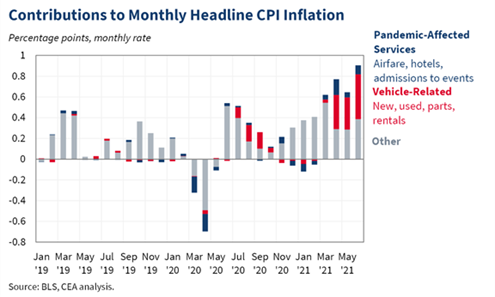
Today, the Labor Department released a new batch of inflation data for the year ending in June. The headline number for the consumer price index has sparked panic in some quarters, as year-over-year inflation is now at 5.4%, the highest annual rate since 2008.

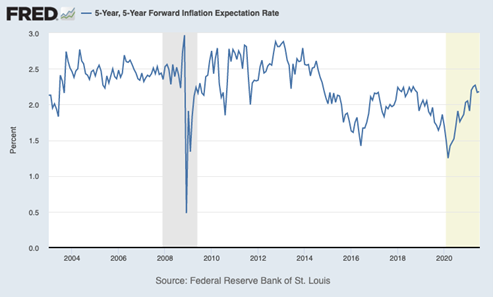
While this backward-looking measure is currently above its recent historical average, there is little cause for concern based on market forecasts of future inflation. Medium-term inflation expectations remain well-anchored, as bond prices show an expected average rate of inflation of 2.2% between 5 and 10 years from today.


This is a very clear market signal that inflation pressures are transitory and will abate as supply chain issues caused by the pandemic work themselves out. Notably, motor vehicles represented 60% of the month-over-month inflation increase in June. As the global semiconductor shortage ebbs, we can expect motor vehicle inflation to return to its historical average.


Another way to strip out the most volatile sectors of the economy and get a clearer picture of where inflation is heading is to look at median CPI, which includes only the middle changing item in the CPI’s basket of goods and services. In contrast to headline CPI, median CPI remains stable at 2.2% year-over-year. In the chart below you can see that CPI is more volatile than median CPI, and historically it has reverted toward median CPI after short deviations.


Lastly, year-over-year inflation numbers remain plagued by base effects, as the economy was depressed in June 2020 due to the poor handling of the pandemic by the Trump administration. Looking at two-year core inflation numbers shows that inflation is still within its historical range at 2.8%. This number is entirely consistent with the Federal Reserve’s average inflation targeting framework, which targets 2% average inflation over the business cycle with short periods of above average inflation making up for periods of below average inflation.


While there is not yet much reason to panic about long-run inflation, there are still things policymakers can do today to decrease the risk of inflation expectations becoming unmoored. For the first time in decades, we have sufficient demand in the economy to support rapid growth. Now we just need supply side investments and reforms to make sure that demand turns into real growth rather than increased inflation. Three items immediately spring to mind for policymakers to work on.

First, Congress should double down on its efforts to pass a bipartisan infrastructure package. While it may seem odd to spend more money to tamp down inflation, infrastructure spending is a special kind of spending. It’s an investment in the future productivity of our economy.

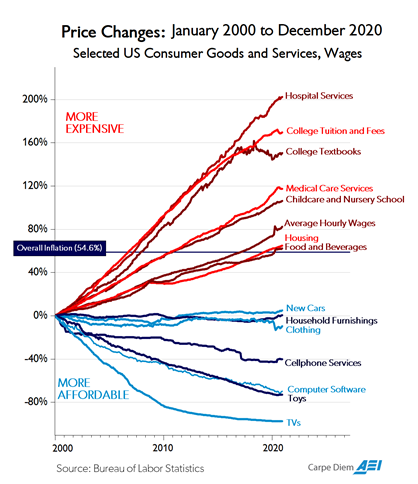
Second, the administration needs to follow through on many of the commitments it made last week in its executive order on promoting competition. Sectors like health care have been driving a disproportionate share of inflation in recent years. Encouraging more competition in that sector and others will have a disinflationary effect. Similarly, policymakers should avoid an unforced error by inadvertently harming sectors like tech and e-commerce, which have been holding down inflation in recent years.

Third, the Biden administration should begin to roll back tariffs implemented during the Trump presidency. These are taxes ultimately borne by American consumers and they raise the input costs for American manufacturers, making them less competitive in global markets.

Will Korean app store legislation force a “decoupling” from the U.S. economy?

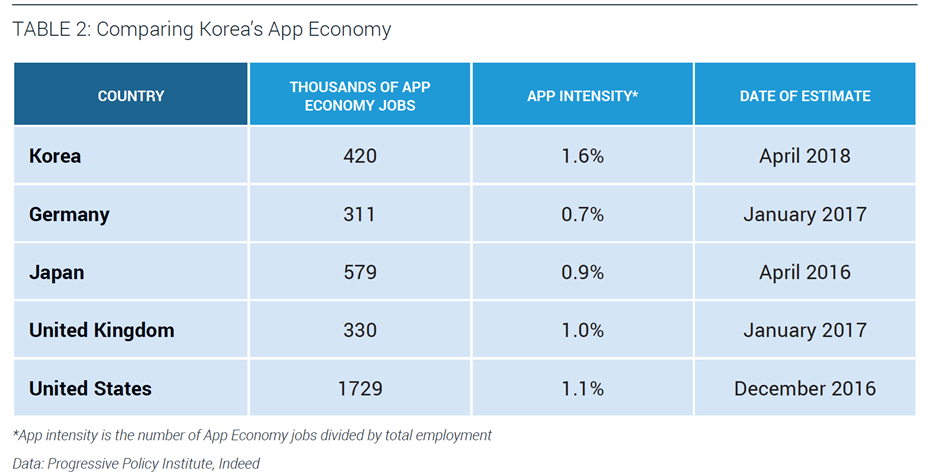
By our analysis, Korea’s “App Economy” is one of the strongest in the world. In our 2018 study,  the Progressive Policy Institute (PPI) estimated that Korea had 420,000 App Economy jobs, amounting to 1.6% of the workforce (see reproduced table below). This figure for “app intensity” was considerably higher than Japan, the United Kingdom, Germany, and even the U.S. at the time (though our latest estimate pegs American app intensity at 1.7% as of August 2020).

Moreover, as of 2020, 8 out of the top ten app companies in Korea were Korean-headquartered, according to download estimates from App Annie.  By comparison, only 1 out of the top ten app companies in Germany were German-headquartered.  Korea has a vibrant domestic App Economy that other countries would be envious of.

But despite this record of success, the Korean government is considering legislation that would dramatically change the app business environment. The legislation—which would amend Korea’s Telecommunications Business Act–would prohibit online app stores from requiring app developers to use the app store’s payment systems for in-app purchases. In effect, this would be equivalent to forcing a brick-and-mortar retailer to allow competitors to set up alternative checkout lanes in their stores.

The first question is: Why try to fix something that isn’t broken? Korean app developers are prospering under the current system and creating well-paying jobs. Why take the risk that a new system will turn out worse?

The second question is: Why undertake measures that would potentially accelerate “decoupling” Korea’s economy from the United States? The legislation under consideration would primarily affect U.S. tech companies, feeding the current American desire to shorten supply chains and build up internal tech production capacities. Korea and the U.S. will always be allies and friends, but in today’s political environment, lawmakers should pay attention to building bridges, not destroying them.

This table is reproduced from “Korea’s App Economy,” May 2018, Progressive Policy Institute. Data for other countries was current in 2018 when table was published. The latest numbers are available on request. 


Ritz for The Hill: How to Strengthen the Bipartisan Infrastructure Framework by Controlling Costs

As lawmakers return to Washington this week, one of their top priorities will be crafting legislation based on the bipartisan infrastructure framework agreed to by President Biden and Senate negotiators last month. Although that agreement set top-line numbers for broad categories of spending, the details for how the money would be spent still need to be fleshed out. Congress should maximize the impact of this transformative investment by including provisions to reduce construction costs and direct funds towards the most beneficial projects.

The costs of building infrastructure in the United States are significantly higher than they are in other countries. New York is home to some of the world’s most expensive mass transit projects, sometimes costing several billion dollars per mile, while costs in other American cities also dwarf those of comparable projects internationally. Roads are no better: A recent tunnel in Seattle cost more than three times as much as a similar project in Paris and seven times as much as one in Madrid. If policymakers can bring the cost of each project down closer to international norms, they can build more infrastructure with the same pool of funds.

Read the full piece. 

PPI Statement on White House Executive Order on Promoting Competition

PPI Statement on White House Executive Order on Promoting Competition

The Progressive Policy Institute (PPI) released the following statement on the Biden administration’s Executive Order aimed at promoting competition. The bulk of this Executive Order is appropriately focused on problems caused by a lack of competition in labor markets, agricultural markets, and health care markets. The 72 initiatives included in this order will solve many of those problems and deliver concrete, tangible benefits for Americans.

“The Progressive Policy Institute commends the Biden administration for working to level the playing field for American consumers. This whole-of-government approach will put workers and families first, a promise the president made during his campaign that he is delivering on today.

“The administration’s actions to ban non-compete agreements and reduce unnecessary occupational licensing will make it easier for workers to pursue economic opportunity and increase their power in the labor market. The order also lowers the costs of medical devices by allowing patients to purchase hearing aids over the counter. Consumers will save money on their internet bills with new rules banning excessive early termination fees and new transparency requirements that will make comparison shopping easier. Changes to the airline industry will make it easier for consumers to get refunds and force airlines to display all add-on fees upfront. Lastly, the order highlights the real harms caused by hospital consolidation in recent decades and directs antitrust enforcement agencies to review and revise their merger guidelines to protect patients.

“While we celebrate many reforms and initiatives in this Executive Order, we are also concerned by policies that could potentially harm job-creating sectors and growth as we recover from the pandemic, including constraints on tech/e-commerce innovation and a return to the long-ago solved issue of net neutrality.

“We hope that the administration also engages with Congress to create meaningful, codified reforms that support consumers for generations to come. Legislative action is necessary to ensure the enduring legacy of these historic initiatives.”

###


PPI Unveils High-Level Advisory Council to Reinventing America’s Schools Project

Council features veteran K-12 leaders, a former U.S. Education Secretary, parents’ groups, public school choice reformers, education foundations and philanthropists, and rigorous policy analysts and evaluators. 

Today, the Progressive Policy Institute’s Reinventing America’s Schools Project announced their Advisory Council, which is composed of leaders in education innovation from across the country.

“PPI believes that ensuring high-quality public schools for all our children is the civil rights imperative of our times,” said Will Marshall, PPI President. “We’re delighted to welcome this impressive roster of leading education reform practitioners and innovators to the Reinventing Public Schools (RAS) Project.”

The Advisory Council will be a resource for strategic thinking, a sounding board for modernizing ideas, and a force for public advocacy.

“Our goal is to speed the pace of K-12 evolution away from standardized, factory-style schools toward 21st century schools designed around principles of parental choice, school autonomy, diverse learning programs and strict public accountability for results,” Marshall said.

The council will be led by David Osborne, Director Emeritus of PPI’s Reinventing America’s Schools Project and the author of Reinventing America’s Schools: Creating a 21st Century Education System. The Reinventing America’s Schools Project Advisory Council includes:

David Osborne, Director Emeritus of the Reinventing America’s Schools project

Myrna Castrejon, California Charter Schools Association

A.J. Crabill, Texas Education Agency

Arne Duncan, Emerson Collective and former Secretary of Education

Howard Fuller, Founder and Director of the Institute for the Transformation of Learning at Marquette University and former Superintendent of Milwaukee Public Schools

Chris Gabrieli, Empower Schools

Robin Lake, Center on Reinventing Public Education

Maya Martin, Parents Amplifying Voices in Education

Jacinto Ramos, Ft. Worth Independent School District and Council of Urban Boards of Education (CUBE)

Keri Rodrigues, National Parents Union

Andy Rotherham, Bellwether Education Partners

Mary Seawell, Gates Family Foundation

Kameelah Shaheed-Diallo, The City Fund

Joe Siedlecki, Michael and Susan Dell Foundation

Paul Vallas, Co-Founder of the Vallas Group, Inc. and former Superintendent of Bridgeport Public Schools

The Progressive Policy Institute (PPI) is a catalyst for policy innovation and political reform based in Washington, D.C. Its mission is to create radically pragmatic ideas for moving America beyond ideological and partisan deadlock. Learn more about PPI by visiting progressivepolicy.org.

The Reinventing America’s Schools Project inspires a 21st century model of public education geared to the knowledge economy. One model, charter schools, are showing the way by providing autonomy for schools, accountability for results, and parental choice among schools tailored to the diverse learning styles of children. The project is co-led by Curtis Valentine and Tressa Pankovits.

Follow the Progressive Policy Institute.

Follow the Reinventing America’s Schools Project.

###

Mosaic Economic Project Announces Applications Open for September Women Changing Policy Cohort

The Mosaic Economic Project application process is now open for the September 2021 Women Changing Policy workshop, scheduled for September 13-15, 2021.

“The Women Changing Policy workshop is an opportunity for diverse women with expertise in economics and technology to hone the skills needed to communicate their work and ideas to policy makers and the media,” said Crystal Swann, Mosaic Economic Project Lead and PPI Senior Fellow. “Through our interactive format, participants get hands-on experience learning the ins and outs of Washington politics and on how to become a go-to policy expert. And it’s a chance to expand their networks.”

This is the third Women Changing Policy workshop. Previous workshops have included candid conversations with influencers in public policy, including leaders and representatives from the United States Congress, the media, and other experts from the policymaking ecosystem.

We encourage women with expertise in economics, finance, technology, telecom and corporate governance to apply. Applicants should be well established in their careers – be it at a corporation, academic institution or NGO–and looking for opportunities to grow their influence on critical issues, from the wealth gap to infrastructure to health care. The Mosaic Economic Project aims to bring new voices to the policy arena. To that end, we value diversity in applicants. This workshop will be held virtually, and the deadline to apply is August 31, 2021.

Interested applicants should apply here.

The Mosaic Economic Project is a network of diverse women in fields of economics and technology. Mosaic programming provides coaching on presenting skills and focuses on connecting and advocating for cohort participants’ to engage in public policy debates, with a particular focus on engaging Congress and the media.

The Progressive Policy Institute (PPI) is a catalyst for policy innovation and political reform based in Washington, D.C. Its mission is to create radically pragmatic ideas for moving America beyond ideological and partisan deadlock. Learn more about PPI by visiting progressivepolicy.org.

Follow the Progressive Policy Institute.

Follow the Mosaic Economic Project.

###

Media Contact: Aaron White – awhite@ppionline.org

Encouraging AI adoption by U.S. SMEs

Introduction:

For the firms that adopt them, artificial intelligence (AI) systems can offer revolutionary new products, increase productivity, raise wages, and expand consumer convenience.[1] But there are open questions about how well the ecosystem of small and medium-sized enterprises (SMEs) across the United States is prepared to adopt these new technologies. While AI systems offer some hope of narrowing the recent productivity gap between small and large firms, that can only happen if the technologies actually diffuse throughout the economy.

While some large firms in the U.S. are on the cutting edge of global AI adoption, the challenge for policymakers now is to help these technologies diffuse across the rest of the economy. To realize the full productivity potential of the U.S., AI tools need to be available to 89% of U.S. firms that have fewer than 20 employees and the 98% that have fewer than 100.[2] An AI-enabled productivity boost would be particularly timely as SMEs are recovering from the effects of the ongoing COVID-19 crisis.

The report discusses the promise for AI systems to increase productivity among U.S. SMEs, the current barriers to AI uptake, and policy tools that may be useful in managing the risks of AI while maximizing the benefits. In short: there is a wide range of policy levers that the U.S. can use to proactively provide the underlying digital and data infrastructure that will make it easier for SMEs to take the leap in adopting AI tools. Much of this infrastructure operates as a type of public good that will likely be underprovided by the market without public support.

Benefits of AI adoption:

The central case for AI adoption is that human cognition is limited in a variety of ways, most notably in time and processing power. Software tools can improve decision-making by increasing the speed and consistency with which decisions can be made, while also allowing more decisions to be planned out ahead of time in the event of various contingencies. Under this broad framework, we can think about “AI” as being a broad suite of technologies that are designed to automate or augment aspects of human decision-making.

AI tools are already being used across a wide range of domains to decrease power costs, improve logistics and sourcing systems, predict cash flows, steamline legal analysis, aid in drug discovery, improve factory safety conditions, and identify logistics efficiencies. This is in addition to opening up entirely new fields like autonomous vehicles, drone delivery systems, and instantaneous language translation.

While many of AI’s most eye-catching use cases will likely remain the preserve of large platforms, the technology also holds tremendous promise for SMEs. The adoption of third-party AI systems will notably enable SMEs to streamline mundane (but often costly) tasks such as marketing, customer relationship management, pre- and post-sales discussions with consumers, and Search Engine Optimization (SEO). These systems can provide a lifeline for SMEs who are overwhelmed by the many challenges of running a business, and they can expand the number of businesses that are eligible for certain financial supports. For example, AI tools can be used to improve the accuracy of credit risk underwriting models and using alternative data sources and a streamlined process, they can make it easier for SMEs to take out loans they otherwise might not qualify for under traditional methods. Along similar lines, research shows that AI-driven robotics have (and will continue) to boost the productivity of SMEs in the manufacturing industry.

Importantly, this upcoming wave of AI technology can help SMEs catch up with larger, international firms because it can democratize the benefits of large information technology (IT) investments that superstar firms have been seeing over the last decade.

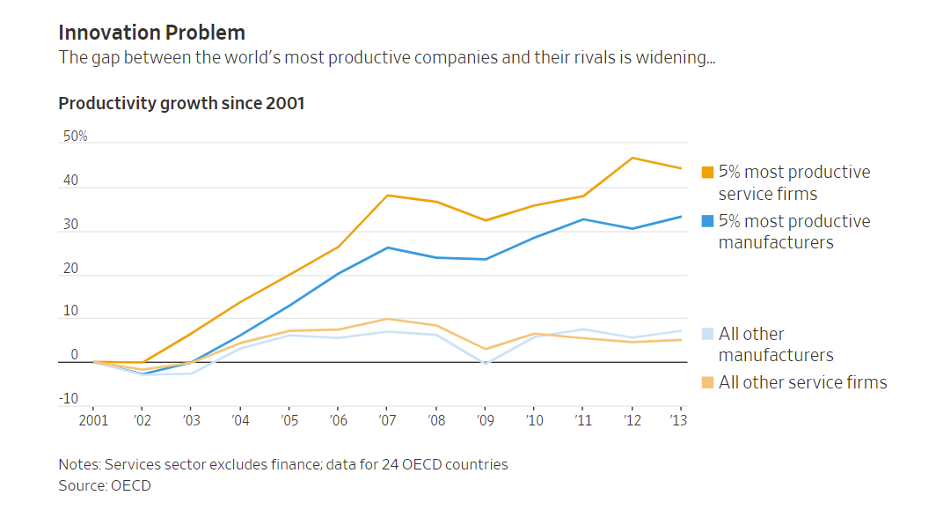
The economist James Bessen has argued that the top 5% of firms in many industries have been increasingly pulling away from the rest of the field because they’ve made large investments in proprietary IT systems. Their smaller rivals struggle to develop their own systems because they lack the necessary scale to hire a large stable of in-house technical talent. Amazon, for example, has a team of 10,000 employees working to improve their Alexa and Echo systems.

While AI tools can’t fully reverse this trend, they can help shrink the gap when embedded into Software as a Service (SaaS) platforms that smaller firms can make use of without the same level of investment. Essentially, through general-purpose AI tools, SMEs can have access to a host of productivity enhancements that these proprietary IT systems offer, but at a price point that is economical for SMEs. By shrinking this productivity gap, smaller firms can begin to compete in earnest while differentiating from large firms through improved customer service and greater product diversity. This will give a large leg up to SMEs who adopt these AI systems and help them better compete with large global incumbent firms.

Consider a firm like Keelvar Systems, which uses advanced sourcing automation to help businesses rapidly shift supply chains around the globe in the event of disruptions or delays. Essentially, it replaces or augments the work that a large supply chain and sourcing office would do within a firm. By using their service, or others like it, SMEs have the ability to benefit from similar levels of sophistication in their supply chain management without having employees spend hundreds of hours on tedious tasks or maintaining expensive proprietary IT systems.

There are firms like Legal Robot that have created a series of tools to help small businesses access legal services that would otherwise require a small army of in-house lawyers. With their service, SMEs can use smart contract templates based on their industry, receive instant contract analysis to make sure they are receiving fair terms and can automate certain aspects of compliance with laws like the GDPR.

Likewise, companies like Bold360 have helped SMEs improve their customer service experiences by offering a variety of AI-powered-chatbots and tools. Many basic customer concerns about products or delivery can be handled by these basic chatbots, freeing up human customer representatives to focus their time on the hard or advanced cases. Again, the pattern here is there is a service that large, multinational companies have been investing billions of dollars to create proprietary versions of, and now the customizability of AI is helping this service become more accessible to SMEs.

What are the barriers to AI adoption for SMEs in the U.S. and what can policymakers do to help create a welcoming environment?

Data investment as a public good

Depending on the context, data can often have the same traits as other public goods. First, it is non-rival—the marginal cost of producing a new copy of a piece of data is zero. Stated differently, multiple individuals can use the same dataset at almost no additional cost. The second important trait is that data is hard to exclude. Consider this report. Once it has been posted online, it is difficult to prevent people from accessing and sharing it as they see fit. This is one of the reasons why copyright infringement is so hard to stamp out.

Oversimplifying, these two features can lead to two opposite problems. On the one hand, economic agents might underinvest in public goods, absent government-created appropriability mechanisms (such as patent and copyright protection). Conversely, public goods tend to be underutilized (at least from a static point of view). Any price that enables economic agents to recoup their investments in a public good will be above the good’s “socially optimal” marginal cost of zero. Public good policies thus involve a tradeoff between incentives to create and incentives to disseminate. For example, patents give inventors the exclusive right to make, use and sell their invention; but inventors must disclose their inventions, and these fall into the public domain after twenty years.

What does this mean for data and artificial intelligence? If policymakers think that data is an essential input for cutting-edge AI, then they should question whether obstacles currently prevent firms from investing in data generation or disseminating their data.

While policies in this space involve significant tradeoffs, some offer much higher returns to social welfare. For instance, to the extent policymakers believe existing datasets are being underutilized, purchasing private entities’ data (through voluntary exchanges) and placing it in public data trusts would be a better policy than imposing data sharing obligations (which could undermine firms incentive to produce data in the first place). This is akin to the idea of government patent buyouts.

Of particular interest for policymakers, however, is the fact that some SMEs are sitting on top of data flows that are not being fully utilized because it is expensive to make data usable and these datasets may not be very valuable in isolation. As an example, industry-level manufacturing data might be quite valuable to all firms in a sector, but the dataflows from one SME are much less valuable. The U.S. could align incentives by providing investment funds to quantify various aspects of business flows and then submit them to public data trusts, which could be accessible for use by all firms in the industry. This would essentially be treating valuable dataflows as a type of public infrastructure that needs government investment to be fully realized.

This kind of public investment can happen not only through incentives for private firms but through the public sector as well. Governments at all levels (state, local, and national) have valuable dataflows regarding infrastructure development, the organization of public transportation, and general macro-level economic data that can be turned into open datasets for public and commercial use. Particularly on the national level, the U.S. should consider investment in IT infrastructure that can coordinate the submission of open datasets on the state and local level.

Indeed, if key scientific or commercial datasets do not yet exist, the public sector may be best positioned to create them in the first place as a type of digital infrastructure provision. One notable structure that may help in this regard is the idea of a Focused Research Organization, which would provide a team of researchers with an ambitious budget and a nimble organizational structure with the specific goal of creating new public datasets or toolkits over a set time period.

Provide regulatory certainty

For SMEs deciding whether to invest in adopting AI tools, regulatory and compliance costs can be a significant deterrent. Policymakers should recognize that regulation is often more burdensome for small firms that generally have less ability to shoulder compliance costs. Especially in industries with low marginal costs, such as the tech sector, larger firms can spread fixed compliance costs across more consumers, giving them a competitive edge over smaller rivals. Regulation can thus act as a powerful barrier to entry. For instance, a study found that the European experiment with GDPR led to a 17% increase in industry concentration among technology vendors that provide support services to websites.

This is not to say that additional regulation is, or is not, necessary in the first place. Indeed, there are a host of malicious or unintentional harms that can occur from improperly calibrated AI systems. Regulation can be a powerful tool to prevent these harms and, when well-balanced, can promote greater trust in the overall ecosystem. But potential regulation should follow sound policymaking principles that reduce the regulatory burden imposed on firms, notably by making regulation easy to understand, risk based, and low-cost to comply with.

In the U.S. there is to date no overriding national AI regulation. Instead, each sectoral regulator (i.e. Federal Aviation Administration, Security and Exchange Commission, Federal Trade Commission, etc.) has been steadily increasing their oversight over the use of algorithms and software in their specific area. This is likely an appropriate approach, as the kinds of risks and tradeoffs at play are going to be very different in healthcare or financial decision-making when compared to consumer applications. As this approach develops, it would be prudent to develop a risk-based framework that allows for more scrutiny of algorithmic decision-making in sensitive areas while giving SMEs confidence to invest in low-risk areas with the knowledge they will not later take on large compliance costs.

However, regulation over data protection has been far more segmented and piecemeal. And the state-by-state patchwork of rules that has developed can be a significant deterrent for SMEs when considering whether to invest in the use of certain AI tools. Policymakers should consider an overriding national privacy law that would be able to set standard rules of the road over the protection of data in all 50 states so that U.S. SMEs can invest with confidence.

Finally, U.S. policymakers should consider aggregating all this information through the creation of a dedicated AI regulatory website that provides a toolkit of resources for SMEs about the benefits of AI adoption for their business, the potential obligations and roadblocks that they need to be aware of, and best practices for cybersecurity hygiene and data sharing.

Expand the AI talent pool

A lack of skilled talent is one of the biggest barriers to AI adoption as the technical skills required to build or adapt AI models are in short supply. In the U.S., especially, smaller companies struggle to compete with the high salaries paid out by large tech firms for top-end machine learning engineers and data scientists.

In broad strokes, this skills shortage can be alleviated in two ways: through upskilling the domestic population and by improving immigration pathways for global talent.

To upskill the domestic population, one relatively simple lever would be to pay some portion of the costs of individuals and businesses who wish to upskill. In the U.S., a portion of a worker’s retraining costs may be written off as a business expense so long as the worker is having their productivity improved in a role they currently occupy. But this expense is not tax deductible if the proposed training would enable them to take on a new role or trade.

For example, if a small manufacturing firm has technically competent IT staff who wish to attend a specialized training course on using machine vision systems in a warehouse environment, this expense would not currently be deductible as it would enable them to take on a new role within the company. This inadvertently creates an incentive to spend more on capital productivity investments than labor productivity investments. Addressing this imbalance would incentivize more firms to invest in worker retraining and help speed the creation of an AI workforce in the U.S.

Secondly, the U.S. needs to urgently address the shortcomings in the U.S. immigration system which make it more difficult for startups to compete with large incumbents on the basis of talent. Approximately 79% of the graduate students in computer science (and related subfields) studying in the U.S. are international students, which means a large majority of potential AI workers U.S. firms may look to recruit must operate through the immigration system. The cost, complexity, and length of this process inevitably favors large, incumbent firms who can afford to navigate the regulatory maze of procuring an H-1B or related work visa.

A recent NBER paper showed in detail the myriad ways in which access to international talent is important for startup success. Utilizing the random nature of the H-1B lottery system, the paper compared startups that randomly received a higher percentage of their visa applications approved to those who did not. The random nature of the H-1B lottery makes an ideal policy experiment because it allows for a clean test in which other potentially confounding variables are controlled for. The study found that a one standard deviation increase in the likelihood of successfully sponsoring an H-1B visa correlated with a 10% increase in the likelihood of receiving external funding, a 20% increase in the likelihood of a successful exit, a 23% increase in successful Initial Public Offering, and a 4.8% increase in the number of patents filed by the startup.

Policymakers could begin to counter this effect by waiving immigration fees for firms of a certain size and by streamlining the application process.

Further, policymakers should look to create a statutory startup visa so that international entrepreneurs have a viable pathway into the U.S. to launch firms of their own. According to research by Michael Roacha and John Skrentny, international STEM PhD students are just as likely to report wanting to work for or launch their own firm as native-born students, but the difficulty of our immigration system pushes them towards working at large incumbent firms.

Using these two levers of upskilling and immigration reform, the U.S. should increase the supply of AI talent available to SMEs or to launch SMEs themselves and thereby spur the adoption of AI adoption.

Conclusion

Artificial intelligence systems hold great potential to streamline the costs of doing business in a modern economy, particularly for SMEs. The last 20 years of the information technology revolution have helped large, established firms reach the cutting edge of productivity while smaller firms have been left behind. But general-purpose AI tools now provide an opportunity for SMEs to take advantage of many of these IT advancements at a cost and a scale that is feasible for them. Policymakers should attempt to proactively build out the digital infrastructure that will make it easier for SMEs to take the leap in adapting AI tools.

Summary of policy recommendations:

Data investment as a public good:

  • Where appropriate, align incentives for the private sector to contribute industry-level SME data to public and private data trusts that could be used by everyone.
  • Invest in making more government datasets open to the public.
  • Fund Focused Research Organizations or similar groups with the explicit goal of creating new scientific and commercial public datasets.

Provide regulatory certainty:

  • Clarify existing regulations and the obligations that SMEs must meet when utilizing a new AI tool.
  • Encourage the development of a risk-based framework that allows for more stringent regulation of sensitive applications while giving certainty to SMEs on investment in low-risk applications.
  • Pass an overriding national privacy law so that SMEs aren’t deterred from investing by a patchwork of differing state-by-state laws.
  • Consider the creation of a new SME regulatory website that provides informational resources to SMEs about the benefits of AI adoption for their business and the potential roadblocks that they need to be aware of.

Expand the AI talent pool

  • Encourage upskilling of the U.S. population by making worker retraining deductible as a business expense.
  • Reevaluate U.S. immigration pathways to make them more attractive for international technical talent.
  • Streamline the immigration application process and waive fees for firms below a certain size to make it easier for SMEs to compete for technical talent.

[1] This report is an adaptation of an earlier paper coauthored with Dirk Auer titled “Encouraging AI Adoption in the EU”.

[2] Annual Survey of Entrepreneurs – Characteristics of Businesses: 2016 Tables, United States Census Bureau

Constructing an Effective Manufacturing Policy

President Biden’s American Jobs Plan proposed to spend $300 billion on rebuilding America’s manufacturing sector. The funds would be distributed through a variety of channels, including $50 billion in semiconductor manufacturing and research, $50 billion for a new office to fund investments to support production of critical goods. Biden also called for the creation of a “new financing program to support debt and equity investments for manufacturing to strengthen the resilience of America’s supply chains.”

The US Innovation and Competition Act of 2021, which passed the Senate in early June, also highlights pro-manufacturing polices. These include funding for semiconductor manufacturing and research, money for regional technology hubs, and the creation of the position of Chief Manufacturing Officer in the White House to coordinate the nation’s manufacturing policies.

We believe that these plans are a big step in the right direction, and applaud the President’s and the Senate’s focus on manufacturing. But the nation’s policy framework for manufacturing needs more explicit emphasis on digitization of physical production, which is the only way that American manufacturers can compete over the long run and create new jobs. In addition, the 2017 Tax Cuts and Jobs Act (TCJA) introduced an odd quirk into the business tax code that will make it more expensive for some manufacturers to borrow.  That quirk needs to be fixed.

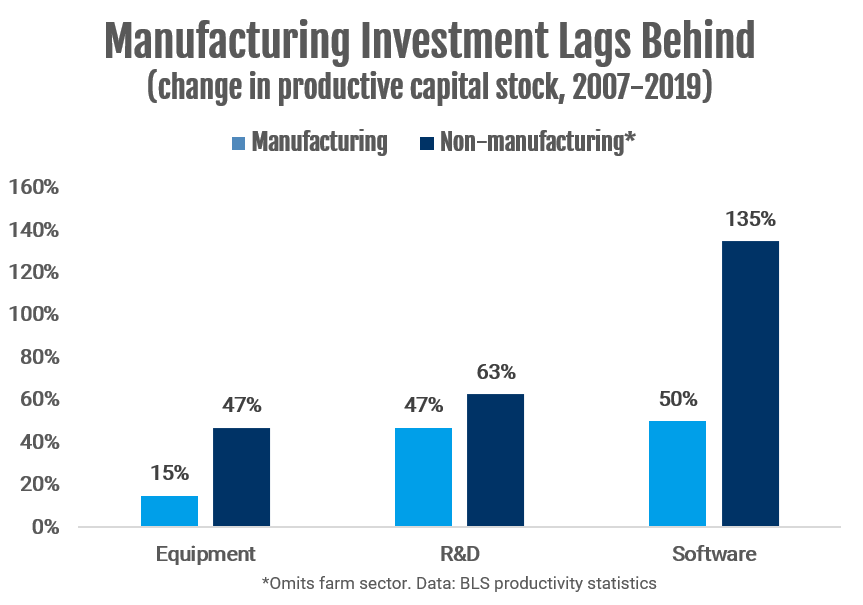
First, we review the facts about manufacturing investment.  Government figures show that domestic investment by manufacturers has been lagging the rest of the economy by a substantial margin. During the last business cycle—which started in 2007 and ended in 2019—the productive stock of equipment rose by 15% in the manufacturing sector, far less than the 47% increase in the rest of the non-farm business sector (see chart below). (Equipment includes everything from industrial machinery to trucks to computers and communications gear bought by manufacturers).

This weakness in factory investment undermines the usual argument that manufacturing workers have been mainly displaced by automation. Certainly automation has been progressing, but if capital investment in robots and the like were the main cause of job loss, the investment surge in equipment would have been much bigger.  The White House 100-day supply chain review points out that “many SME manufacturers are underinvesting in new technology to increase their productivity.” Contrast this with the warehousing industry (including fulfillment centers) where the productive stock of equipment rose by 91% from 2007 to 2019, even as employment soared.

Moreover, manufacturers have been lagging in software and R&D investment as well.  The productive stock of software in the manufacturing sector rose by 50 percent from 2007 to 2019, compared to a 135 percent increase in the non-manufacturing sector.  The productive stock of research and development rose by 47 percent in the manufacturing sector, compared to a 63 percent increase in the non-manufacturing sector.

The investment picture gets even worse when we look at specific industries within manufacturing. Consider the computer and electronics products industry, which includes semiconductor manufacturing. The productive stock of equipment in this industry did not grow at all from 2007 to 2019, and similarly for the stock of software. In other words, the computer and electronics product industry, including semiconductors, had no net investment in equipment and software over this 12-year stretch. This may help explain why government action to boost semiconductor manufacturing investment is necessary now.

Similarly, capital investment in the motor vehicle industry has been lagging. The 22 percent increase in the productive stock of equipment (including robots) is above the norm for manufacturing, but well behind the average for the nonmanufacturing sector. And investment in motor vehicle R&D, while still strong in absolute terms, has barely kept up with the industry’s need to shift to electric vehicles. Once again, the investment data helps us identify manufacturing sectors that need help in competing with China.

We note that the manufacturing sector is responsible for the entire slowdown in equipment investment compared to the 1990s.  That shows how important it is that the U.S. address the issue of weakness in investment in manufacturing.

So what can we do? Biden’s manufacturing plan and the Competition and Innovation Act passed by the Senate are both heading in the right direction, but they could be improved with an overarching vision. As PPI has noted in several reports, we need the American manufacturing industry to invest in digitization—not just robots on the factory floor, but manufacturing platforms that make it easier for American startups to join global supply chains.  The Biden Administration should think in terms of an Internet of Goods, where manufacturers plug into a network of companies that are linked digitally. The Biden manufacturing initiative should build on existing platforms such as Xometry and Fictiv to connect smaller suppliers.

The other big issue is funding. Manufacturing requires large capital investments, so borrowing costs are always a consideration. Unfortunately, in an example of the law of unforeseen consequences, key provisions of the 2017 TCJA are about to make it much more expensive for manufacturers and other capital-heavy businesses to fund their investments, even before any potential increase in the corporate income tax rate.

First, the TCJA permitted full expensing for investments in short-lived assets such as machinery and equipment. However, the “bonus depreciation” will begin phasing out in 2023 and will be eliminated by 2027. That will make it more expensive for manufacturing investment.

Second, the TCJA reduced the amount of interest expenses that most businesses could deduct from 50 percent to 30 percent of a business’s “earnings before interest, taxes, depreciation, and amortization” (EBITDA). Because of the pandemic, the CARES Act temporarily relaxed this restriction for 2020, but it comes back into effect for 2021.

Third, as of 2022, the TCJA further reduces the tax deductibility of interest to 30 percent of business “earnings before interest and tax” (EBIT).  The difference between EBIT and EIBTDA is depreciation and amortization, which can be enormous for asset-heavy manufacturers. This 2022 shift, as embodied in current law, will have the effect of reducing the amount of interest that a manufacturer or other investment-heavy company can deduct.

To understand the magnitude of this change, consider American Axle & Manufacturing, a leading automotive supplier that did $4.7 billion in sales in 2020. The company’s EBITDA was $720 million, and depreciation and amortization was $522 million. That means EBIT was only $188 million (Note: These numbers are all drawn from the company’s public 10K, with no contact with the company).

In 2020 American Axle paid $212 million in interest. Under the TCJA rules that apply to 2021, it would all be deductible, since $212 million is less than 30 percent of $720 million. Under the TCJA rules that apply to 2022 and after, assuming that all numbers remain the same, only $56 million of the interest payment will be deductible. Future borrowing will take the same hit.

When the TCJA was passed, the increased restrictions on the deductibility of interest seemed appealing to many policymakers for several reasons. First, it reduced the bias in the tax code toward debt financing. Second, it discouraged excess borrowing by companies. Third, it raised money and helped balance out the cost of cutting corporate income tax rates.

However, the increased restrictions are likely to disproportionately affect manufacturers, who as a whole paid $96 billion and $90 billion in interest in 2018 and 2019 respectively, more than any other sector of the economy except real estate (who could opt out of the new requirements).  The impact of this provision on companies like American Axle will be even greater if interest rates rise, as seems likely.

Given the acknowledged importance of manufacturing, it might make sense for lawmakers to consider extending the provision of the CARES Act that relaxes the limitations on interest expense deductions to avoid imposing another financial burden on the U.S. manufacturing sector.  This would also cover the coming shift to EBIT. Such a move might be especially appropriate if the current provisions of the tax law that phase out bonus depreciation stay in effect. If we care about domestic factory investment, it seems like a mistake to make it more expensive for manufacturers to borrow even while the depreciation rules become more restrictive.


PPI’s Paul Bledsoe Joins Charles Ellison on WURD Radio

WURD Radio · Reality Check 6.29.2021 – Paul Bledsoe

PPI Strategic Advisor Paul Bledsoe joined Charles Ellison on WURD Radio for a conversation about the human cost of climate change, cutting Trump-era policies around methane regulations, and President Biden’s efforts to include bipartisan climate policy in his infrastructure package, among other things.

Listen to the full interview on WURD Radio’s Soundcloud.

Biotech Innovation: Two Important Questions

INTRODUCTION

It’s rare when a single acquisition can offer insight into two different important questions in innovation. But the proposed purchase of cancer-diagnostic developer Grail — a startup with tremendous potential — by gene-sequencing leader Illumina is just that pivotal. First, is it pro-innovation for European antitrust regulators to have the power to block a deal involving two American biotech companies that do no substantial business in Europe? We argue that such “regulatory imperialism” by the EU has the potential to slow down biotech innovation, especially given the region’s generally lagging performance in biotech (BioNTech notwithstanding).

Second, under what conditions is vertical integration a socially beneficial strategy for accelerating innovation? Successful innovation in the biosciences often combines risk-taking by small companies with the development and regulatory resources of larger companies. We conclude that excessive antitrust focus on blocking vertical integration in the biosciences could impede the development of important new products and treatments.

These issues go far beyond Illumina and Grail. But it’s helpful to have the facts about this particular case. Grail has spent the past five years developing a diagnostic capable of screening for 50 different cancers at once — a test set to launch this year — while Illumina makes the hardware that performs those tests.  Illumina offered to buy Grail, with the idea of integrating Grail’s technology with its own, to simplify the process of using gene sequencing for clinical diagnostics on a massive scale. If successful, this would dramatically reduce the cost of performing cancer screenings.

The Federal Trade Commission (FTC) intervened to block the acquisition, worried that Illumina would block potential competitors of Grail from using its gene sequencers. Illumina promised to supply these competitors with gene sequencing equipment and supplies without price increases.  The FTC, through a complicated series of maneuvers that are not relevant to this paper, temporarily pulled back from its intervention to allow the European Commission to take the first swing at blocking the acquisition. The EU antitrust regulators are planning to rule by July 27 on whether to clear the merger.

And here’s where we come to the first issue: Should the EU antitrust regulators be considering a biotech deal that by the ordinary rules would not come under their jurisdiction? As the Wall Street Journal notes, “Since the merger doesn’t qualify for antitrust review under the bylaws of the European Union or any member states, the Commission asked countries to invoke Article 22 of the EU’s Merger Regulations. This rarely used provision allows countries to refer transactions to the Commission when their governments lack jurisdiction.”

This fits the general EU strategy of “regulatory imperialism.” Rather than focusing on innovation, the EU has tried to position itself as the global leader in regulation in a variety of areas, from artificial intelligence to chemicals to GMOs to data privacy.  The European approach to regulation has been framed by the precautionary principle, which puts less weight on the benefits of innovation and more on the potential harms.

That risk-avoiding approach is one important reason why Europe has consistently lagged in biotech. European biotech is not nonexistent — after all, Pfizer partnered with a German biotech firm, BioNTech, to develop a very successful COVID-19 vaccine. Nevertheless, data from the Organisation for Economic Co-operation and Development shows that business spending on biotech research and development (R&D) in the EU comes to roughly one-third that of the U.S.

Tacitly accepting European jurisdiction over American biotech deals has the potential to slow down commercialization of important technologies. According to the New York Times, Europe has been “a world leader in technology regulation, including privacy and antitrust.” In a recent speech, Emmanuel Macron said that during its turn at the helm of the EU presidency, France would “try to deliver a maximum of regulation and progress.” When the EU sets the global standard on regulation and companies choose to comply with it everywhere (even where standards are lower), that’s known as the “Brussels effect.”

First, on privacy, the General Data Protection Regulation (GDPR) has become a de facto floor on policy for many large multinational companies. The problem for companies — especially in biotech and software — is that there are very high fixed costs to product development (and low marginal costs for distribution), and reworking a product for a different regulatory environment is often more trouble than it’s worth. That leads to a race to the top (or bottom, depending on your perspective) in terms of regulation.

In its first few years in effect, GDPR’s flaws have become manifest and EU policymakers are starting to consider reforms to the law. According to a recent joint report from three academy networks, “GDPR rules have stalled or derailed at least 40 cancer studies funded by the US National Institutes of Health (NIH).” The authors go on to note that “5,000 international health projects were affected by GDPR requirements in 2019 alone.” This flawed model for privacy regulation has unfortunately been exported around the globe.

Second, mergers between globally competitive firms with a presence in multiple jurisdictions have to get clearance from multiple antitrust enforcement agencies. If a single agency in a large market objects to the merger, the deal might fall apart completely. For example, a merger between U.S.-based Honeywell and U.S.-based General Electric collapsed after the EU competition enforcement agency decided to block the deal out of concern it would create a monopoly in jet engines. Of course, the EU’s investigation of the Illumina-Grail merger takes that one step further, given the fact that Grail doesn’t conduct any business in the EU, and Illumina’s business there isn’t substantial, with revenues below the usual threshold for antitrust scrutiny for both the European Commission and individual countries.

The next important question raised by the Illumina-Grail purchase is the role of vertical integration.  We start with the simple observation that innovating in complex systems is both risky and expensive. That’s true in frontier industries such as electric vehicles and e-commerce, and it’s especially true in the biosciences, with the high hurdle set by the need for safety and efficacy.

The cost to bring a drug to market is a huge barrier for startups to remain independent. A 2020 paper in JAMA examining 63 of the 355 new therapeutic drugs and biologic agents approved by the U.S. Food and Drug Administration between 2009 and 2018 found that the median capitalized research and development cost per medicine was $985 million. Other studies using private data have found even higher figures. A 2019 study published in the Journal of Health Economics estimated the average cost to reach approval at $2.6 billion (post-approval R&D costs nudge the total up to $2.9 billion).

Should these complex systems be built by one company, which is better able to integrate all the pieces of the puzzle? (Tesla comes to mind when we are discussing electric vehicles). Or is it better to distribute the risk over multiple companies? The biotech industry has mostly followed this second strategy. Risky R&D is done by small firms with financing by high-risk capital such as venture firms. Then the resulting product, if successfully passing clinical trials, is acquired by a larger firm for commercialization.

In some cases, both strategies are important. The initial stages of research and development of a new idea are farmed out to a smaller company and financed by risk capital. And then when it comes time to build the idea into a complex system, the actual integration is done by a larger company, which has an established distribution network and marketing resources for reaching patients in a targeted fashion. This can greatly accelerate the development process.

The question, then, is whether this integration would be easier within one company or at arms-length. Illumina has made an offer to buy Grail, which was originally spun off from Illumina in order to get funding from risk capital. The goal, obviously, is to accelerate the development of this game changing integration.

The FTC has objected to the acquisition, because the agency worries about Illumina prioritizing its internal customer over other potential cancer diagnostics systems. Certainly, it’s true that some vertical mergers are anti-competitive. “Killer acquisitions” are one type of merger in biotech that is anti-competitive in nature. A recent paper from Ederer, Cunningham and Ma found that between 5% and 7% of acquisitions in the pharmaceutical industry are killer acquisitions, meaning the incumbent firm purchased the startup with the intention of shutting down one or more of its products, because the legacy company offers a competing product that is more profitable.

There is increasing agreement among regulators on both sides of the Atlantic that acquisitions — especially in the pharmaceutical sector — need to be scrutinized more closely if products have the potential to be killed off post-acquisition. One heuristic a regulator might use is to look at how much overlap there is between the acquired product and the incumbent, especially in terms of benefits and use cases. If the incumbent’s product is still on patent, then there is a significant incentive to acquire a competitive product that might be disruptive to an acquirer’s portfolio and shut down the new product.

But there’s little evidence that most vertical acquisitions are anti-competitive. Vertical mergers — or the combination of two companies at different layers of the supply chain — are less likely than horizontal mergers — acquisition of a direct competitor — to be anticompetitive as both economic theory and empirical evidence show. Regarding the theory, firms are engaged in “make or buy” decisions all the time. If they choose to produce an input in-house instead of buying it from the market, then they have vertically integrated (either by developing the capacity on their own or by acquiring another firm with that capacity). Prohibiting firms from vertically integrating via acquisition would forgo some of the benefits of economies of scope and economies of scale. A literature review by Lafontaine and Slade showed that vertical mergers were procompetitive on average.

One of the most common reasons vertical mergers are less suspect than horizontal mergers has to do with “double marginalization.” If you assume two products are monopolies in their respective markets, then the producers of those products will each charge the monopoly price, which is higher than socially optimal. If the two products are complementary, then the companies can merge and create a positive sum scenario by lowering prices. Lower prices reduce deadweight loss, which is good for consumers, and lead to higher profits for the combined firm.

We note that if the FTC ruling stands, it will mean that developers of complex integrated systems will choose to keep their technologies in house rather than spinning them out and run the risk of having an acquisition blocked. And innovative development will be slowed rather than accelerated.


PPI Paper Examines Antitrust Role in Biotech Innovation

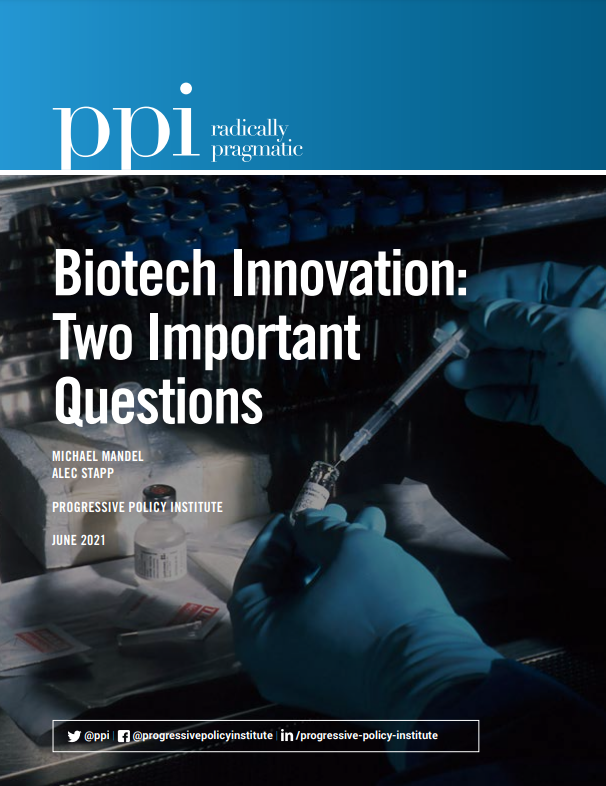
A new paper released today by the Progressive Policy Institute examines two key questions facing the biotech industry in America and the European Union (EU): Is it pro-innovation for European antitrust regulators to have the power to block a deal involving two American biotech companies that do no substantial business in Europe? And, under what conditions is vertical integration a socially beneficial strategy for accelerating innovation?

The paper, titled “Biotech Innovation: Two Important Questions,” is authored by Dr. Michael Mandel and Alec Stapp.

“There is little evidence that most vertical acquisitions are anti-competitive. If our shared goal is to support innovation and scaled production of potentially-lifesaving drugs and medical products, the U.S. and E.U. governments should work to advance integrated development — not regulatory imperialism,” said report authors Dr. Michael Mandel and Alec Stapp.

The paper examines the proposed purchase of cancer-diagnostic developer Grail by gene-sequencing leader Illumina. The Federal Trade Commission (FTC) recently intervened to stop the acquisition, worried that Illumina would block potential competitors of Grail from using its gene sequencers. The FTC ultimately dropped its case, instead allowing the European Commission to take the first swing at blocking the acquisition. The EU will rule by late July on the merger.

The paper concludes that excessive antitrust focus on blocking vertical integration in the biosciences could impede the development of important new products and treatments (though so-called “killer acquisitions” are an important exception that warrant increased scrutiny from regulators). The paper also broadens the scope of the issue, extending beyond the Grail and Illumina case and into the larger climate of regulation, innovation, and integration in the EU and U.S.

Read the full paper here:

The Progressive Policy Institute (PPI) is a catalyst for policy innovation and political reform based in Washington, D.C. Its mission is to create radically pragmatic ideas for moving America beyond ideological and partisan deadlock. Learn more about PPI by visiting progressivepolicy.org.

Follow the Progressive Policy Institute.

###