Antitrust regulators shouldn’t disassemble one of America’s engines of growth

The Department of Justice has presented its framework of sweeping potential remedies in the Google antitrust case, including “behavioral and structural” changes that go far beyond the specifics of the court’s findings.

But government antitrust regulators should be wary about disassembling one of America’s engines of growth. The information sector — of which Google is an important contributor — has performed amazingly well in recent years, accounting for more than a quarter of all private sector growth since 2019. Over the same stretch, the information sector also benefited customers by lowering prices while the rest of the economy was going through an inflationary surge.

Equally important, tech firms are America’s technological leaders in an increasingly competitive world, filling in the gap left by a lack of government funding for research and development.  Over the past ten years, inflation-adjusted U.S. R&D spending has risen by more than 60%. Virtually none of that increase in real R&D spending came from government. Ironically, the competitiveness-enhancing R&D gains have been almost totally driven by businesses such as Google, which invested a stunning $45 billion in R&D in 2023, more than triple a decade earlier.

In a 2022 report from PPI’s Innovation Frontier Project, “American Science And Technology Leadership Under Threat: Restrictive Antitrust Legislation And Growing Global Competition,” co-authors Sharon Belenzon and Ashish Arora of Duke University argue that:

“Antitrust regulations that reduce the size and limit the scope of tech firms weaken their incentives to make the large-scale, long-run investments in science and technology, vital for national security and economic prosperity….At a time when the United States critically depends on a handful of firms to pursue large scale research projects, such proposals would play into the hands of foreign rivals.” 

They further went on to conclude that:

“There is a close relationship between the incentives to invest in research and the scale and scope of the firm. Without the leadership of firms with substantial scale and scope, the full potential of general-purpose technologies may not be realized.” 

Antitrust regulators may be tempted to “fix” America’s engines of growth by disconnecting parts deemed to be unnecessary. But remember: The rest of the world looks enviously at the U.S. tech sector, which is running fast and investing for the future.

Closing the Digital Verification Divide

Introduction

In the internet era, the digitization of government is essential for the efficient and fair provision of public services. From faster access to unemployment benefits and food stamps to easier taxpayer retrieval of IRS tax records, digitization has the potential to make federal and local government work better, especially for lower-income Americans who need its services the most. It is not an exaggeration to say that “making government work better” requires digitization.

But successful digitization of government was slowed until recently by several factors. First, the “digital access divide” meant that many low-income or rural Americans did not have good enough quality Internet to seamlessly make use of digital government services. As a result, digitization of government ran the risk of widening existing inequities. Moreover, government had to maintain non-digital legacy systems as well as the new digital means of access, driving up the expense of service delivery and undercutting potential cost savings.

True, the original digital access divide has been narrowing. Post-pandemic efforts to bring highspeed broadband internet to everyone, such as the BEAD program, are in the process of successfully reducing the obstacles to access.

However, government agencies face a more subtle but pervasive issue — what we call the “digital verification divide.” Verification is the process by which a user verifies that they are who they say they are. Verification includes identity proofing, in which an individual provides sufficient information (e.g., identity history, credentials, documents) to establish a trusted identity online. That’s a prerequisite for higher levels of authentication, which verifies the identity of a user, process, or device, in order to allow access to more protected resources in an information system.

The process of identity proofing and authentication is especially important when users are trying to tap into government systems that contain sensitive personal data, such as individual accounts at the Internal Revenue Service (IRS), the Social Security Administration (SSA), Federal Student Aid (.gov) or Veterans Administration (VA). If government agencies make verification too easy relative to the risk of the transaction, then the wrong people can get access to sensitive personal data. If agencies make verification too hard relative to the risk of the transaction, then it becomes more difficult for constituents to prove their identity, unnecessarily locking them out of services and data that they are entitled to.

A “digital verification divide” is created by two factors that make it harder for low-income and other Americans with sparse document trails to take advantage of digital government. One issue is that low-income and marginalized Americans are less likely to have bank accounts, mortgages, passports, or any of the accumulation of documentation that most people can use to establish their identity and help authenticate themselves for government systems.

The second issue in closing the digital verification divide is that the use of biometrics for identity verification has been mistakenly conflated with the use of biometrics for
surveillance and law enforcement, which poses a very different set of technological and implementation challenges. A typical identity verification system might use a face-matching algorithm that does a “1 to 1” comparison between an individual’s face and a particular government-issued ID. A law enforcement application, by contrast, might use a facial recognition algorithm that does a “1 to many” comparison between an individual’s face and a database of millions of potential matches.

National Institute of Standards and Technology (NIST) testing has shown a steady reduction in the errors from the sort of face-matching algorithms used for identity verification, with the top-scoring ones performing consistently across demographics. Nevertheless, the continuing debate over the use of biometrics in situations such as surveillance and law enforcement has made policymakers reluctant to mandate biometrics for identity verification.

Closing the digital verification divide should be an important goal of policy, both for equity and efficiency reasons. Enabling government to interact digitally with all citizens in a safe way is essential to move the government into the future. Unfortunately, that progress has been slowed by challenges facing “Login.gov,” the widely-used identity proofing and authentication system originally launched by the General Services Administration (GSA) in 2017. The GSA was faced with conflicting demands: On the one hand,
guidelines issued by NIST required a physical or biometric component to achieve a high level of assurance needed by federal agencies to ensure legitimate access to restricted information or accounts requiring identity verification. On the other hand, the GSA apparently felt pressure to stay away from biometrics.

The result: the GSA ended up significantly misrepresenting the capabilities of Login.gov to the agencies using (and paying for) the system, according to a report released in March 2023 by the GSA Inspector General. GSA officials claimed that Login.gov met NIST guidelines which required a physical or biometric component. But “Login.gov has never included a physical or biometric comparison for its customer agencies,” according to the report, titled “GSA Misled Customers on Login.gov’s Compliance with Digital Identity Standards.” Along the same lines, the Treasury Inspector General for Tax Administration came out in September 2023 with a report raising concerns about Login.gov’s ability to stop the types of fraud experienced by the IRS and other government agencies — though its deployment across agencies continues to expand.

This policy brief will examine new evidence about how government agencies on the federal, state and local levels can digitize without creating or widening a digital verification divide. First, we note that the digitization of government needs to both boost efficiency and promote inclusion in order to meet its goals. Second, the success of
digitization of government requires fair treatment to all individuals who need to log on remotely to public-facing government systems. In practice, this may mean following NIST guidelines that suggest providing an alternative video chat with a “trusted referee” for anyone who chooses and is verifying remotely. Finally, we conclude that with the availability of “trusted referees” or a similar alternative channel, biometric facial verification using leading NIST-tested algorithms can provide a high level of security and strong performance, while closing the digital verification divide.

In particular, an integrated system that includes both biometric face matching and the ability to verify users via alternative channels, such as video chat or in-person, can produce better access to digital government for low-income and other Americans with sparse document trails while limiting fraud. By contrast, an approach that relies only on online records is likely to be both less secure and less inclusive

Summarizing, this policy brief identifies and names a major roadblock to digitization of government on every level, and explains how following the NIST guidelines helps overcome those obstacles. Indeed, misguided opposition to biometrics as part of a well-constructed digital verification process has been slowing down effective digitization, and widening the digital verification divide.

Read the full report.

Lewis for Jacksonville Journal Courier: Federal boondoggles threaten our privacy

By Lindsay Mark Lewis

With cyberattacks on the rise, our data privacy has never been in greater peril.

Illinois Attorney General Kwame Raoul’s work helping keep that information safe has been welcome, including his recent call for Meta to step up efforts to thwart hackers. Unfortunately, even with the best intentions, protections can go too far. And now we need his leadership to set things straight.

Keep reading in the Jacksonville Journal Courier.

Backdoors and Balance Sheets: The Consequences of Weakening Encryption on the Future of Work: Joint Report Launch with The McKell Institute

Sydney, Australia

As governments around the world have sought to regulate tech, security agencies have sought new ways to identify ‘backdoors’ into encrypted communications. But to what extent does this stifle innovation, harm Western economies, and serve as a template for autocratic regimes to do the same?

Join us in conversation with the McKell Institute as we delve into encryption and innovation as it relates to the future of work.

RSVP here.

Backdoors and Balance Sheets: The Consequences of Weakening Encryption on the Future of Work: Joint Report Launch with The McKell Institute

Melbourne, Australia

As governments around the world have sought to regulate tech, security agencies have sought new ways to identify ‘backdoors’ into encrypted communications. But to what extent does this stifle innovation, harm Western economies, and serve as a template for autocratic regimes to do the same?

Join us in conversation with the McKell Institute as we delve into encryption and innovation as it relates to the future of work.

RSVP here.

Duty-Free Cyberspace: Why the WTO Should Continue the E-Commerce Tariff Moratorium

Washington, D.C. — As the World Trade Organization (WTO) prepares for its 13th Ministerial Conference late this February, its 164 members face a key decision — whether to renew a 25-year-old e-commerce tariff “moratorium” that helped create a “duty-free cyberspace” principle for the group in 1998 and has done so ever since. The 2024 world of 5.4 billion internet users, and an electronic commerce value likely approaching that of global GDP, may vastly differ from the 150-million-user experiments-with-email world of 1998, but as noted in a new PPI report, duty-free cyberspace is still at the foundation of the digital economy and still essential to policy.

Today, the Progressive Policy Institute (PPI) released a report titled “WTO E-Commerce Tariff Moratorium at 25,” which examines whether the WTO members should continue their current “moratorium” on imposing tariffs on (or otherwise taxing) electronic transmissions over the internet. Report authors Malena Dailey, PPI’s Director of Technology Policy, and Ed Gresser, PPI’s Vice President and Director for Trade and Global Markets, argue that the WTO members should continue this moratorium and outline the extensive policy reasons for why they should do so.

The report demonstrates the value of this moratorium for the growth of the digital economy overall, and for small businesses, individual creators, and entrepreneurs in particular. If the WTO members heed the authors’ advice, they will also help grow and develop the economies of lower-income countries, and simultaneously help the Biden administration achieve its goal of a more “inclusive” trading system.

“This commitment, simply by avoiding unintentional harm, would allow the digital economy to continue the natural growth that has helped hundreds of thousands of small businesses, and countless individuals, enter the global economy and find new ways to realize dreams and earn incomes,” said Malena Dailey.

“Abandoning the moratorium would be a sad mistake — for global progress, for innovation, and for the governments who are losing sight of larger growth and development opportunities in favor of potential tax revenues,” said Ed Gresser. “Duty-free cyberspace remains critical to all these things, and the WTO members should enthusiastically endorse it once again.”

Read and download the report here.


The Progressive Policy Institute (PPI) is a catalyst for policy innovation and political reform based in Washington, D.C. Its mission is to create radically pragmatic ideas for moving America beyond ideological and partisan deadlock. Learn more about PPI by visiting progressivepolicy.org. Find an expert at PPI and follow us on Twitter.


###

Media Contact: Amelia Fox – afox@ppionline.org

WTO E-Commerce Tariff Moratorium at 25

INTRODUCTION

Here’s semi-mythical classical sage Lao Tzu, with some poetic advice to authorities who long to fix things. Sometimes they’re not broken, and are best left as is:

“Those who would gain all under heaven by tampering with it — I have seen that they do not succeed. Those that tamper with it, harm it. Those that grab at it, lose it.”

Prosaic modern economists occasionally echo him, with the unexciting but sometimes correct advice: “Don’t just do something, stand there.”

As the World Trade Organization (WTO) prepares for its 13th Ministerial Conference late in February, both the ancient sage and the modern wonks are offering very good (if also very modest) advice on the most modern of all technologies: the internet and the world’s digital economy. If the WTO members take heed, they will help growth and development in lower-income countries, and simultaneously help the Biden administration achieve its goal of a more “inclusive” trading system that does more to create opportunities for the small and the less powerful “empowering small businesses to enter the market, grow, and compete.”

Read the full report.

Some Observations on Digital Advertising Prices

One important focus in the current Google antitrust trial is the question of competition and prices in the digital advertising market. In a 2019 paper titled “The Declining Cost of Advertising: Policy Implications,” we examined long-term trends in the price of digital and print advertising, using data from the Bureau of Labor Statistics.

The paper showed that print media such as newspapers and periodicals had long boosted ad prices faster than the overall rate of inflation. For example,  from 1982 to 2010, the price of newspaper advertising quadrupled, while the GDP price deflator only doubled. In other words, the real price of newspaper advertising actually doubled over those three decades. Published prices for classified ads confirmed these observations.

The paper then showed that this trend shifted with the increased competition from digital advertising. The price of digital advertising, excluding ads sold by print publishers, fell sharply from 2010 through the beginning of the pandemic. Moreover, the share of GDP going to advertising was lower, suggesting gains for advertisers and consumers.

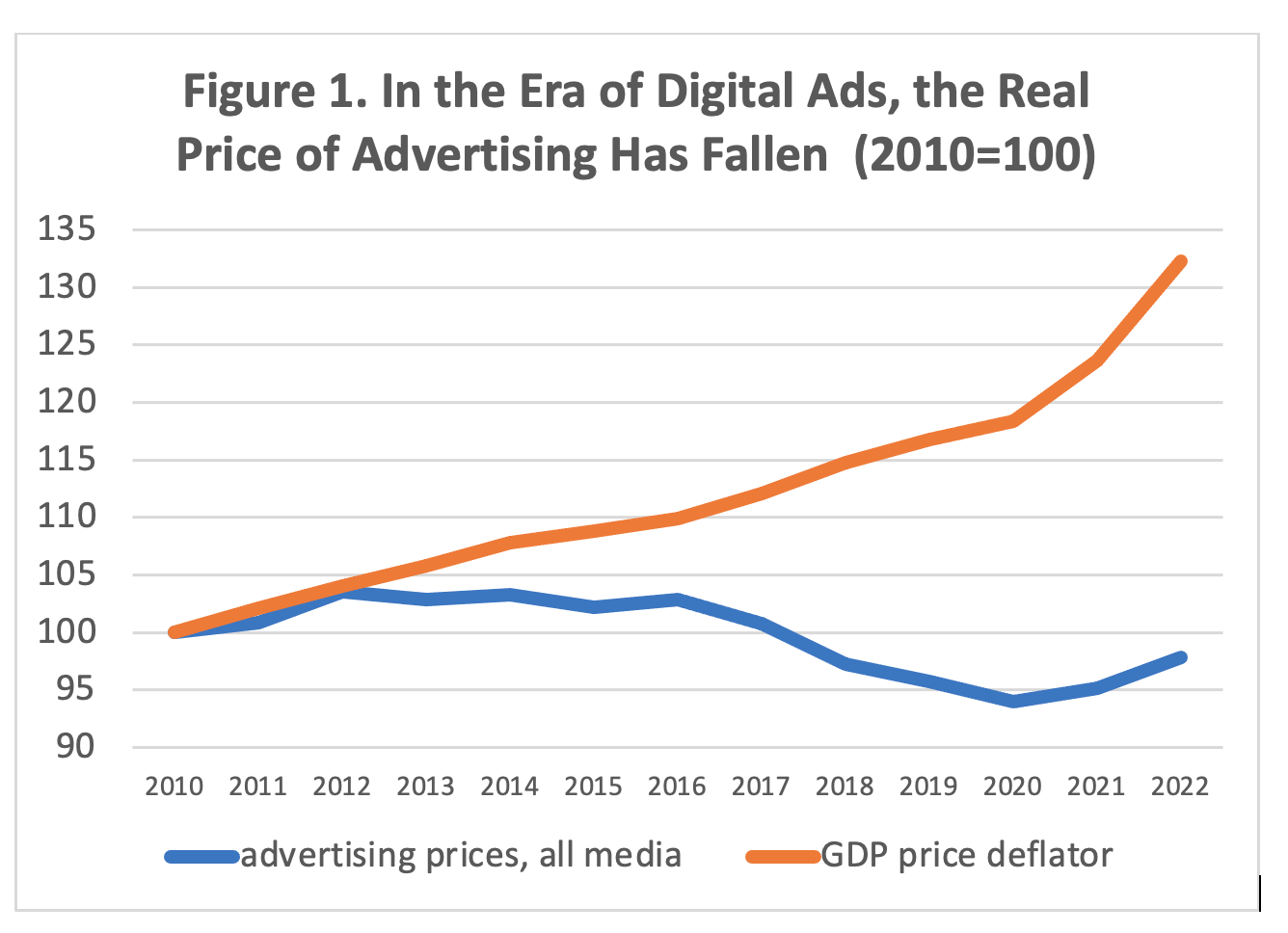
We now extend the analysis through 2022. Figure 1 compares the price of all advertising from 2010 to 2022 with the GDP price deflator over that period. We see that in this period of great expansion of digital advertising, the real price of advertising compared to other goods and services fell by 26%, as the nominal price of advertising fell by 2% while the GDP price deflator rose by 32%. Over the pandemic period 2019 to 2022, the overall price of advertising rose by 2%, while the GDP deflator rose by 13%, suggesting that the real price of advertising was still falling.

Table 1 looks at prices for individual components of advertising. We see that the price of Internet advertising sales, excluding Internet advertising sold by print publishers, fell by 27% from 2010 to 2022.  Meanwhile the price of television advertising, for example, only fell by 1%.

Our conclusion from this data is that the shift to digital advertising has generally been associated with a period of falling real prices for advertising, especially compared to the pre-digital period of rising real prices for newspaper advertising.

Two important caveats here. First, we do not know how well the BLS price indices reflect the full set of prices charged in the market.  Second, this analysis does not speak directly to the question of anti-competitive behavior in digital advertising. However, it does set the broader context.


Table 1.  Advertising Prices, 2010-2022
Percentage price change, 2010-2022
Internet advertising sales, excluding Internet advertising sold by print publishers -27.3%
Advertising space sales in newspapers -8.4%
Advertising space and time sales -2.2%
Radio advertising time sales -1.3%
Television advertising time sales -1.2%
Advertising space sales in periodicals 14.1%

Data: BLS


Ritz and Verral for The Hill: One year after the CHIPS Act, Congress is starving science

By Ben Ritz and Stephen Verral

Public investments in research and development (R&D) during the 20th century have powered many of America’s greatest advancements. However, federal funding for R&D has been declining over the past 50 years. Now, as Congress negotiates spending bills for the new fiscal year, investments in R&D are being further starved in an effort to reduce budget deficits. Although now is a time when the federal government should be unwinding the nation’s debts, cutting R&D funding is a shortsighted decision that will barely change the fiscal trajectory while hobbling America’s ability to innovate.

When Congress passed the bipartisan CHIPS and Science Act one year ago, it was supposed to herald a $200 billion increase in public R&D that reversed the long-term funding decline and prevented China from gaining a technological edge. But lawmakers failed to appropriate the funds needed to meet this target in Fiscal Year 2023 — and the outlook for 2024 is even worse.

Congress will return to Washington in September embroiled in a partisan standoff over spending. Extremists in the far-right Freedom Caucus are demanding massive spending cuts beyond those agreed upon in the debt ceiling negotiations earlier this summer. Included in the House GOP’s proposed appropriations bills are deep cuts to R&D investments in energy, agriculture, the environment, space exploration, and health and medicine. Only the defense sector will see an expansion of R&D funding.

Read more in The Hill.

Can the New Wave of AI Democratize Innovation?: The Case of Agriculture

The full title should be “How the New Wave of AI Can Speed Adoption of New Technologies, Boost Productivity, Create New Well-Paying Jobs, and Democratize Innovation: The Case of Agriculture.”

We’re working on a study of the applications of AI to agriculture. We’ve laid out the main points that we are covering in an attached slide deck.

Here is a summary of the deck:


  1. People are worried that generative artificial intelligence (gAI)–and large language models (LLMs) in particular–will destroy jobs.
  2. We propose that LLMs should be thought of as a General Purpose Adoption Technology (GPAT) with the ability to break down some of the barriers to innovation that have held back stagnant sectors such as agriculture and manufacturing.
  3. The key is that LLMs are democratizing: They will allow small and medium enterprises (SMEs) to experiment with, adopt, and maintain new technologies such as machine learning and robots with less need to depend on expensive third-parties such as systems integrators.
  4. To put it another way, today SMEs that want to digitize have to purchase scarce “complementary inputs” such as design, installation and maintenance expertise at a high price. LLMs lower the long-term cost of those complementary inputs, and make them more widely available
  5. The best analogy is the introduction of the personal computer. Previous to the PC, information technology applications were controlled by centralized IT staff. But the PC brought the IT revolution down to the level of SMEs and individual departments of large enterprises, and greatly accelerated the rate of adoption.
  6. Because GPATs reduce dependence on expensive intermediaries, the new adoption technologies will accelerate diffusion, boost productivity, lower prices, and raise incomes. Mounting evidence also suggests that faster productivity growth could also bring more job creation.
  7. Since 2007, sectors with faster productivity growth have added 2.2 million jobs, while sectors with slower or negative productivity growth have lost 1.2 million jobs.
  8. The new adoption  technologies will aid a wide range of lagging industries, including manufacturing, construction, and food production.
  9. In this study we will focus on agriculture, which  has suffered from the unhappy combination of weak productivity growth for the past 20 years and no employment growth. The result has been rising food prices, stagnant farm incomes, and weak rural incomes.
  10. We suggest that LLMs can accelerate the adoption of digital  innovations on the farm (see Google’s Mineral), while boosting productivity and incomes, creating jobs and reviving local rural economies.
  11. We are already seeing applications of LLMs to agriculture, as the Farmers Business Network shows. We conclude by suggesting that applying LLMs to farming may reduce regional disparities.

Building a Strong Digital Trade Agenda to Foster America’s Success in Digital Economy

A generation of technological innovation, infrastructure deployment, and generally good policy have combined to create a global digital world of 5.3 billion people. The Biden administration recently produced a report, “Declaration on the Future of the Internet,” outlining the vision of the future — one with free flows of information, high-quality consumer protection, economic growth, and liberty preserved.

Today, the Progressive Policy Institute (PPI) released a new report “Digital Trade 2023: The Declaration, The Debates, and the Next Global Economy,” detailing how the Biden administration’s vision is correct, but highly contested across the world. Report author Ed Gresser, Vice President and Director for Trade and Global Markets, provides recommendations on how the administration can achieve its vision and contribute to the next generation’s growth and digital liberty.

“A strong digital trade agenda is both a contributor to growth and American leadership, and a chance to shape the next-generation world economy in the spirit of liberty, inclusion, and American values,” said Ed Gresser.

The report makes the following policy recommendations:

  • An idealistic and ambitious approach in the 15-country “Indo-Pacific Economic Framework” (IPEF), that provides a future vision more attractive than authoritarian alternatives resting on free flows of data, opposition to forced localization of server and data, strong consumer protection, non-discriminatory regulation, anti-spam and anti-disinformation policies, cyber-security, and broad-based growth through encouragement for open electronic commerce.
  • A strong response in the U.S.-EU Trade and Technology Council (TTC) to European Union attempts to create discriminatory regulations and taxes targeting American technologies and firms.
  • Defense of U.S. values in the U.N., WTO, and other venues against “digital sovereignty” campaigns by China and others that endanger the internet’s multi-stakeholder governance, normalize large-scale censorship and firewalling, and generally place the political fears and policy goals of authoritarian governments above the liberties of individuals.
  • Supporting responsible governance of technology and politely but firmly pushing back on attempts either at home or internationally to demonize technological innovation and American success.


Read and download the report here:

The Progressive Policy Institute (PPI) is a catalyst for policy innovation and political reform based in Washington, D.C., with offices in Brussels, Berlin and the United Kingdom. Its mission is to create radically pragmatic ideas for moving America beyond ideological and partisan deadlock. Learn more about PPI by visiting progressivepolicy.org.

Follow the Progressive Policy Institute.

Find an expert at PPI.

###

Media Contact: Amelia Fox, afox@ppionline.org

The U.S. Must Act to Protect Transatlantic Data Flows

Despite its role in supporting a $7.1 trillion transatlantic digital economy, the legal mechanism which allows for U.S.-EU data flow continues to face a high level of scrutiny by the European Union. The result has been the excessive targeting of American companies which — in order to preserve the ability of American businesses to operate in European markets at all — must be swiftly addressed by the Biden Administration by carrying out the steps outlined in President Biden’s October 2022 Executive Order.

A decision by the European Data Protection Board this week creates a fresh sense of urgency for implementing a new U.S.-EU data flow agreement. Following an inquiry into American company Meta’s compliance with European data protection standards, the Board ordered Meta to cease data transfers between the U.S. and EU. It also levied a retroactive fine of 1.2 billion euros for the period in which data transfers were occurring under a legal mechanism that, until this decision, had been deemed valid by the EU.

The decision further complicates an already tricky legal landscape for companies that transfer data across the Atlantic. Prior to 2020, American businesses relied on the Privacy Shield agreement to legally transfer personal data compliant with EU law. But that year, the EU’s Court of Justice declared the Privacy Shield to be invalid. Among other concerns, the Court held that the agreement gave too much leeway to the U.S. government to access data while failing to provide European citizens with appropriate redress should they want their personal information erased. This decision left more than 5,300 companies, large and small, which relied on the agreement, to conduct transatlantic trade without a clear path to compliance with the EU’s data protection rules.

However, the 2020 decision did leave intact the ability for companies to use an alternative legal mechanism called Standard Contractual Clauses (SCCs) — pre-approved, standardized data protection clauses in compliance with the EU’s data privacy law, GDPR. Though the Biden administration wants to replace the Privacy Shield with an updated Data Privacy Framework, a deal negotiated with the European Commission in March 2022, SCCs have provided a legal means for businesses to continue data transfers in the meantime. Still, it is essential that the Framework be quickly implemented so that the United States can receive an adequacy decision from the EU, which would provide a broad legal basis for data transfers between the United States and the EU, rather than relying on a business-by-business basis.

That’s why this week’s Meta decision is so troubling. The European Data Protection Board determined that the SCC mechanism failed to address the risks to the fundamental rights and freedoms of data subjects identified by the Court of Justice in striking down the Privacy Shield. This creates a monumental risk for other American companies, thousands of which currently engage in data transfers supported by SCCs. Though Meta was the first to face investigation, this decision opens the door for a litany of ex-post fines for adhering to agreements that are currently recognized by the EU as valid.

Equally troubling is the potential impact on the European digital sector. The Court’s decision continues a pattern of layer after layer of new EU regulations that seem almost intentionally designed to discourage U.S. digital companies from investing and operating in Europe. But in the modern global economy, cross-border transfers of innovation and risk capital are essential for boosting productivity growth. From this perspective, systematic barriers to transatlantic data transfers will likely undercut tech innovation in Europe, with no evidence that the regulation of American companies has spurred growth of European tech firms.

Making matters worse is that this decision makes it unclear whether any company using SCCs is acting in compliance with GDPR, since the issues cited are a matter of the United States’ lack of data protection laws and concerns about the intelligence communities’ access to personal information. This means any company currently transferring personal data to and from the EU could be exposed to large ex-post fines.

There are immediate actions that could be taken by the Biden Administration to address this risk. In October, President Biden signed an Executive Order outlining steps the U.S. must take to implement U.S. commitments under the proposed European Union-U.S. Data Privacy Framework. Given this week’s decision by the European Data Protection Board and its severe implications for American companies, the Biden Administration must prioritize the implementation of the Framework. Without U.S.-EU data flows, we risk a fractured global market for digital services and the deterioration of U.S. companies’ ability to participate in transatlantic digital trade.


PPI Statement on Supreme Court Decision to Preserve Section 230

Malena Dailey, Technology Policy Analyst at the Progressive Policy Institute (PPI), released the following response in reaction to the U.S. Supreme Court’s rulings in Gonzalez v. Google and Twitter, Inc. v. Taamneh, leaving intact Section 230 of the Communications Decency Act, the legal framework through which websites are able to host third-party content.

“PPI has consistently argued any changes to the landmark Section 230 statute must consider the potential risks to American innovation and the digital ecosystem, including in an amicus brief filed in the case of Gonzalez v. Google.

“Since Section 230’s inception, the internet has been a platform for entrepreneurship, advocacy, and community, empowered by the ability for individuals to lift up their voices online. The preservation of Section 230 is a win for American innovation and the growing digital economy — all of which have spurred American job growth in the last several decades.

“There is a clear need for moderation of content users post on online platforms. While there may be room to update content liability to reflect the harms of the modern internet, any changes must keep in mind the integral role Section 230 plays in the development of an ever-growing digital ecosystem.”

The Progressive Policy Institute (PPI) is a catalyst for policy innovation and political reform based in Washington, D.C. Its mission is to create radically pragmatic ideas for moving America beyond ideological and partisan deadlock. Learn more about PPI by visiting progressivepolicy.org.

Follow the Progressive Policy Institute.

###

Media Contact: Amelia Fox – afox@ppionline.org

Understanding the Chip Export Controls

The development and production of leading-edge semiconductors is a difficult, expensive, and risky endeavor. Case in point: Intel, once the world’s top chipmaker, has fallen behind Taiwan-based TSMC and Korea-based Samsung in mass-producing the latest, most powerful generation of chips, used in applications such as artificial intelligence, autonomous vehicles, and high-end weapons systems.

Moreover, each new generation of chips requires comparable advances in related technologies like software for designing chips (primarily made by U.S.-based companies such as Cadence or Synopsys) and ultra-precise photolithography equipment from companies like Netherlands-based ASML and Japan-based Nikon that are essential to the chip-making process.

So far, there are no Chinese companies on the very short list of global businesses contributing key technologies to leading-edge advanced chips, which aren’t easy even for companies like Intel. However, Chinese manufacturing facilities have become key producers of “mainstream” or “legacy” chips, which are powerful but “not-the-latest-model” chips that run everything from appliances to tire sensors on cars.

Against the background of this complex global chip ecosystem, the United States is pursuing a clear policy: To “maintain as large of a lead as possible” over competitors in “key technologies,” in the words of President Biden’s National Security Advisor, Jake Sullivan. In particular, this goal reflects mounting concern in Washington about China’s long-term strategic threat, both military and economic. Notably, the ruling Chinese Communist Party is doubling down on a “military-civil fusion” research and development strategy that links civilian and military modernization and technology development. The immediacy of the threat can be argued, but not its nature.

The new policy has two parts and a difficult choice. The first part is to slow down the transfer of Western knowledge and capabilities to the Chinese semiconductor industry. This goes under the name “export controls,” but it really means a series of actions, described below, aiming at slowing down or stopping the conveyor belt that for the past two decades has swiftly and efficiently carried technology from the Western countries to the broad swathe of thriving Chinese factories, including those supplying the Chinese military.

The second part of the new policy must be aimed at maintaining and even accelerating advanced Western chip progress. The CHIPS Act is a start, but as noted earlier, the cutting-edge of semiconductor technology is a dangerous and expensive place to be. The U.S. is still the leader, but it can’t expect to go it alone. Other countries have unique knowledge and capabilities that must be appreciated and respected. For example, ASML is the only company in the world making extreme ultraviolet (EUV) lithography equipment, without which the most powerful chips would not be possible.

The difficult choice is how far to extend the new controls in practice. There is a general consensus (though in some cases grudging) that China should be denied the latest and greatest chip technologies. To that end, the Commerce Department’s Bureau of Industry and Security (BIS) is prohibiting the transfer of advanced semiconductor technologies to any Chinese company or fab that manufactures chips for supercomputers and other military applications is included. Moreover, American workers and companies that operate or service advanced chipmaking equipment in China henceforth will require a special waiver to continue their work. The new controls also require non-U.S. companies to comply with the new restrictions or risk being cut off from using American semiconductor technology. Indeed, the U.S. was able to convince the governments of the Netherlands and Japan, home to key suppliers, to ban the export of leading-edge technologies.

This policy, directed toward advanced chips, could well be successful in slowing China’s semiconductor progress. No matter how much China spends on semiconductor R&D, it may not be able to easily match the combined intellectual and scientific heft of the U.S., Europe, Japan, Taiwan, and Korea working together.

But the consensus begins to fray once the policy conversation turns to putting similar controls on mainstream or legacy chips. On the one hand, mainstream semiconductors are still very powerful in historical terms, and the technologies used to make them can be potentially adapted to produce more advanced chips. An argument can be made that to be truly effective, controls have to be both broad and tight. One example of potentially tight controls: The Commerce Department just proposed a set of “guardrails” that would prohibit recipients of CHIPS Act funds from expanding the capacity of their existing legacy manufacturing plants in China by more than 10% from today’s level. That would effectively put a permanent cap on U.S. production of legacy chips in China for export-oriented products.

On the other hand, these chips, used by the bucketful in all sorts of modern applications, are low-margin, and therefore a low-cost country like China logically has a comparative advantage. Moreover, automakers, aerospace companies, and other U.S. businesses benefit from the ability to import these chips at a low price, which then in turn benefits U.S. consumers.

How to escape this conundrum? The key is to look ahead toward the future. The technical bar for each new chip generation gets higher and higher, so the more hands the better when it comes to pushing the frontier forward. The Semiconductor Industry Association estimates that meeting future semiconductor needs will require $3 trillion in investments over the next decade for R&D, supply chain resiliency, and new fabs, both for advanced and mainstream chips. To put this in perspective, Intel’s total capital investment and R&D budget in 2022 came to $42 billion, suggesting what is needed is about 10 Intels.

On a global basis, that’s doable. What’s needed is a “coalition of growth” with no single country monopolizing the funding, expertise, blueprint, or supply chain for manufacturing semiconductors. This diffusion of technical know-how necessitates a balanced approach to address national security needs, safeguard semiconductor supply, and advance semiconductor technology and equipment, as the Department of Commerce and BIS are doing by soliciting public comment on the new restrictions.

The importance of semiconductors will only continue to rise in a digitized society. No one disputes the importance of semiconductors for national security. The United States cannot compromise on ensuring a secure global environment. However, the essential nature of chips will require a roadmap that integrates national security needs with chip advancement and innovation.


Focusing on the Correct Broadband Issues

The U.S. has undertaken a two-pronged effort to close the broadband digital divide. COVID-era legislation such as the Broadband Equity, Access, and Deployment (BEAD) Program is providing tens of billions to wire up unserved areas. And the Affordable Connectivity Program (ACP) provides a subsidy that effectively makes broadband free for as many as 50 million eligible households, based on an analysis of pre-pandemic data. The eligibility criteria are broad, encompassing any household with incomes at or below 200% of the federal poverty guidelines, or participation in any one of a long list of assistance programs, including Pell Grants and Medicaid.

With this sort of focused effort on providing affordable connectivity to everyone, what could go wrong? Some groups have alleged that the broadband industry is still discriminating against poor neighborhoods. Their core claim is that wealthier neighborhoods attract multiple broadband providers, and therefore the government should pay to build multiple networks in poor neighborhoods to create more competition.

For example, a recent study by the California Community Foundation and Digital Equity LA asserts that, within Los Angeles County, the price of high-speed internet is lower in higher-income areas, leaving poorer neighborhoods paying more for access. The claim is that wealthier neighborhoods reap the benefits of competition.

However, the study, while addressing an important issue, suffers from problems  almost too numerous to mention. First, the study is based on only 165 non-randomly chosen residential addresses in LA County, which has more than 3 million households. Second, any disparities in advertised pricing are irrelevant, since with the ACP funding, those most in need of financial assistance can get broadband at effectively zero monthly cost. Third, the preferred solution in the study — to “support independent, community-driven options for internet service” — sounds great until you realize how much money it would cost to lay an additional broadband network in Los Angeles. Indeed, operating a broadband network is an expensive and risky activity: Starry, an independent provider of broadband services in five cities, just filed for bankruptcy.

But the biggest issue with the study is that it is conceptually misguided. With funding in the pipeline for network expansion, and the ACP subsidies widely available, it’s become clear that getting people to sign up for “costless” internet is the major remaining problem to closing the broadband equity gap — the so-called adoption gap.

There’s plenty of evidence that much of the adoption gap is not tied to price. As we noted in our October 2022 blog post, the latest NTIA Internet Use Survey (collected in November 2021, before the ACP became active) showed that only 18% of households without internet access at home cited cost as a reason for being offline. In the NTIA survey, 58% of the offline households “express no interest or need to be online.”

How can the adoption gap be closed? First, building expensive new networks in areas that already have high-speed broadband, like Los Angeles County, is not the way to go. That money could be better spent on extending funding for the ACP.

Instead, we need programs to improve digital literacy and show, step-by-step, how to get online and utilize government and private resources. The Biden Administration has pointed to education efforts as being one of the main drivers of enrollment in ACP, with examples such as a text being sent out to 1.3 million likely eligible households in the state of Michigan resulting in 25,000 additional enrollments, or 1 million SNAP and TANF beneficiaries in Massachusetts being notified about the program resulting in enrollment doubling over just the next 5 days. This kind of effort is not new in LA County where in December 2021, the County launched an outreach campaign for ACP’s predecessor program which generated over 40,000 sign-ups in one month. More recently, numerous LA-based organizations, including the County itself, received modest grants from the FCC’s ACP Outreach Grant Program. Building on these investments and leveraging outreach via multiple organizations will help educate consumers on the benefits of broadband and drive adoption of service.  Continued education efforts are the key to maintaining this momentum.

But by themselves, such programs are not enough since adoption is driven by financial inclusion as well. Without a credit card or a bank account, it’s much harder to use online services such as e-commerce and ride-sharing. Indeed, it’s possible that the people who express no interest in being online are actually responding to these other obstacles. Data show that 4.5% of the U.S. population currently has no access to the financial system, and an additional 14% are “underbanked,” meaning they primarily rely on nonbank transactions. For these households, which include some of those most in need of financial assistance, this acts as an additional barrier to obtaining connectivity.

It’s true that high-speed internet is a sort of prerequisite to participate in today’s society, but if cost is not the barrier for consumers, as is the case with current subsidy programs, examining pricing diverts attention away from the real barriers. In order to fully close the digital divide, the question of internet adoption is what must be addressed by communities and policymakers.

How the Economics and Regulation of Mobile Platforms Affects Japan’s Digital Transformation and Cybersecurity

Section 1. Introduction

In 2018, the Ministry of Economy, Trade, and Industry (METI) published the “Digital Transformation (DX)” report, warning the Japanese economy would suffer from massively slower growth without increased investment in IT hardware and software. Moreover, Japanese companies were encouraged to place a greater emphasis on digital business models. A series of follow- up reports, notably DX Report 2.1, identified four different strategies companies can employ toward transforming to create a digital industry.

More recently, Prime Minister Fumio Kishida has described his vision of a Digital Garden City Nation, where investment in innovative digital technologies would help revitalize regional economies. This includes implementing digital services to solve rural issues.

An essential aspect of digital transformation and innovation is the heavy use of mobile platforms and apps to provide these digital services to users. Mobile apps are essential for the digital transformation of industries such as healthcare, manufacturing, agriculture, energy, and transportation. For example, the digital transformation of health care requires linking doctors, nurses, and other health care professionals wirelessly with patients and with electronic health records. Digital transformation of agriculture requires the use of precision wireless sensors and mobile apps to allow farmers to monitor conditions in the fields for optimal productivity. Digital transformation of manufacturing requires mobile apps that allow factory workers to monitor robots and sophisticated machinery.

How important are mobile apps and mobile platforms for digital transformation and innovation? By PPI’s analysis, roughly 25% of the help-wanted ads for tech workers in Japan mention the need for App Economy skills such as knowledge of the iOS or Android mobile operating systems. That suggests that Japanese employers see a strong need for workers who have the ability to develop and maintain mobile applications.

Indeed, the current mobile application ecosystems, built around the iOS and Android operating systems and the mobile app stores, can provide a good role model for overall digital transformations. These ecosystems have proven successful over the past 15 years in accelerating innovation and encouraging the development of new applications. First, the mobile application ecosystems provide low-cost distribution services for small- and medium-size app developers that they cannot provide themselves. Second, while the iOS and Android ecosystems take somewhat different approaches, the current mobile app stores devote large amounts of technological and human resources to screening out malware and enforcing security standards. The result is that users are willing to download and adopt innovative apps.

Given the effectiveness of the current system in encouraging innovation, this paper addresses the question of whether new regulations now being considered for mobile app stores have a negative impact on security and business activities, with the potential to delay or hinder the digital transformation of the Japanese economy. The problem is that regulators may accidentally undermine the very features of the app stores that make them so effective at encouraging innovation. In particular, regulations that mandate sideloading make it more difficult for the existing app stores to screen for malware and other security issues can lead users to be less trusting of innovative new applications that might control their homes, their cars, their medical devices, and their factories.

Already, Japanese government websites have come under attack by Russian hackers. National security considerations suggest that the security of the mobile application ecosystem should be a high priority for regulators. Less effective screening of new apps, if mandated by government regulators, will also make the digital transformation of the Japanese government more difficult.

In section 2, “The App Store Ecosystem and Digital Transformation (DX),” we show how app innovation is essential to Japan’s digital transformation (DX). In particular, mobile apps are essential for allowing users to interact with enterprise-level IT systems.

In section 3, “Quantifying the Economic Importance of the App Store Ecosystem for Digital Transformation and Innovation,” we estimate the contribution of the app store ecosystem to digital transformation. As noted earlier we find that roughly 25% of tech job postings in Japan require app economy skills. Our methodology is described in the Appendix to the paper.

In section 4, “The Economic Link Between Innovation and a Secure App Store Ecosystem,” we show that developers and consumers both benefit from a secure app store ecosystem. The ability of users to download new apps in safety has fostered innovation, and the expansion of app markets, which in turn had fed back to more innovation.

In section 5, “Allowing Sideloading and Other New App Store Regulations May Hinder Digital Transformation,” we show how new app store regulations can reduce security
and hurt developers and users. The result, from an economic perspective, will be to hinder the process of digital transformation.

In section 6, “Why the European model of tech regulation doesn’t work in Japan,” we discuss the European model of tech regulation, and show how it has led to slower productivity growth and less innovation. This has important implications for Japan, which has been considering an even stricter version of the European approach.


Read the full report in English and Japanese