Ritz for Forbes, “Victorious Democrats Should Thank Young Voters By Funding America’s Future”

On Tuesday, Democrats won control of the U.S. House of Representatives and state legislatures across the country thanks to record-breaking turnout among young voters. Now it is time for newly elected Democrats to stand up for the interests of their constituents by supporting an economic agenda that funds America’s future.

The reckless policies of the current administration, and many of its predecessors, have slashed critical public investments that most benefit young Americans while simultaneously burying them and future generations under a mountain of debt. In a recent report, the Progressive Policy Institute documents these trends and explores how these reckless policies could drain America’s economic strength and seriously harm young Americans for decades if no action is taken to change course.

Continue reading at Forbes.

Kim for Governing, “How ‘Opportunity Zones’ Could Transform Communities”

The new federal program could lure fresh investment to distressed areas. But the clock is ticking.

Twenty years ago, the rural hamlet of South Boston, Va., was a thriving blue-collar, middle-class community. Most of its residents were employed in manufacturing, such as at the nearby Burlington Industries textile plant and Russell Stover candy factory, or out in the tobacco fields.

Today, the once vast tobacco industry is largely derelict (China is now the world’s leading producer), and the Burlington plant and Russell Stover factory are closed. “We lost about $100 million in payroll out of this community over four years,” says South Boston Town Manager Tom Raab.

This is a familiar story for the nation’s rural areas, but Raab is optimistic about a turnaround. He is pinning his hopes, in part, on the new “opportunity zones” program passed in last December’s federal tax overhaul. It could generate billions in economic development for distressed communities like South Boston — provided they get the help they need.

Opportunity zones represent a breakthrough approach to community development. The program relies on an ingenious mechanism for spurring investment: Instead of tax credits or other traditional subsidies, investors are offered a temporary tax deferral for capital gains reinvested in designated opportunity zones. For investments held longer than 10 years, that deferral becomes forgiveness — a huge boon.

Continue reading at Governing.

Ben Ritz Discusses New PPI Report on Two Radio Interviews

Director of PPI’s Center for Funding America’s Future, Ben Ritz, participated in two radio interviews this week to discuss his new report, Defunding America’s Future: The Squeeze on Public Investment in the United States. The report explains how short-sighted fiscal policy is undermining critical investments in education, infrastructure and scientific research that are integral to the long-term health of our economy. Read the full report here.

The first interview was on Facing the Future with host Chase Hagaman, which airs on New Hampshire’s WKXL radio station. Listen to the WKXL interview here.

The second interview was on Reality Check with host Charles Ellison, which airs on Philadelphia’s WURD radio station. Listen to the WURD interview here.

Weinstein for RealClearPolicy, “Time to Get DC’s Finances Under Control”

Once upon a time in Washington, D.C., a compulsive liar was in charge of the local government, the city’s legislature was beyond dysfunctional, and the District had debt as far as the eye could see. Today, a similar situation has returned to Washington, but this time it is the federal government, not the D.C. government, that has lost control over its ability to manage its finances.

In 1995, a Republican-led Congress worked with President Bill Clinton to get the District back on track. They created the District of Columbia Financial Responsibility and Management Assistance Authority — better known as the “Control Board.” The Board arguably saved D.C. from an economic collapse. Could a control board for the federal government do the same for America?

The D.C. Control Board was based on a model that had been successfully used elsewhere to help a number of jurisdictions facing fiscal and economic crisis. In 1978, after Cleveland became the first major city since the Great Depression to default on short-term notes, the Ohio legislature lent to the city to avert bankruptcy and created a state-run system for monitoring local government finances. In 1991, Pennsylvania helped Philadelphia overcome its budget crisis through the Pennsylvania Intergovernmental Cooperation Authority, which exists to this day and has the power to review and approve the city’s five-year financial plans.

Continue reading at RealClearPolicy.

Republicans Double Down on Deepening Deficits

It’s official: House Republicans are campaigning on a pledge to increase the federal budget deficit. It was just 10 months ago that they enacted a package of ostensibly temporary tax cuts that is projected to increase deficits by roughly $2 trillion over the next decade. This week, they offered a series of proposals dubbed “Tax Reform 2.0” to expand upon and make permanent the first tax cut’s expiring provisions. Although the package is unlikely to become law in this Congress, this legislation sends a clear message to voters about the GOP’s main objective if they retain control after the midterm elections: more deficit-financed tax cuts.

The Joint Committee on Taxation estimates that the new tax cut package will add another $657 billion to budget deficits between 2019-2028. This score, however, understates the true cost of the legislation because of the time period analyzed. The original tax cuts are largely in place through 2025, so most of the new package’s costs don’t begin to materialize until 2026. The upshot is that although the $657 billion is technically a 10-year cost estimate, 96 percent of that cost is concentrated in just the last three years.

What would the true cost of “Tax Reform 2.0” be? The Tax Policy Center estimates it could cost nearly $4 trillion over the next 20 years – and that’s on top of the $2 trillion cost of the original tax-cut law. Over half of these additional tax cuts would go to benefit the richest tenth of Americans. The tax cut isn’t just larger for wealthy Americans in dollars – they would also see their after-tax incomes rise by over two percent, while Americans in the bottom half of the income distribution would only see their incomes rise by less than one percent.

And how does the GOP plan to pay for the enormous costs of their regressive tax proposals? They don’t. It was recently reported that when former National Economic Council Director Gary Cohn asked President Trump how he would finance the administration’s budget deficits, Trump proposed to just run the presses — print money.” Congressional Republicans haven’t offered a serious alternative.

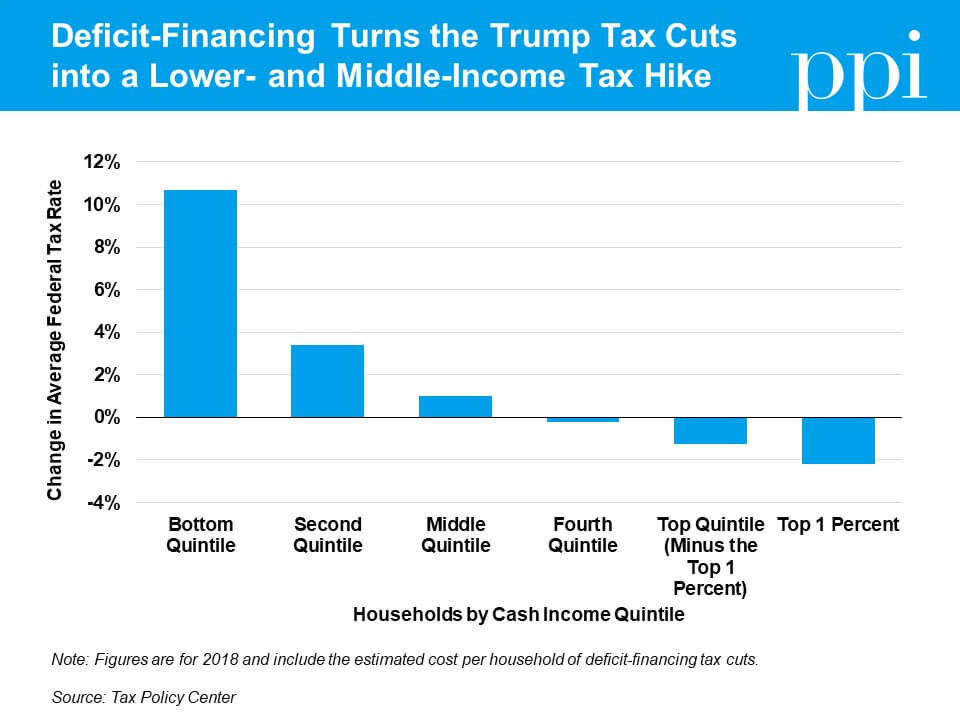
As PPI noted earlier this year, a deficit-financed tax cut is really no tax cut at all. Households that received a tax cut of less than $1,610 in 2018 are likely to lose more in the long-run than they will gain from those tax cuts, including most lower- and middle-income households. Perhaps it should be no surprise that these tax cuts are incredibly unpopular among non-Republicans.

When Republicans won their House majority in 2010, they campaigned against deficits and the implicit tax it imposes on future generations. Eight years later, as those same Republicans prepare to lose their majority, they’ve cravenly embraced the very things they were supposedly elected to oppose.

Alisha Gurani contributed to this post.


Kim for Governing, “When Cities Rely on Fines and Fees, Everybody Loses”

They’re a tempting alternative to raising taxes, but their long-term costs far outweigh the revenue they bring in.

Raising taxes is painful. That may be why, since 2010, 47 states and a number of cities have instead raised both civil and criminal fines and fees. These increases are often viewed as a conflict-free way to plug budget holes.

In the last decade, for example, New York City grew its revenues from fines by 35 percent, raking in $993 million in fiscal 2016 alone. The monies came largely from parking and red light camera violations, as well as stricter enforcement of “quality of life” offenses such as littering and noise. In California, routine traffic tickets now carry a multiplicity of revenue-boosting “surcharges.” As a result, the true price of a $100 traffic ticket is more like $490 — and up to $815 with late fees, according to the Lawyers’ Committee for Civil Rights of the San Francisco Bay Area.

This increasing reliance on fines and fees comes despite what we learned following the shooting in 2014 of Michael Brown by a police officer in Ferguson, Mo. A federal investigation of the city’s police department subsequently revealed that as much as a quarter of the city’s budget was derived from fines and fees. Police officers, under pressure to “produce” revenue, extracted millions of dollars in penalties from lower-income and African-American residents. In 2017, the U.S. Commission on Civil Rights issued a follow-up report finding that the “targeting” of low-income and minority communities for fines and fees is far from unique to Ferguson.

Continue reading at Governing.

CBO Report Shows That We Really Can’t Afford All These Tax Cuts

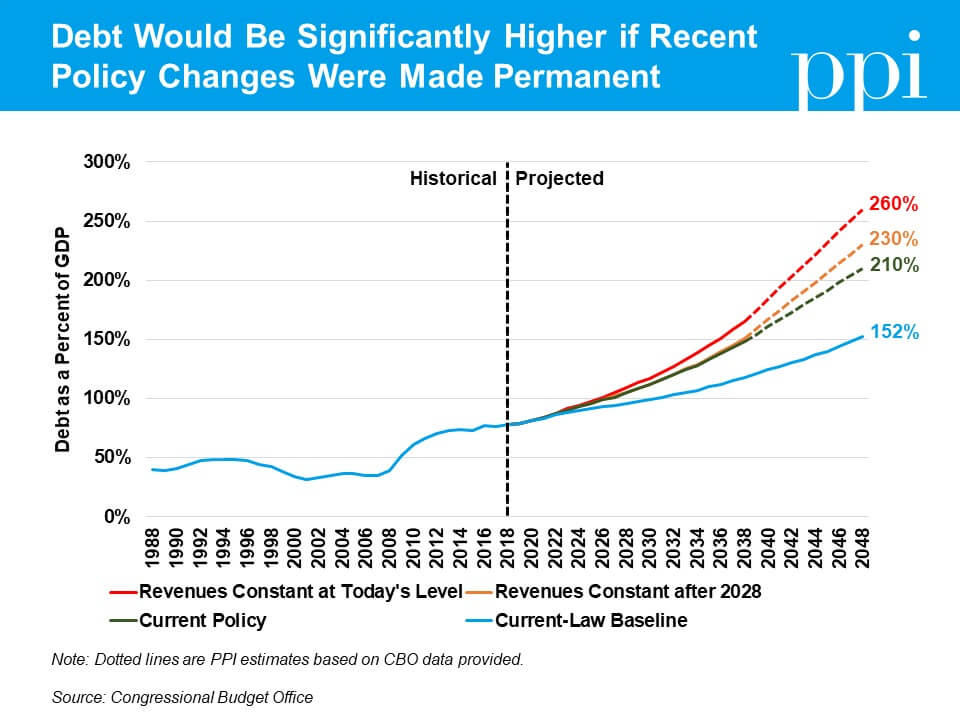
When the non-partisan Congressional Budget Office published its Long-term Budget Outlook in June, it estimated that the national debt relative to the size of the economy would nearly double over the next 30 years – from 78 percent of gross domestic product today to 152 percent of GDP in 2048. Yesterday, a new report from CBO warned that legislation passed within the past year by Donald Trump and the Republican-controlled Congress has the potential to make the problem far worse.

When Washington Republicans enacted a nearly $2 trillion tax cut last year, they included arbitrary expiration dates that minimized the projected cost after 2025. Congress took a similar approach in February, when it passed a bipartisan budget agreement that increased spending by almost $300 billion over just two years. Because CBO is required to make budget projections based on the laws as they are written (the “current-law baseline”), neither of these ostensibly temporary policies had a material impact on the long-term budget picture.

But what if policymakers extended or made these changes permanent? CBO’s models show debt would hit 210 percent of GDP by 2048 under this scenario – 58 percentage points higher than the baseline projection and nearly triple today’s level. CBO also scored two other scenarios: one in which policymakers prevent tax revenue from rising as a percent of GDP after 2028 and one in which policymakers keep taxes at 2018 levels in perpetuity. In these scenarios, CBO projects debt would rise to 230 percent and 260 percent of GDP respectively. However, these projections come with an important caveat. The report states:

“Assessing the economic effects of such large and rising debt would probably require reevaluating the economic relationships in CBO’s current models. In particular, in CBO’s models, the responses of private saving, capital inflows, and interest rates to fiscal policy are based on the nation’s historical experience with federal borrowing. But in these alternative scenarios, debt as a percentage of GDP grows to levels well outside that experience.

Nevertheless, to provide some sense of the possible outcomes, CBO employed its usual models to produce longer-term projections of deficits and debt under the three scenarios—but the actual outcomes would probably be worse than the range of estimates that those models indicate.”

Essentially, these policy scenarios would drive the national debt to unprecedented levels so high that CBO can’t be confident in the precision of its models at that point. These estimates, grim as they are, are thus likely to be overly optimistic.

Yet even under those “optimistic” projections, CBO estimates that the added debt burden from each of the measured scenarios would significantly hurt our economy. By 2038, CBO projects annual national income would be reduced by upwards of $1,000 per person relative to what it would be under current law – and the damage would only get worse as time goes on.

Despite the harm it would cause, Washington Republicans appear committed to pursuing even more unaffordable tax cuts if they retain control of Congress after the midterm elections. House Ways and Means Chairman Kevin Brady (R-TX) has been preparing a “Tax Cuts 2.0” package that would make permanent most expiring provisions of the 2017 tax law. At the direction of President Trump, the Treasury Department also recently explored a move to unilaterally cut capital gains taxes by $100 billion, with 97 percent of the benefit going to the richest tenth of Americans.

Yesterday’s CBO report should be a warning to both them and the American people that we cannot afford to keep piling these irresponsible tax cuts onto our large-and-growing national debt. If Republicans insist on continuing down this reckless fiscal path, Democrats should hold them accountable and offer an alternative approach that pairs responsible fiscal policy with public investments to promote long-term economic growth.  

The Premiums Are Too Damn High

Americans who buy health insurance on the exchanges set up by the Affordable Care Act (ACA) are having sticker shock as preliminary rates are filed for the 2019 plan year. Healthcare analysts expect insurance premiums to skyrocket during the next open enrollment period, which inconveniently begins just before the 2018 midterm elections. These higher premiums will be the direct result of changes in the ACA pushed through Congress by the

Trump administration and Republicans – changes explicitly intended to sabotage the ACA (“Obamacare”) by destabilizing healthcare markets. A bipartisan solution, reinsurance, is needed to undo the damage inflicted on the individual market.

Bledsoe & Ritz for The Hill, “Democrats must bridge the generational divide to prevent climate and budget crises”

Amid the daily drama of President Trump’s tweets and scandals, it can be hard to focus on the most important issues for our future. An unfortunate consequence of this purposeful turmoil is that few serious solutions are being offered for addressing two of the greatest threats facing the United States: runaway climate change and unsustainable budget policies.

The resignation of EPA Administrator Scott Pruitt may end his days of plundering the environment and public treasury, but the Trump administration will continue doing both even in his absence, risking long-term national well-being for temporary political benefits. It’s critical that Democrats offer credible alternatives, especially if they hope to inspire younger voters who will bear the burden of these problems, because we cannot afford to dither on either issue much longer.

We speak from experience. One of us is a baby boomer who has spent most of his career working on energy and climate policy; the other is a millennial focused on the federal budget. Although our two fields may seem unrelated, both these existential challenges require our generations to work together to solve.

Continue reading at The Hill.

New Projections Make Clear We Can’t Afford the Trump Agenda

Yesterday, the non-partisan Congressional Budget Office published their first long-term budget outlook since the passage of last year’s tax cuts and February’s spending increases. In contrast to April’s budget and economic outlook, which made budget projections only for the next decade, the long-term budget outlook offers budget projections over the next 30 years – and it shows a significantly worse picture. The projections should dissuade policymakers who want to extend or double down on the unaffordable policies enacted by the Trump administration and Congress over the past year.

Over the next 30 years, CBO projects the that our national debt relative to the size of the economy will nearly double – from 78 percent of gross domestic product today to 152 percent of GDP in 2048. This would be well over the all-time high reached at the end of World War II, when our national debt topped out at 106 percent of GDP.

But there’s a big difference between our fiscal situations in 1946 and today. Back then, our debt was the result of temporary borrowing to respond to a national emergency. After the war ended, the federal government ran balanced or near-balanced budgets almost every year for the next three decades. That, combined with a post-war boom in economic growth, resulted in the national debt plummeting to just 23 percent of GDP in 1974. Our current and future debts, however, are caused not by temporary borrowing but by a structural mismatch between revenue and spending that will only grow worse as time goes on. And with potential economic growth projected to be just half of what it was in the aftermath of WW2, this structural mismatch is one that will be virtually impossible to grow our way out of.

The main problem is the unsustainable growth of social insurance programs that provide health care and retirement benefits. As our population ages, CBO projects that annual spending on these programs will increase by 5.4 percent of GDP over the next 30 years – four fifths of which is attributable to growth in just two programs: Social Security and Medicare. Because federal revenue will grow more slowly than spending on these programs, the government must borrow more and more money each year to help finance them – and that comes with a higher cost of debt service.

In 2018, the federal government will spend about $316 billion on interest payments (equivalent to 1.6 percent of GDP). By 2048, CBO projects that interest on the debt would consume 6.3 percent of GDP under current law – nearly five times today’s levels. In contrast, CBO projects that discretionary spending (the portion of the federal budget appropriated annually by Congress) will shrink from 6.3 percent of GDP in 2018 to 5.5 percent of GDP in 2048, which means that interest on the debt will eventually cost more than all discretionary spending combined.

To put these figures in perspective, discretionary spending – which is divided evenly between defense and non-defense programs – has never fallen below 6 percent of GDP since the end of WW2. CBO warns that could change as soon as 2021. The crowding out of discretionary spending has significant ramifications for our ability to invest in the future, as discretionary spending funds critical public investments such as education, infrastructure, and scientific research. These investments help to spur innovation and productivity which are essential to long-term economic growth and future prosperity. Meanwhile, CBO estimates that allowing our irresponsible fiscal policy to continue could reduce the size of our economy by $2500 per person come 2048.

As concerning as these projections are, they could be even worse if the policies enacted over the past year are allowed to remain in place. In December, Washington Republicans rammed through a package of tax cuts that will cost almost $2 trillion before much of them are scheduled to expire by the end of the next decade. A bipartisan budget deal just two months later then paved the way for nearly $300 billion in additional spending over the next two years, but these elevated spending levels are assumed by CBO to expire after 2019. Although these laws will result in debt levels that are significantly higher in the near term, neither has a substantial impact on the long-term budget outlook after 2041 because most of their policies won’t be in effect for over the latter two thirds of the projection period.

But extending current policies – or making them permanent – would dramatically worsen our fiscal situation. The Committee for a Responsible Federal Budget estimates that doing so would result in the national debt surpassing its post-WW2 record by 2029 (echoing PPI’s estimates from earlier this year). And by 2048, CRFB projects the national debt would be almost double the size of the economy. Simply put, we cannot afford to maintain the policies put in place during the first year of the Trump administration, let alone double down on them as many Congressional Republicans have proposed.

Instead, policymakers need to heed CBO’s warning and reverse course immediately. If they permanently increase revenue by 11 percent, cut spending by 10 percent, or adopt some combination of the two beginning in 2019, policymakers could stabilize our debt at current levels for the foreseeable future. If they wait another 10 years to act, however, the size of the policy changes needed to stabilize the debt at today’s levels would increase by half. That translates into an additional cost of over $600 (in 2019 dollars) per person per year. With unemployment at historically low levels, there is little justification for continuing to rack up massive debts today at the expense of taxpayers tomorrow.

Ritz for NY Daily News, “How Trump and Republicans are damning Social Security and Medicare”

When the Social Security and Medicare trustees warned last week that both programs are on tenuous financial footing, Treasury Secretary Steve Mnuchin said: “The administration’s economic agenda — tax cuts, regulatory reform and improved trade agreements — will generate the long-term growth needed to help secure these programs and lead them to a more stable path.” He couldn’t be more wrong.

As more and more baby boomers retire, Social Security and Medicare will require additional revenue just to fund the same level of benefits enjoyed by previous generations. Yet instead of raising more revenue to help fund these programs, the Trump administration and Congressional Republicans recklessly pursued a package of tax cuts that the non-partisan Congressional Budget Office projects will reduce revenue by $2 trillion over the next decade. This law put Social Security and Medicare on a decidedly less stable path.

Continue reading at the New York Daily News.

Before Expanding Medicare, We Have to Pay for Current Beneficiaries

It’s no secret that the American health care system is far from perfect. The United States spends a higher percentage of our gross domestic product on health care than any other country despite having comparable outcomes. And although the Affordable Care Act successfully reduced the percentage of uninsured Americans by almost half between 2010 and 2016, 8.8 percent still had no coverage according to the most recent Census estimate – one of the highest rates of any OECD country. Moreover, Republican sabotage of the ACA has threatened to dramatically increase costs and reverse much of these coverage gains.

Many Democrats have embraced “Medicare for All” as their preferred mechanism for addressing these problems. Medicare is already one of the largest health insurers in the United States, covering about one sixth of the population, including most Americans over the age of 65, as well as a select few other groups, such as individuals with disabilities. Expanding Medicare to cover the rest of the population has a natural appeal given the program’s overwhelming popularity with both beneficiaries and the general public. But this week’s report from the program’s trustees warns of serious financial challenges that threaten Medicare’s ability to meet its obligations to current beneficiaries. The program cannot be expanded unless these problems are resolved and benefits can be sustainably financed.

Medicare consists of two financing mechanisms: Hospital Insurance (HI) and Supplemental Medical Insurance (SMI) trust funds. The HI trust fund pays for Medicare Part A, which covers hospital services, nursing facilities, home health assistance, and hospice care. HI is primarily funded by premiums and a payroll tax of 1.45 percent paid by both workers and their employers (or 2.9 percent in the case of self-employed workers who are required to pay both taxes). In years when these revenue sources exceed spending, the Treasury Department credits the HI trust fund for the balance. In subsequent years when spending exceeds revenue, Medicare can then draw upon these surpluses to make up the shortfall.

Although HI used to have regular annual budget surpluses up until 2004, it is now running chronic cash deficits. The trustees report projects that the trust fund will be exhausted by 2026, at which point Medicare would only have enough revenue to meet 91 percent of its Part A obligations. The HI trust fund’s exhaustion date is typically the metric most commonly cited in the media when discussing Medicare’s financial health, but in reality it’s only the tip of the iceberg: the challenges facing HI pale in comparison to those facing SMI.

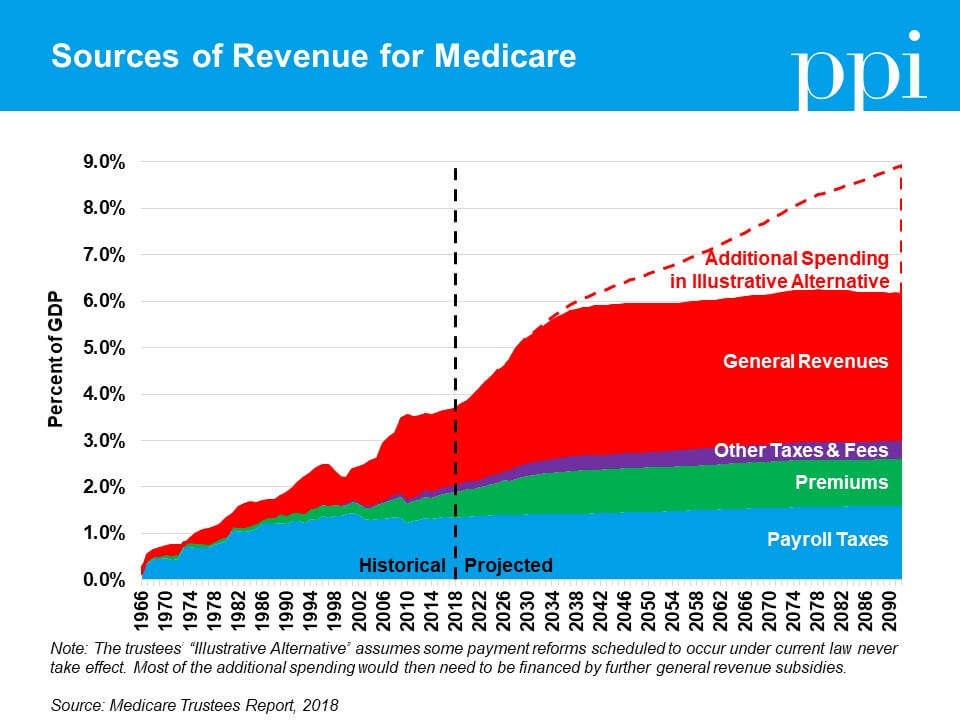
Unlike HI, SMI – which covers both Medicare Part B (outpatient services and medical equipment) and Part D (prescription drugs) – only receives about one quarter of its revenues from dedicated sources. The remainder is automatically funded by general revenues, which ensures that SMI can never become insolvent but also obscures the true cost to both voters and policymakers. This structure is particularly problematic because Medicare is the fastest growing program in the federal budget: as the total size of SMI grows, it threatens to crowd out other public priorities that compete for the same pool of resources even if the proportion of the program funded by general revenues remains the same.

When taken together, Medicare’s dedicated revenue sources only cover about half of its spending. In that context, it makes sense that many voters would feel they get a better deal out of Medicare than other forms of insurance – they’re only seeing half the cost. Additionally, there are far more workers paying taxes into Medicare than there are beneficiaries. The Medicare model works for providing subsidized care to targeted subsets of the population, but if it were extended to cover the whole population, suddenly there would be fewer taxpayers than beneficiaries and no way to defray the cost.

One alternative that several moderate Democrats have suggested is to offer consumers an option to buy into Medicare voluntarily instead of automatically enrolling the entire population. This “public option” approach would preserve the private health insurance market but allow a public plan to compete. If the public plan is able to deliver more efficient health services or achieve lower prices through the use of Medicare’s rate-setting system, it could eventually grow to dominate the market through consumer choice and develop into a de facto single-payer system.

Before policymakers go this route, however, they need to ensure that any public option is self-financed through premiums (as many of the current proposals recommend). To the extent coverage is subsidized by the government, it must be limited to the same subsidies consumers receive from programs such as those in the Affordable Care Act to purchase private insurance. Should the public option be subsidized by general revenues the same way as SMI, it would become increasingly unsustainable as market share grows – an outcome would be bad for taxpayers and beneficiaries alike.

Trustees Reports Highlight Challenges Facing Medicare and Social Security

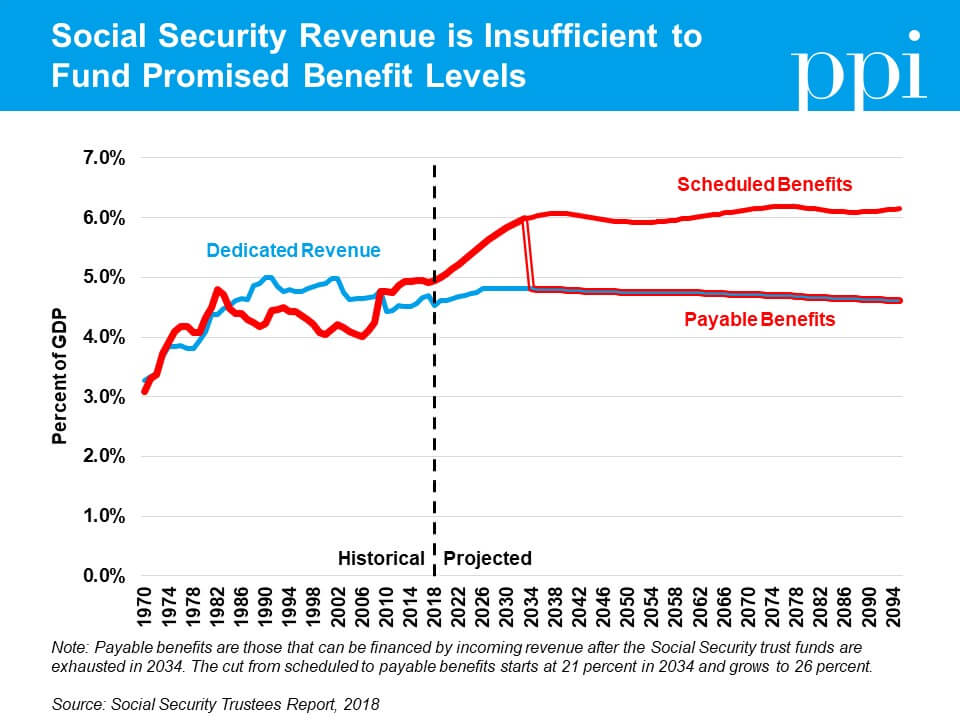
The new reports released yesterday by the trustees for Social Security and Medicare warn that both programs face a growing gap between scheduled benefits and the dedicated revenue sources that finance them. If nothing is done to address the shortfalls in these programs, they will pose a grave threat to both the beneficiaries who depend on Social Security and Medicare and the other critical public investments that will increasingly have to compete with these programs for limited resources.

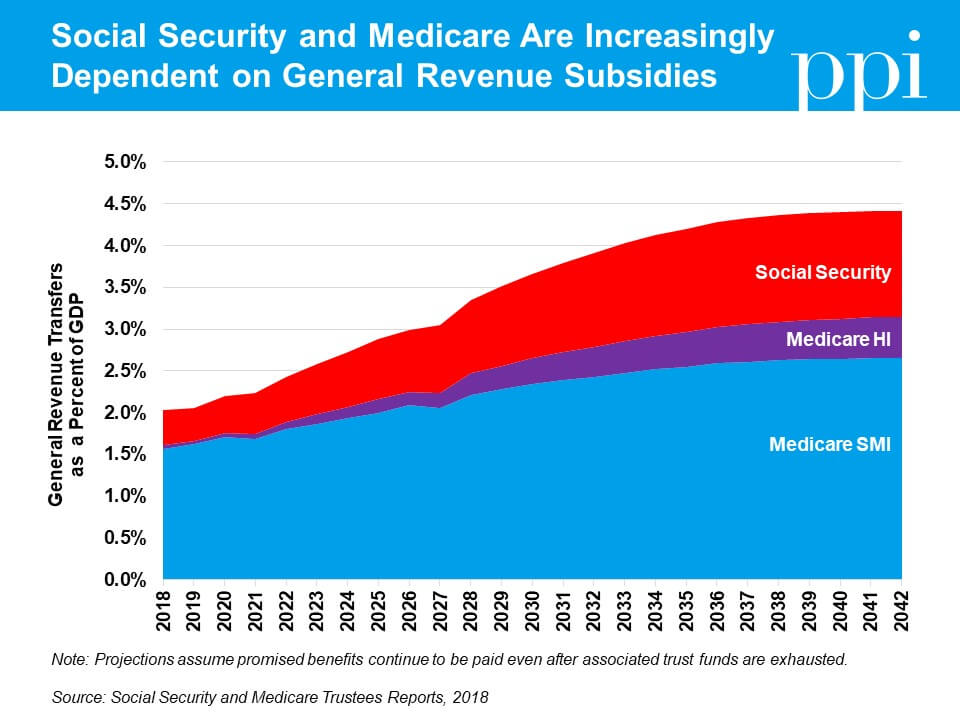
Unlike most programs in the federal budget, which are funded from the same pool of general revenues, Social Security and Medicare were designed with dedicated revenue sources intended to finance their benefits (primarily payroll taxes for Social Security and a combination of taxes, premiums, and fees for Medicare). But in 2017, Medicare required $307 billion in general revenue funding to meet its obligations, while Social Security required another $41 billion – a combined gap which equaled roughly two percent of gross domestic product.

In less than 20 years, that gap will double to more than four percent of GDP as the baby boomers move into retirement and the ratio of workers to beneficiaries falls. This growth places an enormous burden on the rest of the federal budget by increasing existing deficits and creating competition with all the other federal programs, from defense to education, that require general revenue funding. For comparison, discretionary spending – the part of the budget that includes all federal spending appropriated annually by Congress, including everything from the military to infrastructure funding – totaled just 6.3 percent of GDP in 2017 and is set to fall in future years.

Under current law, Social Security and Medicare are allowed to spend more than they collect in dedicated revenue, but only up to a point. In years when dedicated revenue exceeds spending, the Treasury Department credits one of four trust funds for the balance: the Old Age and Survivors Insurance (OASI) and Disability Insurance (DI) trust funds for Social Security, and the Hospital Insurance (HI) and Supplemental Medical Insurance (SMI) trust funds for Medicare. In subsequent years when spending exceeds revenue, Social Security and Medicare can then use transfers from general revenue to draw upon these established surpluses and make up their annual shortfall.

Once the fund balances are exhausted, however, benefits are automatically reduced to what is payable with incoming revenue (except for SMI, which by design is partially funded with general revenues and can never be exhausted). The trustees projected the following trust fund exhaustions in their reports:

  • HI will be exhausted in 2026, at which point benefits would be reduced by 9 percent;
  • DI will be exhausted in 2032, at which point benefits would be reduced by 4 percent;
  • OASI will be exhausted in 2034, at which point benefits would be reduced by 23 percent; and
  • If OASI and DI were combined, they would be exhausted in 2034, at which point benefits would be reduced by 21 percent – a cut that would gradually increase to 26 percent as the gap between revenues and scheduled benefits continues to grow.

Waiting until the last minute to address these shortfalls would be catastrophic for a number of reasons. First, it creates the prospect of sudden and draconian benefit cuts for seniors and individuals with disabilities. Uncertainty about the future of Social Security and Medicare undermines the ability of all Americans to plan for their retirement accordingly and risks jeopardizing public support for the program. In fact, recent polls have found a majority of Americans both young and old already lack confidence in the ability of Social Security and Medicare to pay future benefits as scheduled. Restoring long-term solvency to these programs would help restore public confidence in them as well.

The alternative to sudden benefit cuts, that future workers will be asked to bear the entire cost of poor decisions made by previous generations, is hardly better. The Social Security trustees note in their report that if action were delayed until 2034, policymakers would need to immediately and permanently increase revenue by an amount equal to a one-third increase in the payroll tax rate to prevent sudden benefit cuts in Social Security alone. Combined with the even-larger tax increases necessary to fully fund Medicare, this would be an enormous tax burden to place entirely on the shoulders of tomorrow’s workers. The longer policymakers wait to begin phasing in changes, the harder it will be to have older generations contribute to the solution and defray the burden.

Finally, the competition for limited resources created by growing general revenue subsidies threatens to crowd out other important progressive priorities. General revenue is already insufficient to cover current spending levels – a reality that pre-dated last year’s tax legislation. Because the trust funds aren’t invested as external savings, the government must borrow from private investors to repay the trust fund surpluses as they’re drawn down (replacing this intragovernmental debt with more economically significant debt held by the public). This debt comes with added interest costs, further increasing the pressure on the federal budget.

In the coming years before trust fund exhaustion, funding that could be used for public investments in our future such as infrastructure, education, and scientific research will be increasingly consumed by growing subsidies for social insurance programs and interest costs. Even worse would be a scenario in which policymakers use the existence of the trust funds as an excuse to delay action on correcting the imbalances between dedicated revenues and spending, only to abandon the system and provide unlimited infusions of general revenues when the trust funds’ exhaustion would otherwise force hard choices.

We can do better. Our elected officials should table costly policy proposals that threaten to make the problem worse and instead work towards phasing in pragmatic reforms to strengthen and secure the future of these important programs.

Social Security & Medicare Trustees Reports: A Reality Check for Expansion Advocates & Tax Cutters Alike

WASHINGTON — Ben Ritz, director of the Center for Funding America’s Future at the Progressive Policy Institute (PPI), today released the following statement after the annual Social Security and Medicare Trustees reports were released:

“The annual reports from the Social Security and Medicare trustees should serve as a reality check for politicians who support costly expansions of these programs. As they have consistently done for several years, the trustees again warn that current program revenues are insufficient to sustainably finance promised benefits – an imbalance that must be addressed by policymakers before considering changes that could make the problem even worse and crowd out resources needed for other important public investments.

“Last year, Social Security spent $41 billion more on benefits than it collected in dedicated revenue. Over the next 25 years, the gap between dedicated revenue and promised benefits will grow to 1.26 percent of gross domestic product as the baby boomers move into retirement and the ratio of workers to retirees continues its decline. If nothing is done to address this growing shortfall, beneficiaries face the prospect of a sudden and permanent 21-percent benefit cut beginning in 2034 (the year in which the combined Social Security trust funds, which are credited with surpluses from previous years in which program revenue exceeded spending, are exhausted).

“The challenges facing Medicare are even more alarming. The gap between spending and dedicated program revenue ($307 billion in 2017) is projected to double as a share of the economy in the next 25 years, from 1.58 percent of GDP in 2017 to 3.16 percent of GDP in 2042. If these gaps are left unaddressed, Medicare and Social Security will consume an ever-greater share of general revenue, leaving less money available to fund critical public investments in our future – including key progressive priorities such as infrastructure, education, and scientific research.

“Policymakers could strengthen Medicare and Social Security while protecting public investments for the foreseeable future by modernizing their benefit structures and adopting modest revenue increases. Unfortunately, President Trump and Congressional Republicans made bipartisan action even less likely than it already was when they passed their egregious $2 trillion tax cut last year. Although the financial challenges facing Social Security and Medicare predate the tax bill and exceed it in size, Republicans cannot expect Democrats to make changes to programs that benefit the middle class just so the GOP can squander the savings on more tax giveaways for the wealthy.

“Nevertheless, Republican recklessness doesn’t give Democrats an excuse to ignore the very real problems facing Social Security and Medicare. Democrats have a moral obligation to not only reverse the Trump tax cuts but also to secure the future of our social insurance programs in a way that is equitable to both current beneficiaries and young workers. Elected officials in both parties should take their lead from the trustees instead of Trump by eschewing expensive tax cuts and broad-based benefit expansions, instead pursuing pragmatic reforms that ensure benefits are adequate and sustainable for all.”

Ben Ritz is available for comment.

###

CBO Analysis Exposes Trump’s Faulty Fiscal Policy

President Trump’s most recent budget proposal was widely panned when it was released in February for being both fiscally irresponsible and dependent on unrealistic economic assumptions. An analysis published last week by the non-partisan Congressional Budget Office confirms these criticisms were valid and highlights the significant difference between the Trump administration’s approach to fiscal policy and that of Trump’s predecessor, President Barack Obama. Based on CBO’s analysis, anyone who criticized Obama’s fiscal policy for being irresponsible should be outraged about Trump’s.

When the Obama administration released its final budget proposal in 2016, CBO estimated that it would result in the national debt held by the public equaling 77.4 percent of gross domestic product in 2026. According to last week’s CBO report, debt under the most recent Trump administration budget proposal would reach 85.3 percent in the same year. In dollar terms, CBO estimates that the federal government would accumulate over $2 trillion more in debt by 2026 under the most recent Trump budget than it estimated would be accumulated under the final Obama budget two years ago.

Perhaps more interesting is the discrepancy between the projections of CBO and Trump’s Office of Management and Budget: CBO projects debt as a percent of GDP will be almost 9 percentage points higher in 2026 under the Trump budget than OMB projected in February. By comparison, the difference between OMB’s and CBO’s estimates of the final Obama budget was only about 2 percent of GDP.

The Trump administration’s unrealistic budget forecasts continue its pattern of dubious economic claims. Prior to the passage of last year’s tax legislation, for example, the Trump administration claimed it would fully pay for itself or even reduce the national debt. CBO, on the other hand, now projects the legislation to cost roughly $2 trillion over the next decade – an assessment most independent analysts largely agree with.

But even CBO’s forecasts likely understate the debt that would be accumulated under the Trump administration’s fiscal policy. CBO is required to score the president’s budget assuming even its most unrealistic policy proposals could be enacted. These policies include deep cuts to non-defense discretionary spending (the category of federal spending that includes virtually all non-defense, non-entitlement programs), which would reduce such spending below its lowest level as a share of the economy since before World War II.

Just before the Trump budget was published, however, the Republican-controlled Congress passed – and President Trump signed – legislation that significantly increased both defense and non-defense discretionary spending. By the end of the projection period, CBO estimates that non-defense discretionary spending under the Trump budget would be less than half what it would be if the spending policies in February’s budget deal were extended. The idea that Congress would suddenly reverse course and support such deep cuts to this long-starved category of federal spending is outlandish at best.

Altogether, last week’s CBO report should serve as a damning indictment of the Trump administration’s faulty fiscal policy. It’s remarkable that this administration had to rely upon so many flawed assumptions in crafting this year’s budget proposal, and even then, produced debt projections well above those in President Obama’s final budget. President Trump has certainly earned his self-proclaimed status as “the king of debt” with this year’s budget. On the other hand, perhaps it should be no surprise given the recent track record of Democratic and Republican presidents that one of the former would put forth a more responsible budget proposal than one of the latter.

Are Democrats Really the Party of Fiscal Responsibility? (Part 2)

Earlier this week, we published a blog exploring the relationship between budget deficits and unemployment under both Democratic and Republican presidents over the last 40 years. Our analysis found that deficits under Democratic presidents rose and fell with unemployment (which is what should happen when adhering to responsible counter-cyclical fiscal policy), while deficits under Republican presidents did not. Moreover, we found that deficits under Democratic presidents were consistently lower than those under Republican presidents facing comparable economic circumstances. Below is a chart depicting the data upon which our analysis was based:

Following the blog’s publication, a lively discussion ensued on Twitter over how much credit a president deserves for the fiscal situation on their watch. Marc Goldwein of the Committee for a Responsible Federal Budget and Brian Riedl of the Manhattan Institute rightly pointed out that Congress plays a major role in crafting federal fiscal policy and should be taken into consideration when adjudicating fiscal records by party.

As a result, we decided to make a second chart that focused on partisan control of Congress instead of the White House. The underlying data is the same as the chart above, with the exception of projections for 2019 and 2020, which were removed because nobody knows what the composition of Congress will look like after this year’s midterm elections. (We considered doing a third chart that combines the partisan composition of both the presidency and Congress, but there weren’t enough data points for every possible permutation to draw any reasonable conclusions.)

The chart above shows that, under comparable economic circumstances, deficits under divided Congresses have generally been slightly lower than deficits under unified Congresses. The chart also shows that deficits under unified Congresses have been roughly identical in level regardless of which party is in control. But there is one key way in which the partisan control of a unified Congress matters: when at least one chamber of Congress was controlled by Democrats, budget deficits have historically had a modest correlation with unemployment. When Republicans were in full control of Congress, however, deficits have had little to no relationship with the unemployment rate.

This finding appears to reinforce our conclusion from the previous blog: under Democratic governance, budget deficits have been consistent with responsible counter-cyclical fiscal policy. Under Republican governance, they have not.

There are many possible rationales for why Democrats appear to have a better budgetary track record than Republicans. Goldwein hypothesized that “Republican Congresses make Democratic presidents their best (fiscal selves) while they enable Republican presidents to be their worst fiscal selves.” David Leonhardt of the New York Times, whose column last the weekend inspired PPI’s first analysis, suggested that although this phenomenon may have some effect, there have also been instances (specifically in the early years of the Clinton administration) in which Democrats pursued responsible fiscal policy of their own volition that cannot be explained by this “external pressure” theory.

Regardless of the reason, there is relatively strong evidence that the federal budget over the past 40 years has been more responsibly managed under Democrats than Republicans – at least in the short term. Riedl noted that our analysis ignores the impact of policy changes implemented under a president (or Congress) that are inexpensive in the short term while costing more in later years. A cursory review of the record suggests to us that Democrats would likely still come out ahead under this metric over the past 40 years, but for now it remains a very real blind spot we hope to address at some point in the future when we have more time to compile and analyze the data.

Another good point Riedl made is that the biggest contributor to long-term budget deficits is the rising cost of social insurance programs that were created by Democratic administrations more than 40 years ago. These programs, the largest of which are Social Security and Medicare, are growing roughly twice as fast as the economy as more and more baby boomers move into retirement and begin collecting benefits. Other categories of federal spending, meanwhile, are projected to shrink relative to the size of the economy.

Although Democrats have generally been the more fiscally responsible party since the Carter administration, they still need to present voters with a credible plan for making their social insurance legacy from earlier years more fiscally sustainable. Doing so would cement their recent superiority on the issue of responsible fiscal stewardship and save young voters – a key component of the Democratic Party’s base – from being buried under a mountain of debt.